LESSON OBJECTIVES
At theend of the lesson, you should be able to:
1. Identify the different ideas in psychology about the self
2. Create your own definition of the self based on the
definitions from psychology; and
3. Analyse the effects of various factors identified in
psychology in the formation of the “self”.
3.
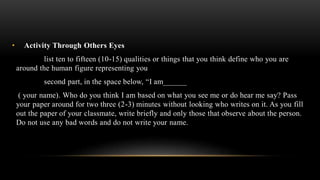
• Activity ThroughOthers Eyes
list ten to fifteen (10-15) qualities or things that you think define who you are
around the human figure representing you
second part, in the space below, “I am______
( your name). Who do you think I am based on what you see me or do hear me say? Pass
your paper around for two three (2-3) minutes without looking who writes on it. As you fill
out the paper of your classmate, write briefly and only those that observe about the person.
Do not use any bad words and do not write your name.
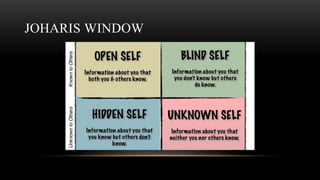
• The JohariWindow is the psychological model developed by Joseph Luft and Harrington
Ingham, that talks about the relationship and mutual understanding between the group
members. ... Hidden Self: This quadrant of the Johari window shows the state of an
individual known to him but not known to the others. The Johari window is a technique
that helps people better understand their relationship with themselves and others.
6.
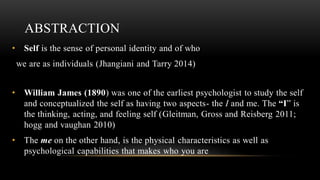
ABSTRACTION
• Self isthe sense of personal identity and of who
we are as individuals (Jhangiani and Tarry 2014)
• William James (1890) was one of the earliest psychologist to study the self
and conceptualized the self as having two aspects- the I and me. The “I” is
the thinking, acting, and feeling self (Gleitman, Gross and Reisberg 2011;
hogg and vaughan 2010)
• The me on the other hand, is the physical characteristics as well as
psychological capabilities that makes who you are
• Carl Rogers(1959) theory of personality also used the
same terms the “I” as the one who acts
• and decides while me is what you think or feel about
yourself as an object
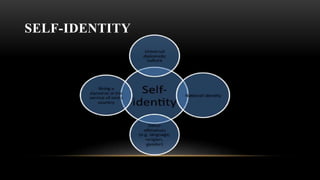
• The selfis an individual person as the object of his or her own
reflective consciousness.
• Identity is composed of personal characteristics, social roles,
and responsibilities, as well as affiliations that define who one
is.
12.
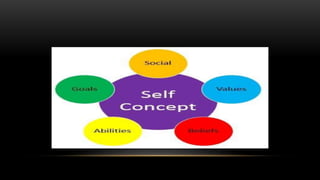
SELF CONCEPT?
• Iswhat basically comes to your mind when you are about
who you are
• the recognition of one's potential and qualities as an
individual, especially in relation to social context.
13.
• Self, identityand Self-concept are not fixed in one time
frame
• For example, when you are asked about who you are, you
can say “I was a varsity player in 5th Grade which pertains to
the past,
• “ a college student” which may be the present, and a “future
politician” which is the future
• They are not fixed for life nor are they ever-changing at
every moment.
14.
• Think ofa malleable metal, strong and hard but can be bent
and molded into other shapes. Think about water. It can take
any shape of the container, but at its core, it is still the same
element.
• Carl Roger captured this idea in his concept of self-schema
of our organized system or collection of knowledge about
who we are.
16.
• The schemais not limited to example above. It may also
include interest, work, course, age, name and physical
characteristics among others. As you grow and adapt to the
changes around you, they also change. But they are not
passive receivers. They actively shape and affect how you
see, think and feel about things
17.
• For example,when someone states your first name even if
they are not talking about you, your attention is drawn to
them. If you have the provincial language and you hear
someone using it, it catches your attention. If you consider
yourself a book-lover, a bookstore may always entice you out
of all the other stores in a mall.
18.
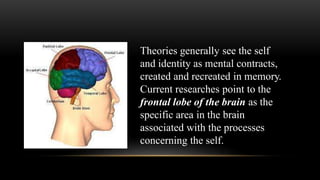
Theories generally seethe self
and identity as mental contracts,
created and recreated in memory.
Current researches point to the
frontal lobe of the brain as the
specific area in the brain
associated with the processes
concerning the self.
19.
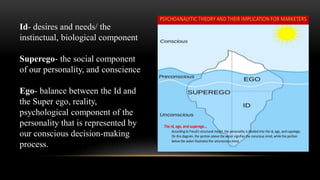
• Several psychologist,especially during the fields earlier
development, followed this trend of thought, looking deeper
into the mind of the person to theorize about the self, identity,
self concept and in turn ones personality. The influential of
them is Sigmund Freud. Basically, Freud saw the self, its
mental processes, and ones behaviour as the results of the
interaction between the Id, the Ego, and the Superego
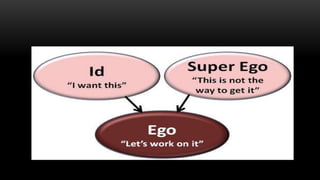
20.
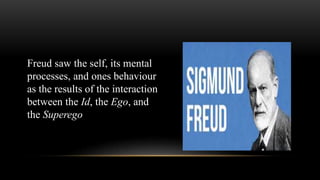
Freud saw theself, its mental
processes, and ones behaviour
as the results of the interaction
between the Id, the Ego, and
the Superego
21.
Id- desires andneeds/ the
instinctual, biological component
Superego- the social component
of our personality, and conscience
Ego- balance between the Id and
the Super ego, reality,
psychological component of the
personality that is represented by
our conscious decision-making
process.
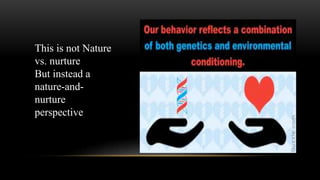
24.
This is notNature
vs. nurture
But instead a
nature-and-
nurture
perspective
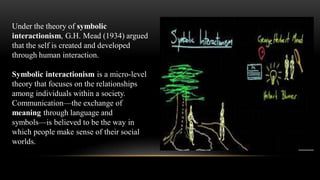
25.
Under the theoryof symbolic
interactionism, G.H. Mead (1934) argued
that the self is created and developed
through human interaction.
Symbolic interactionism is a micro-level
theory that focuses on the relationships
among individuals within a society.
Communication—the exchange of
meaning through language and
symbols—is believed to be the way in
which people make sense of their social
worlds.
26.
REASONS WHY SELFAND IDENTITY ARE SOCIAL
PRODUCTS
• 1. We do not create ourselves out of nothing.
• 2. Whether we like to admit it or not, We actually need
others to affirm and reinforce who we think we are
• 3. What We think is important to us may also have been
influenced by what is important in our social or historical
context.
27.
• Social interactionand group affiliation, therefore are vital
factors in creating our self concept especially in the aspect
of providing us with our social identity or our perception
of who we are based on our membership to certain groups
• When we are aware of our self concept; this is also called
self-awareness
Carver and Scheier(1981) – identified two types of self that we can be
aware of
1. The private self or your internal standards and private thoughts and
feelings, and
2. the public self or your public image commonly geared toward having a
good presentation of yourself to others
Self awareness also presents us with at least three other self-schema:
Actual- self is who you are at the moment
Ideal- self is who like to be
Ought- self is who you think you should be
30.
• Student interestedin basketball but is also academically challenged in most
of your subject.
• Your ideal self -might be to practice and more play with the varsity team
• Ought- to pass your subjects as a responsible student.
• One has to find a solution to such discrepancies to avoid agitation,
dejection, or other negative emotions. In some instances, all three may be
in line with one another.
• Self-awareness may be positive or negative depending on the
circumstance's and our next course of action.
31.
• Self-awareness cankeep you from doing something
dangerous; it can help remind you that is an exam
tomorrow in one of your subjects when you are about to
spend time playing computer games with your cousins,
among others. In instances, self-awareness can be too
much that we are concerned about being observed and
criticized by others. Also known as self-consciousness
32.
• At othertimes, especially with large crowds, we may
experience DE individuation or the loss of individual self
awareness and individual accountability in groups
• A lot of people will attune themselves with the emotions of
their group and because the large crowd also provides some
kind of anonymity, we may lessen our self-control and act in
ways that we will not do when we are alone. A common
example is a mass demonstration erupting into a riot
•
34.
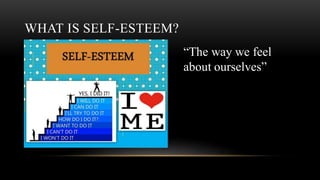
• Our groupidentity and self-awareness also has a great impact
on our self-esteem.
• It is defined as our own positive or negative perception or
evaluation of ourselves
• Affects our self-esteem is through Social comparison.
• According to the social comparison theory we learn about
ourselves, the appropriateness of our behaviours, as well as
our social status by comparing aspects of ourselves with other
people
35.
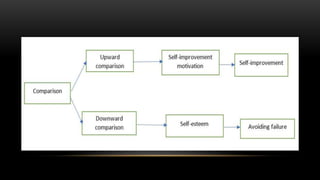
• Downward socialcomparison- we create a positive self-
concept by comparing ourselves with those who are worse
off than us, by having the advantage, we can raise our
self-esteem.
• Upward social comparison- which is comparing
ourselves with those who are better off than us, while it
can be a form of motivation for some, a lot who do this
actually felt lower-self-esteem as they highlight more of
their weakness or inequities.
36.
• Social comparisonalso entails what is called self-evaluation
maintenance theory, which states that we can feel threatened
when someone out-performs us, especially when that person is
close to us.
• In this case we usually act In three ways
• First, we distance ourselves from that person or redefine our
relationship with them
37.
• Some willresult to the silent treatment, change of friends,
while some may redefine by being closer to that person,
hoping that some association may give him a certain kind
of acknowledgement also
39.
• Second, wemay also also reconsider the importance of the
aspect or skill in which you were outperformed.
• Lastly-we my also strengthen our resolve to improve that
certain aspect of ourselves
• Achieving your goal through hard work may increase your
self-esteem.
40.
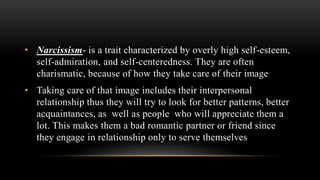
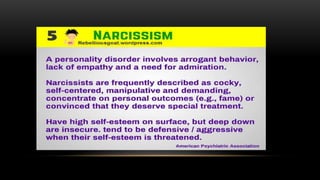
• Narcissism- isa trait characterized by overly high self-esteem,
self-admiration, and self-centeredness. They are often
charismatic, because of how they take care of their image
• Taking care of that image includes their interpersonal
relationship thus they will try to look for better patterns, better
acquaintances, as well as people who will appreciate them a
lot. This makes them a bad romantic partner or friend since
they engage in relationship only to serve themselves
43.
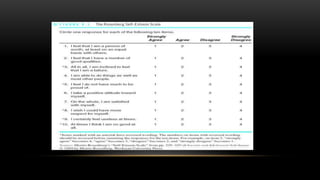
• Rosenberg scaletests and measurements for self-esteem
• Try to be honest and objective about what you feel and see
about yourself
• The only source of a persons healthy perspective of herself
• People with high self-esteem are commonly described as
outgoing, adventurous, and adaptable in a lot of situations.
They are also dismiss other activities that do not conform to
their self-concept or boost their self-esteem.
• They may also be bullies and experiment on abusive behaviors
with drugs, alcohol and sex
45.
• Eastern- Asia
•Western- Europe and Northern America
• In the Philippines alone each region may have a
similar varying perception regarding the self