ORAL COMMUNICATION

By:Anuj
Ajay
Anika
CONTENTS
Introduction
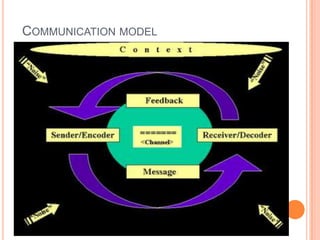
 Model of communication
 Merits of oral communication
 Limitations of oral communication
 Barriers
 Essentials of effective oral communication
 Ways to Improve Oral Communication
 Types of oral communication

It is said that it does not matter
what you say, what matters is
how you say it
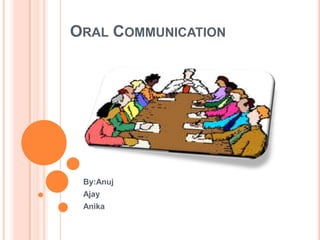
ORAL COMMUNICATION

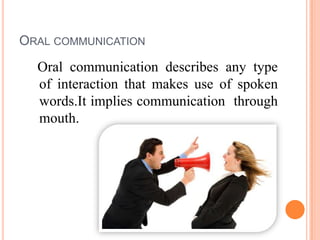
Oral communication describes any type
of interaction that makes use of spoken
words.It implies communication through
mouth.
COMMUNICATION MODEL
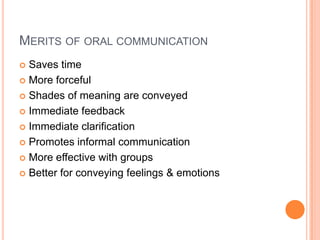
MERITS OF ORAL COMMUNICATION
Saves time
 More forceful
 Shades of meaning are conveyed
 Immediate feedback
 Immediate clarification
 Promotes informal communication
 More effective with groups
 Better for conveying feelings & emotions

LIMITATIONS OF ORAL COMMUNICATION
Distance a hurdle (in absence of mechanical
device)
 Unsuitable for lengthy messages
 Message cannot be retained for long
 Word once uttered cannot be taken back
 Hard to control voice pitch & tone
 Demands thinking coherently as one speaks
 May lead to misunderstandings

BARRIERS
Status
 Halo
 Complexes
 Closed & all knowing mind
 Poor retention
 Premature evaluations
 Abstracting
 Cognitive dissonance
 Language barrier

ESSENTIALS OF EFFECTIVE ORAL COMMUNICATION
Clear pronunciation
 Brevity
 Precision
 Conviction
 Logical sequence
 Appropriate word choice
 Avoid hackneyed phrases & cliches
 Natural voice
 Finding the right register

WAYS TO IMPROVE ORAL COMMUNICATION
Read
 Listen
 Speak

TYPES OF ORAL COMMUNICATION
•Face To Face
•Video Conferencing
•Telephone
•Active-Passive Communication
•Interviews
•Group Discussion
•Presentations
•Grapevine
Oral communication
Oral communication

Oral communication

  • 1.
  • 2.
    CONTENTS Introduction  Model ofcommunication  Merits of oral communication  Limitations of oral communication  Barriers  Essentials of effective oral communication  Ways to Improve Oral Communication  Types of oral communication 
  • 3.
    It is saidthat it does not matter what you say, what matters is how you say it
  • 4.
    ORAL COMMUNICATION Oral communicationdescribes any type of interaction that makes use of spoken words.It implies communication through mouth.
  • 5.
  • 6.
    MERITS OF ORALCOMMUNICATION Saves time  More forceful  Shades of meaning are conveyed  Immediate feedback  Immediate clarification  Promotes informal communication  More effective with groups  Better for conveying feelings & emotions 
  • 7.
    LIMITATIONS OF ORALCOMMUNICATION Distance a hurdle (in absence of mechanical device)  Unsuitable for lengthy messages  Message cannot be retained for long  Word once uttered cannot be taken back  Hard to control voice pitch & tone  Demands thinking coherently as one speaks  May lead to misunderstandings 
  • 8.
    BARRIERS Status  Halo  Complexes Closed & all knowing mind  Poor retention  Premature evaluations  Abstracting  Cognitive dissonance  Language barrier 
  • 9.
    ESSENTIALS OF EFFECTIVEORAL COMMUNICATION Clear pronunciation  Brevity  Precision  Conviction  Logical sequence  Appropriate word choice  Avoid hackneyed phrases & cliches  Natural voice  Finding the right register 
  • 10.
    WAYS TO IMPROVEORAL COMMUNICATION Read  Listen  Speak 
  • 11.
    TYPES OF ORALCOMMUNICATION •Face To Face •Video Conferencing •Telephone •Active-Passive Communication •Interviews •Group Discussion •Presentations •Grapevine