Interpersonal Communication Skills
What are interpersonal communication skills? Verbal & non-verbal interactions in one-on-one & small-group settings. Also known as “people skills” or “soft skills”. Ranked in a survey as the  most important  requirement for successful job performance.
Types of Interpersonal Skills Assertion skills Listening skills  Conflict-resolution skills  (read the course notes for more explanation)
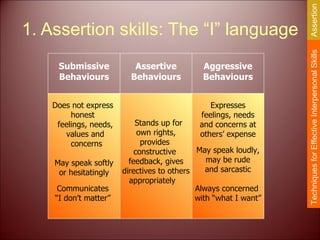
1. Assertion skills: The “I” language Submissive Behaviours Assertive Behaviours Aggressive Behaviours Does not express  honest  feelings, needs,  values and  concerns May speak softly or hesitatingly Communicates  “ I don’t matter”  Stands up for own rights, provides  constructive  feedback, gives directives to others appropriately  Expresses feelings, needs and concerns at others’ expense May speak loudly, may be rude and sarcastic Always concerned  with “what I want” Techniques for Effective Interpersonal Skills Assertion
Three-part assertion message Use of “I” language in assertion. Behaviour: When you do not let me know you will be  late   + Feelings: I feel annoyed +   Effects: because I am unable to reschedule my  timetable . Techniques for Effective Interpersonal Skills Assertion
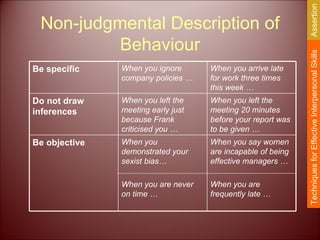
Non-judgmental Description of Behaviour Techniques for Effective Interpersonal Skills Assertion Be specific When you ignore company policies … When you arrive late for work three times this week … Do not draw inferences When you left the meeting early just because Frank criticised you … When you left the meeting 20 minutes before your report was to be given … Be objective When you demonstrated your sexist bias… When you are never on time … When you say women are incapable of being effective managers … When you are frequently late …
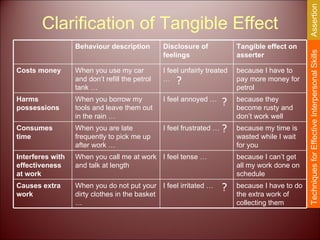
Clarification of Tangible Effect ? ? ? ? Techniques for Effective Interpersonal Skills Assertion Behaviour description Disclosure of feelings Tangible effect on asserter Costs money When you use my car and don’t refill the petrol tank … I feel unfairly treated … because I have to pay more money for petrol Harms possessions When you borrow my tools and leave them out in the rain … I feel annoyed … because they become rusty and don’t work well Consumes time  When you are late frequently to pick me up after work … I feel frustrated … because my time is wasted while I wait for you Interferes with effectiveness at work When you call me at work and talk at length I feel tense … because I can’t get all my work done on schedule Causes extra work When you do not put your dirty clothes in the basket … I feel irritated … because I have to do the extra work of collecting them
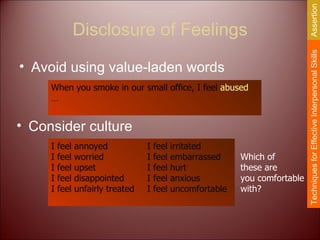
Disclosure of Feelings Avoid using value-laden words When you smoke in our small office, I feel  abused  … I feel annoyed I feel irritated I feel worried I feel embarrassed I feel upset I feel hurt I feel disappointed I feel anxious I feel unfairly treated I feel uncomfortable Consider culture Which of these are you comfortable with? Techniques for Effective Interpersonal Skills Assertion
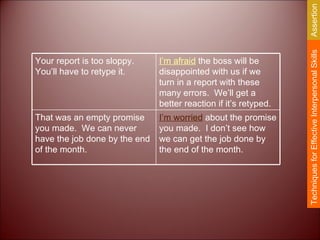
Techniques for Effective Interpersonal Skills Assertion Your report is too sloppy.  You’ll have to retype it. I’m afraid  the boss will be disappointed with us if we turn in a report with these many errors.  We’ll get a better reaction if it’s retyped. That was an empty promise you made.  We can never have the job done by the end of the month. I’m worried  about the promise you made.  I don’t see how we can get the job done by the end of the month.
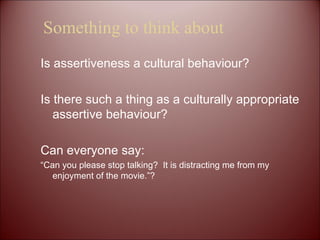
Something to think about Is assertiveness a cultural behaviour? Is there such a thing as a culturally appropriate assertive behaviour? Can everyone say:  “ Can you please stop talking?  It is distracting me from my enjoyment of the movie.”?
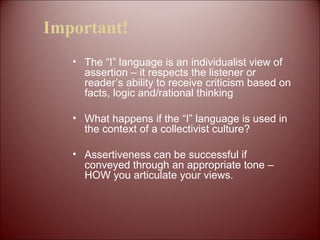
Important! The “I” language is an individualist view of assertion – it respects the listener or reader’s ability to receive criticism based on facts, logic and/rational thinking  What happens if the “I” language is used in the context of a collectivist culture? Assertiveness can be successful if conveyed through an appropriate tone – HOW you articulate your views.
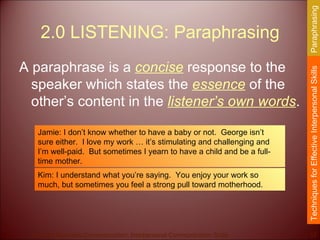
ES2002 Business Communication: Interpersonal Communication Skills 2.0 LISTENING: Paraphrasing A paraphrase is a  concise  response to the speaker which states the  essence  of the other’s content in the  listener’s own words . Jamie: I don’t know whether to have a baby or not.  George isn’t  sure either.  I love my work … it’s stimulating and challenging and I’m well-paid.  But sometimes I yearn to have a child and be a full-time mother. Kim: I understand what you’re saying.  You enjoy your work so much, but sometimes you feel a strong pull toward motherhood.  Techniques for Effective Interpersonal Skills Paraphrasing
Paraphrasing Paraphrasing is active listening – crucial in resolving conflict A mediator who paraphrases may be able to separate  what   happened  from  what one feels  about what happened
Paraphrasing Re-state sender’s message in your own words (1) to show your desire to understand the sender or (2) set the facts straight So, you’re saying that … Let me just see if I’ve understood you correctly … So it was you, not George, who first contacted  GM Tires  about their faulty equipment…? Techniques for Effective Interpersonal Skills Paraphrasing
LISTENING: Seeking more information If someone gives you constructive feedback,   listen carefully: 1. What is the main complaint? 2. Seek more information, if necessary: “ You’ve said I’m not presenting a good attitude to customers.  Can you describe exactly what I’m doing?” (Of course, beware of your tone)
CONCLUSION If you have effective interpersonal communication skills, you have  1. appropriate assertion skills 2. active listening skills 3. the ability to accept criticism 4. respect for the face and dignity of the  other person

Interpersonal communication

  • 1.
  • 2.
    What are interpersonalcommunication skills? Verbal & non-verbal interactions in one-on-one & small-group settings. Also known as “people skills” or “soft skills”. Ranked in a survey as the most important requirement for successful job performance.
  • 3.
    Types of InterpersonalSkills Assertion skills Listening skills Conflict-resolution skills (read the course notes for more explanation)
  • 4.
    1. Assertion skills:The “I” language Submissive Behaviours Assertive Behaviours Aggressive Behaviours Does not express honest feelings, needs, values and concerns May speak softly or hesitatingly Communicates “ I don’t matter” Stands up for own rights, provides constructive feedback, gives directives to others appropriately Expresses feelings, needs and concerns at others’ expense May speak loudly, may be rude and sarcastic Always concerned with “what I want” Techniques for Effective Interpersonal Skills Assertion
  • 5.
    Three-part assertion messageUse of “I” language in assertion. Behaviour: When you do not let me know you will be late + Feelings: I feel annoyed + Effects: because I am unable to reschedule my timetable . Techniques for Effective Interpersonal Skills Assertion
  • 6.
    Non-judgmental Description ofBehaviour Techniques for Effective Interpersonal Skills Assertion Be specific When you ignore company policies … When you arrive late for work three times this week … Do not draw inferences When you left the meeting early just because Frank criticised you … When you left the meeting 20 minutes before your report was to be given … Be objective When you demonstrated your sexist bias… When you are never on time … When you say women are incapable of being effective managers … When you are frequently late …
  • 7.
    Clarification of TangibleEffect ? ? ? ? Techniques for Effective Interpersonal Skills Assertion Behaviour description Disclosure of feelings Tangible effect on asserter Costs money When you use my car and don’t refill the petrol tank … I feel unfairly treated … because I have to pay more money for petrol Harms possessions When you borrow my tools and leave them out in the rain … I feel annoyed … because they become rusty and don’t work well Consumes time When you are late frequently to pick me up after work … I feel frustrated … because my time is wasted while I wait for you Interferes with effectiveness at work When you call me at work and talk at length I feel tense … because I can’t get all my work done on schedule Causes extra work When you do not put your dirty clothes in the basket … I feel irritated … because I have to do the extra work of collecting them
  • 8.
    Disclosure of FeelingsAvoid using value-laden words When you smoke in our small office, I feel abused … I feel annoyed I feel irritated I feel worried I feel embarrassed I feel upset I feel hurt I feel disappointed I feel anxious I feel unfairly treated I feel uncomfortable Consider culture Which of these are you comfortable with? Techniques for Effective Interpersonal Skills Assertion
  • 9.
    Techniques for EffectiveInterpersonal Skills Assertion Your report is too sloppy. You’ll have to retype it. I’m afraid the boss will be disappointed with us if we turn in a report with these many errors. We’ll get a better reaction if it’s retyped. That was an empty promise you made. We can never have the job done by the end of the month. I’m worried about the promise you made. I don’t see how we can get the job done by the end of the month.
  • 10.
    Something to thinkabout Is assertiveness a cultural behaviour? Is there such a thing as a culturally appropriate assertive behaviour? Can everyone say: “ Can you please stop talking? It is distracting me from my enjoyment of the movie.”?
  • 11.
    Important! The “I”language is an individualist view of assertion – it respects the listener or reader’s ability to receive criticism based on facts, logic and/rational thinking What happens if the “I” language is used in the context of a collectivist culture? Assertiveness can be successful if conveyed through an appropriate tone – HOW you articulate your views.
  • 12.
    ES2002 Business Communication:Interpersonal Communication Skills 2.0 LISTENING: Paraphrasing A paraphrase is a concise response to the speaker which states the essence of the other’s content in the listener’s own words . Jamie: I don’t know whether to have a baby or not. George isn’t sure either. I love my work … it’s stimulating and challenging and I’m well-paid. But sometimes I yearn to have a child and be a full-time mother. Kim: I understand what you’re saying. You enjoy your work so much, but sometimes you feel a strong pull toward motherhood. Techniques for Effective Interpersonal Skills Paraphrasing
  • 13.
    Paraphrasing Paraphrasing isactive listening – crucial in resolving conflict A mediator who paraphrases may be able to separate what happened from what one feels about what happened
  • 14.
    Paraphrasing Re-state sender’smessage in your own words (1) to show your desire to understand the sender or (2) set the facts straight So, you’re saying that … Let me just see if I’ve understood you correctly … So it was you, not George, who first contacted GM Tires about their faulty equipment…? Techniques for Effective Interpersonal Skills Paraphrasing
  • 15.
    LISTENING: Seeking moreinformation If someone gives you constructive feedback, listen carefully: 1. What is the main complaint? 2. Seek more information, if necessary: “ You’ve said I’m not presenting a good attitude to customers. Can you describe exactly what I’m doing?” (Of course, beware of your tone)
  • 16.
    CONCLUSION If youhave effective interpersonal communication skills, you have 1. appropriate assertion skills 2. active listening skills 3. the ability to accept criticism 4. respect for the face and dignity of the other person