Faculty of Management StudiesMaharshi Dayanand Saraswati University, AjmerA Presentation on CORPORATE GOVERNANCEPresented by:AnusuyaMehraHarmeet SinghManish SharmaRajkumarRanwaRoopal JainVijayMundelPresented in class of:Dr. Ashish Pareek
Meaning of corporate governance   Corporate governance is the way, a company manages itself in order to ensure fair and equitable returns to all shareholders and other financial stakeholders.The Cadbury Committee report defines it as “the system by which companies are directed and controlled.Corporate governance is the process where by people in power direct, monitor and lead corporation, and thereby either create, modify or destroy the structure and system and under which they operate.
Definition	Corporate Governance may be defined as a set of systems, processes and principles which ensure that a company is governed in the best interest of all stakeholders. It is the system by which companies are directed and controlled. It is about promoting corporate fairness, transparency and accountability. In other words, 'good corporate governance' is simply 'good business'
Objectives:-Predictability
Transparency
Accountability
Efficiency & effectiveness
Stakeholder satisfactionAim of corporate governance  The aim of "Good Corporate Governance" is to ensure commitment of the board in managing the company in a transparent manner for maximizing long-term value of the company for its shareholders and all other partners. It integrates all the participants involved in a process, which is economic, and at the same time social. The aim is to align as nearly as possible the interests of individuals, corporations and society.
ConceptThe concept of corporate governance primarily hinges on complete transparency, integrity and accountability of management.The concept of good corporate governance connotes that ethics as important as economics ,fair play as crucial as financial success , morals as vital as market share.
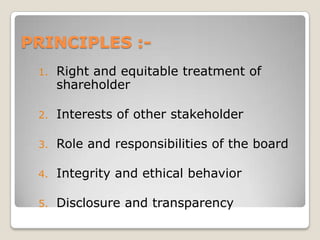
PRINCIPLES :-Right and equitable treatment of shareholderInterests of other stakeholderRole and responsibilities of the boardIntegrity and ethical behaviorDisclosure and transparency
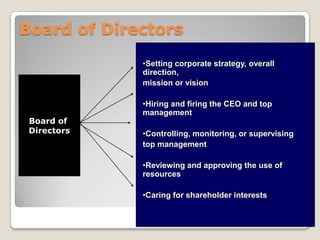
Board of DirectorsSetting corporate strategy, overall direction, mission or visionHiring and firing the CEO and top management
Controlling, monitoring, or supervisingtop managementReviewing and approving the use of resources
Caring for shareholder interestsBoard of Directors
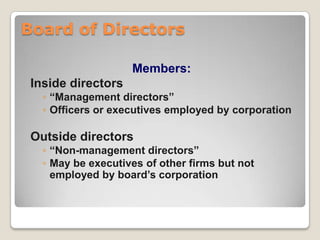
Board of DirectorsMembers:Inside directors“Management directors”Officers or executives employed by corporationOutside directors“Non-management directors”May be executives of other firms but not employed by board’s corporation
Board ResponsibilitiesMonitor and evaluate corporate performance.Monitor and evaluate corporate strategy.Determine executive compensation.Evaluate senior management performance.Communicate with share holders.Evaluate board performance.Manage Executive Director/CEO succession.
Reasons for growing demand for corporate governanceEconomic reforms that allowed the growth of free enterprise and freed private investment opportunities.The growing awareness of investors and investors group of their rights.Exposures of domestic private and public sector companies to greater domestic and foreign competition ,which has multiplied choices for consumers and compelled increases in efficiency. The consequential changes in the shareholding pattern of private and public sector companies.
Reasons for growing demand for corporate governance continue…The growing importance of institutional investors and public financial institutions, gradually asserting and transforming themselves in their new role as active shareholders rather than as lenders.The stock exchanges becoming increasingly conscious of their roles as self regulatory organizations and exploring the possibility of using the listing agreement as a tool for raising the standard of corporate governance.
Measures to improve Corporate Conduct	The measures that were suggested for improving corporate conduct included:Improving financial disclosure norms.Making relevant nonfinancial disclosure mandatory.Making the management more accountable towards fulfilling its responsibility to society at large.Changing the composition and functioning of company boards with greater proportion of competent non executive director.Suggesting ways of effective involvement of institutional investors in the management and conduct of the affair of a company.Facilitating free play of market forces in securing a change of management.
Code of Conduct for corporate governance…	SEBI prescribes that there should be a conduct for board of directors. While drafting the code of conduct for corporate governance for the entire corporate sector following aspects can be kept in view:Prescribing of ethical values which are universally acceptable.Ensuring transparency in functioning.Encouraging discipline.Avoiding conflict of interest.Respecting one another.Loyalty to the organization.Providing motivation.Providing of requisite incentives for efficient and effective functioning.
Importance of Corporate GovernanceShapes the growth and future of capital market & economy.Instrument of investor’s protection.Protecting the interest of Shareholders and all other stakeholder.Contributes to the efficiency of the business enterprise.Creation of wealth.Enables firm to compete internationally in sustained way.Keeps an eye on the issues of insider training.
Pre Requisites……A proper system, consisting of clearly defined an adequate structure of roles, authority and responsibility.Vision, principles and norms which indicate development path, guidelines and norms for performance.A proper system for guiding, monitoring, reporting and controlling.
Regulatory and Voluntary Actions	According to OECD 1998, good corporate governance can best be achieve through a combination of regulatory and voluntary private action. On regulatory side they should focus on:Fairness
Transparency
Accountability
ResponsibilityFactors influencing corporate governance The ownership structureThe structure of company boardsThe Financial structureThe institutional environment
The search for a new approach to corporate governance…	It resulted in the setting up of the:Teadway commission (USA):- It placed great emphasis on the composition and functioning of Board of Directors. The committee report published in October, 1987.Cadbury Committee (UK):- It examined the issue of corporate governance from the point of view of share holder of a company. The committee report published in December, 1992.King Committee (South Africa):- It was setup to develop a code of ethics for business enterprises. The committee report published in November, 1994.

Presentation on corporate goverence

  • 1.
    Faculty of ManagementStudiesMaharshi Dayanand Saraswati University, AjmerA Presentation on CORPORATE GOVERNANCEPresented by:AnusuyaMehraHarmeet SinghManish SharmaRajkumarRanwaRoopal JainVijayMundelPresented in class of:Dr. Ashish Pareek
  • 2.
    Meaning of corporategovernance Corporate governance is the way, a company manages itself in order to ensure fair and equitable returns to all shareholders and other financial stakeholders.The Cadbury Committee report defines it as “the system by which companies are directed and controlled.Corporate governance is the process where by people in power direct, monitor and lead corporation, and thereby either create, modify or destroy the structure and system and under which they operate.
  • 3.
    Definition Corporate Governance maybe defined as a set of systems, processes and principles which ensure that a company is governed in the best interest of all stakeholders. It is the system by which companies are directed and controlled. It is about promoting corporate fairness, transparency and accountability. In other words, 'good corporate governance' is simply 'good business'
  • 4.
  • 5.
  • 6.
  • 7.
  • 8.
    Stakeholder satisfactionAim ofcorporate governance The aim of "Good Corporate Governance" is to ensure commitment of the board in managing the company in a transparent manner for maximizing long-term value of the company for its shareholders and all other partners. It integrates all the participants involved in a process, which is economic, and at the same time social. The aim is to align as nearly as possible the interests of individuals, corporations and society.
  • 9.
    ConceptThe concept ofcorporate governance primarily hinges on complete transparency, integrity and accountability of management.The concept of good corporate governance connotes that ethics as important as economics ,fair play as crucial as financial success , morals as vital as market share.
  • 10.
    PRINCIPLES :-Right andequitable treatment of shareholderInterests of other stakeholderRole and responsibilities of the boardIntegrity and ethical behaviorDisclosure and transparency
  • 11.
    Board of DirectorsSettingcorporate strategy, overall direction, mission or visionHiring and firing the CEO and top management
  • 12.
    Controlling, monitoring, orsupervisingtop managementReviewing and approving the use of resources
  • 13.
    Caring for shareholderinterestsBoard of Directors
  • 14.
    Board of DirectorsMembers:Insidedirectors“Management directors”Officers or executives employed by corporationOutside directors“Non-management directors”May be executives of other firms but not employed by board’s corporation
  • 15.
    Board ResponsibilitiesMonitor andevaluate corporate performance.Monitor and evaluate corporate strategy.Determine executive compensation.Evaluate senior management performance.Communicate with share holders.Evaluate board performance.Manage Executive Director/CEO succession.
  • 16.
    Reasons for growingdemand for corporate governanceEconomic reforms that allowed the growth of free enterprise and freed private investment opportunities.The growing awareness of investors and investors group of their rights.Exposures of domestic private and public sector companies to greater domestic and foreign competition ,which has multiplied choices for consumers and compelled increases in efficiency. The consequential changes in the shareholding pattern of private and public sector companies.
  • 17.
    Reasons for growingdemand for corporate governance continue…The growing importance of institutional investors and public financial institutions, gradually asserting and transforming themselves in their new role as active shareholders rather than as lenders.The stock exchanges becoming increasingly conscious of their roles as self regulatory organizations and exploring the possibility of using the listing agreement as a tool for raising the standard of corporate governance.
  • 18.
    Measures to improveCorporate Conduct The measures that were suggested for improving corporate conduct included:Improving financial disclosure norms.Making relevant nonfinancial disclosure mandatory.Making the management more accountable towards fulfilling its responsibility to society at large.Changing the composition and functioning of company boards with greater proportion of competent non executive director.Suggesting ways of effective involvement of institutional investors in the management and conduct of the affair of a company.Facilitating free play of market forces in securing a change of management.
  • 19.
    Code of Conductfor corporate governance… SEBI prescribes that there should be a conduct for board of directors. While drafting the code of conduct for corporate governance for the entire corporate sector following aspects can be kept in view:Prescribing of ethical values which are universally acceptable.Ensuring transparency in functioning.Encouraging discipline.Avoiding conflict of interest.Respecting one another.Loyalty to the organization.Providing motivation.Providing of requisite incentives for efficient and effective functioning.
  • 20.
    Importance of CorporateGovernanceShapes the growth and future of capital market & economy.Instrument of investor’s protection.Protecting the interest of Shareholders and all other stakeholder.Contributes to the efficiency of the business enterprise.Creation of wealth.Enables firm to compete internationally in sustained way.Keeps an eye on the issues of insider training.
  • 21.
    Pre Requisites……A propersystem, consisting of clearly defined an adequate structure of roles, authority and responsibility.Vision, principles and norms which indicate development path, guidelines and norms for performance.A proper system for guiding, monitoring, reporting and controlling.
  • 22.
    Regulatory and VoluntaryActions According to OECD 1998, good corporate governance can best be achieve through a combination of regulatory and voluntary private action. On regulatory side they should focus on:Fairness
  • 23.
  • 24.
  • 25.
    ResponsibilityFactors influencing corporategovernance The ownership structureThe structure of company boardsThe Financial structureThe institutional environment
  • 26.
    The search fora new approach to corporate governance… It resulted in the setting up of the:Teadway commission (USA):- It placed great emphasis on the composition and functioning of Board of Directors. The committee report published in October, 1987.Cadbury Committee (UK):- It examined the issue of corporate governance from the point of view of share holder of a company. The committee report published in December, 1992.King Committee (South Africa):- It was setup to develop a code of ethics for business enterprises. The committee report published in November, 1994.
  • 27.
    Kumar Mangalam BirlaCommittee 1999A committee was set up by SEBI under the Chairmanship of Kumar Mangalam Birla to promote and raise standards of corporate governance. The committee in its report observed that “the strong Corporate Governance if indispensable to resilient and vibrant capital markets and is an important instrument of investor protection. It is the blood that fills the veins of transparent corporate disclosure and high quality accounting practices. It is the muscle that moves a viable and accessible financial reporting structure.”
  • 28.
    NareshChand Committee Report,2002:- The committee was appointed by SEBI to make recommendation on the representation of independent directors on company boards and the composition of audit committees. The major highlight and recommendations are as follows:It makes no distinction between a board within executive chairman and non executive chairman.
  • 29.
    It is sufficientto have compulsory rotation of audit partners in every five years.
  • 30.
    Independent directors shouldplay a larger role to ensure the corporate governance practices are improve and that the interest of stock holders other than promoters are protected.Narayana Murthy committee,2003This committee was constituted by SEBI, under the chairmanship of Narayana Murthy to suggest how best to further improve corporate governance practice.The committee included representatives from stock exchanges , chambers of commerce and industry , investors association and professional bodies and debated on key issues and made recommendation…
  • 31.
    RecommendationsDisclosure of accountingtreatment Audit qualificationRisk management – board disclosureTraining of board membersUse of proceeds of IPOWritten code of conduct for executive managementNominee directors-exclusive of nominee directors from the definition of independent directorInternal policy on access to audit committees
  • 32.
    Corporate governance andsome Indian organisationTata group chairman , Ratan Tata, bagged the “Corporate governance” award for the year 2001-02 instituted by the government of India.ICRA assigned an SVG1 rating to the stakeholders value creation and governance practices of Wipro in 2004. Wipro is the first company to be assigned the highest SVG1 rating by ICRA.
  • 33.
    Example of corporategovernanceSatyam scandal in 2009…………….
  • 34.