A is supported by the text. The example given is that one may change what they say when their mother enters, indicating they may shield some information.
Interpersonal CommunicationInterpersonal communicationis communication that occurs between two persons who have a relationship between them. It occurs when you send or receive messages and when you assign meaning to such messages. Interpersonal communication is always distorted by noise, occurs within a context, and involves some opportunity for feedback. Interpersonal communicators are conscious of one another and of their connection with one another. They're interdependent; what one person thinks and says impacts on what the other thinks and says. Interpersonal communication includes the conversations that take place between an interviewer and a potential employee, a son and his father, two sisters, a teacher and a student, two lovers, and two friends. Even the stranger asking for directions from a local resident has a relationship with that person. In early theories, the communication process was viewed as linear. In this linear view of communication, the speaker spoke and the listener listened; after the speaker finished speaking, the listener would speak. Communication was seen as proceeding in a relatively straight line. Speaking and listening were seen as taking place at different times; when you spoke, you didn't listen, and when you listened, you didn't speak. This linear model was soon replaced with an interactional view in which the speaker and the listener were seen as exchanging turns at speaking and listening. For example, A spoke while B listened and then B (exchanging the listener's role for the speaker's role) spoke in response to what A said and A listened. Speaking and listening were still viewed as separate acts that did not overlap and that were not performed at the same time by the same person. A more satisfying view and the one held currently sees communication as a transactional process where each person serves simultaneously as speaker and listener. At the same time that you send messages, you're also receiving messages from your own communications and from the reactions of the other person. At the same time that you are listening, you're also sending messages. In a transactional view, each person is seen as both speaker and listener, as simultaneously communicating and receiving messages. Also, in a transactional view the elements of communication are seen as interdependent (never independent). Each exists in relation to the others. A change in anyone element of the process produces changes in the other elements. For example, you're talking with a group of your friends, and your mother enters the group. This change in "audience" will lead to other changes; perhaps you'll change what you say of how you say it. Regardless of what change is introduced, other changes will be produced as a result. (Devito, Joseph A. Messafes: Building Interpersonal Communication Skills, 4th Ed. pp. 5-6)
3.
Step OneTake itparagraph by paragraph Make a one sentence summary for each
4.
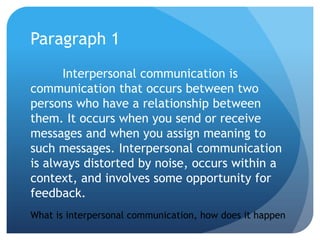
Paragraph 1Interpersonal communicationis communication that occurs between two persons who have a relationship between them. It occurs when you send or receive messages and when you assign meaning to such messages. Interpersonal communication is always distorted by noise, occurs within a context, and involves some opportunity for feedback.What is interpersonal communication, how does it happen
5.
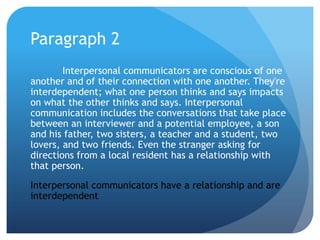
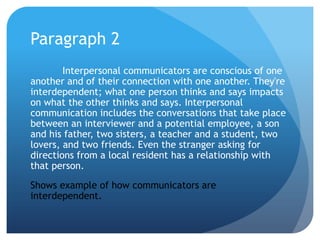
Paragraph 2 Interpersonal communicatorsare conscious of one another and of their connection with one another. They're interdependent; what one person thinks and says impacts on what the other thinks and says. Interpersonal communication includes the conversations that take place between an interviewer and a potential employee, a son and his father, two sisters, a teacher and a student, two lovers, and two friends. Even the stranger asking for directions from a local resident has a relationship with that person.Interpersonal communicators have a relationship and are interdependent
6.
Paragraph 3 In earlytheories, the communication process was viewed as linear. In this linear view of communication, the speaker spoke and the listener listened; after the speaker finished speaking, the listener would speak. Communication was seen as proceeding in a relatively straight line. Speaking and listening were seen as taking place at different times; when you spoke, you didn't listen, and when you listened, you didn't speak.Linear model of communication
7.
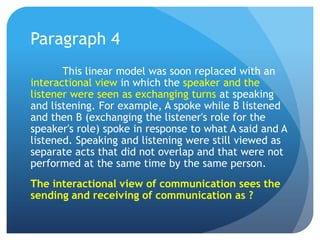
Paragraph 4 This linearmodel was soon replaced with an interactional view in which the speaker and the listener were seen as exchanging turns at speaking and listening. For example, A spoke while B listened and then B (exchanging the listener's role for the speaker's role) spoke in response to what A said and A listened. Speaking and listening were still viewed as separate acts that did not overlap and that were not performed at the same time by the same person.Interactional model of communication
8.
Paragraph 5A moresatisfying view and the one held currently sees communication as a transactional process where each person serves simultaneously as speaker and listener. At the same time that you send messages, you're also receiving messages from your own communications and from the reactions of the other person. At the same time that you are listening, you're also sending messages. In a transactional view, each person is seen as both speaker and listener, as simultaneously communicating and receiving messages. Also, in a transactional view the elements of communication are seen as interdependent (never independent). Each exists in relation to the others. A change in anyone element of the process produces changes in the other elements. For example, you're talking with a group of your friends, and your mother enters the group. This change in "audience" will lead to other changes; perhaps you'll change what you say of how you say it. Regardless of what change is introduced, other changes will be produced as a result. Transactional model of communication
9.
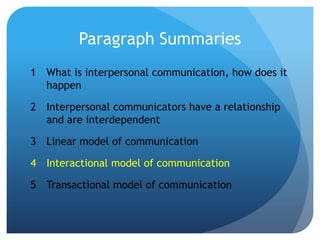
Paragraph SummariesWhat isinterpersonal communication, how does it happenInterpersonal communicators have a relationship and are interdependentLinear model of communicationInteractional model of communicationTransactional model of communication
10.
Which sentence beststates the main idea of this passage?Interpersonal communication is always distorted by noise, occurs within a context, and involves some opportunity for feedback. Communication processes are viewed as varied. Three theories about interpersonal communication, giving meaning to messages sent and received, have evolved over time. Interpersonal communication occurs between two people who have a relationship.
11.
Which sentence beststates the main idea of this passage?Interpersonal communication is always distorted by noise, occurs within a context, and involves some opportunity for feedback. (paragraph 1)Communication processes are viewed as varied. (yes, but what are they?)Three theories about interpersonal communication, giving meaning to messages sent and received, have evolved over time. Interpersonal communication occurs between two people who have a relationship. (paragraph 2)
12.
Which sentence beststates the main idea of this passage?Interpersonal communication is always distorted by noise, occurs within a context, and involves some opportunity for feedback. Communication processes are viewed as varied. Three theories about interpersonal communication, giving meaning to messages sent and received, have evolved over time.Interpersonal communication occurs between two people who have a relationship.
13.
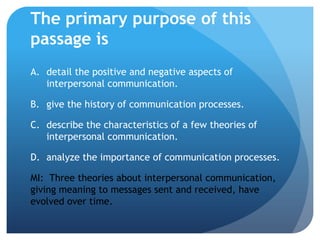
The primary purposeof this passage isdetail the positive and negative aspects of interpersonal communication. give the history of communication processes. describe the characteristics of a few theories of interpersonal communication. analyze the importance of communication processes.
The primary purposeof this passage isdetail the positive and negative aspects of interpersonal communication. give the history of communication processes. describe the characteristics of a few theories of interpersonal communication. analyze the importance of communication processes.MI: Three theories about interpersonal communication, giving meaning to messages sent and received, have evolved over time.
16.
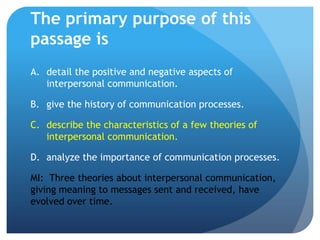
The primary purposeof this passage isdetail the positive and negative aspects of interpersonal communication. give the history of communication processes. describe the characteristics of a few theories of interpersonal communication.analyze the importance of communication processes.MI: Three theories about interpersonal communication, giving meaning to messages sent and received, have evolved over time.
17.
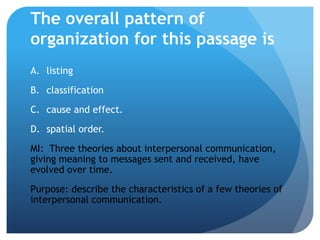
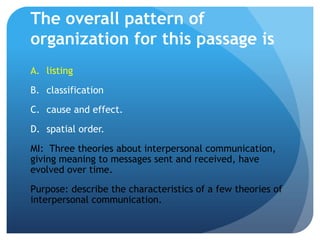
The overall patternof organization for this passage islistingclassificationcause and effect. spatial order.MI: Three theories about interpersonal communication, giving meaning to messages sent and received, have evolved over time.Purpose: describe the characteristics of a few theories of interpersonal communication.
18.
The overall patternof organization for this passage islistingclassificationcause and effect. spatial order.MI: Three theories about interpersonal communication, giving meaning to messages sent and received, have evolved over time.Purpose: describe the characteristics of a few theories of interpersonal communication.
19.
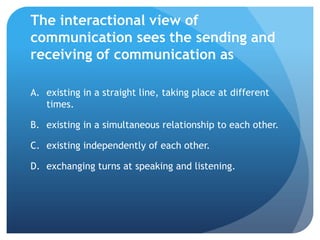
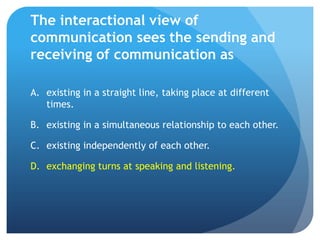
The interactional viewof communication sees the sending and receiving of communication asexisting in a straight line, taking place at different times. existing in a simultaneous relationship to each other. existing independently of each other. exchanging turns at speaking and listening.
20.
Supporting Detail QuestionGoback to the textLook for “interactional view of communication”Recall paragraph summaries
21.
Paragraph SummariesWhat isinterpersonal communication, how does it happenInterpersonal communicators have a relationship and are interdependentLinear model of communicationInteractional model of communicationTransactional model of communication
22.
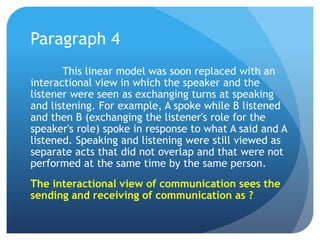
Paragraph 4 This linearmodel was soon replaced with an interactional view in which the speaker and the listener were seen as exchanging turns at speaking and listening. For example, A spoke while B listened and then B (exchanging the listener's role for the speaker's role) spoke in response to what A said and A listened. Speaking and listening were still viewed as separate acts that did not overlap and that were not performed at the same time by the same person.The interactional view of communication sees the sending and receiving of communication as ?
23.
Paragraph 4 This linearmodel was soon replaced with an interactional view in which the speaker and the listener were seen as exchanging turns at speaking and listening. For example, A spoke while B listened and then B (exchanging the listener's role for the speaker's role) spoke in response to what A said and A listened. Speaking and listening were still viewed as separate acts that did not overlap and that were not performed at the same time by the same person.The interactional view of communication sees the sending and receiving of communication as ?
24.
The interactional viewof communication sees the sending and receiving of communication asexisting in a straight line, taking place at different times. existing in a simultaneous relationship to each other. existing independently of each other. exchanging turns at speaking and listening.
25.
As used inline 3, the word distorted most nearly means“Interpersonal communication is always distorted by noise, occurs within a context, and involves some opportunity for feedback.”interruptedfixeddistractedmisused
26.
As used inline 3, the word distorted most nearly means“Interpersonal communication is always distorted by noise, occurs within a context, and involves some opportunity for feedback.”interruptedfixeddistractedmisusedIf something is getting in the way of the communication it would be interrupting.
27.
The tone ofthis passage isinformalobjectivehumorousclinical
28.
The tone ofthis passage isinformalobjectivehumorousclinical
29.
Fact or Opinion?"Eventhe stranger asking for directions from a local resident has a relationship with that person." (lines 9-10)opinionfact
30.
Paragraph 2 Interpersonal communicatorsare conscious of one another and of their connection with one another. They're interdependent; what one person thinks and says impacts on what the other thinks and says. Interpersonal communication includes the conversations that take place between an interviewer and a potential employee, a son and his father, two sisters, a teacher and a student, two lovers, and two friends. Even the stranger asking for directions from a local resident has a relationship with that person.Shows example of how communicators are interdependent.
31.
Fact or Opinion?"Eventhe stranger asking for directions from a local resident has a relationship with that person." (lines 9-10)opinionfact
32.
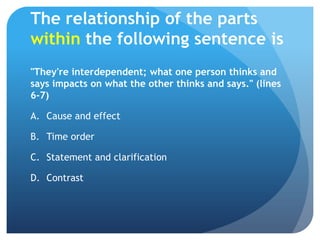
The relationship ofthe parts within the following sentence is"They're interdependent; what one person thinks and says impacts on what the other thinks and says." (lines 6-7)Cause and effect Time order Statement and clarification Contrast
33.
Look for thepunctuation that divides the sentence…"They're interdependent; what one person thinks and says impacts on what the other thinks and says." (lines 6-7)
34.
Is there asignal word that follows?"They're interdependent; what one person thinks and says impacts on what the other thinks and says." (lines 6-7)In this case – noBummerNow what do we do?
35.
Look at whatthe second part of the sentence does for the first…"They're interdependent; what one person thinks and says impacts on what the other thinks and says." (lines 6-7)It tells us what “they’re interdependent” means
36.
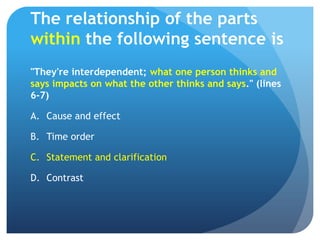
The relationship ofthe parts within the following sentence is"They're interdependent; what one person thinks and says impacts on what the other thinks and says." (lines 6-7)Cause and effect Time order Statement and clarification Contrast
37.
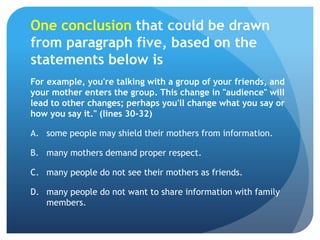
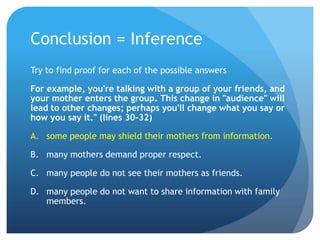
One conclusion thatcould be drawn from paragraph five, based on the statements below isFor example, you're talking with a group of your friends, and your mother enters the group. This change in "audience" will lead to other changes; perhaps you'll change what you say or how you say it." (lines 30-32)some people may shield their mothers from information. many mothers demand proper respect. many people do not see their mothers as friends. many people do not want to share information with family members.
38.
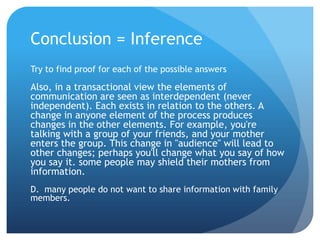
Conclusion = InferenceTryto find proof for each of the possible answersAlso, in a transactional view the elements of communication are seen as interdependent (never independent). Each exists in relation to the others. A change in anyone element of the process produces changes in the other elements. For example, you're talking with a group of your friends, and your mother enters the group. This change in "audience" will lead to other changes; perhaps you'll change what you say of how you say it. some people may shield their mothers from information.A. some people may shield their mothers from information.
39.
Conclusion = InferenceTryto find proof for each of the possible answersAlso, in a transactional view the elements of communication are seen as interdependent (never independent). Each exists in relation to the others. A change in anyone element of the process produces changes in the other elements. For example, you're talking with a group of your friends, and your mother enters the group. This change in "audience" will lead to other changes; perhaps you'll change what you say of how you say it. some people may shield their mothers from information.B. many mothers demand proper respect.
40.
Conclusion = InferenceTryto find proof for each of the possible answersAlso, in a transactional view the elements of communication are seen as interdependent (never independent). Each exists in relation to the others. A change in anyone element of the process produces changes in the other elements. For example, you're talking with a group of your friends, and your mother enters the group. This change in "audience" will lead to other changes; perhaps you'll change what you say of how you say it. some people may shield their mothers from information.C. many people do not see their mothers as friends.
41.
Conclusion = InferenceTryto find proof for each of the possible answersAlso, in a transactional view the elements of communication are seen as interdependent (never independent). Each exists in relation to the others. A change in anyone element of the process produces changes in the other elements. For example, you're talking with a group of your friends, and your mother enters the group. This change in "audience" will lead to other changes; perhaps you'll change what you say of how you say it. some people may shield their mothers from information.D. many people do not want to share information with family members.
42.
Conclusion = InferenceTryto find proof for each of the possible answersFor example, you're talking with a group of your friends, and your mother enters the group. This change in "audience" will lead to other changes; perhaps you'll change what you say or how you say it." (lines 30-32)some people may shield their mothers from information.many mothers demand proper respect. many people do not see their mothers as friends. many people do not want to share information with family members.







![PROCESS OF COMMUNICATION [Autosaved].pptx](https://cdn.slidesharecdn.com/ss_thumbnails/processofcommunicationautosaved-230213040504-e4f1dc44-thumbnail.jpg?width=640&height=640&fit=bounds)


