@kimchinijiglypuff
DYADIC COMMUNICATION
- It is a process of oral
communication that involves
small groups – two to seven
participants – as sender/ or
receiver.
@kimchinijiglypuff
NATURE OF DYADIC
COMMUNICATION
1. Intimacy, because the participants
have a shared history (previous
encounter)
2. Immediacy, because the process takes
place now, and feedback is immediate
3. Proximity, because the process occurs
“here,” face-to-face
@kimchinijiglypuff
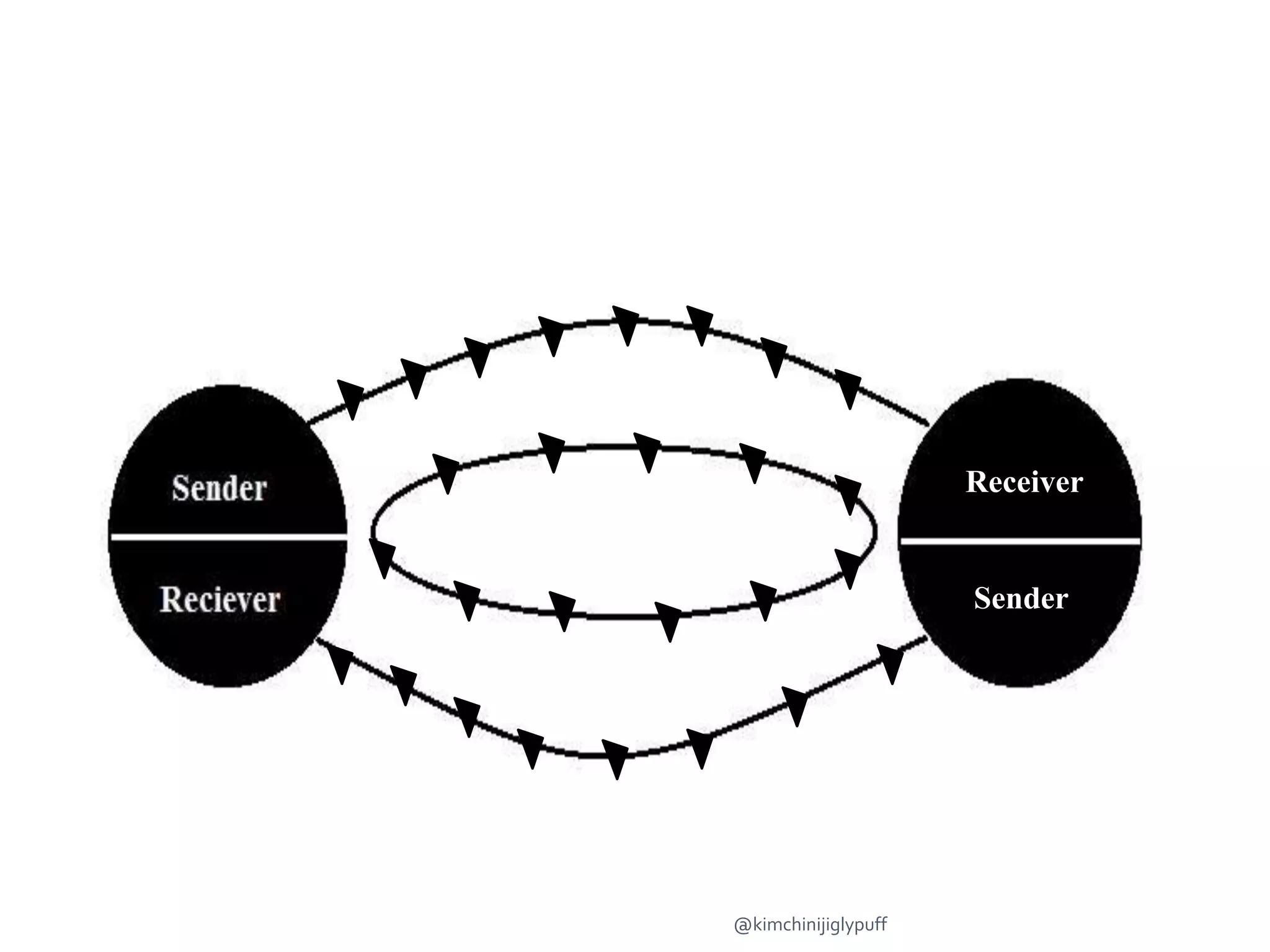
ILLUSTRATION OFADYADIC
COMMUNICATION
Receiver
Sender
@kimchinijiglypuff
CONVERSATION
- It is the block from which interpersonal
relationships evolves.
- Conversation is a face-to-face means of
communication using verbal and non-verbal
symbols.
- It can take place anywhere.
- The act of people talking to each other does
not always qualify as conversation unless
their communication is spontaneous with no
definite agenda or purpose and the
participants have a shared history.
@kimchinijiglypuff
NATURE OF CONVERSATION
1. It involves two active participants who
alternately function as sender and receiver of the
message. Anyone has the right to interrupt,
respond, or refuse to do any of these.
2. It has no specific or definite topic or purpose, but
it may cover an unlimited number of subject
matter in which the participants have mutual
interest and concern.
3. The participants have a shared history (previous
encounter); they are not total strangers.
@kimchinijiglypuff
NATURE OF CONVERSATION
4. The encounter is spontaneous
or unplanned.
5. The flow of message is two-
way.
6. Reception and evaluation of
the feedback are immediate.
@kimchinijiglypuff
TIPS TO BEAGOOD
CONVERSATIONALIST
AWARENESS OF OTHERS
1. Observe the one-minute rule.
2. Seek topics of mutual interest
3. Listen to what the other person has to say.
4. Ask questions.
@kimchinijiglypuff
TIPS TO BEAGOOD
CONVERSATIONALIST
AWARENESS OF SELF
1. Be tactful and courteous.
2. Express sincere compliments.
3. Do not step on somebody’s toes.
4. Do not argue.
@kimchinijiglypuff
DIALOGUE
- It is another form of dyadic communication
involving two active participants in a face-to-
face encounter – the sender and the receiver of
the message.
- It differs in communication in that a dialogue
is purposive; it has a definite agenda or topic
to discuss, usually problem solving.
@kimchinijiglypuff
CHARACTERISTICS OFA
DIALOGUE
 Is planned, not spontaneous;
 Is more intimate than a conversation because
there is a problem to be solved;
 Requires more self-revelation in aid of
problem solving; and
 Is more orderly than a conversation where
anything goes in terms of topic and speaker.
@kimchinijiglypuff
FIVE-STEPPATTERN FORA
DIALOGUE
1. Greeting and small talk
2. Introducing the topic
3. Exchanging and processing of
information
4. Summarizing decisions and clarifying
the next step
5. Formal closing
@kimchinijiglypuff
CHARACTERISTIC OFAN ETHICAL
DIALOGUE
1. Authenticity
2. Empathy
3. Confirmation
4. Presentness
5. Equality
6. Supportive Climate
@kimchinijiglypuff
INTERVIEW
- It is a dyadic communication
involving two parties – the
interviewer and the interviewee
or subject, mainly for the
purpose of gathering
information.
@kimchinijiglypuff
INTERVIEWACCORDING TO
THEIR PURPOSES
1. A press interview gathers information, facts,
and data to review a problem.
2. A performance-appraisal interview evaluates
the job performance of someone for purposes
of promotion.
3. A counseling interview seeks to alter
undesirable behavior.
4. A grievance interview aims to improve or
solve problem situations.
@kimchinijiglypuff
INTERVIEWACCORDING TO
THEIR PURPOSES
5. A correction interview identifies unacceptable
behavior for the purpose of modifying such
behavior.
6. A sales interview presents a solution to a
problem and makes a sale.
7. An exit interview identifies one’s reasons for
leaving or creating goodwill.
8. A survey interview seeks to gather data to
answer some research questions.
@kimchinijiglypuff
GUIDANCE ON CONDUCTINGAN
INTERVIEW
A. THE INTERVIEWER
1. The interview should have a definite purpose.
2. The interview questions should suit the purpose of
the interview and the interviewee’s personality and
status.
3. The interviewee’s convenience and comfort should
be taken into consideration in setting the time and
the place of the interview.
4. Ground rules must be laid down, particularly the
scope and limitations.
5. The data gathered in the interview should be
reviewed and clarified for accuracy.
@kimchinijiglypuff
GUIDANCE ON CONDUCTINGAN
INTERVIEW
B. THE INTERVIEWEE
1. He should know the purpose of the interview, except in
cases where the purpose is obvious, as in interviews
related to jobs, scholarships or loans.
2. He should know the scope and limitations of the
interview, the kind of information he expected to give.
He should be prepared to present such information,
perhaps with visual aids.
3. He should be open-minded, cooperative, helpful, and
friendly. Regardless the purpose, the interviewee should
not be defensive, hostile, or evasive in answering
questions because the interviewer may get an
unfavorable impression.
@kimchinijiglypuff

Dyadic Communication

  • 1.
  • 2.
    DYADIC COMMUNICATION - Itis a process of oral communication that involves small groups – two to seven participants – as sender/ or receiver. @kimchinijiglypuff
  • 3.
    NATURE OF DYADIC COMMUNICATION 1.Intimacy, because the participants have a shared history (previous encounter) 2. Immediacy, because the process takes place now, and feedback is immediate 3. Proximity, because the process occurs “here,” face-to-face @kimchinijiglypuff
  • 4.
  • 5.
    CONVERSATION - It isthe block from which interpersonal relationships evolves. - Conversation is a face-to-face means of communication using verbal and non-verbal symbols. - It can take place anywhere. - The act of people talking to each other does not always qualify as conversation unless their communication is spontaneous with no definite agenda or purpose and the participants have a shared history. @kimchinijiglypuff
  • 6.
    NATURE OF CONVERSATION 1.It involves two active participants who alternately function as sender and receiver of the message. Anyone has the right to interrupt, respond, or refuse to do any of these. 2. It has no specific or definite topic or purpose, but it may cover an unlimited number of subject matter in which the participants have mutual interest and concern. 3. The participants have a shared history (previous encounter); they are not total strangers. @kimchinijiglypuff
  • 7.
    NATURE OF CONVERSATION 4.The encounter is spontaneous or unplanned. 5. The flow of message is two- way. 6. Reception and evaluation of the feedback are immediate. @kimchinijiglypuff
  • 8.
    TIPS TO BEAGOOD CONVERSATIONALIST AWARENESSOF OTHERS 1. Observe the one-minute rule. 2. Seek topics of mutual interest 3. Listen to what the other person has to say. 4. Ask questions. @kimchinijiglypuff
  • 9.
    TIPS TO BEAGOOD CONVERSATIONALIST AWARENESSOF SELF 1. Be tactful and courteous. 2. Express sincere compliments. 3. Do not step on somebody’s toes. 4. Do not argue. @kimchinijiglypuff
  • 10.
    DIALOGUE - It isanother form of dyadic communication involving two active participants in a face-to- face encounter – the sender and the receiver of the message. - It differs in communication in that a dialogue is purposive; it has a definite agenda or topic to discuss, usually problem solving. @kimchinijiglypuff
  • 11.
    CHARACTERISTICS OFA DIALOGUE  Isplanned, not spontaneous;  Is more intimate than a conversation because there is a problem to be solved;  Requires more self-revelation in aid of problem solving; and  Is more orderly than a conversation where anything goes in terms of topic and speaker. @kimchinijiglypuff
  • 12.
    FIVE-STEPPATTERN FORA DIALOGUE 1. Greetingand small talk 2. Introducing the topic 3. Exchanging and processing of information 4. Summarizing decisions and clarifying the next step 5. Formal closing @kimchinijiglypuff
  • 13.
    CHARACTERISTIC OFAN ETHICAL DIALOGUE 1.Authenticity 2. Empathy 3. Confirmation 4. Presentness 5. Equality 6. Supportive Climate @kimchinijiglypuff
  • 14.
    INTERVIEW - It isa dyadic communication involving two parties – the interviewer and the interviewee or subject, mainly for the purpose of gathering information. @kimchinijiglypuff
  • 15.
    INTERVIEWACCORDING TO THEIR PURPOSES 1.A press interview gathers information, facts, and data to review a problem. 2. A performance-appraisal interview evaluates the job performance of someone for purposes of promotion. 3. A counseling interview seeks to alter undesirable behavior. 4. A grievance interview aims to improve or solve problem situations. @kimchinijiglypuff
  • 16.
    INTERVIEWACCORDING TO THEIR PURPOSES 5.A correction interview identifies unacceptable behavior for the purpose of modifying such behavior. 6. A sales interview presents a solution to a problem and makes a sale. 7. An exit interview identifies one’s reasons for leaving or creating goodwill. 8. A survey interview seeks to gather data to answer some research questions. @kimchinijiglypuff
  • 17.
    GUIDANCE ON CONDUCTINGAN INTERVIEW A.THE INTERVIEWER 1. The interview should have a definite purpose. 2. The interview questions should suit the purpose of the interview and the interviewee’s personality and status. 3. The interviewee’s convenience and comfort should be taken into consideration in setting the time and the place of the interview. 4. Ground rules must be laid down, particularly the scope and limitations. 5. The data gathered in the interview should be reviewed and clarified for accuracy. @kimchinijiglypuff
  • 18.
    GUIDANCE ON CONDUCTINGAN INTERVIEW B.THE INTERVIEWEE 1. He should know the purpose of the interview, except in cases where the purpose is obvious, as in interviews related to jobs, scholarships or loans. 2. He should know the scope and limitations of the interview, the kind of information he expected to give. He should be prepared to present such information, perhaps with visual aids. 3. He should be open-minded, cooperative, helpful, and friendly. Regardless the purpose, the interviewee should not be defensive, hostile, or evasive in answering questions because the interviewer may get an unfavorable impression. @kimchinijiglypuff