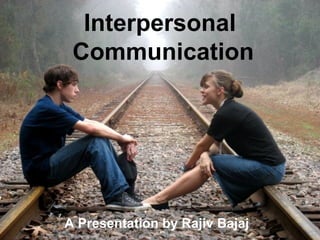
Interpersonal  Communication A Presentation by Rajiv Bajaj
Definition –  Interpersonal Communication The Contextual View  - Comparison with other forms of communication Examines how many people are involved, how physically close they are to one another, how many sensory channels are used, and the feedback provided
Differs from other forms of communication –  Fewer participants involved  Interactants are in close physical proximity to each other  Many sensory channels used. Feedback is immediate Contextual definition does not take into account the relationship between the interactants
The Developmental View   - We have many different relationships with people  Researchers say that our definition of interpersonal communication  must  account for these  differences E.g. - Interacting with a sales clerk in a store different than the relationship we have with our friends and family members
This is the Developmental View  This view defines interpersonal communication as communication that occurs between people who have known each other for some time  Importantly, these people view each other as unique individuals, not as people who are simply acting out social situations
Direct & Interactive Interpersonal Communication refers to face-to-face or person-to-person communication Extremely relevant to achieving personal as well as professional success Often Direct & Interactive – Makes effective use of oral as well as non-verbal channels – words, body language, facial expressions, spacing, tones, gestures, action
Human Behaviour  Calls for insight into Behaviour & Understanding of how people react under different situations Has particular significance in all people-oriented situations Relevant in dealing with people – both inside & outside the organisation – especially for handling grievances & difficult situations
How You Behave Matters Pleasant & unpleasant situations are bound to develop in any organisation where a large number of people work A Manager might have to convey appreciation and praise OR punishment & unpalatable developments, criticism & reprimand In such cases, not only WHAT the Manager says, but also HOW he says it, and WHAT is done through ACTIONS assumes meaning
Good leaders constantly polish their verbal & non-verbal skills  These skills are used to create the desired impression – both positive & negative The words that they choose, the way they express them, the tone, gestures & actions in totality are all impact creating First impressions carry considerable value – if it is right, it results in a positive relationship
Other skills essential to build effective I-C skills are the ability to win trust, build rapport, ask the right questions, and elicit full information Involves creating right impressions & communicating the intended message convincingly Calls for sincerity in approach & bringing in transparency in communication Means  asking appropriate questions in an appropriate manner, and making the other person communicate
Also means making the other person confide in you – means breaking the other person’s reluctance For counseling, negotiation, hearing of appeals, personal interviews etc, additional communication skills would be called for These have to be developed through conscious efforts
Develop a Positive Attitude People should necessarily have one basic skill – the ability to get along with others Whilst job-oriented skills & knowledge are relevant, what is equally relevant, if not more, is the right attitude People may accept a lack of knowledge , but will never accept rudeness or indifference Hence, building the RMA is very important !
Control Bad Feelings People come to work not only with their hands & heads, but also their hearts They come not only with knowledge, wisdom & intelligence, but also feelings & emotions Dealing with other people requires control over moods !
Any work situation is a mix of positive & negative, good & bad strokes Good Interpersonal skills require underplaying negative strokes & not letting them spoil one’s temper Learn to rise above bad feelings coming from any quarter and do not let these show up or hinder dealings with people
Use Logic  “  Two forces – Logic & Emotion – are at work throughout our lives. Often they push and pull in opposite directions. The one that prevails at any particular time, will determine how we get along with others, and may affect our level of achievement. It is easy to respond to situations with emotions rather than logic, but responding logically helps us to deal constructively with difficult situations.”   – Roberta Cava  Above quote brings out beautifully the strength of rational response in difficult situations
Harmonious Interpersonal Relationships are the secret of success. “  I will pay more for the ability to deal with people than for any other ability under the sun.”    – John Rockfeller
Leadership & Communication  Skills
Leadership & Communication closely inter-related Good leaders master the art of communication A Leader, by definition, is a person who has a following Whatever the business or profession, a Leader communicates through verbal & nonverbal messages, especially by setting an example or being a role model
Followers keenly look up to them for messages & inspiration Business leaders are also team leaders – they inspire & motivate their team mates The ability to get across, build rapport & win trust becomes so crucial that acquiring these communication skills becomes a critical necessity !
Transactional Analysis Regarded as one of the most promising breakthroughs in psychiatry  Constitutes yet another valuable approach to understanding of Human Behaviour & Action Developed by Dr Eric Berne, author of the book ‘Games People Play’ & subsequently discussed by Dr Thomas A Harris in his book  ‘ I’m OK – You’re OK ’
Starting-point of the theory - When two people encounter each other, one of them will speak to the other. This is called the Transaction Stimulus. The reaction from the other person is called the Transaction Response The person sending the Stimulus is called the Agent. The person who responds is called the Respondent T.A. became the method of examining the transaction wherein: 'I do something to you, and you do something back'.
In any personal interaction, a study of TA is useful in understanding & appropriately responding to varied behaviour TA divides an individual’s personality into three Ego States Ego State has been defined as a constant pattern of thinking, feeling or behaving These states are produced by recalling past events involving real people, real times, real places & real feelings
P A C PARENT EGO STATE Behaviours, thoughts & feelings copied from parents or parent figures. ADULT EGO STATE Behaviours, thoughts & feelings which are direct responses to the here and now  CHILD EGO STATE Behaviours, thoughts & feelings replayed from childhood
The Parent State  - Our ingrained voice of authority, absorbed conditioning, learning and attitudes from when we were young We were conditioned by our real parents, teachers, and ALL older people, next door neighbours, aunts and uncles Parent is made up of huge number of hidden and overt recorded playbacks
Typically embodied by phrases and attitudes starting with 'how to', 'under no circumstances', 'always' and 'never forget', 'don't lie, cheat, steal', etc, etc.  Formed by external events and influences upon us as we grow through early childhood We can change it, but this is easier said than done
The Child State  - Our internal reaction and feelings to external events form the 'Child‘ This is the seeing, hearing, feeling, and emotional body of data within each of us When anger or despair dominates reason, the Child is in control Like our Parent we can change it, but it is no easier
The Adult State - Our 'Adult' is our ability to think and determine action for ourselves, based on received data  The adult in us begins to form at around ten months old  Is the means by which we keep our Parent and Child under control  If we are to change our Parent or Child we must do so through our adult
In other words: Parent is our 'Taught' concept of life  Adult is our 'Thought' concept of life  Child is our 'Felt' concept of life
When we communicate we are doing so from one of our own Ego States, our Parent, Adult or Child  Our feelings at the time determine which one we use, and at any time something can trigger a shift from one state to another  When we respond, we are also doing this from one of the three states, and it is in the analysis of these stimuli and responses that the essence of Transactional Analysis lies
Core of Berne's theory  -  Effective transactions must be complementary They must go back from the receiving ego state to the sending ego state  For example, if the stimulus is Parent to Child, the response must be Child to Parent, or the transaction is 'crossed', and there will be a problem between sender and receiver
If a crossed transaction occurs, there is an ineffective communication  Worse still, either or both parties will be upset  For the relationship to continue smoothly the agent or the respondent must rescue the situation with a complementary transaction
In serious break-downs, there is no chance of immediately resuming a discussion about the original subject matter Attention is focused on the relationship  Discussion can only continue constructively when and if the relationship is mended TA also refers to FOUR LIFE POSITIONS concerning one’s own self as well as others
Life Positions Life positions are basic beliefs about self and others, which are used to justify decisions and behaviour These life positions are perceptions of the world and the people that we ‘transact’ with, as well as of ourselves Life positions are existential positions, one of which we are more likely to go to under stress
I’M OK, YOU’RE NOT OK One Up Position I’M NOT OK, YOU’RE NOT OK Hopeless Position I’M OK, YOU’RE OK Healthy Position I’M NOT OK, YOU’RE OK One Down Position
I’m OK – You’re OK Eminently desirable position Indicates an acceptance of one’s own self-worth as well as that of others Positive approach in dealing with real life situations Person concerned shows sense of maturity & comfort in dealing with others
People with this attitude enjoy positions of leadership They succeed in developing & sustaining meaningful interpersonal relationships Attitude Displayed -  "It's no-one's fault, blame isn't the issue - what matters is how we go forward and sort things out."  (I'm okay and you are okay - 'happy')
I’m Not OK – You’re OK Relates to acceptance of others but not of self Person suffers from an inferiority complex – feels there is something lacking in him Shows a shortcoming in dealing with real life situations Will be submissive or passive Often display subservient attitude
Are conspicuous by their self-denial Very often, look up to others for advice & seek constant guidance Display lack of confidence in their own abilities Attitude Displayed – I’m to blame ( You are okay and I'm not okay – ‘helpless’ )
I’m OK – You’re Not OK Relates to acceptance of self but not of others Feels there is something lacking in others. Suffers from superiority complex Is aggressive & even intimidating Tries to dominate and tends to give unsolicited advice to others Displays Attitude - You are to blame (I'm okay and you are not okay - 'angry')
I’m Not OK – You’re Not OK Refers to rejection of both self & others Nothing is right. Something is lacking in them and in others as well Opposite of “ I’m OK – You’re OK ” kind of person Visibly negative & pessimistic approach Undermine themselves as well as others
Look down upon others, and do not give others credit for positive developments Does not see the positive side of anything Not capable of becoming an effective leader Displays Attitude - We are both to blame ( I’m not okay and you are not okay – ‘hopeless’ )
Against backdrop of these Life Positions, TA attempts to analyse a transaction Transaction forms a basic unit of communication – stimulus by one person and response by another Transactions take place each time people meet or a communication takes place
The Three Transactions Three Categories: Complementary  – Smooth conversations with expected responses emanating Crossed  – Unexpected response, breakdown in communication Hidden  – Words spoken do not express real meanings. Real responses conveyed through facial expressions or other actions
Understanding life positions from which a person operates is essential for making communication effective Knowledge of human behaviours and of transaction types helps to enhance the communication skills of a Leader
 

Interpersonal Communication

  • 1.
    Interpersonal CommunicationA Presentation by Rajiv Bajaj
  • 2.
    Definition – Interpersonal Communication The Contextual View - Comparison with other forms of communication Examines how many people are involved, how physically close they are to one another, how many sensory channels are used, and the feedback provided
  • 3.
    Differs from otherforms of communication – Fewer participants involved Interactants are in close physical proximity to each other Many sensory channels used. Feedback is immediate Contextual definition does not take into account the relationship between the interactants
  • 4.
    The Developmental View - We have many different relationships with people Researchers say that our definition of interpersonal communication must account for these differences E.g. - Interacting with a sales clerk in a store different than the relationship we have with our friends and family members
  • 5.
    This is theDevelopmental View This view defines interpersonal communication as communication that occurs between people who have known each other for some time Importantly, these people view each other as unique individuals, not as people who are simply acting out social situations
  • 6.
    Direct & InteractiveInterpersonal Communication refers to face-to-face or person-to-person communication Extremely relevant to achieving personal as well as professional success Often Direct & Interactive – Makes effective use of oral as well as non-verbal channels – words, body language, facial expressions, spacing, tones, gestures, action
  • 7.
    Human Behaviour Calls for insight into Behaviour & Understanding of how people react under different situations Has particular significance in all people-oriented situations Relevant in dealing with people – both inside & outside the organisation – especially for handling grievances & difficult situations
  • 8.
    How You BehaveMatters Pleasant & unpleasant situations are bound to develop in any organisation where a large number of people work A Manager might have to convey appreciation and praise OR punishment & unpalatable developments, criticism & reprimand In such cases, not only WHAT the Manager says, but also HOW he says it, and WHAT is done through ACTIONS assumes meaning
  • 9.
    Good leaders constantlypolish their verbal & non-verbal skills These skills are used to create the desired impression – both positive & negative The words that they choose, the way they express them, the tone, gestures & actions in totality are all impact creating First impressions carry considerable value – if it is right, it results in a positive relationship
  • 10.
    Other skills essentialto build effective I-C skills are the ability to win trust, build rapport, ask the right questions, and elicit full information Involves creating right impressions & communicating the intended message convincingly Calls for sincerity in approach & bringing in transparency in communication Means asking appropriate questions in an appropriate manner, and making the other person communicate
  • 11.
    Also means makingthe other person confide in you – means breaking the other person’s reluctance For counseling, negotiation, hearing of appeals, personal interviews etc, additional communication skills would be called for These have to be developed through conscious efforts
  • 12.
    Develop a PositiveAttitude People should necessarily have one basic skill – the ability to get along with others Whilst job-oriented skills & knowledge are relevant, what is equally relevant, if not more, is the right attitude People may accept a lack of knowledge , but will never accept rudeness or indifference Hence, building the RMA is very important !
  • 13.
    Control Bad FeelingsPeople come to work not only with their hands & heads, but also their hearts They come not only with knowledge, wisdom & intelligence, but also feelings & emotions Dealing with other people requires control over moods !
  • 14.
    Any work situationis a mix of positive & negative, good & bad strokes Good Interpersonal skills require underplaying negative strokes & not letting them spoil one’s temper Learn to rise above bad feelings coming from any quarter and do not let these show up or hinder dealings with people
  • 15.
    Use Logic “ Two forces – Logic & Emotion – are at work throughout our lives. Often they push and pull in opposite directions. The one that prevails at any particular time, will determine how we get along with others, and may affect our level of achievement. It is easy to respond to situations with emotions rather than logic, but responding logically helps us to deal constructively with difficult situations.” – Roberta Cava Above quote brings out beautifully the strength of rational response in difficult situations
  • 16.
    Harmonious Interpersonal Relationshipsare the secret of success. “ I will pay more for the ability to deal with people than for any other ability under the sun.” – John Rockfeller
  • 17.
  • 18.
    Leadership & Communicationclosely inter-related Good leaders master the art of communication A Leader, by definition, is a person who has a following Whatever the business or profession, a Leader communicates through verbal & nonverbal messages, especially by setting an example or being a role model
  • 19.
    Followers keenly lookup to them for messages & inspiration Business leaders are also team leaders – they inspire & motivate their team mates The ability to get across, build rapport & win trust becomes so crucial that acquiring these communication skills becomes a critical necessity !
  • 20.
    Transactional Analysis Regardedas one of the most promising breakthroughs in psychiatry Constitutes yet another valuable approach to understanding of Human Behaviour & Action Developed by Dr Eric Berne, author of the book ‘Games People Play’ & subsequently discussed by Dr Thomas A Harris in his book ‘ I’m OK – You’re OK ’
  • 21.
    Starting-point of thetheory - When two people encounter each other, one of them will speak to the other. This is called the Transaction Stimulus. The reaction from the other person is called the Transaction Response The person sending the Stimulus is called the Agent. The person who responds is called the Respondent T.A. became the method of examining the transaction wherein: 'I do something to you, and you do something back'.
  • 22.
    In any personalinteraction, a study of TA is useful in understanding & appropriately responding to varied behaviour TA divides an individual’s personality into three Ego States Ego State has been defined as a constant pattern of thinking, feeling or behaving These states are produced by recalling past events involving real people, real times, real places & real feelings
  • 23.
    P A CPARENT EGO STATE Behaviours, thoughts & feelings copied from parents or parent figures. ADULT EGO STATE Behaviours, thoughts & feelings which are direct responses to the here and now CHILD EGO STATE Behaviours, thoughts & feelings replayed from childhood
  • 24.
    The Parent State - Our ingrained voice of authority, absorbed conditioning, learning and attitudes from when we were young We were conditioned by our real parents, teachers, and ALL older people, next door neighbours, aunts and uncles Parent is made up of huge number of hidden and overt recorded playbacks
  • 25.
    Typically embodied byphrases and attitudes starting with 'how to', 'under no circumstances', 'always' and 'never forget', 'don't lie, cheat, steal', etc, etc. Formed by external events and influences upon us as we grow through early childhood We can change it, but this is easier said than done
  • 26.
    The Child State - Our internal reaction and feelings to external events form the 'Child‘ This is the seeing, hearing, feeling, and emotional body of data within each of us When anger or despair dominates reason, the Child is in control Like our Parent we can change it, but it is no easier
  • 27.
    The Adult State- Our 'Adult' is our ability to think and determine action for ourselves, based on received data The adult in us begins to form at around ten months old Is the means by which we keep our Parent and Child under control If we are to change our Parent or Child we must do so through our adult
  • 28.
    In other words:Parent is our 'Taught' concept of life Adult is our 'Thought' concept of life Child is our 'Felt' concept of life
  • 29.
    When we communicatewe are doing so from one of our own Ego States, our Parent, Adult or Child Our feelings at the time determine which one we use, and at any time something can trigger a shift from one state to another When we respond, we are also doing this from one of the three states, and it is in the analysis of these stimuli and responses that the essence of Transactional Analysis lies
  • 30.
    Core of Berne'stheory - Effective transactions must be complementary They must go back from the receiving ego state to the sending ego state For example, if the stimulus is Parent to Child, the response must be Child to Parent, or the transaction is 'crossed', and there will be a problem between sender and receiver
  • 31.
    If a crossedtransaction occurs, there is an ineffective communication Worse still, either or both parties will be upset For the relationship to continue smoothly the agent or the respondent must rescue the situation with a complementary transaction
  • 32.
    In serious break-downs,there is no chance of immediately resuming a discussion about the original subject matter Attention is focused on the relationship Discussion can only continue constructively when and if the relationship is mended TA also refers to FOUR LIFE POSITIONS concerning one’s own self as well as others
  • 33.
    Life Positions Lifepositions are basic beliefs about self and others, which are used to justify decisions and behaviour These life positions are perceptions of the world and the people that we ‘transact’ with, as well as of ourselves Life positions are existential positions, one of which we are more likely to go to under stress
  • 34.
    I’M OK, YOU’RENOT OK One Up Position I’M NOT OK, YOU’RE NOT OK Hopeless Position I’M OK, YOU’RE OK Healthy Position I’M NOT OK, YOU’RE OK One Down Position
  • 35.
    I’m OK –You’re OK Eminently desirable position Indicates an acceptance of one’s own self-worth as well as that of others Positive approach in dealing with real life situations Person concerned shows sense of maturity & comfort in dealing with others
  • 36.
    People with thisattitude enjoy positions of leadership They succeed in developing & sustaining meaningful interpersonal relationships Attitude Displayed - "It's no-one's fault, blame isn't the issue - what matters is how we go forward and sort things out." (I'm okay and you are okay - 'happy')
  • 37.
    I’m Not OK– You’re OK Relates to acceptance of others but not of self Person suffers from an inferiority complex – feels there is something lacking in him Shows a shortcoming in dealing with real life situations Will be submissive or passive Often display subservient attitude
  • 38.
    Are conspicuous bytheir self-denial Very often, look up to others for advice & seek constant guidance Display lack of confidence in their own abilities Attitude Displayed – I’m to blame ( You are okay and I'm not okay – ‘helpless’ )
  • 39.
    I’m OK –You’re Not OK Relates to acceptance of self but not of others Feels there is something lacking in others. Suffers from superiority complex Is aggressive & even intimidating Tries to dominate and tends to give unsolicited advice to others Displays Attitude - You are to blame (I'm okay and you are not okay - 'angry')
  • 40.
    I’m Not OK– You’re Not OK Refers to rejection of both self & others Nothing is right. Something is lacking in them and in others as well Opposite of “ I’m OK – You’re OK ” kind of person Visibly negative & pessimistic approach Undermine themselves as well as others
  • 41.
    Look down uponothers, and do not give others credit for positive developments Does not see the positive side of anything Not capable of becoming an effective leader Displays Attitude - We are both to blame ( I’m not okay and you are not okay – ‘hopeless’ )
  • 42.
    Against backdrop ofthese Life Positions, TA attempts to analyse a transaction Transaction forms a basic unit of communication – stimulus by one person and response by another Transactions take place each time people meet or a communication takes place
  • 43.
    The Three TransactionsThree Categories: Complementary – Smooth conversations with expected responses emanating Crossed – Unexpected response, breakdown in communication Hidden – Words spoken do not express real meanings. Real responses conveyed through facial expressions or other actions
  • 44.
    Understanding life positionsfrom which a person operates is essential for making communication effective Knowledge of human behaviours and of transaction types helps to enhance the communication skills of a Leader
  • 45.