INTERACTIVEINTERACTIVE
TEACHINGTEACHING
METHODOLOGIESMETHODOLOGIES
Presented By:Presented By:
Akhil KaushikAkhil Kaushik
Assistant Professor, CSE Deptt.,Assistant Professor, CSE Deptt.,
T.I.T&S BhiwaniT.I.T&S Bhiwani
TALK FLOWTALK FLOW
• IntroductionIntroduction
•Dale Carnegie's ApproachDale Carnegie's Approach
•Changing role of a TeacherChanging role of a Teacher
•Bloom's TaxonomyBloom's Taxonomy
•Gardner's Multiple Intelligence TheoryGardner's Multiple Intelligence Theory
•Various Teaching MethodologiesVarious Teaching Methodologies

•ConclusionConclusion
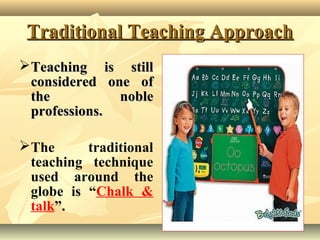
Traditional Teaching ApproachTraditional Teaching Approach
Teaching is stillTeaching is still
considered one ofconsidered one of
the noblethe noble
professions.professions.
The traditional
teaching technique
used around the
globe is “Chalk &
talk”.
HISTORYHISTORY
 Knowledge flowKnowledge flow
from teacher tofrom teacher to
student.student.
 Earlier, teacher wasEarlier, teacher was
the only source ofthe only source of
knowledge.knowledge.
 Students just actedStudents just acted
as listeners.as listeners.
COOL CLASSROOMCOOL CLASSROOM
Problems with Chalk-talkProblems with Chalk-talk
 ShhhShhh is mostis most
common word usedcommon word used
by teachers in theby teachers in the
world.world.
 Our students alsoOur students also
keepkeep shhhshhh in thein the
interview room.interview room.
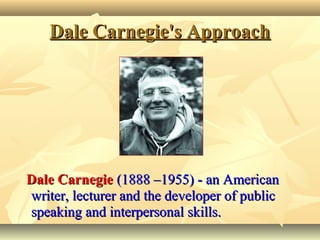
Dale Carnegie's ApproachDale Carnegie's Approach
Dale CarnegieDale Carnegie (1888 –1955) - an American(1888 –1955) - an American
writer, lecturer and the developer of publicwriter, lecturer and the developer of public
speaking and interpersonal skills.speaking and interpersonal skills.
Dale Carnegie's ApproachDale Carnegie's Approach
contd..contd..
 Simplify complex information by “Simplify complex information by “AnalogyAnalogy”.”.
 Communicate with greater impact.Communicate with greater impact.
 Respond to difficult classroom situations.Respond to difficult classroom situations.
 Inspire peers & students to embrace change.Inspire peers & students to embrace change.
Dale Carnegie's ApproachDale Carnegie's Approach
contd..contd..
 Analogy – Methodology used to simplify complex
information and explaining with help of real-life
examples.
 Example: Ajay Mehra,
#1437-a, Sector- 35 B,
Chandigarh (U.T)
is related to --- ajay.mehra@yahoo.com
Dale Carnegie's ApproachDale Carnegie's Approach
contd..contd..
Communicate with greater impactCommunicate with greater impact: -: -
 Word EmphasisWord Emphasis: stressing key words, phrases: stressing key words, phrases
and ideas.and ideas.
 PausesPauses: stop to aid understanding.: stop to aid understanding.
 PacingPacing: variations in speed of talk.: variations in speed of talk.
 Voice modulationVoice modulation: variations in voice tone.: variations in voice tone.
 Body GesturesBody Gestures: movement of body relevant to: movement of body relevant to
message.message.
Dale Carnegie's ApproachDale Carnegie's Approach
contd..contd..
““If you believe in what you are doing, then letIf you believe in what you are doing, then let
nothing hold you up in your work. Much ofnothing hold you up in your work. Much of
the best work of the world has been donethe best work of the world has been done
against seeming impossibilities. The thing is toagainst seeming impossibilities. The thing is to
get the work done.”get the work done.”
Dale Carnegie's ApproachDale Carnegie's Approach
contd..contd..
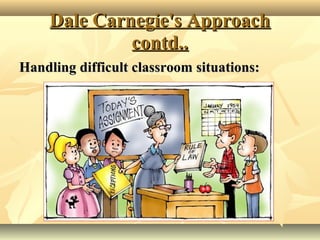
Handling difficult classroom situations:Handling difficult classroom situations:
Dale Carnegie's ApproachDale Carnegie's Approach
contd..contd..

Wear a smile to the class.Wear a smile to the class.

Relax and the listeners will relax with you.Relax and the listeners will relax with you.

Great domain expertise.Great domain expertise.

Communicate with competence andCommunicate with competence and
confidence.confidence.

““RespondRespond” rather than “” rather than “ReactReact”.”.
Dale Carnegie's ApproachDale Carnegie's Approach
contd..contd..
Inspire peers &Inspire peers &
students to embracestudents to embrace
““CHANGECHANGE””
Changing Role of TeacherChanging Role of Teacher
“What you can do for the students that
Dr. Google cannot do ?”
Changing Role of TeacherChanging Role of Teacher
 Teacher is not theTeacher is not the
only source ofonly source of
knowledge.knowledge.
 ““You need to earnYou need to earn
the respect.”the respect.”
 E-learningE-learning is here tois here to
stay.stay.
Bloom's TaxonomyBloom's Taxonomy
Benjamin S. BloomBenjamin S. Bloom (1913 – 1999) - American(1913 – 1999) - American
educational psychologist renowned for educationaleducational psychologist renowned for educational
objectives and the theory of mastery learning.objectives and the theory of mastery learning.
Bloom's Taxonomy contdBloom's Taxonomy contd....
KnowledgeKnowledge
Exhibit memory of previously-learned materials by recallingExhibit memory of previously-learned materials by recalling
facts, terms, basic concepts and answersfacts, terms, basic concepts and answers
Questions like:Questions like: What are the health benefits of eating apples?What are the health benefits of eating apples?
ComprehensionComprehension
Demonstrative understanding of facts and ideas by organizing,Demonstrative understanding of facts and ideas by organizing,
comparing, translating, interpreting, giving descriptions andcomparing, translating, interpreting, giving descriptions and
stating main ideasstating main ideas
Questions like:Questions like: Compare the health benefits of eating apples vs.Compare the health benefits of eating apples vs.
oranges.oranges.
Bloom's Taxonomy contdBloom's Taxonomy contd....
ApplicationApplication
Using new knowledge. Solve problems to new situations byUsing new knowledge. Solve problems to new situations by
applying acquired knowledge, facts, techniques and rules in aapplying acquired knowledge, facts, techniques and rules in a
different waydifferent way
Questions like:Questions like: Which kinds of apples are best for baking a pie,Which kinds of apples are best for baking a pie,
and why?and why?
AnalysisAnalysis
Examine and break information into parts by identifyingExamine and break information into parts by identifying
motives or causes. Make inferences and find evidence tomotives or causes. Make inferences and find evidence to
support generalizationssupport generalizations
Questions like:Questions like: List four ways of serving foods made with applesList four ways of serving foods made with apples
and explain which ones have the highest health benefits.and explain which ones have the highest health benefits.
What isWhat is IntelligenceIntelligence??
IntelligenceIntelligence
• Dr. Rajendra PrasadDr. Rajendra Prasad
• Rabindra Nath TagoreRabindra Nath Tagore
• Lata MangeshkarLata Mangeshkar
• Sachin TendulkarSachin Tendulkar
• Swami VivekanandSwami Vivekanand
• M.F. HussainM.F. Hussain
• Vikram SethVikram Seth
• Prabhu DevaPrabhu Deva
Gardner's Multiple IntelligenceGardner's Multiple Intelligence
TheoryTheory
Howard Earl GardnerHoward Earl Gardner - an American developmental- an American developmental
psychologist who is based at Harvard University.psychologist who is based at Harvard University.
Gardner's Multiple IntelligenceGardner's Multiple Intelligence
Theory contd..Theory contd..
 Math-logical Intelligence:Math-logical Intelligence: How my studentsHow my students
will think more logically & critically?will think more logically & critically?
 Linguistic Intelligence:Linguistic Intelligence: How can I make myHow can I make my
students use spoken or written language tostudents use spoken or written language to
learn better?learn better?
 Interpersonal Intelligence:Interpersonal Intelligence: How to bringHow to bring
collaborative learning, peer discussions andcollaborative learning, peer discussions and
interactions in class?interactions in class?
 Intrapersonal Intelligence:Intrapersonal Intelligence: How can I provideHow can I provide
my students to reflect about the subject?my students to reflect about the subject?
Gardner's Multiple IntelligenceGardner's Multiple Intelligence
Theory contd..Theory contd..
Various Teaching MethodologiesVarious Teaching Methodologies
Chalk – TalkChalk – Talk
Teacher:Teacher: lectures andlectures and
explains.explains.
Students:Students: listen andlisten and
understand.understand.
• KnowledgeKnowledge
• ComprehensionComprehension
• Math-logicalMath-logical
Various Teaching MethodologiesVarious Teaching Methodologies
SeminarSeminar
Teacher:Teacher: Explains &Explains &
demonstrates.demonstrates.
Students:Students: Observe &Observe &
understand.understand.
1)1) KnowledgeKnowledge
2)2) ComprehensionComprehension
3)3) Math-logicalMath-logical
4)4) LinguisticLinguistic
Various Teaching MethodologiesVarious Teaching Methodologies
BrainstormingBrainstorming
Teacher:Teacher: Guides &Guides &
conducts.conducts.
Students:Students: Give ideas &Give ideas &
participate.participate.
1)1) ApplyApply
2)2) AnalyzeAnalyze
3)3)IntrapersonalIntrapersonal
4)4)InterpersonalInterpersonal
Various Teaching MethodologiesVarious Teaching Methodologies
QuizQuiz
Teacher:Teacher: Questions &Questions &
facilitates.facilitates.
Students:Students: Answer &Answer &
participate.participate.
1)1) KnowledgeKnowledge
2)2) UnderstandingUnderstanding
3)3) LinguisticLinguistic
4)4) InterpersonalInterpersonal
Various Teaching MethodologiesVarious Teaching Methodologies
Group DiscussionGroup Discussion
Teacher:Teacher: Monitors &Monitors &
facilitates.facilitates.
Students:Students: Discusses &Discusses &
participate.participate.
1)1) ApplyApply
2)2) AnalyzeAnalyze
3)3) LinguisticLinguistic
4)4) InterpersonalInterpersonal
Various Teaching MethodologiesVarious Teaching Methodologies
Role PlayRole Play
Teacher:Teacher: Facilitates &Facilitates &
guides.guides.
Students:Students: Participate &Participate &
conducts.conducts.
1)1) ApplyApply
2)2) Spatial/VisualSpatial/Visual
3)3) LinguisticLinguistic
4)4) KinestheticKinesthetic
Various Teaching MethodologiesVarious Teaching Methodologies
DebateDebate
Teacher:Teacher: Facilitates &Facilitates &
conducts.conducts.
Students:Students: Discuss &Discuss &
give ideas.give ideas.
1)1) ComprehensionComprehension
2)2) AnalyzeAnalyze
3)3) LinguisticLinguistic
4)4) InterpersonalInterpersonal
ConclusionConclusion
 Understand changing role of teacher.Understand changing role of teacher.
 Make class more interactive for students.Make class more interactive for students.
 Design session plans or lecture plans keepingDesign session plans or lecture plans keeping
Bloom's taxonomy & Gardner's multipleBloom's taxonomy & Gardner's multiple
intelligence theory.intelligence theory.
 Use interactive ways of teaching rather thanUse interactive ways of teaching rather than
just chalk & talk.just chalk & talk.
 Don't forgot curriculum in new ways ofDon't forgot curriculum in new ways of
teaching.teaching.
The BeginningThe Beginning
Anyone who refuses to be a student,Anyone who refuses to be a student,
refuses to be a teacher!refuses to be a teacher!
THANKS TO:THANKS TO:
• GODGOD..
• TheThe August AssemblyAugust Assembly including myincluding my friendsfriends,,
colleagues & associates for their benigncolleagues & associates for their benign
presence.presence.
• All of myAll of my studentsstudents especially: Prakash.especially: Prakash.
Interactive teaching methodologies

Interactive teaching methodologies

  • 1.
  • 2.
    Presented By:Presented By: AkhilKaushikAkhil Kaushik Assistant Professor, CSE Deptt.,Assistant Professor, CSE Deptt., T.I.T&S BhiwaniT.I.T&S Bhiwani
  • 3.
    TALK FLOWTALK FLOW •IntroductionIntroduction •Dale Carnegie's ApproachDale Carnegie's Approach •Changing role of a TeacherChanging role of a Teacher •Bloom's TaxonomyBloom's Taxonomy •Gardner's Multiple Intelligence TheoryGardner's Multiple Intelligence Theory •Various Teaching MethodologiesVarious Teaching Methodologies •ConclusionConclusion
  • 4.
    Traditional Teaching ApproachTraditionalTeaching Approach Teaching is stillTeaching is still considered one ofconsidered one of the noblethe noble professions.professions. The traditional teaching technique used around the globe is “Chalk & talk”.
  • 5.
    HISTORYHISTORY  Knowledge flowKnowledgeflow from teacher tofrom teacher to student.student.  Earlier, teacher wasEarlier, teacher was the only source ofthe only source of knowledge.knowledge.  Students just actedStudents just acted as listeners.as listeners.
  • 6.
  • 7.
    Problems with Chalk-talkProblemswith Chalk-talk  ShhhShhh is mostis most common word usedcommon word used by teachers in theby teachers in the world.world.  Our students alsoOur students also keepkeep shhhshhh in thein the interview room.interview room.
  • 8.
    Dale Carnegie's ApproachDaleCarnegie's Approach Dale CarnegieDale Carnegie (1888 –1955) - an American(1888 –1955) - an American writer, lecturer and the developer of publicwriter, lecturer and the developer of public speaking and interpersonal skills.speaking and interpersonal skills.
  • 9.
    Dale Carnegie's ApproachDaleCarnegie's Approach contd..contd..  Simplify complex information by “Simplify complex information by “AnalogyAnalogy”.”.  Communicate with greater impact.Communicate with greater impact.  Respond to difficult classroom situations.Respond to difficult classroom situations.  Inspire peers & students to embrace change.Inspire peers & students to embrace change.
  • 10.
    Dale Carnegie's ApproachDaleCarnegie's Approach contd..contd..  Analogy – Methodology used to simplify complex information and explaining with help of real-life examples.  Example: Ajay Mehra, #1437-a, Sector- 35 B, Chandigarh (U.T) is related to --- ajay.mehra@yahoo.com
  • 11.
    Dale Carnegie's ApproachDaleCarnegie's Approach contd..contd.. Communicate with greater impactCommunicate with greater impact: -: -  Word EmphasisWord Emphasis: stressing key words, phrases: stressing key words, phrases and ideas.and ideas.  PausesPauses: stop to aid understanding.: stop to aid understanding.  PacingPacing: variations in speed of talk.: variations in speed of talk.  Voice modulationVoice modulation: variations in voice tone.: variations in voice tone.  Body GesturesBody Gestures: movement of body relevant to: movement of body relevant to message.message.
  • 12.
    Dale Carnegie's ApproachDaleCarnegie's Approach contd..contd.. ““If you believe in what you are doing, then letIf you believe in what you are doing, then let nothing hold you up in your work. Much ofnothing hold you up in your work. Much of the best work of the world has been donethe best work of the world has been done against seeming impossibilities. The thing is toagainst seeming impossibilities. The thing is to get the work done.”get the work done.”
  • 13.
    Dale Carnegie's ApproachDaleCarnegie's Approach contd..contd.. Handling difficult classroom situations:Handling difficult classroom situations:
  • 14.
    Dale Carnegie's ApproachDaleCarnegie's Approach contd..contd..  Wear a smile to the class.Wear a smile to the class.  Relax and the listeners will relax with you.Relax and the listeners will relax with you.  Great domain expertise.Great domain expertise.  Communicate with competence andCommunicate with competence and confidence.confidence.  ““RespondRespond” rather than “” rather than “ReactReact”.”.
  • 15.
    Dale Carnegie's ApproachDaleCarnegie's Approach contd..contd.. Inspire peers &Inspire peers & students to embracestudents to embrace ““CHANGECHANGE””
  • 16.
    Changing Role ofTeacherChanging Role of Teacher “What you can do for the students that Dr. Google cannot do ?”
  • 18.
    Changing Role ofTeacherChanging Role of Teacher  Teacher is not theTeacher is not the only source ofonly source of knowledge.knowledge.  ““You need to earnYou need to earn the respect.”the respect.”  E-learningE-learning is here tois here to stay.stay.
  • 19.
    Bloom's TaxonomyBloom's Taxonomy BenjaminS. BloomBenjamin S. Bloom (1913 – 1999) - American(1913 – 1999) - American educational psychologist renowned for educationaleducational psychologist renowned for educational objectives and the theory of mastery learning.objectives and the theory of mastery learning.
  • 20.
  • 21.
    Bloom's Taxonomy contdBloom'sTaxonomy contd.... KnowledgeKnowledge Exhibit memory of previously-learned materials by recallingExhibit memory of previously-learned materials by recalling facts, terms, basic concepts and answersfacts, terms, basic concepts and answers Questions like:Questions like: What are the health benefits of eating apples?What are the health benefits of eating apples? ComprehensionComprehension Demonstrative understanding of facts and ideas by organizing,Demonstrative understanding of facts and ideas by organizing, comparing, translating, interpreting, giving descriptions andcomparing, translating, interpreting, giving descriptions and stating main ideasstating main ideas Questions like:Questions like: Compare the health benefits of eating apples vs.Compare the health benefits of eating apples vs. oranges.oranges.
  • 22.
    Bloom's Taxonomy contdBloom'sTaxonomy contd.... ApplicationApplication Using new knowledge. Solve problems to new situations byUsing new knowledge. Solve problems to new situations by applying acquired knowledge, facts, techniques and rules in aapplying acquired knowledge, facts, techniques and rules in a different waydifferent way Questions like:Questions like: Which kinds of apples are best for baking a pie,Which kinds of apples are best for baking a pie, and why?and why? AnalysisAnalysis Examine and break information into parts by identifyingExamine and break information into parts by identifying motives or causes. Make inferences and find evidence tomotives or causes. Make inferences and find evidence to support generalizationssupport generalizations Questions like:Questions like: List four ways of serving foods made with applesList four ways of serving foods made with apples and explain which ones have the highest health benefits.and explain which ones have the highest health benefits.
  • 23.
    What isWhat isIntelligenceIntelligence??
  • 24.
    IntelligenceIntelligence • Dr. RajendraPrasadDr. Rajendra Prasad • Rabindra Nath TagoreRabindra Nath Tagore • Lata MangeshkarLata Mangeshkar • Sachin TendulkarSachin Tendulkar • Swami VivekanandSwami Vivekanand • M.F. HussainM.F. Hussain • Vikram SethVikram Seth • Prabhu DevaPrabhu Deva
  • 25.
    Gardner's Multiple IntelligenceGardner'sMultiple Intelligence TheoryTheory Howard Earl GardnerHoward Earl Gardner - an American developmental- an American developmental psychologist who is based at Harvard University.psychologist who is based at Harvard University.
  • 26.
    Gardner's Multiple IntelligenceGardner'sMultiple Intelligence Theory contd..Theory contd..
  • 27.
     Math-logical Intelligence:Math-logicalIntelligence: How my studentsHow my students will think more logically & critically?will think more logically & critically?  Linguistic Intelligence:Linguistic Intelligence: How can I make myHow can I make my students use spoken or written language tostudents use spoken or written language to learn better?learn better?  Interpersonal Intelligence:Interpersonal Intelligence: How to bringHow to bring collaborative learning, peer discussions andcollaborative learning, peer discussions and interactions in class?interactions in class?  Intrapersonal Intelligence:Intrapersonal Intelligence: How can I provideHow can I provide my students to reflect about the subject?my students to reflect about the subject? Gardner's Multiple IntelligenceGardner's Multiple Intelligence Theory contd..Theory contd..
  • 28.
    Various Teaching MethodologiesVariousTeaching Methodologies Chalk – TalkChalk – Talk Teacher:Teacher: lectures andlectures and explains.explains. Students:Students: listen andlisten and understand.understand. • KnowledgeKnowledge • ComprehensionComprehension • Math-logicalMath-logical
  • 29.
    Various Teaching MethodologiesVariousTeaching Methodologies SeminarSeminar Teacher:Teacher: Explains &Explains & demonstrates.demonstrates. Students:Students: Observe &Observe & understand.understand. 1)1) KnowledgeKnowledge 2)2) ComprehensionComprehension 3)3) Math-logicalMath-logical 4)4) LinguisticLinguistic
  • 30.
    Various Teaching MethodologiesVariousTeaching Methodologies BrainstormingBrainstorming Teacher:Teacher: Guides &Guides & conducts.conducts. Students:Students: Give ideas &Give ideas & participate.participate. 1)1) ApplyApply 2)2) AnalyzeAnalyze 3)3)IntrapersonalIntrapersonal 4)4)InterpersonalInterpersonal
  • 31.
    Various Teaching MethodologiesVariousTeaching Methodologies QuizQuiz Teacher:Teacher: Questions &Questions & facilitates.facilitates. Students:Students: Answer &Answer & participate.participate. 1)1) KnowledgeKnowledge 2)2) UnderstandingUnderstanding 3)3) LinguisticLinguistic 4)4) InterpersonalInterpersonal
  • 32.
    Various Teaching MethodologiesVariousTeaching Methodologies Group DiscussionGroup Discussion Teacher:Teacher: Monitors &Monitors & facilitates.facilitates. Students:Students: Discusses &Discusses & participate.participate. 1)1) ApplyApply 2)2) AnalyzeAnalyze 3)3) LinguisticLinguistic 4)4) InterpersonalInterpersonal
  • 33.
    Various Teaching MethodologiesVariousTeaching Methodologies Role PlayRole Play Teacher:Teacher: Facilitates &Facilitates & guides.guides. Students:Students: Participate &Participate & conducts.conducts. 1)1) ApplyApply 2)2) Spatial/VisualSpatial/Visual 3)3) LinguisticLinguistic 4)4) KinestheticKinesthetic
  • 34.
    Various Teaching MethodologiesVariousTeaching Methodologies DebateDebate Teacher:Teacher: Facilitates &Facilitates & conducts.conducts. Students:Students: Discuss &Discuss & give ideas.give ideas. 1)1) ComprehensionComprehension 2)2) AnalyzeAnalyze 3)3) LinguisticLinguistic 4)4) InterpersonalInterpersonal
  • 35.
    ConclusionConclusion  Understand changingrole of teacher.Understand changing role of teacher.  Make class more interactive for students.Make class more interactive for students.  Design session plans or lecture plans keepingDesign session plans or lecture plans keeping Bloom's taxonomy & Gardner's multipleBloom's taxonomy & Gardner's multiple intelligence theory.intelligence theory.  Use interactive ways of teaching rather thanUse interactive ways of teaching rather than just chalk & talk.just chalk & talk.  Don't forgot curriculum in new ways ofDon't forgot curriculum in new ways of teaching.teaching.
  • 36.
    The BeginningThe Beginning Anyonewho refuses to be a student,Anyone who refuses to be a student, refuses to be a teacher!refuses to be a teacher!
  • 37.
    THANKS TO:THANKS TO: •GODGOD.. • TheThe August AssemblyAugust Assembly including myincluding my friendsfriends,, colleagues & associates for their benigncolleagues & associates for their benign presence.presence. • All of myAll of my studentsstudents especially: Prakash.especially: Prakash.