
Learning Styles
and
Teaching Strategies
BY: QURAT-UL-AIN IMRAN
1
TODAY’S GOALS
• To learn about different learning styles.
•To identify students’ preferred learning style
(s)
•To identify strategies for your preferred
teaching style 2
WHY THIS SESSION?
3
 Best educational Institutions always look
for ways to make their educational
initiatives more effective.
 In any educational institution teaching
serves as an important vehicle for
achieving institutional goals of increase
effectiveness, efficiency and
enhancement of students’ learning.
4
-Educators must have more knowledge and
understanding of learning process, particularly
how individual learns.
5
Today’s highly successful
colleges/universities are distinguished by
the ability to have their faculties continue
to improve their efforts to advance
students’ learning.
What is learning?
6
LEARNING
Dictionary Definition:
“Learning is the acquisition of
knowledge or skills through
study, experience, or being
taught”. 7
“We define learning as the
transformative process of taking in
information that—when internalized
and mixed with what we
have experienced—changes what we
know and builds on what we do. It’s
based on input, process, and
reflection. It is what changes us.”
Definitions By Educationists:
8
“The process of gaining knowledge
and expertise.”
-From the adult learner by malcolm knowles
“A process that leads to change,
which occurs as a result
of experience and increases the
potential of improved
performance and future 9
How do People Learn?
•Easy answer: We don’t know for sure.
•Difficult answer: We have multiple theories
that provide glimpses of an answer from
many different perspectives. These stem
from psychologists, philosophers,
sociologists, anthropologists, evolutionary
biologists, linguists, neuroscientists… 10
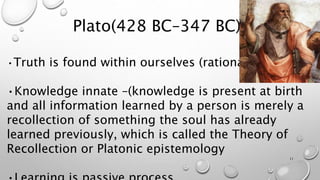
Plato(428 BC–347 BC)
•Truth is found within ourselves (rationalist)
•Knowledge innate –(knowledge is present at birth
and all information learned by a person is merely a
recollection of something the soul has already
learned previously, which is called the Theory of
Recollection or Platonic epistemology
11
Aristotle (470 –399 BCE)
• Student of Plato
•Truth is found outside of ourselves using our
senses (Empiricist).
12
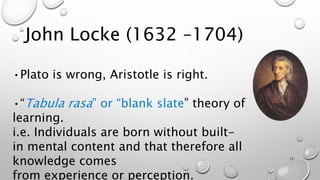
John Locke (1632 –1704)
•Plato is wrong, Aristotle is right.
•“Tabula rasa” or “blank slate” theory of
learning.
i.e. Individuals are born without built-
in mental content and that therefore all
knowledge comes
from experience or perception.
13
LEARNING THEORIES
Main theories of learning :
 Behaviorism
 Cognitivism
 Social Learning Theory or Social Constructivism
 Multiple Intelligences
 Brain-Based Learning
14
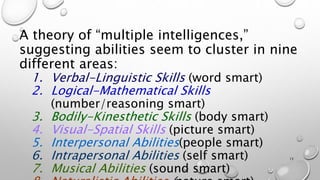
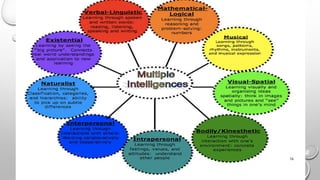
A theory of “multiple intelligences,”
suggesting abilities seem to cluster in nine
different areas:
1. Verbal-Linguistic Skills (word smart)
2. Logical-Mathematical Skills
(number/reasoning smart)
3. Bodily-Kinesthetic Skills (body smart)
4. Visual-Spatial Skills (picture smart)
5. Interpersonal Abilities(people smart)
6. Intrapersonal Abilities (self smart)
7. Musical Abilities (sound smart)
15
16
What is learning style?
17
LEARNING STYLE
The “characteristic strengths and
preferences in the ways that learner
takes in and process information”
- R. Felder
18
Learning style is individual’s unique
approach to learning based on
strengths, weaknesses and
preferences.
It is preferred way of thinking,
processing and understanding 19
Every class room consist of individuals
with diverse strengths backgrounds
and approaches to learning.
Understanding and responding to each
individual learning style can be
challenging for teachers. 20
Learning styles proposed by
different
Psychologist/Educationists
21
 Myers-Briggs Type Indicator (MBTI) –Isabel Briggs
Myers, Gifts Differing, Consulting Psychologist Press,
1980
 Kolb Model –David Kolb, Experiential Learning,
Prentice Hall, 1984
 Felder-Silverman Model –Felder, R.M. & Silverman,
L.K. (1988) Learning styles and Teaching Strategies in
Engineering Education, Engineering Education, 78,
pp. 674-681
22
Keirsey Temperaments –David Keirsey, Please
Understand Me, Prometheus Nemesis Book
Company, 1978
VARK Model –By Fleming and Mills (1992)
23
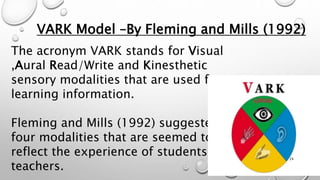
VARK Model –By Fleming and Mills (1992)
The acronym VARK stands for Visual
,Aural Read/Write and Kinesthetic
sensory modalities that are used for
learning information.
Fleming and Mills (1992) suggested
four modalities that are seemed to
reflect the experience of students and
teachers.
24
Prefer to see information such as pictures, diagrams
or demonstrations.
Picture words and concepts that they hear as
images.
Might get easily distracted during a lecture with no
visual aids.
Could become overwhelmed with intense visuals
accompanied by lecture.
Benefit from using charts, maps, notes, and flash
cards when studying.
VISUAL LEARNERS
25
Techniques for Visual Learners
•Graphic organizers
•Charts
•Graphs
•Maps
•Draw a picture of the learning
•Video
26
AUDITORY LEARNERS
Prefer to hear information spoken.
Can absorb a lecture with little effort.
May not need detailed notes to learn.
Often avoid eye contact in order to
concentrate.
May read aloud to themselves.
Like background music when they study. 27
Techniques for Auditory
Learners
•Tape record important
information
•Read aloud
•Retell
28
Tactile or Kinesthetic Learners
 Prefer touch as their primary mode for taking in
information
 In traditional lecture situations, they should write out
important facts
 Create study sheets connected to vivid examples
 Role-playing might help them learn and remember
important ideas 29
Techniques for Tactile/Kinesthetic
Learners
•Move during the lesson
•Act it out with body
•Touch it
•Feel it
•Recite while moving
30
31
How to Teach to All Three Learning Styles
 Most likely we have a good mix of all three
learning styles in our class.
 It is highly encouraged to incorporate teaching
methods that will benefit each type of learner.
 Instead of just orally presenting use role play,
audience participation and even music to
convey information.
 Give your students guided notes to fill in the
blanks and use visuals in your slides.
 Have your students reteach the information to
ACTIVITY
32
TEACHING METHODS
33
“A thousand teachers, a thousand
methods.”
-Chinese Proverb
34
INSTRUCTIONAL METHODS
1. Lecture
2. Lecture discussion
3. Seminar
4. Symposium
5. Conferences
6. Workshops
7.PANEL DISCUSSION
8. GROUP DISCUSSION
9. TUTORIALS
10. ROLE PLAY
11. INTEGRATED
TEACHING (HORIZONTAL
AND VERTICAL)
35
Types of Teaching
Teacher- centered (Passive learning)
•“Traditional class“
•Instructor is "verbal" textbook
•Student is passive "tape recorder"
•In exams, students repeat what the instructor told
Student-centered (Active learning)
•Students activities in class, e.g. quizzes
•Students lookup definitions and vocabulary before/after
class
•Visual aids, demonstrations, etc.,
36
Teacher Teaches (not The Blackboard,
OHP, or PPT)
37
The Four Aces of Effective Teaching
The "Four Aces of Effective Teaching" (Walls, 1999)
summarize the most prevalent recommendations from
the teaching-effectiveness research literature .
Ace 1: Outcomes
Ace 2: Clarity
Ace 3: Engagement
Ace 4: Enthusiasm
38
ACE 1: OUTCOMES
 The first Ace of Effective Teaching concerns the
utilization of an outcomes-based instructional orientation.
Outcomes enable students to focus their
attention on clear learning goals.
These outcomes inform students of where they
are going and how they will get there.
Outcomes also provide the teacher with a
framework for designing and delivering the
course content.
Outcomes enable teachers to assess student
learning as a measure of their own instructional
39
Some questions for you?
Reflection…..
Q1:What were the desired student outcomes for
your last class?
Q2:What did your students actually learn, and how
was that learning documented?
Q3:Did the employed instructional strategies
effectively contribute to each student’s ability to
accomplish the stated outcomes? 40
ACE 2: CLARITY
The second Ace of Effective
Teaching involves the
clarity of instruction.
More effective teachers
typically provide students
with highly explicit
directions and
explanations concerning
41
Lecture should be
structured in a way that
affords students the
opportunity to make
connections between the
new material that is being
presented and the
concepts that they have
ACE 2: CLARITY
42
Some questions for you?
Reflection…..
 During your last class meeting, what instructional
techniques did you employ to provide the students
with a clear explanation of the lesson content?
 What types of illustrations, demonstrations, heuristics,
and the like were used to supplement and clarify
verbal explanation?
 Were there any concepts and/or skills that you were
able to incorporate from previous lessons and
courses?
 Did you allocate sufficient time for your students to
43
ACE 3: ENGAGEMENT
The third Ace of Effective
Teaching is engagement.
Teachers must create a
dynamic, educational
environment that affords
students the opportunity to
practice every concept that
they are learning.
More effective teachers utilize
instructional strategies that
44
As a general rule, a teacher
should limit a lecture to no
more than thirty minutes
before employing a learning
activity that actively engages all
students (Walls & Cather,
1987).
This type of curricular
alignment is a critical
ACE 3: ENGAGEMENT
45
Some questions for you?
Reflection…..
 In your last class, how much time were your
students engaged in learning activities other
than note taking?
 On how many occasions during your last class
did students have the opportunity to be
actively engaged in the learning process?
 How many of your students are asleep or off-
task at any point in a given lesson?
46
ACE 4: ENTHUSIASM
The fourth Ace of Effective Teaching is
enthusiasm.
If you hate to teach it, your students will
hate to learn it. Conversely, if you love to
teach it, your students may very well love to
learn it.
Enthusiasm is contagious.
More effective teachers display a high level
of enthusiasm that reflects their
47
ACE 4: ENTHUSIASM (Conti….)
These characteristics are derived from
the individual teacher’s subject matter
knowledge and instructional experience.
Teachers can begin to establish a
positive learning environment by
showing their passion for the subject
matter, using student names, reinforcing
student participation during class, and
being active in moving among the 48
ACE 4: ENTHUSIASM conti…..
It is the teacher's
responsibility to establish
a classroom environment
that allows for a high
degree of student
achievement. Ultimately,
high levels of student
achievement serve as a
49
Some questions for you?
Reflection…..
 Were your students excited about attending your last
class?
 Were you excited about teaching your last class?
 What have you done to effectively communicate your
passion for the subject matter that you teach to your
students?
 How have your past teaching, research, and service been
used to positively impact the teaching-learning
environment for your students?
50
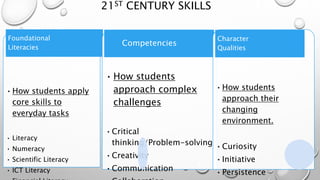
21ST CENTURY SKILLS
51
•How students apply
core skills to
everyday tasks
• Literacy
• Numeracy
• Scientific Literacy
• ICT Literacy
Foundational
Literacies
• How students
approach complex
challenges
•Critical
thinking/Problem-solving
•Creativity
•Communication
Competencies
•How students
approach their
changing
environment.
•Curiosity
•Initiative
•Persistence
Character
Qualities
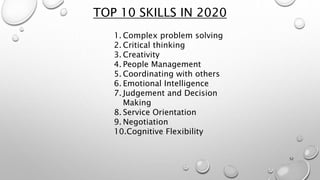
TOP 10 SKILLS IN 2020
52
1. Complex problem solving
2. Critical thinking
3. Creativity
4. People Management
5. Coordinating with others
6. Emotional Intelligence
7. Judgement and Decision
Making
8. Service Orientation
9. Negotiation
10.Cognitive Flexibility
53

Learning styles

  • 1.
  • 2.
    TODAY’S GOALS • Tolearn about different learning styles. •To identify students’ preferred learning style (s) •To identify strategies for your preferred teaching style 2
  • 3.
  • 4.
     Best educationalInstitutions always look for ways to make their educational initiatives more effective.  In any educational institution teaching serves as an important vehicle for achieving institutional goals of increase effectiveness, efficiency and enhancement of students’ learning. 4
  • 5.
    -Educators must havemore knowledge and understanding of learning process, particularly how individual learns. 5 Today’s highly successful colleges/universities are distinguished by the ability to have their faculties continue to improve their efforts to advance students’ learning.
  • 6.
  • 7.
    LEARNING Dictionary Definition: “Learning isthe acquisition of knowledge or skills through study, experience, or being taught”. 7
  • 8.
    “We define learningas the transformative process of taking in information that—when internalized and mixed with what we have experienced—changes what we know and builds on what we do. It’s based on input, process, and reflection. It is what changes us.” Definitions By Educationists: 8
  • 9.
    “The process ofgaining knowledge and expertise.” -From the adult learner by malcolm knowles “A process that leads to change, which occurs as a result of experience and increases the potential of improved performance and future 9
  • 10.
    How do PeopleLearn? •Easy answer: We don’t know for sure. •Difficult answer: We have multiple theories that provide glimpses of an answer from many different perspectives. These stem from psychologists, philosophers, sociologists, anthropologists, evolutionary biologists, linguists, neuroscientists… 10
  • 11.
    Plato(428 BC–347 BC) •Truthis found within ourselves (rationalist) •Knowledge innate –(knowledge is present at birth and all information learned by a person is merely a recollection of something the soul has already learned previously, which is called the Theory of Recollection or Platonic epistemology 11
  • 12.
    Aristotle (470 –399BCE) • Student of Plato •Truth is found outside of ourselves using our senses (Empiricist). 12
  • 13.
    John Locke (1632–1704) •Plato is wrong, Aristotle is right. •“Tabula rasa” or “blank slate” theory of learning. i.e. Individuals are born without built- in mental content and that therefore all knowledge comes from experience or perception. 13
  • 14.
    LEARNING THEORIES Main theoriesof learning :  Behaviorism  Cognitivism  Social Learning Theory or Social Constructivism  Multiple Intelligences  Brain-Based Learning 14
  • 15.
    A theory of“multiple intelligences,” suggesting abilities seem to cluster in nine different areas: 1. Verbal-Linguistic Skills (word smart) 2. Logical-Mathematical Skills (number/reasoning smart) 3. Bodily-Kinesthetic Skills (body smart) 4. Visual-Spatial Skills (picture smart) 5. Interpersonal Abilities(people smart) 6. Intrapersonal Abilities (self smart) 7. Musical Abilities (sound smart) 15
  • 16.
  • 17.
  • 18.
    LEARNING STYLE The “characteristicstrengths and preferences in the ways that learner takes in and process information” - R. Felder 18
  • 19.
    Learning style isindividual’s unique approach to learning based on strengths, weaknesses and preferences. It is preferred way of thinking, processing and understanding 19
  • 20.
    Every class roomconsist of individuals with diverse strengths backgrounds and approaches to learning. Understanding and responding to each individual learning style can be challenging for teachers. 20
  • 21.
    Learning styles proposedby different Psychologist/Educationists 21
  • 22.
     Myers-Briggs TypeIndicator (MBTI) –Isabel Briggs Myers, Gifts Differing, Consulting Psychologist Press, 1980  Kolb Model –David Kolb, Experiential Learning, Prentice Hall, 1984  Felder-Silverman Model –Felder, R.M. & Silverman, L.K. (1988) Learning styles and Teaching Strategies in Engineering Education, Engineering Education, 78, pp. 674-681 22
  • 23.
    Keirsey Temperaments –DavidKeirsey, Please Understand Me, Prometheus Nemesis Book Company, 1978 VARK Model –By Fleming and Mills (1992) 23
  • 24.
    VARK Model –ByFleming and Mills (1992) The acronym VARK stands for Visual ,Aural Read/Write and Kinesthetic sensory modalities that are used for learning information. Fleming and Mills (1992) suggested four modalities that are seemed to reflect the experience of students and teachers. 24
  • 25.
    Prefer to seeinformation such as pictures, diagrams or demonstrations. Picture words and concepts that they hear as images. Might get easily distracted during a lecture with no visual aids. Could become overwhelmed with intense visuals accompanied by lecture. Benefit from using charts, maps, notes, and flash cards when studying. VISUAL LEARNERS 25
  • 26.
    Techniques for VisualLearners •Graphic organizers •Charts •Graphs •Maps •Draw a picture of the learning •Video 26
  • 27.
    AUDITORY LEARNERS Prefer tohear information spoken. Can absorb a lecture with little effort. May not need detailed notes to learn. Often avoid eye contact in order to concentrate. May read aloud to themselves. Like background music when they study. 27
  • 28.
    Techniques for Auditory Learners •Taperecord important information •Read aloud •Retell 28
  • 29.
    Tactile or KinestheticLearners  Prefer touch as their primary mode for taking in information  In traditional lecture situations, they should write out important facts  Create study sheets connected to vivid examples  Role-playing might help them learn and remember important ideas 29
  • 30.
    Techniques for Tactile/Kinesthetic Learners •Moveduring the lesson •Act it out with body •Touch it •Feel it •Recite while moving 30
  • 31.
    31 How to Teachto All Three Learning Styles  Most likely we have a good mix of all three learning styles in our class.  It is highly encouraged to incorporate teaching methods that will benefit each type of learner.  Instead of just orally presenting use role play, audience participation and even music to convey information.  Give your students guided notes to fill in the blanks and use visuals in your slides.  Have your students reteach the information to
  • 32.
  • 33.
  • 34.
    “A thousand teachers,a thousand methods.” -Chinese Proverb 34
  • 35.
    INSTRUCTIONAL METHODS 1. Lecture 2.Lecture discussion 3. Seminar 4. Symposium 5. Conferences 6. Workshops 7.PANEL DISCUSSION 8. GROUP DISCUSSION 9. TUTORIALS 10. ROLE PLAY 11. INTEGRATED TEACHING (HORIZONTAL AND VERTICAL) 35
  • 36.
    Types of Teaching Teacher-centered (Passive learning) •“Traditional class“ •Instructor is "verbal" textbook •Student is passive "tape recorder" •In exams, students repeat what the instructor told Student-centered (Active learning) •Students activities in class, e.g. quizzes •Students lookup definitions and vocabulary before/after class •Visual aids, demonstrations, etc., 36
  • 37.
    Teacher Teaches (notThe Blackboard, OHP, or PPT) 37
  • 38.
    The Four Acesof Effective Teaching The "Four Aces of Effective Teaching" (Walls, 1999) summarize the most prevalent recommendations from the teaching-effectiveness research literature . Ace 1: Outcomes Ace 2: Clarity Ace 3: Engagement Ace 4: Enthusiasm 38
  • 39.
    ACE 1: OUTCOMES The first Ace of Effective Teaching concerns the utilization of an outcomes-based instructional orientation. Outcomes enable students to focus their attention on clear learning goals. These outcomes inform students of where they are going and how they will get there. Outcomes also provide the teacher with a framework for designing and delivering the course content. Outcomes enable teachers to assess student learning as a measure of their own instructional 39
  • 40.
    Some questions foryou? Reflection….. Q1:What were the desired student outcomes for your last class? Q2:What did your students actually learn, and how was that learning documented? Q3:Did the employed instructional strategies effectively contribute to each student’s ability to accomplish the stated outcomes? 40
  • 41.
    ACE 2: CLARITY Thesecond Ace of Effective Teaching involves the clarity of instruction. More effective teachers typically provide students with highly explicit directions and explanations concerning 41
  • 42.
    Lecture should be structuredin a way that affords students the opportunity to make connections between the new material that is being presented and the concepts that they have ACE 2: CLARITY 42
  • 43.
    Some questions foryou? Reflection…..  During your last class meeting, what instructional techniques did you employ to provide the students with a clear explanation of the lesson content?  What types of illustrations, demonstrations, heuristics, and the like were used to supplement and clarify verbal explanation?  Were there any concepts and/or skills that you were able to incorporate from previous lessons and courses?  Did you allocate sufficient time for your students to 43
  • 44.
    ACE 3: ENGAGEMENT Thethird Ace of Effective Teaching is engagement. Teachers must create a dynamic, educational environment that affords students the opportunity to practice every concept that they are learning. More effective teachers utilize instructional strategies that 44
  • 45.
    As a generalrule, a teacher should limit a lecture to no more than thirty minutes before employing a learning activity that actively engages all students (Walls & Cather, 1987). This type of curricular alignment is a critical ACE 3: ENGAGEMENT 45
  • 46.
    Some questions foryou? Reflection…..  In your last class, how much time were your students engaged in learning activities other than note taking?  On how many occasions during your last class did students have the opportunity to be actively engaged in the learning process?  How many of your students are asleep or off- task at any point in a given lesson? 46
  • 47.
    ACE 4: ENTHUSIASM Thefourth Ace of Effective Teaching is enthusiasm. If you hate to teach it, your students will hate to learn it. Conversely, if you love to teach it, your students may very well love to learn it. Enthusiasm is contagious. More effective teachers display a high level of enthusiasm that reflects their 47
  • 48.
    ACE 4: ENTHUSIASM(Conti….) These characteristics are derived from the individual teacher’s subject matter knowledge and instructional experience. Teachers can begin to establish a positive learning environment by showing their passion for the subject matter, using student names, reinforcing student participation during class, and being active in moving among the 48
  • 49.
    ACE 4: ENTHUSIASMconti….. It is the teacher's responsibility to establish a classroom environment that allows for a high degree of student achievement. Ultimately, high levels of student achievement serve as a 49
  • 50.
    Some questions foryou? Reflection…..  Were your students excited about attending your last class?  Were you excited about teaching your last class?  What have you done to effectively communicate your passion for the subject matter that you teach to your students?  How have your past teaching, research, and service been used to positively impact the teaching-learning environment for your students? 50
  • 51.
    21ST CENTURY SKILLS 51 •Howstudents apply core skills to everyday tasks • Literacy • Numeracy • Scientific Literacy • ICT Literacy Foundational Literacies • How students approach complex challenges •Critical thinking/Problem-solving •Creativity •Communication Competencies •How students approach their changing environment. •Curiosity •Initiative •Persistence Character Qualities
  • 52.
    TOP 10 SKILLSIN 2020 52 1. Complex problem solving 2. Critical thinking 3. Creativity 4. People Management 5. Coordinating with others 6. Emotional Intelligence 7. Judgement and Decision Making 8. Service Orientation 9. Negotiation 10.Cognitive Flexibility
  • 53.