Teaching
Approaches
Prepared by:
Asuncion, Jeri Mayah P.
CONSTRUCTIVISM
Is a philosophy of education that
says that people construct
knowledge through their
experiences and interactions with
the world.
Traditional
Curriculum
Transactional
curriculum
Teacher transmits
information to
students who
passively listen
and acquire facts.
Students are
actively involved
in their learning
to reach new
understandings.
• Children learn more, and enjoy learning
more when they are actively involved,
rather than passive listeners.
• Students working with and learning from
one another-and the development of a
strong learning community.
• Divergent thinking
• Learning through real life situations
COOPERATIVE
LEARNING
Is an educational approach to
teaching and learning that
involves group of students
working together to solve a
problem, complete a task or
create a product.
Types of Cooperative learning
Informal cooperative learning groups
Formal Cooperative learning groups
Cooperative Base Groups
Five phases of
Cooperative Learning
• Engagement
• Exploration
• Transformation
• Presentation
• Reflection
Five Basic Elements
Positive Interdependence
Individual and group accountability
Interpersonal and small group skills
Face-to-face promotive interaction
Group processing
Benefits
Celebration of diversity
Acknowledgement of individual
differences
Interpersonal development
Actively involving students in learning
More opportunities for personal
feedback
Not all group learning is
cooperative learning
• Groups arguing over divisive conflicts and power
struggles
• A member sits quietly, too shy to participate
• One member does the work, while the other members
talk about something
• No one does the work because the one who normally
works the hardest doesn’t want to be a sucker.
• A more talented member may come up with all the
answers, dictate to the group, or work separately,
ignoring other group members.
TELL ME AND I FORGET
SHOW ME AND I MAY
REMEMBER,
INVOLVE ME AND I WILL
UNDERSTAND
INQUIRY-BASED LEARNING
TEACHER PROVIDES ALL
THE INFORMATION
STUDENTS THEN RECITE
WHAT THEY HAVE
LEARNED
CONSTRUCT OWN KNOWLEDGE
THROUGH EXPERIENCES
Levels of Inquiry
•Structured
• Guided
•Open
CONTEXTUALIZED
Contextualized teaching means
exerting effort to extend learning
beyond the classroom into
relevant contexts in the real
world.
K TO 12 Law
The Enhanced Basic Education Act
of 2013 allows schools to localize
and indigenize the K to 12
curriculum.
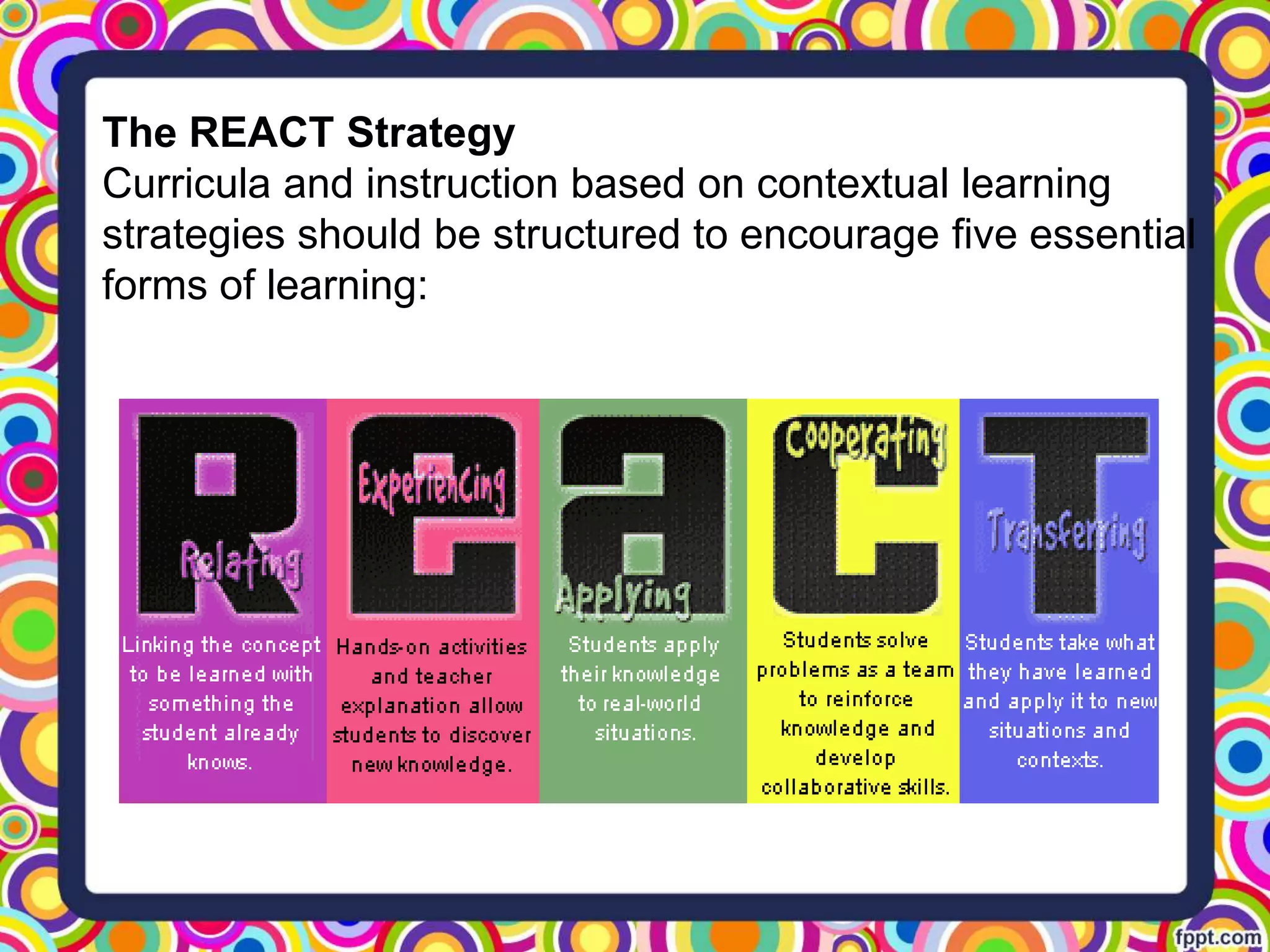
The REACT Strategy
Curricula and instruction based on contextual learning
strategies should be structured to encourage five essential
forms of learning:
EXPERIENCING
Learning in the context of life
experience, or relating, is the kind of
contextual learning that typically occurs
with very young children. With adult
learners, however, providing this
meaningful context for learning becomes
more difficult. The curriculum that
attempts to place learning in the context
of life experiences must, first, call the
student’s attention to everyday sights,
events, and conditions. It must then
relate those everyday situations to new
information to be absorbed or a problem
to be solved.
.
Halimbawa
Experiencing—learning in the
context of exploration, discovery, and
invention—is the heart of contextual
learning. However motivated or tuned-in
students may become as a result of
other instructional strategies such as
video, narrative, or text-based activities,
these remain relatively passive forms of
learning. And learning appears to "take"
far more quickly when students are able
to manipulate equipment and materials
and to do other forms of active
research.
HALIMBAWA:
Applying concepts and
information in a useful context
often projects students into an
imagined future (a possible
career) or into an unfamiliar
location (a workplace). This
happens most commonly through
text, video, labs, and activities,
and these contextual learning
experiences are often followed up
with firsthand experiences such as
plant tours, mentoring
arrangements, and internships.
HALIMBAWA:
Cooperating—learning in the
context of sharing, responding, and
communicating with other learners—is a
primary instructional strategy in contextual
teaching. The experience of cooperating not
only helps the majority of students learn the
material, it also is consistent with the real-
world focus of contextual teaching.
HALIMBAWA:
Learning in the context of
existing knowledge, or
transferring, uses and builds
upon what the student has
already learned. Such an
approach is similar to relating,
Students develop confidence in
their problem-solving abilities if
we make a point of building new
learning experiences on what
they already know.
HALIMBAWA:

Teaching approaches

  • 1.
  • 2.
    CONSTRUCTIVISM Is a philosophyof education that says that people construct knowledge through their experiences and interactions with the world.
  • 3.
    Traditional Curriculum Transactional curriculum Teacher transmits information to studentswho passively listen and acquire facts. Students are actively involved in their learning to reach new understandings.
  • 4.
    • Children learnmore, and enjoy learning more when they are actively involved, rather than passive listeners. • Students working with and learning from one another-and the development of a strong learning community. • Divergent thinking • Learning through real life situations
  • 5.
    COOPERATIVE LEARNING Is an educationalapproach to teaching and learning that involves group of students working together to solve a problem, complete a task or create a product.
  • 6.
    Types of Cooperativelearning Informal cooperative learning groups Formal Cooperative learning groups Cooperative Base Groups
  • 7.
    Five phases of CooperativeLearning • Engagement • Exploration • Transformation • Presentation • Reflection
  • 8.
    Five Basic Elements PositiveInterdependence Individual and group accountability Interpersonal and small group skills Face-to-face promotive interaction Group processing
  • 9.
    Benefits Celebration of diversity Acknowledgementof individual differences Interpersonal development Actively involving students in learning More opportunities for personal feedback
  • 10.
    Not all grouplearning is cooperative learning • Groups arguing over divisive conflicts and power struggles • A member sits quietly, too shy to participate • One member does the work, while the other members talk about something • No one does the work because the one who normally works the hardest doesn’t want to be a sucker. • A more talented member may come up with all the answers, dictate to the group, or work separately, ignoring other group members.
  • 11.
    TELL ME ANDI FORGET SHOW ME AND I MAY REMEMBER, INVOLVE ME AND I WILL UNDERSTAND
  • 12.
  • 13.
    TEACHER PROVIDES ALL THEINFORMATION STUDENTS THEN RECITE WHAT THEY HAVE LEARNED
  • 14.
  • 17.
  • 18.
    CONTEXTUALIZED Contextualized teaching means exertingeffort to extend learning beyond the classroom into relevant contexts in the real world.
  • 19.
    K TO 12Law The Enhanced Basic Education Act of 2013 allows schools to localize and indigenize the K to 12 curriculum.
  • 20.
    The REACT Strategy Curriculaand instruction based on contextual learning strategies should be structured to encourage five essential forms of learning: EXPERIENCING
  • 21.
    Learning in thecontext of life experience, or relating, is the kind of contextual learning that typically occurs with very young children. With adult learners, however, providing this meaningful context for learning becomes more difficult. The curriculum that attempts to place learning in the context of life experiences must, first, call the student’s attention to everyday sights, events, and conditions. It must then relate those everyday situations to new information to be absorbed or a problem to be solved. .
  • 22.
  • 23.
    Experiencing—learning in the contextof exploration, discovery, and invention—is the heart of contextual learning. However motivated or tuned-in students may become as a result of other instructional strategies such as video, narrative, or text-based activities, these remain relatively passive forms of learning. And learning appears to "take" far more quickly when students are able to manipulate equipment and materials and to do other forms of active research.
  • 24.
  • 25.
    Applying concepts and informationin a useful context often projects students into an imagined future (a possible career) or into an unfamiliar location (a workplace). This happens most commonly through text, video, labs, and activities, and these contextual learning experiences are often followed up with firsthand experiences such as plant tours, mentoring arrangements, and internships.
  • 26.
  • 27.
    Cooperating—learning in the contextof sharing, responding, and communicating with other learners—is a primary instructional strategy in contextual teaching. The experience of cooperating not only helps the majority of students learn the material, it also is consistent with the real- world focus of contextual teaching.
  • 28.
  • 29.
    Learning in thecontext of existing knowledge, or transferring, uses and builds upon what the student has already learned. Such an approach is similar to relating, Students develop confidence in their problem-solving abilities if we make a point of building new learning experiences on what they already know.
  • 30.

Editor's Notes