INNOVATIVE TEACHING 
METHODOLOGIES 
Presentation by 
R. EDIN BROW 
9841993332, edinbrow@gmail.com
WWhhaatt RReeccrruuiitteerrss LLooookk FFoorr 
Industry Requirements 
◦ Leadership 
◦ Analytical Skills 
◦ Problem Solving Skills 
◦ Teamwork 
◦ Communication Skills 
◦ Creativity 
◦ Passion/Interest in 
Industry 
◦ Integrity 
Student’s Role 
• Enrich vocabulary for effective 
communication. 
• Acquire LSRW skills through 
Role play, Situational Dialogue, 
Debate, Seminars, Group 
discussions , Oral 
Presentations. 
Teacher’s Role 
◦ Teacher should acts as an 
advisor, organizer, facilitator, 
guide, motivator, evaluator, 
and so on.
CCoonnssttrruuccttiivviisstt AApppprrooaacchh 
 Brader-Araje and M.G. Jones expound constructivism as 
"the idea that development of understanding requires the 
learner to actively engage in meaning-making situations.” 
 It is creativity which generates competence in the learner to 
create, to invent, to put forward original and useful ideas in 
context of varied situations. 
 In a constructivist classroom, the teacher as a facilitator 
shows some objects to learner, or draws the fetching pictures 
of certain things and urges them to apply their brains, 
imagination, memory and wit to unfold various names 
(synonyms) of that object.
MMiinndd--MMaappppiinngg TThheeoorryy 
 Prof. Tony Buzan of England pioneered the effective use of 
Mind-Mapping Theory. 
 This theory entails the effective use of task-based pictorial 
representations and attractive graphics of certain objects. 
 The Mind-Map is the manifestation of the brilliance of thinking. 
 Mind-map graphics renewed and intensified the interest of the 
students in the classroom, and they contemplated and pressed 
their brains to evoke, to recall, to think out various synonyms 
of the pictorial objects.
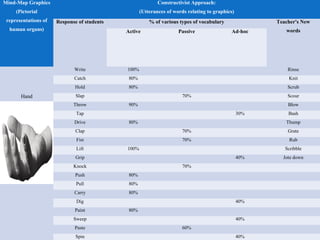
Mind-Map Graphics 
(Pictorial 
representations of 
human organs) 
Constructivist Approach: 
(Utterances of words relating to graphics) 
Response of students % of various types of vocabulary Teacher's New 
Active Passive Ad-hoc words 
Hand 
Write 100% Rinse 
Catch 80% Knit 
Hold 80% Scrub 
Slap 70% Scour 
Throw 90% Blow 
Tap 30% Bash 
Drive 80% Thump 
Clap 70% Grate 
Fist 70% Rub 
Lift 100% Scribble 
Grip 40% Jote down 
Knock 70% 
Push 80% 
Pull 80% 
Carry 80% 
Dig 40% 
Paint 80% 
Sweep 40% 
Paste 60% 
Spin 40%
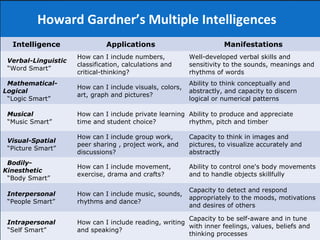
Howard Gardner’s Multiple Intelligences 
Intelligence Applications Manifestations 
Verbal-Linguistic 
“Word Smart” 
How can I include numbers, 
classification, calculations and 
critical-thinking? 
Well-developed verbal skills and 
sensitivity to the sounds, meanings and 
rhythms of words 
Mathematical- 
Logical 
“Logic Smart” 
How can I include visuals, colors, 
art, graph and pictures? 
Ability to think conceptually and 
abstractly, and capacity to discern 
logical or numerical patterns 
Musical 
“Music Smart” 
How can I include private learning 
time and student choice? 
Ability to produce and appreciate 
rhythm, pitch and timber 
Visual-Spatial 
“Picture Smart” 
How can I include group work, 
peer sharing , project work, and 
discussions? 
Capacity to think in images and 
pictures, to visualize accurately and 
abstractly 
Bodily- 
Kinesthetic 
“Body Smart” 
How can I include movement, 
exercise, drama and crafts? 
Ability to control one's body movements 
and to handle objects skillfully 
Interpersonal 
“People Smart” 
How can I include music, sounds, 
rhythms and dance? 
Capacity to detect and respond 
appropriately to the moods, motivations 
and desires of others 
Intrapersonal 
“Self Smart” 
How can I include reading, writing 
and speaking? 
Capacity to be self-aware and in tune 
with inner feelings, values, beliefs and 
thinking processes
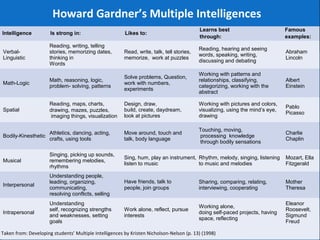
Howard Gardner’s Multiple Intelligences 
Intelligence Is strong in: Likes to: Learns best 
through: 
Famous 
examples: 
Verbal- 
Linguistic 
Reading, writing, telling 
stories, memorizing dates, 
thinking in 
Words 
Read, write, talk, tell stories, 
memorize, work at puzzles 
Reading, hearing and seeing 
words, speaking, writing, 
discussing and debating 
Abraham 
Lincoln 
Math-Logic Math, reasoning, logic, 
problem- solving, patterns 
Solve problems, Question, 
work with numbers, 
experiments 
Working with patterns and 
relationships, classifying, 
categorizing, working with the 
abstract 
Albert 
Einstein 
Spatial 
Reading, maps, charts, 
drawing, mazes, puzzles, 
imaging things, visualization 
Design, draw, 
build, create, daydream, 
look at pictures 
Working with pictures and colors, 
visualizing, using the mind’s eye, 
drawing 
Pablo 
Picasso 
Bodily-Kinesthetic Athletics, dancing, acting, 
crafts, using tools 
Move around, touch and 
talk, body language 
Touching, moving, 
processing knowledge 
through bodily sensations 
Charlie 
Chaplin 
Musical 
Singing, picking up sounds, 
remembering melodies, 
rhythms 
Sing, hum, play an instrument, 
listen to music 
Rhythm, melody, singing, listening 
to music and melodies 
Mozart, Ella 
Fitzgerald 
Interpersonal 
Understanding people, 
leading, organizing, 
communicating, 
resolving conflicts, selling 
Have friends, talk to 
people, join groups 
Sharing, comparing, relating, 
interviewing, cooperating 
Mother 
Theresa 
Intrapersonal 
Understanding 
self, recognizing strengths 
and weaknesses, setting 
goals 
Work alone, reflect, pursue 
interests 
Working alone, 
doing self-paced projects, having 
space, reflecting 
Eleanor 
Roosevelt, 
Sigmund 
Freud 
Taken from: Developing students’ Multiple Intelligences by Kristen Nicholson-Nelson (p. 13) (1998)
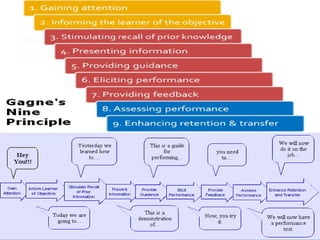
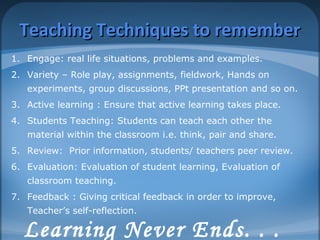
TTeeaacchhiinngg TTeecchhnniiqquueess ttoo rreemmeemmbbeerr 
1. Engage: real life situations, problems and examples. 
2. Variety – Role play, assignments, fieldwork, Hands on 
experiments, group discussions, PPt presentation and so on. 
3. Active learning : Ensure that active learning takes place. 
4. Students Teaching: Students can teach each other the 
material within the classroom i.e. think, pair and share. 
5. Review: Prior information, students/ teachers peer review. 
6. Evaluation: Evaluation of student learning, Evaluation of 
classroom teaching. 
7. Feedback : Giving critical feedback in order to improve, 
Teacher’s self-reflection. 
Learning Never Ends. . .
References: 
Thanks to all 
1.Gardner, Howard. Frames of Minds: The Theory of Multiple Intelligences. New 
York: Basic Books, 1983. 
2.Hills, J.R. Assessment. from http://sites.google.com/site/uvuedpsych/ files 
/assessment _ packet_highered.doc. 
3.Clark, D. R. (2004).The Art and Science of Leadership. from 
http://www.nwlink.com/~donclark/hrd/learning/id/nine_step_id.html 
My Sincere thanks to Heavenly Father 
Teacher The Greatest 
Innovator. . .

Innovative teaching methodologies

  • 1.
    INNOVATIVE TEACHING METHODOLOGIES Presentation by R. EDIN BROW 9841993332, edinbrow@gmail.com
  • 2.
    WWhhaatt RReeccrruuiitteerrss LLooookkFFoorr Industry Requirements ◦ Leadership ◦ Analytical Skills ◦ Problem Solving Skills ◦ Teamwork ◦ Communication Skills ◦ Creativity ◦ Passion/Interest in Industry ◦ Integrity Student’s Role • Enrich vocabulary for effective communication. • Acquire LSRW skills through Role play, Situational Dialogue, Debate, Seminars, Group discussions , Oral Presentations. Teacher’s Role ◦ Teacher should acts as an advisor, organizer, facilitator, guide, motivator, evaluator, and so on.
  • 3.
    CCoonnssttrruuccttiivviisstt AApppprrooaacchh Brader-Araje and M.G. Jones expound constructivism as "the idea that development of understanding requires the learner to actively engage in meaning-making situations.”  It is creativity which generates competence in the learner to create, to invent, to put forward original and useful ideas in context of varied situations.  In a constructivist classroom, the teacher as a facilitator shows some objects to learner, or draws the fetching pictures of certain things and urges them to apply their brains, imagination, memory and wit to unfold various names (synonyms) of that object.
  • 4.
    MMiinndd--MMaappppiinngg TThheeoorryy Prof. Tony Buzan of England pioneered the effective use of Mind-Mapping Theory.  This theory entails the effective use of task-based pictorial representations and attractive graphics of certain objects.  The Mind-Map is the manifestation of the brilliance of thinking.  Mind-map graphics renewed and intensified the interest of the students in the classroom, and they contemplated and pressed their brains to evoke, to recall, to think out various synonyms of the pictorial objects.
  • 5.
    Mind-Map Graphics (Pictorial representations of human organs) Constructivist Approach: (Utterances of words relating to graphics) Response of students % of various types of vocabulary Teacher's New Active Passive Ad-hoc words Hand Write 100% Rinse Catch 80% Knit Hold 80% Scrub Slap 70% Scour Throw 90% Blow Tap 30% Bash Drive 80% Thump Clap 70% Grate Fist 70% Rub Lift 100% Scribble Grip 40% Jote down Knock 70% Push 80% Pull 80% Carry 80% Dig 40% Paint 80% Sweep 40% Paste 60% Spin 40%
  • 8.
    Howard Gardner’s MultipleIntelligences Intelligence Applications Manifestations Verbal-Linguistic “Word Smart” How can I include numbers, classification, calculations and critical-thinking? Well-developed verbal skills and sensitivity to the sounds, meanings and rhythms of words Mathematical- Logical “Logic Smart” How can I include visuals, colors, art, graph and pictures? Ability to think conceptually and abstractly, and capacity to discern logical or numerical patterns Musical “Music Smart” How can I include private learning time and student choice? Ability to produce and appreciate rhythm, pitch and timber Visual-Spatial “Picture Smart” How can I include group work, peer sharing , project work, and discussions? Capacity to think in images and pictures, to visualize accurately and abstractly Bodily- Kinesthetic “Body Smart” How can I include movement, exercise, drama and crafts? Ability to control one's body movements and to handle objects skillfully Interpersonal “People Smart” How can I include music, sounds, rhythms and dance? Capacity to detect and respond appropriately to the moods, motivations and desires of others Intrapersonal “Self Smart” How can I include reading, writing and speaking? Capacity to be self-aware and in tune with inner feelings, values, beliefs and thinking processes
  • 9.
    Howard Gardner’s MultipleIntelligences Intelligence Is strong in: Likes to: Learns best through: Famous examples: Verbal- Linguistic Reading, writing, telling stories, memorizing dates, thinking in Words Read, write, talk, tell stories, memorize, work at puzzles Reading, hearing and seeing words, speaking, writing, discussing and debating Abraham Lincoln Math-Logic Math, reasoning, logic, problem- solving, patterns Solve problems, Question, work with numbers, experiments Working with patterns and relationships, classifying, categorizing, working with the abstract Albert Einstein Spatial Reading, maps, charts, drawing, mazes, puzzles, imaging things, visualization Design, draw, build, create, daydream, look at pictures Working with pictures and colors, visualizing, using the mind’s eye, drawing Pablo Picasso Bodily-Kinesthetic Athletics, dancing, acting, crafts, using tools Move around, touch and talk, body language Touching, moving, processing knowledge through bodily sensations Charlie Chaplin Musical Singing, picking up sounds, remembering melodies, rhythms Sing, hum, play an instrument, listen to music Rhythm, melody, singing, listening to music and melodies Mozart, Ella Fitzgerald Interpersonal Understanding people, leading, organizing, communicating, resolving conflicts, selling Have friends, talk to people, join groups Sharing, comparing, relating, interviewing, cooperating Mother Theresa Intrapersonal Understanding self, recognizing strengths and weaknesses, setting goals Work alone, reflect, pursue interests Working alone, doing self-paced projects, having space, reflecting Eleanor Roosevelt, Sigmund Freud Taken from: Developing students’ Multiple Intelligences by Kristen Nicholson-Nelson (p. 13) (1998)
  • 10.
    TTeeaacchhiinngg TTeecchhnniiqquueess ttoorreemmeemmbbeerr 1. Engage: real life situations, problems and examples. 2. Variety – Role play, assignments, fieldwork, Hands on experiments, group discussions, PPt presentation and so on. 3. Active learning : Ensure that active learning takes place. 4. Students Teaching: Students can teach each other the material within the classroom i.e. think, pair and share. 5. Review: Prior information, students/ teachers peer review. 6. Evaluation: Evaluation of student learning, Evaluation of classroom teaching. 7. Feedback : Giving critical feedback in order to improve, Teacher’s self-reflection. Learning Never Ends. . .
  • 11.
    References: Thanks toall 1.Gardner, Howard. Frames of Minds: The Theory of Multiple Intelligences. New York: Basic Books, 1983. 2.Hills, J.R. Assessment. from http://sites.google.com/site/uvuedpsych/ files /assessment _ packet_highered.doc. 3.Clark, D. R. (2004).The Art and Science of Leadership. from http://www.nwlink.com/~donclark/hrd/learning/id/nine_step_id.html My Sincere thanks to Heavenly Father Teacher The Greatest Innovator. . .