Teaching Aptitude
Mr. Tarun Rawat
Department of Higher Education, Bhopal
Madhya Pradesh, India
Concept of Teaching
Teaching is to cause the pupil to learn and acquire the
desired knowledge, skills and also desirable ways of living
in the society. It is a process in which learner, teacher,
curriculum and other variables are organized in a
systematic and psychological way to attain some pre-
determined goals.
Teaching is one of the instruments of education and
is a special function is to impart understanding and skill.
The main function of teaching is to make learning
effective. So, teaching and learning are very closely
related.
• Teaching is both Art and Science
• It is Dynamic & Diverse in Application.
Level of Teaching
We can define teaching according to the following three view points:
(a) Authoritarian
(b) Democratic
(c) Liassez faire
(a) Authoritarian:-
• Teaching is an activity of memory level only
• This teaching does not develop thoughts and attitude in the students.
• Is known as thoughtless teaching
• This teaching is teachers centric criticism of the teachers.
(b) Democratic teaching:-
• Teaching is done at understanding level.
• Memory level teaching is the prerequisite (concept) is first memorized and then understand
• Such teaching is known as thoughtful teaching.
• According to this point of view, teaching is an interactive process, primarily involving classroom talks
which takes place between teachers and student.
• Here students can ask questions to teachers.
(c) Laissez Faire Attitude:-
• It is more difficult then memory level and understanding level of teaching.
• Memory level and understanding level teaching are must for the reflective level of teaching.
• It is highly thoughtful activity.
• In this level both students and teachers are participants.
• This level produces insights.
Objectives of teaching are as follows:
• Desired changes in Learners.
• To build behavior, attitude and conduct.
• Acquisition of knowledge.
• To make student able to apply his knowledge.
• Formation of belief.
• To avail an efficient member for society.
Keys
• Attitude: It involves mind's tendency to certain
ideas, values, people, system, institutions.
• Behaviour: It relates to the actual
expression of feelings, action or inaction orally or
through body language.
• Conduct: the manner in which a person behaves.
Learning
• “Learning is the relatively permanent change in a person's
knowledge or behavior due to experience.
• Crow and Crow “Learning involves the acquisition of habits,
knowledge and attitudes.
• Skinner also includes in learning both acquisition and
retention.
• Transfer in learning is feasible. Material, things and subject
matter learned in one situation may facilitate learning in the
other situation
CONCEPT OF LEARNING
• Learning is a key concept in human behavior. It is the
axiom of all teaching and learning. It influences the
acquisition of information, attitudes and beliefs, goals,
achievements and failures, behavior, both adaptive and
maladaptive, and even personality traits.
Definition of learning should have three elements:
• Learning is a change in behavior.
• This change takes place through experience or practice.
Changes due to growth cannot be considered as
learning.
• The change in behavior must be relatively permanent
that occurs as a result of experience and practice., i.e.
the learned response must last for a long time.
Characteristics of Learning
• Modification of Behavior
• Learning is Purposive: learning is a goal-directed
activity.
• Learning is a continuous Process
• Learning is a Universal Phenomenon
• Learning is Progressive and Developmental
• Learning is Transferable
• Learning includes adjustment
TYPES OF LEARNING
• Conditioning: Classical conditioning, Operant
learning.
• Motor Learning: -It is also labeled as psychomotor
learning or skill learning. This includes all kinds of
things, people learn to do, such as eating with spoon
or fork, swimming, typewriting, drives a car etc.
Learning of such skills depends upon maturity,
sensory-motor co-ordination and integration of the
responses.
• Discrimination Learning: Differentiation between
mother and a stranger, taste of learning. Situations of
discrimination learning may be as incidental learning.
Cont…………
• Concept Learning: It is more specifically meant for human
subjects. Learning a concept is learning to react to some
common property/properties in a group of objects. In
children, concept learning starts at a very young age. At a
very early stage they try to learn about various stimuli of
the environment and attach verbal labels for them, such as
house, wood, fruit, man, girl etc.
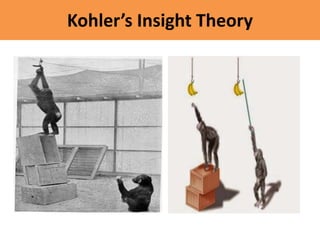
• Problem – Solving: This is highest level of learning. In
problem solving learning, a problem is given to the
organism, which discovers some of its relationship with its
environment by some sort of manipulation. Gestalt
Psychologists have made a series of experiments in this
direction.
Thorndike’s Trial & Error Theory
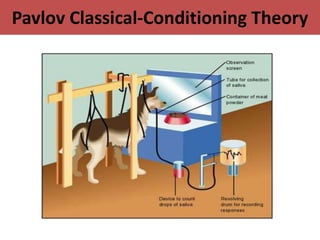
Pavlov Classical-Conditioning Theory
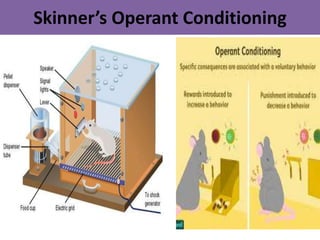
Skinner’s Operant Conditioning
Kohler’s Insight Theory
Learner’s characteristics
• Personal
• Academic
• Social and emotional, and
• Cognitive
Bloom’s Taxonomy
Bloom’s Taxonomy is a set of three hierarchical
models used to classify educational learning
objectives into levels of complexity & specificity. It is a
hierarchical ordering of cognitive skills that can help
teachers teach & students learn.
It was developed to provide a common language
for teachers to discuss & exchange learning and
assessment methods.
1956 (Bloom’s classification)
Benjamin Bloom developed the structure of different learning
domain in 1956.
Revision of Bloom’s Taxonomy with title ”A Taxonomy for
Taxonomy for Teaching, Learning and Assessment”. This title draws
attention away from the somewhat static notion of “educational
objectives”
•The verb generally refers to [actions associated with] the
intended cognitive process.
•The object generally describes the knowledge students are
expected to acquire or construct.
2001 (Revision of Bloom’s Taxonomy)
Bloom’s Classification of Learning Domain
1. Cognitive
(Intelligence/Thinking/Reasoning/Problem
solving) or mental skills (knowledge)
2. Affective (Emotions/Feeling/Values) or (attitude)
3. Sensory (Conative/Psychomotor) or manual or
physical skills.
Cognitive Domain
1956 Benjamin Bloom 2001 Revised (Lorin Anderson &
David Krathwohl)
Evaluation Create
Synthesis Evaluation
Analysis Analyze
application Apply
Comprehensive Understand
Knowledge Remember
The 6 Levels of Cognitive Domain
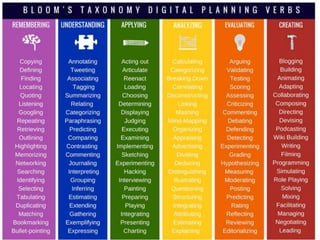
1. The first level of Bloom’s Taxonomy is to Remember.
Memorize a poem, recall state capitals, remember math
formulas.
2. The second level of Bloom’s Taxonomy is to
Understand.
Illustrate the difference between a rectangle and square,
Solution with reason.
3. The third level of Bloom’s Taxonomy is to Apply.
use a formula to solve a problem, select a design to meet
a purpose, Application in the Exams.
Cont……..
4. The fourth level of Bloom’s Taxonomy is to
Analyze.
Explain how the steps of the scientific process work
together, identify why a machine isn’t working.
5. The fifth level of Bloom’s Taxonomy is to Evaluate.
Make a judgment regarding an ethical dilemma.
6. The sixth and final level of Bloom’s taxonomy is to
Create.
Design a new solution to an ‘old’ problem that
acknowledges the previous failures, write a poem
based on a given theme and tone.
Look an Overview
https://youtu.be/fqgTBwElPzU
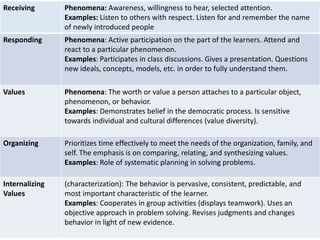
Affective Domain
Receiving Phenomena: Awareness, willingness to hear, selected attention.
Examples: Listen to others with respect. Listen for and remember the name
of newly introduced people
Responding Phenomena: Active participation on the part of the learners. Attend and
react to a particular phenomenon.
Examples: Participates in class discussions. Gives a presentation. Questions
new ideals, concepts, models, etc. in order to fully understand them.
Values Phenomena: The worth or value a person attaches to a particular object,
phenomenon, or behavior.
Examples: Demonstrates belief in the democratic process. Is sensitive
towards individual and cultural differences (value diversity).
Organizing Prioritizes time effectively to meet the needs of the organization, family, and
self. The emphasis is on comparing, relating, and synthesizing values.
Examples: Role of systematic planning in solving problems.
Internalizing
Values
(characterization): The behavior is pervasive, consistent, predictable, and
most important characteristic of the learner.
Examples: Cooperates in group activities (displays teamwork). Uses an
objective approach in problem solving. Revises judgments and changes
behavior in light of new evidence.
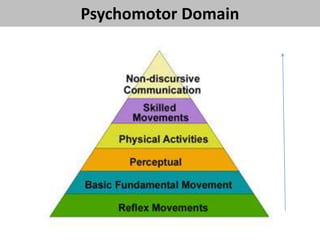
Psychomotor Domain
Thank You

Teaching aptitude.pptx

  • 1.
    Teaching Aptitude Mr. TarunRawat Department of Higher Education, Bhopal Madhya Pradesh, India
  • 2.
    Concept of Teaching Teachingis to cause the pupil to learn and acquire the desired knowledge, skills and also desirable ways of living in the society. It is a process in which learner, teacher, curriculum and other variables are organized in a systematic and psychological way to attain some pre- determined goals. Teaching is one of the instruments of education and is a special function is to impart understanding and skill. The main function of teaching is to make learning effective. So, teaching and learning are very closely related. • Teaching is both Art and Science • It is Dynamic & Diverse in Application.
  • 3.
    Level of Teaching Wecan define teaching according to the following three view points: (a) Authoritarian (b) Democratic (c) Liassez faire (a) Authoritarian:- • Teaching is an activity of memory level only • This teaching does not develop thoughts and attitude in the students. • Is known as thoughtless teaching • This teaching is teachers centric criticism of the teachers. (b) Democratic teaching:- • Teaching is done at understanding level. • Memory level teaching is the prerequisite (concept) is first memorized and then understand • Such teaching is known as thoughtful teaching. • According to this point of view, teaching is an interactive process, primarily involving classroom talks which takes place between teachers and student. • Here students can ask questions to teachers. (c) Laissez Faire Attitude:- • It is more difficult then memory level and understanding level of teaching. • Memory level and understanding level teaching are must for the reflective level of teaching. • It is highly thoughtful activity. • In this level both students and teachers are participants. • This level produces insights.
  • 4.
    Objectives of teachingare as follows: • Desired changes in Learners. • To build behavior, attitude and conduct. • Acquisition of knowledge. • To make student able to apply his knowledge. • Formation of belief. • To avail an efficient member for society.
  • 5.
    Keys • Attitude: Itinvolves mind's tendency to certain ideas, values, people, system, institutions. • Behaviour: It relates to the actual expression of feelings, action or inaction orally or through body language. • Conduct: the manner in which a person behaves.
  • 6.
    Learning • “Learning isthe relatively permanent change in a person's knowledge or behavior due to experience. • Crow and Crow “Learning involves the acquisition of habits, knowledge and attitudes. • Skinner also includes in learning both acquisition and retention. • Transfer in learning is feasible. Material, things and subject matter learned in one situation may facilitate learning in the other situation
  • 7.
    CONCEPT OF LEARNING •Learning is a key concept in human behavior. It is the axiom of all teaching and learning. It influences the acquisition of information, attitudes and beliefs, goals, achievements and failures, behavior, both adaptive and maladaptive, and even personality traits. Definition of learning should have three elements: • Learning is a change in behavior. • This change takes place through experience or practice. Changes due to growth cannot be considered as learning. • The change in behavior must be relatively permanent that occurs as a result of experience and practice., i.e. the learned response must last for a long time.
  • 8.
    Characteristics of Learning •Modification of Behavior • Learning is Purposive: learning is a goal-directed activity. • Learning is a continuous Process • Learning is a Universal Phenomenon • Learning is Progressive and Developmental • Learning is Transferable • Learning includes adjustment
  • 9.
    TYPES OF LEARNING •Conditioning: Classical conditioning, Operant learning. • Motor Learning: -It is also labeled as psychomotor learning or skill learning. This includes all kinds of things, people learn to do, such as eating with spoon or fork, swimming, typewriting, drives a car etc. Learning of such skills depends upon maturity, sensory-motor co-ordination and integration of the responses. • Discrimination Learning: Differentiation between mother and a stranger, taste of learning. Situations of discrimination learning may be as incidental learning.
  • 10.
    Cont………… • Concept Learning:It is more specifically meant for human subjects. Learning a concept is learning to react to some common property/properties in a group of objects. In children, concept learning starts at a very young age. At a very early stage they try to learn about various stimuli of the environment and attach verbal labels for them, such as house, wood, fruit, man, girl etc. • Problem – Solving: This is highest level of learning. In problem solving learning, a problem is given to the organism, which discovers some of its relationship with its environment by some sort of manipulation. Gestalt Psychologists have made a series of experiments in this direction.
  • 11.
  • 12.
  • 13.
  • 14.
  • 15.
    Learner’s characteristics • Personal •Academic • Social and emotional, and • Cognitive
  • 16.
    Bloom’s Taxonomy Bloom’s Taxonomyis a set of three hierarchical models used to classify educational learning objectives into levels of complexity & specificity. It is a hierarchical ordering of cognitive skills that can help teachers teach & students learn. It was developed to provide a common language for teachers to discuss & exchange learning and assessment methods.
  • 17.
    1956 (Bloom’s classification) BenjaminBloom developed the structure of different learning domain in 1956. Revision of Bloom’s Taxonomy with title ”A Taxonomy for Taxonomy for Teaching, Learning and Assessment”. This title draws attention away from the somewhat static notion of “educational objectives” •The verb generally refers to [actions associated with] the intended cognitive process. •The object generally describes the knowledge students are expected to acquire or construct. 2001 (Revision of Bloom’s Taxonomy)
  • 18.
    Bloom’s Classification ofLearning Domain 1. Cognitive (Intelligence/Thinking/Reasoning/Problem solving) or mental skills (knowledge) 2. Affective (Emotions/Feeling/Values) or (attitude) 3. Sensory (Conative/Psychomotor) or manual or physical skills.
  • 19.
    Cognitive Domain 1956 BenjaminBloom 2001 Revised (Lorin Anderson & David Krathwohl) Evaluation Create Synthesis Evaluation Analysis Analyze application Apply Comprehensive Understand Knowledge Remember
  • 21.
    The 6 Levelsof Cognitive Domain 1. The first level of Bloom’s Taxonomy is to Remember. Memorize a poem, recall state capitals, remember math formulas. 2. The second level of Bloom’s Taxonomy is to Understand. Illustrate the difference between a rectangle and square, Solution with reason. 3. The third level of Bloom’s Taxonomy is to Apply. use a formula to solve a problem, select a design to meet a purpose, Application in the Exams.
  • 22.
    Cont…….. 4. The fourthlevel of Bloom’s Taxonomy is to Analyze. Explain how the steps of the scientific process work together, identify why a machine isn’t working. 5. The fifth level of Bloom’s Taxonomy is to Evaluate. Make a judgment regarding an ethical dilemma. 6. The sixth and final level of Bloom’s taxonomy is to Create. Design a new solution to an ‘old’ problem that acknowledges the previous failures, write a poem based on a given theme and tone.
  • 23.
  • 24.
  • 25.
    Receiving Phenomena: Awareness,willingness to hear, selected attention. Examples: Listen to others with respect. Listen for and remember the name of newly introduced people Responding Phenomena: Active participation on the part of the learners. Attend and react to a particular phenomenon. Examples: Participates in class discussions. Gives a presentation. Questions new ideals, concepts, models, etc. in order to fully understand them. Values Phenomena: The worth or value a person attaches to a particular object, phenomenon, or behavior. Examples: Demonstrates belief in the democratic process. Is sensitive towards individual and cultural differences (value diversity). Organizing Prioritizes time effectively to meet the needs of the organization, family, and self. The emphasis is on comparing, relating, and synthesizing values. Examples: Role of systematic planning in solving problems. Internalizing Values (characterization): The behavior is pervasive, consistent, predictable, and most important characteristic of the learner. Examples: Cooperates in group activities (displays teamwork). Uses an objective approach in problem solving. Revises judgments and changes behavior in light of new evidence.
  • 26.
  • 27.