Introduction to Genetic Algorithms 1
Introduction to
Genetic Algorithms
Introduction to Genetic Algorithms 2
Genetic Algorithms (GA)
OVERVIEW
A class of probabilistic optimization algorithms
Inspired by the biological evolution process
Uses concepts of “Natural Selection” and
“Genetic Inheritance” (Darwin 1859)
Originally developed by John Holland (1975)
Introduction to Genetic Algorithms 3
GA overview (cont)
Particularly well suited for hard problems where
little is known about the underlying search space
Widely-used in business, science and engineering
Introduction to Genetic Algorithms 4
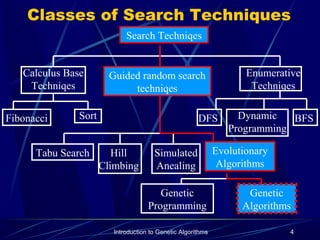
Classes of Search Techniques
Search Techniqes
Calculus Base
Techniqes
Guided random search
techniqes
Enumerative
Techniqes
BFSDFS Dynamic
Programming
Tabu Search Hill
Climbing
Simulated
Anealing
Evolutionary
Algorithms
Genetic
Programming
Genetic
Algorithms
Fibonacci Sort
Introduction to Genetic Algorithms 5
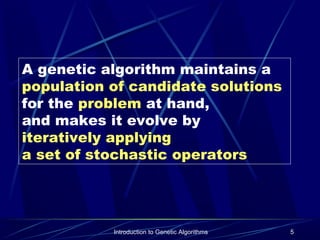
A genetic algorithm maintains a
population of candidate solutions
for the problem at hand,
and makes it evolve by
iteratively applying
a set of stochastic operators
Introduction to Genetic Algorithms 6
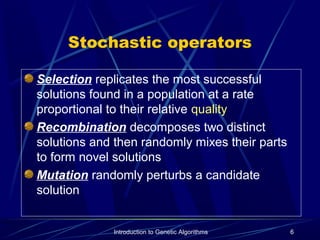
Stochastic operators
Selection replicates the most successful
solutions found in a population at a rate
proportional to their relative quality
Recombination decomposes two distinct
solutions and then randomly mixes their parts
to form novel solutions
Mutation randomly perturbs a candidate
solution
Introduction to Genetic Algorithms 7
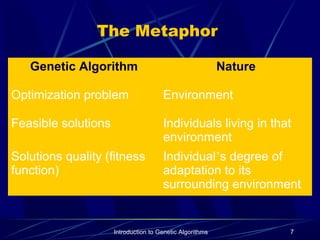
The Metaphor
Genetic Algorithm Nature
Optimization problem Environment
Feasible solutions Individuals living in that
environment
Solutions quality (fitness
function)
Individual’s degree of
adaptation to its
surrounding environment
Introduction to Genetic Algorithms 8
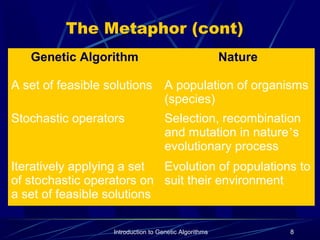
The Metaphor (cont)
Genetic Algorithm Nature
A set of feasible solutions A population of organisms
(species)
Stochastic operators Selection, recombination
and mutation in nature’s
evolutionary process
Iteratively applying a set
of stochastic operators on
a set of feasible solutions
Evolution of populations to
suit their environment
Introduction to Genetic Algorithms 9
The Metaphor (cont)
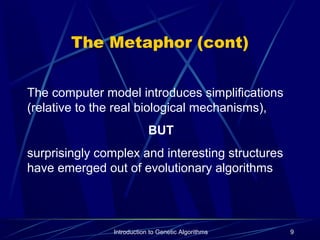
The computer model introduces simplifications
(relative to the real biological mechanisms),
BUT
surprisingly complex and interesting structures
have emerged out of evolutionary algorithms
Introduction to Genetic Algorithms 10
Simple Genetic Algorithm
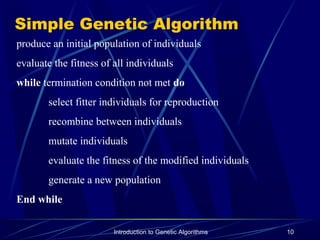
produce an initial population of individuals
evaluate the fitness of all individuals
while termination condition not met do
select fitter individuals for reproduction
recombine between individuals
mutate individuals
evaluate the fitness of the modified individuals
generate a new population
End while
Introduction to Genetic Algorithms 11
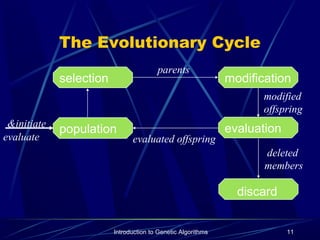
The Evolutionary Cycle
selection
population evaluation
modification
discard
deleted
members
parents
modified
offspring
evaluated offspring
initiate&
evaluate
Introduction to Genetic Algorithms 12
Example:
the MAXONE problem
Suppose we want to maximize the number of
ones in a string of l binary digits
Is it a trivial problem?
It may seem so because we know the answer in
advance
However, we can think of it as maximizing the
number of correct answers, each encoded by 1,
to l yes/no difficult questions`
Introduction to Genetic Algorithms 13
Example (cont)
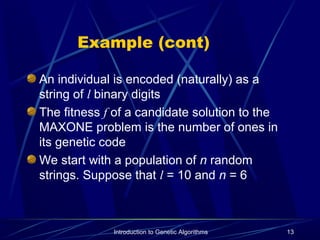
An individual is encoded (naturally) as a
string of l binary digits
The fitness f of a candidate solution to the
MAXONE problem is the number of ones in
its genetic code
We start with a population of n random
strings. Suppose that l = 10 and n = 6
Introduction to Genetic Algorithms 14
Example (initialization)
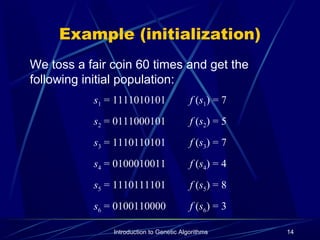
We toss a fair coin 60 times and get the
following initial population:
s1 = 1111010101 f (s1) = 7
s2 = 0111000101 f (s2) = 5
s3 = 1110110101 f (s3) = 7
s4 = 0100010011 f (s4) = 4
s5 = 1110111101 f (s5) = 8
s6 = 0100110000 f (s6) = 3
Introduction to Genetic Algorithms 15
Example (selection1)
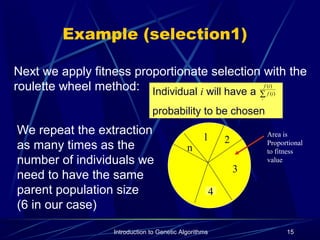
Next we apply fitness proportionate selection with the
roulette wheel method:
21
n
3
Area is
Proportional
to fitness
value
Individual i will have a
probability to be chosen
∑i
if
if
)(
)(
4
We repeat the extraction
as many times as the
number of individuals we
need to have the same
parent population size
(6 in our case)
Introduction to Genetic Algorithms 16
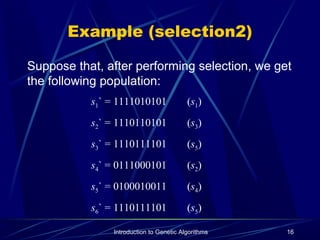
Example (selection2)
Suppose that, after performing selection, we get
the following population:
s1` = 1111010101 (s1)
s2` = 1110110101 (s3)
s3` = 1110111101 (s5)
s4` = 0111000101 (s2)
s5` = 0100010011 (s4)
s6` = 1110111101 (s5)
Introduction to Genetic Algorithms 17
Example (crossover1)
Next we mate strings for crossover. For each
couple we decide according to crossover
probability (for instance 0.6) whether to actually
perform crossover or not
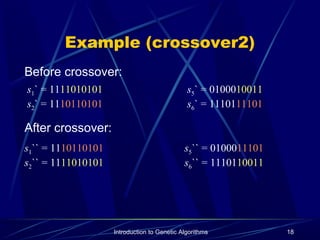
Suppose that we decide to actually perform
crossover only for couples (s1`, s2`) and (s5`, s6`).
For each couple, we randomly extract a
crossover point, for instance 2 for the first and 5
for the second
Introduction to Genetic Algorithms 18
Example (crossover2)
s1` = 1111010101
s2` = 1110110101
s5` = 0100010011
s6` = 1110111101
Before crossover:
After crossover:
s1`` = 1110110101
s2`` = 1111010101
s5`` = 0100011101
s6`` = 1110110011
Introduction to Genetic Algorithms 19
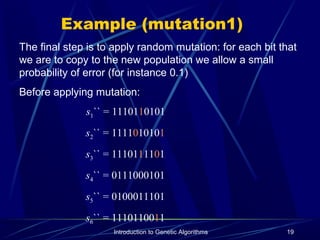
Example (mutation1)
The final step is to apply random mutation: for each bit that
we are to copy to the new population we allow a small
probability of error (for instance 0.1)
Before applying mutation:
s1`` = 1110110101
s2`` = 1111010101
s3`` = 1110111101
s4`` = 0111000101
s5`` = 0100011101
s6`` = 1110110011
Introduction to Genetic Algorithms 20
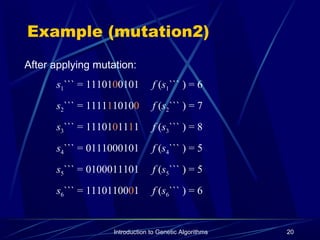
Example (mutation2)
After applying mutation:
s1``` = 1110100101 f (s1``` ) = 6
s2``` = 1111110100 f (s2``` ) = 7
s3``` = 1110101111 f (s3``` ) = 8
s4``` = 0111000101 f (s4``` ) = 5
s5``` = 0100011101 f (s5``` ) = 5
s6``` = 1110110001 f (s6``` ) = 6
Introduction to Genetic Algorithms 21
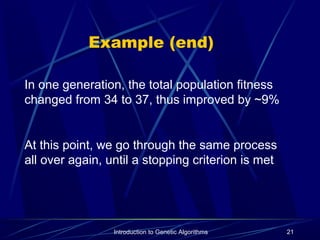
Example (end)
In one generation, the total population fitness
changed from 34 to 37, thus improved by ~9%
At this point, we go through the same process
all over again, until a stopping criterion is met
Introduction to Genetic Algorithms 22
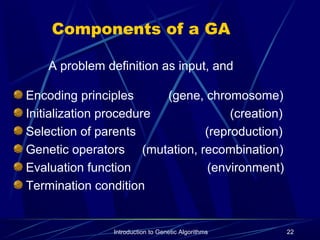
Components of a GA
A problem definition as input, and
Encoding principles (gene, chromosome)
Initialization procedure (creation)
Selection of parents (reproduction)
Genetic operators (mutation, recombination)
Evaluation function (environment)
Termination condition
Introduction to Genetic Algorithms 23
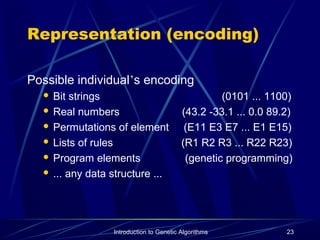
Representation (encoding)
Possible individual’s encoding
 Bit strings (0101 ... 1100)
 Real numbers (43.2 -33.1 ... 0.0 89.2)
 Permutations of element (E11 E3 E7 ... E1 E15)
 Lists of rules (R1 R2 R3 ... R22 R23)
 Program elements (genetic programming)
 ... any data structure ...
Introduction to Genetic Algorithms 24
Representation (cont)
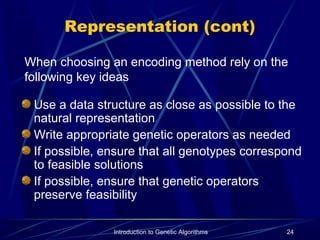
When choosing an encoding method rely on the
following key ideas
Use a data structure as close as possible to the
natural representation
Write appropriate genetic operators as needed
If possible, ensure that all genotypes correspond
to feasible solutions
If possible, ensure that genetic operators
preserve feasibility
Introduction to Genetic Algorithms 25
Initialization
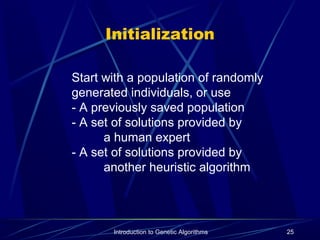
Start with a population of randomly
generated individuals, or use
- A previously saved population
- A set of solutions provided by
a human expert
- A set of solutions provided by
another heuristic algorithm
Introduction to Genetic Algorithms 26
Selection
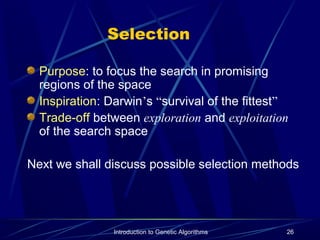
Purpose: to focus the search in promising
regions of the space
Inspiration: Darwin’s “survival of the fittest”
Trade-off between exploration and exploitation
of the search space
Next we shall discuss possible selection methods
Introduction to Genetic Algorithms 27
Fitness Proportionate Selection
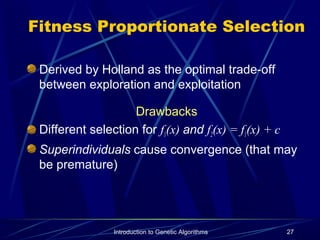
Derived by Holland as the optimal trade-off
between exploration and exploitation
Drawbacks
Different selection for f1(x) and f2(x) = f1(x) + c
Superindividuals cause convergence (that may
be premature)
Introduction to Genetic Algorithms 28
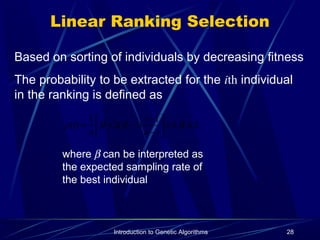
Linear Ranking Selection
Based on sorting of individuals by decreasing fitness
The probability to be extracted for the ith individual
in the ranking is defined as
21,
1
1
)1(2
1
)( ≤≤





−
−
−−= βββ
n
i
n
ip
where β can be interpreted as
the expected sampling rate of
the best individual
Introduction to Genetic Algorithms 29
Local Tournament Selection
Extracts k individuals from the population
with uniform probability (without re-insertion)
and makes them play a “tournament”,
where the probability for an individual to win
is generally proportional to its fitness
Selection pressure is directly proportional to
the number k of participants
Introduction to Genetic Algorithms 30
Recombination (Crossover)
* Enables the evolutionary process
to move toward promising
regions of the search space
* Matches good parents’ sub-solutions
to construct better offspring
Introduction to Genetic Algorithms 31
Mutation
Purpose: to simulate the effect of errors that
happen with low probability during duplication
Results:
- Movement in the search space
- Restoration of lost information to the population
Introduction to Genetic Algorithms 32
Evaluation (fitness function)
Solution is only as good as the evaluation
function; choosing a good one is often the
hardest part
Similar-encoded solutions should have a
similar fitness
Introduction to Genetic Algorithms 33
Termination condition
Examples:
A pre-determined number of generations or time
has elapsed
A satisfactory solution has been achieved
No improvement in solution quality has taken
place for a pre-determined number of generations

Introduction to Genetic algorithms

  • 1.
    Introduction to GeneticAlgorithms 1 Introduction to Genetic Algorithms
  • 2.
    Introduction to GeneticAlgorithms 2 Genetic Algorithms (GA) OVERVIEW A class of probabilistic optimization algorithms Inspired by the biological evolution process Uses concepts of “Natural Selection” and “Genetic Inheritance” (Darwin 1859) Originally developed by John Holland (1975)
  • 3.
    Introduction to GeneticAlgorithms 3 GA overview (cont) Particularly well suited for hard problems where little is known about the underlying search space Widely-used in business, science and engineering
  • 4.
    Introduction to GeneticAlgorithms 4 Classes of Search Techniques Search Techniqes Calculus Base Techniqes Guided random search techniqes Enumerative Techniqes BFSDFS Dynamic Programming Tabu Search Hill Climbing Simulated Anealing Evolutionary Algorithms Genetic Programming Genetic Algorithms Fibonacci Sort
  • 5.
    Introduction to GeneticAlgorithms 5 A genetic algorithm maintains a population of candidate solutions for the problem at hand, and makes it evolve by iteratively applying a set of stochastic operators
  • 6.
    Introduction to GeneticAlgorithms 6 Stochastic operators Selection replicates the most successful solutions found in a population at a rate proportional to their relative quality Recombination decomposes two distinct solutions and then randomly mixes their parts to form novel solutions Mutation randomly perturbs a candidate solution
  • 7.
    Introduction to GeneticAlgorithms 7 The Metaphor Genetic Algorithm Nature Optimization problem Environment Feasible solutions Individuals living in that environment Solutions quality (fitness function) Individual’s degree of adaptation to its surrounding environment
  • 8.
    Introduction to GeneticAlgorithms 8 The Metaphor (cont) Genetic Algorithm Nature A set of feasible solutions A population of organisms (species) Stochastic operators Selection, recombination and mutation in nature’s evolutionary process Iteratively applying a set of stochastic operators on a set of feasible solutions Evolution of populations to suit their environment
  • 9.
    Introduction to GeneticAlgorithms 9 The Metaphor (cont) The computer model introduces simplifications (relative to the real biological mechanisms), BUT surprisingly complex and interesting structures have emerged out of evolutionary algorithms
  • 10.
    Introduction to GeneticAlgorithms 10 Simple Genetic Algorithm produce an initial population of individuals evaluate the fitness of all individuals while termination condition not met do select fitter individuals for reproduction recombine between individuals mutate individuals evaluate the fitness of the modified individuals generate a new population End while
  • 11.
    Introduction to GeneticAlgorithms 11 The Evolutionary Cycle selection population evaluation modification discard deleted members parents modified offspring evaluated offspring initiate& evaluate
  • 12.
    Introduction to GeneticAlgorithms 12 Example: the MAXONE problem Suppose we want to maximize the number of ones in a string of l binary digits Is it a trivial problem? It may seem so because we know the answer in advance However, we can think of it as maximizing the number of correct answers, each encoded by 1, to l yes/no difficult questions`
  • 13.
    Introduction to GeneticAlgorithms 13 Example (cont) An individual is encoded (naturally) as a string of l binary digits The fitness f of a candidate solution to the MAXONE problem is the number of ones in its genetic code We start with a population of n random strings. Suppose that l = 10 and n = 6
  • 14.
    Introduction to GeneticAlgorithms 14 Example (initialization) We toss a fair coin 60 times and get the following initial population: s1 = 1111010101 f (s1) = 7 s2 = 0111000101 f (s2) = 5 s3 = 1110110101 f (s3) = 7 s4 = 0100010011 f (s4) = 4 s5 = 1110111101 f (s5) = 8 s6 = 0100110000 f (s6) = 3
  • 15.
    Introduction to GeneticAlgorithms 15 Example (selection1) Next we apply fitness proportionate selection with the roulette wheel method: 21 n 3 Area is Proportional to fitness value Individual i will have a probability to be chosen ∑i if if )( )( 4 We repeat the extraction as many times as the number of individuals we need to have the same parent population size (6 in our case)
  • 16.
    Introduction to GeneticAlgorithms 16 Example (selection2) Suppose that, after performing selection, we get the following population: s1` = 1111010101 (s1) s2` = 1110110101 (s3) s3` = 1110111101 (s5) s4` = 0111000101 (s2) s5` = 0100010011 (s4) s6` = 1110111101 (s5)
  • 17.
    Introduction to GeneticAlgorithms 17 Example (crossover1) Next we mate strings for crossover. For each couple we decide according to crossover probability (for instance 0.6) whether to actually perform crossover or not Suppose that we decide to actually perform crossover only for couples (s1`, s2`) and (s5`, s6`). For each couple, we randomly extract a crossover point, for instance 2 for the first and 5 for the second
  • 18.
    Introduction to GeneticAlgorithms 18 Example (crossover2) s1` = 1111010101 s2` = 1110110101 s5` = 0100010011 s6` = 1110111101 Before crossover: After crossover: s1`` = 1110110101 s2`` = 1111010101 s5`` = 0100011101 s6`` = 1110110011
  • 19.
    Introduction to GeneticAlgorithms 19 Example (mutation1) The final step is to apply random mutation: for each bit that we are to copy to the new population we allow a small probability of error (for instance 0.1) Before applying mutation: s1`` = 1110110101 s2`` = 1111010101 s3`` = 1110111101 s4`` = 0111000101 s5`` = 0100011101 s6`` = 1110110011
  • 20.
    Introduction to GeneticAlgorithms 20 Example (mutation2) After applying mutation: s1``` = 1110100101 f (s1``` ) = 6 s2``` = 1111110100 f (s2``` ) = 7 s3``` = 1110101111 f (s3``` ) = 8 s4``` = 0111000101 f (s4``` ) = 5 s5``` = 0100011101 f (s5``` ) = 5 s6``` = 1110110001 f (s6``` ) = 6
  • 21.
    Introduction to GeneticAlgorithms 21 Example (end) In one generation, the total population fitness changed from 34 to 37, thus improved by ~9% At this point, we go through the same process all over again, until a stopping criterion is met
  • 22.
    Introduction to GeneticAlgorithms 22 Components of a GA A problem definition as input, and Encoding principles (gene, chromosome) Initialization procedure (creation) Selection of parents (reproduction) Genetic operators (mutation, recombination) Evaluation function (environment) Termination condition
  • 23.
    Introduction to GeneticAlgorithms 23 Representation (encoding) Possible individual’s encoding  Bit strings (0101 ... 1100)  Real numbers (43.2 -33.1 ... 0.0 89.2)  Permutations of element (E11 E3 E7 ... E1 E15)  Lists of rules (R1 R2 R3 ... R22 R23)  Program elements (genetic programming)  ... any data structure ...
  • 24.
    Introduction to GeneticAlgorithms 24 Representation (cont) When choosing an encoding method rely on the following key ideas Use a data structure as close as possible to the natural representation Write appropriate genetic operators as needed If possible, ensure that all genotypes correspond to feasible solutions If possible, ensure that genetic operators preserve feasibility
  • 25.
    Introduction to GeneticAlgorithms 25 Initialization Start with a population of randomly generated individuals, or use - A previously saved population - A set of solutions provided by a human expert - A set of solutions provided by another heuristic algorithm
  • 26.
    Introduction to GeneticAlgorithms 26 Selection Purpose: to focus the search in promising regions of the space Inspiration: Darwin’s “survival of the fittest” Trade-off between exploration and exploitation of the search space Next we shall discuss possible selection methods
  • 27.
    Introduction to GeneticAlgorithms 27 Fitness Proportionate Selection Derived by Holland as the optimal trade-off between exploration and exploitation Drawbacks Different selection for f1(x) and f2(x) = f1(x) + c Superindividuals cause convergence (that may be premature)
  • 28.
    Introduction to GeneticAlgorithms 28 Linear Ranking Selection Based on sorting of individuals by decreasing fitness The probability to be extracted for the ith individual in the ranking is defined as 21, 1 1 )1(2 1 )( ≤≤      − − −−= βββ n i n ip where β can be interpreted as the expected sampling rate of the best individual
  • 29.
    Introduction to GeneticAlgorithms 29 Local Tournament Selection Extracts k individuals from the population with uniform probability (without re-insertion) and makes them play a “tournament”, where the probability for an individual to win is generally proportional to its fitness Selection pressure is directly proportional to the number k of participants
  • 30.
    Introduction to GeneticAlgorithms 30 Recombination (Crossover) * Enables the evolutionary process to move toward promising regions of the search space * Matches good parents’ sub-solutions to construct better offspring
  • 31.
    Introduction to GeneticAlgorithms 31 Mutation Purpose: to simulate the effect of errors that happen with low probability during duplication Results: - Movement in the search space - Restoration of lost information to the population
  • 32.
    Introduction to GeneticAlgorithms 32 Evaluation (fitness function) Solution is only as good as the evaluation function; choosing a good one is often the hardest part Similar-encoded solutions should have a similar fitness
  • 33.
    Introduction to GeneticAlgorithms 33 Termination condition Examples: A pre-determined number of generations or time has elapsed A satisfactory solution has been achieved No improvement in solution quality has taken place for a pre-determined number of generations