ClassroomManagement & InteractiveTeaching
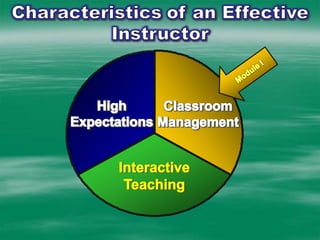
Characteristicsof an Effective Instructor ModuleIClassroomManagementHighExpectationsInteractive Teaching
Classroom Management & OrganizationClassroom Management: The set of strategies used to ensure a productive, harmonious learning environment.Classroom Organization: The ways instructors structure time, space, and classroom interactions to promote learning.
Classroom Management StrategiesRefer to all of the things that an instructor  does to organizestudentsspace, time, and materials so instruction in content and student learning can take place. It is important to:Establish routines and procedures for every taskCommunicate discipline plan which includes positive and negative consequences.“Effective teachers MANAGEtheir classrooms.Ineffective teachers DISCIPLINEtheir classrooms.”
Innovative Methods of TeachingWe think of the effective teachers we have had over the years with a sense of recognition, but those who have touched our humanity we remember with a deep sense of gratitude.
Innovative Methods of TeachingI hear and I forget.I see and I believe.I do and I understand.  The empires of the future are the empires of the mind.- Winston Churchill
Where to Start…Start with clear learning objectives/outcomesHelps you plan session and helps participants by providing clear view of the session’s direction Follow an outline Periodically refer to the learning outcomes during the session to remind everyone where you are and prevent people from getting lost
Increase ParticipationResearch shows people will: Listenfor only 15-20 minutes without a breakLearnmore when given an opportunity to process what they are learningRetainmore if they review or use the information immediately after learning it
Increase ParticipationParticipantslike to be actively involvedParticipantswant to share knowledge and ideasYou don’t have to be an expert and answer all questions, because learners can address questions as wellKeepsgroup’s attentive and involved
Points to Keep in MindMake more interactive  by involving the group by frequently stopping and asking questionsStrive for a “30% / 70%  split30% lecture/ 70% active discussion
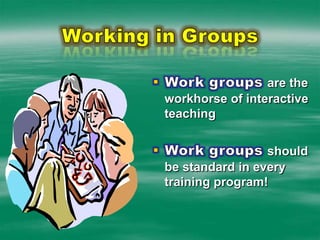
This won’t always be possibleWorking in GroupsWork groups are the workhorse of interactive teachingWork groups should be standard in every training program!
Using Work GroupsStimulates individual input. Learners obtain feedback from multiple perspectives.Offers opportunity for peer instruction.Allows you to evaluate their learning
How to Utilize Work GroupsExplain the procedure Form groups Describe taskSpecify a time limitRecommend a processMonitor progressAct as a timekeeper & answer questionsProcess the information
When to Use Group WorkWarm upsPractice SessionReviewBreak Up LecturesComplete assignments
Interactive TechniquesThink/Pair/Share Question & Answer Period Demonstration
Think/Pair/Share (5-7 minutes)Pose a question or problem.  Thisshould require participant to explain a concept in their own words or to apply, synthesize, or evaluate what they’ve learned.Give participants one minute toTHINKabout their answers individually.Have them PAIR with a partner to compare answers.Ask them to SHARE their responses with the class.
Asking QuestionsOpen-Ended QuestionsAsk questions to get participants to think, analyze, or evaluatePrepare questions ahead of timeQuestions should not have a single, right answer, e.g., “How could this procedure be improved?” or “What problems might occur with this technique?”Closed-Ended QuestionsHave a short, definite answers  Work best when asked fairly rapidly in a series to break the participants out of a passive mode
DemonstrationDemonstrationis one of the most effective teaching methods because of its visual impact.A visual presentation of one or more techniques, processes, skills, etc.  You or a participant, often assisted by others, go through the motion of showing, doing, explaining, etc.
Other Proven TechniquesBrainstormingField Trips Assigned readingDiscussionJob aids Role play
SummaryTelling is not teaching.  You must engage participants in learning activities that lead to a higher level of understanding and result in the participant's ability to apply what he learned on the job.Interactive teaching is a two-way process of active participant engagement with each other, the facilitator, and the content.
SummaryKeep in mind, however, that interactivity is a means to a greater end – participant learning. The most effective learning involves leading participants to a point of reflection on contentWhat does this mean to me? How can I use this? Is this better than what I'm doing now? This reflection is the goal of interactivity.
TEACHING WITH SENSE OF HUMOUR Laughter is a natural, universal phenomenon, with beneficial effects, both physical and psychological.
Everyone loves a teacher with an infectious         sense of humor.Cordialrelationship.
Ability to relax people and reduce tension.

رفعت بشري عزيز Classroom management and_interactive_teaching_(1)

  • 1.
  • 2.
    Characteristicsof an EffectiveInstructor ModuleIClassroomManagementHighExpectationsInteractive Teaching
  • 3.
    Classroom Management &OrganizationClassroom Management: The set of strategies used to ensure a productive, harmonious learning environment.Classroom Organization: The ways instructors structure time, space, and classroom interactions to promote learning.
  • 4.
    Classroom Management StrategiesReferto all of the things that an instructor does to organizestudentsspace, time, and materials so instruction in content and student learning can take place. It is important to:Establish routines and procedures for every taskCommunicate discipline plan which includes positive and negative consequences.“Effective teachers MANAGEtheir classrooms.Ineffective teachers DISCIPLINEtheir classrooms.”
  • 5.
    Innovative Methods ofTeachingWe think of the effective teachers we have had over the years with a sense of recognition, but those who have touched our humanity we remember with a deep sense of gratitude.
  • 6.
    Innovative Methods ofTeachingI hear and I forget.I see and I believe.I do and I understand. The empires of the future are the empires of the mind.- Winston Churchill
  • 7.
    Where to Start…Startwith clear learning objectives/outcomesHelps you plan session and helps participants by providing clear view of the session’s direction Follow an outline Periodically refer to the learning outcomes during the session to remind everyone where you are and prevent people from getting lost
  • 8.
    Increase ParticipationResearch showspeople will: Listenfor only 15-20 minutes without a breakLearnmore when given an opportunity to process what they are learningRetainmore if they review or use the information immediately after learning it
  • 9.
    Increase ParticipationParticipantslike tobe actively involvedParticipantswant to share knowledge and ideasYou don’t have to be an expert and answer all questions, because learners can address questions as wellKeepsgroup’s attentive and involved
  • 10.
    Points to Keepin MindMake more interactive by involving the group by frequently stopping and asking questionsStrive for a “30% / 70% split30% lecture/ 70% active discussion
  • 11.
    This won’t alwaysbe possibleWorking in GroupsWork groups are the workhorse of interactive teachingWork groups should be standard in every training program!
  • 12.
    Using Work GroupsStimulatesindividual input. Learners obtain feedback from multiple perspectives.Offers opportunity for peer instruction.Allows you to evaluate their learning
  • 13.
    How to UtilizeWork GroupsExplain the procedure Form groups Describe taskSpecify a time limitRecommend a processMonitor progressAct as a timekeeper & answer questionsProcess the information
  • 14.
    When to UseGroup WorkWarm upsPractice SessionReviewBreak Up LecturesComplete assignments
  • 15.
  • 16.
    Think/Pair/Share (5-7 minutes)Posea question or problem. Thisshould require participant to explain a concept in their own words or to apply, synthesize, or evaluate what they’ve learned.Give participants one minute toTHINKabout their answers individually.Have them PAIR with a partner to compare answers.Ask them to SHARE their responses with the class.
  • 17.
    Asking QuestionsOpen-Ended QuestionsAskquestions to get participants to think, analyze, or evaluatePrepare questions ahead of timeQuestions should not have a single, right answer, e.g., “How could this procedure be improved?” or “What problems might occur with this technique?”Closed-Ended QuestionsHave a short, definite answers Work best when asked fairly rapidly in a series to break the participants out of a passive mode
  • 18.
    DemonstrationDemonstrationis one ofthe most effective teaching methods because of its visual impact.A visual presentation of one or more techniques, processes, skills, etc. You or a participant, often assisted by others, go through the motion of showing, doing, explaining, etc.
  • 19.
    Other Proven TechniquesBrainstormingFieldTrips Assigned readingDiscussionJob aids Role play
  • 20.
    SummaryTelling is notteaching. You must engage participants in learning activities that lead to a higher level of understanding and result in the participant's ability to apply what he learned on the job.Interactive teaching is a two-way process of active participant engagement with each other, the facilitator, and the content.
  • 21.
    SummaryKeep in mind,however, that interactivity is a means to a greater end – participant learning. The most effective learning involves leading participants to a point of reflection on contentWhat does this mean to me? How can I use this? Is this better than what I'm doing now? This reflection is the goal of interactivity.
  • 22.
    TEACHING WITH SENSEOF HUMOUR Laughter is a natural, universal phenomenon, with beneficial effects, both physical and psychological.
  • 23.
    Everyone loves ateacher with an infectious sense of humor.Cordialrelationship.
  • 24.
    Ability to relaxpeople and reduce tension.
  • 25.
  • 26.
  • 27.
    Students enjoys humorin forms of funny anecdotes
  • 28.
    When there isa willingness to change, there is hope for progress in any field.INSTRUCTOR THE GREATEST INNOVATORAnyone who stops learning is old, whether at twenty or eighty. Anyone who keeps learning stays young. To teach is to learn twice Instructors should guide withoutdictating, and participate withoutdominatingThe critical factor is not class size but rather the nature of the teaching as it affects learning. LEARNING NEVER ENDS
  • 29.