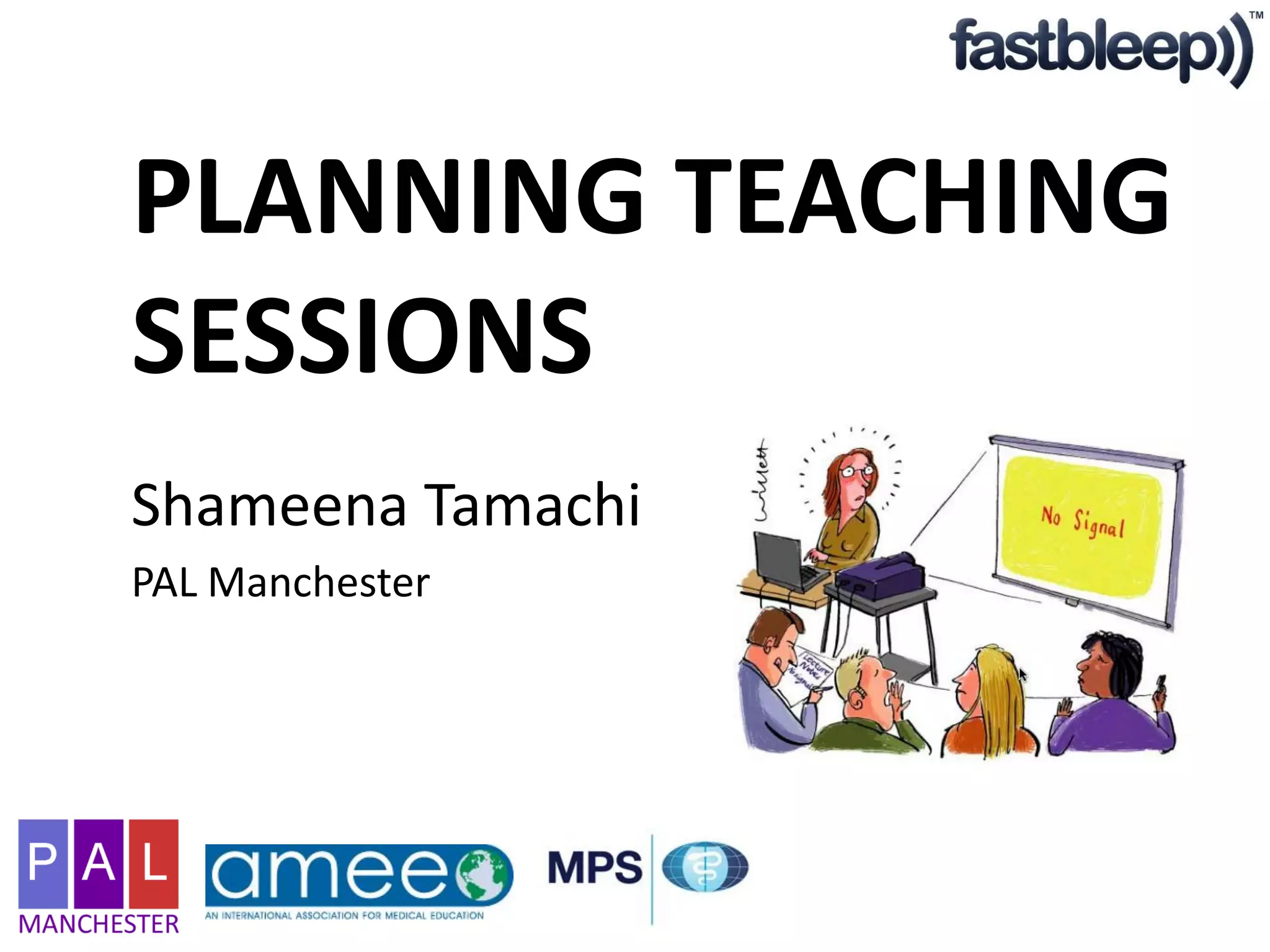
PLANNING TEACHING
SESSIONS
Shameena Tamachi
PAL Manchester
Learning Objectives
1. To review the strengths, challenges and
   common problems associated with clinical
   teaching
2. To gain an awareness of how doctors teach
   and how students learn
3. To understand the importance of planning
4. To learn techniques for creating effective
   teaching sessions
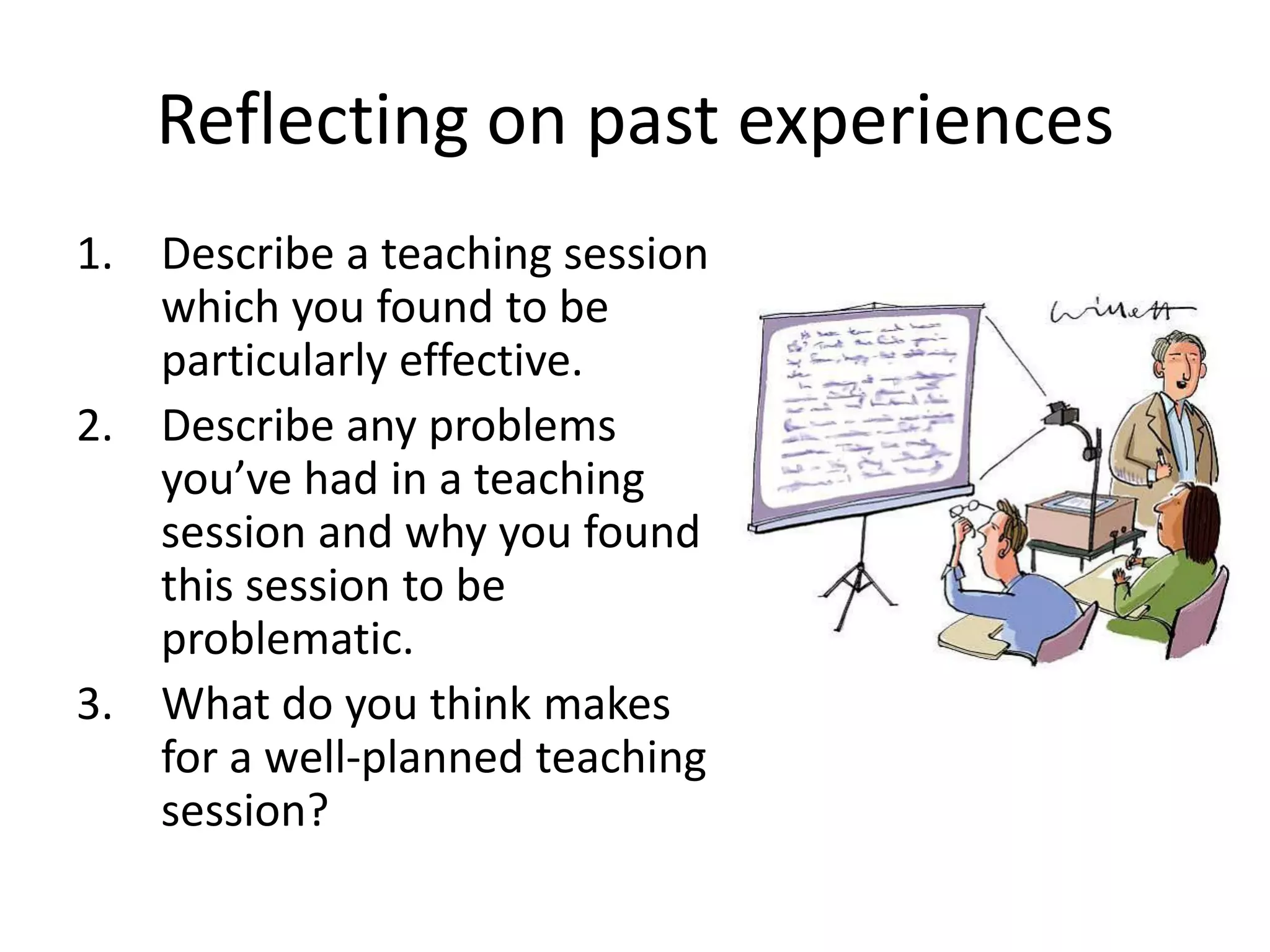
Reflecting on past experiences
1. Describe a teaching session
   which you found to be
   particularly effective.
2. Describe any problems
   you’ve had in a teaching
   session and why you found
   this session to be
   problematic.
3. What do you think makes
   for a well-planned teaching
   session?
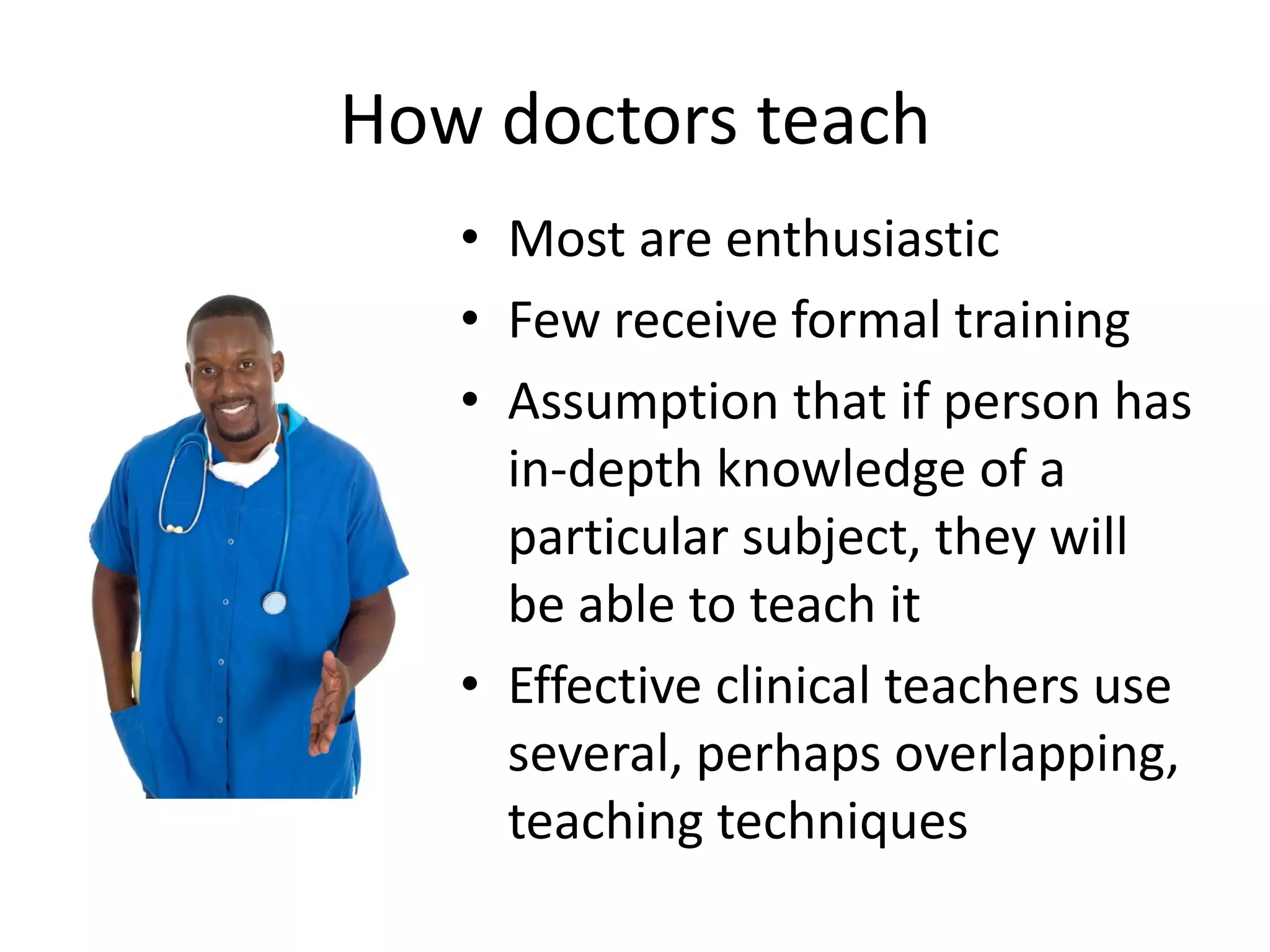
How doctors teach
   • Most are enthusiastic
   • Few receive formal training
   • Assumption that if person has
     in-depth knowledge of a
     particular subject, they will
     be able to teach it
   • Effective clinical teachers use
     several, perhaps overlapping,
     teaching techniques
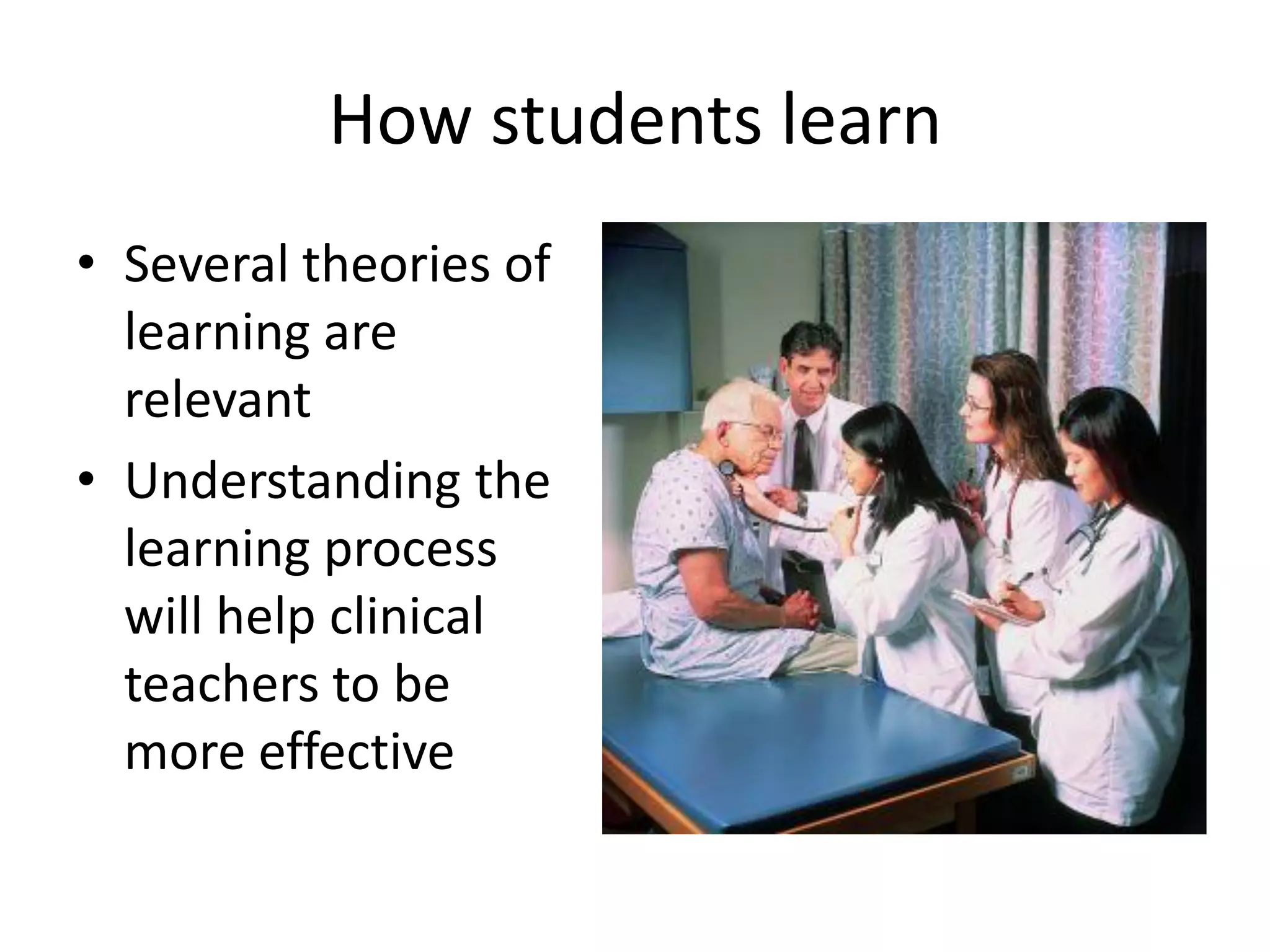
How students learn
• Several theories of
  learning are
  relevant
• Understanding the
  learning process
  will help clinical
  teachers to be
  more effective
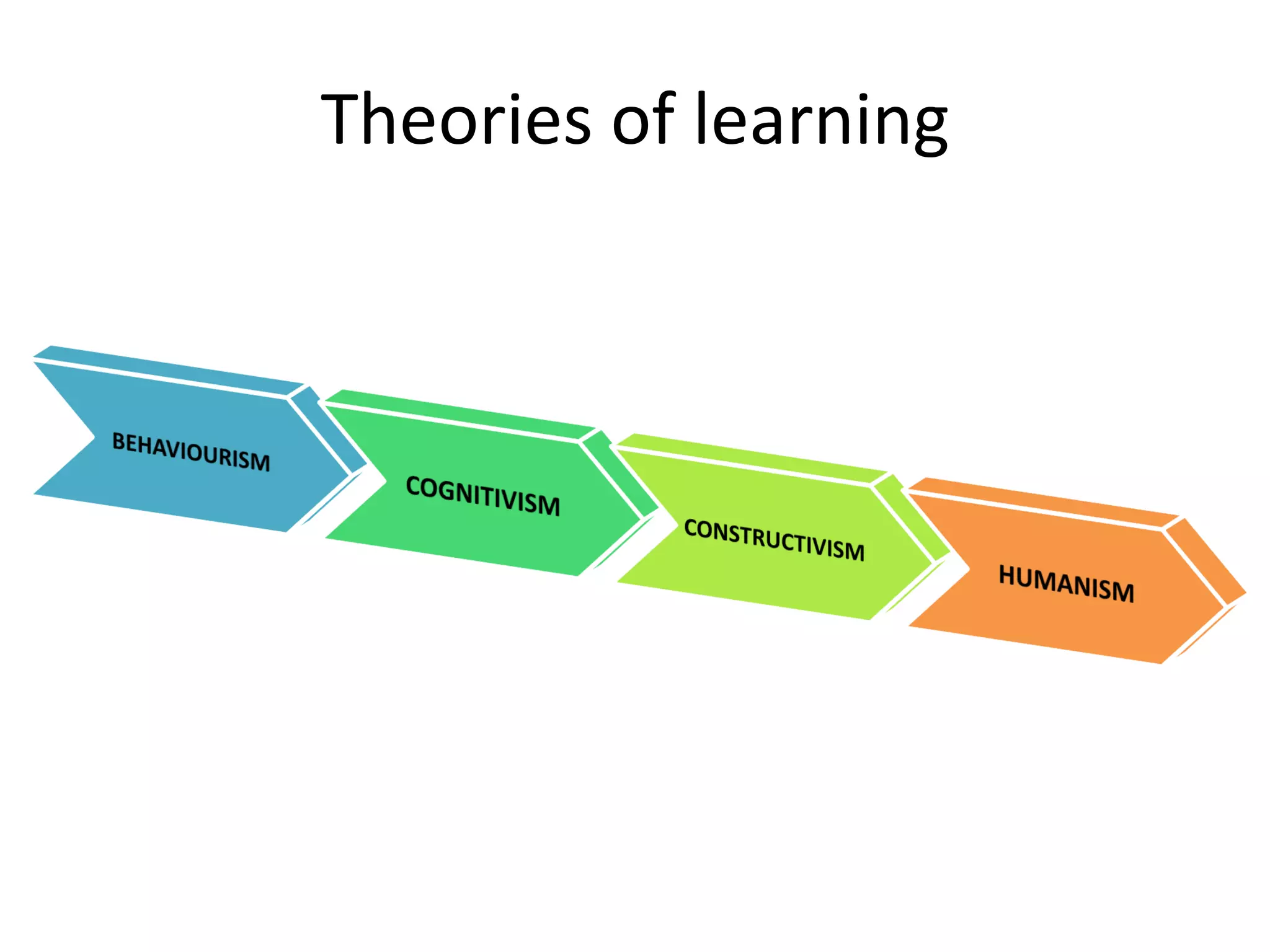
Theories of learning
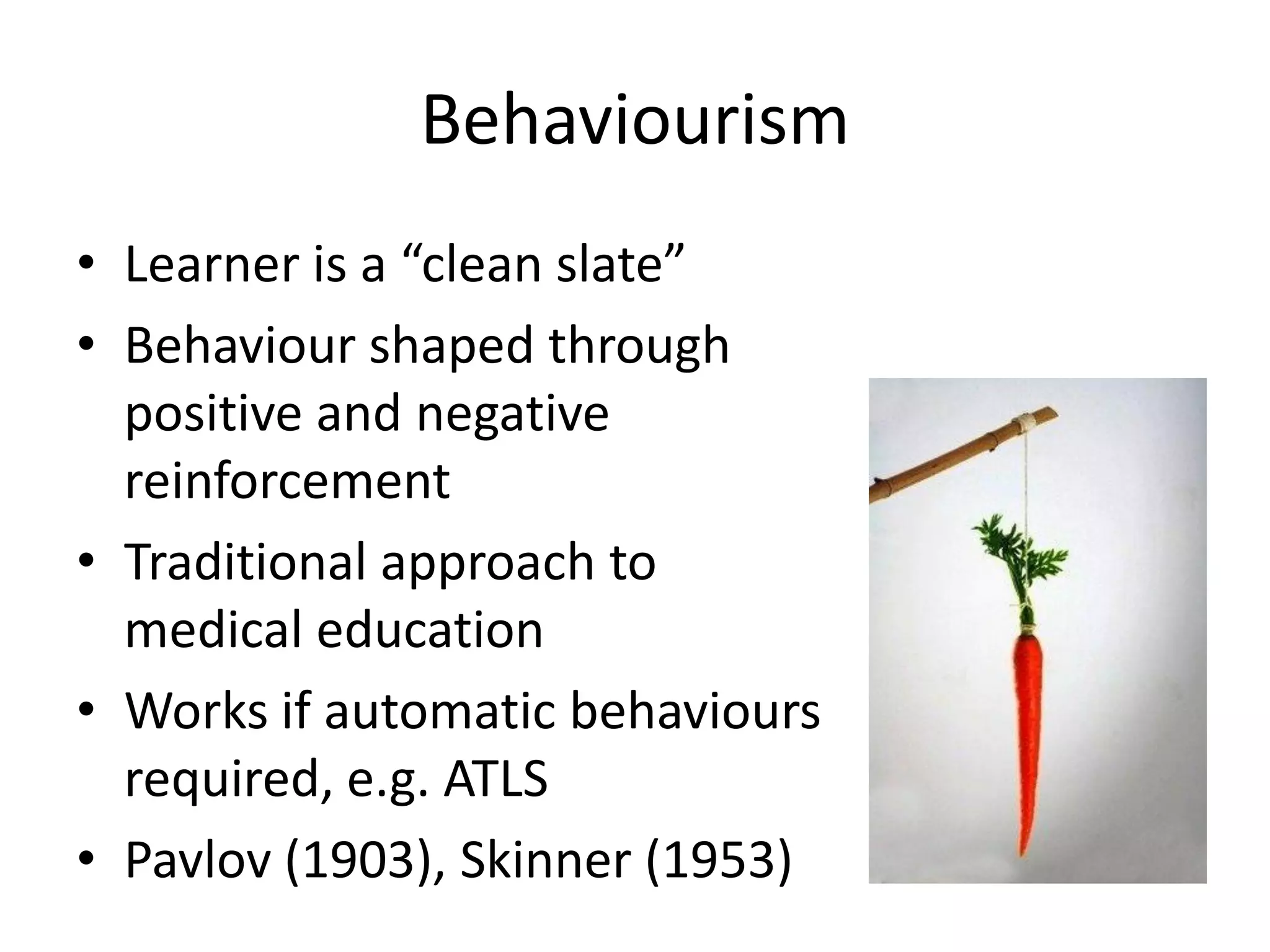
Behaviourism
• Learner is a “clean slate”
• Behaviour shaped through
  positive and negative
  reinforcement
• Traditional approach to
  medical education
• Works if automatic behaviours
  required, e.g. ATLS
• Pavlov (1903), Skinner (1953)
Cognitivism
• Metaphor of mind as a computer
• Mental processes, e.g. thinking, memory,
  problem-solving, need to be understood
• People are rational beings that require active
  participation in order to learn
• Miller (1956), Mayer (1998)
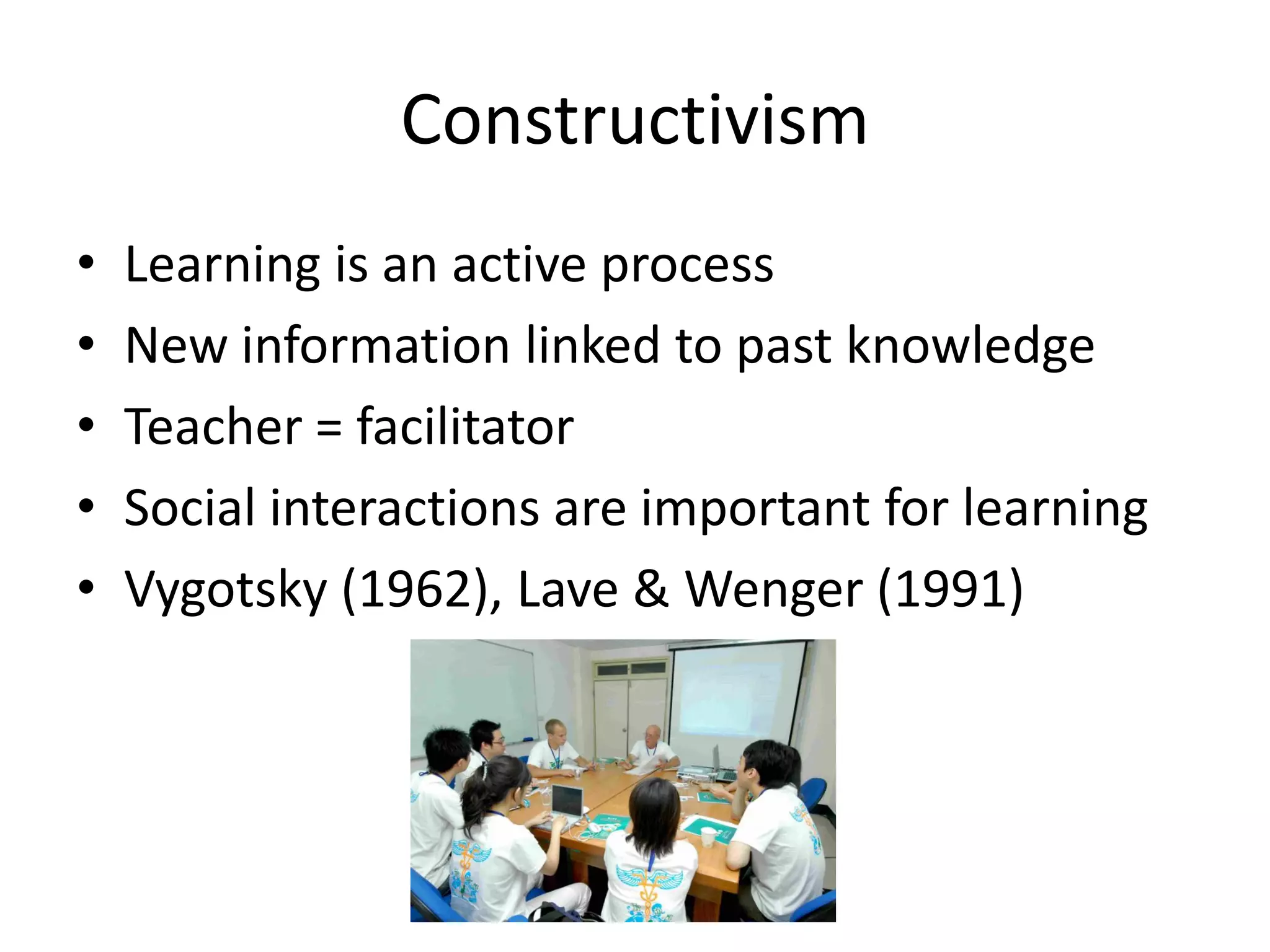
Constructivism
•   Learning is an active process
•   New information linked to past knowledge
•   Teacher = facilitator
•   Social interactions are important for learning
•   Vygotsky (1962), Lave & Wenger (1991)
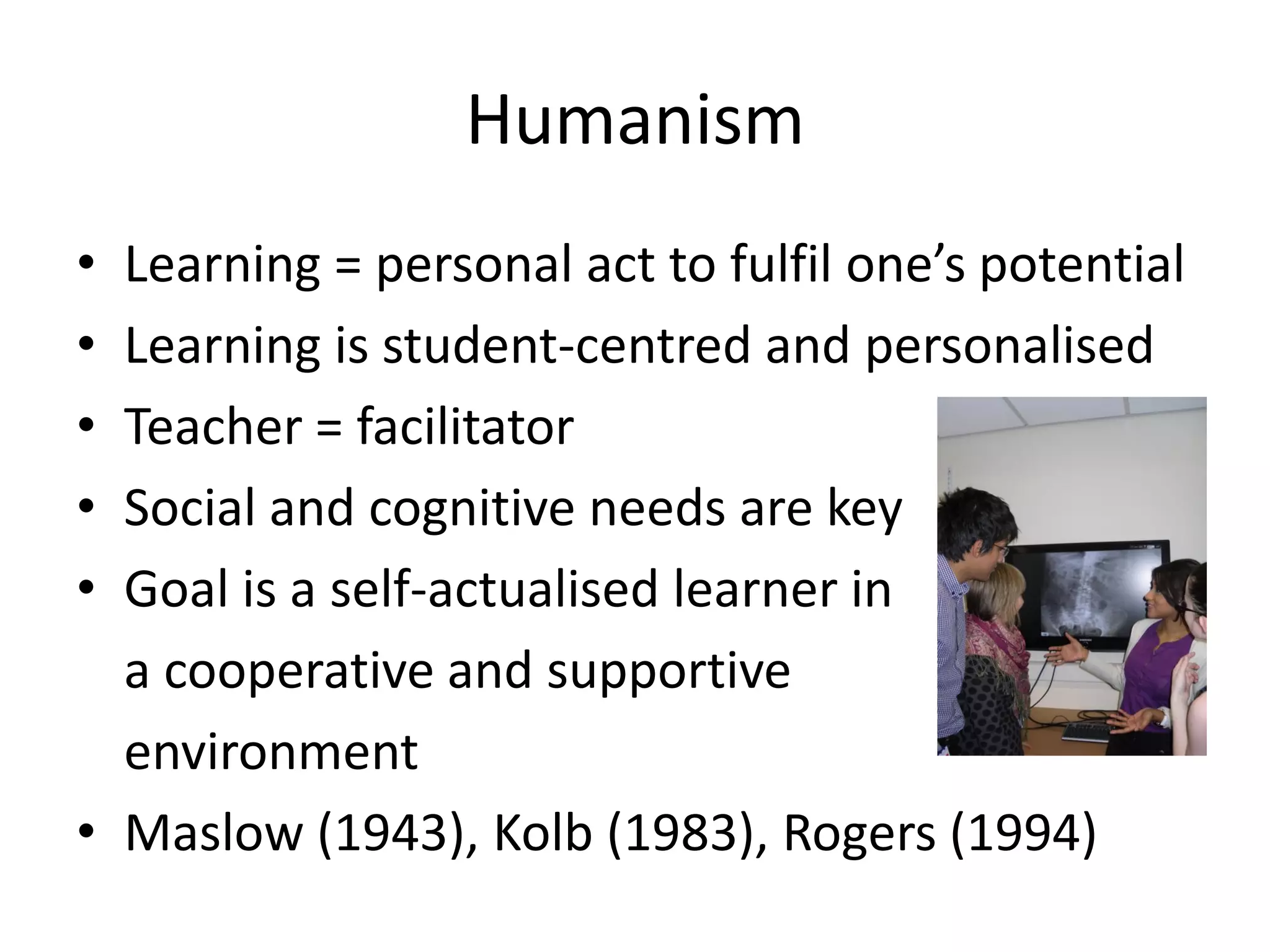
Humanism
• Learning = personal act to fulfil one’s potential
• Learning is student-centred and personalised
• Teacher = facilitator
• Social and cognitive needs are key
• Goal is a self-actualised learner in
  a cooperative and supportive
  environment
• Maslow (1943), Kolb (1983), Rogers (1994)
Kolb’s Experiential Learning Theory
• A cyclical process linking concrete experience,
  perception, cognition and behaviour
• Learning enhanced with sound, logical theory
• Learner benefits from practical applications of
  theory
• Learners learn better with “hands-on”
  experiences
• Learning enhanced when learner able to
  observe and collect wide range of information
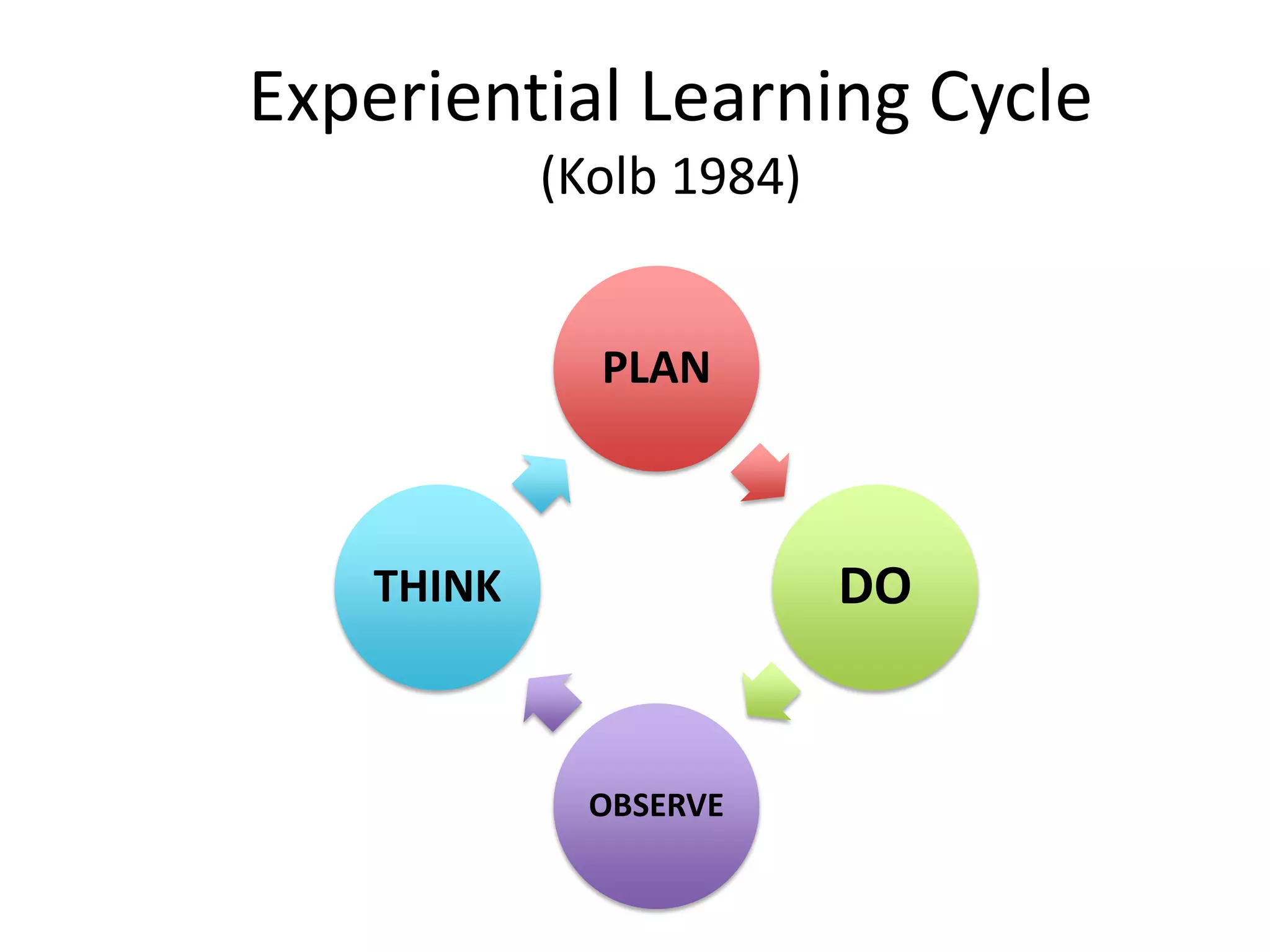
Experiential Learning Cycle
            (Kolb 1984)


              PLAN


    THINK                 DO


              OBSERVE
Using Experiential Learning Theory
               – A Case Study
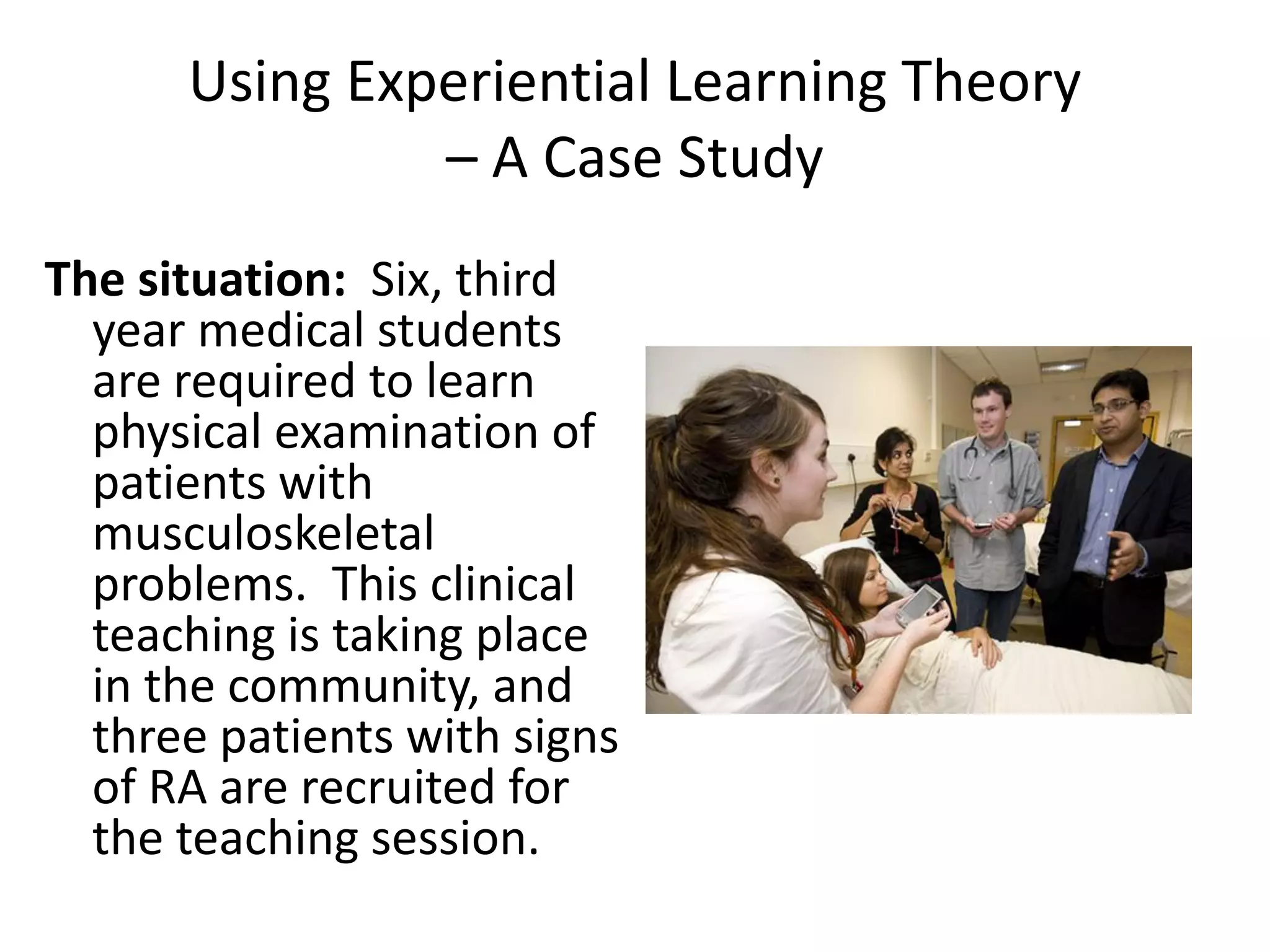
The situation: Six, third
  year medical students
  are required to learn
  physical examination of
  patients with
  musculoskeletal
  problems. This clinical
  teaching is taking place
  in the community, and
  three patients with signs
  of RA are recruited for
  the teaching session.
Using Experiential Learning Theory
              – A Case Study
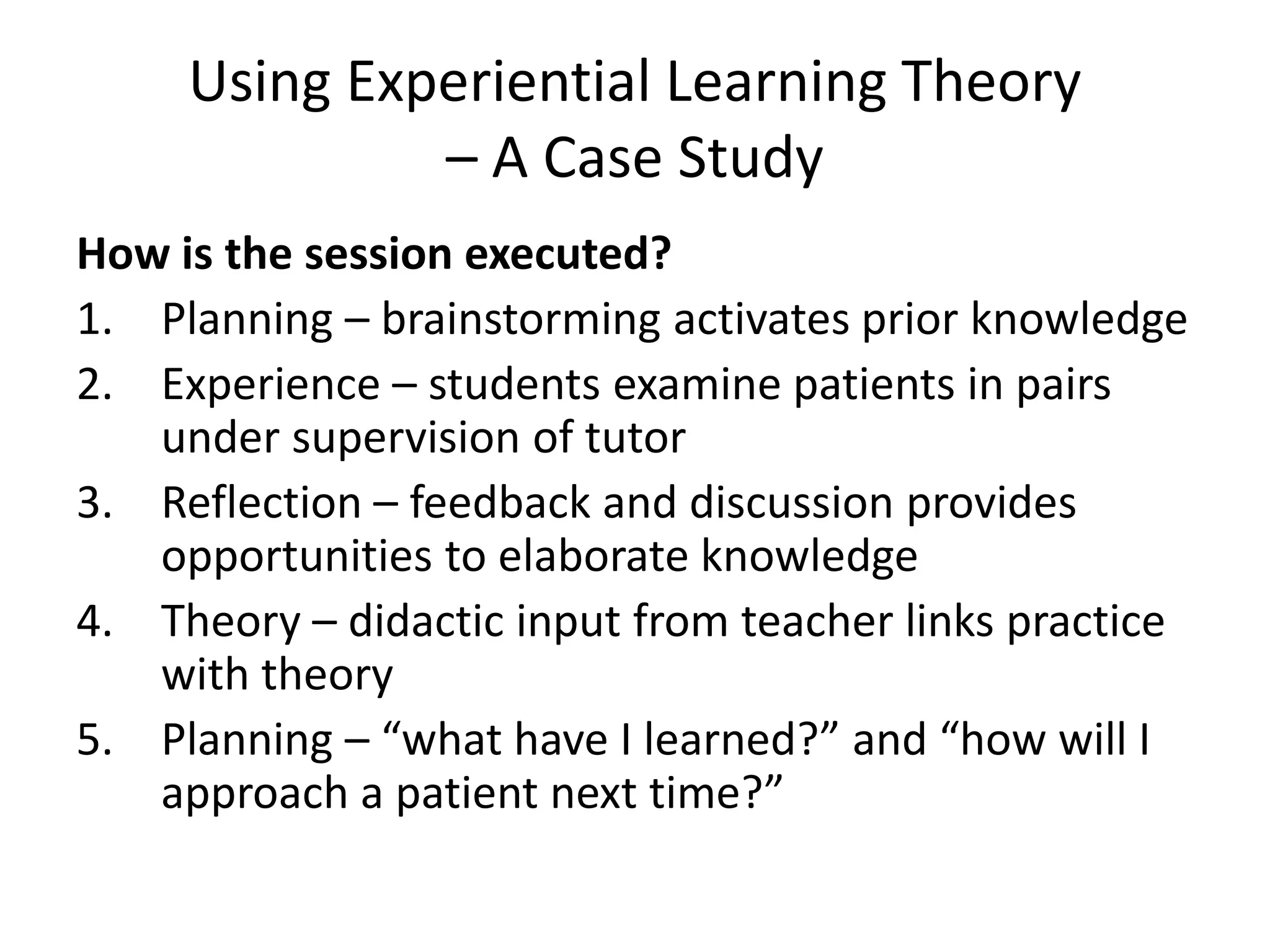
How is the session executed?
1. Planning – brainstorming activates prior knowledge
2. Experience – students examine patients in pairs
   under supervision of tutor
3. Reflection – feedback and discussion provides
   opportunities to elaborate knowledge
4. Theory – didactic input from teacher links practice
   with theory
5. Planning – “what have I learned?” and “how will I
   approach a patient next time?”
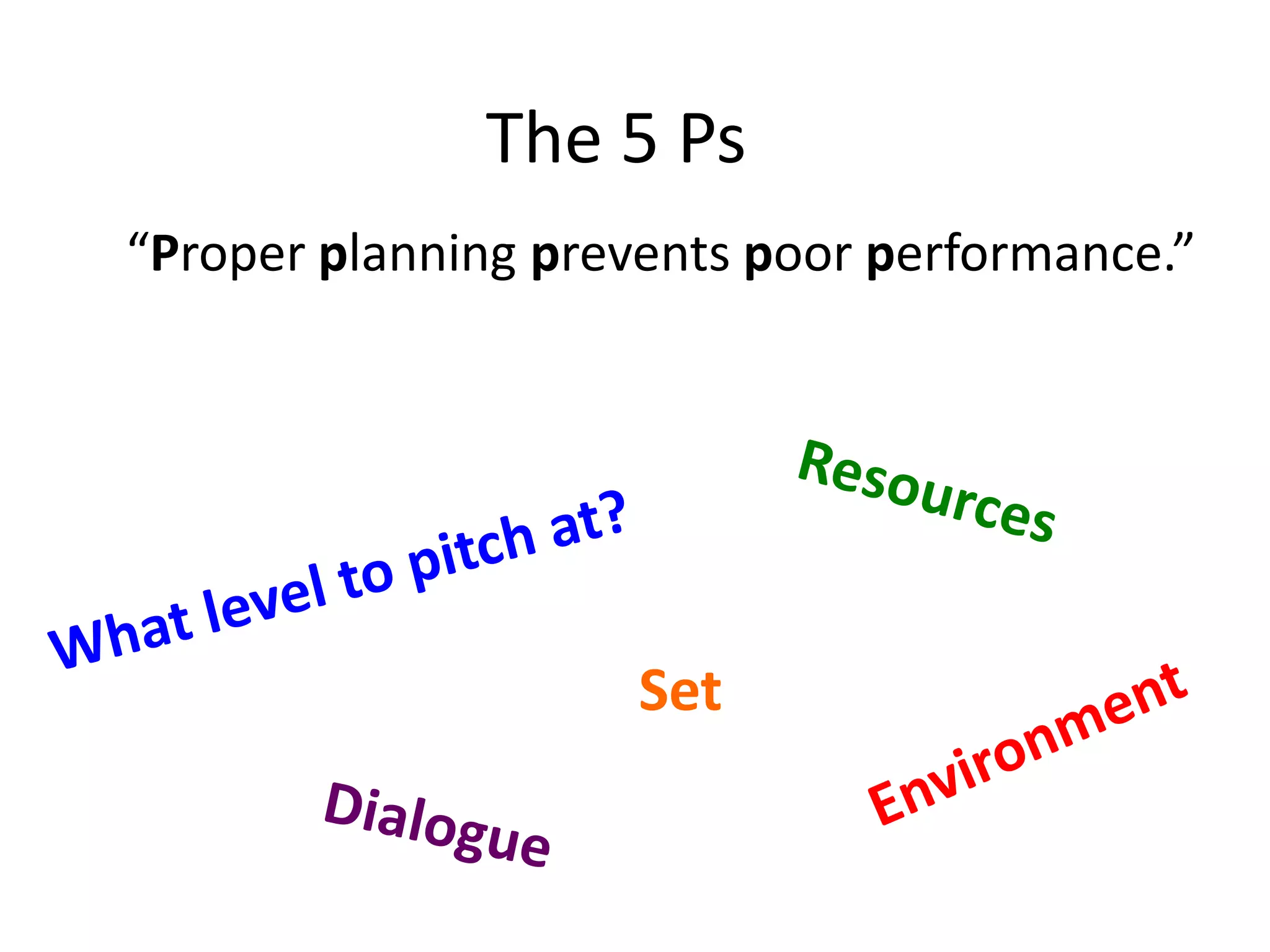
The 5 Ps
“Proper planning prevents poor performance.”


                     Set
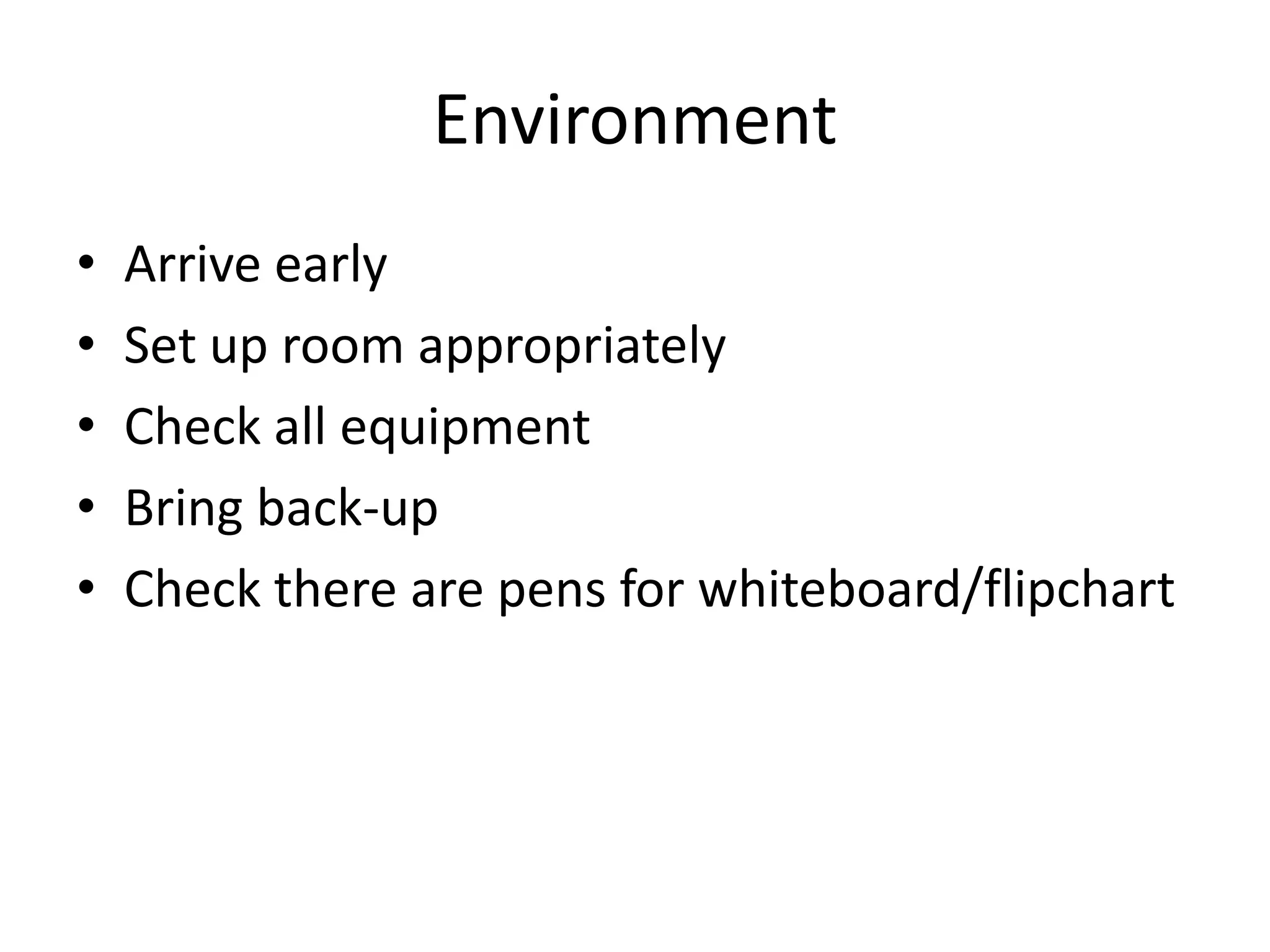
Environment
•   Arrive early
•   Set up room appropriately
•   Check all equipment
•   Bring back-up
•   Check there are pens for whiteboard/flipchart
Set
• Setting of presentation is established in first
  30 seconds
• If this is done effectively you will get people to
  tune in
• Key points to get across are usefulness,
  content, objectives and role of participants
Dialogue
• You may want to divide participants into pairs
  or small groups
• Ask open and closed questions
• Involve as many different participants as
  possible
• When wrapping up ask for any final questions
• Summarise at very end
What is the
appropriate level to
     pitch the
  presentation?
Resources

Don’t forget “LIGHT”…
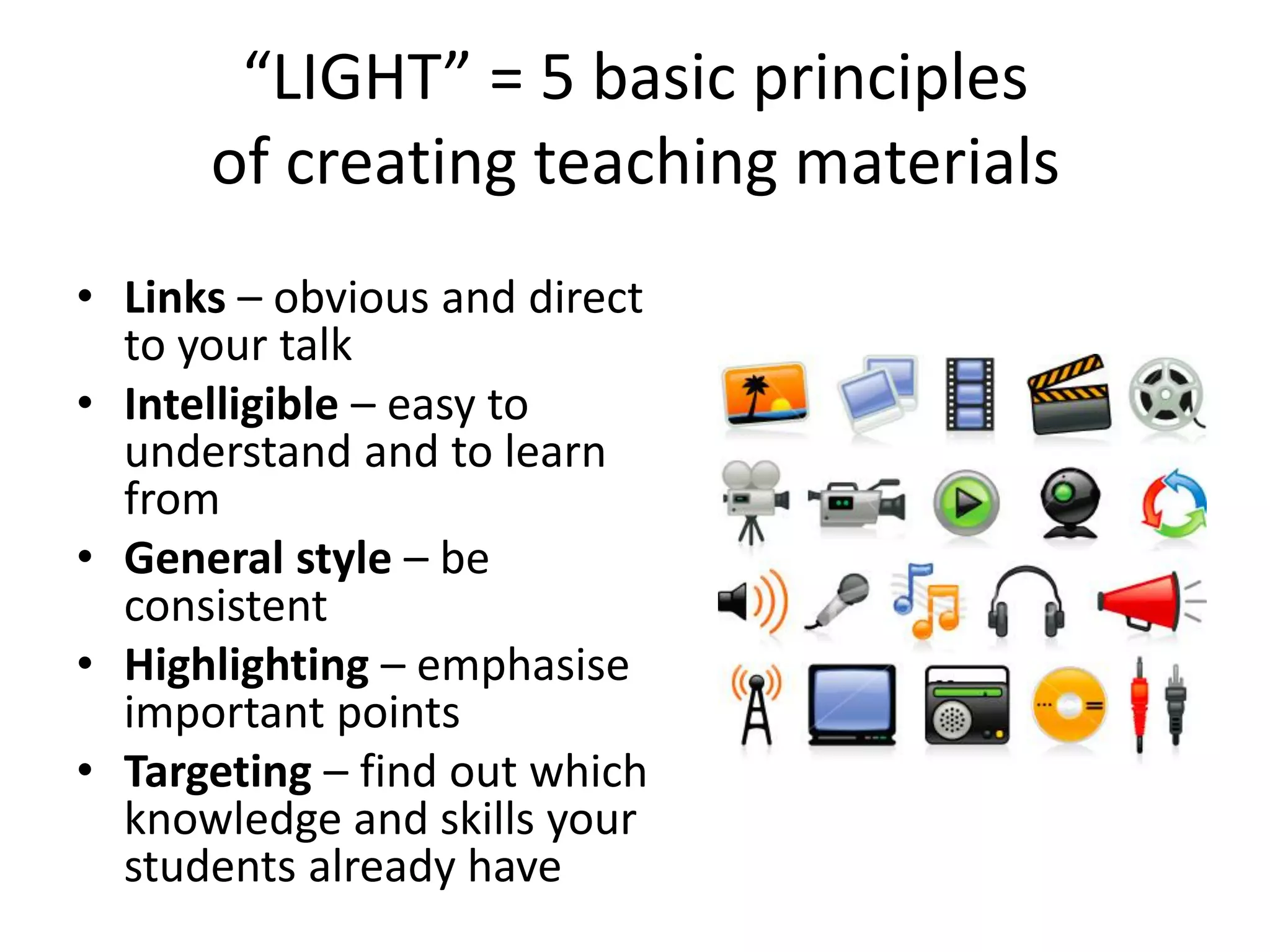
“LIGHT” = 5 basic principles
      of creating teaching materials
• Links – obvious and direct
  to your talk
• Intelligible – easy to
  understand and to learn
  from
• General style – be
  consistent
• Highlighting – emphasise
  important points
• Targeting – find out which
  knowledge and skills your
  students already have
Are there any final questions?
Summary
• Understanding the learning process will help
  clinical teachers to be effective.
• Planning provides structure and context for
  both teacher and students, as well as a
  framework for reflection and evaluation.
• Following the 5 basic principles of creating
  teaching materials will help in avoiding
  common problems with presentations.
Thank you for your attention.

Planning Teaching Sessions

  • 1.
  • 2.
    Learning Objectives 1. Toreview the strengths, challenges and common problems associated with clinical teaching 2. To gain an awareness of how doctors teach and how students learn 3. To understand the importance of planning 4. To learn techniques for creating effective teaching sessions
  • 3.
    Reflecting on pastexperiences 1. Describe a teaching session which you found to be particularly effective. 2. Describe any problems you’ve had in a teaching session and why you found this session to be problematic. 3. What do you think makes for a well-planned teaching session?
  • 4.
    How doctors teach • Most are enthusiastic • Few receive formal training • Assumption that if person has in-depth knowledge of a particular subject, they will be able to teach it • Effective clinical teachers use several, perhaps overlapping, teaching techniques
  • 5.
    How students learn •Several theories of learning are relevant • Understanding the learning process will help clinical teachers to be more effective
  • 6.
  • 7.
    Behaviourism • Learner isa “clean slate” • Behaviour shaped through positive and negative reinforcement • Traditional approach to medical education • Works if automatic behaviours required, e.g. ATLS • Pavlov (1903), Skinner (1953)
  • 8.
    Cognitivism • Metaphor ofmind as a computer • Mental processes, e.g. thinking, memory, problem-solving, need to be understood • People are rational beings that require active participation in order to learn • Miller (1956), Mayer (1998)
  • 9.
    Constructivism • Learning is an active process • New information linked to past knowledge • Teacher = facilitator • Social interactions are important for learning • Vygotsky (1962), Lave & Wenger (1991)
  • 10.
    Humanism • Learning =personal act to fulfil one’s potential • Learning is student-centred and personalised • Teacher = facilitator • Social and cognitive needs are key • Goal is a self-actualised learner in a cooperative and supportive environment • Maslow (1943), Kolb (1983), Rogers (1994)
  • 11.
    Kolb’s Experiential LearningTheory • A cyclical process linking concrete experience, perception, cognition and behaviour • Learning enhanced with sound, logical theory • Learner benefits from practical applications of theory • Learners learn better with “hands-on” experiences • Learning enhanced when learner able to observe and collect wide range of information
  • 12.
    Experiential Learning Cycle (Kolb 1984) PLAN THINK DO OBSERVE
  • 13.
    Using Experiential LearningTheory – A Case Study The situation: Six, third year medical students are required to learn physical examination of patients with musculoskeletal problems. This clinical teaching is taking place in the community, and three patients with signs of RA are recruited for the teaching session.
  • 14.
    Using Experiential LearningTheory – A Case Study How is the session executed? 1. Planning – brainstorming activates prior knowledge 2. Experience – students examine patients in pairs under supervision of tutor 3. Reflection – feedback and discussion provides opportunities to elaborate knowledge 4. Theory – didactic input from teacher links practice with theory 5. Planning – “what have I learned?” and “how will I approach a patient next time?”
  • 15.
    The 5 Ps “Properplanning prevents poor performance.” Set
  • 16.
    Environment • Arrive early • Set up room appropriately • Check all equipment • Bring back-up • Check there are pens for whiteboard/flipchart
  • 17.
    Set • Setting ofpresentation is established in first 30 seconds • If this is done effectively you will get people to tune in • Key points to get across are usefulness, content, objectives and role of participants
  • 18.
    Dialogue • You maywant to divide participants into pairs or small groups • Ask open and closed questions • Involve as many different participants as possible • When wrapping up ask for any final questions • Summarise at very end
  • 19.
    What is the appropriatelevel to pitch the presentation?
  • 20.
  • 21.
    “LIGHT” = 5basic principles of creating teaching materials • Links – obvious and direct to your talk • Intelligible – easy to understand and to learn from • General style – be consistent • Highlighting – emphasise important points • Targeting – find out which knowledge and skills your students already have
  • 22.
    Are there anyfinal questions?
  • 23.
    Summary • Understanding thelearning process will help clinical teachers to be effective. • Planning provides structure and context for both teacher and students, as well as a framework for reflection and evaluation. • Following the 5 basic principles of creating teaching materials will help in avoiding common problems with presentations.
  • 24.
    Thank you foryour attention.