Designing a TBL Plan Victor GAO Zhejiang Education Institute 2002 05 17
What is needed for learning? Jane Willis : Essential conditions:  Learning won’t happen unless… Motivation Exposure Opportunities to use the language Desirable conditions : Instruction (it counts but not essential)
How can we help a learner? We cannot really teach language, we can only create conditions with which, language will develop spontaneously in the learners’ mind in its own way.
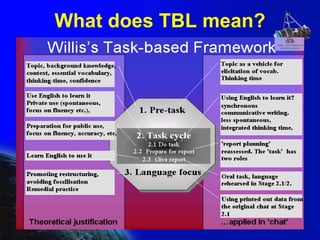
What does TBL mean?
This is a task! Did you in the past few weeks:   (Understanding what a task is)   ask for way to somewhere? identify who is the person in charge of sth.? try to find out who had taken your pen and forgot to return it to you? try to borrow a brand-new bicycle from your friend? work out the best bus-route to a school you haven’t been to? explain to your head teacher why you didn't attend an important meeting last week?
So a task is… A task is a piece of work undertaken for oneself or for others, freely or for some reward.  It means  what people do in everyday life, at work, at play, and in between.  ( Long 1985:89 )  任务是人们在日常生活中所从事的有目的的活动  such as:
How do I plan a TBL lesson? Teaching objectives A warmer  Task cycle Task demonstration / instruction Doing the task Preparing and giving a report Language focus Follow-up activities Considerations/check points
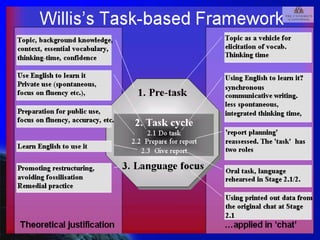
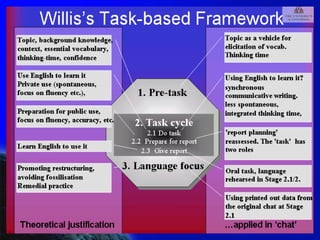
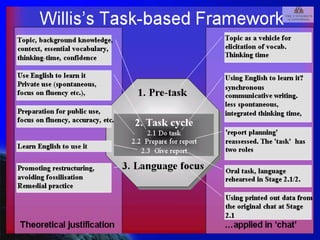
1. Pre-task Stage: Teacher prepares the learners in topic,   as a vehicle for eliciting the vocabulary   话题 Activate background knowledge,   背景   contextualize,   语境 essential vocabulary,   关键词汇   functional language/verb patterns,   有用的句型 thinking-time,   学生准备的时间   confidence, feeling secure , 信心和安全感的建立
 
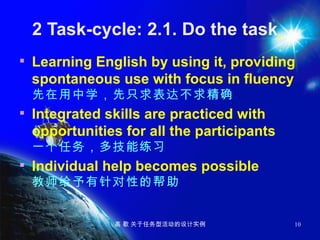
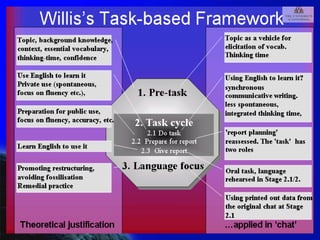
2 Task-cycle: 2.1. Do the task   Learning English by using it, providing spontaneous use with focus in fluency  先在用中学,先只求表达不求精确 Integrated skills are practiced with opportunities for all the participants  一个任务,多技能练习 Individual help becomes possible  教师给予有针对性的帮助
 
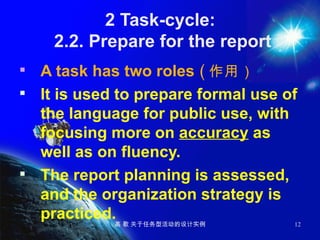
2 Task-cycle:  2.2. Prepare for the report A task has two roles  ( 作用) It is used to prepare formal use of the language for public use, with focusing more on  accuracy  as well as on fluency. The report planning is assessed, and the organization strategy is practiced.
 
2. Task-cycle:  2.3. Give the report Learn English for different purposes by using it (formal delivery of a speech,  An oral presentation task, language is rehearsed meaningfully and repeatedly in “ preparing the task and do the task”. “repetition leads to fluency”
 
3. Language Focus Stage The report to the whole class prompts opportunities for remedial practice to reconstruct the language used in the tasks,  to avoid fossilization,   Data from the original chat in “do the task” can be recorded and printed-out for remedial practice or reflective use
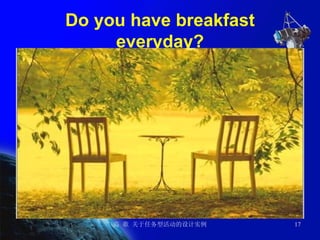
Do you have breakfast everyday?
Do you have breakfast  everyday?   What’s this? It’s porridge Do you have it for breakfast? Yes, I do. How do you like it,  very much or a little? Very much. How often do you have it? Everyday.
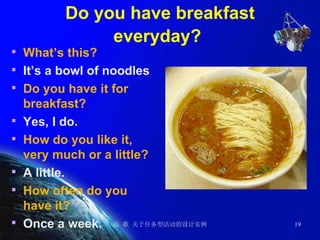
Do you have breakfast everyday?   What’s this? It’s a bowl of noodles Do you have it for breakfast? Yes, I do. How do you like it, very much or a little? A little. How often do you have it? Once a week.
A motto to remember Meaningful repetition leads to fluency The repetition has to be meaningful, contextualized, in use and authentic
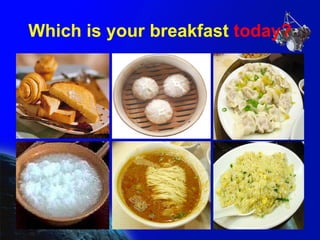
Which is your breakfast  today?
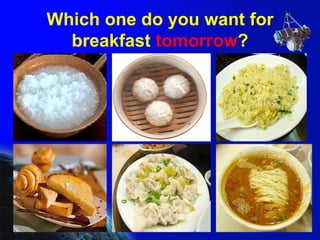
Which one do you want for breakfast  tomorrow ?
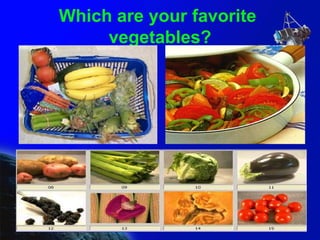
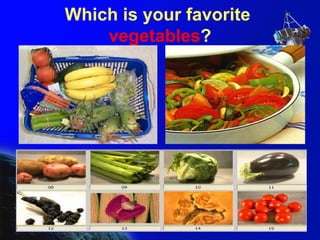
Which are your favorite  vegetables?
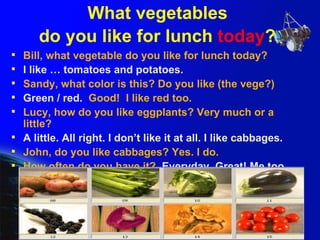
What vegetables  do you like for lunch  today ?   Bill, what vegetable do you like for lunch today?  I like … tomatoes and potatoes. Sandy, what color is this? Do you like (the vege?) Green / red.   Good!  I like red too.  Lucy, how do you like eggplants? Very much or a little? A little. All right. I don’t like it at all. I like cabbages. John, do you like cabbages? Yes. I do. How often do you have it?  Everyday. Great! Me too.
What do you like for a drink  after class ?
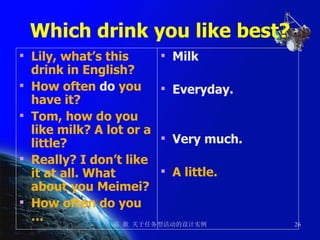
Which drink you like best? Lily, what’s this drink in English? How often  do  you have it? Tom, how do you like milk? A lot or a little? Really? I don’t like it at all. What about you Meimei?  How often do you … Milk Everyday. Very much. A little.
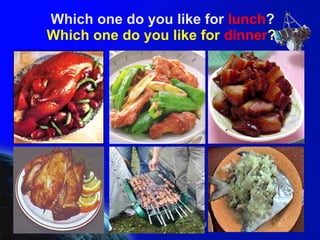
Which one do you like for  lunch ? Which one do you like for  dinner ?
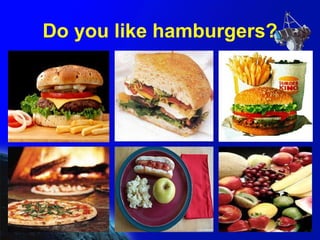
Do you like hamburgers?
Do you like  Chinese  Breakfast? How do you like this Chinese breakfast? A little or very much? If not, what do you want to have for your Chinese breakfast?
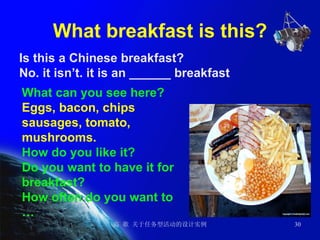
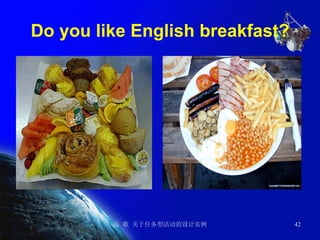
What breakfast is this? Is this a Chinese breakfast? No. it isn’t. it is an ______ breakfast  What can you see here? Eggs, bacon, chips sausages, tomato, mushrooms. How do you like it? Do you want to have it for breakfast? How often do you want to …
 
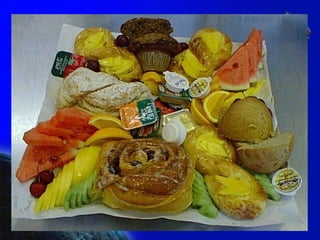
Is this an  English  breakfast? Is this a Chinese breakfast? No. it isn’t. it is an European breakfast  What can you see here? Different cakes, watermelon, butter,bacon, some pie, pineapples, mushrooms. How do you like it? Do you want to have it for breakfast? How often do you want to …
 
Teaching objectives Language structures: Do you like …? I like … …  very much/a lot, a little  I don’t like … at all What about you/your father?  What does he/she like to eat? What food does/doesn’t you/he like? Where is he from? Where  do you usually like to eat? What food do you often like to eat? Why do you like …? Because …
Option for Structure: Asking one’s preference: Do you like …? What about her?  What does he/she like to eat? What food does/doesn't he like?  Why do you like …? Because …  Express opinions: I like … …  very much, a little  I don’t like … at all.  Asking one’s routine or habits Where  do you usually like to eat? What food do you often like to eat? Where is he from?
Warming up (1)  Asking about students’ breakfast   (Starting from the learners’ personal experience) Alice, do you usually have breakfast in the morning?  (Asking about one’s routine) When do you have it?  (developing) What do you have for breakfast?  (Eliciting the vocabulary needed for tasks later)
Warming up (2)  Asking about students’ breakfast Jane, what about you?  (Comparing preferences between learners) I usually have … for breakfast.  (Teacher participates to built up the rapport.) John, do you like … for breakfast? Billy, what about you?  (To get more students involved in the discussion)
From warming-up to  opinion exchange  Asking about students’ lunch: Diana, what do you usually have for lunch?  (To elicit more vocabulary for later use)  What food you don’t like for lunch?  Why?  (Try to elicit some adjectives for reasons)  John, do you like … for lunch? Billy, what about you?  (To get more students involved in the discussion)
Function: Opinion comparison  Asking about students’ dinner: Diana, what do you usually have for lunch  (to elicit more vocab for later use)  What kind of food you don’t like for dinner?  (vocabulary practice) Why?  (try to elicit some adjectives for reasons)  John, do you like … for dinner? Billy, what about you?  (to get more students involved in the discussion)
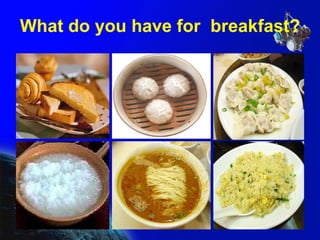
What do you have for  breakfast?
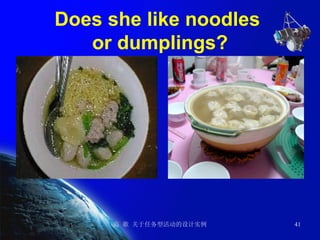
Does she like noodles  or dumplings?
Do you like English breakfast?
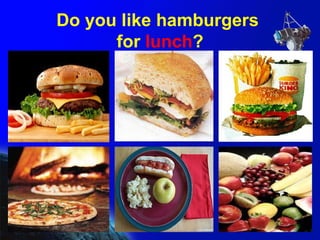
Do you like hamburgers  for  lunch ?
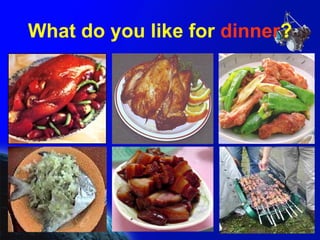
What do you like for  dinner ?
Which is your favorite  vegetables ?
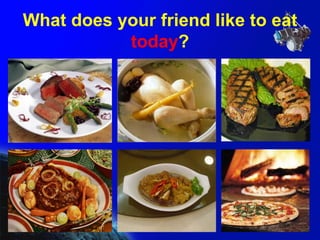
What does your friend like to eat  today ?
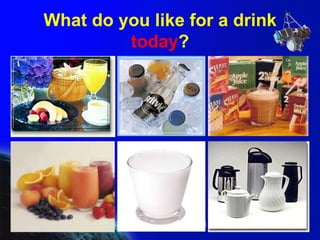
What do you like for a drink  today ?
Operation check points Make sure that  all the vocabulary are on the board in certain categories Then ask students to exchange opinions on food Demonstrate this activity to students Followed by asking some learners to act as models for the rest List the verb patterns for the next activities
Task 1:  Yours and mine (pair work) Clear instructions by the teacher: Please write down the kinds of food you usually have for breakfast, lunch and dinner.  Now  please ask your desk mate what he/she often has for breakfast, lunch and dinner  Put these food down on the left-hand side of the sheet. What are the food that both of you like? What are the food that one of you likes?
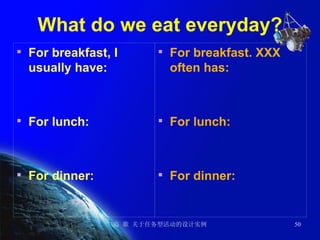
What do we eat everyday? For breakfast, I usually have: For lunch: For dinner:   For breakfast. XXX often has:  For lunch: For dinner:
Second task:  Here is our meal today!  (group work) In a group of five or six students, compare   How many kinds of food that all of the members like? How many kinds of food that few of members like? Discuss why you like or dislike a certain  kind of food Jot down notes for reporting back to the whole class
Operation check points (2) Make sure that   All the students know how to use the language for the task  (pre-task phase) The teacher demonstrates with a few learners for the whole class  (pre-task) Or you can sit in each group to offer help  (teacher’s role during the task) Take notes on learners strength and weakness for language focus later  (as in 3)
Third task:  This is our menu today!   (Group work Option  A ) Ask each two students in each group to plan a breakfast, lunch, dinner respectively for the whole group Talk to all to make sure everybody in the group likes the food. So they have to check with each member that the food they select are their favorite They should write down the menu to report back to the group for consensus
Third task:  My best meals! (Group work Option  B ) Ask each student to write down the best breakfast, lunch and dinner that they would like to have everyday. The teacher must move around to talk with students to offer help or advice The menu should be written down neatly for language accuracy focus
Next Step: Language focus (1) The teacher writes down the problem sentences in certain ways that she/he has observed during the tasks performance Asks students to analyze if they are correct or not ( do not tell them!) Encourages the students to discuss them in pairs or groups again
Language focus (2) Listen to the tape of the text While listening, stop occasionally to ask students to predict the next sentence or missing words   Ask questions about the text Do some exercises based on the texts. Examples of the exercises are on the next pages.
Steps for follow-up activities Students copy the menu of “my best meals” onto their exercise book as homework  (consolidation) Put the homework up on the wall of the classroom for demonstration  (sense of achievement) The students select the best writing for the intranet / broadcast  programs   (sense of achievement)
Considerations PowerPoint document:  what, how to present, for what purpose, where for resources?  Preparing a larger task! Board work design  (for doing tasks)   Teaching aids preparation  Feedback as motivation  (educational) Sense of achievement  (motivation)
PowerPoint document: What:  pictures for visual effect  Where:   www.google.com   ( 图像 ) How:  arrangement as functions When:  elicitation and during the task  Who:  getting targeted
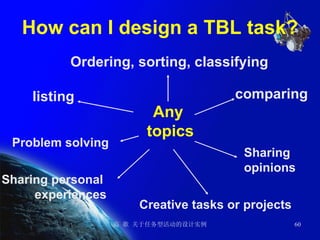
How can I design a TBL task? Ordering, sorting, classifying listing comparing Problem solving Sharing  opinions Sharing personal  experiences Creative tasks or projects Any  topics
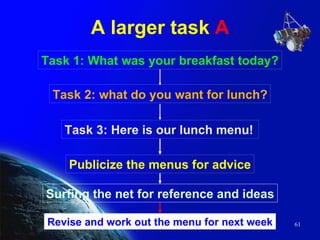
A larger task  A Task 1: What was your breakfast today? Task 2: what do you want for lunch? Task 3: Here is our lunch menu!   Publicize the menus for advice Surfing the net for reference and ideas Revise and work out the menu for next week
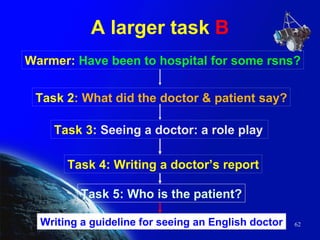
A larger task  B Warmer:  Have been to hospital for some rsns? Task 2 : What did the doctor & patient say? Task 3 : Seeing a doctor: a role play   Task 4: Writing a doctor’s report Task 5: Who is the patient? Writing a guideline for seeing an English doctor
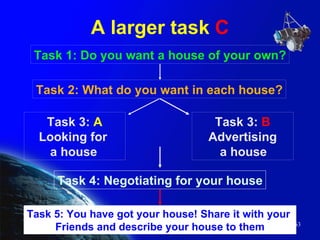
A larger task  C Task 1: Do you want a house of your own? Task 2: What do you want in each house? Task 3:  A Looking for  a house   Task 4: Negotiating for your house Task 5: You have got your house! Share it with your  Friends and describe your house to them Task 3:  B  Advertising a house
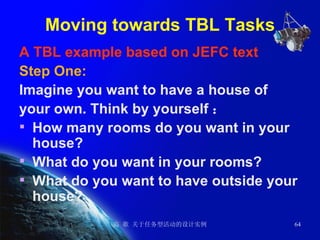
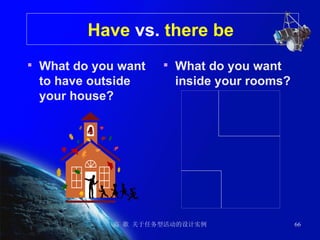
Moving towards TBL Tasks A TBL example based on JEFC text Step One:  Imagine you want to have a house of  your own. Think by yourself : How many rooms do you want in your house? What do you want in your rooms?  What do you want to have outside your house?
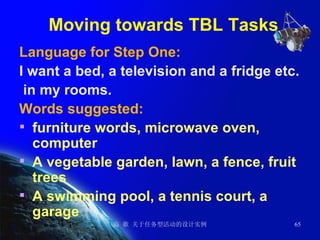
Moving towards TBL Tasks Language for Step One: I want a bed, a television and a fridge etc. in my rooms. Words suggested:   furniture words, microwave oven, computer A vegetable garden, lawn, a fence, fruit trees A swimming pool, a tennis court, a garage
Have   vs.   there be   What do you want to have outside your house? What do you want  inside your rooms?
Progression Steps Step Two:  Mr Green has a house for rent. Now telephone Mr Green and ask: what are there in the house  what are there outside the house  Your phone conversation starts with: (Language for Step Two) Is there … / Are there any … in / beside / behind, in front of  / near …
Progression Steps Step Three: Situation 1 Mr. Green’s house is too expensive and you do not have enough money. However, your friend is rich and of course has a lot of money. Now try to tell your friend how good the house is and ask him to rent the house. The house is very good! There is a big television  inside and there are many trees outside! … You can play … outside … You can watch … in the …
Progression Steps Step Four: Written work: Option One:  Write a newspaper ads. Saying that you are looking for a house and what kind of house you want Option two:  Write an advertisement for Mr. Green in a newspaper. Try to say how good the house is
Progression Steps Step Four: Written work: Option One:  You have rent the house and you are very happy. Now you are writing a letter to your parents telling them how your house is.
Suggestions Never translate: demonstrate  Never explain: act Never make speech: ask questions Never imitate mistakes: correct Never speak with single words: use sentence Never speak too much: make students speak much
Principles Never use the book: use your lesson plan Never jump around: follow your plan Never go too fast: keep the pace of the student Never speak too slowly: speak normally Never speak too quickly: speak naturally Never speak too loudly: speak naturally Never be impatience: take it easy
The dynamic classroom A good lesson plan does not necessarily mean a good result in teaching. Teaching is a moment to moment decision making process, therefore a plan is only a plan The teacher-learner rapport also counts The teacher’s Language proficiency
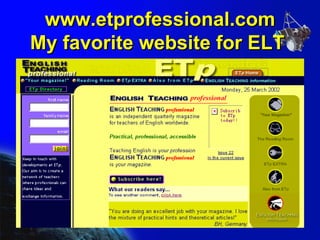
www.etprofessional.com My favorite website for ELT
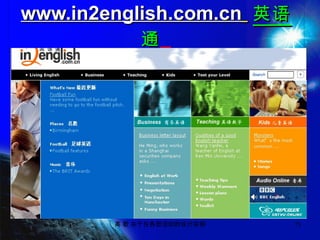
www.in2english.com.cn   英语通
Publications 《 狼来了! 》 -新千年英语教学畅想 教学月刊 中学文科版   2001 年 1 月号 作者: 高 歌
Publications 关于任务型学习活动的思考 教学月刊 中学文科版   2001 年 7 月号 作者: 高 歌
Publications 把课堂的 时间、空间和自由给学生 任务型教学活动的理念、设计与运作 教学月刊 中学文科版   2001 年 8 月号 作者: 高 歌
Presentations 《 教学的魅力在于想象与创新 》 二论任务型学习在现行中学教材中的设计与实践 (教学法系列讲座) 高 歌 浙江省中小学教师培训中心
Presentations Task-Based Learning,  Do I really know you? 三论任务型教学的设计与实践 (教学法系列讲座) 高 歌 浙江省中小学教师培训中心
Presentations A Reflective Approach to Task-based Learning 任务型学习教学教学实例分析 (教学法系列讲座) 高 歌 浙江省中小学教师培训中心
Publications 分享,我们会更好 信息通讯技术下的 ESL 备课与教学设计 (教学法讲座) 高 歌 浙江省中小学教师培训中心

On Task Based Learning Lesson Design

  • 1.
    Designing a TBLPlan Victor GAO Zhejiang Education Institute 2002 05 17
  • 2.
    What is neededfor learning? Jane Willis : Essential conditions: Learning won’t happen unless… Motivation Exposure Opportunities to use the language Desirable conditions : Instruction (it counts but not essential)
  • 3.
    How can wehelp a learner? We cannot really teach language, we can only create conditions with which, language will develop spontaneously in the learners’ mind in its own way.
  • 4.
  • 5.
    This is atask! Did you in the past few weeks: (Understanding what a task is) ask for way to somewhere? identify who is the person in charge of sth.? try to find out who had taken your pen and forgot to return it to you? try to borrow a brand-new bicycle from your friend? work out the best bus-route to a school you haven’t been to? explain to your head teacher why you didn't attend an important meeting last week?
  • 6.
    So a taskis… A task is a piece of work undertaken for oneself or for others, freely or for some reward. It means what people do in everyday life, at work, at play, and in between. ( Long 1985:89 ) 任务是人们在日常生活中所从事的有目的的活动 such as:
  • 7.
    How do Iplan a TBL lesson? Teaching objectives A warmer Task cycle Task demonstration / instruction Doing the task Preparing and giving a report Language focus Follow-up activities Considerations/check points
  • 8.
    1. Pre-task Stage:Teacher prepares the learners in topic, as a vehicle for eliciting the vocabulary 话题 Activate background knowledge, 背景 contextualize, 语境 essential vocabulary, 关键词汇 functional language/verb patterns, 有用的句型 thinking-time, 学生准备的时间 confidence, feeling secure , 信心和安全感的建立
  • 9.
  • 10.
    2 Task-cycle: 2.1.Do the task Learning English by using it, providing spontaneous use with focus in fluency 先在用中学,先只求表达不求精确 Integrated skills are practiced with opportunities for all the participants 一个任务,多技能练习 Individual help becomes possible 教师给予有针对性的帮助
  • 11.
  • 12.
    2 Task-cycle: 2.2. Prepare for the report A task has two roles ( 作用) It is used to prepare formal use of the language for public use, with focusing more on accuracy as well as on fluency. The report planning is assessed, and the organization strategy is practiced.
  • 13.
  • 14.
    2. Task-cycle: 2.3. Give the report Learn English for different purposes by using it (formal delivery of a speech, An oral presentation task, language is rehearsed meaningfully and repeatedly in “ preparing the task and do the task”. “repetition leads to fluency”
  • 15.
  • 16.
    3. Language FocusStage The report to the whole class prompts opportunities for remedial practice to reconstruct the language used in the tasks, to avoid fossilization, Data from the original chat in “do the task” can be recorded and printed-out for remedial practice or reflective use
  • 17.
    Do you havebreakfast everyday?
  • 18.
    Do you havebreakfast everyday? What’s this? It’s porridge Do you have it for breakfast? Yes, I do. How do you like it, very much or a little? Very much. How often do you have it? Everyday.
  • 19.
    Do you havebreakfast everyday? What’s this? It’s a bowl of noodles Do you have it for breakfast? Yes, I do. How do you like it, very much or a little? A little. How often do you have it? Once a week.
  • 20.
    A motto toremember Meaningful repetition leads to fluency The repetition has to be meaningful, contextualized, in use and authentic
  • 21.
    Which is yourbreakfast today?
  • 22.
    Which one doyou want for breakfast tomorrow ?
  • 23.
    Which are yourfavorite vegetables?
  • 24.
    What vegetables do you like for lunch today ? Bill, what vegetable do you like for lunch today? I like … tomatoes and potatoes. Sandy, what color is this? Do you like (the vege?) Green / red. Good! I like red too. Lucy, how do you like eggplants? Very much or a little? A little. All right. I don’t like it at all. I like cabbages. John, do you like cabbages? Yes. I do. How often do you have it? Everyday. Great! Me too.
  • 25.
    What do youlike for a drink after class ?
  • 26.
    Which drink youlike best? Lily, what’s this drink in English? How often do you have it? Tom, how do you like milk? A lot or a little? Really? I don’t like it at all. What about you Meimei? How often do you … Milk Everyday. Very much. A little.
  • 27.
    Which one doyou like for lunch ? Which one do you like for dinner ?
  • 28.
    Do you likehamburgers?
  • 29.
    Do you like Chinese Breakfast? How do you like this Chinese breakfast? A little or very much? If not, what do you want to have for your Chinese breakfast?
  • 30.
    What breakfast isthis? Is this a Chinese breakfast? No. it isn’t. it is an ______ breakfast What can you see here? Eggs, bacon, chips sausages, tomato, mushrooms. How do you like it? Do you want to have it for breakfast? How often do you want to …
  • 31.
  • 32.
    Is this an English breakfast? Is this a Chinese breakfast? No. it isn’t. it is an European breakfast What can you see here? Different cakes, watermelon, butter,bacon, some pie, pineapples, mushrooms. How do you like it? Do you want to have it for breakfast? How often do you want to …
  • 33.
  • 34.
    Teaching objectives Languagestructures: Do you like …? I like … … very much/a lot, a little I don’t like … at all What about you/your father? What does he/she like to eat? What food does/doesn’t you/he like? Where is he from? Where do you usually like to eat? What food do you often like to eat? Why do you like …? Because …
  • 35.
    Option for Structure:Asking one’s preference: Do you like …? What about her? What does he/she like to eat? What food does/doesn't he like? Why do you like …? Because … Express opinions: I like … … very much, a little I don’t like … at all. Asking one’s routine or habits Where do you usually like to eat? What food do you often like to eat? Where is he from?
  • 36.
    Warming up (1) Asking about students’ breakfast (Starting from the learners’ personal experience) Alice, do you usually have breakfast in the morning? (Asking about one’s routine) When do you have it? (developing) What do you have for breakfast? (Eliciting the vocabulary needed for tasks later)
  • 37.
    Warming up (2) Asking about students’ breakfast Jane, what about you? (Comparing preferences between learners) I usually have … for breakfast. (Teacher participates to built up the rapport.) John, do you like … for breakfast? Billy, what about you? (To get more students involved in the discussion)
  • 38.
    From warming-up to opinion exchange Asking about students’ lunch: Diana, what do you usually have for lunch? (To elicit more vocabulary for later use) What food you don’t like for lunch? Why? (Try to elicit some adjectives for reasons) John, do you like … for lunch? Billy, what about you? (To get more students involved in the discussion)
  • 39.
    Function: Opinion comparison Asking about students’ dinner: Diana, what do you usually have for lunch (to elicit more vocab for later use) What kind of food you don’t like for dinner? (vocabulary practice) Why? (try to elicit some adjectives for reasons) John, do you like … for dinner? Billy, what about you? (to get more students involved in the discussion)
  • 40.
    What do youhave for breakfast?
  • 41.
    Does she likenoodles or dumplings?
  • 42.
    Do you likeEnglish breakfast?
  • 43.
    Do you likehamburgers for lunch ?
  • 44.
    What do youlike for dinner ?
  • 45.
    Which is yourfavorite vegetables ?
  • 46.
    What does yourfriend like to eat today ?
  • 47.
    What do youlike for a drink today ?
  • 48.
    Operation check pointsMake sure that all the vocabulary are on the board in certain categories Then ask students to exchange opinions on food Demonstrate this activity to students Followed by asking some learners to act as models for the rest List the verb patterns for the next activities
  • 49.
    Task 1: Yours and mine (pair work) Clear instructions by the teacher: Please write down the kinds of food you usually have for breakfast, lunch and dinner. Now please ask your desk mate what he/she often has for breakfast, lunch and dinner Put these food down on the left-hand side of the sheet. What are the food that both of you like? What are the food that one of you likes?
  • 50.
    What do weeat everyday? For breakfast, I usually have: For lunch: For dinner: For breakfast. XXX often has: For lunch: For dinner:
  • 51.
    Second task: Here is our meal today! (group work) In a group of five or six students, compare How many kinds of food that all of the members like? How many kinds of food that few of members like? Discuss why you like or dislike a certain kind of food Jot down notes for reporting back to the whole class
  • 52.
    Operation check points(2) Make sure that All the students know how to use the language for the task (pre-task phase) The teacher demonstrates with a few learners for the whole class (pre-task) Or you can sit in each group to offer help (teacher’s role during the task) Take notes on learners strength and weakness for language focus later (as in 3)
  • 53.
    Third task: This is our menu today! (Group work Option A ) Ask each two students in each group to plan a breakfast, lunch, dinner respectively for the whole group Talk to all to make sure everybody in the group likes the food. So they have to check with each member that the food they select are their favorite They should write down the menu to report back to the group for consensus
  • 54.
    Third task: My best meals! (Group work Option B ) Ask each student to write down the best breakfast, lunch and dinner that they would like to have everyday. The teacher must move around to talk with students to offer help or advice The menu should be written down neatly for language accuracy focus
  • 55.
    Next Step: Languagefocus (1) The teacher writes down the problem sentences in certain ways that she/he has observed during the tasks performance Asks students to analyze if they are correct or not ( do not tell them!) Encourages the students to discuss them in pairs or groups again
  • 56.
    Language focus (2)Listen to the tape of the text While listening, stop occasionally to ask students to predict the next sentence or missing words Ask questions about the text Do some exercises based on the texts. Examples of the exercises are on the next pages.
  • 57.
    Steps for follow-upactivities Students copy the menu of “my best meals” onto their exercise book as homework (consolidation) Put the homework up on the wall of the classroom for demonstration (sense of achievement) The students select the best writing for the intranet / broadcast programs (sense of achievement)
  • 58.
    Considerations PowerPoint document: what, how to present, for what purpose, where for resources? Preparing a larger task! Board work design (for doing tasks) Teaching aids preparation Feedback as motivation (educational) Sense of achievement (motivation)
  • 59.
    PowerPoint document: What: pictures for visual effect Where: www.google.com ( 图像 ) How: arrangement as functions When: elicitation and during the task Who: getting targeted
  • 60.
    How can Idesign a TBL task? Ordering, sorting, classifying listing comparing Problem solving Sharing opinions Sharing personal experiences Creative tasks or projects Any topics
  • 61.
    A larger task A Task 1: What was your breakfast today? Task 2: what do you want for lunch? Task 3: Here is our lunch menu! Publicize the menus for advice Surfing the net for reference and ideas Revise and work out the menu for next week
  • 62.
    A larger task B Warmer: Have been to hospital for some rsns? Task 2 : What did the doctor & patient say? Task 3 : Seeing a doctor: a role play Task 4: Writing a doctor’s report Task 5: Who is the patient? Writing a guideline for seeing an English doctor
  • 63.
    A larger task C Task 1: Do you want a house of your own? Task 2: What do you want in each house? Task 3: A Looking for a house Task 4: Negotiating for your house Task 5: You have got your house! Share it with your Friends and describe your house to them Task 3: B Advertising a house
  • 64.
    Moving towards TBLTasks A TBL example based on JEFC text Step One: Imagine you want to have a house of your own. Think by yourself : How many rooms do you want in your house? What do you want in your rooms? What do you want to have outside your house?
  • 65.
    Moving towards TBLTasks Language for Step One: I want a bed, a television and a fridge etc. in my rooms. Words suggested: furniture words, microwave oven, computer A vegetable garden, lawn, a fence, fruit trees A swimming pool, a tennis court, a garage
  • 66.
    Have vs. there be What do you want to have outside your house? What do you want inside your rooms?
  • 67.
    Progression Steps StepTwo: Mr Green has a house for rent. Now telephone Mr Green and ask: what are there in the house what are there outside the house Your phone conversation starts with: (Language for Step Two) Is there … / Are there any … in / beside / behind, in front of / near …
  • 68.
    Progression Steps StepThree: Situation 1 Mr. Green’s house is too expensive and you do not have enough money. However, your friend is rich and of course has a lot of money. Now try to tell your friend how good the house is and ask him to rent the house. The house is very good! There is a big television inside and there are many trees outside! … You can play … outside … You can watch … in the …
  • 69.
    Progression Steps StepFour: Written work: Option One: Write a newspaper ads. Saying that you are looking for a house and what kind of house you want Option two: Write an advertisement for Mr. Green in a newspaper. Try to say how good the house is
  • 70.
    Progression Steps StepFour: Written work: Option One: You have rent the house and you are very happy. Now you are writing a letter to your parents telling them how your house is.
  • 71.
    Suggestions Never translate:demonstrate Never explain: act Never make speech: ask questions Never imitate mistakes: correct Never speak with single words: use sentence Never speak too much: make students speak much
  • 72.
    Principles Never usethe book: use your lesson plan Never jump around: follow your plan Never go too fast: keep the pace of the student Never speak too slowly: speak normally Never speak too quickly: speak naturally Never speak too loudly: speak naturally Never be impatience: take it easy
  • 73.
    The dynamic classroomA good lesson plan does not necessarily mean a good result in teaching. Teaching is a moment to moment decision making process, therefore a plan is only a plan The teacher-learner rapport also counts The teacher’s Language proficiency
  • 74.
  • 75.
  • 76.
    Publications 《 狼来了!》 -新千年英语教学畅想 教学月刊 中学文科版 2001 年 1 月号 作者: 高 歌
  • 77.
    Publications 关于任务型学习活动的思考 教学月刊中学文科版 2001 年 7 月号 作者: 高 歌
  • 78.
    Publications 把课堂的 时间、空间和自由给学生任务型教学活动的理念、设计与运作 教学月刊 中学文科版 2001 年 8 月号 作者: 高 歌
  • 79.
    Presentations 《 教学的魅力在于想象与创新》 二论任务型学习在现行中学教材中的设计与实践 (教学法系列讲座) 高 歌 浙江省中小学教师培训中心
  • 80.
    Presentations Task-Based Learning, Do I really know you? 三论任务型教学的设计与实践 (教学法系列讲座) 高 歌 浙江省中小学教师培训中心
  • 81.
    Presentations A ReflectiveApproach to Task-based Learning 任务型学习教学教学实例分析 (教学法系列讲座) 高 歌 浙江省中小学教师培训中心
  • 82.
    Publications 分享,我们会更好 信息通讯技术下的ESL 备课与教学设计 (教学法讲座) 高 歌 浙江省中小学教师培训中心