




Principles of Effective Teaching & Assessmen
1
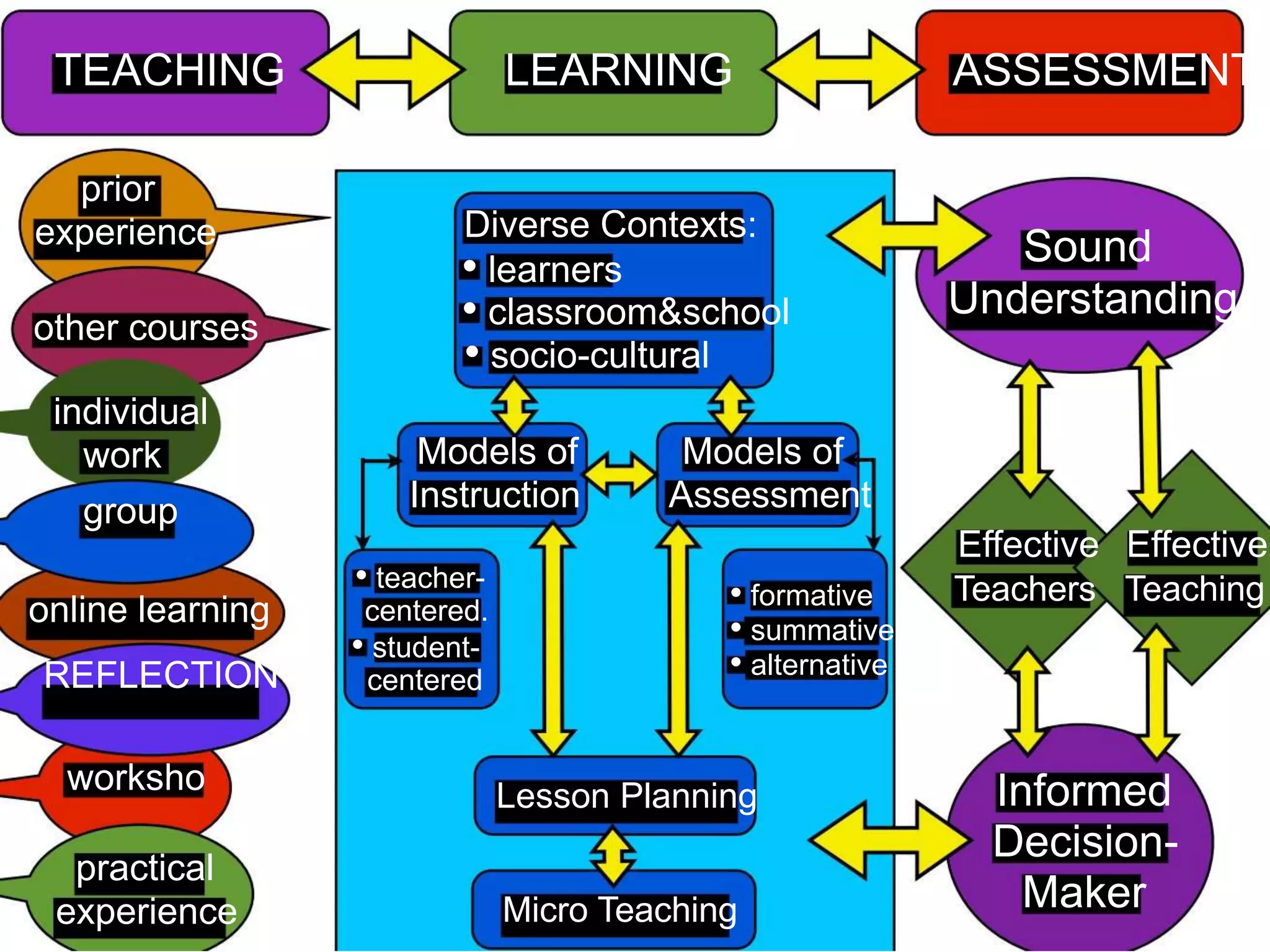
TEACHING
prior
experience
other courses
individual
work
group
LEARNING
Diverse Contexts:
• learners
• classroom&school
• socio-cultural
Models of Models of
Instruction Assessment
• teacher-
ASSESSMENT
Sound
Understanding
Effective Effective
online learning
REFLECTION
worksho
practical
experience
centered.
• student-
centered
• formative
• summative
• alternative
Lesson Planning
Micro Teaching
Teachers Teaching
Informed
Decision-
Maker
On becoming a teacher:
• Who or what motivates you?
• Who or what inspires you?
• Do you see yourself as a teacher now? If yes, what
do you think of yourself as a teacher?
• What are your goals as a teacher ?
4
About your teachers
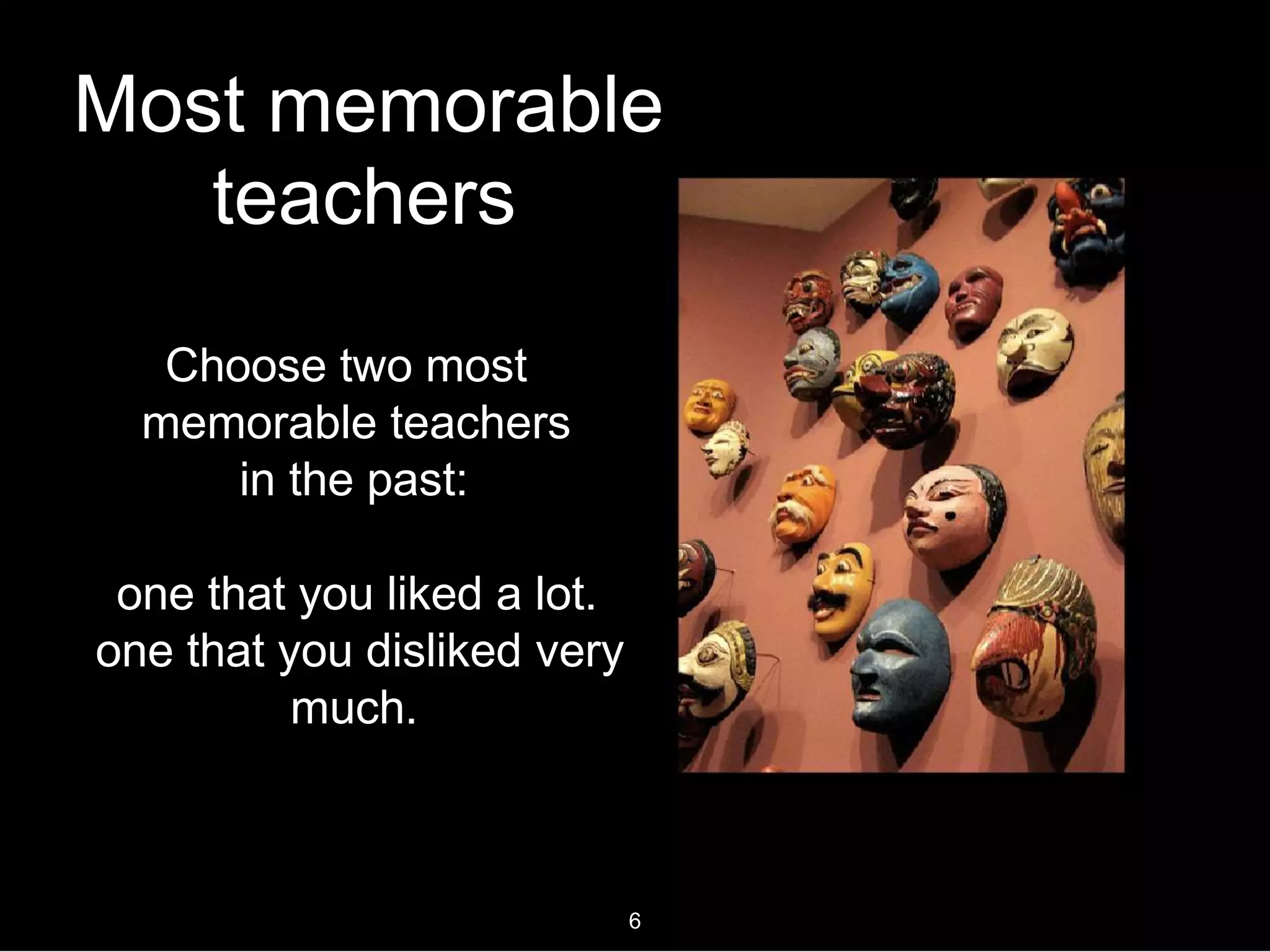
Most memorable
teachers
Choose two most
memorable teachers
in the past:
one that you liked a lot.
one that you disliked very
much.
6
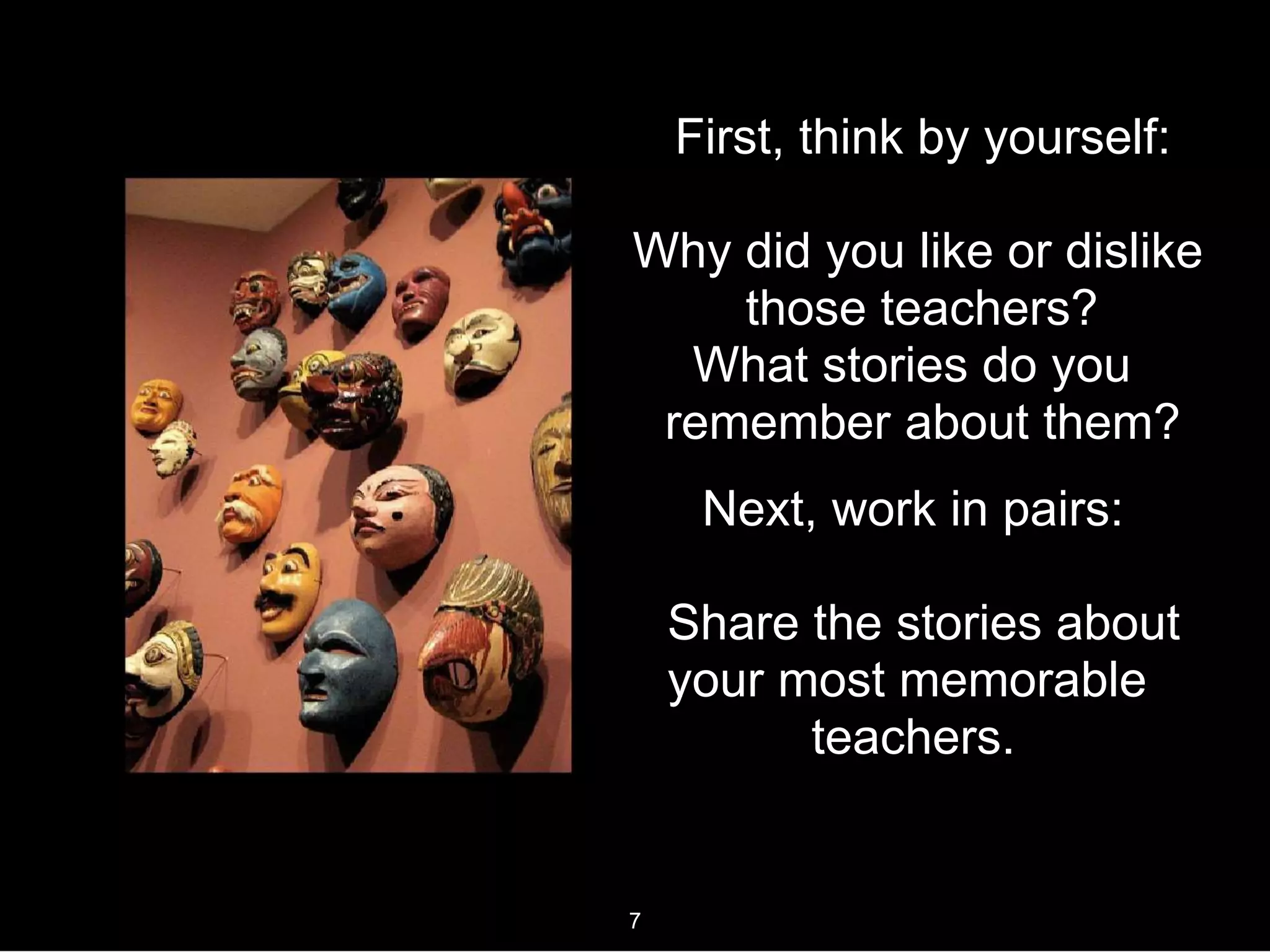
First, think by yourself:
Why did you like or dislike
those teachers?
What stories do you
remember about them?
Next, work in pairs:
Share the stories about
your most memorable
teachers.
7
Effective Teaching?
Do you think those teachers taught effectively or not?
Explain your answers.
What are the characteristics of effective teaching based on
your past experiences?
8
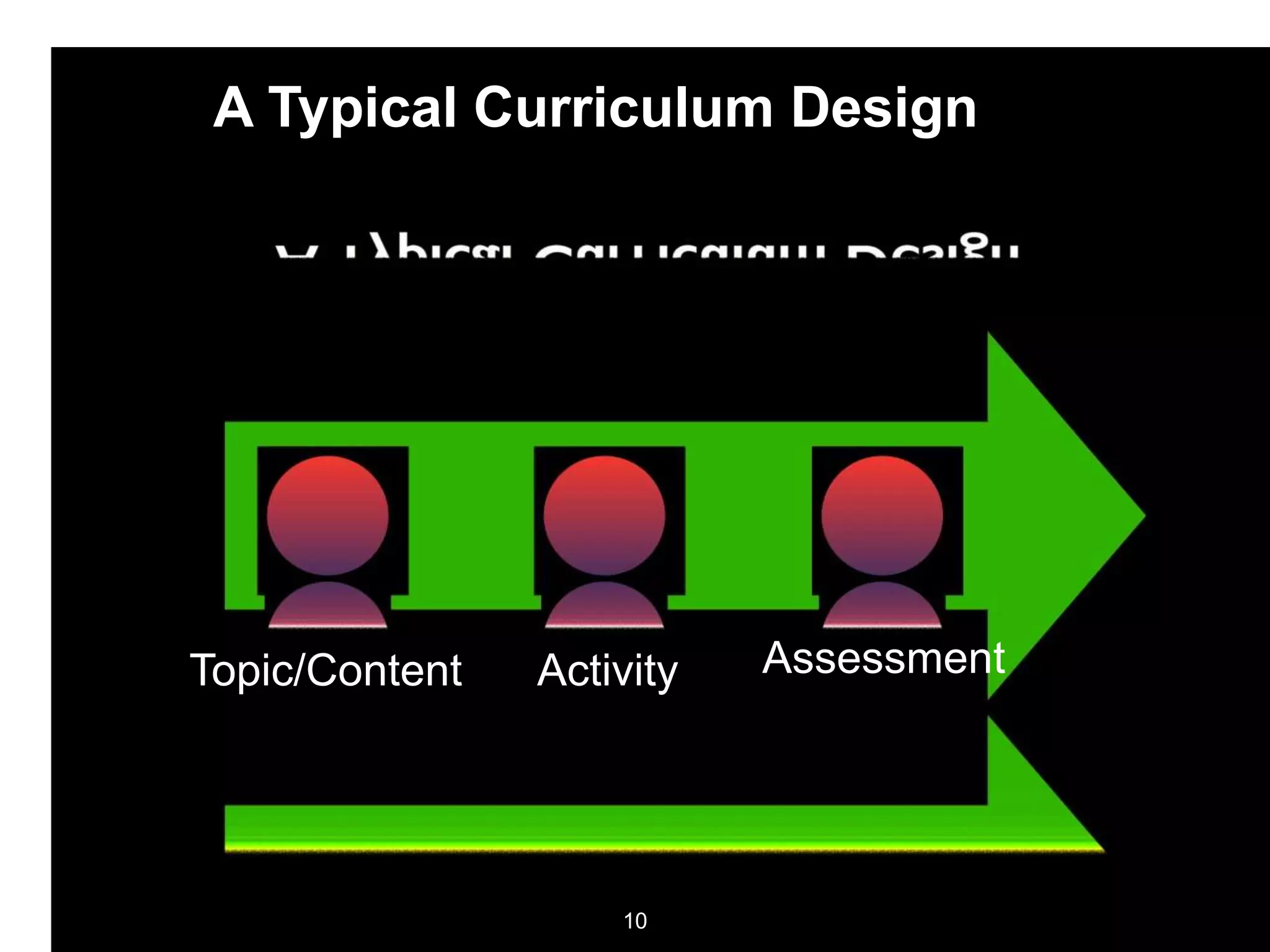
A Typical Curriculum Design
Topic/Content Activity Assessment
10
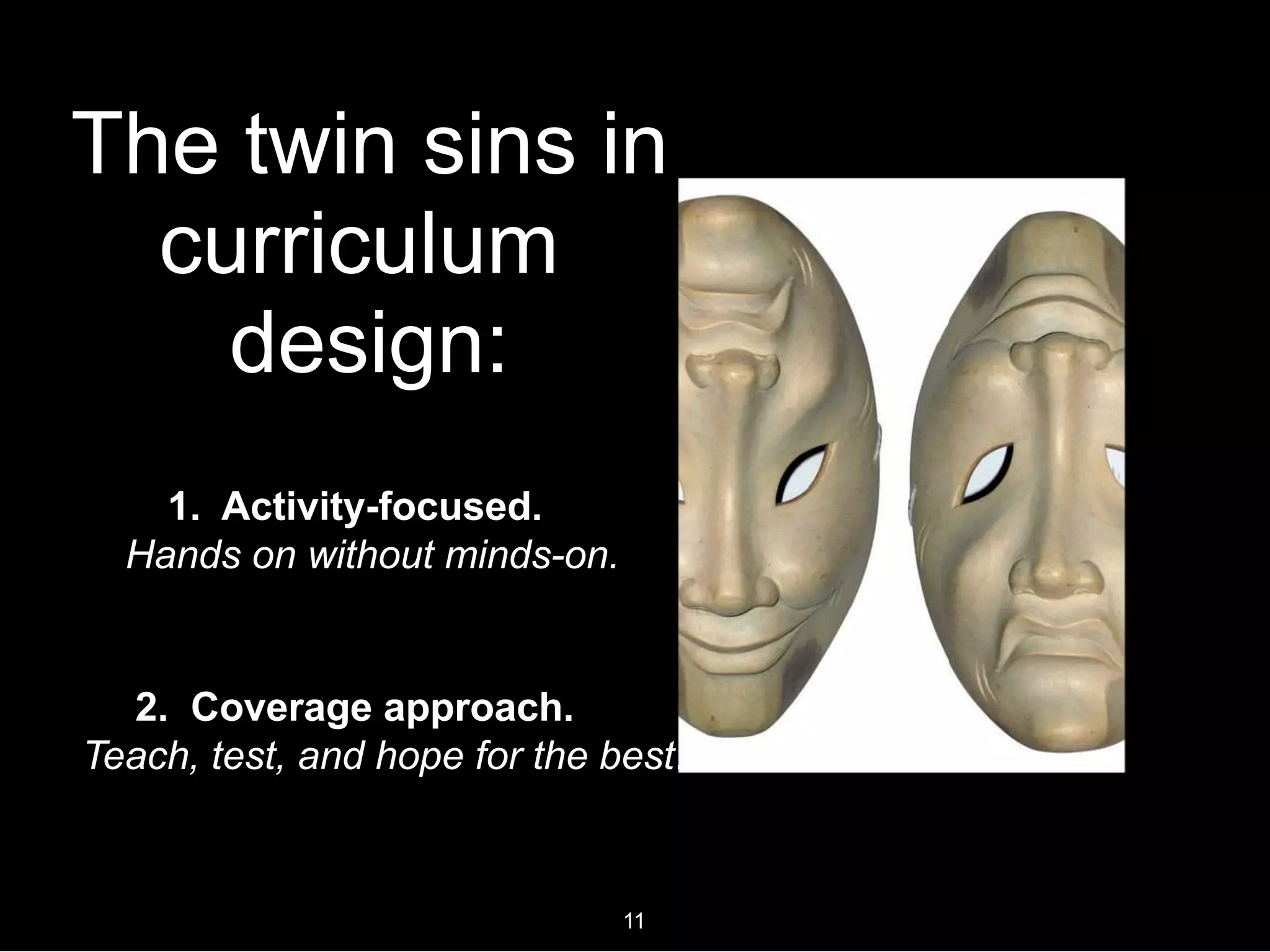
The twin sins in
curriculum
design:
1. Activity-focused.
Hands on without minds-on.
2. Coverage approach.
Teach, test, and hope for the best.
11
Concepts of Learning
(Marton et al., 1993)
• Getting more knowledge.
• Memorizing and reproducing.
•Applying facts and procedures.
• Understanding.
• Seeing something in a different way.
• Changing as a person.
Models of Learning
(Watkins, Carnell, & Lodge, 2007)
• RECEPTION. “Learning = being taught.”
Concerned with quantity, facts, skills; assumes transmission of knowledge fr
an external source (e.g. teacher). Emotional & social aspects are not attende
to.
• CONSTRUCTION. “Learning = individual sense-making.”
Concerned with the learner’s construction of meaning through discussion,
discovery, open-ended learning, making connections.
• CO-CONSTRUCTION. “Learning = building knowledge with others.”
Concerned with the learner’s construction of meaning through interaction &
collaboration with others, especially through dialogue.
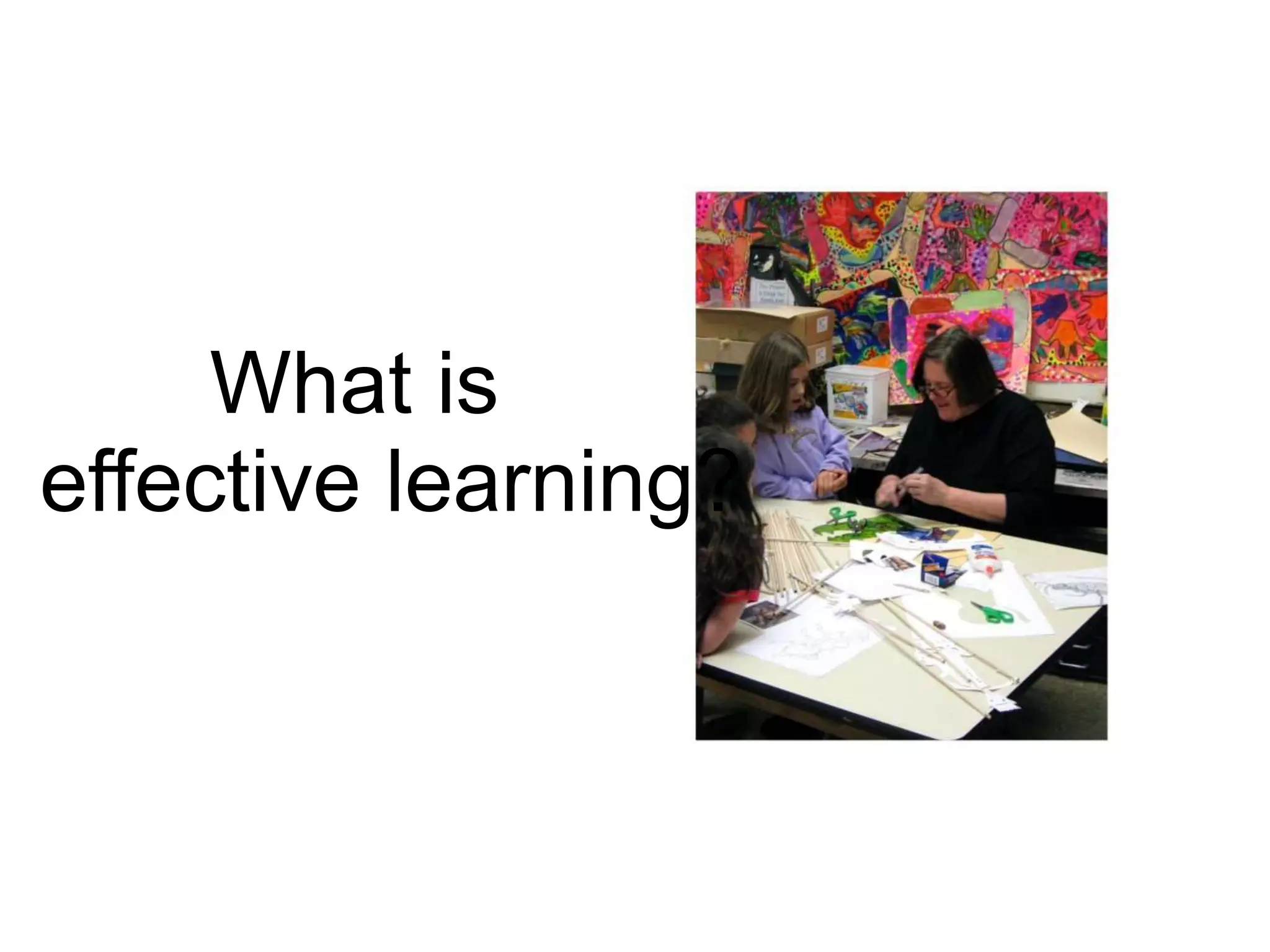
What is
effective learning?
Effective learning is...
(Watkins, Carnell, & Lodge, 2007)
• an activity of construction.
• handled with (or in the context of) others.
• driven by the learner.
• the monitoring and review of the
effectiveness of approaches & strategies for
the goals and context.
An effective learner ...
(Watkins, Carnell, & Lodge, 2007)
• is active and strategic.
• is skilled in collaboration.
• takes responsibility for their learning.
• understands her/his learning and plans,
monitors and reflects on their learning.
An effective teaching is
the teaching that
makes effective learning happen.
An effective teaching is
empowering learners
to become effective learners.
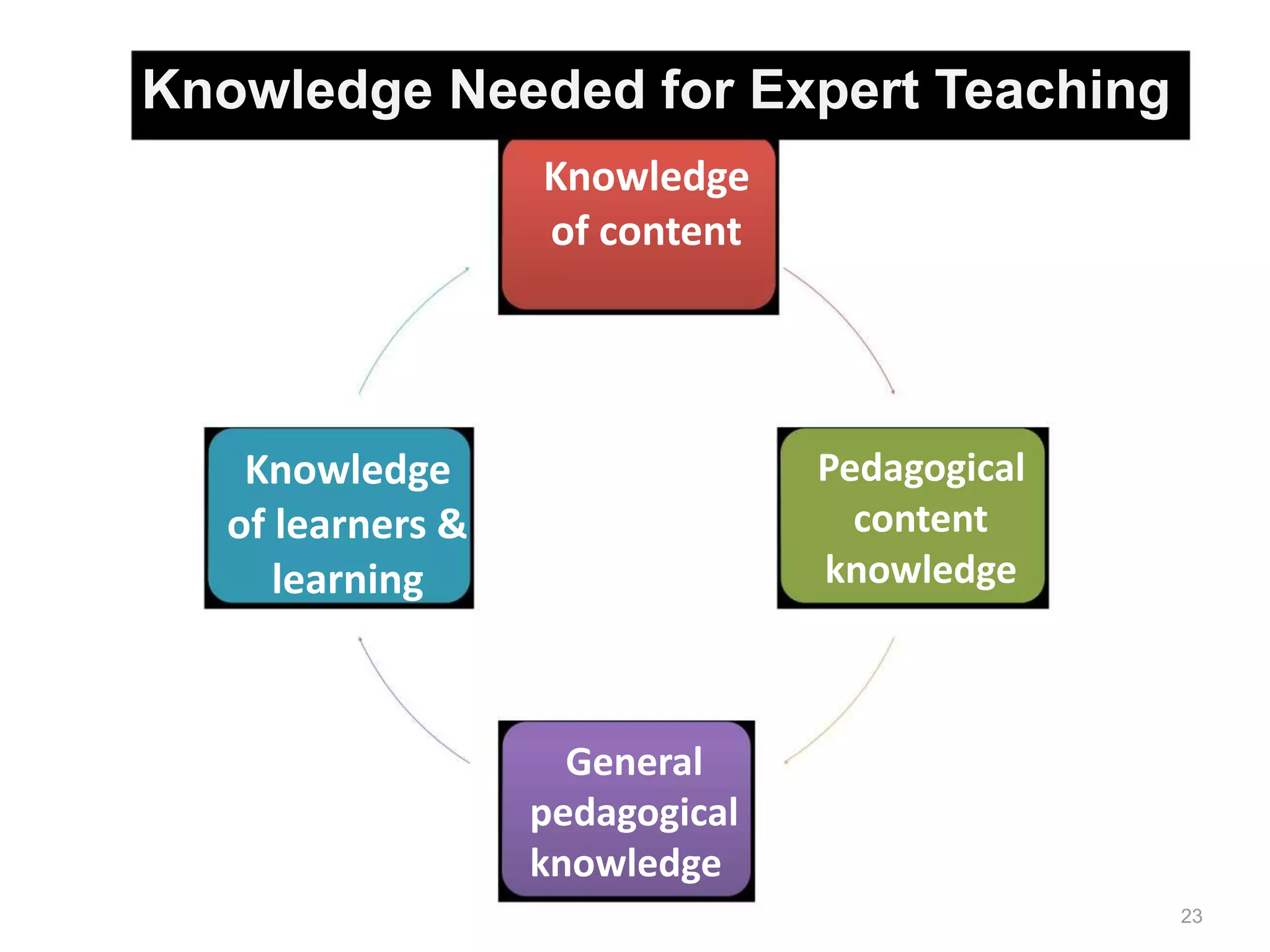
Knowledge Needed for Expert Teaching
Knowledge
of content
Knowledge
of learners &
learning
General
pedagogical
knowledge
Pedagogical
content
knowledge
23
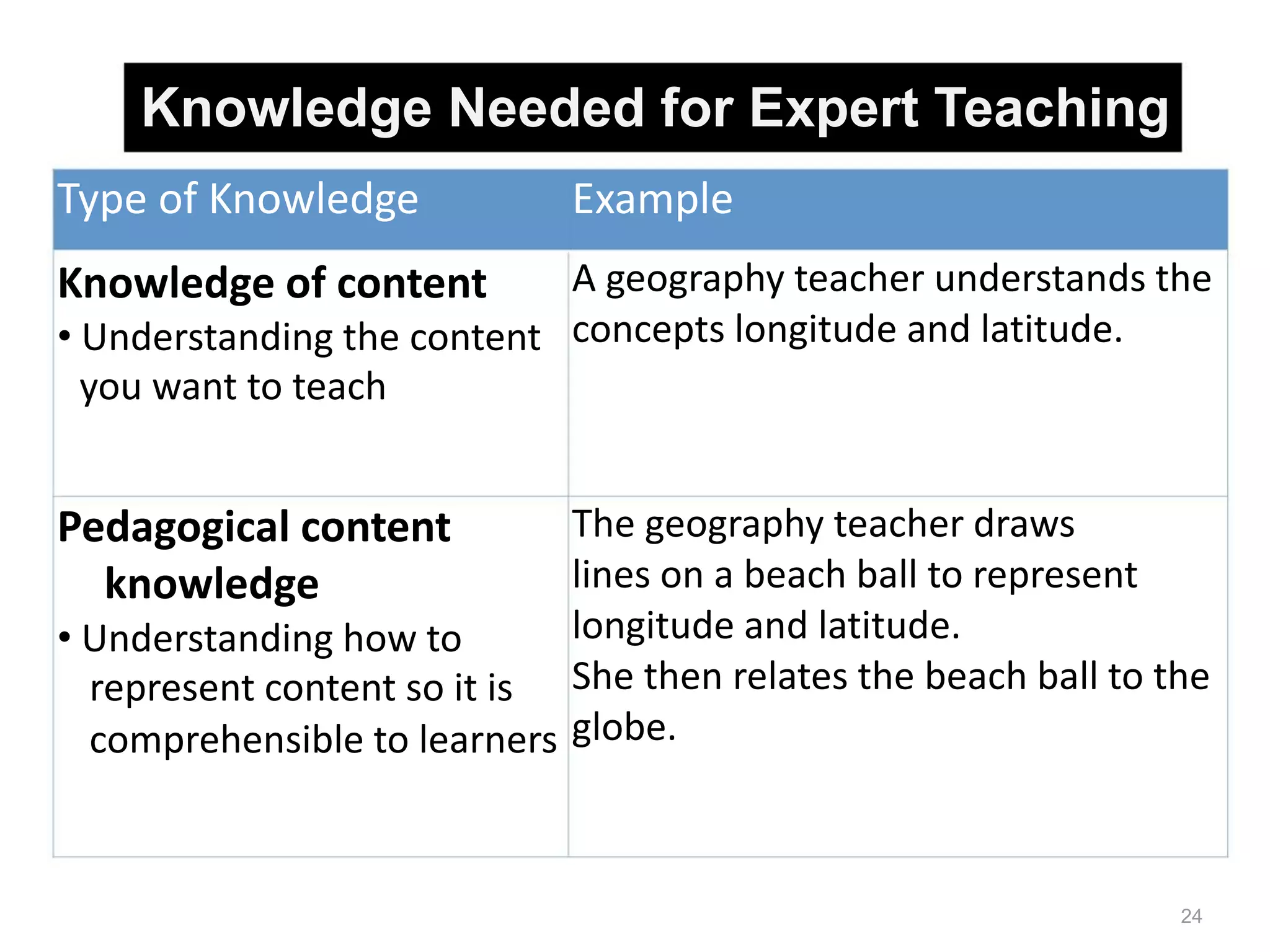
Knowledge Needed for Expert Teaching
Type of Knowledge Example
Knowledge of content
• Understanding the content
you want to teach
Pedagogical content
knowledge
• Understanding how to
represent content so it is
comprehensible to learners
A geography teacher understands the
concepts longitude and latitude.
The geography teacher draws
lines on a beach ball to represent
longitude and latitude.
She then relates the beach ball to the
globe.
24
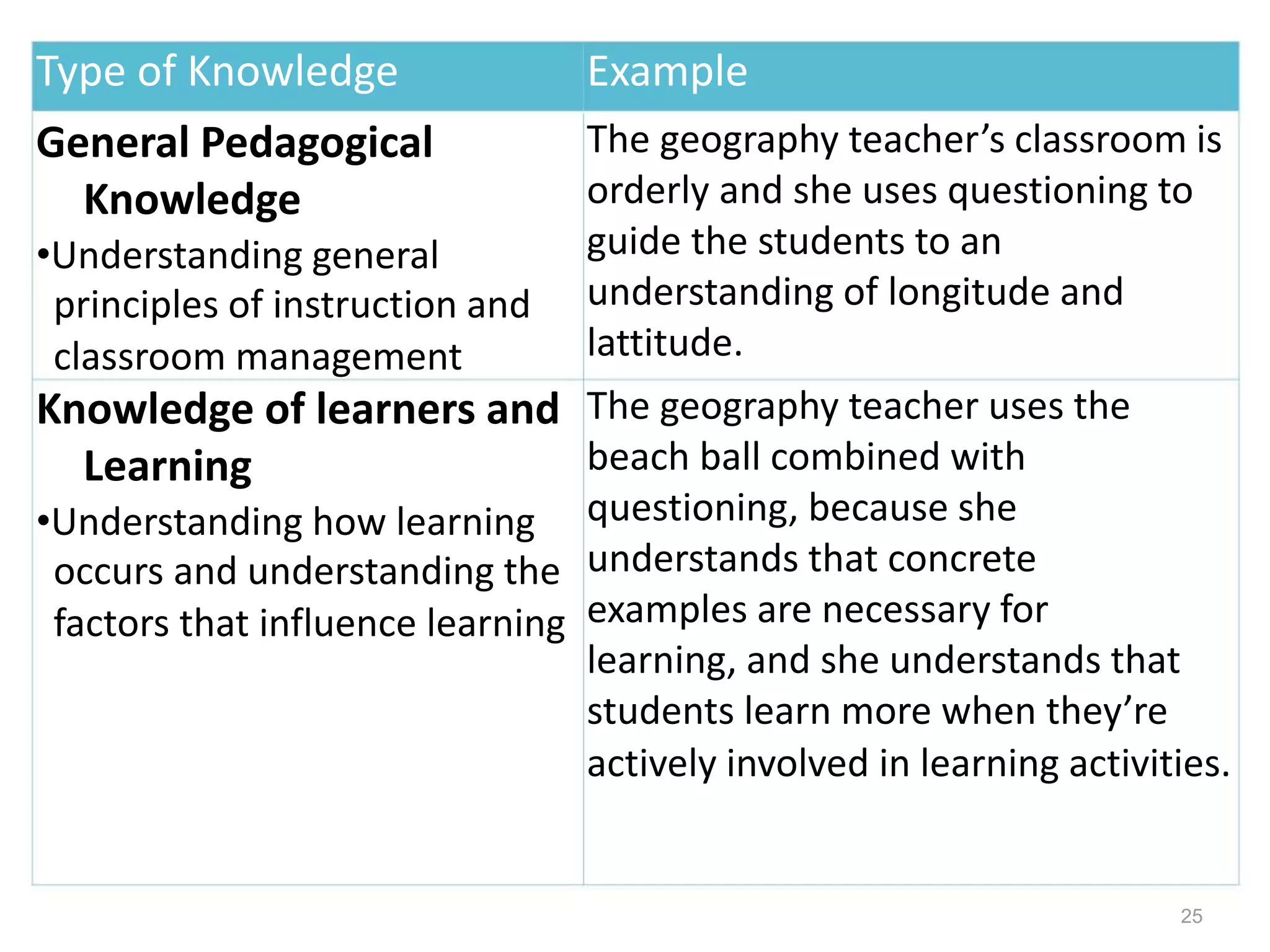
Type of Knowledge Example
General Pedagogical
Knowledge
•Understanding general
principles of instruction and
classroom management
Knowledge of learners and
Learning
•Understanding how learning
occurs and understanding the
factors that influence learning
The geography teacher’s classroom is
orderly and she uses questioning to
guide the students to an
understanding of longitude and
lattitude.
The geography teacher uses the
beach ball combined with
questioning, because she
understands that concrete
examples are necessary for
learning, and she understands that
students learn more when they’re
actively involved in learning activities.
25
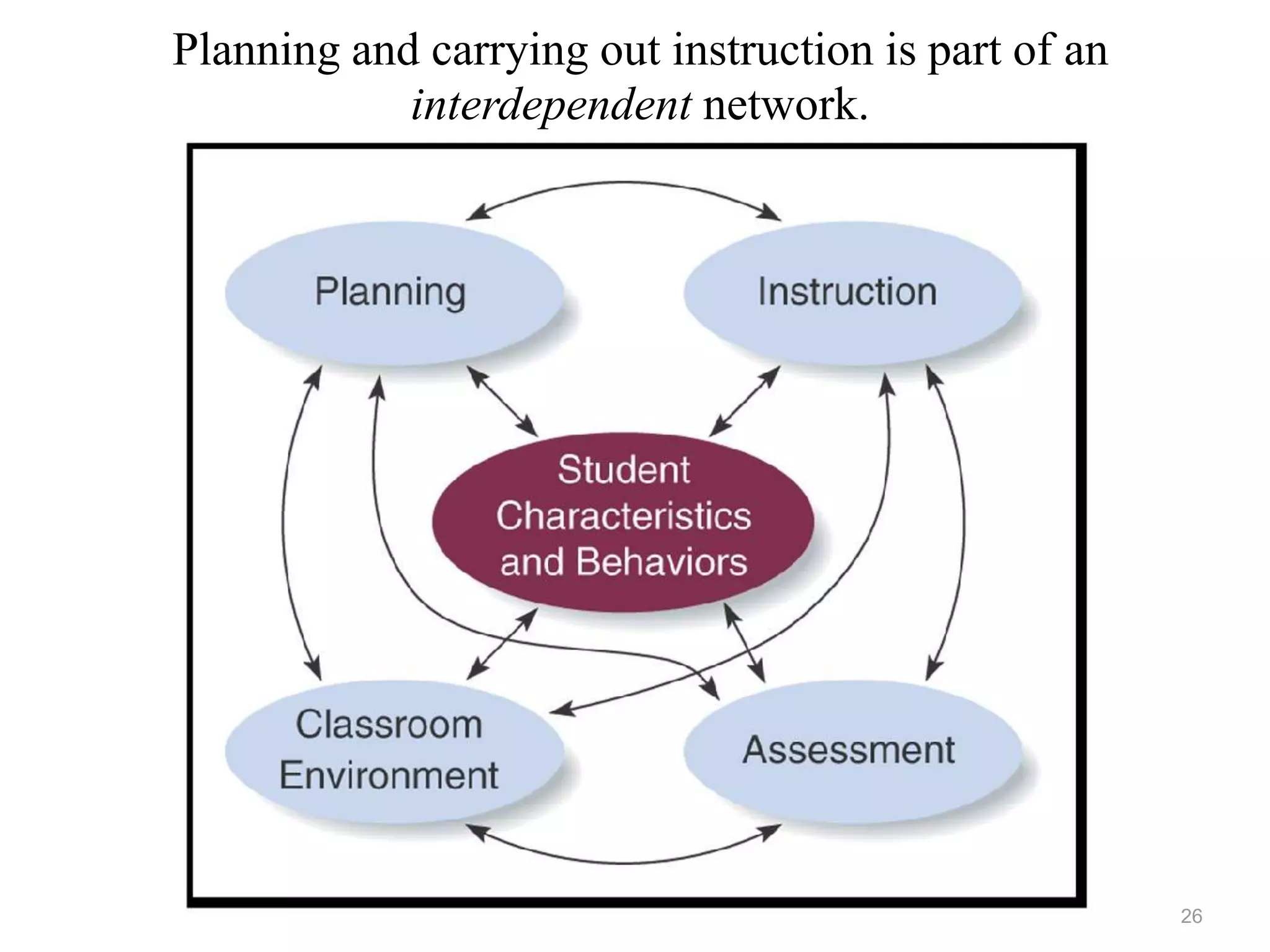
Planning and carrying out instruction is part of an
interdependent network.
26
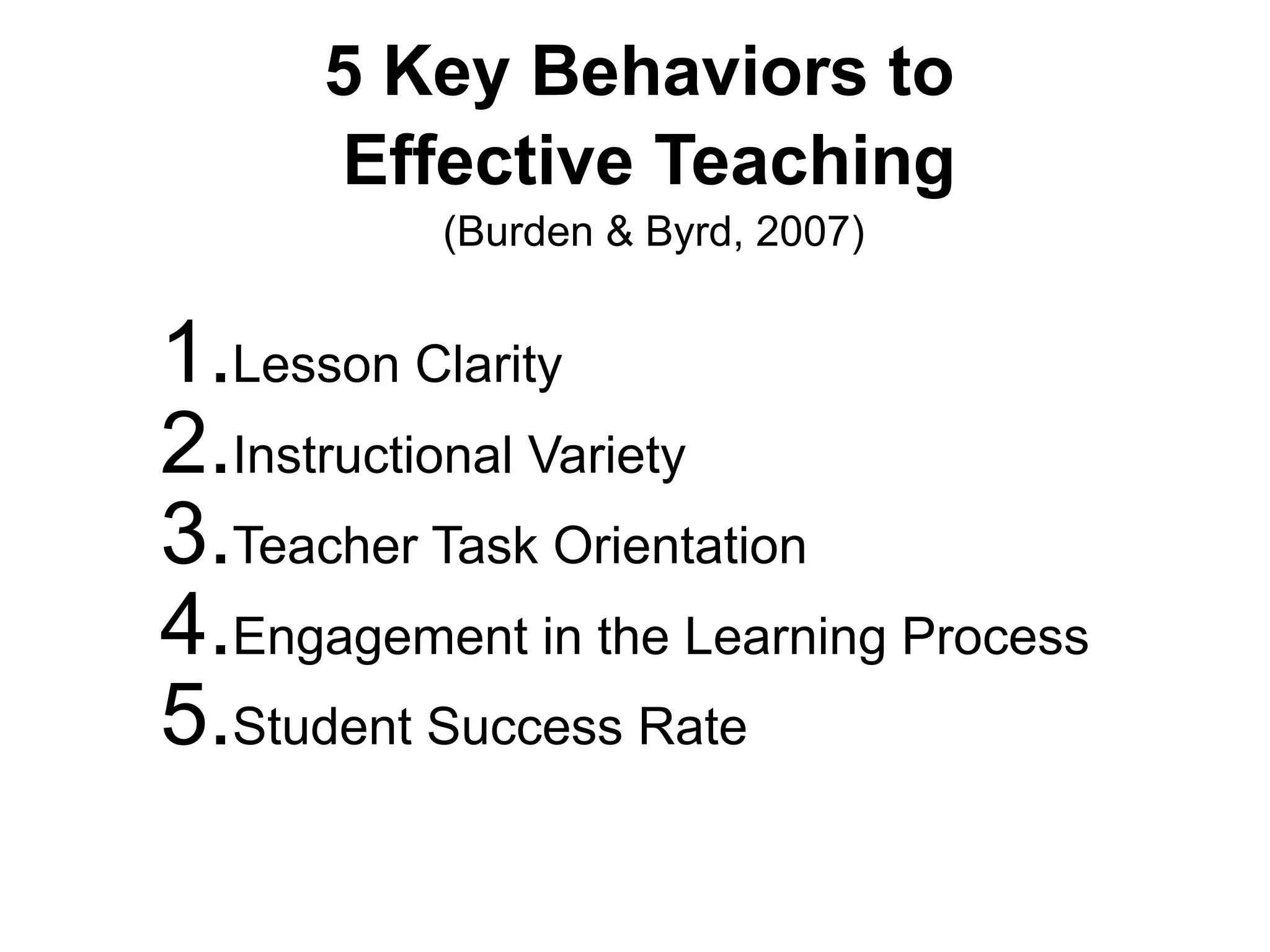
5 Key Behaviors to
Effective Teaching
(Burden & Byrd, 2007)
1.Lesson Clarity
2.Instructional Variety
3.Teacher Task Orientation
4.Engagement in the Learning Process
5.Student Success Rate
1. Lesson Clarity
• Make their positions clear to learners.
• Explain concepts in ways that help students
follow along in a logical step-by-step order.
• Have an oral delivery that is direct, audible
to all students.
2. Instructional Variety
• Refers to variability and flexibility of
delivery of a lesson.
• Includes the use of learning materials,
equipment, displays and space in the
classroom.
• Includes the variety of models of
instruction.
3. Teacher Task Orientation
• Refers to how much classroom time the
teacher devotes to teaching.
• Highly conversant with topics likely to
appear on assessments.
• Provide students with the greatest
possibility to learn and to practice the
material.
4. Engagement in
the Learning Process
• Refers to the time students actively
engaged in learning.
• When students jump out of their seats, talk,
read a magazine, or leave for the rest room,
they are obviously not engaged in instruction.
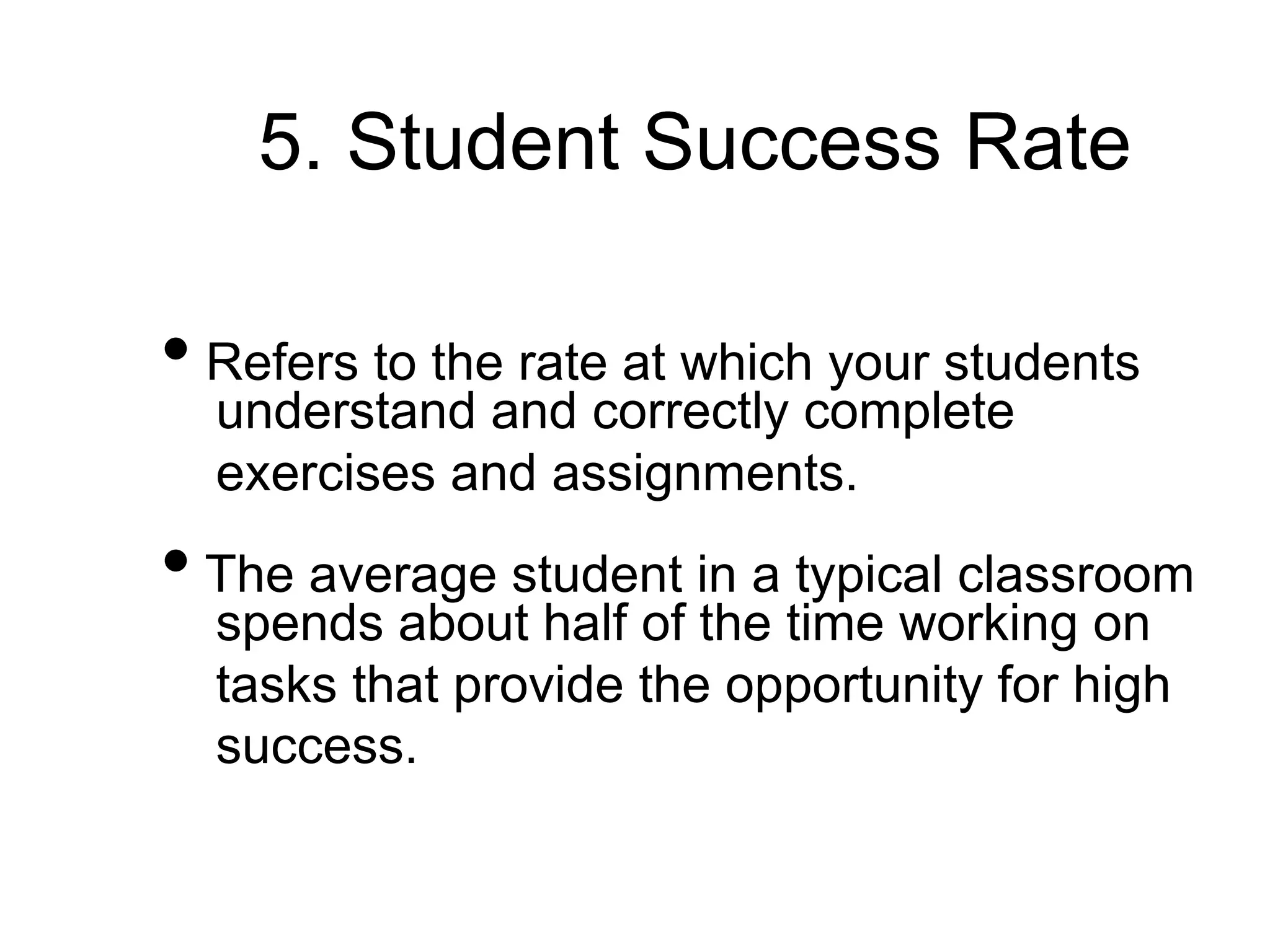
5. Student Success Rate
• Refers to the rate at which your students
understand and correctly complete
exercises and assignments.
• The average student in a typical classroom
spends about half of the time working on
tasks that provide the opportunity for high
success.
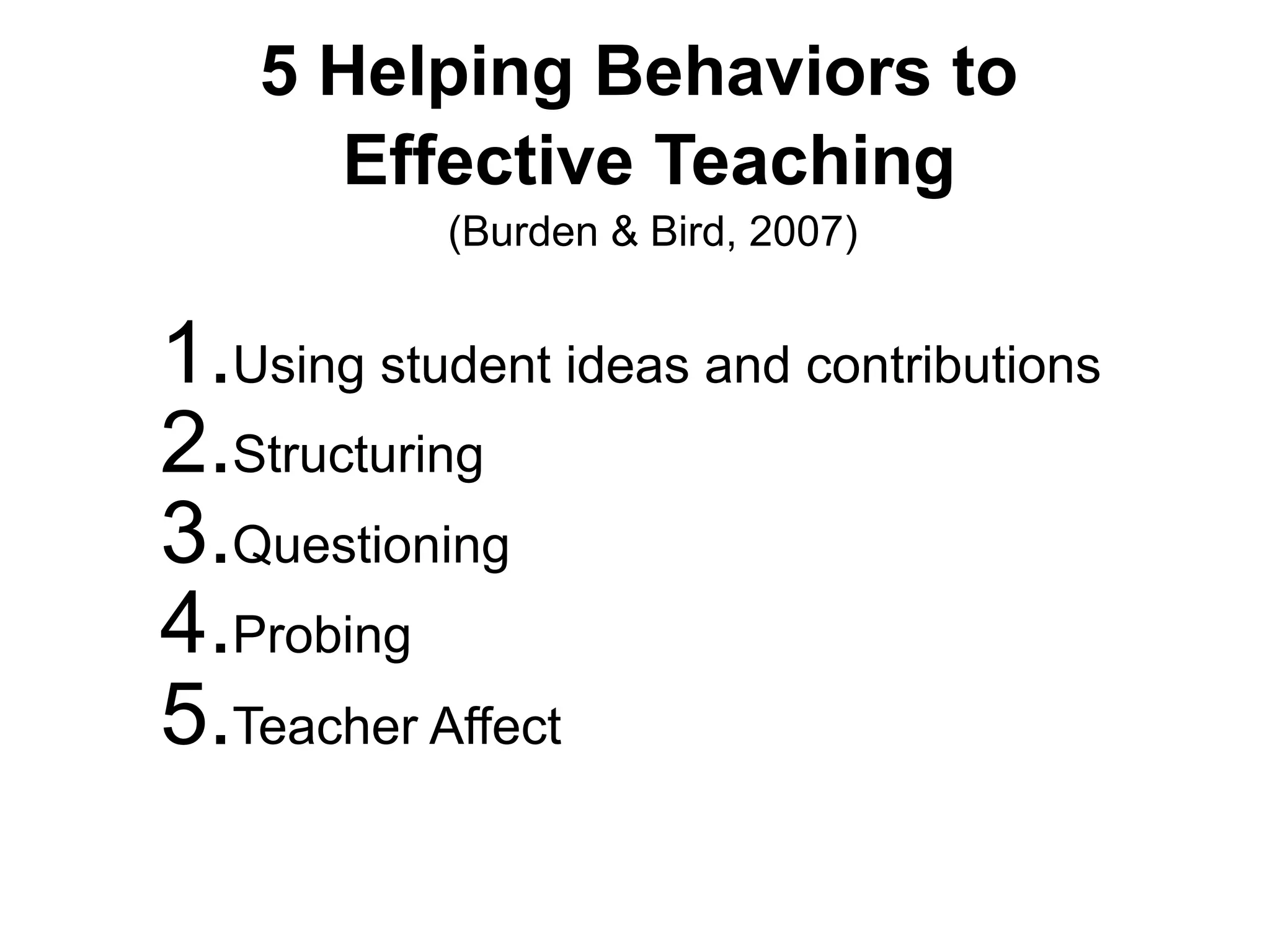
5 Helping Behaviors to
Effective Teaching
(Burden & Bird, 2007)
1.Using student ideas and contributions
2.Structuring
3.Questioning
4.Probing
5.Teacher Affect
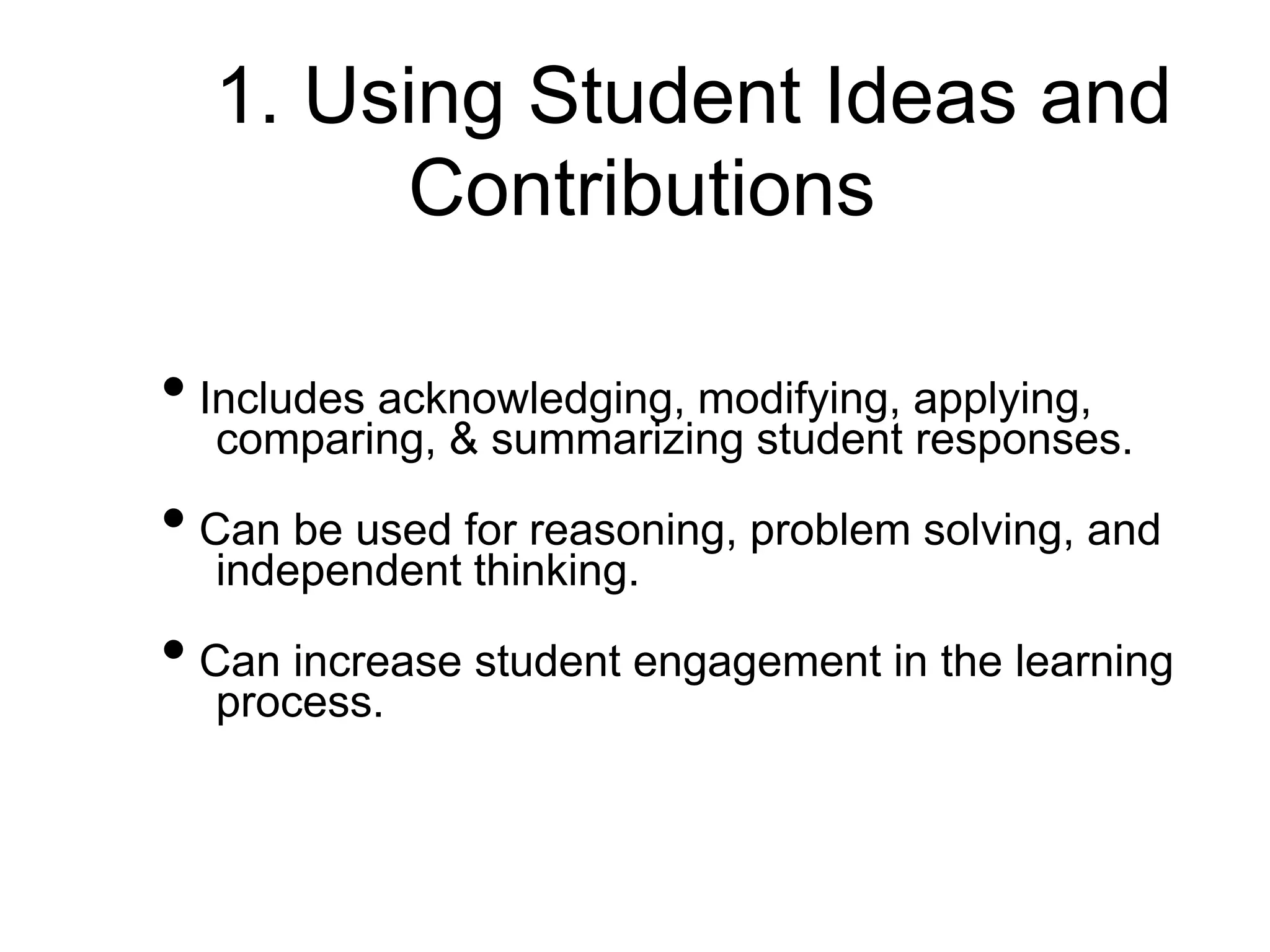
1. Using Student Ideas and
Contributions
• Includes acknowledging, modifying, applying,
comparing, & summarizing student responses.
• Can be used for reasoning, problem solving, and
independent thinking.
• Can increase student engagement in the learning
process.
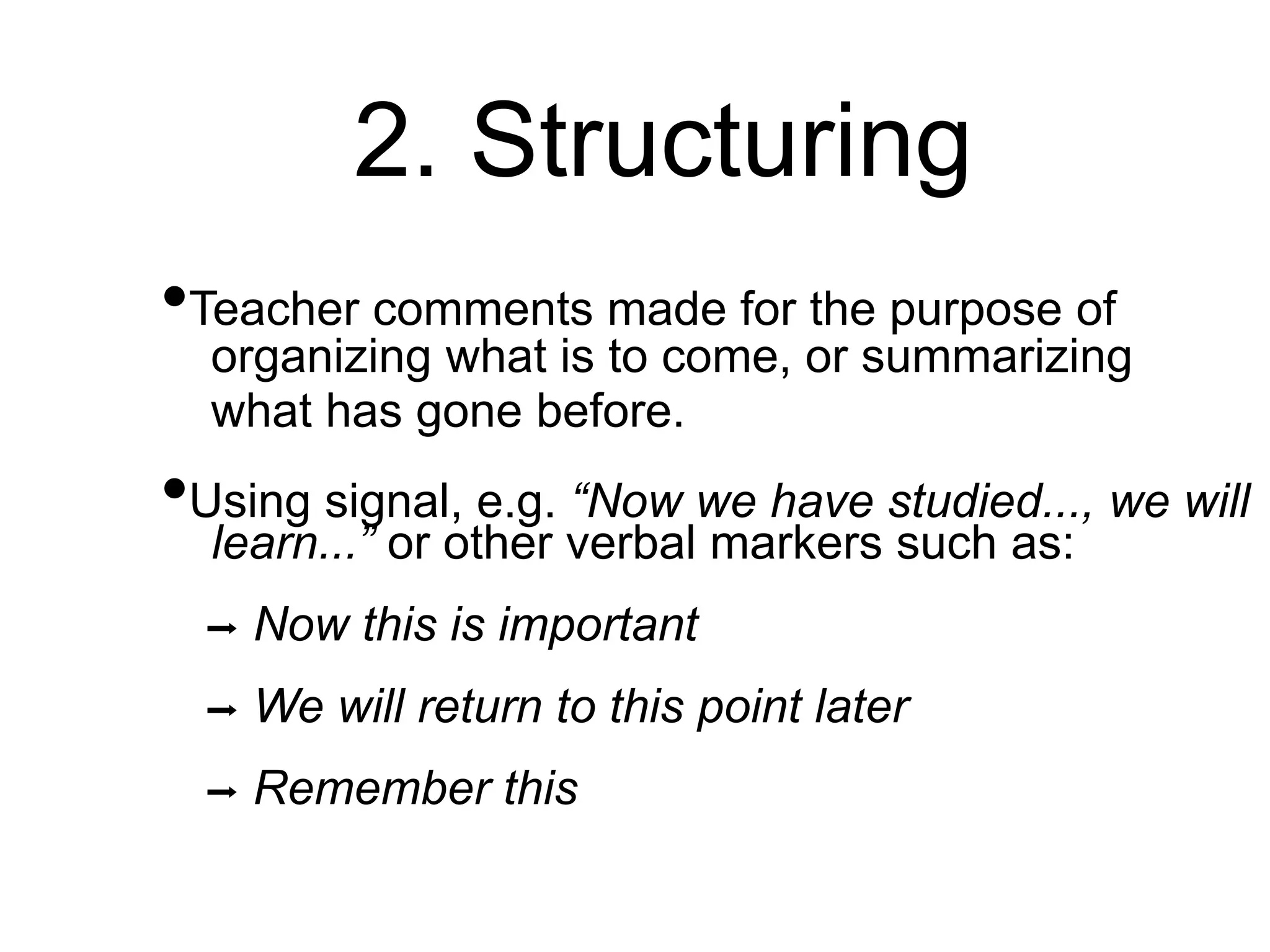
2. Structuring
•Teacher comments made for the purpose of
organizing what is to come, or summarizing
what has gone before.
•Using signal, e.g. “Now we have studied..., we will
learn...” or other verbal markers such as:
➡ Now this is important
➡ We will return to this point later
➡ Remember this
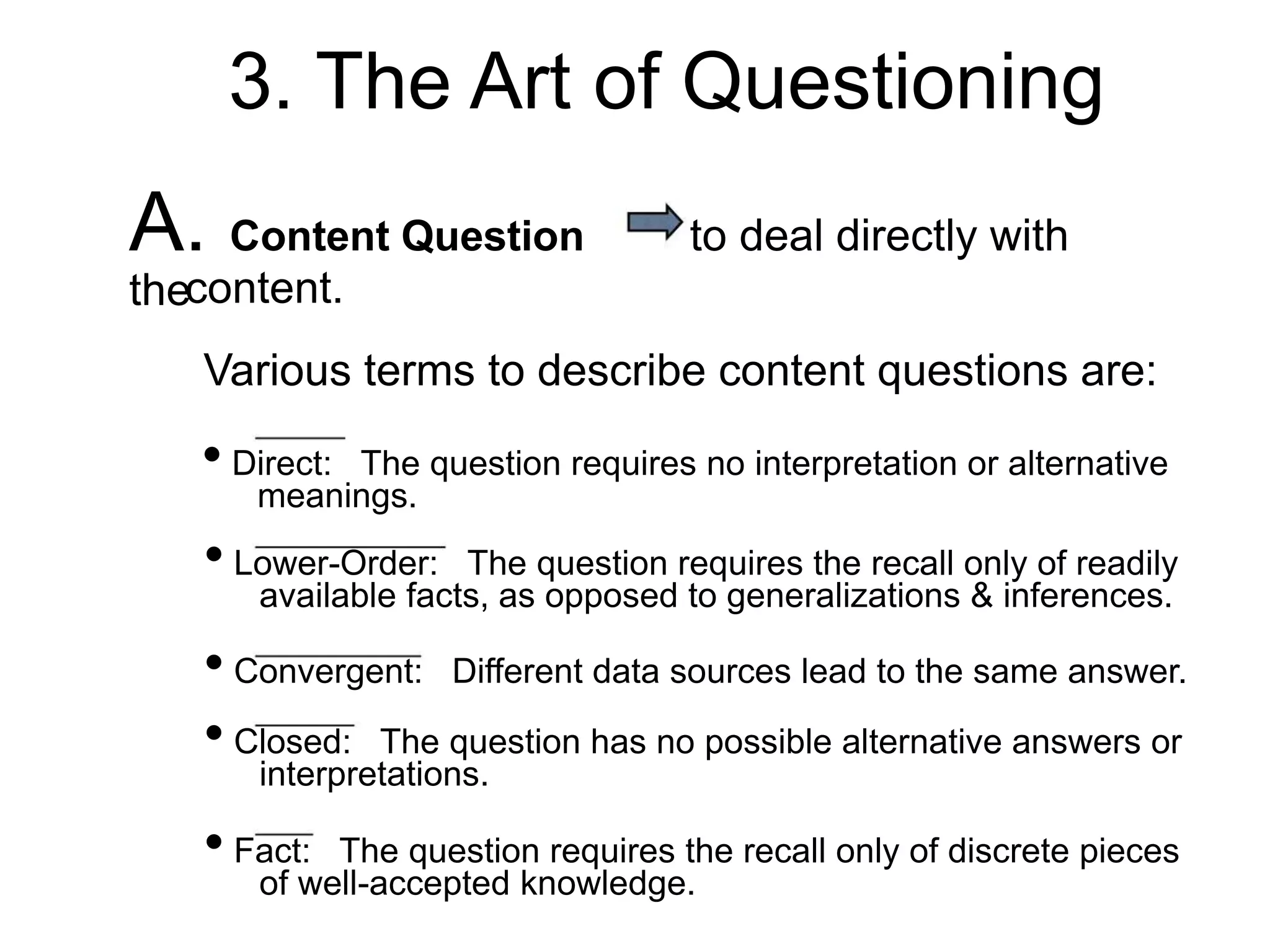
3. The Art of Questioning
A. Content Question to deal directly with
thecontent.
Various terms to describe content questions are:
• Direct: The question requires no interpretation or alternative
meanings.
• Lower-Order: The question requires the recall only of readily
available facts, as opposed to generalizations & inferences.
• Convergent: Different data sources lead to the same answer.
• Closed: The question has no possible alternative answers or
interpretations.
• Fact: The question requires the recall only of discrete pieces
of well-accepted knowledge.
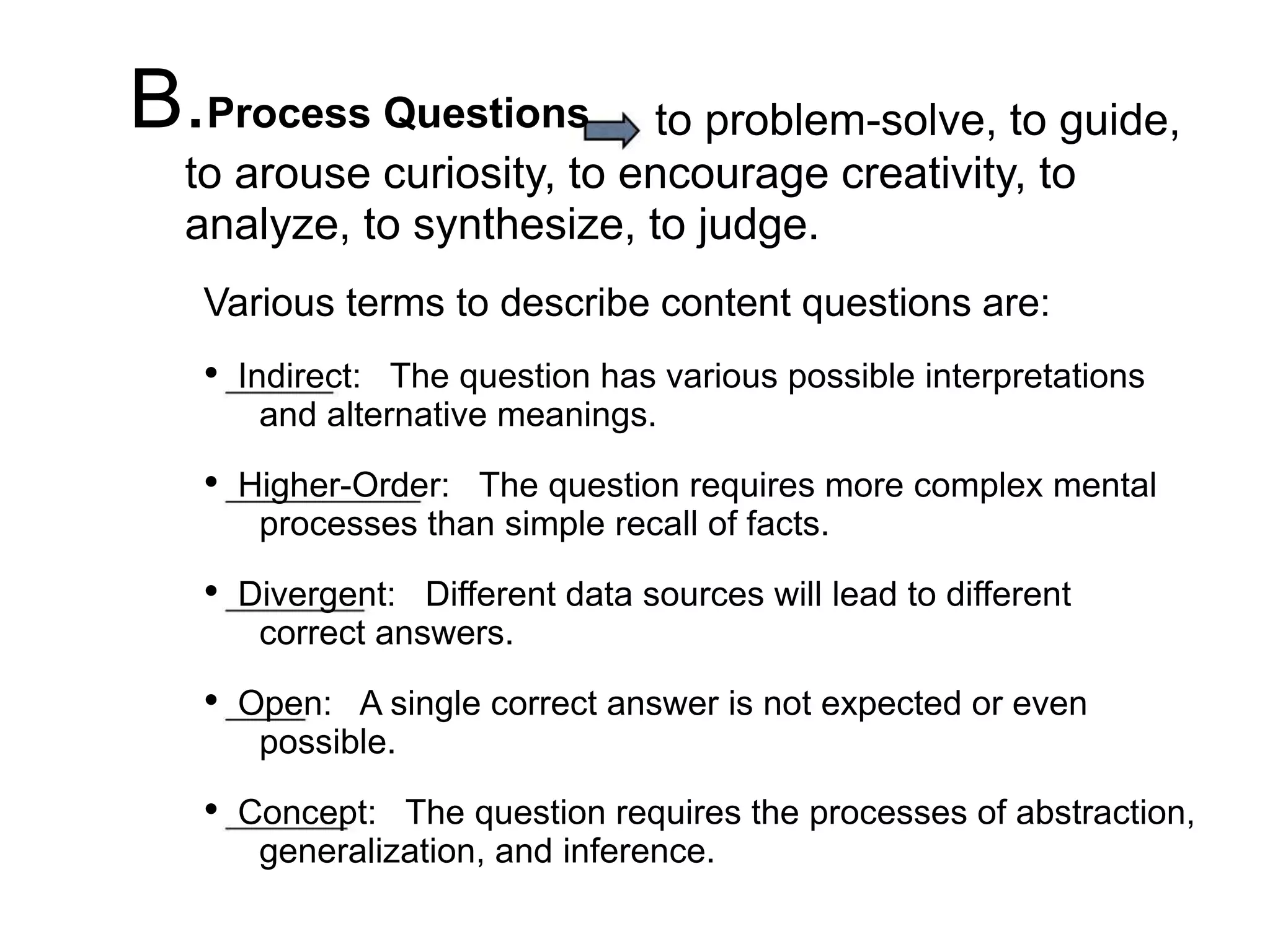
B.Process Questions to problem-solve, to guide,
to arouse curiosity, to encourage creativity, to
analyze, to synthesize, to judge.
Various terms to describe content questions are:
• Indirect: The question has various possible interpretations
and alternative meanings.
• Higher-Order: The question requires more complex mental
processes than simple recall of facts.
• Divergent: Different data sources will lead to different
correct answers.
• Open: A single correct answer is not expected or even
possible.
• Concept: The question requires the processes of abstraction,
generalization, and inference.
4. Probing
• Refers to teacher statements that
encourage students to elaborate on an
answer, either their own or another
student’s.
• Probing can be questions or expressions
that elicit, solicit or redirect information.
• Probing often is used to shift a discussion
to some higher thought level.
5. Teacher Affect
• Enthusiasm is an important aspect of a
teacher’s affect.
• Enthusiasm is the teacher’s vigor, power,
involvement, excitement, & interest.
• It is conveyed to students in many ways:
vocal inflection, gesture, eye contact, and
movement.
Break
5. Instructional
Strategies
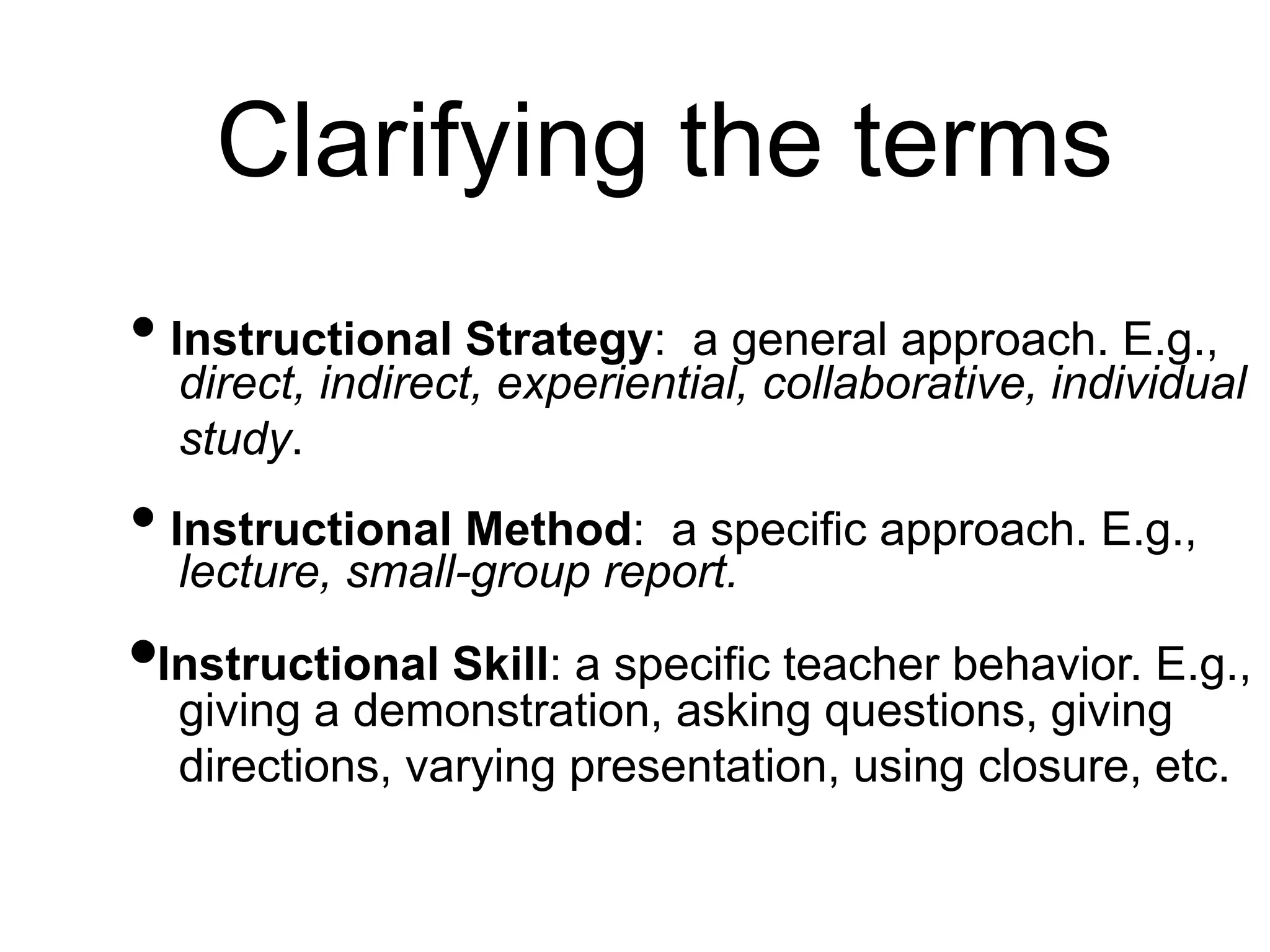
Clarifying the terms
• Instructional Strategy: a general approach. E.g.,
direct, indirect, experiential, collaborative, individual
study.
• Instructional Method: a specific approach. E.g.,
lecture, small-group report.
•Instructional Skill: a specific teacher behavior. E.g.,
giving a demonstration, asking questions, giving
directions, varying presentation, using closure, etc.
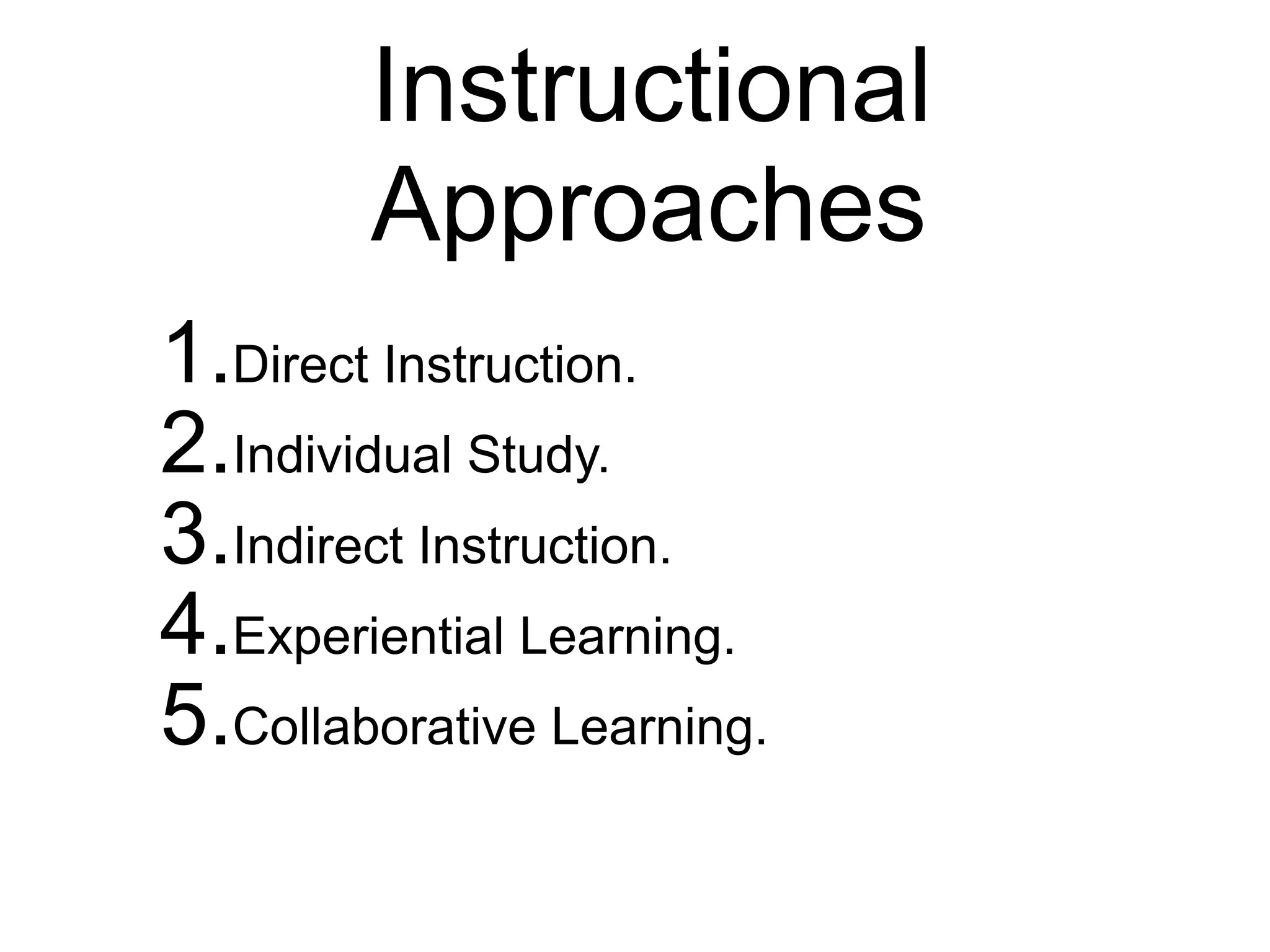
Instructional
Approaches
1.Direct Instruction.
2.Individual Study.
3.Indirect Instruction.
4.Experiential Learning.
5.Collaborative Learning.
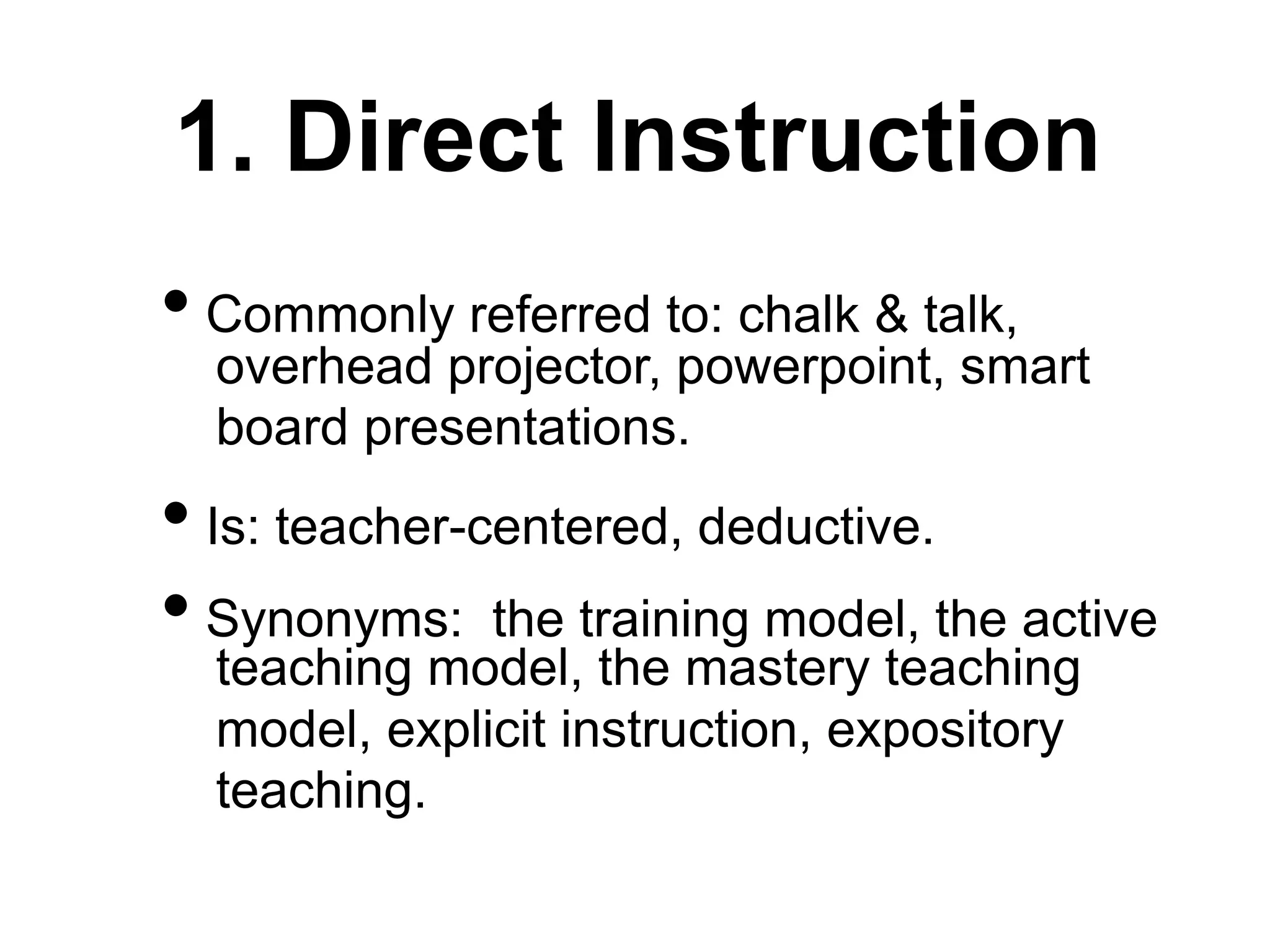
1. Direct Instruction
• Commonly referred to: chalk & talk,
overhead projector, powerpoint, smart
board presentations.
• Is: teacher-centered, deductive.
• Synonyms: the training model, the active
teaching model, the mastery teaching
model, explicit instruction, expository
teaching.
What is Direct
Instruction?
•“Direct instruction is a teacher-centered
strategy in which the teacher is the major
information provider. In the direct instruction
model, the teacher’s role is to pass facts, rules,
or action sequences on the students in the
most direct way possible. This usually takes a
presentation and recitation format with
explanations, examples, and opportunities for
practice and feedback.” (Borich, 2004, p. 180).
Examples of Methods
• Lecture, assigned questions, didactic
questioning, explicit teaching, research
reports, workbooks, audio, videotape, DVD,
powerpoint presentations, library research,
and practice-and-drill.
Direct Instruction Steps
1.Anticipatory (setting the stage).
2.Objectives & Purpose (explaining what will happen).
3.Input (presenting new info or skill).
4.Model (demonstrating).
5.Check for understanding (i.e., question, observe,
etc.).
6.Guided practice (step-by-step/monitored).
7.Independent Practice.
(Lang & Evans, 2006)
Direct Instruction is
effective...
•for acquiring information or step-by-step
skills.
•if the instructor is knowledgeable and skillful.
•with careful planning, suitable content, right
context.
•when combined with or followed by other
strategies.
2. Individual Study
• Synonyms: independent learning, self-
regulated learning, self-directed study (or
learning), self-teaching, and individualized
study.
What is
Individual Study?
• Individual study is an individual educational
pursuit carried on by a person to self
improve; it can be student-initiated or
teacher-initiated, but the focus is on study
under the guidance of a teacher.
Examples of Method:
• Essays, reports, projects, models, journals,
inquiry, games, fantasies, interviews,
brainstorming, problem-solving, decision
making, learning centers, learning units,
individualized assignments. computer-
assisted instruction, independent research
correspondence courses, distance
education.
Individual Study is
effective when ...
• a teacher can provide an environment that allows
growth of learner independence.
• a teacher can match student’s personal interests and
the curriculum goals.
• a teacher wants to improve students’ independent
learning capabilities.
• it is combined with other strategies.
• when a teacher wants to ask students to apply the
content previously learned.
3. Indirect Instruction
• Synonyms: inquiry, induction, problem-solving,
action research, decision making, and discovery.
• It is student centered; high student
involvement.
• It is flexible, frees students to explore diverse
possibilities, reduces fears of incorrect answers,
fosters development of creativity, & promotes
development of interpersonal skills.
What is
Indirect Instruction?
• Indirect Instruction is an instructional
strategy that believes that learning can be
more meaningful, thorough, and usable
when learners seek and discover
knowledge.
Examples of Methods:
• Examples of method: debates, panels, field
studies, research reports, group
investigation, brainstorming, simulations,
guided inquiry, and unguided inquiry.
Indirect Instruction is
effective when ... (1)
• thinking outcomes are desired.
• value, attitude, or interpersonal or group skills
outcomes are desired.
• process (learning “how”) is at least as important
as product (getting “the right answer”).
• Students need to experience something in
order to benefit from later instruction.
• There are no “right” answers.
Indirect Instruction is
effective when ... (2)
•The focus is personalized understanding &
long-term retention of concepts &
generalizations.
•Ego involvement & intrinsic motivation are
desirable.
•Decisions need to be made or problems
need to be solved.
•Life-long learning capability is desired.
Basic Steps in Using the
Inquiry Teaching Method
1.Set up the problem situation.
2.Provide experiences to bring out essential
elements.
3.Set up experiences to bring out contrasting
elements.
4.Concept or generalization is formed.
5.The concept or generalization is applied.
4. Experiential
Instructional Strategy
• Is an action strategy.
• Is contextual, realistic, & meaningful.
• Is inductive, learner-centered, & activity-
oriented.
• Personalized reflection is key.
• Learners are more emotionally involved
(affective aspect).
What is Experiential
Learning?
• Experiential learning is experiences that are
designed and chosen for their ability to
extend and challenge student thinking in a
broad range of capabilities.
Experiential learning (cont.)
• The emphasis is on the process of learning
and not the product.
• Because of experience and reflection,
knowledge is constantly being transformed
(created & recreated) within learner.
• Learning is a process (not an outcome) by
which concepts are constantly modified by
experience.
The Kolb Model of
Experiential Learning
1.Concrete experience. Learners must involve themselves
fully in new experiences.
2.Reflective observation. Learners must observe these
experiences, analyze & reflect.
3.Abstract conceptualization. Learners must develop
abstractions that, in turn, create concepts &
generalizations that are logically sound.
4.Active experimentation. Learners must use these new
theories to take action, such as making decisions &
solving problems.
Experiential Learning is
effective when ...
• a teacher wants to teach not only specific
content but also the knowledge, values,
skills and abilities related to common
essential learning (e.g., communication,
critical & creative thinking, & personal and
social values and skills).
5. Collaborative Learning
Strategy
•An umbrella term that includes various interactive
approaches & methods for group work.
• Students working in small groups tend to learn
more & retain longer.
• Teachers’ role is to facilitate learning, not
transmitting information.
• Involves creating & managing meaningful learning
experiences & stimulating student thinking.
What is Collaborative
Learning?
•An instructional strategy in teaching and
learning in which students interact to share
ideas, explore a question, & complete a
project.
• Collaborative instruction methods range
from class discussions through small-group
methods or cooperative learning to using
Internet when working on assignment.
Collaborative Learning
is effective when ...
• teacher can structure and guide group learning
experiences.
• students need to discover or state their
personal points of view.
• teacher want students’ active participation,
increased motivation, & high-rate of retention.
• teacher makes careful observation, practices
good listening, interpersonal & intervention skills.
Assessment Questions
What is assessment?
•Assessment is the process of seeking and obtaining
information about student development and the
effectiveness of instruction.
• The term “assessment” derives from a Latin word,
“assidere” which means “to sit beside.”
• The origins of the term “assessment” could
promote the constructive image of the teacher
sitting alongside the learner in an educational
context where the task is to bring out the learner’s
understanding.
Teaching Stories
“What is effective assessment?
Read each of your story
and then share it with the
group.
What is your idea of
effective assessment?
“Not everything that
counts can be counted
and not everything
that can be counted
counts.”
Why is assessment important?
(1)
• Traditionally, assessment is used for:
1. sorting out people.
2.reward for students.
3.information for parents about their kids.
4.judging the effectiveness of teachers and
schools.
Why is assessment important?
(2)
• Assessment is important to promote
effective learning.
• Assessment is important to help students
learn (assessment for learning).
Stiggins (2002) observes...
“Politicians routinely ask,
“How can we use assessment as the basis for
doling out rewards and punishment to increase
teacher and student effort?”
instead of the more important question of:
“How can we use assessment to help our studen
want to learn? How can we help them feel able to
learn?” (p. 758).
Assessment & Evaluation
•Assessment expert Grant Wiggins
differentiates between assessment &
evaluation in this way” “When teachers
ASSESS student performance, they’re not
placing a value or judgment on it - that’s
EVALUATING or grading. They’re simply
reporting a student’s profile or
achievement.
Formative & Summative
• Formative assessments occur when the content is being
taught. It is non-evaluative. It is usually used to inform
teachers about how much students have understood the
content.
• Summative assessment occurs after the content has been
taught. It is evaluative and is used to assign a course grade.
•An analogy from Robert Stake, an educational researcher:
“When the cook tastes the soup, that’s formative. When the
guests taste the soup, that’s summative.”
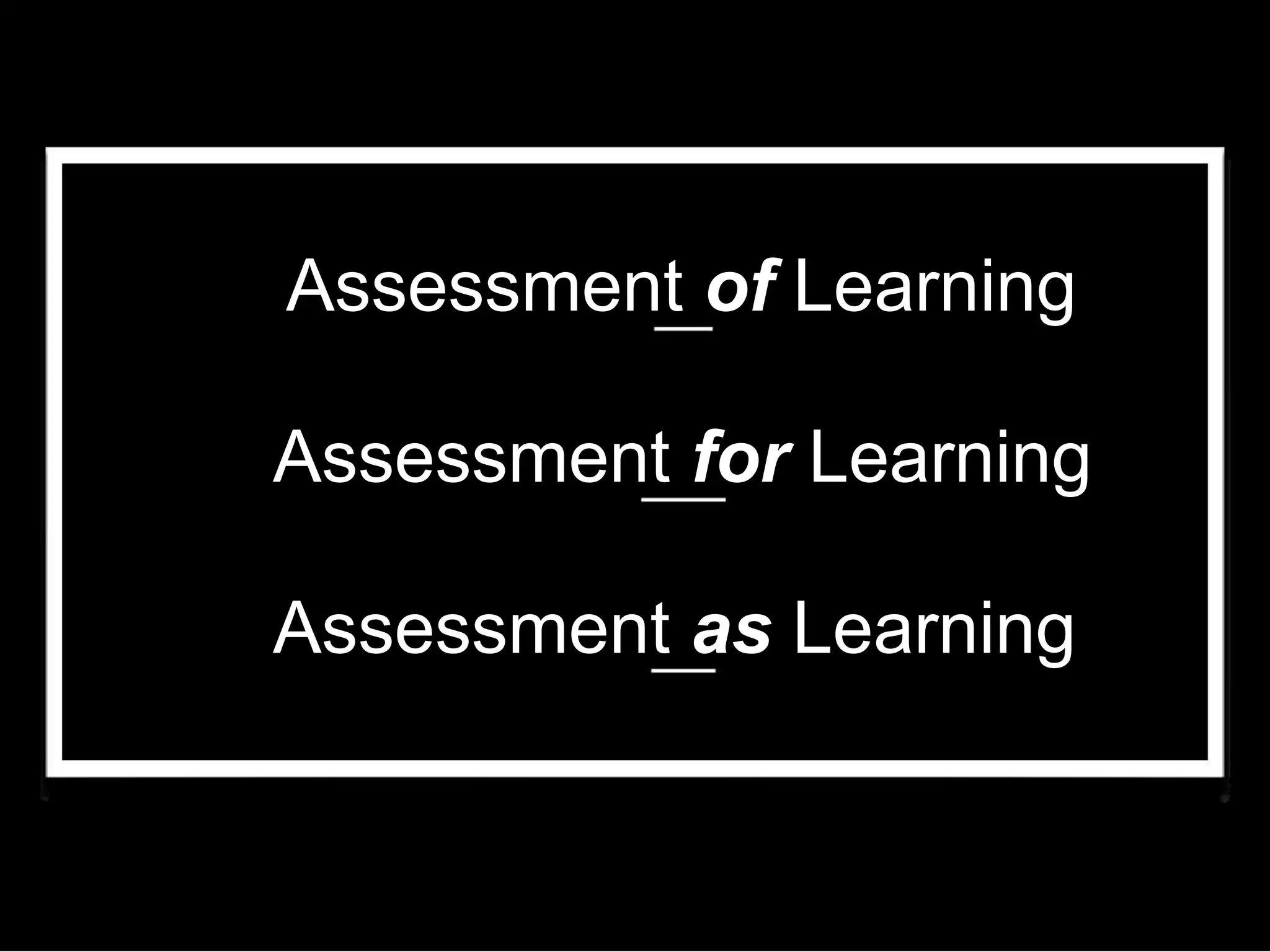
Assessment of Learning
Assessment for Learning
Assessment as Learning
Classroom Assessment
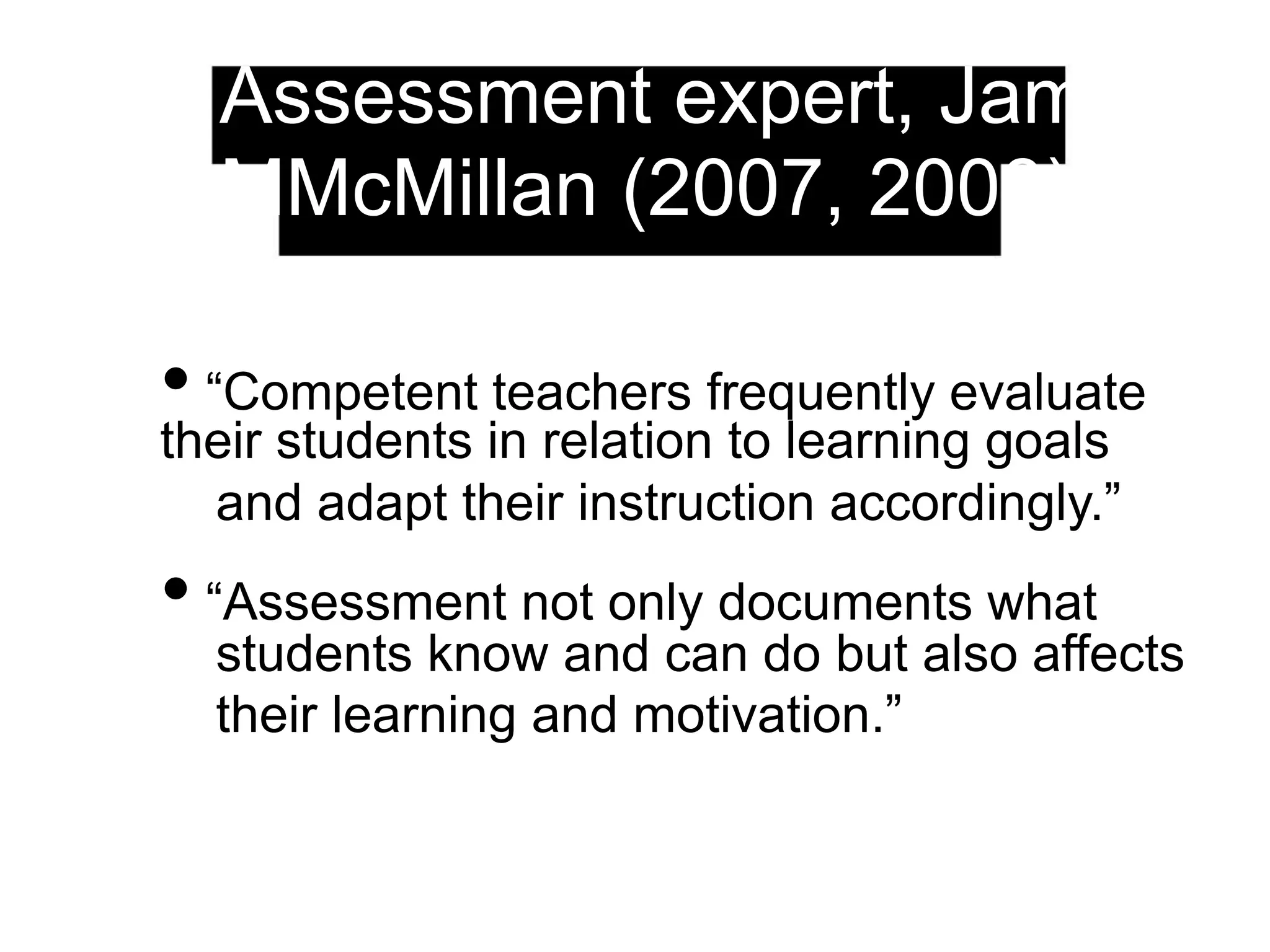
Assessment expert, James
MMcMillan (2007, 2008)
• “Competent teachers frequently evaluate
their students in relation to learning goals
and adapt their instruction accordingly.”
• “Assessment not only documents what
students know and can do but also affects
their learning and motivation.”
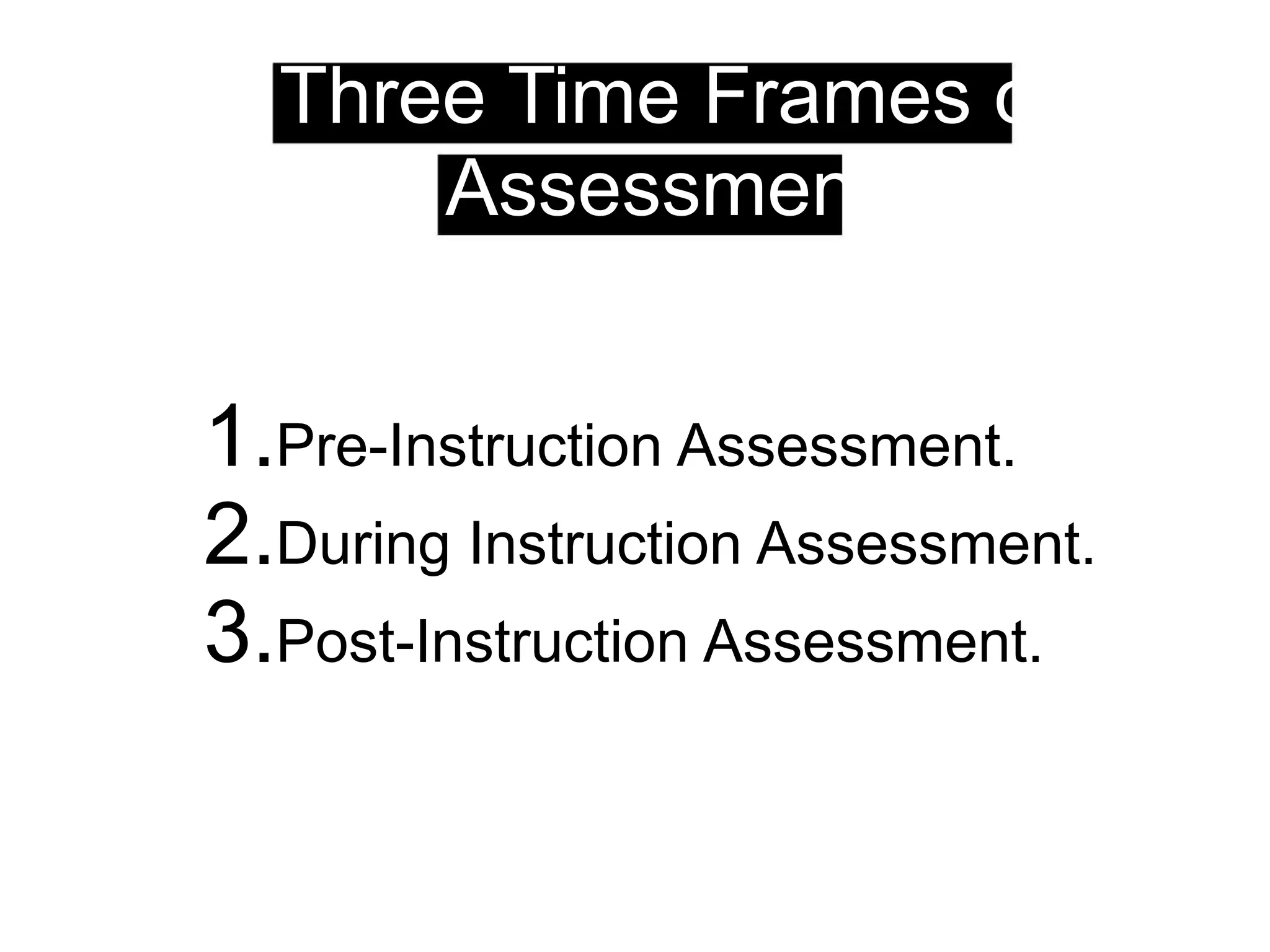
Three Time Frames of
Assessment
1.Pre-Instruction Assessment.
2.During Instruction Assessment.
3.Post-Instruction Assessment.
1. Pre-Instruction Assessment:
Questions
• Do my students have the pre-requisite knowledge and
skills to be successful?
• What will interest my students?
• What will motivate my students?
• How long should I plan to cover each unit?
• What teaching strategies should I use?
• How should I grade the students?
• What type of group learning should I use?
• What are my learning objectives or targets?
1. Pre-Instruction Assessment:
Strategies
• Observe how well they perform in the first lessons.
• Observe students’ behavior and characteristics in the
first lessons.
• Questionnaires/Interviews.
• Diagnostic Pre-Tests.
• Look at students’ prior grades and scores on tests
but keep your high expectations of each of them.
• Remember this is only initial data. It is developing and
will change later. Avoid “labeling” students!
2. During Instruction Assessment:
Questions
• Are students paying attention on me?
• Are the students understanding the material?
• To which students should I direct questions?
• What type of questions should I ask?
• How should I respond to student questions?
• When should I stop lecturing?
• Which students need extra help?
• Which students should be left alone?
2. During Instruction Assessment:
Strategies
• This is usually referred to as the formative assessment.
• Teacher’s ongoing observation and monitoring of
students’ learning while teaching informs about what to do
next.
• Assessment during instruction requires listening to
student answers, observing other students for indications
of understanding or confusion, framing the next question,
and looking around the class for misbehavior.
• Oral questions, reflection, & feedback are important
aspects of assessment during instruction.
• Get students to assess their progress on day-to-day basis.
3. Post-Instruction Assessment:
Questions
• How much have my students learned?
• What should I do next?
• Do I need to review anything the class didn’t understand?
• What grades should I give?
• What should I tell my students?
• How should I change my instruction next time?
• Do the test scores really reflect what my students know
and can do?
• Is there anything that students misunderstood?
3. Post-Instruction Assessment:
Strategies
• This assessment is usually referred to as summative
assessment or formal assessment.
• The purpose is to document student performance.
• This assessment provides information about how well
students have mastered the material, whether the
students are ready for the next unit, what grades
should be given, what comments should be made to
parents, and how a teacher should adapt his/her
instruction.
Traditional Tests
Traditional tests are paper-and-pencil tests in which
students select from choices, calculate numbers, construct
short responses or write essays.
1.Selected-response items:
multiple-choice items, true/false items, matching items.
2.Constructed-response items:
short-answer items, essays
Alternative Assessments
• Alternative assessments require students to solve
some type of authentic problem or to perform in
terms of completing a project or demonstrating skills
outside the context of a test or an essay.
• Some of the examples are: projects, portfolios,
performances, role-plays, dramas, art products,
experiments, reports, presentations, conferences, etc
Common Characteristics of
Alternative Assessments
1.Ask students to perform, create, produce or do
something.
2.Tap higher-level thinking and problem-solving skills.
3.Use tasks that represent meaningful instructional activitie
4.Invoke real-world applications.
5.People, not machines, do the scoring, using human
judgment.
6.Require new instructional and assessment roles for
teachers.
•Write questions that you have
on “effective assessment” based
on today’s lesson.
99
Why is assessment important?
(1)
• Traditionally, assessment is used for:
1.sorting out people.
2.reward for students.
3.information for parents about their kids.
4.judging the effectiveness of teachers and
schools.
Why is assessment important?
(2)
• Assessment is important to promote
effective learning.
• Assessment is important to help students
learn (assessment for learning).
Stiggins (2002) observes...
“Politicians routinely ask,
“How can we use assessment as the basis for
doling out rewards and punishment to increase
teacher and student effort?”
instead of the more important question of:
“How can we use assessment to help our studen
want to learn? How can we help them feel able to
learn?” (p. 758).
Assessment & Evaluation
•Assessment expert Grant Wiggins
differentiates between assessment &
evaluation in this way” “When teachers
ASSESS student performance, they’re not
placing a value or judgment on it - that’s
EVALUATING or grading. They’re simply
reporting a student’s profile or
achievement.
Formative & Summative
• Formative assessments occur when the content is being
taught. It is non-evaluative. It is usually used to inform
teachers about how much students have understood the
content.
• Summative assessment occurs after the content has been
taught. It is evaluative and is used to assign a course grade.
•An analogy from Robert Stake, an educational researcher:
“When the cook tastes the soup, that’s formative. When the
guests taste the soup, that’s summative.”

8 principles of effective teaching and assessment

  • 1.
    Principles of EffectiveTeaching & Assessmen 1
  • 2.
    TEACHING prior experience other courses individual work group LEARNING Diverse Contexts: •learners • classroom&school • socio-cultural Models of Models of Instruction Assessment • teacher- ASSESSMENT Sound Understanding Effective Effective online learning REFLECTION worksho practical experience centered. • student- centered • formative • summative • alternative Lesson Planning Micro Teaching Teachers Teaching Informed Decision- Maker
  • 3.
    On becoming ateacher: • Who or what motivates you? • Who or what inspires you? • Do you see yourself as a teacher now? If yes, what do you think of yourself as a teacher? • What are your goals as a teacher ? 4
  • 4.
  • 5.
    Most memorable teachers Choose twomost memorable teachers in the past: one that you liked a lot. one that you disliked very much. 6
  • 6.
    First, think byyourself: Why did you like or dislike those teachers? What stories do you remember about them? Next, work in pairs: Share the stories about your most memorable teachers. 7
  • 7.
    Effective Teaching? Do youthink those teachers taught effectively or not? Explain your answers. What are the characteristics of effective teaching based on your past experiences? 8
  • 8.
    A Typical CurriculumDesign Topic/Content Activity Assessment 10
  • 9.
    The twin sinsin curriculum design: 1. Activity-focused. Hands on without minds-on. 2. Coverage approach. Teach, test, and hope for the best. 11
  • 10.
    Concepts of Learning (Martonet al., 1993) • Getting more knowledge. • Memorizing and reproducing. •Applying facts and procedures. • Understanding. • Seeing something in a different way. • Changing as a person.
  • 11.
    Models of Learning (Watkins,Carnell, & Lodge, 2007) • RECEPTION. “Learning = being taught.” Concerned with quantity, facts, skills; assumes transmission of knowledge fr an external source (e.g. teacher). Emotional & social aspects are not attende to. • CONSTRUCTION. “Learning = individual sense-making.” Concerned with the learner’s construction of meaning through discussion, discovery, open-ended learning, making connections. • CO-CONSTRUCTION. “Learning = building knowledge with others.” Concerned with the learner’s construction of meaning through interaction & collaboration with others, especially through dialogue.
  • 12.
  • 13.
    Effective learning is... (Watkins,Carnell, & Lodge, 2007) • an activity of construction. • handled with (or in the context of) others. • driven by the learner. • the monitoring and review of the effectiveness of approaches & strategies for the goals and context.
  • 14.
    An effective learner... (Watkins, Carnell, & Lodge, 2007) • is active and strategic. • is skilled in collaboration. • takes responsibility for their learning. • understands her/his learning and plans, monitors and reflects on their learning.
  • 15.
    An effective teachingis the teaching that makes effective learning happen. An effective teaching is empowering learners to become effective learners.
  • 16.
    Knowledge Needed forExpert Teaching Knowledge of content Knowledge of learners & learning General pedagogical knowledge Pedagogical content knowledge 23
  • 17.
    Knowledge Needed forExpert Teaching Type of Knowledge Example Knowledge of content • Understanding the content you want to teach Pedagogical content knowledge • Understanding how to represent content so it is comprehensible to learners A geography teacher understands the concepts longitude and latitude. The geography teacher draws lines on a beach ball to represent longitude and latitude. She then relates the beach ball to the globe. 24
  • 18.
    Type of KnowledgeExample General Pedagogical Knowledge •Understanding general principles of instruction and classroom management Knowledge of learners and Learning •Understanding how learning occurs and understanding the factors that influence learning The geography teacher’s classroom is orderly and she uses questioning to guide the students to an understanding of longitude and lattitude. The geography teacher uses the beach ball combined with questioning, because she understands that concrete examples are necessary for learning, and she understands that students learn more when they’re actively involved in learning activities. 25
  • 19.
    Planning and carryingout instruction is part of an interdependent network. 26
  • 20.
    5 Key Behaviorsto Effective Teaching (Burden & Byrd, 2007) 1.Lesson Clarity 2.Instructional Variety 3.Teacher Task Orientation 4.Engagement in the Learning Process 5.Student Success Rate
  • 22.
    1. Lesson Clarity •Make their positions clear to learners. • Explain concepts in ways that help students follow along in a logical step-by-step order. • Have an oral delivery that is direct, audible to all students.
  • 23.
    2. Instructional Variety •Refers to variability and flexibility of delivery of a lesson. • Includes the use of learning materials, equipment, displays and space in the classroom. • Includes the variety of models of instruction.
  • 25.
    3. Teacher TaskOrientation • Refers to how much classroom time the teacher devotes to teaching. • Highly conversant with topics likely to appear on assessments. • Provide students with the greatest possibility to learn and to practice the material.
  • 26.
    4. Engagement in theLearning Process • Refers to the time students actively engaged in learning. • When students jump out of their seats, talk, read a magazine, or leave for the rest room, they are obviously not engaged in instruction.
  • 28.
    5. Student SuccessRate • Refers to the rate at which your students understand and correctly complete exercises and assignments. • The average student in a typical classroom spends about half of the time working on tasks that provide the opportunity for high success.
  • 30.
    5 Helping Behaviorsto Effective Teaching (Burden & Bird, 2007) 1.Using student ideas and contributions 2.Structuring 3.Questioning 4.Probing 5.Teacher Affect
  • 31.
    1. Using StudentIdeas and Contributions • Includes acknowledging, modifying, applying, comparing, & summarizing student responses. • Can be used for reasoning, problem solving, and independent thinking. • Can increase student engagement in the learning process.
  • 33.
    2. Structuring •Teacher commentsmade for the purpose of organizing what is to come, or summarizing what has gone before. •Using signal, e.g. “Now we have studied..., we will learn...” or other verbal markers such as: ➡ Now this is important ➡ We will return to this point later ➡ Remember this
  • 34.
    3. The Artof Questioning A. Content Question to deal directly with thecontent. Various terms to describe content questions are: • Direct: The question requires no interpretation or alternative meanings. • Lower-Order: The question requires the recall only of readily available facts, as opposed to generalizations & inferences. • Convergent: Different data sources lead to the same answer. • Closed: The question has no possible alternative answers or interpretations. • Fact: The question requires the recall only of discrete pieces of well-accepted knowledge.
  • 35.
    B.Process Questions toproblem-solve, to guide, to arouse curiosity, to encourage creativity, to analyze, to synthesize, to judge. Various terms to describe content questions are: • Indirect: The question has various possible interpretations and alternative meanings. • Higher-Order: The question requires more complex mental processes than simple recall of facts. • Divergent: Different data sources will lead to different correct answers. • Open: A single correct answer is not expected or even possible. • Concept: The question requires the processes of abstraction, generalization, and inference.
  • 37.
    4. Probing • Refersto teacher statements that encourage students to elaborate on an answer, either their own or another student’s. • Probing can be questions or expressions that elicit, solicit or redirect information. • Probing often is used to shift a discussion to some higher thought level.
  • 39.
    5. Teacher Affect •Enthusiasm is an important aspect of a teacher’s affect. • Enthusiasm is the teacher’s vigor, power, involvement, excitement, & interest. • It is conveyed to students in many ways: vocal inflection, gesture, eye contact, and movement.
  • 41.
  • 42.
  • 43.
    Clarifying the terms •Instructional Strategy: a general approach. E.g., direct, indirect, experiential, collaborative, individual study. • Instructional Method: a specific approach. E.g., lecture, small-group report. •Instructional Skill: a specific teacher behavior. E.g., giving a demonstration, asking questions, giving directions, varying presentation, using closure, etc.
  • 44.
    Instructional Approaches 1.Direct Instruction. 2.Individual Study. 3.IndirectInstruction. 4.Experiential Learning. 5.Collaborative Learning.
  • 45.
    1. Direct Instruction •Commonly referred to: chalk & talk, overhead projector, powerpoint, smart board presentations. • Is: teacher-centered, deductive. • Synonyms: the training model, the active teaching model, the mastery teaching model, explicit instruction, expository teaching.
  • 46.
    What is Direct Instruction? •“Directinstruction is a teacher-centered strategy in which the teacher is the major information provider. In the direct instruction model, the teacher’s role is to pass facts, rules, or action sequences on the students in the most direct way possible. This usually takes a presentation and recitation format with explanations, examples, and opportunities for practice and feedback.” (Borich, 2004, p. 180).
  • 47.
    Examples of Methods •Lecture, assigned questions, didactic questioning, explicit teaching, research reports, workbooks, audio, videotape, DVD, powerpoint presentations, library research, and practice-and-drill.
  • 48.
    Direct Instruction Steps 1.Anticipatory(setting the stage). 2.Objectives & Purpose (explaining what will happen). 3.Input (presenting new info or skill). 4.Model (demonstrating). 5.Check for understanding (i.e., question, observe, etc.). 6.Guided practice (step-by-step/monitored). 7.Independent Practice. (Lang & Evans, 2006)
  • 49.
    Direct Instruction is effective... •foracquiring information or step-by-step skills. •if the instructor is knowledgeable and skillful. •with careful planning, suitable content, right context. •when combined with or followed by other strategies.
  • 50.
    2. Individual Study •Synonyms: independent learning, self- regulated learning, self-directed study (or learning), self-teaching, and individualized study.
  • 51.
    What is Individual Study? •Individual study is an individual educational pursuit carried on by a person to self improve; it can be student-initiated or teacher-initiated, but the focus is on study under the guidance of a teacher.
  • 52.
    Examples of Method: •Essays, reports, projects, models, journals, inquiry, games, fantasies, interviews, brainstorming, problem-solving, decision making, learning centers, learning units, individualized assignments. computer- assisted instruction, independent research correspondence courses, distance education.
  • 53.
    Individual Study is effectivewhen ... • a teacher can provide an environment that allows growth of learner independence. • a teacher can match student’s personal interests and the curriculum goals. • a teacher wants to improve students’ independent learning capabilities. • it is combined with other strategies. • when a teacher wants to ask students to apply the content previously learned.
  • 54.
    3. Indirect Instruction •Synonyms: inquiry, induction, problem-solving, action research, decision making, and discovery. • It is student centered; high student involvement. • It is flexible, frees students to explore diverse possibilities, reduces fears of incorrect answers, fosters development of creativity, & promotes development of interpersonal skills.
  • 55.
    What is Indirect Instruction? •Indirect Instruction is an instructional strategy that believes that learning can be more meaningful, thorough, and usable when learners seek and discover knowledge.
  • 56.
    Examples of Methods: •Examples of method: debates, panels, field studies, research reports, group investigation, brainstorming, simulations, guided inquiry, and unguided inquiry.
  • 57.
    Indirect Instruction is effectivewhen ... (1) • thinking outcomes are desired. • value, attitude, or interpersonal or group skills outcomes are desired. • process (learning “how”) is at least as important as product (getting “the right answer”). • Students need to experience something in order to benefit from later instruction. • There are no “right” answers.
  • 58.
    Indirect Instruction is effectivewhen ... (2) •The focus is personalized understanding & long-term retention of concepts & generalizations. •Ego involvement & intrinsic motivation are desirable. •Decisions need to be made or problems need to be solved. •Life-long learning capability is desired.
  • 59.
    Basic Steps inUsing the Inquiry Teaching Method 1.Set up the problem situation. 2.Provide experiences to bring out essential elements. 3.Set up experiences to bring out contrasting elements. 4.Concept or generalization is formed. 5.The concept or generalization is applied.
  • 60.
    4. Experiential Instructional Strategy •Is an action strategy. • Is contextual, realistic, & meaningful. • Is inductive, learner-centered, & activity- oriented. • Personalized reflection is key. • Learners are more emotionally involved (affective aspect).
  • 61.
    What is Experiential Learning? •Experiential learning is experiences that are designed and chosen for their ability to extend and challenge student thinking in a broad range of capabilities.
  • 62.
    Experiential learning (cont.) •The emphasis is on the process of learning and not the product. • Because of experience and reflection, knowledge is constantly being transformed (created & recreated) within learner. • Learning is a process (not an outcome) by which concepts are constantly modified by experience.
  • 63.
    The Kolb Modelof Experiential Learning 1.Concrete experience. Learners must involve themselves fully in new experiences. 2.Reflective observation. Learners must observe these experiences, analyze & reflect. 3.Abstract conceptualization. Learners must develop abstractions that, in turn, create concepts & generalizations that are logically sound. 4.Active experimentation. Learners must use these new theories to take action, such as making decisions & solving problems.
  • 64.
    Experiential Learning is effectivewhen ... • a teacher wants to teach not only specific content but also the knowledge, values, skills and abilities related to common essential learning (e.g., communication, critical & creative thinking, & personal and social values and skills).
  • 65.
    5. Collaborative Learning Strategy •Anumbrella term that includes various interactive approaches & methods for group work. • Students working in small groups tend to learn more & retain longer. • Teachers’ role is to facilitate learning, not transmitting information. • Involves creating & managing meaningful learning experiences & stimulating student thinking.
  • 66.
    What is Collaborative Learning? •Aninstructional strategy in teaching and learning in which students interact to share ideas, explore a question, & complete a project. • Collaborative instruction methods range from class discussions through small-group methods or cooperative learning to using Internet when working on assignment.
  • 67.
    Collaborative Learning is effectivewhen ... • teacher can structure and guide group learning experiences. • students need to discover or state their personal points of view. • teacher want students’ active participation, increased motivation, & high-rate of retention. • teacher makes careful observation, practices good listening, interpersonal & intervention skills.
  • 68.
  • 69.
    What is assessment? •Assessmentis the process of seeking and obtaining information about student development and the effectiveness of instruction. • The term “assessment” derives from a Latin word, “assidere” which means “to sit beside.” • The origins of the term “assessment” could promote the constructive image of the teacher sitting alongside the learner in an educational context where the task is to bring out the learner’s understanding.
  • 70.
    Teaching Stories “What iseffective assessment?
  • 71.
    Read each ofyour story and then share it with the group.
  • 72.
    What is youridea of effective assessment?
  • 73.
    “Not everything that countscan be counted and not everything that can be counted counts.”
  • 74.
    Why is assessmentimportant? (1) • Traditionally, assessment is used for: 1. sorting out people. 2.reward for students. 3.information for parents about their kids. 4.judging the effectiveness of teachers and schools.
  • 75.
    Why is assessmentimportant? (2) • Assessment is important to promote effective learning. • Assessment is important to help students learn (assessment for learning).
  • 76.
    Stiggins (2002) observes... “Politiciansroutinely ask, “How can we use assessment as the basis for doling out rewards and punishment to increase teacher and student effort?” instead of the more important question of: “How can we use assessment to help our studen want to learn? How can we help them feel able to learn?” (p. 758).
  • 77.
    Assessment & Evaluation •Assessmentexpert Grant Wiggins differentiates between assessment & evaluation in this way” “When teachers ASSESS student performance, they’re not placing a value or judgment on it - that’s EVALUATING or grading. They’re simply reporting a student’s profile or achievement.
  • 78.
    Formative & Summative •Formative assessments occur when the content is being taught. It is non-evaluative. It is usually used to inform teachers about how much students have understood the content. • Summative assessment occurs after the content has been taught. It is evaluative and is used to assign a course grade. •An analogy from Robert Stake, an educational researcher: “When the cook tastes the soup, that’s formative. When the guests taste the soup, that’s summative.”
  • 79.
    Assessment of Learning Assessmentfor Learning Assessment as Learning
  • 80.
  • 81.
    Assessment expert, James MMcMillan(2007, 2008) • “Competent teachers frequently evaluate their students in relation to learning goals and adapt their instruction accordingly.” • “Assessment not only documents what students know and can do but also affects their learning and motivation.”
  • 82.
    Three Time Framesof Assessment 1.Pre-Instruction Assessment. 2.During Instruction Assessment. 3.Post-Instruction Assessment.
  • 83.
    1. Pre-Instruction Assessment: Questions •Do my students have the pre-requisite knowledge and skills to be successful? • What will interest my students? • What will motivate my students? • How long should I plan to cover each unit? • What teaching strategies should I use? • How should I grade the students? • What type of group learning should I use? • What are my learning objectives or targets?
  • 84.
    1. Pre-Instruction Assessment: Strategies •Observe how well they perform in the first lessons. • Observe students’ behavior and characteristics in the first lessons. • Questionnaires/Interviews. • Diagnostic Pre-Tests. • Look at students’ prior grades and scores on tests but keep your high expectations of each of them. • Remember this is only initial data. It is developing and will change later. Avoid “labeling” students!
  • 85.
    2. During InstructionAssessment: Questions • Are students paying attention on me? • Are the students understanding the material? • To which students should I direct questions? • What type of questions should I ask? • How should I respond to student questions? • When should I stop lecturing? • Which students need extra help? • Which students should be left alone?
  • 86.
    2. During InstructionAssessment: Strategies • This is usually referred to as the formative assessment. • Teacher’s ongoing observation and monitoring of students’ learning while teaching informs about what to do next. • Assessment during instruction requires listening to student answers, observing other students for indications of understanding or confusion, framing the next question, and looking around the class for misbehavior. • Oral questions, reflection, & feedback are important aspects of assessment during instruction. • Get students to assess their progress on day-to-day basis.
  • 87.
    3. Post-Instruction Assessment: Questions •How much have my students learned? • What should I do next? • Do I need to review anything the class didn’t understand? • What grades should I give? • What should I tell my students? • How should I change my instruction next time? • Do the test scores really reflect what my students know and can do? • Is there anything that students misunderstood?
  • 88.
    3. Post-Instruction Assessment: Strategies •This assessment is usually referred to as summative assessment or formal assessment. • The purpose is to document student performance. • This assessment provides information about how well students have mastered the material, whether the students are ready for the next unit, what grades should be given, what comments should be made to parents, and how a teacher should adapt his/her instruction.
  • 89.
    Traditional Tests Traditional testsare paper-and-pencil tests in which students select from choices, calculate numbers, construct short responses or write essays. 1.Selected-response items: multiple-choice items, true/false items, matching items. 2.Constructed-response items: short-answer items, essays
  • 90.
    Alternative Assessments • Alternativeassessments require students to solve some type of authentic problem or to perform in terms of completing a project or demonstrating skills outside the context of a test or an essay. • Some of the examples are: projects, portfolios, performances, role-plays, dramas, art products, experiments, reports, presentations, conferences, etc
  • 91.
    Common Characteristics of AlternativeAssessments 1.Ask students to perform, create, produce or do something. 2.Tap higher-level thinking and problem-solving skills. 3.Use tasks that represent meaningful instructional activitie 4.Invoke real-world applications. 5.People, not machines, do the scoring, using human judgment. 6.Require new instructional and assessment roles for teachers.
  • 92.
    •Write questions thatyou have on “effective assessment” based on today’s lesson. 99
  • 93.
    Why is assessmentimportant? (1) • Traditionally, assessment is used for: 1.sorting out people. 2.reward for students. 3.information for parents about their kids. 4.judging the effectiveness of teachers and schools.
  • 94.
    Why is assessmentimportant? (2) • Assessment is important to promote effective learning. • Assessment is important to help students learn (assessment for learning).
  • 95.
    Stiggins (2002) observes... “Politiciansroutinely ask, “How can we use assessment as the basis for doling out rewards and punishment to increase teacher and student effort?” instead of the more important question of: “How can we use assessment to help our studen want to learn? How can we help them feel able to learn?” (p. 758).
  • 96.
    Assessment & Evaluation •Assessmentexpert Grant Wiggins differentiates between assessment & evaluation in this way” “When teachers ASSESS student performance, they’re not placing a value or judgment on it - that’s EVALUATING or grading. They’re simply reporting a student’s profile or achievement.
  • 97.
    Formative & Summative •Formative assessments occur when the content is being taught. It is non-evaluative. It is usually used to inform teachers about how much students have understood the content. • Summative assessment occurs after the content has been taught. It is evaluative and is used to assign a course grade. •An analogy from Robert Stake, an educational researcher: “When the cook tastes the soup, that’s formative. When the guests taste the soup, that’s summative.”

Editor's Notes