Article Reference Number: OPP 029

In-vitro and In-vivo anti-inflammatory potential of Tabernaemontana divaricata leaves
Sumithra Mohan*, J. Anbu, Arijit Chakraborty, Ariadasy Canagasaby, Odelia Sawian
School of Pharmaceutical Sciences, Vels University, VISTAS
Pallavaram, Chennai -117.

Presenting author
Arijit Chakraborty
M.Pharm (Pharmacology)
Vels University
Inflammation

Definition
• Inflammation is a non specific, localized immune reaction of the
organism, which tries to localized the pathogenic agents. Many
consider the syndrome a self- defense mechanism.
• It consist in vascular, metabolic, cellular changes, triggered by the
entering of pathogenic agents in healthy tissues of the body.
Mechanism action of Anti-inflammatory drugs.
Arachidonic acid
COX 1
Constitutive

GI
Prostagland
mucosa
ins

GI mucosal
protection

COX 2
Inhibitors
Platelet
Thrombox
ane
Hemostasis

Prostaglan
dins
Mediate pain,
inflammation and fever
Plant selection
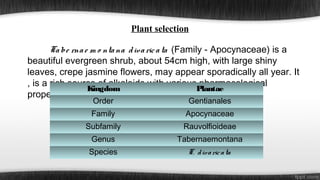
Ta be rna e m o nta na d iva ric a ta (Family - Apocynaceae) is a
beautiful evergreen shrub, about 54cm high, with large shiny
leaves, crepe jasmine flowers, may appear sporadically all year. It
, is a rich source of alkaloids with various pharmacological
Kingdom
Plantae
properties.
Order

Gentianales

Family

Apocynaceae

Subfamily

Rauvolfioideae

Genus

Tabernaemontana

Species

T. d iva ric a ta
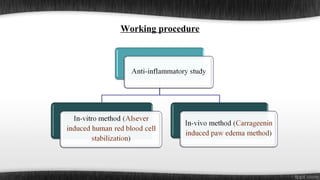
Working procedure
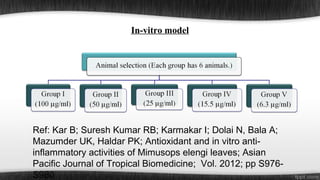
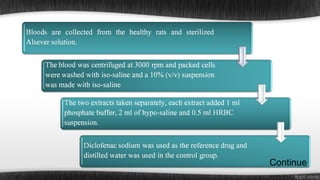
In-vitro model

Ref: Kar B; Suresh Kumar RB; Karmakar I; Dolai N, Bala A;
Mazumder UK, Haldar PK; Antioxidant and in vitro antiinflammatory activities of Mimusops elengi leaves; Asian
Pacific Journal of Tropical Biomedicine; Vol. 2012; pp S976S980
Continue
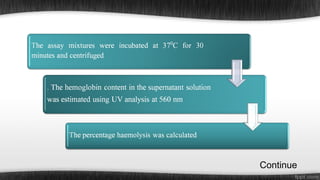
…….
Continue
…….
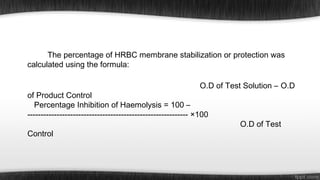
The percentage of HRBC membrane stabilization or protection was
calculated using the formula:
O.D of Test Solution – O.D

of Product Control
Percentage Inhibition of Haemolysis = 100 –
------------------------------------------------------------ ×100
Control

O.D of Test
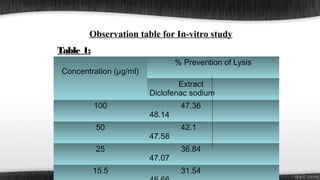
Observation table for In-vitro study
Table 1:
% Prevention of Lysis

Concentration (µg/ml)

Extract
Diclofenac sodium
100
50
25
15.5

48.14
47.58
47.07

47.36
42.1
36.84
31.54
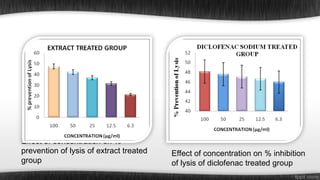
Effect of concentration on %
prevention of lysis of extract treated
group

Effect of concentration on % inhibition
of lysis of diclofenac treated group
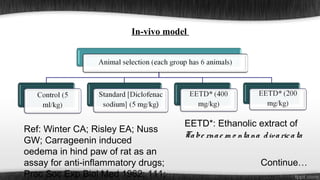
In-vivo model

Ref: Winter CA; Risley EA; Nuss
GW; Carrageenin induced
oedema in hind paw of rat as an
assay for anti-inflammatory drugs;
Proc Soc Exp Biol Med 1962; 111;

EETD*: Ethanolic extract of
Ta be rna e m o nta na d iva ric a ta
Continue…
…..
Continue…
Continue…
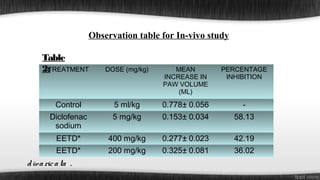
Observation table for In-vivo study
Table
2:
TREATMENT

DOSE (mg/kg)

MEAN
INCREASE IN
PAW VOLUME
(ML)

PERCENTAGE
INHIBITION

Control

5 ml/kg

0.778± 0.056

-

Diclofenac
sodium

5 mg/kg

0.153± 0.034

58.13

EETD*

400 mg/kg

0.277± 0.023

42.19

EETD*
0.325± Ta be
36.02
EETD*: 200 mg/kg Extract of0.081 rna e m o nta na
Ethanolic

d iva ric a ta .
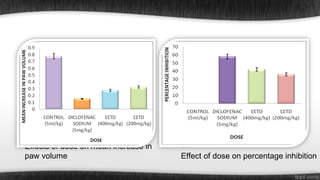
Effects of dose on mean increase in
paw volume

Effect of dose on percentage inhibition
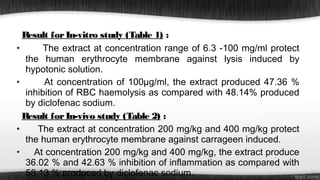
Result for In-vitro study (Table 1) :
•
The extract at concentration range of 6.3 -100 mg/ml protect
the human erythrocyte membrane against lysis induced by
hypotonic solution.
•
At concentration of 100µg/ml, the extract produced 47.36 %
inhibition of RBC haemolysis as compared with 48.14% produced
by diclofenac sodium.
Result for In-vivo study (Table 2) :
•
The extract at concentration 200 mg/kg and 400 mg/kg protect
the human erythrocyte membrane against carrageen induced.
•
At concentration 200 mg/kg and 400 mg/kg, the extract produce
36.02 % and 42.63 % inhibition of inflammation as compared with
58.13 % produced by diclofenac sodium.
Conclusion
In conclusion the present study demonstrated that
Ta be rna e m o nta na d iv a ric a ta leaves extract has anti-inflammatory
activity at a dose of 100 µg/ml in in-vitro study and 200 mg/kg and
400 mg/kg in in-vivo study.
Acknowledgement

The authors are thankful to the authority of the School Of
Pharmaceutical Science, Vels University, Pallavaram, Chennai 600117, India, for providing necessary facilities for the present study.
In vivo and in-vitro anti-inflammatory study

In vivo and in-vitro anti-inflammatory study

  • 1.
    Article Reference Number:OPP 029 In-vitro and In-vivo anti-inflammatory potential of Tabernaemontana divaricata leaves Sumithra Mohan*, J. Anbu, Arijit Chakraborty, Ariadasy Canagasaby, Odelia Sawian School of Pharmaceutical Sciences, Vels University, VISTAS Pallavaram, Chennai -117. Presenting author Arijit Chakraborty M.Pharm (Pharmacology) Vels University
  • 2.
    Inflammation Definition • Inflammation isa non specific, localized immune reaction of the organism, which tries to localized the pathogenic agents. Many consider the syndrome a self- defense mechanism. • It consist in vascular, metabolic, cellular changes, triggered by the entering of pathogenic agents in healthy tissues of the body.
  • 3.
    Mechanism action ofAnti-inflammatory drugs. Arachidonic acid COX 1 Constitutive GI Prostagland mucosa ins GI mucosal protection COX 2 Inhibitors Platelet Thrombox ane Hemostasis Prostaglan dins Mediate pain, inflammation and fever
  • 4.
    Plant selection Ta berna e m o nta na d iva ric a ta (Family - Apocynaceae) is a beautiful evergreen shrub, about 54cm high, with large shiny leaves, crepe jasmine flowers, may appear sporadically all year. It , is a rich source of alkaloids with various pharmacological Kingdom Plantae properties. Order Gentianales Family Apocynaceae Subfamily Rauvolfioideae Genus Tabernaemontana Species T. d iva ric a ta
  • 5.
  • 6.
    In-vitro model Ref: KarB; Suresh Kumar RB; Karmakar I; Dolai N, Bala A; Mazumder UK, Haldar PK; Antioxidant and in vitro antiinflammatory activities of Mimusops elengi leaves; Asian Pacific Journal of Tropical Biomedicine; Vol. 2012; pp S976S980
  • 7.
  • 8.
  • 9.
    The percentage ofHRBC membrane stabilization or protection was calculated using the formula: O.D of Test Solution – O.D of Product Control Percentage Inhibition of Haemolysis = 100 – ------------------------------------------------------------ ×100 Control O.D of Test
  • 10.
    Observation table forIn-vitro study Table 1: % Prevention of Lysis Concentration (µg/ml) Extract Diclofenac sodium 100 50 25 15.5 48.14 47.58 47.07 47.36 42.1 36.84 31.54
  • 11.
    Effect of concentrationon % prevention of lysis of extract treated group Effect of concentration on % inhibition of lysis of diclofenac treated group
  • 12.
    In-vivo model Ref: WinterCA; Risley EA; Nuss GW; Carrageenin induced oedema in hind paw of rat as an assay for anti-inflammatory drugs; Proc Soc Exp Biol Med 1962; 111; EETD*: Ethanolic extract of Ta be rna e m o nta na d iva ric a ta Continue… …..
  • 13.
  • 14.
  • 16.
    Observation table forIn-vivo study Table 2: TREATMENT DOSE (mg/kg) MEAN INCREASE IN PAW VOLUME (ML) PERCENTAGE INHIBITION Control 5 ml/kg 0.778± 0.056 - Diclofenac sodium 5 mg/kg 0.153± 0.034 58.13 EETD* 400 mg/kg 0.277± 0.023 42.19 EETD* 0.325± Ta be 36.02 EETD*: 200 mg/kg Extract of0.081 rna e m o nta na Ethanolic d iva ric a ta .
  • 17.
    Effects of doseon mean increase in paw volume Effect of dose on percentage inhibition
  • 18.
    Result for In-vitrostudy (Table 1) : • The extract at concentration range of 6.3 -100 mg/ml protect the human erythrocyte membrane against lysis induced by hypotonic solution. • At concentration of 100µg/ml, the extract produced 47.36 % inhibition of RBC haemolysis as compared with 48.14% produced by diclofenac sodium. Result for In-vivo study (Table 2) : • The extract at concentration 200 mg/kg and 400 mg/kg protect the human erythrocyte membrane against carrageen induced. • At concentration 200 mg/kg and 400 mg/kg, the extract produce 36.02 % and 42.63 % inhibition of inflammation as compared with 58.13 % produced by diclofenac sodium.
  • 19.
    Conclusion In conclusion thepresent study demonstrated that Ta be rna e m o nta na d iv a ric a ta leaves extract has anti-inflammatory activity at a dose of 100 µg/ml in in-vitro study and 200 mg/kg and 400 mg/kg in in-vivo study.
  • 20.
    Acknowledgement The authors arethankful to the authority of the School Of Pharmaceutical Science, Vels University, Pallavaram, Chennai 600117, India, for providing necessary facilities for the present study.