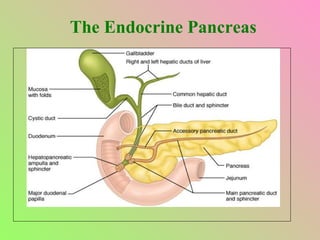
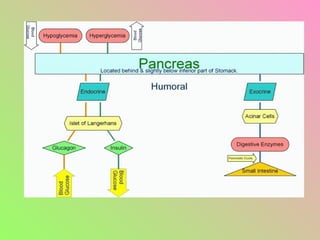
The Endocrine Pancreas
 
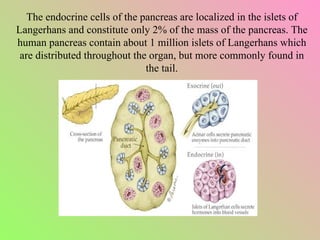
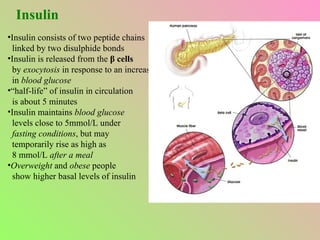
The endocrine cells of the pancreas are localized in the islets of Langerhans and constitute only 2% of the mass of the pancreas. The human pancreas contain about 1 million islets of Langerhans which are distributed throughout the organ, but more commonly found in the tail.
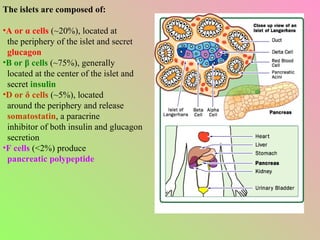
The islets are composed of: A or  α cells  (~20%), located at the periphery of the islet and secret glucagon B or  β cells  (~75%), generally located at the center of the islet and secret  insulin D or  δ cells  (~5%), located around the periphery and release somatostatin , a paracrine inhibitor of both insulin and glucagon secretion F cells  (<2%) produce pancreatic polypeptide
Insulin Insulin consists of two peptide chains linked by two disulphide bonds Insulin is released from the  β cells by  exocytosis  in response to an increase in   blood glucose “ half-life” of insulin in circulation is about 5 minutes Insulin maintains  blood glucose levels close to 5mmol/L under fasting conditions , but may temporarily rise as high as 8 mmol/L  after a meal Overweight  and  obese  people show higher basal levels of insulin
Regulation of secretion Elevation  of plasma glucose concentration directly stimulates: - a rapid rise of insulin secretion - there is an increase in  inreacellular  Ca, which is responsible for releasing insulin (entry of glucose into  β cells  does not depend on presence of insulin) Insulin secretion by  β cells   as glucose levels decline Increased  amono acid  concentrations in plasma  insulin secretion Stimulation of  right vagus nerve   insulin secretion Sympathetic  stimulation  release of insulin ( α-receptor mechanism ) Gastrointestinal hormones  (glucagon, gastrin, secretin and gastric inhibitory peptide)  insulin release Keto acids  insulin secretion Somatostatin, secreted by  δ cells   insulin secretion Drugs (orally active) -  sulphonylureas  (e.g. tolbutamide)  insulin secretion -  glibizide/gliburide   insulin secretion and promotes its action at cellular level -  biguanides  (e.g. phenformin) act by increasing glucose catabolism  glucose absorption in the intestine -  thiazide diuretics   insulin secretion -  diazxide  (used in the treatment of hypertension)  insulin secretion Leptin  basal and glucose-stimulated insulin release
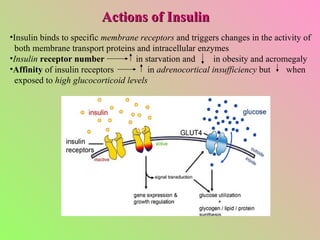
Actions of Insulin Insulin binds to specific  membrane receptors  and triggers changes in the activity of both membrane transport proteins and intracellular enzymes Insulin  receptor number   in starvation and  in obesity and acromegaly Affinity  of insulin receptors  in  adrenocortical insufficiency  but  when exposed to  high glucocorticoid levels
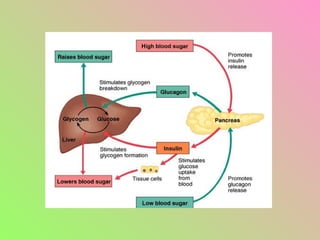
Insulin  blood glucose by facilitating glucose uptake in  muscles  and  adipose tissue Brain, liver, kidneys, red blood cells & intestinal mucosa are exceptions Insulin  glycogen synthesis ( glycogenesis ) in the  liver  &  glycogen breakdown ( glycogenolysis ) Insulin is an  anabolic hormone  & promotes the rate of protein synthesis by: - stimulating amino acid uptake in the  liver  and  skeletal muscle - inhibiting protein breakdown - inhibiting conversion of amino acids to glucose ( gluconeogenesis ) Insulin promotes  storage of fat  and decreases its utilization by: -  inhibiting  the breakdown of stored lipid ( by hormone-sensitive lipase )  free fatty acid levels in circulation -  stimulating  fatty acid synthesis from glucose in the  liver -  promoting  glycerol synthesis in  lipid cells -  promoting  carbohydrate utilization so that fat is spared ( resting muscle normally oxidizes fatty acids for energy ) Insulin  plasma levels of  K   (  cellular uptake)
 
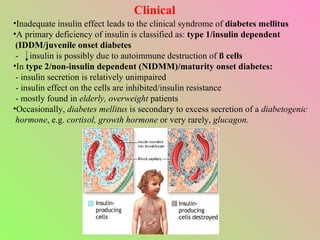
Clinical Inadequate insulin effect leads to the clinical syndrome of  diabetes mellitus A primary deficiency of insulin is classified as:  type 1/insulin dependent (IDDM/juvenile onset diabetes -  insulin is possibly due to autoimmune destruction of  ß cells In  type 2/non-insulin dependent (NIDMM)/maturity onset diabetes: - insulin secretion is relatively unimpaired - insulin effect on the cells are inhibited/insulin resistance - mostly found in  elderly, overweight  patients Occasionally,  diabetes mellitus  is secondary to excess secretion of a  diabetogenic hormone , e.g.  cortisol, growth hormone  or very rarely,  glucagon .
Symptoms and biochemical abnormalities Hypergycemia - decreased glucose uptake & utilization  plasma glucose level Glucosuria -  plasma glucose ~11 mmol/L crosses renal T max  limit  excreted in urine Polyuria -  glucose within the renal tubules  osmotic retention of H2O  urine production ( osmotic diuresis ) Polydipsia - polyuria  dehydration  thirst and drinking Reduction in amino acid uptake  protein synthesis  negative nitrogen balance  impaired growth ( in children )/muscle wasting & weight loss ( in adults ) Lipid mobilization   plasma free fatty acid levels  weight loss Ketosis -  ß-oxidation of fatty acid  ketone bodies  metabolic acidosis Increased ventilation - respiratory compensation of acidosis
Treatment If the patient remain untreated, diabetes mellitus will eventually lead to  ketotic coma  and death from  dehydration  and  acidosis -  recombinant insulin  treatment can lead to a good control of glucose levels. Cases in which  hyperglycemia  is associated with  obesity ,  diet alone  or  diet in combination with physical exercise  may be adequate Excess insulin   hypoglycemia  sympathetic activity  tremor, sweating,  heart rate, anxiety, may  coma , could reversed by intravenous  glucose / glucagon
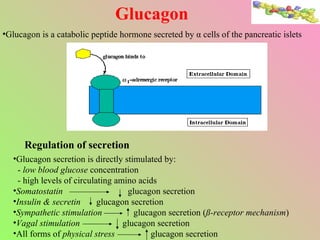
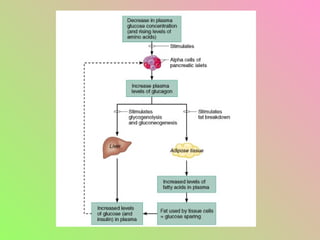
Glucagon Glucagon is a catabolic peptide hormone secreted by  α cells of the  pancreatic islets Regulation of secretion Glucagon secretion is directly stimulated by: -  low blood glucose  concentration - high levels of circulating amino acids Somatostatin   glucagon secretion Insulin & secretin   glucagon secretion Sympathetic stimulation   glucagon secretion ( ß-receptor mechanism ) Vagal stimulation   glucagon secretion All forms of  physical stress   glucagon secretion
 
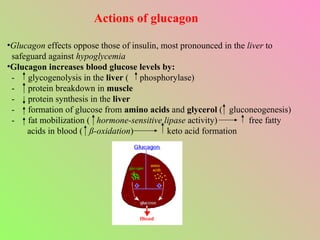
Actions of glucagon Glucagon  effects oppose those of insulin, most pronounced in the  liver  to safeguard against  hypoglycemia Glucagon increases blood glucose levels by: -  glycogenolysis in the  liver  (  phosphorylase) -  protein breakdown in  muscle -  protein synthesis in the  liver -  formation of glucose from  amino acids  and  glycerol  (  gluconeogenesis) -  fat mobilization (  hormone-sensitive lipase  activity)  free fatty acids in blood (  ß-oxidation )  keto acid formation
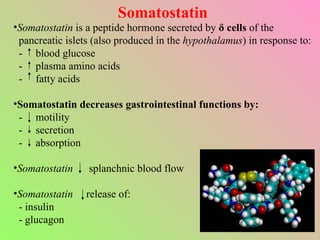
Somatostatin Somatostatin  is a peptide hormone secreted by  δ cells  of the pancreatic islets (also produced in the  hypothalamus ) in response to: -  blood glucose -  plasma amino acids -  fatty acids Somatostatin decreases gastrointestinal functions by: -  motility -  secretion -  absorption   Somatostatin  splanchnic blood flow Somatostatin   release of: - insulin - glucagon
Amylin A  pancreatic hormone , is stored in the  ß cells  and released together with insulin Amylin is a potent inhibitor of gastric emptying Amylin  insulin secretion It can induce  insulin resistance

18. endocrine pancreas

  • 1.
  • 2.
  • 3.
    The endocrine cellsof the pancreas are localized in the islets of Langerhans and constitute only 2% of the mass of the pancreas. The human pancreas contain about 1 million islets of Langerhans which are distributed throughout the organ, but more commonly found in the tail.
  • 4.
    The islets arecomposed of: A or α cells (~20%), located at the periphery of the islet and secret glucagon B or β cells (~75%), generally located at the center of the islet and secret insulin D or δ cells (~5%), located around the periphery and release somatostatin , a paracrine inhibitor of both insulin and glucagon secretion F cells (<2%) produce pancreatic polypeptide
  • 5.
    Insulin Insulin consistsof two peptide chains linked by two disulphide bonds Insulin is released from the β cells by exocytosis in response to an increase in blood glucose “ half-life” of insulin in circulation is about 5 minutes Insulin maintains blood glucose levels close to 5mmol/L under fasting conditions , but may temporarily rise as high as 8 mmol/L after a meal Overweight and obese people show higher basal levels of insulin
  • 6.
    Regulation of secretionElevation of plasma glucose concentration directly stimulates: - a rapid rise of insulin secretion - there is an increase in inreacellular Ca, which is responsible for releasing insulin (entry of glucose into β cells does not depend on presence of insulin) Insulin secretion by β cells as glucose levels decline Increased amono acid concentrations in plasma insulin secretion Stimulation of right vagus nerve insulin secretion Sympathetic stimulation release of insulin ( α-receptor mechanism ) Gastrointestinal hormones (glucagon, gastrin, secretin and gastric inhibitory peptide) insulin release Keto acids insulin secretion Somatostatin, secreted by δ cells insulin secretion Drugs (orally active) - sulphonylureas (e.g. tolbutamide) insulin secretion - glibizide/gliburide insulin secretion and promotes its action at cellular level - biguanides (e.g. phenformin) act by increasing glucose catabolism glucose absorption in the intestine - thiazide diuretics insulin secretion - diazxide (used in the treatment of hypertension) insulin secretion Leptin basal and glucose-stimulated insulin release
  • 7.
    Actions of InsulinInsulin binds to specific membrane receptors and triggers changes in the activity of both membrane transport proteins and intracellular enzymes Insulin receptor number in starvation and in obesity and acromegaly Affinity of insulin receptors in adrenocortical insufficiency but when exposed to high glucocorticoid levels
  • 8.
    Insulin bloodglucose by facilitating glucose uptake in muscles and adipose tissue Brain, liver, kidneys, red blood cells & intestinal mucosa are exceptions Insulin glycogen synthesis ( glycogenesis ) in the liver & glycogen breakdown ( glycogenolysis ) Insulin is an anabolic hormone & promotes the rate of protein synthesis by: - stimulating amino acid uptake in the liver and skeletal muscle - inhibiting protein breakdown - inhibiting conversion of amino acids to glucose ( gluconeogenesis ) Insulin promotes storage of fat and decreases its utilization by: - inhibiting the breakdown of stored lipid ( by hormone-sensitive lipase ) free fatty acid levels in circulation - stimulating fatty acid synthesis from glucose in the liver - promoting glycerol synthesis in lipid cells - promoting carbohydrate utilization so that fat is spared ( resting muscle normally oxidizes fatty acids for energy ) Insulin plasma levels of K ( cellular uptake)
  • 9.
  • 10.
    Clinical Inadequate insulineffect leads to the clinical syndrome of diabetes mellitus A primary deficiency of insulin is classified as: type 1/insulin dependent (IDDM/juvenile onset diabetes - insulin is possibly due to autoimmune destruction of ß cells In type 2/non-insulin dependent (NIDMM)/maturity onset diabetes: - insulin secretion is relatively unimpaired - insulin effect on the cells are inhibited/insulin resistance - mostly found in elderly, overweight patients Occasionally, diabetes mellitus is secondary to excess secretion of a diabetogenic hormone , e.g. cortisol, growth hormone or very rarely, glucagon .
  • 11.
    Symptoms and biochemicalabnormalities Hypergycemia - decreased glucose uptake & utilization plasma glucose level Glucosuria - plasma glucose ~11 mmol/L crosses renal T max limit excreted in urine Polyuria - glucose within the renal tubules osmotic retention of H2O urine production ( osmotic diuresis ) Polydipsia - polyuria dehydration thirst and drinking Reduction in amino acid uptake protein synthesis negative nitrogen balance impaired growth ( in children )/muscle wasting & weight loss ( in adults ) Lipid mobilization plasma free fatty acid levels weight loss Ketosis - ß-oxidation of fatty acid ketone bodies metabolic acidosis Increased ventilation - respiratory compensation of acidosis
  • 12.
    Treatment If thepatient remain untreated, diabetes mellitus will eventually lead to ketotic coma and death from dehydration and acidosis - recombinant insulin treatment can lead to a good control of glucose levels. Cases in which hyperglycemia is associated with obesity , diet alone or diet in combination with physical exercise may be adequate Excess insulin hypoglycemia sympathetic activity tremor, sweating, heart rate, anxiety, may coma , could reversed by intravenous glucose / glucagon
  • 13.
    Glucagon Glucagon isa catabolic peptide hormone secreted by α cells of the pancreatic islets Regulation of secretion Glucagon secretion is directly stimulated by: - low blood glucose concentration - high levels of circulating amino acids Somatostatin glucagon secretion Insulin & secretin glucagon secretion Sympathetic stimulation glucagon secretion ( ß-receptor mechanism ) Vagal stimulation glucagon secretion All forms of physical stress glucagon secretion
  • 14.
  • 15.
    Actions of glucagonGlucagon effects oppose those of insulin, most pronounced in the liver to safeguard against hypoglycemia Glucagon increases blood glucose levels by: - glycogenolysis in the liver ( phosphorylase) - protein breakdown in muscle - protein synthesis in the liver - formation of glucose from amino acids and glycerol ( gluconeogenesis) - fat mobilization ( hormone-sensitive lipase activity) free fatty acids in blood ( ß-oxidation ) keto acid formation
  • 16.
    Somatostatin Somatostatin is a peptide hormone secreted by δ cells of the pancreatic islets (also produced in the hypothalamus ) in response to: - blood glucose - plasma amino acids - fatty acids Somatostatin decreases gastrointestinal functions by: - motility - secretion - absorption Somatostatin splanchnic blood flow Somatostatin release of: - insulin - glucagon
  • 17.
    Amylin A pancreatic hormone , is stored in the ß cells and released together with insulin Amylin is a potent inhibitor of gastric emptying Amylin insulin secretion It can induce insulin resistance