SUMANDEEP COLLEGE OF NURSING
DRUG PRESENTATION ON
CALCIUM CHANNEL BLOCKERS
PRESENTED BY
NIKHIL VAISHNAV
M.SC. NURSING 2ND YEAR
CALCIUM CHANNEL BLOCKERS
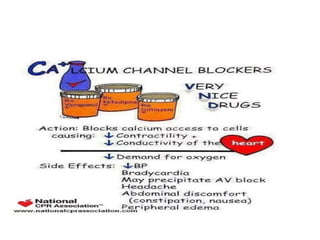
Calcium channel blockers (CCBs) also known as calcium
antagonists.
These medications disrupt the movement of calcium (Ca2+)
through calcium channels.
they are first line antihypertensive drugs.
They are also used to treat angina.
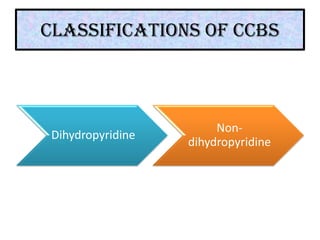
CLASSIFICATIONS OF CCBs
Dihydropyridine
Non-
dihydropyridine
DIHYDROPYRIDINE
Dihydropyridine CCBs are derived from the
molecule dihydropyridine.
They are mostly used to reduce systemic vascular
resistance and arterial pressure.
Sometimes they are used to treat angina.
They are easily identified by their suffix “dipine”.
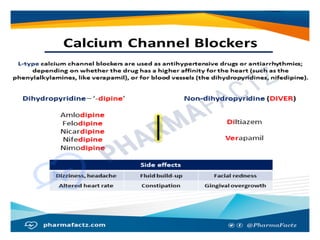
• Examples of dihydropyridine are :
1. Amlodipine (Norvasc)
2. Aranidipine (Sapresta)
3. Lacidipine (Motens, Lacipil)
4. Lercanidipine (Zanidip)
5. Manidipine (Calslot, Madipine)
6. Nicardipine (Cardene, Carden SR)
7. Nifedipine (Procardia, Adalat)
8. Nilvadipine (Nivadil)
9. Nimodipine (Nimotop)
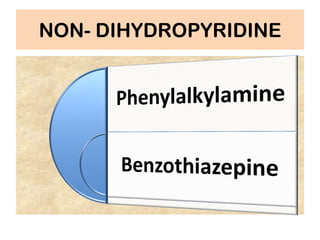
NON- DIHYDROPYRIDINE
PHENYLALKYLAMINE
• The Phenylalkylamine class of CCBs mainly
affect the cells of the heart .
• They have negative inotropic and negative
chronotropic effects .
• They have minimal vasodilatory effects
compared with dihydropyridine.
• Examples are : verapamil etc.
BENZOTHIAZEPINE
• It belongs to the molecule Benzothiazepine.
• These drugs are intermediate class between
dihydropyridine and Phenylalkylamine.
• They have both cardiac depressor and
vasodilator action.
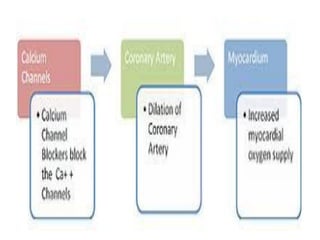
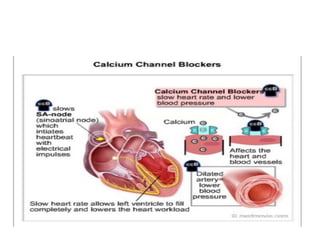
MECHANISM OF ACTION
• CCBs has four effects:
1) They act on vascular smooth muscle, reduce
contraction of the arteries and cause vasodilation .
2) They act on cardiac muscles (myocardium), they
reduce the force of contraction of the heart( Negative
inotropic ).
3) They slow down the conduction of electrical activity
within the heart, slow down the heartbeat ( Negative
chronotropic ).
4) They block the calcium signal on adrenal cortex cells,
they directly reduce aldosterone production, which
correlates to lower blood pressure.
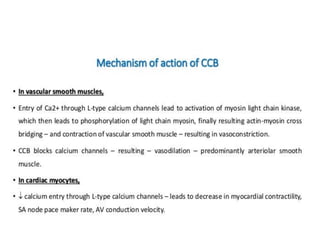
• Calcium + Troponin complex in the heart and
actin and myosin interaction - Heart contacts.
• Calcium + Calmodulin complex in the vessels
and
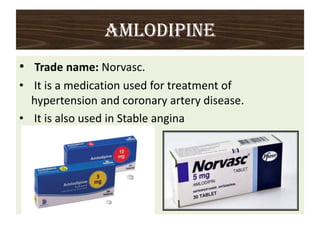
AMLODIPINE
• Trade name: Norvasc.
• It is a medication used for treatment of
hypertension and coronary artery disease.
• It is also used in Stable angina
MECHANISM OF ACTION
It produces coronary vasodilation by inhibiting
the entry of calcium ions into the voltage
gated channels of the vascular smooth muscle
and myocardium during depolarization.
It decreases cardiac work, decrease cardiac
oxygen consumption.
• Indications: Hypertension, Stable angina,
Prinzmetal’s angina.
• Contraindications: Known hypersensitivity to
dihydropyridine, Second or third degree heart
block, Lactation.
• Availability:It is available in Tablets—2.5, 5,
10 mg.
• Side effects: Dizziness, light-headedness,
headache, asthenia, fatigue, lethargy, peripheral
edema, somnolence, flushing, nausea, abdominal
pain.
• Nursing care: Monitor patient carefully (BP,
cardiac rhythm, and output) while adjusting drug
to therapeutic dose; use special caution if patient
has CHF..
• Monitor BP very carefully if patient is also on
nitrates.
• Monitor cardiac rhythm regularly
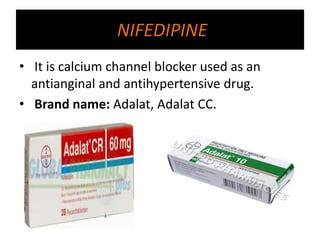
NIFEDIPINE
• It is calcium channel blocker used as an
antianginal and antihypertensive drug.
• Brand name: Adalat, Adalat CC.
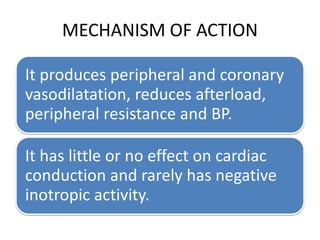
MECHANISM OF ACTION
It produces peripheral and coronary
vasodilatation, reduces afterload,
peripheral resistance and BP.
It has little or no effect on cardiac
conduction and rarely has negative
inotropic activity.
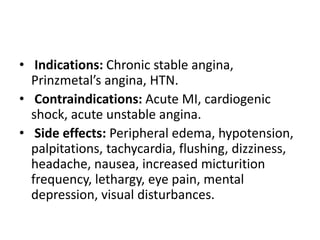
• Indications: Chronic stable angina,
Prinzmetal’s angina, HTN.
• Contraindications: Acute MI, cardiogenic
shock, acute unstable angina.
• Side effects: Peripheral edema, hypotension,
palpitations, tachycardia, flushing, dizziness,
headache, nausea, increased micturition
frequency, lethargy, eye pain, mental
depression, visual disturbances.
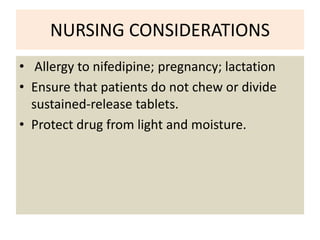
NURSING CONSIDERATIONS
• Allergy to nifedipine; pregnancy; lactation
• Ensure that patients do not chew or divide
sustained-release tablets.
• Protect drug from light and moisture.
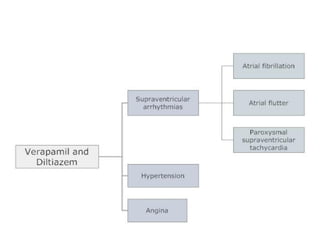
VERAPAMIL
• It is used to treat hypertension, chest pain
from cardiac ischemia and supraventricular
tachycardia.
ACTION
Verapamil inhibits entry of calcium ions
into arterial smooth muscle as well as
the myocytes and conducting tissues.
Verapamil reduces BP, relieves angina
and slows AV conduction.
INDICATIONS
• Angina pectoris due to coronary artery spasm
(Prinzmetal’s variant angina)
• Effort-associated angina
• Chronic stable angina
• Unstable, crescendo, preinfarction angina
• Essential hypertension
• Parenteral: Treatment of supraventricular
tachyarrhythmia.
• Parenteral: Temporary control of rapid ventricular rate
in atrial flutter or atrial fibrillation
CONTRAINDICATIONS
Cardiogenic shock.
severe bradycardia.
severe left ventricular dysfunction.
uncompensated heart failure.
hypotension (systolic pressure <90 mm Hg),
SIDE EFFECTS
• Bradycardia.
• CHF.
• MI.
• AV block.
• transient Asystole.
• hypotension.
• pulmonary and peripheral edema.
• nausea. Constipation.
• fatigue, hypotension, dizziness, headache.
NURSING CONSIDERATIONS
Ensure that patient swallows SR tablets whole;
patient should not cut, crush, or chew them.
Protect IV solution from light.
Allergic to verapamil.
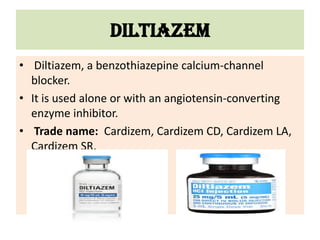
DILTIAZEM
• Diltiazem, a benzothiazepine calcium-channel
blocker.
• It is used alone or with an angiotensin-converting
enzyme inhibitor.
• Trade name: Cardizem, Cardizem CD, Cardizem LA,
Cardizem SR.
MECHANISM OF ACTION
• Slows SA and AV node conduction
(antiarrhythmic effect) without affecting
normal arterial action potential or
Interventricular conduction.
INDICATIONS
• Vasospastic angina (Prinzmetal's variant or at
rest angina).
• chronic stable (classic effort-associated)
angina
• Essential hypertension
• Atrial fibrillation
• atrial flutter.
• supraventricular tachycardia.
CONTRAINDICATIONS
Known hypersensitivity to drug; sick sinus syndrome
(unless pacemaker is in place and functioning).
second- or third-degree AV block.
severe hypotension (systolic <90 mm Hg or diastolic <60
mm Hg).
patients undergoing intracranial surgery; bleeding
aneurysms.
SIDE EFFECTS
CNS: Headache, fatigue, dizziness, asthenia, drowsiness,
nervousness, insomnia, confusion, tremor, gait abnormality.
CV: Edema, arrhythmias, angina, second- or third-degree AV
block, bradycardia,
CHF: flushing, hypotension, syncope, palpitations.
GI: Nausea, constipation, anorexia, vomiting, diarrhoea,
impaired taste, weight increase. Skin: Rash.
NURSING IMPLICATIONS
• Check BP and ECG before initiation of therapy
and monitor particularly during dosage
adjustment period.
• Lab tests: Do baseline and periodic liver and
renal function tests.
• Monitor for and report S&S of CHF.
• Monitor for headache. An analgesic may be
required.
• Supervise ambulation as indicated.

Calcium channel blockers nikku

  • 1.
    SUMANDEEP COLLEGE OFNURSING DRUG PRESENTATION ON CALCIUM CHANNEL BLOCKERS PRESENTED BY NIKHIL VAISHNAV M.SC. NURSING 2ND YEAR
  • 2.
    CALCIUM CHANNEL BLOCKERS Calciumchannel blockers (CCBs) also known as calcium antagonists. These medications disrupt the movement of calcium (Ca2+) through calcium channels. they are first line antihypertensive drugs. They are also used to treat angina.
  • 3.
  • 5.
    DIHYDROPYRIDINE Dihydropyridine CCBs arederived from the molecule dihydropyridine. They are mostly used to reduce systemic vascular resistance and arterial pressure. Sometimes they are used to treat angina. They are easily identified by their suffix “dipine”.
  • 6.
    • Examples ofdihydropyridine are : 1. Amlodipine (Norvasc) 2. Aranidipine (Sapresta) 3. Lacidipine (Motens, Lacipil) 4. Lercanidipine (Zanidip) 5. Manidipine (Calslot, Madipine) 6. Nicardipine (Cardene, Carden SR) 7. Nifedipine (Procardia, Adalat) 8. Nilvadipine (Nivadil) 9. Nimodipine (Nimotop)
  • 7.
  • 8.
    PHENYLALKYLAMINE • The Phenylalkylamineclass of CCBs mainly affect the cells of the heart . • They have negative inotropic and negative chronotropic effects . • They have minimal vasodilatory effects compared with dihydropyridine. • Examples are : verapamil etc.
  • 9.
    BENZOTHIAZEPINE • It belongsto the molecule Benzothiazepine. • These drugs are intermediate class between dihydropyridine and Phenylalkylamine. • They have both cardiac depressor and vasodilator action.
  • 10.
    MECHANISM OF ACTION •CCBs has four effects: 1) They act on vascular smooth muscle, reduce contraction of the arteries and cause vasodilation . 2) They act on cardiac muscles (myocardium), they reduce the force of contraction of the heart( Negative inotropic ). 3) They slow down the conduction of electrical activity within the heart, slow down the heartbeat ( Negative chronotropic ). 4) They block the calcium signal on adrenal cortex cells, they directly reduce aldosterone production, which correlates to lower blood pressure.
  • 15.
    • Calcium +Troponin complex in the heart and actin and myosin interaction - Heart contacts. • Calcium + Calmodulin complex in the vessels and
  • 16.
    AMLODIPINE • Trade name:Norvasc. • It is a medication used for treatment of hypertension and coronary artery disease. • It is also used in Stable angina
  • 17.
    MECHANISM OF ACTION Itproduces coronary vasodilation by inhibiting the entry of calcium ions into the voltage gated channels of the vascular smooth muscle and myocardium during depolarization. It decreases cardiac work, decrease cardiac oxygen consumption.
  • 18.
    • Indications: Hypertension,Stable angina, Prinzmetal’s angina. • Contraindications: Known hypersensitivity to dihydropyridine, Second or third degree heart block, Lactation. • Availability:It is available in Tablets—2.5, 5, 10 mg.
  • 19.
    • Side effects:Dizziness, light-headedness, headache, asthenia, fatigue, lethargy, peripheral edema, somnolence, flushing, nausea, abdominal pain. • Nursing care: Monitor patient carefully (BP, cardiac rhythm, and output) while adjusting drug to therapeutic dose; use special caution if patient has CHF.. • Monitor BP very carefully if patient is also on nitrates. • Monitor cardiac rhythm regularly
  • 20.
    NIFEDIPINE • It iscalcium channel blocker used as an antianginal and antihypertensive drug. • Brand name: Adalat, Adalat CC.
  • 21.
    MECHANISM OF ACTION Itproduces peripheral and coronary vasodilatation, reduces afterload, peripheral resistance and BP. It has little or no effect on cardiac conduction and rarely has negative inotropic activity.
  • 22.
    • Indications: Chronicstable angina, Prinzmetal’s angina, HTN. • Contraindications: Acute MI, cardiogenic shock, acute unstable angina. • Side effects: Peripheral edema, hypotension, palpitations, tachycardia, flushing, dizziness, headache, nausea, increased micturition frequency, lethargy, eye pain, mental depression, visual disturbances.
  • 23.
    NURSING CONSIDERATIONS • Allergyto nifedipine; pregnancy; lactation • Ensure that patients do not chew or divide sustained-release tablets. • Protect drug from light and moisture.
  • 24.
    VERAPAMIL • It isused to treat hypertension, chest pain from cardiac ischemia and supraventricular tachycardia.
  • 25.
    ACTION Verapamil inhibits entryof calcium ions into arterial smooth muscle as well as the myocytes and conducting tissues. Verapamil reduces BP, relieves angina and slows AV conduction.
  • 26.
    INDICATIONS • Angina pectorisdue to coronary artery spasm (Prinzmetal’s variant angina) • Effort-associated angina • Chronic stable angina • Unstable, crescendo, preinfarction angina • Essential hypertension • Parenteral: Treatment of supraventricular tachyarrhythmia. • Parenteral: Temporary control of rapid ventricular rate in atrial flutter or atrial fibrillation
  • 27.
    CONTRAINDICATIONS Cardiogenic shock. severe bradycardia. severeleft ventricular dysfunction. uncompensated heart failure. hypotension (systolic pressure <90 mm Hg),
  • 28.
    SIDE EFFECTS • Bradycardia. •CHF. • MI. • AV block. • transient Asystole. • hypotension. • pulmonary and peripheral edema. • nausea. Constipation. • fatigue, hypotension, dizziness, headache.
  • 29.
    NURSING CONSIDERATIONS Ensure thatpatient swallows SR tablets whole; patient should not cut, crush, or chew them. Protect IV solution from light. Allergic to verapamil.
  • 30.
    DILTIAZEM • Diltiazem, abenzothiazepine calcium-channel blocker. • It is used alone or with an angiotensin-converting enzyme inhibitor. • Trade name: Cardizem, Cardizem CD, Cardizem LA, Cardizem SR.
  • 32.
    MECHANISM OF ACTION •Slows SA and AV node conduction (antiarrhythmic effect) without affecting normal arterial action potential or Interventricular conduction.
  • 33.
    INDICATIONS • Vasospastic angina(Prinzmetal's variant or at rest angina). • chronic stable (classic effort-associated) angina • Essential hypertension • Atrial fibrillation • atrial flutter. • supraventricular tachycardia.
  • 34.
    CONTRAINDICATIONS Known hypersensitivity todrug; sick sinus syndrome (unless pacemaker is in place and functioning). second- or third-degree AV block. severe hypotension (systolic <90 mm Hg or diastolic <60 mm Hg). patients undergoing intracranial surgery; bleeding aneurysms.
  • 35.
    SIDE EFFECTS CNS: Headache,fatigue, dizziness, asthenia, drowsiness, nervousness, insomnia, confusion, tremor, gait abnormality. CV: Edema, arrhythmias, angina, second- or third-degree AV block, bradycardia, CHF: flushing, hypotension, syncope, palpitations. GI: Nausea, constipation, anorexia, vomiting, diarrhoea, impaired taste, weight increase. Skin: Rash.
  • 36.
    NURSING IMPLICATIONS • CheckBP and ECG before initiation of therapy and monitor particularly during dosage adjustment period. • Lab tests: Do baseline and periodic liver and renal function tests. • Monitor for and report S&S of CHF. • Monitor for headache. An analgesic may be required. • Supervise ambulation as indicated.