ANTIANGINAL
DRUGS
PRESENTED BY
PANKAJ SINGH RANA
NURSE PRACTITIONER IN
CRITICAL CARE
SRHU, HCON
Introduction :
• Angina pectoris is characterized by sudden
severe pressing chest pain or heaviness
radiating to the neck, jaw, back and arms.
• It is often associated with diaphoresis,
tachypnea and nausea.
• Angina is caused by coronary flow that is
insufficient to meet oxygen demands of the
myocardium.
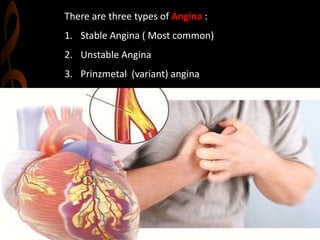
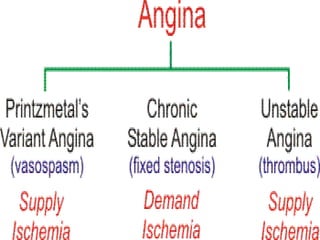
There are three types of Angina :
1. Stable Angina ( Most common)
2. Unstable Angina
3. Prinzmetal (variant) angina
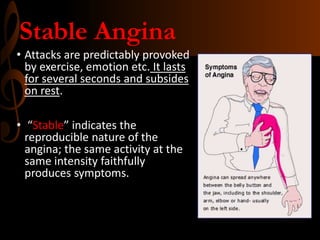
Stable Angina
• Attacks are predictably provoked
by exercise, emotion etc. It lasts
for several seconds and subsides
on rest.
• “Stable” indicates the
reproducible nature of the
angina; the same activity at the
same intensity faithfully
produces symptoms.
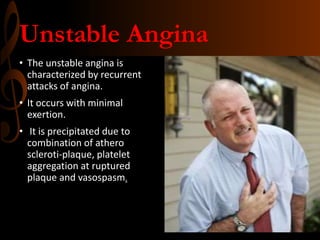
Unstable Angina
• The unstable angina is
characterized by recurrent
attacks of angina.
• It occurs with minimal
exertion.
• It is precipitated due to
combination of athero
scleroti-plaque, platelet
aggregation at ruptured
plaque and vasospasm.
Prinzmetal (Variant)
Angina
• This is a relatively uncommon pattern of myocardial
ischemia usually occurring at rest or during sleep and
often in young individuals.
• It is induced by coronary artery vasospasm, it generally
responds promptly to vasodilators.
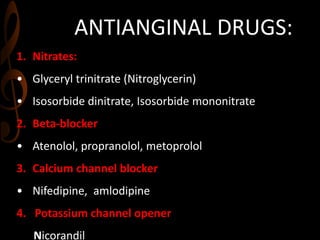
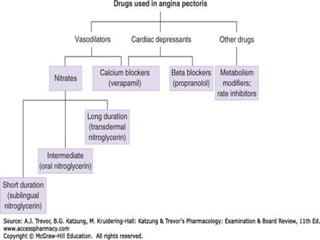
ANTIANGINAL DRUGS:
1. Nitrates:
• Glyceryl trinitrate (Nitroglycerin)
• Isosorbide dinitrate, Isosorbide mononitrate
2. Beta-blocker
• Atenolol, propranolol, metoprolol
3. Calcium channel blocker
• Nifedipine, amlodipine
4. Potassium channel opener
Nicorandil
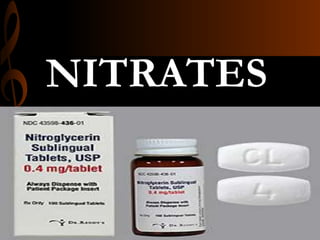
NITRATES
NITRATES
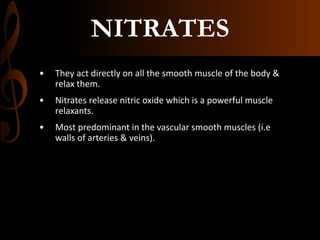
• They act directly on all the smooth muscle of the body &
relax them.
• Nitrates release nitric oxide which is a powerful muscle
relaxants.
• Most predominant in the vascular smooth muscles (i.e
walls of arteries & veins).
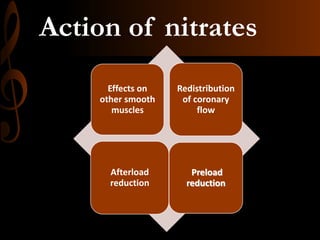
Action of nitrates
Effects on
other smooth
muscles
Redistribution
of coronary
flow
Afterload
reduction
Preload
reduction
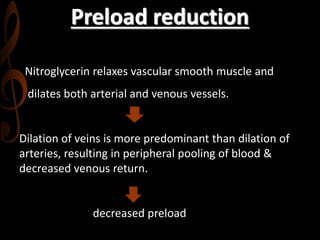
Preload reduction
Nitroglycerin relaxes vascular smooth muscle and
dilates both arterial and venous vessels.
Dilation of veins is more predominant than dilation of
arteries, resulting in peripheral pooling of blood &
decreased venous return.
decreased preload
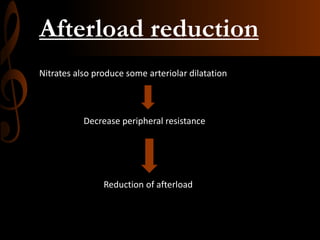
Afterload reduction
Nitrates also produce some arteriolar dilatation
Decrease peripheral resistance
Reduction of afterload
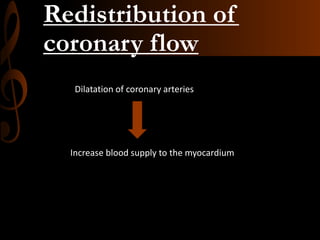
Redistribution of
coronary flow
Dilatation of coronary arteries
Increase blood supply to the myocardium
Effects on other smooth
muscles
• Relax the bronchi, biliary tracts & esophagus
muscles.
• Also dilates cutaneous vessels & meningeal
vessels .
Available forms
1. Sublingual Tablets.
2. Topical Ointment and
Transdermal Patches.
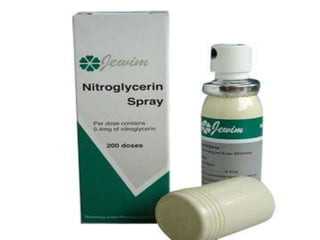
3. Translingual Spray.
4. Transmucosal Tablets.
5. Intravenous (IV).
Therapeutic uses of
antianginal drugs
Nitrates:-
• Angina pectoris
• MI
• Congestive cardiac failure
• Biliary colic
• Cyanide poisoning
• Oesophageal spasm
Nitroglycerine
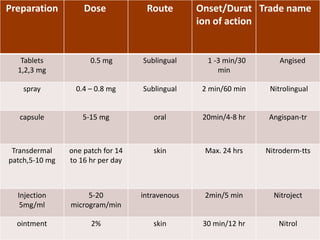
Preparation Dose Route Onset/Durat
ion of action
Trade name
Tablets
1,2,3 mg
0.5 mg Sublingual 1 -3 min/30
min
Angised
spray 0.4 – 0.8 mg Sublingual 2 min/60 min Nitrolingual
capsule 5-15 mg oral 20min/4-8 hr Angispan-tr
Transdermal
patch,5-10 mg
one patch for 14
to 16 hr per day
skin Max. 24 hrs Nitroderm-tts
Injection
5mg/ml
5-20
microgram/min
intravenous 2min/5 min Nitroject
ointment 2% skin 30 min/12 hr Nitrol
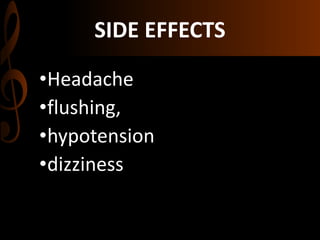
SIDE EFFECTS
•Headache
•flushing,
•hypotension
•dizziness
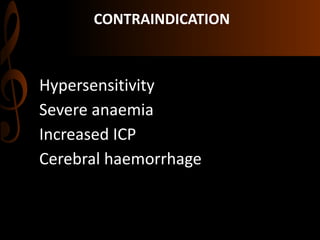
CONTRAINDICATION
Hypersensitivity
Severe anaemia
Increased ICP
Cerebral haemorrhage
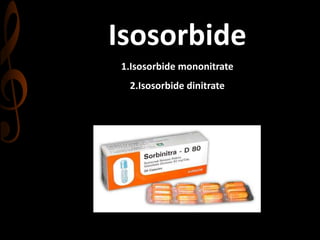
Isosorbide
1.Isosorbide mononitrate
2.Isosorbide dinitrate
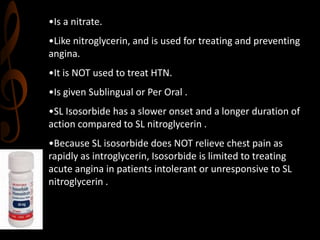
•Is a nitrate.
•Like nitroglycerin, and is used for treating and preventing
angina.
•It is NOT used to treat HTN.
•Is given Sublingual or Per Oral .
•SL Isosorbide has a slower onset and a longer duration of
action compared to SL nitroglycerin .
•Because SL isosorbide does NOT relieve chest pain as
rapidly as introglycerin, Isosorbide is limited to treating
acute angina in patients intolerant or unresponsive to SL
nitroglycerin .
Dose & Route
1.Isosorbide mononitrate:-
20 to 40 mg orally
2.Isosorbide dinitrate:
5 -1o mg sublingually or orally
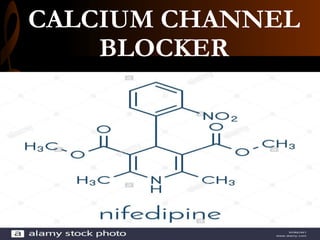
CALCIUM CHANNEL
BLOCKER
CCB have negative chronotropic effect
and dromotropic action on heart
• COMMON CALCIUM CHANNEL BLOCKER USED ARE
• VERAPEMIL ( most potent)
• NIFIDEPINE
• DILTIZEM ( least potent)
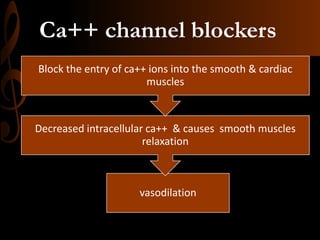
Ca++ channel blockers
vasodilation
Decreased intracellular ca++ & causes smooth muscles
relaxation
Block the entry of ca++ ions into the smooth & cardiac
muscles
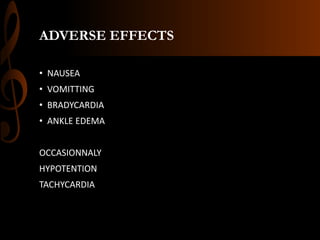
ADVERSE EFFECTS
• NAUSEA
• VOMITTING
• BRADYCARDIA
• ANKLE EDEMA
OCCASIONNALY
HYPOTENTION
TACHYCARDIA
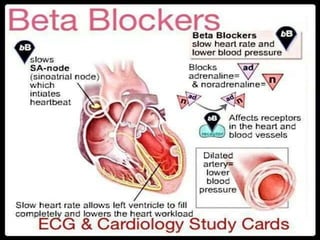
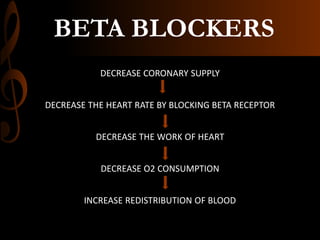
BETA BLOCKERS
DECREASE CORONARY SUPPLY
DECREASE THE HEART RATE BY BLOCKING BETA RECEPTOR
DECREASE THE WORK OF HEART
DECREASE O2 CONSUMPTION
INCREASE REDISTRIBUTION OF BLOOD
DRUGS
• MAINLY TWO DRUGS USED
• ATENOLOL
• METOPROLOL
ADVERSE EFFECT
Hypotension
Depression
Bradycardia
Heart block
CHF
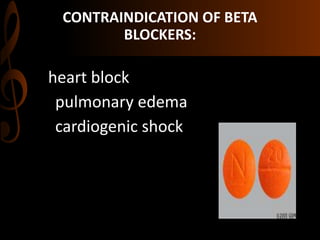
CONTRAINDICATION OF BETA
BLOCKERS:
heart block
pulmonary edema
cardiogenic shock
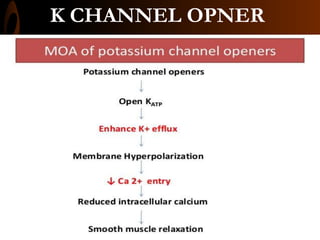
K CHANNEL OPNER
DRUG USED
NICORANDIL
5-10 MG TAB
2MG/VIAL
ADVRSE EFFECT
•FLUSHING
•PALPITATION
•WEAKNESS
•DIZZINESS
•NAUSEA
•VOMITING
NURSING RESPONSIBILITY
Nursing intervention
Client teaching
Nursing intervention
• History collection
• Assess the duration,time started & character of pain.
• Monitor vital signs.
• Assist in various diagnostic test like ECG, Echo &
other blood investigation.
• Nitrates should be kept away from flame.
• Store nitrates in original container.
• An analgesic can be given to treat headache.
IN IV NTG:
•Do not mix NTG with other drugs
•Do not use PVC tubing's for IV
administration because its absorb the
nitrates.
•Use glass bottles & tubing's provided by
manufacturer.
• It is Given by infusion pump.
Ointment/transdermal patch
• Remove transdermal patches before defibrillation to
prevents burns.
• Rotate ointment & transdermal patches sites.
• Remove ointment & previous patch before applying
new ointment or patch.
• Do not trim transdermal patch to alter dose.
• Do not rub or massage the area after application of
ointment.
• Apply to the chest, upper arm, or upper thigh to
promote absorption and increase onset of systemic
action.
• Do not get ointment on hands as it can cause
headache.
• Wash hands after application.
• Apply to a nonhairy sites, avoid application to
skin folds or irritated sites.
Transmucosal Tablets:
The nurse should place one tablet between
lip and gum above incisors or between cheek
and gum to promote slow dissolving and
extended absorption.
Sublingual tablets:
Place under the tongue.
Spray
•Do not shake when administering &
hold
•vertically & spray under the tongue.
•Advise do not swallow immediately.
CLIENT TEACHING
• NTG loose potency if exposed to light,
moisture or heat.
• Avoid alcohol, hot bath as they cause
vasodilation & lead to hypotension.
• Teach about adverse effects.
• Encourage client to discontinue tobacco which
causes vasoconstriction.
• Encourage to eat high fiber rich diet.
• Instruct client do not chew SL tablets,place
under the tongue.
• Do not eat food or smoke until tablets dissolve.
SUBLINGUAL TABLETS;
In cute anginal attacks, teach client to lie
down & take NTG tablets as soon as possible;
upto 3 NTG tablets in every 5 min.
If no relief go for emergency services.
Antianginal drug

Antianginal drug

  • 1.
    ANTIANGINAL DRUGS PRESENTED BY PANKAJ SINGHRANA NURSE PRACTITIONER IN CRITICAL CARE SRHU, HCON
  • 2.
    Introduction : • Anginapectoris is characterized by sudden severe pressing chest pain or heaviness radiating to the neck, jaw, back and arms. • It is often associated with diaphoresis, tachypnea and nausea. • Angina is caused by coronary flow that is insufficient to meet oxygen demands of the myocardium.
  • 3.
    There are threetypes of Angina : 1. Stable Angina ( Most common) 2. Unstable Angina 3. Prinzmetal (variant) angina
  • 5.
    Stable Angina • Attacksare predictably provoked by exercise, emotion etc. It lasts for several seconds and subsides on rest. • “Stable” indicates the reproducible nature of the angina; the same activity at the same intensity faithfully produces symptoms.
  • 6.
    Unstable Angina • Theunstable angina is characterized by recurrent attacks of angina. • It occurs with minimal exertion. • It is precipitated due to combination of athero scleroti-plaque, platelet aggregation at ruptured plaque and vasospasm.
  • 7.
    Prinzmetal (Variant) Angina • Thisis a relatively uncommon pattern of myocardial ischemia usually occurring at rest or during sleep and often in young individuals. • It is induced by coronary artery vasospasm, it generally responds promptly to vasodilators.
  • 8.
    ANTIANGINAL DRUGS: 1. Nitrates: •Glyceryl trinitrate (Nitroglycerin) • Isosorbide dinitrate, Isosorbide mononitrate 2. Beta-blocker • Atenolol, propranolol, metoprolol 3. Calcium channel blocker • Nifedipine, amlodipine 4. Potassium channel opener Nicorandil
  • 10.
  • 11.
    NITRATES • They actdirectly on all the smooth muscle of the body & relax them. • Nitrates release nitric oxide which is a powerful muscle relaxants. • Most predominant in the vascular smooth muscles (i.e walls of arteries & veins).
  • 12.
    Action of nitrates Effectson other smooth muscles Redistribution of coronary flow Afterload reduction Preload reduction
  • 13.
    Preload reduction Nitroglycerin relaxesvascular smooth muscle and dilates both arterial and venous vessels. Dilation of veins is more predominant than dilation of arteries, resulting in peripheral pooling of blood & decreased venous return. decreased preload
  • 14.
    Afterload reduction Nitrates alsoproduce some arteriolar dilatation Decrease peripheral resistance Reduction of afterload
  • 15.
    Redistribution of coronary flow Dilatationof coronary arteries Increase blood supply to the myocardium
  • 16.
    Effects on othersmooth muscles • Relax the bronchi, biliary tracts & esophagus muscles. • Also dilates cutaneous vessels & meningeal vessels .
  • 17.
    Available forms 1. SublingualTablets. 2. Topical Ointment and Transdermal Patches. 3. Translingual Spray. 4. Transmucosal Tablets. 5. Intravenous (IV).
  • 19.
    Therapeutic uses of antianginaldrugs Nitrates:- • Angina pectoris • MI • Congestive cardiac failure • Biliary colic • Cyanide poisoning • Oesophageal spasm
  • 20.
    Nitroglycerine Preparation Dose RouteOnset/Durat ion of action Trade name Tablets 1,2,3 mg 0.5 mg Sublingual 1 -3 min/30 min Angised spray 0.4 – 0.8 mg Sublingual 2 min/60 min Nitrolingual capsule 5-15 mg oral 20min/4-8 hr Angispan-tr Transdermal patch,5-10 mg one patch for 14 to 16 hr per day skin Max. 24 hrs Nitroderm-tts Injection 5mg/ml 5-20 microgram/min intravenous 2min/5 min Nitroject ointment 2% skin 30 min/12 hr Nitrol
  • 21.
  • 22.
  • 23.
  • 24.
    •Is a nitrate. •Likenitroglycerin, and is used for treating and preventing angina. •It is NOT used to treat HTN. •Is given Sublingual or Per Oral . •SL Isosorbide has a slower onset and a longer duration of action compared to SL nitroglycerin . •Because SL isosorbide does NOT relieve chest pain as rapidly as introglycerin, Isosorbide is limited to treating acute angina in patients intolerant or unresponsive to SL nitroglycerin .
  • 25.
    Dose & Route 1.Isosorbidemononitrate:- 20 to 40 mg orally 2.Isosorbide dinitrate: 5 -1o mg sublingually or orally
  • 26.
  • 27.
    CCB have negativechronotropic effect and dromotropic action on heart • COMMON CALCIUM CHANNEL BLOCKER USED ARE • VERAPEMIL ( most potent) • NIFIDEPINE • DILTIZEM ( least potent)
  • 28.
    Ca++ channel blockers vasodilation Decreasedintracellular ca++ & causes smooth muscles relaxation Block the entry of ca++ ions into the smooth & cardiac muscles
  • 29.
    ADVERSE EFFECTS • NAUSEA •VOMITTING • BRADYCARDIA • ANKLE EDEMA OCCASIONNALY HYPOTENTION TACHYCARDIA
  • 31.
    BETA BLOCKERS DECREASE CORONARYSUPPLY DECREASE THE HEART RATE BY BLOCKING BETA RECEPTOR DECREASE THE WORK OF HEART DECREASE O2 CONSUMPTION INCREASE REDISTRIBUTION OF BLOOD
  • 32.
    DRUGS • MAINLY TWODRUGS USED • ATENOLOL • METOPROLOL
  • 33.
  • 34.
    CONTRAINDICATION OF BETA BLOCKERS: heartblock pulmonary edema cardiogenic shock
  • 35.
  • 36.
  • 37.
  • 38.
  • 39.
    Nursing intervention • Historycollection • Assess the duration,time started & character of pain. • Monitor vital signs. • Assist in various diagnostic test like ECG, Echo & other blood investigation. • Nitrates should be kept away from flame. • Store nitrates in original container. • An analgesic can be given to treat headache.
  • 40.
    IN IV NTG: •Donot mix NTG with other drugs •Do not use PVC tubing's for IV administration because its absorb the nitrates. •Use glass bottles & tubing's provided by manufacturer. • It is Given by infusion pump.
  • 41.
    Ointment/transdermal patch • Removetransdermal patches before defibrillation to prevents burns. • Rotate ointment & transdermal patches sites. • Remove ointment & previous patch before applying new ointment or patch. • Do not trim transdermal patch to alter dose. • Do not rub or massage the area after application of ointment. • Apply to the chest, upper arm, or upper thigh to promote absorption and increase onset of systemic action.
  • 42.
    • Do notget ointment on hands as it can cause headache. • Wash hands after application. • Apply to a nonhairy sites, avoid application to skin folds or irritated sites.
  • 43.
    Transmucosal Tablets: The nurseshould place one tablet between lip and gum above incisors or between cheek and gum to promote slow dissolving and extended absorption. Sublingual tablets: Place under the tongue.
  • 44.
    Spray •Do not shakewhen administering & hold •vertically & spray under the tongue. •Advise do not swallow immediately.
  • 45.
    CLIENT TEACHING • NTGloose potency if exposed to light, moisture or heat. • Avoid alcohol, hot bath as they cause vasodilation & lead to hypotension. • Teach about adverse effects. • Encourage client to discontinue tobacco which causes vasoconstriction. • Encourage to eat high fiber rich diet.
  • 46.
    • Instruct clientdo not chew SL tablets,place under the tongue. • Do not eat food or smoke until tablets dissolve. SUBLINGUAL TABLETS; In cute anginal attacks, teach client to lie down & take NTG tablets as soon as possible; upto 3 NTG tablets in every 5 min. If no relief go for emergency services.