 Presented by
 Rasel Mahbub
 Dept of pharmacy
 Jagannath University

DM is characterized by elevated blood
sugar levels due to absolute or relative
lack of insulin.
Type 1 diabetes - -cell failure at outset
•Insulin dependent
Type 2 diabetes - Gradual -cell
deterioration
•Early stages: Diet and Oral agents
•Late-stage: Insulin therapy
Glycosylated hemoglobin Hb-A1c :
It is used to monitor the plasma glucose
concentration over prolonged periods of
time (4-6 weeks).
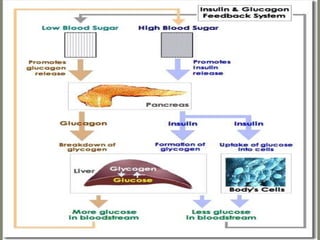
Insulin secretion is promoted by ↑ blood
glucose levels, amino acids, GI hormones
and by β-2 agonist.
Proinsulin is converted to insulin and C
peptide.
Insulin is referred as the storage hormone
as it promotes anabolism and inhibits
catabolism of carbohydrates, fatty acids
and protein.
In the absence of insulin, most tissues
cannot use glucose and fats/proteins are
broken down to provide energy.
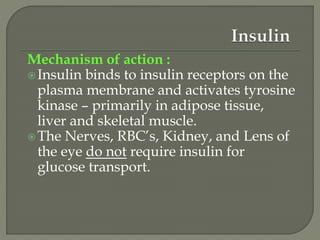
Mechanism of action :
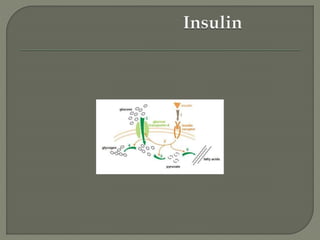
Insulin binds to insulin receptors on the
plasma membrane and activates tyrosine
kinase – primarily in adipose tissue,
liver and skeletal muscle.
The Nerves, RBC’s, Kidney, and Lens of
the eye do not require insulin for
glucose transport.
Liver :
Insulin increase the storage of glucose as
glycogen in the liver.
It inserts the GLUT-2 glucose transport
molecule in the cell membrane.
It inhibits gluconeogenesis – thus
significantly ↓ glucose output by the liver.
It decrease the protein catabolism.
Muscle :
Insulin stimulates the glycogen
synthesis and protein synthesis.
Glucose transport into the cells is
facilitated by GLUT-4 into the cell
membrane.
It inhibits the protein catabolism.
Adipose tissue :
Insulin facilitates the storage of
triglyceride by activating plasma
lipoprotein lipase and inhibiting
intracellular lipolysis.
It increase the glucose uptake by
GLUT-4 insertion into the cell
membrane.
Insulin is a 51 AA peptide
Not active orally.
Insulin is inactivated by insulinase found
mainly in liver and kidney.
Dose reduced in renal insufficiency
Sources of Insulin :
• Beef pancreas / Pork pancreas
• Human insulin: recombinant DNA origin
Human Insulin :
Do not contain measurable amounts of
proinsulin or contaminants.
Diminished antibody
Less allergic reactions
Less lipodystrophy
Preferred in gestational diabetes
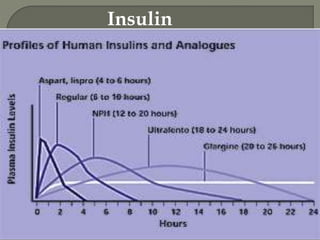
Insulin preparations :
Rapid acting insulin : Lispro,
Aspart and Glulisine
Short acting insulin:
Regular (crystalline)
Intermediate acting insulin: NPH
(isophane) and Lente (insulin zinc)
Long acting insulin:
Ultralente, Detimir and Glargine
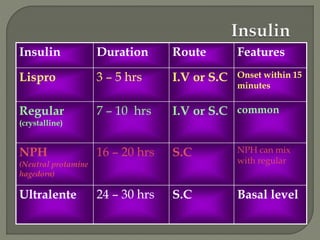
Insulin Duration Route Features
Lispro 3 – 5 hrs I.V or S.C Onset within 15
minutes
Regular
(crystalline)
7 – 10 hrs I.V or S.C common
NPH
(Neutral protamine
hagedorn)
16 – 20 hrs S.C NPH can mix
with regular
Ultralente 24 – 30 hrs S.C Basal level
Insulin
Adverse effects of Insulin :
Hypoglycemia
Allergic reactions
Lipodystrophy
Others includes
• Seizures
• Coma
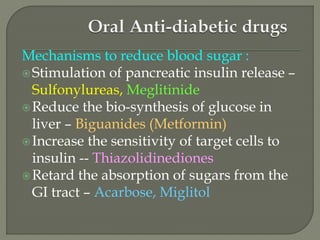
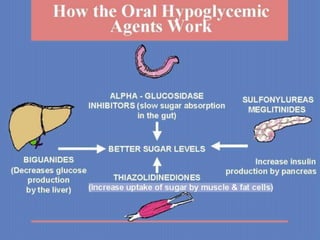
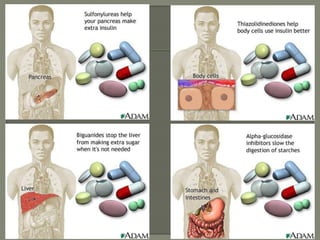
Mechanisms to reduce blood sugar :
Stimulation of pancreatic insulin release –
Sulfonylureas, Meglitinide
Reduce the bio-synthesis of glucose in
liver – Biguanides (Metformin)
Increase the sensitivity of target cells to
insulin -- Thiazolidinediones
Retard the absorption of sugars from the
GI tract – Acarbose, Miglitol
Sulfonylureas :
First generation : Acetohexamide,
Chlorpropamide, Tolbutamide,
Tolazamide
Second generation : Glipizide, Glyburide
– more potent, more efficacious and fewer
adverse effects.
Third generation : Glimiperide
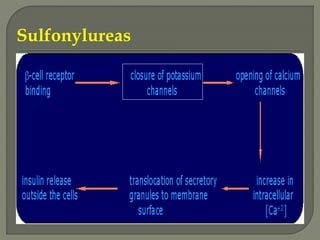
Sulfonylureas
Sulfonylureas
Dose
(mg)
Duration
(h)
First Generation
Tolbutamide (Orinase) 1000-1500 6-8
Chlorpropamide (Diabinese) 250-375 24-60
Tolazamide (Tolinase) 250-375 12-24
Second generation
Glipizide (Glucotrol) 10 10-24
Glyburide (Micronase)
(Glibenclamide)
Third generation
5 16-24
Glimepiride (Amaryl) 1-2 24
Sulfonylureas : Adverse effects :
Hypoglycemia
Cholestatic jaundice
Weight gain
Cross placenta – fetal hypoglycemia.
Chlorpropamide : It can cause water
retention by ↑ release of ADH (SIADH)
Disulfiram-like reaction with alcohol.
Repaglinide, Nateglinide :
More rapidly acting insulin enhancers
and shorter duration than sulfonylurea.
Hypoglycemia is the common adverse
effect.
Less weight gain
Repaglinide, Nateglinide
The drug has minimal renal excretion thus
useful in patients with DM and impaired
renal function.
It is designed to be taken with each meal
to stimulate insulin release with meal.
If a meal is skipped, so is the repaglinide.
Biguanides (Metformin):
Inhibits gluconeogenesis.
Does not promote insulin secretion.
It increase the sensitivity of liver and
muscle to insulin.
It causes modest weight loss.
Metformin (Glucophage) :
It does not cause hypoglycemia.
It produces a significant ↓ TG and LDL,
and ↑HDL.
There is a serious concern about lactic
acidosis especially in patients with kidney
disease.
Thiazolidinediones
Enhance glucose and lipid metabolism
through action on Peroxisome Proliferator
Activated Receptor (PPAR–γ)
Enhance sensitivity to insulin in muscle
and fat by increasing the GLUT 4 glucose
transporters.
E.g. ; Pioglitazone Actos, Rosiglitazone
Avandia
Thiazolidinediones :
Beneficial effects on serum lipid; ↓TG and
↑HDL.
Troglitazone is associated with hepatitis.
Edema.
Alpha-Glucosidase Inhibitors:
It inhibits -glucosidase which converts
dietary starch and complex
carbohydrates into simple sugars
It reduces absorption of glucose after
meals.
The main side effects includes flatulence
and diarrhea.
Acarbose (Glucobay) , Miglitol (Glyset)
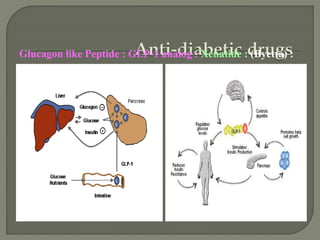
Glucagon like Peptide : GLP-1 analog :
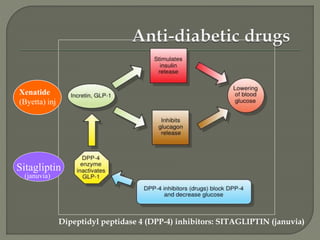
Xenatide : (Byetta) :
GLP is an incretin released from the small
intestine which increase the glucose
dependent insulin secretion.
Xenatide suppress glucagon release and
reduce appetite
It is administered by SC injection.
Glucagon like Peptide : GLP-1 analog : Xenatide : (Byetta) :
Dipeptidyl peptidase 4 (DPP-4) inhibitors: SITAGLIPTIN (januvia)
Xenatide
(Byetta) inj
Sitagliptin
(januvia)
Sitagliptin (Januvia) is an oral anti-
diabetic drug.
It inhibit the dipeptidyl peptidase 4 (DPP-
4), an enzyme which inactivates the
incretins GLP-1 and GIP, that are released
in response to a meal.
It potentiates the secretion of insulin and
suppress the release of glucagon by the
pancreas.
Glucagon :
It has positive inotropic action and
chronotropic action on the heart.
It acts by stimulation of glucagon
receptors and not through beta 1 receptors.
This is the basis for using glucagon in beta
blocker overdose.