Understanding and Resolving Conflict Mark Smallwood Brigham Young University
Agenda What is conflict? What is conflict’s role in business? Different views of conflict Kinds of conflict Stages of conflict resolution Methods of conflict resolution Group Exercise Review
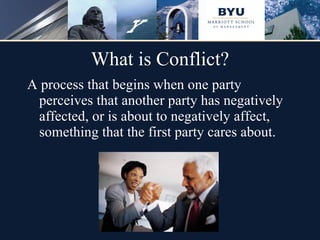
What is Conflict? A process that begins when one party perceives that another party has negatively affected, or is about to negatively affect, something that the first party cares about.
A Few Questions Is conflict bad for business? What kind of conflict is seen in our business? Does this conflict help or hurt our performance?
Conflicts About Conflict’s Role Different Views Traditional View Human Relations View Interactionist View
Different Views Traditional View Conflict is bad! Same as violence, destruction, irrationality
Different Views Human Relations View It’s going to happen, so cope with it!
Different Views Interactionist View Functional conflict is good for business and even encouraged Functional vs. dysfunctional conflict
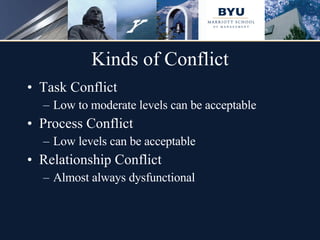
Kinds of Conflict Task Conflict Low to moderate levels can be acceptable Process Conflict Low levels can be acceptable Relationship Conflict Almost always dysfunctional
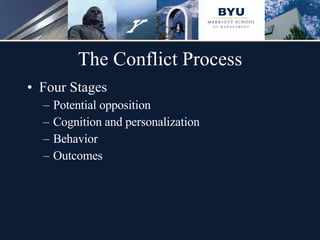
The Conflict Process Four Stages Potential opposition Cognition and personalization Behavior Outcomes
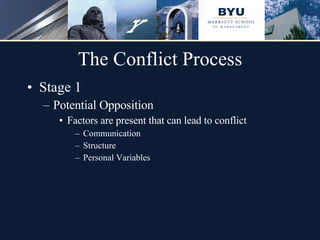
The Conflict Process Stage 1 Potential Opposition Factors are present that can lead to conflict Communication Structure Personal Variables
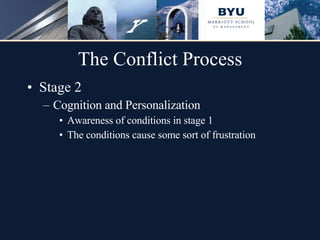
The Conflict Process Stage 2 Cognition and Personalization Awareness of conditions in stage 1 The conditions cause some sort of frustration
The Conflict Process Stage 3 Behavior An action is done that frustrates another person’s interests The conflict becomes known to the differing parties and to others
 
The Conflict Process Stage 4 Outcomes Functional Outcomes Dysfunctional Outcomes
Conflict Resolution Even in the interactionist view of conflict, conflict can become dysfunctional. At this point, someone may need to step in and help resolve the conflict.
Methods for Resolving Conflict Passive conflict resolution Win-win Structured problem solving Confronting conflict Choosing a winner Selecting a better alternative Preventing Conflict
Methods for Resolving Conflict Passive conflict resolution Just ignore the conflict Win-win Satisfy both side’s needs
Methods for Resolving Conflict Structured problem solving Gather data about the problem Have a third party observer analyze the data and make an argument for one side Mediation Confronting conflict Listen the problem and help the parties resolve it
Methods for Resolving Conflict Choosing a winner Choose the winner, then deal with the negative feelings between the two parties Selecting a better alternative Choose an idea neither of the parties considered
Methods for Resolving Conflict Preventing conflict “ Skilled leaders use different techniques to create an environment that is relatively free of conflict…” (Foster)
Shea & Gould Law Firm “ At its peak, the firm had 350 lawyers and played a leading role in New York politics, banking, real estate and sports” Closed its doors after not being able to resolve a conflict about the firms future
Let’s Try These Out! Split up in groups of three people Choose a conflict that could be faced in this organization Discuss how it would be handled using each of the methods listed previously
Let’s Try These Out! Describe your conflict What method would be best for handling your chosen situation? Would that method be best for all situations in this organization? What does everyone else think?
Summary Conflict can be good for a business When it isn’t good, the conflict must be resolved Different methods exist to resolve conflict No one method is best for any conflict
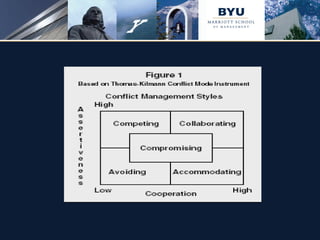
Bibliography Bacal, Robert. “Organizational Conflict - The Good, The Bad & The Ugly.” http://conflict911.com/conflictarticles/orgconflict.htm. Foster, S. Thomas.  Managing Quality: An Integrative Approach . 2 nd  ed., Pearson Education, Inc., 2004. pp. 325-329. Geyelin, Milo,  Felsenthal, Edward.  “Irreconcilable differences force Shea & Gould closure”. Wall Street Journal. (Eastern edition). New York, N.Y.: Jan 31, 1994. pg. B1. Robbins, Steven P. Essentials of Organizational Behavior. 8 th  ed., Pearson Education, Inc., 2005. pp. 193-201.  Thomas, K.W. “Conflict and Negotiation Processes in Organizations,” in M.D. Dunnette and L.M. Hough,  Handbook of Industrial and Organizational Psychology , 2 nd  ed., vol. 3, pp. 651-717. Thomas, K.W., and R.H. Kilmann.  Thomas-Kilmann Conflict Mode Instrument.  Sterling Forest, NY: Xicom, Inc., 1974.

In Conflict Resolution

  • 1.
    Understanding and ResolvingConflict Mark Smallwood Brigham Young University
  • 2.
    Agenda What isconflict? What is conflict’s role in business? Different views of conflict Kinds of conflict Stages of conflict resolution Methods of conflict resolution Group Exercise Review
  • 3.
    What is Conflict?A process that begins when one party perceives that another party has negatively affected, or is about to negatively affect, something that the first party cares about.
  • 4.
    A Few QuestionsIs conflict bad for business? What kind of conflict is seen in our business? Does this conflict help or hurt our performance?
  • 5.
    Conflicts About Conflict’sRole Different Views Traditional View Human Relations View Interactionist View
  • 6.
    Different Views TraditionalView Conflict is bad! Same as violence, destruction, irrationality
  • 7.
    Different Views HumanRelations View It’s going to happen, so cope with it!
  • 8.
    Different Views InteractionistView Functional conflict is good for business and even encouraged Functional vs. dysfunctional conflict
  • 9.
    Kinds of ConflictTask Conflict Low to moderate levels can be acceptable Process Conflict Low levels can be acceptable Relationship Conflict Almost always dysfunctional
  • 10.
    The Conflict ProcessFour Stages Potential opposition Cognition and personalization Behavior Outcomes
  • 11.
    The Conflict ProcessStage 1 Potential Opposition Factors are present that can lead to conflict Communication Structure Personal Variables
  • 12.
    The Conflict ProcessStage 2 Cognition and Personalization Awareness of conditions in stage 1 The conditions cause some sort of frustration
  • 13.
    The Conflict ProcessStage 3 Behavior An action is done that frustrates another person’s interests The conflict becomes known to the differing parties and to others
  • 14.
  • 15.
    The Conflict ProcessStage 4 Outcomes Functional Outcomes Dysfunctional Outcomes
  • 16.
    Conflict Resolution Evenin the interactionist view of conflict, conflict can become dysfunctional. At this point, someone may need to step in and help resolve the conflict.
  • 17.
    Methods for ResolvingConflict Passive conflict resolution Win-win Structured problem solving Confronting conflict Choosing a winner Selecting a better alternative Preventing Conflict
  • 18.
    Methods for ResolvingConflict Passive conflict resolution Just ignore the conflict Win-win Satisfy both side’s needs
  • 19.
    Methods for ResolvingConflict Structured problem solving Gather data about the problem Have a third party observer analyze the data and make an argument for one side Mediation Confronting conflict Listen the problem and help the parties resolve it
  • 20.
    Methods for ResolvingConflict Choosing a winner Choose the winner, then deal with the negative feelings between the two parties Selecting a better alternative Choose an idea neither of the parties considered
  • 21.
    Methods for ResolvingConflict Preventing conflict “ Skilled leaders use different techniques to create an environment that is relatively free of conflict…” (Foster)
  • 22.
    Shea & GouldLaw Firm “ At its peak, the firm had 350 lawyers and played a leading role in New York politics, banking, real estate and sports” Closed its doors after not being able to resolve a conflict about the firms future
  • 23.
    Let’s Try TheseOut! Split up in groups of three people Choose a conflict that could be faced in this organization Discuss how it would be handled using each of the methods listed previously
  • 24.
    Let’s Try TheseOut! Describe your conflict What method would be best for handling your chosen situation? Would that method be best for all situations in this organization? What does everyone else think?
  • 25.
    Summary Conflict canbe good for a business When it isn’t good, the conflict must be resolved Different methods exist to resolve conflict No one method is best for any conflict
  • 26.
    Bibliography Bacal, Robert.“Organizational Conflict - The Good, The Bad & The Ugly.” http://conflict911.com/conflictarticles/orgconflict.htm. Foster, S. Thomas. Managing Quality: An Integrative Approach . 2 nd ed., Pearson Education, Inc., 2004. pp. 325-329. Geyelin, Milo,  Felsenthal, Edward. “Irreconcilable differences force Shea & Gould closure”. Wall Street Journal. (Eastern edition). New York, N.Y.: Jan 31, 1994. pg. B1. Robbins, Steven P. Essentials of Organizational Behavior. 8 th ed., Pearson Education, Inc., 2005. pp. 193-201. Thomas, K.W. “Conflict and Negotiation Processes in Organizations,” in M.D. Dunnette and L.M. Hough, Handbook of Industrial and Organizational Psychology , 2 nd ed., vol. 3, pp. 651-717. Thomas, K.W., and R.H. Kilmann. Thomas-Kilmann Conflict Mode Instrument. Sterling Forest, NY: Xicom, Inc., 1974.