SOCIAL PSYCHOLOGY
WHAT IS CONFLICT?
 According to Erik Erikson's theory of
psychosocial development, a conflict is a
turning point during which an individual
struggles to attain some psychological quality.
Sometimes referred to as a psychosocial crisis,
this can be a time of both vulnerability and
strength, as the individual works toward
success or failure.
 For example:- Erikson's first stage of
psychosocial development the conflict centres
on trust versus mistrust.
 In the earliest stages of a child's life, they are
learning whether they can trust the people
around them.
TYPES OF CONFLICT
 Approach-approach conflict: occurs when you must
choose between two desirable outcomes.
 Avoidance-avoidance conflict: occurs when you
must choose between two unattractive outcomes.
 Approach-avoidance: exists when ONE event or
goal has both attractive and unattractive features.
 Multiple approach-avoidance conflicts: here you
must choose between two or more things, each of
which has both desirable and undesirable
features.
LEVELS OF CONFLICT
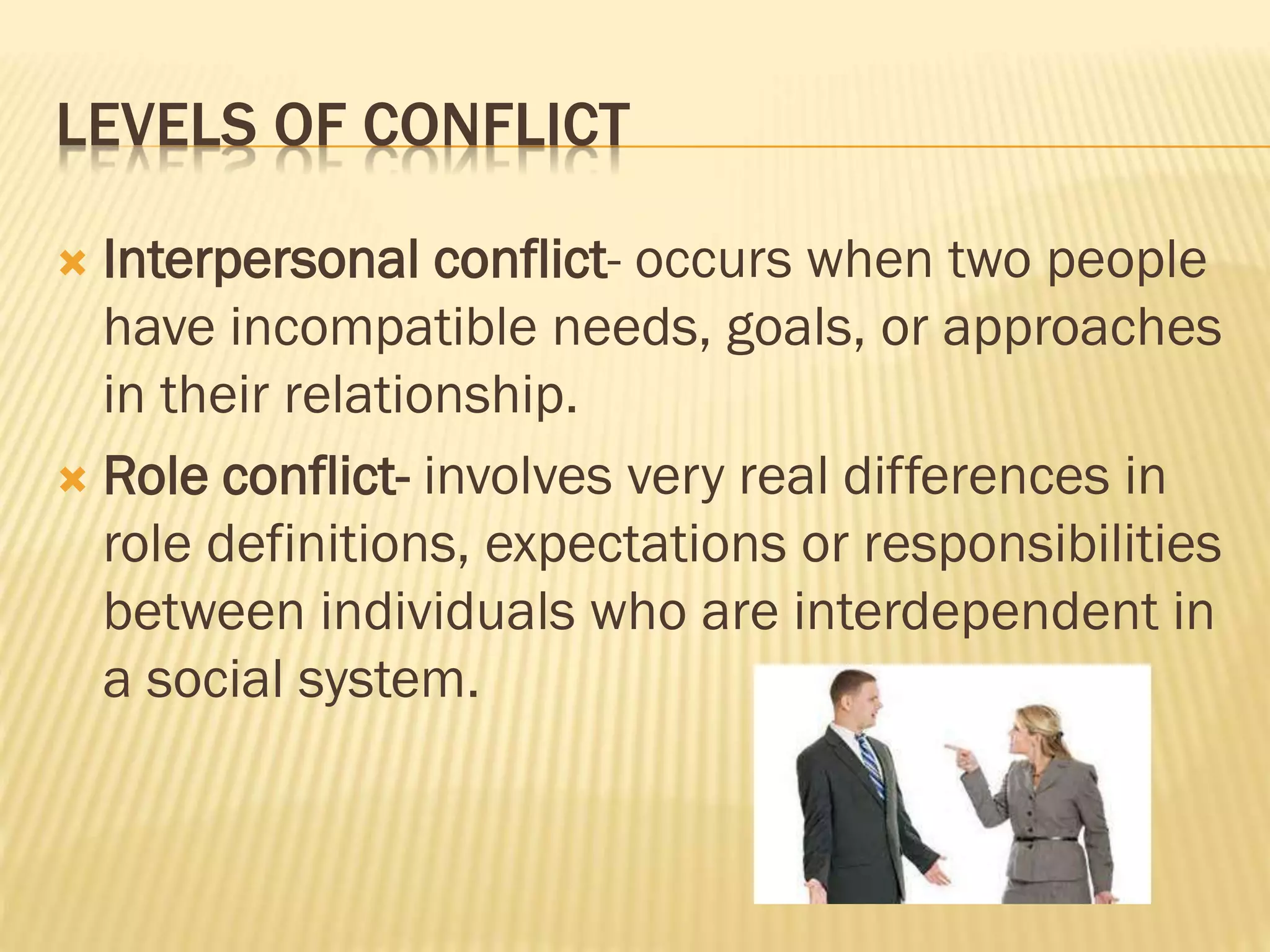
 Interpersonal conflict- occurs when two people
have incompatible needs, goals, or approaches
in their relationship.
 Role conflict- involves very real differences in
role definitions, expectations or responsibilities
between individuals who are interdependent in
a social system.
 Intergroup conflict- occurs between collections
of people such as ethnic or racial groups,
departments or levels of decision making in the
same organization, and union and
management.
 Multi-Party conflict- occurs in societies when
different interest groups and organizations
have varying priorities over resource
management and policy development.
 International conflict- occurs between states at
the global level.
SOURCES OF CONFLICT
Social
Dilemmas
Competition
Perceived
Injustice
Mispercep
tion
 Social Dilemmas
Several of the problems that most
threaten our human future arise as
various parties pursue their self-
interests, ironically, to their collective
detriment.
FOR EXAMPLE:
- PRISONER’S DILEMMA
 Prisoner’s Dilemma
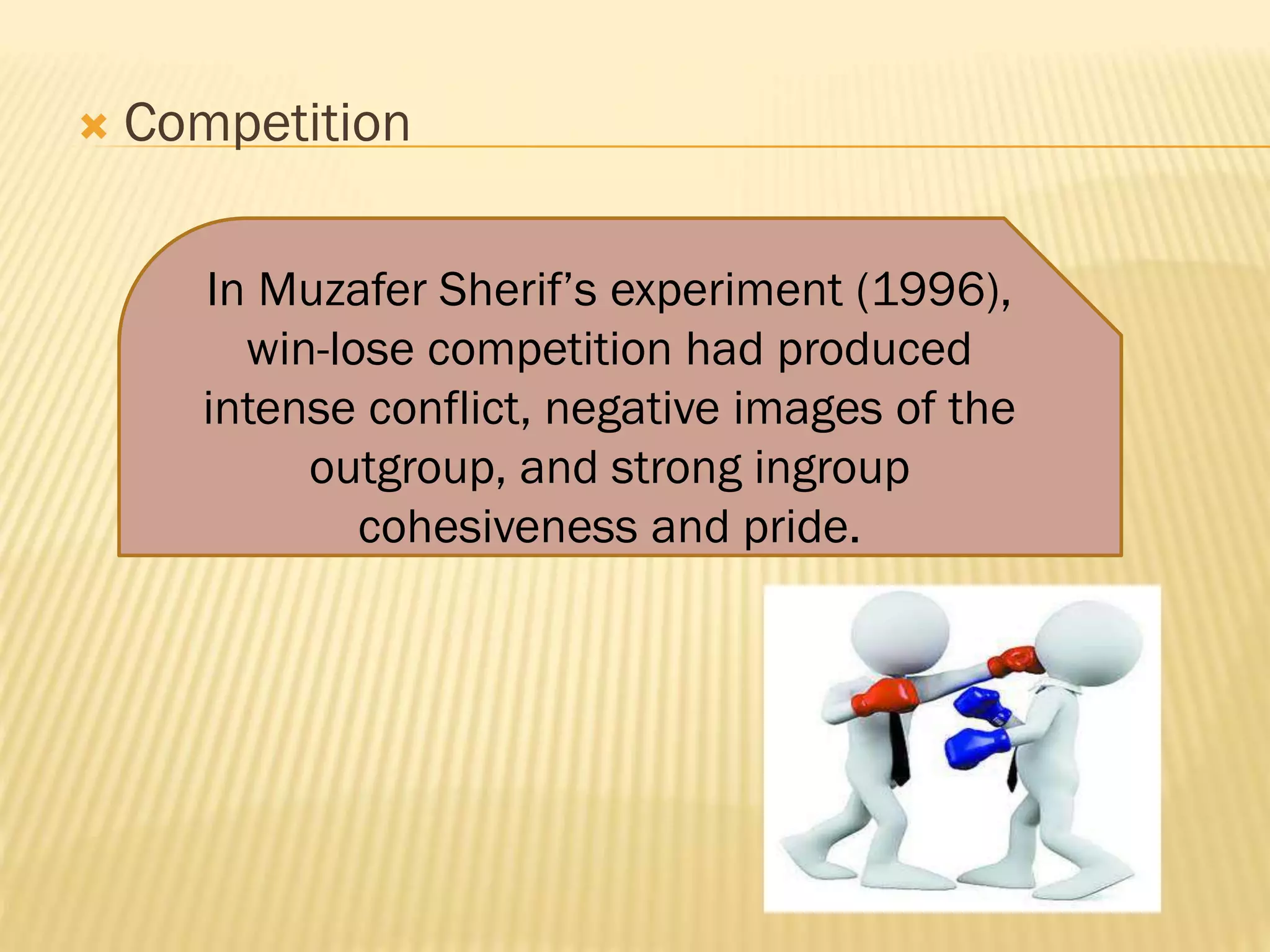
 Competition
In Muzafer Sherif’s experiment (1996),
win-lose competition had produced
intense conflict, negative images of the
outgroup, and strong ingroup
cohesiveness and pride.
 Perceived Injustice
“That’s unfair!” “What a rip-off!” “We
deserve better!”
Such comments typify conflicts bred by
perceived injustice
What is Justice:
-People perceive justice as equity- the
distribution of rewards in proportion to
individuals’ contributions (Walster &
others, 1978).
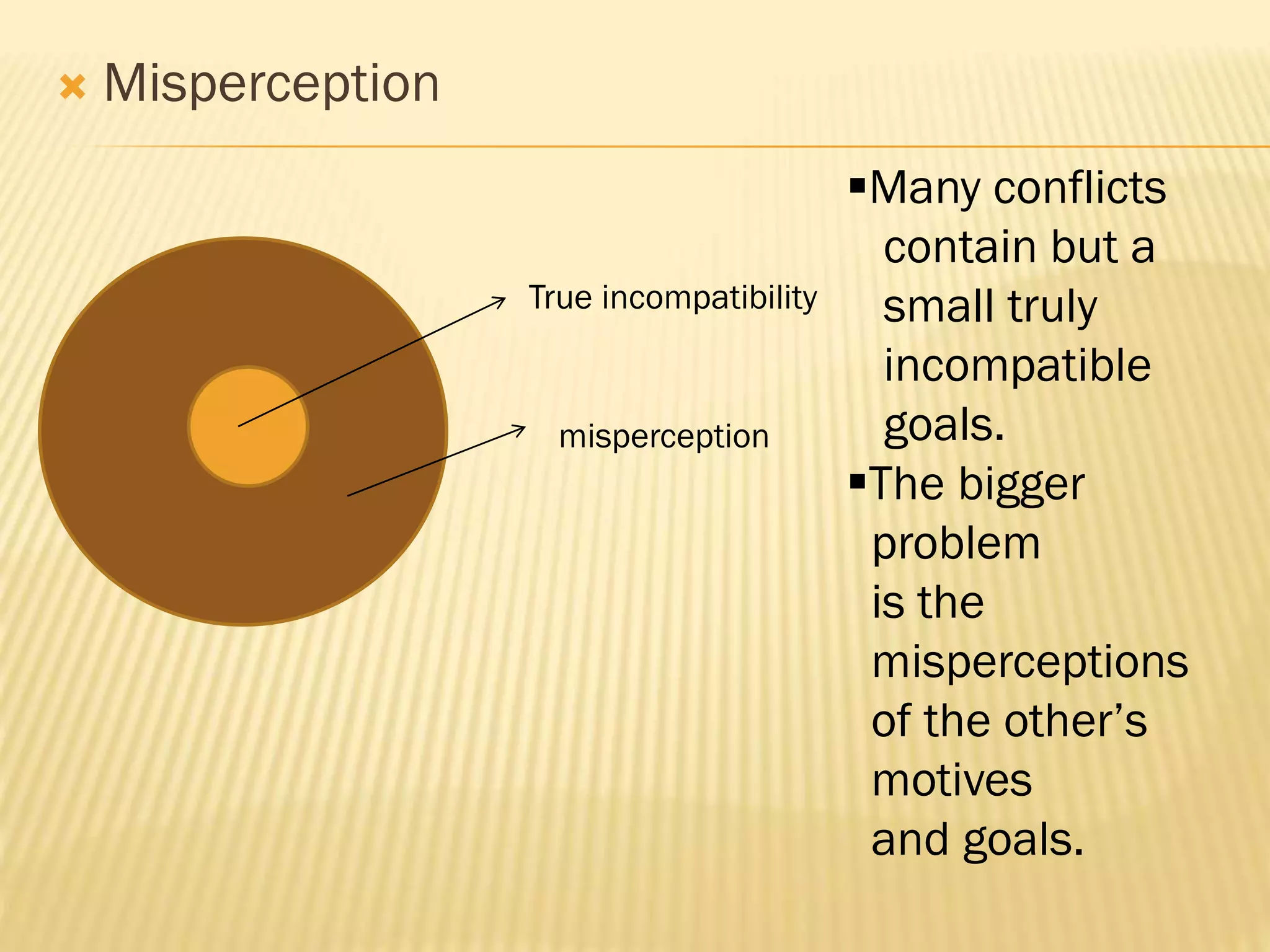
 Misperception
True incompatibility
misperception
Many conflicts
contain but a
small truly
incompatible
goals.
The bigger
problem
is the
misperceptions
of the other’s
motives
and goals.
Seeds of Misperception
Self-serving
bias
In-group bias
Fundamental
attribution
error
Polarize
Stereotype
Preconceptions
Self-justify
Groupthink
• Refer to the reciprocal views of
one another often held by parties
in conflict
• For example: each may view
itself as moral and peace-loving
and the other as evil and
aggressive.
MIRROR-
IMAGE
PERCEPTION
• If misperceptions accompany
conflict, then they should
appear and disappear as
conflicts wax and wane.
• The same process that create
the enemy’s image can reverse
that image when the enemy
becomes an ally.
SHIFTING
PERCEPTIONS
DEALING WITH CONFLICT
4 Cs
Contact
Coopera
tion
Communic
ation
Conciliati
on
 Contact Desegregation- is the process of
ending the separation of two groups usually
referring to races.
 Cooperation
•Having a common enemy unifies
groups of competing boys in Sherif’s
camping experiments – and in many
subsequent experiments (Dion, 1979)
Common
External Threat
•Super ordinate Goals- goals that
compel all in a group and require
cooperative effort.
Superordinate
Goals
•With cooperative learning in Aronson’s experiment,
students learn not only the material given but other
lessons as well. Cross-racial friendships also begin
to blossom.
•John McConahay wrote the cooperative learning is
the most effective practice for improving race
relations.
Cooperative
Learning
 Communication
Bargaining
•Seeking an
agreement
through
direct
negotiations
between
parties.
Mediation
•An attempt
by a neutral
third party to
resolve a
conflict by
facilitating
communicati
ons and
offering
suggestions.
Arbitration
•Resolution of
a conflict by
a neutral
third party
who studies
both sides
and imposes
a settlement.
 Conciliation
GRIT (Graduated and reciprocated
initiatives in tension reduction)
The basic idea is that disputant can initiate de-
escalation by making a small, unilateral (one-
sided) concession to the other side, and at the
same time, communicating a desire or even an
expectation that this gesture will be matched
with an equal response from the opponent. If the
opponent does respond positively, the first party
can make a second concession, and a “peace
spiral” is begun.
Conflicts (social psychology)

Conflicts (social psychology)

  • 1.
  • 2.
    WHAT IS CONFLICT? According to Erik Erikson's theory of psychosocial development, a conflict is a turning point during which an individual struggles to attain some psychological quality. Sometimes referred to as a psychosocial crisis, this can be a time of both vulnerability and strength, as the individual works toward success or failure.
  • 3.
     For example:-Erikson's first stage of psychosocial development the conflict centres on trust versus mistrust.  In the earliest stages of a child's life, they are learning whether they can trust the people around them.
  • 4.
    TYPES OF CONFLICT Approach-approach conflict: occurs when you must choose between two desirable outcomes.  Avoidance-avoidance conflict: occurs when you must choose between two unattractive outcomes.  Approach-avoidance: exists when ONE event or goal has both attractive and unattractive features.  Multiple approach-avoidance conflicts: here you must choose between two or more things, each of which has both desirable and undesirable features.
  • 5.
    LEVELS OF CONFLICT Interpersonal conflict- occurs when two people have incompatible needs, goals, or approaches in their relationship.  Role conflict- involves very real differences in role definitions, expectations or responsibilities between individuals who are interdependent in a social system.
  • 6.
     Intergroup conflict-occurs between collections of people such as ethnic or racial groups, departments or levels of decision making in the same organization, and union and management.  Multi-Party conflict- occurs in societies when different interest groups and organizations have varying priorities over resource management and policy development.  International conflict- occurs between states at the global level.
  • 7.
  • 8.
     Social Dilemmas Severalof the problems that most threaten our human future arise as various parties pursue their self- interests, ironically, to their collective detriment. FOR EXAMPLE: - PRISONER’S DILEMMA
  • 9.
  • 10.
     Competition In MuzaferSherif’s experiment (1996), win-lose competition had produced intense conflict, negative images of the outgroup, and strong ingroup cohesiveness and pride.
  • 11.
     Perceived Injustice “That’sunfair!” “What a rip-off!” “We deserve better!” Such comments typify conflicts bred by perceived injustice What is Justice: -People perceive justice as equity- the distribution of rewards in proportion to individuals’ contributions (Walster & others, 1978).
  • 12.
     Misperception True incompatibility misperception Manyconflicts contain but a small truly incompatible goals. The bigger problem is the misperceptions of the other’s motives and goals.
  • 13.
    Seeds of Misperception Self-serving bias In-groupbias Fundamental attribution error Polarize Stereotype Preconceptions Self-justify Groupthink
  • 14.
    • Refer tothe reciprocal views of one another often held by parties in conflict • For example: each may view itself as moral and peace-loving and the other as evil and aggressive. MIRROR- IMAGE PERCEPTION • If misperceptions accompany conflict, then they should appear and disappear as conflicts wax and wane. • The same process that create the enemy’s image can reverse that image when the enemy becomes an ally. SHIFTING PERCEPTIONS
  • 15.
    DEALING WITH CONFLICT 4Cs Contact Coopera tion Communic ation Conciliati on
  • 16.
     Contact Desegregation-is the process of ending the separation of two groups usually referring to races.
  • 17.
     Cooperation •Having acommon enemy unifies groups of competing boys in Sherif’s camping experiments – and in many subsequent experiments (Dion, 1979) Common External Threat •Super ordinate Goals- goals that compel all in a group and require cooperative effort. Superordinate Goals •With cooperative learning in Aronson’s experiment, students learn not only the material given but other lessons as well. Cross-racial friendships also begin to blossom. •John McConahay wrote the cooperative learning is the most effective practice for improving race relations. Cooperative Learning
  • 18.
     Communication Bargaining •Seeking an agreement through direct negotiations between parties. Mediation •Anattempt by a neutral third party to resolve a conflict by facilitating communicati ons and offering suggestions. Arbitration •Resolution of a conflict by a neutral third party who studies both sides and imposes a settlement.
  • 19.
     Conciliation GRIT (Graduatedand reciprocated initiatives in tension reduction) The basic idea is that disputant can initiate de- escalation by making a small, unilateral (one- sided) concession to the other side, and at the same time, communicating a desire or even an expectation that this gesture will be matched with an equal response from the opponent. If the opponent does respond positively, the first party can make a second concession, and a “peace spiral” is begun.