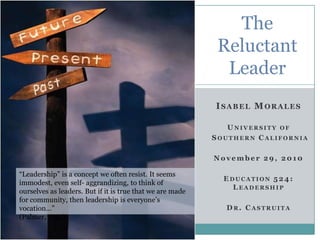
The
                                                            Reluctant
                                                             Leader
                                              1


                                                           ISABEL MORALES

                                                              U NIVERSITY OF
                                                           SOUTHERN CALIFORNIA

                                                           November 29, 2010

“Leadership” is a concept we often resist. It seems
                                                             E DUCATION 5 2 4 :
immodest, even self- aggrandizing, to think of
                                                                LEADERSHIP
ourselves as leaders. But if it is true that we are made
for community, then leadership is everyone’s
vocation…”                                                   DR. CASTRUITA
(Palmer, 1992)
Why am I here?
                                         2
“Where did you come from and
where are you going?

What makes life worth living and
work worth doing?

If you have a faith or a personal
philosophy that answers these
questions, cherish it and nourish it.”
(Bolman& Deal, 2002)
Where I come from
                                                3
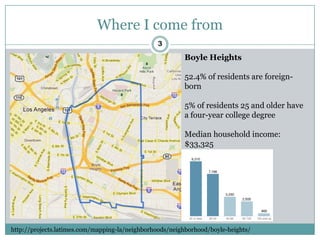
                                                         Boyle Heights

                                                         52.4% of residents are foreign-
                                                         born

                                                         5% of residents 25 and older have
                                                         a four-year college degree

                                                         Median household income:
                                                         $33,325


http://projects.latimes.com/mapping-la/neighborhoods/neighborhood/boyle-heights/
A Change is Needed
                                      4

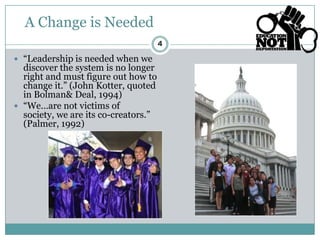
 “Leadership is needed when we
  discover the system is no longer
  right and must figure out how to
  change it.” (John Kotter, quoted
  in Bolman& Deal, 1994)
 “We…are not victims of
  society, we are its co-creators.”
  (Palmer, 1992)
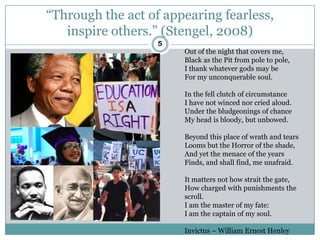
“Through the act of appearing fearless,
   inspire others.” (Stengel, 2008)
                   5
                       Out of the night that covers me,
                       Black as the Pit from pole to pole,
                       I thank whatever gods may be
                       For my unconquerable soul.

                       In the fell clutch of circumstance
                       I have not winced nor cried aloud.
                       Under the bludgeonings of chance
                       My head is bloody, but unbowed.

                       Beyond this place of wrath and tears
                       Looms but the Horror of the shade,
                       And yet the menace of the years
                       Finds, and shall find, me unafraid.

                       It matters not how strait the gate,
                       How charged with punishments the
                       scroll.
                       I am the master of my fate:
                       I am the captain of my soul.

                       Invictus – William Ernest Henley
Emergent Leadership
                                   6

 “Some people are leaders because of their formal
  position in an organization, whereas others are
  leaders because of the way other group members
  respond to them.” (Northouse, 2007)
  • Loyal and honest
  • Avoid group-think and respectfully
  speak my mind, even if it is the lone
  dissenting voice.
  • Seek others’ opinions
  • I respect and value my colleagues
  • Morale-booster
  • Initiate new ideas
Servant Leadership
        7


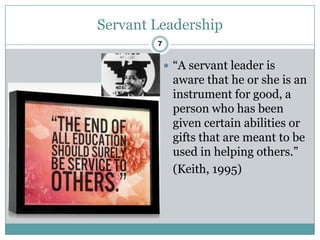
             “A servant leader is
             aware that he or she is an
             instrument for good, a
             person who has been
             given certain abilities or
             gifts that are meant to be
             used in helping others.”
             (Keith, 1995)
Leadership Development
                           8

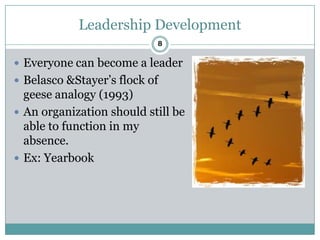
 Everyone can become a leader
 Belasco &Stayer’s flock of
  geese analogy (1993)
 An organization should still be
  able to function in my
  absence.
 Ex: Yearbook
Ethics
                              9

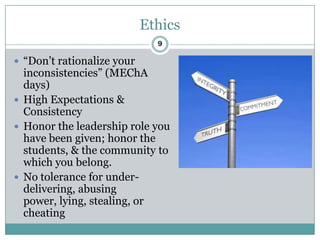
 “Don’t rationalize your
  inconsistencies” (MEChA
  days)
 High Expectations &
  Consistency
 Honor the leadership role you
  have been given; honor the
  students, & the community to
  which you belong.
 No tolerance for under-
  delivering, abusing
  power, lying, stealing, or
  cheating
Internal Accountability & Agency
                               10

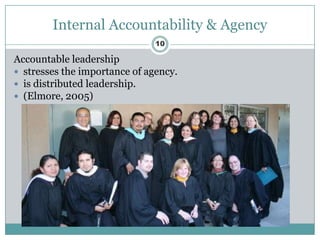
Accountable leadership
 stresses the importance of agency.
 is distributed leadership.
 (Elmore, 2005)
My Strengths as a Leader
                           11

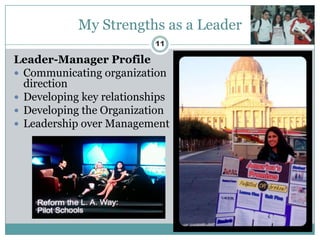
Leader-Manager Profile
 Communicating organization
  direction
 Developing key relationships
 Developing the Organization
 Leadership over Management
Strengths:
                                    Cognitive Frames
                               12

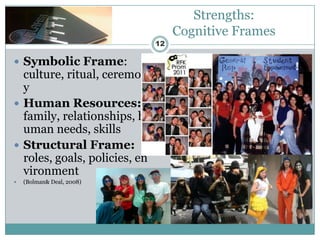
 Symbolic Frame:
  culture, ritual, ceremon
  y
 Human Resources:
  family, relationships, h
  uman needs, skills
 Structural Frame:
  roles, goals, policies, en
  vironment
   (Bolman& Deal, 2008)
Self-Actualization Strengths
                          13

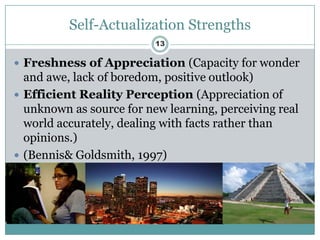
 Freshness of Appreciation (Capacity for wonder
  and awe, lack of boredom, positive outlook)
 Efficient Reality Perception (Appreciation of
  unknown as source for new learning, perceiving real
  world accurately, dealing with facts rather than
  opinions.)
 (Bennis& Goldsmith, 1997)
Conflict Style
                             14

 My style is compromising and accommodating.
 I listen to others, can see a variety of perspectives.
 (Thomas-Killman Conflict Self-Assesment)
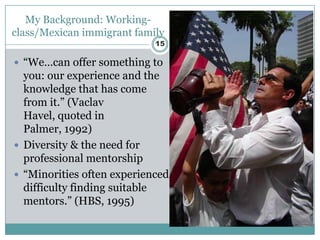
My Background: Working-
class/Mexican immigrant family
                            15

 “We…can offer something to
  you: our experience and the
  knowledge that has come
  from it.” (Vaclav
  Havel, quoted in
  Palmer, 1992)
 Diversity & the need for
  professional mentorship
 “Minorities often experienced
  difficulty finding suitable
  mentors.” (HBS, 1995)
Areas of Improvement
                             16

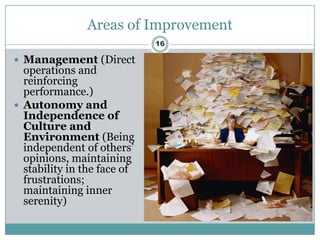
 Management (Direct
  operations and
  reinforcing
  performance.)
 Autonomy and
  Independence of
  Culture and
  Environment (Being
  independent of others’
  opinions, maintaining
  stability in the face of
  frustrations;
  maintaining inner
  serenity)
Areas of Improvement
                            17

 Political Frame: Improve at
  networking and coalition-
  building. Come out of my shell.
 Conflict: I need to become more
  comfortable with conflict. I can
  be too accommodating and
  compromising when I do not
  know people well enough. I need
  to “stick to my guns” around
  casual acquaintances.
 Implications: Surround myself
  with colleagues who are strong in
  the areas that I am not, so that
  together, we are stronger.
Where to next?
                          18

 I love teaching and
  am effective at it.
 Teaching 12th grade
  civics/econ allows to
  incorporate civic
  engagement and
  empowerment
  without the pressures
  of standardized
  testing.
 Is it how I can best
  serve my
  community?
Goals to fulfill…
                                 19


                                      Isabel Morales


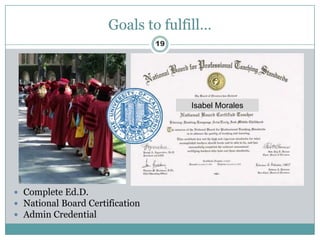
 Complete Ed.D.
 National Board Certification
 Admin Credential
What I will be doing in 5-10 years:
                                    20

My heart belongs to youth and the teaching profession:
•Develop as a teacher-leader.
• Continue teaching high school while also teaching at the college level.
• Develop a partnership between my college students and my high school
students.
• Mentoring of students AND professionals.
• Advocacy work. (Teachers alone can’t solve social ills)
References
                                                  21
   Belasco, J., and Stayer, R. (1993). Flight of the Buffalo: Soaring to Excellence, Learning to Let
    Employees Lead. New York : Warner Books. pp 16-23.
   Bennis, Warren and Goldsmith, Joan. (1997) Learning to Lead – Workbook on Becoming a
    Leader, pp30- 36, 167-169. (material found in Reader – Unit 1)
   Bolman, L. & Deal, T. (2008). Fourth Edition. Reframing Organizations: Artistry, Choice and
    Leadership. San Francisco: Jossey-Bass.
   Bolman, L., and Deal, T.. (2002). Leading With Soul and Spirit. The School Administrator
    (AASA) web edition, pp. 1-10Eicher, J. (2005) Second Edition. Leader-Manager Profile: Self
    Assessment. Pennsylvania, HRDQ.
   Elmore, Richard. (2005) Accountable Leadership
   Henley, W.E. Invictus
   Keith, K.M. (1995). Call to Servant Leadership. Facilities Manager
   Monitor Company – Personal Leadership and Diversity, (1995) Harvard Business School
   Murphy, J. (1988). The Unheroic Side of Leadership: Notes from the Swamp. Phi Delta
    KAPPAN, 69(9), 654-659.
   Northouse, Peter G. (2003) Fourth Edition. Leadership – Theory and Practice. Thousand
    Oaks: Sage PublicatiLeading from Within: Let your life speakons.
   Palmer, P. (1992).. San Francisco: Jossey Bass. pp 73-94.
   Senge, P. (1990). The Leader’s New Work: Building Learning Organizations. Sloan
    Management Review, Fall 1990, Pp. 7-23.
   Stengel, Richard. Mandela: His 8 Lessons of Leadership
   Thomas-Killman Conflict Mode Instrument
   http://projects.latimes.com/mapping-la/neighborhoods/neighborhood/boyle-heights/

EDUC 524 Final

  • 1.
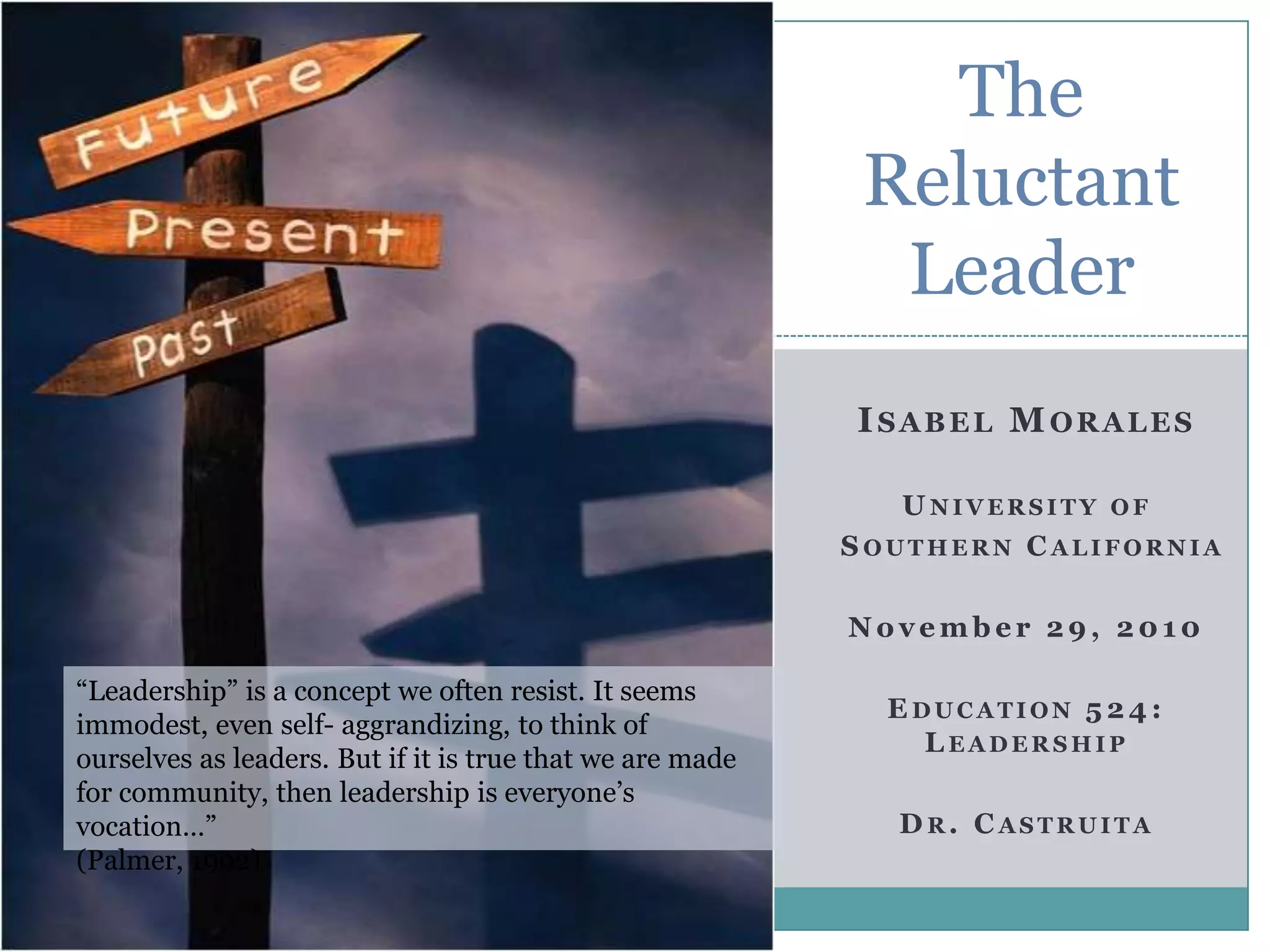
    The Reluctant Leader 1 ISABEL MORALES U NIVERSITY OF SOUTHERN CALIFORNIA November 29, 2010 “Leadership” is a concept we often resist. It seems E DUCATION 5 2 4 : immodest, even self- aggrandizing, to think of LEADERSHIP ourselves as leaders. But if it is true that we are made for community, then leadership is everyone’s vocation…” DR. CASTRUITA (Palmer, 1992)
  • 2.
    Why am Ihere? 2 “Where did you come from and where are you going? What makes life worth living and work worth doing? If you have a faith or a personal philosophy that answers these questions, cherish it and nourish it.” (Bolman& Deal, 2002)
  • 3.
    Where I comefrom 3 Boyle Heights 52.4% of residents are foreign- born 5% of residents 25 and older have a four-year college degree Median household income: $33,325 http://projects.latimes.com/mapping-la/neighborhoods/neighborhood/boyle-heights/
  • 4.
    A Change isNeeded 4  “Leadership is needed when we discover the system is no longer right and must figure out how to change it.” (John Kotter, quoted in Bolman& Deal, 1994)  “We…are not victims of society, we are its co-creators.” (Palmer, 1992)
  • 5.
    “Through the actof appearing fearless, inspire others.” (Stengel, 2008) 5 Out of the night that covers me, Black as the Pit from pole to pole, I thank whatever gods may be For my unconquerable soul. In the fell clutch of circumstance I have not winced nor cried aloud. Under the bludgeonings of chance My head is bloody, but unbowed. Beyond this place of wrath and tears Looms but the Horror of the shade, And yet the menace of the years Finds, and shall find, me unafraid. It matters not how strait the gate, How charged with punishments the scroll. I am the master of my fate: I am the captain of my soul. Invictus – William Ernest Henley
  • 6.
    Emergent Leadership 6  “Some people are leaders because of their formal position in an organization, whereas others are leaders because of the way other group members respond to them.” (Northouse, 2007) • Loyal and honest • Avoid group-think and respectfully speak my mind, even if it is the lone dissenting voice. • Seek others’ opinions • I respect and value my colleagues • Morale-booster • Initiate new ideas
  • 7.
    Servant Leadership 7  “A servant leader is aware that he or she is an instrument for good, a person who has been given certain abilities or gifts that are meant to be used in helping others.” (Keith, 1995)
  • 8.
    Leadership Development 8  Everyone can become a leader  Belasco &Stayer’s flock of geese analogy (1993)  An organization should still be able to function in my absence.  Ex: Yearbook
  • 9.
    Ethics 9  “Don’t rationalize your inconsistencies” (MEChA days)  High Expectations & Consistency  Honor the leadership role you have been given; honor the students, & the community to which you belong.  No tolerance for under- delivering, abusing power, lying, stealing, or cheating
  • 10.
    Internal Accountability &Agency 10 Accountable leadership  stresses the importance of agency.  is distributed leadership.  (Elmore, 2005)
  • 11.
    My Strengths asa Leader 11 Leader-Manager Profile  Communicating organization direction  Developing key relationships  Developing the Organization  Leadership over Management
  • 12.
    Strengths: Cognitive Frames 12  Symbolic Frame: culture, ritual, ceremon y  Human Resources: family, relationships, h uman needs, skills  Structural Frame: roles, goals, policies, en vironment  (Bolman& Deal, 2008)
  • 13.
    Self-Actualization Strengths 13  Freshness of Appreciation (Capacity for wonder and awe, lack of boredom, positive outlook)  Efficient Reality Perception (Appreciation of unknown as source for new learning, perceiving real world accurately, dealing with facts rather than opinions.)  (Bennis& Goldsmith, 1997)
  • 14.
    Conflict Style 14  My style is compromising and accommodating.  I listen to others, can see a variety of perspectives.  (Thomas-Killman Conflict Self-Assesment)
  • 15.
    My Background: Working- class/Mexicanimmigrant family 15  “We…can offer something to you: our experience and the knowledge that has come from it.” (Vaclav Havel, quoted in Palmer, 1992)  Diversity & the need for professional mentorship  “Minorities often experienced difficulty finding suitable mentors.” (HBS, 1995)
  • 16.
    Areas of Improvement 16  Management (Direct operations and reinforcing performance.)  Autonomy and Independence of Culture and Environment (Being independent of others’ opinions, maintaining stability in the face of frustrations; maintaining inner serenity)
  • 17.
    Areas of Improvement 17  Political Frame: Improve at networking and coalition- building. Come out of my shell.  Conflict: I need to become more comfortable with conflict. I can be too accommodating and compromising when I do not know people well enough. I need to “stick to my guns” around casual acquaintances.  Implications: Surround myself with colleagues who are strong in the areas that I am not, so that together, we are stronger.
  • 18.
    Where to next? 18  I love teaching and am effective at it.  Teaching 12th grade civics/econ allows to incorporate civic engagement and empowerment without the pressures of standardized testing.  Is it how I can best serve my community?
  • 19.
    Goals to fulfill… 19 Isabel Morales  Complete Ed.D.  National Board Certification  Admin Credential
  • 20.
    What I willbe doing in 5-10 years: 20 My heart belongs to youth and the teaching profession: •Develop as a teacher-leader. • Continue teaching high school while also teaching at the college level. • Develop a partnership between my college students and my high school students. • Mentoring of students AND professionals. • Advocacy work. (Teachers alone can’t solve social ills)
  • 21.
    References 21  Belasco, J., and Stayer, R. (1993). Flight of the Buffalo: Soaring to Excellence, Learning to Let Employees Lead. New York : Warner Books. pp 16-23.  Bennis, Warren and Goldsmith, Joan. (1997) Learning to Lead – Workbook on Becoming a Leader, pp30- 36, 167-169. (material found in Reader – Unit 1)  Bolman, L. & Deal, T. (2008). Fourth Edition. Reframing Organizations: Artistry, Choice and Leadership. San Francisco: Jossey-Bass.  Bolman, L., and Deal, T.. (2002). Leading With Soul and Spirit. The School Administrator (AASA) web edition, pp. 1-10Eicher, J. (2005) Second Edition. Leader-Manager Profile: Self Assessment. Pennsylvania, HRDQ.  Elmore, Richard. (2005) Accountable Leadership  Henley, W.E. Invictus  Keith, K.M. (1995). Call to Servant Leadership. Facilities Manager  Monitor Company – Personal Leadership and Diversity, (1995) Harvard Business School  Murphy, J. (1988). The Unheroic Side of Leadership: Notes from the Swamp. Phi Delta KAPPAN, 69(9), 654-659.  Northouse, Peter G. (2003) Fourth Edition. Leadership – Theory and Practice. Thousand Oaks: Sage PublicatiLeading from Within: Let your life speakons.  Palmer, P. (1992).. San Francisco: Jossey Bass. pp 73-94.  Senge, P. (1990). The Leader’s New Work: Building Learning Organizations. Sloan Management Review, Fall 1990, Pp. 7-23.  Stengel, Richard. Mandela: His 8 Lessons of Leadership  Thomas-Killman Conflict Mode Instrument  http://projects.latimes.com/mapping-la/neighborhoods/neighborhood/boyle-heights/

Editor's Notes

  • #2 Although I’m not the type of person to aspire to positions of power, nor did I necessarily WANT to be a leader, situations called for me to step forward.The past few months have made me question myself and reevaluate my goals.
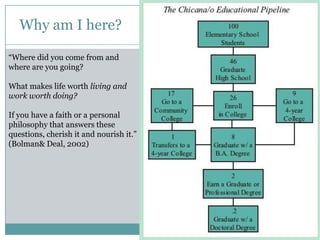
  • #3 One thing that has stayed constant is my passion and my vision. The driving force behind anything I do is the Chicana/o Educational Pipeline, which shows that only 8 out of every 100 Latino students graduates with a Bachelor’s Degree.