ICU Emergency  AIRWAY MANAGEMENT Dalhousie Critical Care Lecture Series
Introduction Case history Airway assessment Sedation the KISS approach Ventilation vs. Intubation Airway adjuncts Education
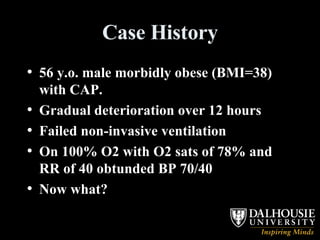
Case History 56 y.o. male morbidly obese (BMI=38) with CAP. Gradual deterioration over 12 hours  Failed non-invasive ventilation On 100% O2 with O2 sats of 78% and RR of 40 obtunded BP 70/40 Now what?
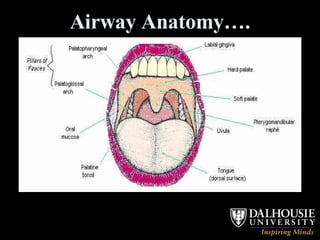
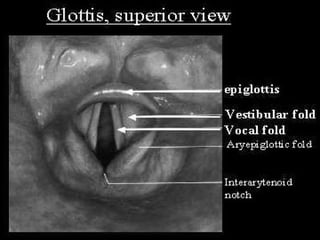
Airway Anatomy….
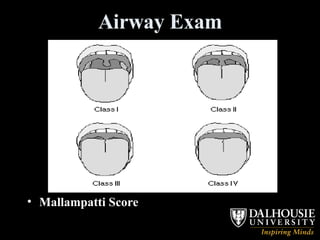
Airway Exam Mallampatti Score
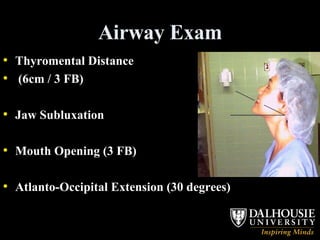
Airway Exam Thyromental Distance (6cm / 3 FB) Jaw Subluxation Mouth Opening (3 FB) Atlanto-Occipital Extension (30 degrees)
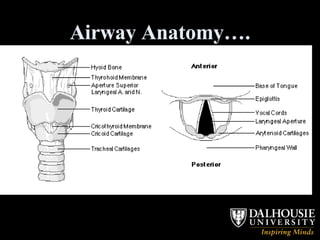
Airway Anatomy….
 
Airway Exam Check old anesthetic records (remember Star Trek) IV Access unless in extremis (place tube) Sedation if necessary
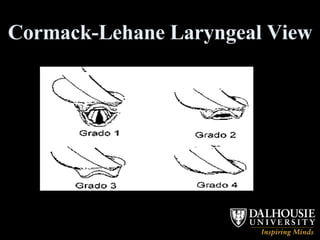
Cormack-Lehane Laryngeal View
Definition  Minimal Sedation -Anxiolysis Conscious sedation is the use of medication to minimally depress the LOC in a patient while allowing the patient to continually and independently maintain a patent A/W and respond appropriately to verbal commands or gentle stimulation.  Chet Wyman, University of Maryland School of Medicine
Sedatives In The Ideal World Safe Painless route of administration Rapid predictable onset Predictable duration Reversible Absence of cardio/respiratory/CNS depression There are no drugs available which achieve these ideals!
Midazolam (Versed®) Short acting benzodiazepine used for sedation, anxiolysis, and amnesia  also used as an induction agent for GA and as an adjunct to regional anesthesia.
Midazolam Onset: 1-3 minutes Peak Effect: 3-5 minutes Duration of action: 45-60 minutes Adverse reactions: Respiratory depression especially with opioids.  Minimal hemodynamic effects Antagonist: Flumazenil
Fentanyl It is a synthetic opioid 100 times more potent than  morphine Mu1 receptors produce analgesia and physical dependence Mu2 receptors produce respiratory depression, nausea, vomiting, constipation and bradycardia
Fentanyl Onset: Immediate response Duration of action: < 60 minutes Half life: 2-4 hrs. Increased risk of respiratory depression when given with Benzodiazepines Antagonist: Naloxone
Etomidate 0.3 mg/kg, with a time to effect of 15 to 45 seconds  duration of action of 3 to 12 minutes  most hemodynamically neutral of the sedative agents used for RSI  The hemodynamic stability associated with  etomidate  makes it the drug of choice for the intubation of hypotensive patients, as well as an attractive option for patients with intracranial pathology, when hypotension must be avoided
Etomidate Some researchers have raised concerns regarding the safety of etomidate in the setting of adrenal insufficiency Adrenal insufficiency in meningococcal sepsis: bioavailable cortisol levels and impact of interleukin-6 levels and intubation with etomidate on adrenal function and mortality. AUden Brinker M; Joosten KF; Liem O; de Jong FH; Hop WC; Hazelzet JA; van Dijk M; Hokken-Koelega AC SOJ Clin Endocrinol Metab. 2005 Sep;90(9):5110-7. Epub 2005 Jun 28.  Should we use etomidate as an induction agent for endotracheal intubation in patients with septic shock?: a critical appraisal. AUJackson WL Jr SOChest 2005 Mar;127(3):1031-8. Risk factors of relative adrenocortical deficiency in intensive care patients needing mechanical ventilation. Care Med 2005 Mar;31(3):388-392 .   When intubating the critically ill patient with possible adrenal insufficiency, the clinician must weigh the relative risk of cortisol suppression against the hemodynamic instability that may be caused by other induction agents
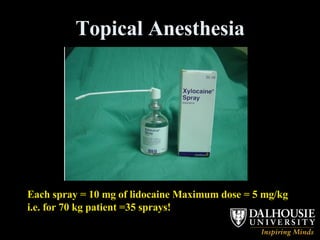
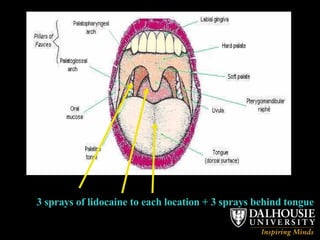
Topical Anesthesia Each spray = 10 mg of lidocaine Maximum dose = 5 mg/kg i.e. for 70 kg patient =35 sprays!
3 sprays of lidocaine to each location + 3 sprays behind tongue
Airway Management
4 Questions Can I oxygenate this patient with a BVM? Can I ventilate with a supra-glottic device (SGD) i.e. LMA? Can I place a tube in the trachea? Can I secure a surgical airway? Murphy et al CJA 2005 52:3
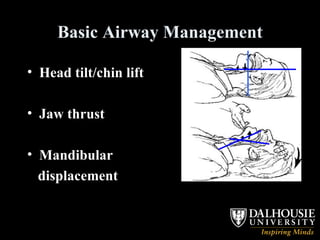
Basic Airway Management Head tilt/chin lift Jaw thrust Mandibular displacement
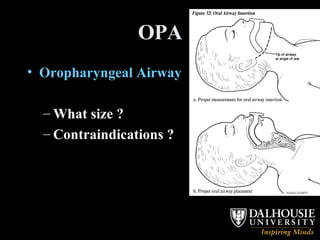
OPA Oropharyngeal Airway What size ? Contraindications ?
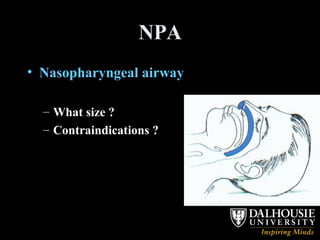
NPA Nasopharyngeal airway What size ? Contraindications ?
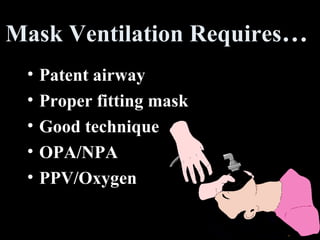
Mask Ventilation Requires …  Patent airway Proper fitting mask Good technique OPA/NPA PPV/Oxygen
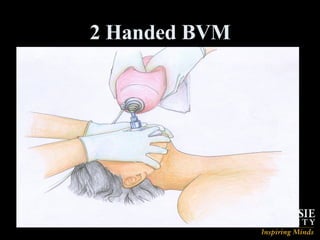
2 Handed BVM
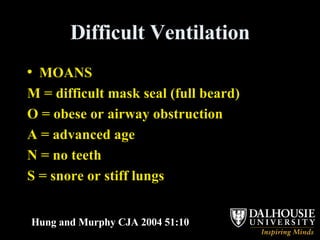
Difficult Ventilation MOANS M = difficult mask seal (full beard) O = obese or airway obstruction A = advanced age N = no teeth S = snore or stiff lungs Hung and Murphy CJA 2004 51:10
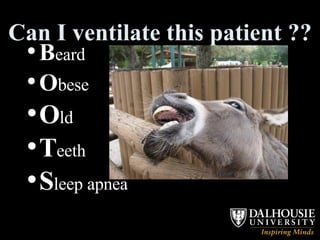
Can I ventilate this patient ?? B eard O bese O ld T eeth  S leep apnea
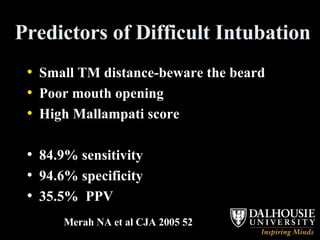
Predictors of Difficult Intubation Small TM distance-beware the beard Poor mouth opening High Mallampati score 84.9% sensitivity 94.6% specificity 35.5%  PPV Merah NA et al CJA 2005 52
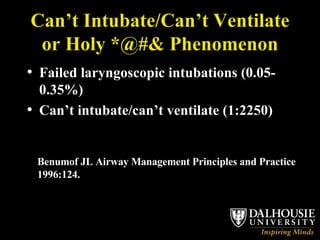
Can’t Intubate/Can’t Ventilate or Holy *@#& Phenomenon Failed laryngoscopic intubations (0.05-0.35%) Can’t intubate/can’t ventilate (1:2250) Benumof JL Airway Management Principles and Practice 1996:124.
Time to intubate . . . Basic Equipment PPV (BVM ventilation) Oxygen ETT Suction Laryngoscope Bougie LMA
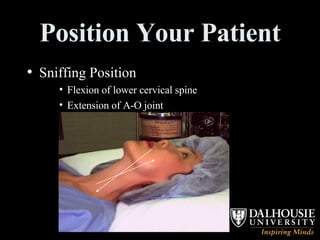
Position Your Patient Sniffing Position Flexion of lower cervical spine Extension of A-O joint
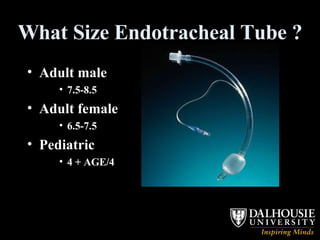
What Size Endotracheal Tube ? Adult male 7.5-8.5 Adult female 6.5-7.5 Pediatric 4 + AGE/4
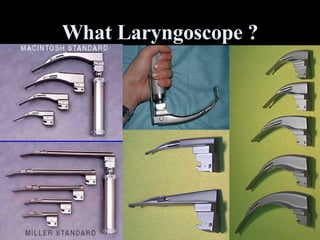
What Laryngoscope ?
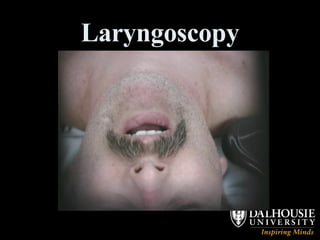
Laryngoscopy
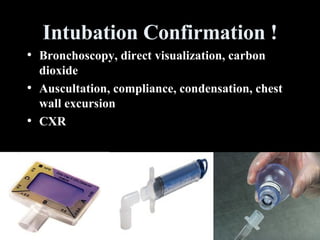
Intubation Confirmation ! Bronchoscopy, direct visualization, carbon dioxide Auscultation, compliance, condensation, chest wall excursion CXR
 
Airway Adjuncts
Cricoid Pressure New data suggests it is better to position larynx with right hand and then demonstrate position BURP larynx posterior, up and to the patient’s right C/I in c-spine fracture
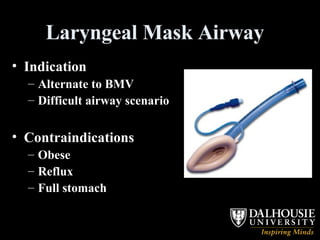
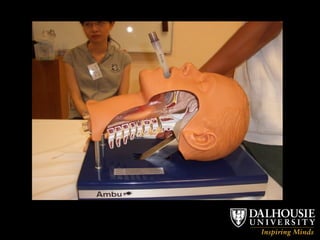
Laryngeal Mask Airway  Indication Alternate to BMV Difficult airway scenario Contraindications  Obese Reflux Full stomach
 
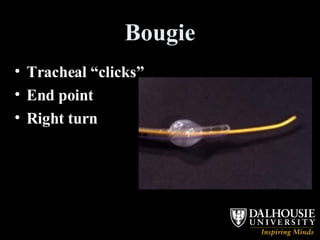
Bougie Tracheal “clicks” End point Right turn
Special Cases Obesity Rheumatoid arthritis Head and neck cancer Trauma/Fractured c-spine
Obesity Redundant tissue in oropharynx Thoracic kyphosis    FRC Minimal apnea time i.e. rapid desaturation
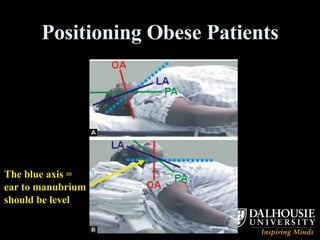
Positioning Obese Patients The blue axis = ear to manubrium should be level
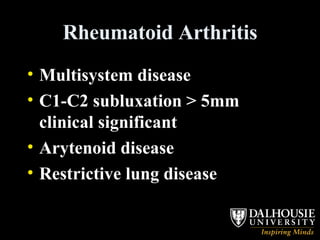
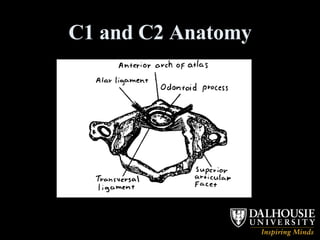
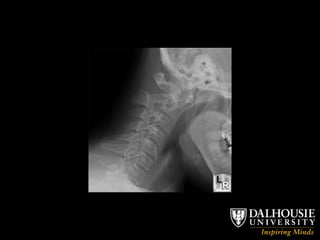
Rheumatoid Arthritis Multisystem disease C1-C2 subluxation > 5mm clinical significant Arytenoid disease Restrictive lung disease
C1 and C2 Anatomy
 
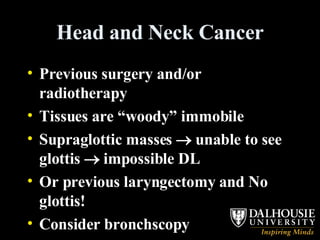
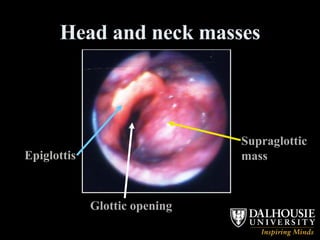
Head and Neck Cancer Previous surgery and/or radiotherapy Tissues are “woody” immobile Supraglottic masses    unable to see glottis    impossible DL Or previous laryngectomy and No glottis! Consider bronchscopy
Head and neck masses Epiglottis Glottic opening Supraglottic mass
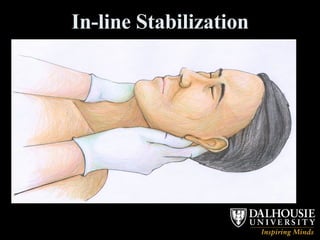
C-spine Trauma Head Injury common In-line stabilization essential Maintain oxygenation and BP
In-line Stabilization
What about the Patient with Pneumonia? How would you manage this scenario?
Answer This is an emergency situation,  Call for HELP Confirm patient is on 100% O2 ! Take a brief history including drugs (sedatives) Examine airway for ease of  Ventilation  and  Intubation   Assist ventilation, 2 handed BVM + OPA Recheck vitals Position patient for airway management Do not make patient APNEIC

Icu Emergency Airway Management

  • 1.
    ICU Emergency AIRWAY MANAGEMENT Dalhousie Critical Care Lecture Series
  • 2.
    Introduction Case historyAirway assessment Sedation the KISS approach Ventilation vs. Intubation Airway adjuncts Education
  • 3.
    Case History 56y.o. male morbidly obese (BMI=38) with CAP. Gradual deterioration over 12 hours Failed non-invasive ventilation On 100% O2 with O2 sats of 78% and RR of 40 obtunded BP 70/40 Now what?
  • 4.
  • 5.
  • 6.
    Airway Exam ThyromentalDistance (6cm / 3 FB) Jaw Subluxation Mouth Opening (3 FB) Atlanto-Occipital Extension (30 degrees)
  • 7.
  • 8.
  • 9.
    Airway Exam Checkold anesthetic records (remember Star Trek) IV Access unless in extremis (place tube) Sedation if necessary
  • 10.
  • 11.
    Definition MinimalSedation -Anxiolysis Conscious sedation is the use of medication to minimally depress the LOC in a patient while allowing the patient to continually and independently maintain a patent A/W and respond appropriately to verbal commands or gentle stimulation. Chet Wyman, University of Maryland School of Medicine
  • 12.
    Sedatives In TheIdeal World Safe Painless route of administration Rapid predictable onset Predictable duration Reversible Absence of cardio/respiratory/CNS depression There are no drugs available which achieve these ideals!
  • 13.
    Midazolam (Versed®) Shortacting benzodiazepine used for sedation, anxiolysis, and amnesia also used as an induction agent for GA and as an adjunct to regional anesthesia.
  • 14.
    Midazolam Onset: 1-3minutes Peak Effect: 3-5 minutes Duration of action: 45-60 minutes Adverse reactions: Respiratory depression especially with opioids. Minimal hemodynamic effects Antagonist: Flumazenil
  • 15.
    Fentanyl It isa synthetic opioid 100 times more potent than morphine Mu1 receptors produce analgesia and physical dependence Mu2 receptors produce respiratory depression, nausea, vomiting, constipation and bradycardia
  • 16.
    Fentanyl Onset: Immediateresponse Duration of action: < 60 minutes Half life: 2-4 hrs. Increased risk of respiratory depression when given with Benzodiazepines Antagonist: Naloxone
  • 17.
    Etomidate 0.3 mg/kg,with a time to effect of 15 to 45 seconds duration of action of 3 to 12 minutes most hemodynamically neutral of the sedative agents used for RSI The hemodynamic stability associated with etomidate makes it the drug of choice for the intubation of hypotensive patients, as well as an attractive option for patients with intracranial pathology, when hypotension must be avoided
  • 18.
    Etomidate Some researchershave raised concerns regarding the safety of etomidate in the setting of adrenal insufficiency Adrenal insufficiency in meningococcal sepsis: bioavailable cortisol levels and impact of interleukin-6 levels and intubation with etomidate on adrenal function and mortality. AUden Brinker M; Joosten KF; Liem O; de Jong FH; Hop WC; Hazelzet JA; van Dijk M; Hokken-Koelega AC SOJ Clin Endocrinol Metab. 2005 Sep;90(9):5110-7. Epub 2005 Jun 28. Should we use etomidate as an induction agent for endotracheal intubation in patients with septic shock?: a critical appraisal. AUJackson WL Jr SOChest 2005 Mar;127(3):1031-8. Risk factors of relative adrenocortical deficiency in intensive care patients needing mechanical ventilation. Care Med 2005 Mar;31(3):388-392 .   When intubating the critically ill patient with possible adrenal insufficiency, the clinician must weigh the relative risk of cortisol suppression against the hemodynamic instability that may be caused by other induction agents
  • 19.
    Topical Anesthesia Eachspray = 10 mg of lidocaine Maximum dose = 5 mg/kg i.e. for 70 kg patient =35 sprays!
  • 20.
    3 sprays oflidocaine to each location + 3 sprays behind tongue
  • 21.
  • 22.
    4 Questions CanI oxygenate this patient with a BVM? Can I ventilate with a supra-glottic device (SGD) i.e. LMA? Can I place a tube in the trachea? Can I secure a surgical airway? Murphy et al CJA 2005 52:3
  • 23.
    Basic Airway ManagementHead tilt/chin lift Jaw thrust Mandibular displacement
  • 24.
    OPA Oropharyngeal AirwayWhat size ? Contraindications ?
  • 25.
    NPA Nasopharyngeal airwayWhat size ? Contraindications ?
  • 26.
    Mask Ventilation Requires… Patent airway Proper fitting mask Good technique OPA/NPA PPV/Oxygen
  • 27.
  • 28.
    Difficult Ventilation MOANSM = difficult mask seal (full beard) O = obese or airway obstruction A = advanced age N = no teeth S = snore or stiff lungs Hung and Murphy CJA 2004 51:10
  • 29.
    Can I ventilatethis patient ?? B eard O bese O ld T eeth S leep apnea
  • 30.
    Predictors of DifficultIntubation Small TM distance-beware the beard Poor mouth opening High Mallampati score 84.9% sensitivity 94.6% specificity 35.5% PPV Merah NA et al CJA 2005 52
  • 31.
    Can’t Intubate/Can’t Ventilateor Holy *@#& Phenomenon Failed laryngoscopic intubations (0.05-0.35%) Can’t intubate/can’t ventilate (1:2250) Benumof JL Airway Management Principles and Practice 1996:124.
  • 32.
    Time to intubate. . . Basic Equipment PPV (BVM ventilation) Oxygen ETT Suction Laryngoscope Bougie LMA
  • 33.
    Position Your PatientSniffing Position Flexion of lower cervical spine Extension of A-O joint
  • 34.
    What Size EndotrachealTube ? Adult male 7.5-8.5 Adult female 6.5-7.5 Pediatric 4 + AGE/4
  • 35.
  • 36.
  • 37.
    Intubation Confirmation !Bronchoscopy, direct visualization, carbon dioxide Auscultation, compliance, condensation, chest wall excursion CXR
  • 38.
  • 39.
  • 40.
    Cricoid Pressure Newdata suggests it is better to position larynx with right hand and then demonstrate position BURP larynx posterior, up and to the patient’s right C/I in c-spine fracture
  • 41.
    Laryngeal Mask Airway Indication Alternate to BMV Difficult airway scenario Contraindications Obese Reflux Full stomach
  • 42.
  • 43.
    Bougie Tracheal “clicks”End point Right turn
  • 44.
    Special Cases ObesityRheumatoid arthritis Head and neck cancer Trauma/Fractured c-spine
  • 45.
    Obesity Redundant tissuein oropharynx Thoracic kyphosis  FRC Minimal apnea time i.e. rapid desaturation
  • 46.
    Positioning Obese PatientsThe blue axis = ear to manubrium should be level
  • 47.
    Rheumatoid Arthritis Multisystemdisease C1-C2 subluxation > 5mm clinical significant Arytenoid disease Restrictive lung disease
  • 48.
    C1 and C2Anatomy
  • 49.
  • 50.
    Head and NeckCancer Previous surgery and/or radiotherapy Tissues are “woody” immobile Supraglottic masses  unable to see glottis  impossible DL Or previous laryngectomy and No glottis! Consider bronchscopy
  • 51.
    Head and neckmasses Epiglottis Glottic opening Supraglottic mass
  • 52.
    C-spine Trauma HeadInjury common In-line stabilization essential Maintain oxygenation and BP
  • 53.
  • 54.
    What about thePatient with Pneumonia? How would you manage this scenario?
  • 55.
    Answer This isan emergency situation, Call for HELP Confirm patient is on 100% O2 ! Take a brief history including drugs (sedatives) Examine airway for ease of Ventilation and Intubation Assist ventilation, 2 handed BVM + OPA Recheck vitals Position patient for airway management Do not make patient APNEIC