,19$6,9( %/22'
35(6685(
021,725,1*
Dr. Ubaidur Rahaman
Senior Resident, Critical Care Medicine,
SGPGIMS,
Lucknow, India
$UWHULDO R[JHQ FRQWHQW DUWHULDO SUHVVXUHV EORRG IORZ YHORFLW PRGH RI FDUGLDF ZRUN
DQG PRGH RI UHVSLUDWLRQ DOO DUH LQFLGHQWDO DQG VXERUGLQDWH
WKH DOO FRPELQH WKHLU DFWLRQV RQO LQ VHUYLFH WR WKH FHOOV”
Pfluger, German Physiologist, about 100 years ago

“'HVSLWH WKH PRGHUQ WHFKQRORJLHV RI VW FHQWXU ZH DUH RQO DEOH WR PRQLWRU
ZKDW SIOXJHU FDOOHG ‘LQFLGHQWDO DQG VXERUGLQDWH’”
PINSKI’s Functional hemodynamic monitoring, page 240
1896: Riva Rocci
Sphygmomanometer
Arm encircling inflatable elastic cuff pressure
Only Systolic BP measuredpressure at which radial artery pulse disappears

1905: Kortokoff
Kortokoff sounds ( auscultatory method)
Both Systolic and Diastolic BP measured
Fundamental Principle
Pressure required to obliterate blood flow

low flow conditions
shock or high vasopressor doses
can attenuate or obliterate
generation of sound
underestimation of BP

non compressible arteries
Severe atherosclerosis
Overestimation of BP
AUTOMATED NIBP

Based on oscillometry ( described by Marey in 1876)
Variations in cuff pressure resulting from arterial pulsations
during cuff deflation sensed by monitor

Pressure at which peak amplitude of arterial pulsations occur, corresponds
closely to directly measured MAP
Systolic and Diastolic BP are derived from proprietary formulas
Systolic and Diastolic BP are less reliable than MAP
INVASIVE BLOOD PRESSURE MONITORING

The technique involves the insertion of a catheter into a suitable artery
and then displaying
the measured pressure wave on a monitor
ADVANTAGE OF IABP

• continuous beat-to-beat pressure measurement,
close monitoring of critically ill patients on vasoactive drugs
•Pulse waveform analysis provides other important hemodynamic parameters
• reduces the risk of tissue injury and neuropraxias in patients who will
require prolonged blood pressure measurement
•allows frequent arterial blood sampling
•more accurate than NIBP, especially in the extremely
hypotensive or the patient with arrhythmias.
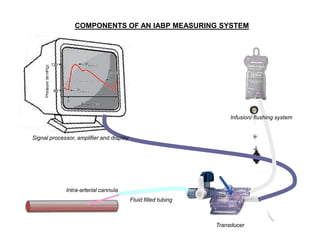
COMPONENTS OF AN IABP MEASURING SYSTEM

Infusion/ flushing system

Signal processor, amplifier and display

Intra-arterial cannula
Fluid filled tubing

Transducer
COMPONENTS OF AN IABP MEASURING SYSTEM
Intra-arterial cannula
•Should be wide and short
• Forward flowing blood contains kinetic energy.
•When flowing blood is suddenly stopped
by tip of catheter, kinetic energy is partially converted into pressure.
This may add 2-10mmHg to SBP.
•This is referred to as end hole artifact or end pressure product.
•Cannulation sites: Radial, Ulnar, Dorsalis Pedis, Posterior tibial, Femoral arteries

Fluid filled tubing
•provides a column of non-compressible, bubble free fluid between
the arterial blood and the pressure transducer for hydraulic coupling.
• Ideally, the tubing should be short, wide and non-compliant (stiff) to reduce damping.
•extra 3-way taps and unnecessary lengths of tubing should be avoided where possible
COMPONENTS OF AN IABP MEASURING SYSTEM

.
Transducer
Converts mechanical impulse of a pressure wave into an electrical signal through
movement of a displaceable sensing diaphragm.
It functions on principle of strain gauze and wheatstone bridge circuit.
COMPONENTS OF AN IABP MEASURING SYSTEM
Strain Gauze
Are based on the principle that the electrical resistance of wire or silicone increases
with increasing stretch.
The flexible diagram is attached to wire or silicone strain gauges
in such a way that with movement of the diaphragm
the gauges are stretched or compressed, altering their resistance

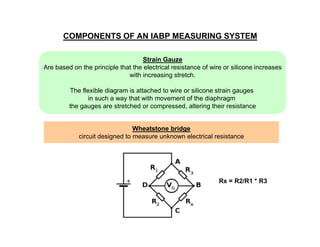
Wheatstone bridge
circuit designed to measure unknown electrical resistance

Rx = R2/R1 * R3
COMPONENTS OF AN IABP MEASURING SYSTEM
Signal processor, amplifier and display
The pressure transducer relays its electrical signal via a cable to a microprocessor
where it is filtered, amplified, analyzed and displayed on a screen
as a waveform of pressure vs. time.
Beat to beat blood pressure can be seen and further analysis of the pressure waveform
can be made, either clinically, looking at the characteristic shape of the waveform,
or with more complex systems, using the shape of the waveform
to calculate cardiac output and other cardiovascular parameters

.
Infusion/flushing system
Fills the pressure tubing with fluid and helps prevent blood from clotting in catheter,
by continuously flushing fluid through the system at a rate of 1-3ml/hr,
by keeping a flush bag at pressure of 300mmHg.
Heparinizing the flush system is not necessary
COMPONENTS OF AN IABP MEASURING SYSTEM

Wheatstone bridge

diagphragm
Strain gauge

Signal processor, amplifier
and display
SOME TECHNICAL ASPECTS
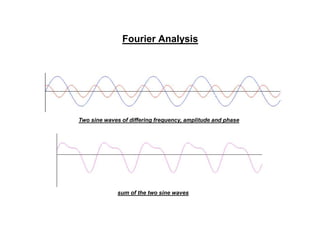
Fourier Analysis

Two sine waves of differing frequency, amplitude and phase

sum of the two sine waves
FUNDAMENTAL FREQUENCY

The arterial pressure wave consists of a fundamental wave and
a series of harmonic waves.
Harmonic waves are smaller waves whose frequencies are
multiples of the fundamental frequency
The process of analyzing a complex waveform in terms of its constituent sine waves is
called Fourier Analysis
In the IABP system,
the complex waveform is broken down by a microprocessor into its component sine waves,
then reconstructed
from the fundamental and eight or more harmonic waves of higher frequency
to give an accurate representation of the original waveform.
The IABP system must be able to transmit and detect the high frequency components
of the arterial waveform in order to represent the arterial pressure wave precisely.
This is important to remember when considering the natural frequency of the system
FUNDAMENTAL FREQUENCY
The arteiral pressure wave has a characteristic periodicity termed the fundamental
frequency, which is equal to the pulse rate.
Although the pulse rate is reported in beats per minute, fundamental frequency
is reported in cycles per second or hertz (Hz).
If the heart rate is 60 beats/min, then this equals one cycle per second ( 1 Hz)
So the fundamental frequency is 1 Hz.
First 10 harmonics for this this waveform would go up to 10 Hz,
so that any recording system would require a frequency response
that was undistorted up to 10 Hz to accurately reproduce the original signal.
If the heart rate were 180/min, then frequency response would need to be 20 Hz.
Therefore most of the information of arterial pressure waveform is contained
in the range of 0-20 Hz.
A properly designed measurement system should therefore produce minimal amplitude and
phase distortion for this range of frequencies.
Natural Frequency  Resonance

Every material has a frequency at which it oscillates freely.
This is called its natural frequency.

If a force with a similar frequency to the natural frequency is applied to a system,
it will begin to oscillate at its maximum amplitude.
This phenomenon is known as resonance.

In 1850, a suspension bridge in France collapsed
when soldiers marching across it in time with the natural frequency of
the bridge caused it to resonate.
The bridge began to oscillate, swinging wildly as the marching continued
until eventually it collapsed.
The natural frequency of a system is determined by the properties of its components.
It may be increased by:
•Reducing the length of the cannula or tubing
•Reducing the compliance of the cannula or diaphragm
•Reducing the density of the fluid used in the tubing
•Increasing the diameter of the cannula or tubing

Most commercially available systems have a natural frequency of around 200Hz
but this is reduced by the
addition of three-way taps, bubbles, clots and additional lengths of tubing
Pressure monitoring system will have optimal dynamic response
if its natural frequency is as high as possible
.
In theory, this is best achieved
by using short lengths of stiff pressure tubing and
limiting the number of stopcocks
and other monitoring system appliances.
Blood clots and air bubbles trapped and concealed in
Stopcocks and other connection points will have similar adverse influences
on the system’s dynamic response.

As a general rule, adding air bubbles to monitoring systems
will not improve their dynamic response
because
any increase in system damping is always accompanied by a decrease in natural frequency.
Somewhat paradoxically, monitoring system resonance may increase and cause
even greater systolic pressure overshoot
DAMPING
Anything that reduces energy in an oscillating system will reduce
the amplitude of the oscillations.
This is termed damping.
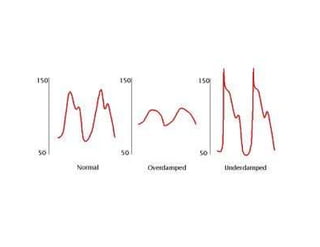
Some degree of damping is required in all systems (critical damping), but if excessive
(overdamping) or insufficient (underdamping) the output will be adversely effected.
In an IABP measuring system, most damping is from friction in the fluid pathway.
There are however, a number of other factors that will cause overdamping including:
• Three way taps
• Bubbles and clots
• Vasospasm
• Narrow, long or compliant tubing
• Kinks in the cannula or tubing
These may be a major source of error, causing an
under-reading of SBP and overreading of DBP
although the mean blood pressure is relatively unaffected.
Damping also causes a reduction in the natural frequency of the system,
allowing resonance and distortion of the signal.
FAST FLUSH TEST (SQUARE WAVE TEST)

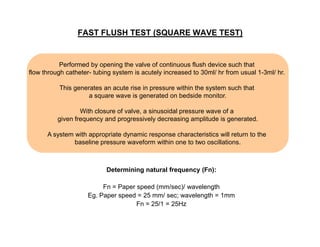
Performed by opening the valve of continuous flush device such that
flow through catheter- tubing system is acutely increased to 30ml/ hr from usual 1-3ml/ hr.
This generates an acute rise in pressure within the system such that
a square wave is generated on bedside monitor.
With closure of valve, a sinusoidal pressure wave of a
given frequency and progressively decreasing amplitude is generated.
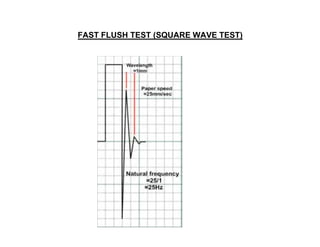
A system with appropriate dynamic response characteristics will return to the
baseline pressure waveform within one to two oscillations.

Determining natural frequency (Fn):
Fn = Paper speed (mm/sec)/ wavelength
Eg. Paper speed = 25 mm/ sec; wavelength = 1mm
Fn = 25/1 = 25Hz
FAST FLUSH TEST (SQUARE WAVE TEST)
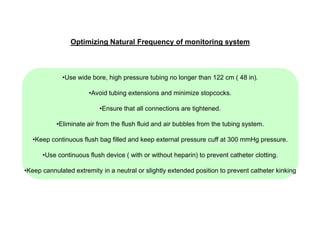
Optimizing Natural Frequency of monitoring system

•Use wide bore, high pressure tubing no longer than 122 cm ( 48 in).
•Avoid tubing extensions and minimize stopcocks.
•Ensure that all connections are tightened.
•Eliminate air from the flush fluid and air bubbles from the tubing system.
•Keep continuous flush bag filled and keep external pressure cuff at 300 mmHg pressure.
•Use continuous flush device ( with or without heparin) to prevent catheter clotting.
•Keep cannulated extremity in a neutral or slightly extended position to prevent catheter kinking
When to perform FAST FLUSH TEST

•Whenever the waveform seems overdamped or underdamped.
•Whenever physiological changes of the patient ( increased heart rate, vasoconstriction)
place higher demand on the monitoring system.
•After opening the system
•Before implementing interventions or changes of interventions.
•Whenever the accuracy of arterial blood pressure measurement is in doubt.
•At least every 8-12 hours
ZEROING AND LEVELLING
ZEROING
For a pressure transducer to read accurately, atmospheric pressure must be
discounted from the pressure measurement.
This is done by exposing the transducer to atmospheric pressure and
calibrating pressure reading to zero.
Note that at this point, the level of the transducer is not important.
A transducer should be zeroed several times per day to eliminate any baseline drift.
ZEROING AND LEVELLING
LEVELLING
The pressure transducer must be set at the appropriate level in relation to patient
in order to measure blood pressure correctly.
This is usually taken to be level with the patient’s heart,
at the 4th intercostal space, in mid-axillary line ( PHLEBOSTASIS AXIS)
.
Failure to do this results in an error due to hydrostatic pressure,
being measured in addition to blood pressure.
This can be significant –
every 10cm error in levelling will result in a 7.4mmHg error in the pressure measured;
a transducer too low overreads, a transducer too high under reads.
THANKYOU

Invasive blood pressure_monitoring

  • 1.
    ,19$6,9( %/22' 35(6685( 021,725,1* Dr. UbaidurRahaman Senior Resident, Critical Care Medicine, SGPGIMS, Lucknow, India
  • 2.
    $UWHULDO R[JHQ FRQWHQWDUWHULDO SUHVVXUHV EORRG IORZ YHORFLW PRGH RI FDUGLDF ZRUN DQG PRGH RI UHVSLUDWLRQ DOO DUH LQFLGHQWDO DQG VXERUGLQDWH WKH DOO FRPELQH WKHLU DFWLRQV RQO LQ VHUYLFH WR WKH FHOOV” Pfluger, German Physiologist, about 100 years ago “'HVSLWH WKH PRGHUQ WHFKQRORJLHV RI VW FHQWXU ZH DUH RQO DEOH WR PRQLWRU ZKDW SIOXJHU FDOOHG ‘LQFLGHQWDO DQG VXERUGLQDWH’” PINSKI’s Functional hemodynamic monitoring, page 240
  • 3.
    1896: Riva Rocci Sphygmomanometer Armencircling inflatable elastic cuff pressure Only Systolic BP measuredpressure at which radial artery pulse disappears 1905: Kortokoff Kortokoff sounds ( auscultatory method) Both Systolic and Diastolic BP measured
  • 4.
    Fundamental Principle Pressure requiredto obliterate blood flow low flow conditions shock or high vasopressor doses can attenuate or obliterate generation of sound underestimation of BP non compressible arteries Severe atherosclerosis Overestimation of BP
  • 5.
    AUTOMATED NIBP Based onoscillometry ( described by Marey in 1876) Variations in cuff pressure resulting from arterial pulsations during cuff deflation sensed by monitor Pressure at which peak amplitude of arterial pulsations occur, corresponds closely to directly measured MAP Systolic and Diastolic BP are derived from proprietary formulas Systolic and Diastolic BP are less reliable than MAP
  • 6.
    INVASIVE BLOOD PRESSUREMONITORING The technique involves the insertion of a catheter into a suitable artery and then displaying the measured pressure wave on a monitor
  • 7.
    ADVANTAGE OF IABP •continuous beat-to-beat pressure measurement, close monitoring of critically ill patients on vasoactive drugs •Pulse waveform analysis provides other important hemodynamic parameters • reduces the risk of tissue injury and neuropraxias in patients who will require prolonged blood pressure measurement •allows frequent arterial blood sampling •more accurate than NIBP, especially in the extremely hypotensive or the patient with arrhythmias.
  • 8.
    COMPONENTS OF ANIABP MEASURING SYSTEM Infusion/ flushing system Signal processor, amplifier and display Intra-arterial cannula Fluid filled tubing Transducer
  • 9.
    COMPONENTS OF ANIABP MEASURING SYSTEM Intra-arterial cannula •Should be wide and short • Forward flowing blood contains kinetic energy. •When flowing blood is suddenly stopped by tip of catheter, kinetic energy is partially converted into pressure. This may add 2-10mmHg to SBP. •This is referred to as end hole artifact or end pressure product. •Cannulation sites: Radial, Ulnar, Dorsalis Pedis, Posterior tibial, Femoral arteries Fluid filled tubing •provides a column of non-compressible, bubble free fluid between the arterial blood and the pressure transducer for hydraulic coupling. • Ideally, the tubing should be short, wide and non-compliant (stiff) to reduce damping. •extra 3-way taps and unnecessary lengths of tubing should be avoided where possible
  • 10.
    COMPONENTS OF ANIABP MEASURING SYSTEM . Transducer Converts mechanical impulse of a pressure wave into an electrical signal through movement of a displaceable sensing diaphragm. It functions on principle of strain gauze and wheatstone bridge circuit.
  • 11.
    COMPONENTS OF ANIABP MEASURING SYSTEM Strain Gauze Are based on the principle that the electrical resistance of wire or silicone increases with increasing stretch. The flexible diagram is attached to wire or silicone strain gauges in such a way that with movement of the diaphragm the gauges are stretched or compressed, altering their resistance Wheatstone bridge circuit designed to measure unknown electrical resistance Rx = R2/R1 * R3
  • 12.
    COMPONENTS OF ANIABP MEASURING SYSTEM Signal processor, amplifier and display The pressure transducer relays its electrical signal via a cable to a microprocessor where it is filtered, amplified, analyzed and displayed on a screen as a waveform of pressure vs. time. Beat to beat blood pressure can be seen and further analysis of the pressure waveform can be made, either clinically, looking at the characteristic shape of the waveform, or with more complex systems, using the shape of the waveform to calculate cardiac output and other cardiovascular parameters . Infusion/flushing system Fills the pressure tubing with fluid and helps prevent blood from clotting in catheter, by continuously flushing fluid through the system at a rate of 1-3ml/hr, by keeping a flush bag at pressure of 300mmHg. Heparinizing the flush system is not necessary
  • 13.
    COMPONENTS OF ANIABP MEASURING SYSTEM Wheatstone bridge diagphragm Strain gauge Signal processor, amplifier and display
  • 14.
  • 15.
    Fourier Analysis Two sinewaves of differing frequency, amplitude and phase sum of the two sine waves
  • 16.
    FUNDAMENTAL FREQUENCY The arterialpressure wave consists of a fundamental wave and a series of harmonic waves. Harmonic waves are smaller waves whose frequencies are multiples of the fundamental frequency The process of analyzing a complex waveform in terms of its constituent sine waves is called Fourier Analysis In the IABP system, the complex waveform is broken down by a microprocessor into its component sine waves, then reconstructed from the fundamental and eight or more harmonic waves of higher frequency to give an accurate representation of the original waveform. The IABP system must be able to transmit and detect the high frequency components of the arterial waveform in order to represent the arterial pressure wave precisely. This is important to remember when considering the natural frequency of the system
  • 17.
    FUNDAMENTAL FREQUENCY The arteiralpressure wave has a characteristic periodicity termed the fundamental frequency, which is equal to the pulse rate. Although the pulse rate is reported in beats per minute, fundamental frequency is reported in cycles per second or hertz (Hz). If the heart rate is 60 beats/min, then this equals one cycle per second ( 1 Hz) So the fundamental frequency is 1 Hz. First 10 harmonics for this this waveform would go up to 10 Hz, so that any recording system would require a frequency response that was undistorted up to 10 Hz to accurately reproduce the original signal. If the heart rate were 180/min, then frequency response would need to be 20 Hz. Therefore most of the information of arterial pressure waveform is contained in the range of 0-20 Hz. A properly designed measurement system should therefore produce minimal amplitude and phase distortion for this range of frequencies.
  • 18.
    Natural Frequency Resonance Every material has a frequency at which it oscillates freely. This is called its natural frequency. If a force with a similar frequency to the natural frequency is applied to a system, it will begin to oscillate at its maximum amplitude. This phenomenon is known as resonance. In 1850, a suspension bridge in France collapsed when soldiers marching across it in time with the natural frequency of the bridge caused it to resonate. The bridge began to oscillate, swinging wildly as the marching continued until eventually it collapsed.
  • 19.
    The natural frequencyof a system is determined by the properties of its components. It may be increased by: •Reducing the length of the cannula or tubing •Reducing the compliance of the cannula or diaphragm •Reducing the density of the fluid used in the tubing •Increasing the diameter of the cannula or tubing Most commercially available systems have a natural frequency of around 200Hz but this is reduced by the addition of three-way taps, bubbles, clots and additional lengths of tubing
  • 20.
    Pressure monitoring systemwill have optimal dynamic response if its natural frequency is as high as possible . In theory, this is best achieved by using short lengths of stiff pressure tubing and limiting the number of stopcocks and other monitoring system appliances. Blood clots and air bubbles trapped and concealed in Stopcocks and other connection points will have similar adverse influences on the system’s dynamic response. As a general rule, adding air bubbles to monitoring systems will not improve their dynamic response because any increase in system damping is always accompanied by a decrease in natural frequency. Somewhat paradoxically, monitoring system resonance may increase and cause even greater systolic pressure overshoot
  • 21.
    DAMPING Anything that reducesenergy in an oscillating system will reduce the amplitude of the oscillations. This is termed damping. Some degree of damping is required in all systems (critical damping), but if excessive (overdamping) or insufficient (underdamping) the output will be adversely effected. In an IABP measuring system, most damping is from friction in the fluid pathway. There are however, a number of other factors that will cause overdamping including: • Three way taps • Bubbles and clots • Vasospasm • Narrow, long or compliant tubing • Kinks in the cannula or tubing These may be a major source of error, causing an under-reading of SBP and overreading of DBP although the mean blood pressure is relatively unaffected. Damping also causes a reduction in the natural frequency of the system, allowing resonance and distortion of the signal.
  • 23.
    FAST FLUSH TEST(SQUARE WAVE TEST) Performed by opening the valve of continuous flush device such that flow through catheter- tubing system is acutely increased to 30ml/ hr from usual 1-3ml/ hr. This generates an acute rise in pressure within the system such that a square wave is generated on bedside monitor. With closure of valve, a sinusoidal pressure wave of a given frequency and progressively decreasing amplitude is generated. A system with appropriate dynamic response characteristics will return to the baseline pressure waveform within one to two oscillations. Determining natural frequency (Fn): Fn = Paper speed (mm/sec)/ wavelength Eg. Paper speed = 25 mm/ sec; wavelength = 1mm Fn = 25/1 = 25Hz
  • 24.
    FAST FLUSH TEST(SQUARE WAVE TEST)
  • 25.
    Optimizing Natural Frequencyof monitoring system •Use wide bore, high pressure tubing no longer than 122 cm ( 48 in). •Avoid tubing extensions and minimize stopcocks. •Ensure that all connections are tightened. •Eliminate air from the flush fluid and air bubbles from the tubing system. •Keep continuous flush bag filled and keep external pressure cuff at 300 mmHg pressure. •Use continuous flush device ( with or without heparin) to prevent catheter clotting. •Keep cannulated extremity in a neutral or slightly extended position to prevent catheter kinking
  • 26.
    When to performFAST FLUSH TEST •Whenever the waveform seems overdamped or underdamped. •Whenever physiological changes of the patient ( increased heart rate, vasoconstriction) place higher demand on the monitoring system. •After opening the system •Before implementing interventions or changes of interventions. •Whenever the accuracy of arterial blood pressure measurement is in doubt. •At least every 8-12 hours
  • 27.
    ZEROING AND LEVELLING ZEROING Fora pressure transducer to read accurately, atmospheric pressure must be discounted from the pressure measurement. This is done by exposing the transducer to atmospheric pressure and calibrating pressure reading to zero. Note that at this point, the level of the transducer is not important. A transducer should be zeroed several times per day to eliminate any baseline drift.
  • 28.
    ZEROING AND LEVELLING LEVELLING Thepressure transducer must be set at the appropriate level in relation to patient in order to measure blood pressure correctly. This is usually taken to be level with the patient’s heart, at the 4th intercostal space, in mid-axillary line ( PHLEBOSTASIS AXIS) . Failure to do this results in an error due to hydrostatic pressure, being measured in addition to blood pressure. This can be significant – every 10cm error in levelling will result in a 7.4mmHg error in the pressure measured; a transducer too low overreads, a transducer too high under reads.
  • 29.