

Airway
Management


             Pediatrics
Overview
   •REFLECTION                              •Advanced airway
                                             management
   •Pediatric airway
    anatomy & physiology                    •PRACTICE

   •O2 delivery devices                     •Rapid sequence
                                             intubation (RSI)
   •Basic airway
    management                              •The Difficult Airway

   •PRACTICE                                •PRACTICE


                                       Page 1
Pediatrics                xxx00.#####.ppt 7/10/2012 8:23:12 AM
Pediatric Airway
Anatomy &
Physiology


              Pediatrics
Objectives
   By the end of this workshop, the learner will:
        ‐List 5 anatomical differences between a pediatric and adult
         airway
        ‐Describe in your own words at least 3 physiologic factors that
         make pediatric patients more susceptible to hypoxemia


                                            Page 3
Pediatrics                     xxx00.#####.ppt 7/10/2012 8:23:12 AM
Children are NOT small adults!!!
   •Major differences between pediatric and adult
    airway are:
        ‐Size

        ‐Shape

        ‐Position

   •Pediatric airway similar to adult at approx. 8-14
    years of age


                                     Page 4
Pediatrics              xxx00.#####.ppt 7/10/2012 8:23:12 AM
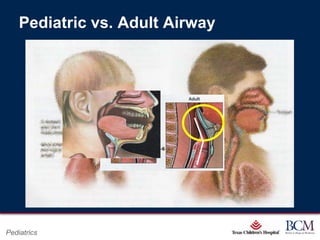
Pediatric vs. Adult Airway


                               Page 5
Pediatrics        xxx00.#####.ppt 7/10/2012 8:23:12 AM
Pediatric vs. Adult Airway

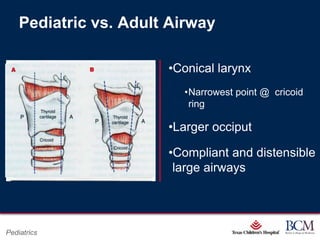
                                        •Conical larynx
                                                •Narrowest point @ cricoid
                                                 ring

                                        •Larger occiput

                                        •Compliant and distensible
                                         large airways


                               Page 6
Pediatrics        xxx00.#####.ppt 7/10/2012 8:23:12 AM
Pediatric vs. Adult Airway
   •Larger adenoidal tissues

   •Narrower tracheal diameter and shorter tracheal
    length

   •Narrower larger airways


                                    Page 7
Pediatrics             xxx00.#####.ppt 7/10/2012 8:23:12 AM
So what is the relevance?

    Larynx more superior and anterior •Shortens thyromental distance
                                      •“Bunching” of the tongue in the
                                      oropharynx
                                      •More acute angle between
                                      tracheal opening & epiglottis
    Relatively large tongue                      •Difficult to move out of the way
    Large, floppy epiglottis                     •Can cause obstruction
                                                 •Influences choice of
                                                 laryngoscope blade
    Conical larynx                               •Narrowest point is cricoid
                                                 •Influences ETT size


                                            Page 8
Pediatrics                     xxx00.#####.ppt 7/10/2012 8:23:12 AM
So what is the relevance?

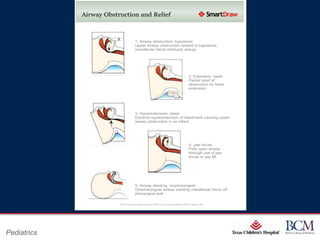
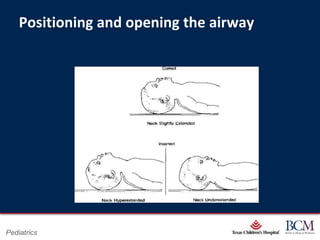
    Large occiput                                  •Obstructs airway
                                                   •Influences patient positioning
    Compliant & distensible large                  •Susceptible to collapse &
    airways                                        obstruction
    Narrower tracheal diameter,      •Alters airway resistance
    large airways & shorter tracheal •Can influence WOB
    length
    Larger adenoidal/tonsillar                     •Can cause obstruction
    tissue                                         •Susceptible to bleeding


                                              Page 9
Pediatrics                       xxx00.#####.ppt 7/10/2012 8:23:12 AM
Physiologic Differences
   •Lower %age of slow twitch muscle fibers

   •Preferentially nose-breathers

   •Compliant chest wall

   •Ribs in a horizontal position

   •Flatter diaphragm

   •Higher oxygen consumption

   •Higher MV:FRC
                                    Page 11
Pediatrics              xxx00.#####.ppt 7/10/2012 8:23:12 AM
Physiologic Differences
   •Lower %age of slow twitch muscle fibers

   •Preferentially nose-breathers

   •Compliant chest wall

   •Ribs in a horizontal position

   •Flatter diaphragm

   •Higher oxygen consumption

   •Higher MV:FRC
                                    Page 12
Pediatrics              xxx00.#####.ppt 7/10/2012 8:23:12 AM
Oxygen Delivery
Devices &
Basic Airway
Management

             Pediatrics
Objectives
   By the end of this workshop, the learner will:
        ‐Decide which O2 delivery device would be most appropriate
         given a case-based example
        ‐Recall at least:
             •5 complications associated with the use of airway
              adjuncts
             •3 complications associated with BVM
        ‐Practice the placement of airway adjuncts using an airway
         task trainer
        ‐Perform proper bag-valve mask ventilation using an airway
         task trainer

                                           Page 14
Pediatrics                     xxx00.#####.ppt 7/10/2012 8:23:12 AM
Oxygen delivery devices
   •Nasal Cannula                        •Non rebreather mask

   •Heated high flow Nasal               •Cpap/Bipap
    Cannula
                                         •Tent/hoods
   •Simple Face mask
                                         •Bag mask
   •Venturi mask


                                   Page 15
Pediatrics             xxx00.#####.ppt 7/10/2012 8:23:12 AM
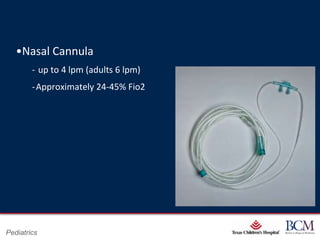
•Nasal Cannula
        ‐ up to 4 lpm (adults 6 lpm)
        ‐Approximately 24-45% Fio2


                                             Page 16
Pediatrics                       xxx00.#####.ppt 7/10/2012 8:23:12 AM
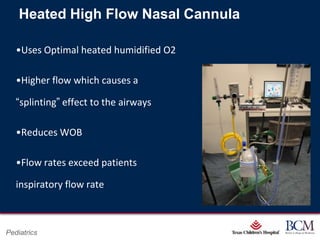
Heated High Flow Nasal Cannula

   •Uses Optimal heated humidified O2

   •Higher flow which causes a

   “splinting” effect to the airways

   •Reduces WOB

   •Flow rates exceed patients

   inspiratory flow rate


                                          Page 17
Pediatrics                    xxx00.#####.ppt 7/10/2012 8:23:12 AM
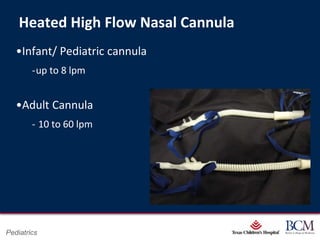
Heated High Flow Nasal Cannula
   •Infant/ Pediatric cannula
        ‐up to 8 lpm


   •Adult Cannula
        ‐ 10 to 60 lpm


                                     Page 18
Pediatrics               xxx00.#####.ppt 7/10/2012 8:23:12 AM
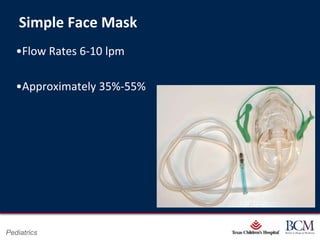
Simple Face Mask
   •Flow Rates 6-10 lpm

   •Approximately 35%-55%


                                      Page 19
Pediatrics                xxx00.#####.ppt 7/10/2012 8:23:12 AM
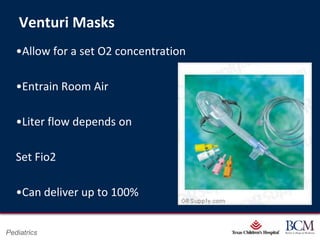
Venturi Masks
   •Allow for a set O2 concentration

   •Entrain Room Air

   •Liter flow depends on

   Set Fio2

   •Can deliver up to 100%

                                     Page 20
Pediatrics               xxx00.#####.ppt 7/10/2012 8:23:12 AM
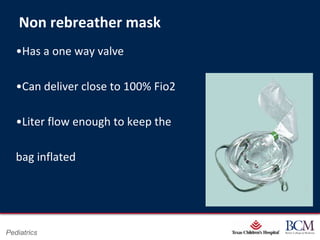
Non rebreather mask
   •Has a one way valve

   •Can deliver close to 100% Fio2

   •Liter flow enough to keep the

   bag inflated


                                      Page 21
Pediatrics                xxx00.#####.ppt 7/10/2012 8:23:12 AM
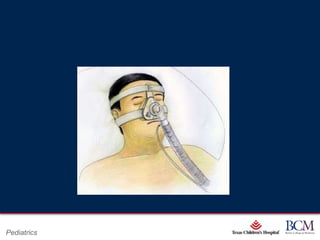
Bipap/Cpap
   •BiPAP- delivers a higher pressure on inspiration,
    helping the patient obtain a full breath, and a low
    pressure on expiration, allowing the patient to exhale
    easily.

   •CPAP-delivers a steady pressure of air, which assists the
    patient's inspiration (breathing in) and resists expiration
    (breathing out).


                                      Page 22
Pediatrics                xxx00.#####.ppt 7/10/2012 8:23:12 AM
Page 23
Pediatrics   xxx00.#####.ppt 7/10/2012 8:23:12 AM
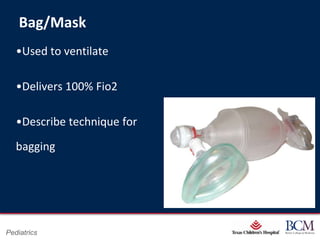
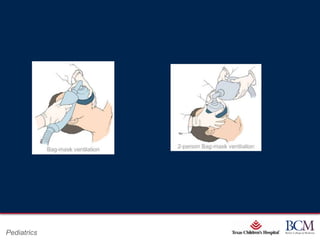
Bag/Mask
   •Used to ventilate

   •Delivers 100% Fio2

   •Describe technique for
   bagging


                                     Page 24
Pediatrics               xxx00.#####.ppt 7/10/2012 8:23:12 AM
Page 25
Pediatrics   xxx00.#####.ppt 7/10/2012 8:23:12 AM
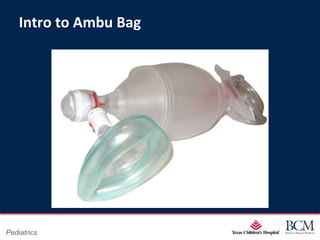
Intro to Ambu Bag


                               Page 26
Pediatrics         xxx00.#####.ppt 7/10/2012 8:23:12 AM
Page 27
Pediatrics   xxx00.#####.ppt 7/10/2012 8:23:12 AM
Positioning and opening the airway


                                Page 28
Pediatrics          xxx00.#####.ppt 7/10/2012 8:23:12 AM
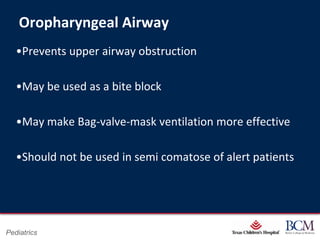
Oropharyngeal Airway
   •Prevents upper airway obstruction

   •May be used as a bite block

   •May make Bag-valve-mask ventilation more effective

   •Should not be used in semi comatose of alert patients


                                     Page 29
Pediatrics               xxx00.#####.ppt 7/10/2012 8:23:12 AM
Complications of Oropharyngeal Airways
   •Vomiting and aspiration

   •Obstruction can occur if the tube is to Large or to small

   •Dental damage

   •Oral damage

   •Laryngospasm

                                      Page 30
Pediatrics                xxx00.#####.ppt 7/10/2012 8:23:12 AM
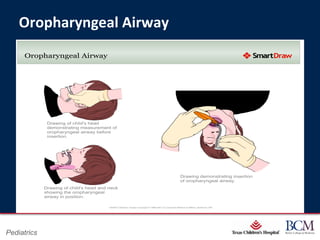
Oropharyngeal Airway


                              Page 31
Pediatrics        xxx00.#####.ppt 7/10/2012 8:23:12 AM
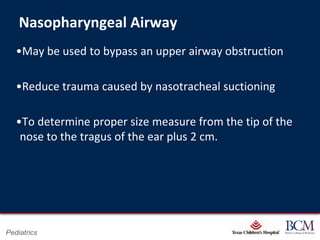
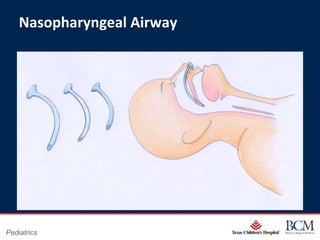
Nasopharyngeal Airway
   •May be used to bypass an upper airway obstruction

   •Reduce trauma caused by nasotracheal suctioning

   •To determine proper size measure from the tip of the
    nose to the tragus of the ear plus 2 cm.


                                    Page 32
Pediatrics              xxx00.#####.ppt 7/10/2012 8:23:12 AM
Complications of Nasopharyngeal
    Airways
   •Laryngospasm and coughing (too long)

   •Nosebleeds

   •Do not use of patients undergoing anticoagulation
    therapy.

   •Sinus infection


                                    Page 33
Pediatrics              xxx00.#####.ppt 7/10/2012 8:23:12 AM
Nasopharyngeal Airway


                              Page 34
Pediatrics        xxx00.#####.ppt 7/10/2012 8:23:12 AM
What would you do???
   •Intervention

   •Why

   •Liter flow


                               Page 36
Pediatrics         xxx00.#####.ppt 7/10/2012 8:23:12 AM
•14 y/o male with end-stage CF and recent sinus surgery
    is admitted to your service. His blood gas is as followed
    pH 7.35 Pco2 60 Pao2 85, HCO3 26

   Vital signs O2 sat 88%, RR 30 HR 95 BP 130/90

   What would you do?


                                      Page 37
Pediatrics                xxx00.#####.ppt 7/10/2012 8:23:12 AM
•16 year old soccer player is admitted to the ICU,
    following an acute onset of SOB after a coughing spell.
    His recent chest x-ray shows a moderate right sided
    pneumothorax. Pt is hemodynamically stable.

   •What would you recommend?


                                      Page 38
Pediatrics                xxx00.#####.ppt 7/10/2012 8:23:12 AM
•A 6 month old RSV+ is admitted to the ICU with
    increase WOB. His vital signs are as followed

   HR 180 RR 80 Sat 90

   What would you recommend?


                                     Page 39
Pediatrics               xxx00.#####.ppt 7/10/2012 8:23:12 AM
Advanced Airway
Management:
Orotracheal
Intubation


             Pediatrics
Objectives
   By the end of this workshop, the learner will:
        ‐Identify 5 laryngeal anatomic landmarks seen during
         laryngoscopy
        ‐Recall at least 3 indications and 5 complications associated
         with orotracheal intubation
        ‐Choose the appropriate sized ETT and laryngoscopy blade
         according to the patient‟s age/weight
        ‐Decide on an appropriate combination and dosage of
         medications required for intubation
        ‐Carry out the proper sequence of events involved in tracheal
         intubation

                                          Page 41
Pediatrics                    xxx00.#####.ppt 7/10/2012 8:23:12 AM
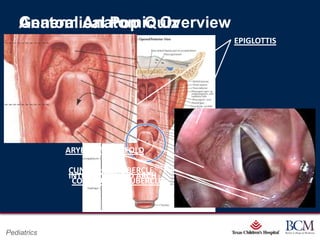
General Anatomic Overview
    Anatomical Pop Quiz
                                                                  EPIGLOTTIS


             ARYEPIGLOTTIC FOLD

             CUNEIFORM TUBERCLE
             INTERARYTENOID ARCH
              CORNICULATE TUBERCLE


                                       Page 42
Pediatrics                 xxx00.#####.ppt 7/10/2012 8:23:12 AM
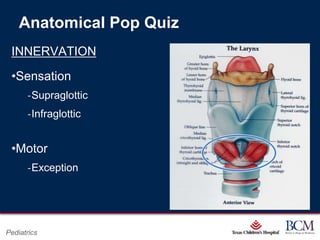
Anatomical Pop Quiz
 INNERVATION
 •Sensation
      ‐Supraglottic
      ‐Infraglottic


 •Motor
      ‐Exception


                                  Page 43
Pediatrics            xxx00.#####.ppt 7/10/2012 8:23:12 AM
1st Commandment


                           Page 44
Pediatrics     xxx00.#####.ppt 7/10/2012 8:23:12 AM
3 Basic Components
   •Most difficult airways can be recognized by 3
    maneuvers:
        ‐Examination of the oropharynx
        ‐Evaluation of the range of motion at the atlanto-occipital
         joint
        ‐Measurement of the mandibular displacement area


                                         Page 45
Pediatrics                   xxx00.#####.ppt 7/10/2012 8:23:12 AM
Examination of the oropharynx

   •With mouth open to the fullest extent and tongue
    maximally protruding you can assess:
        ‐ROM at TMJ

        ‐Size of tongue

        ‐Palate (highly arch palate increases difficulty)


                                          Page 46
Pediatrics                    xxx00.#####.ppt 7/10/2012 8:23:12 AM
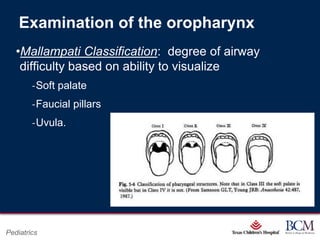
Examination of the oropharynx
   •Mallampati Classification: degree of airway
    difficulty based on ability to visualize
        ‐Soft palate
        ‐Faucial pillars
        ‐Uvula.


                                       Page 47
Pediatrics                 xxx00.#####.ppt 7/10/2012 8:23:12 AM
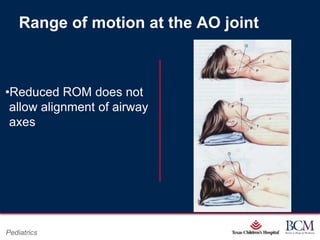
Range of motion at the AO joint


•Reduced ROM does not
 allow alignment of airway
 axes


                                  Page 48
Pediatrics            xxx00.#####.ppt 7/10/2012 8:23:12 AM
Mandibular Displacement Area
   •Tongue & soft tissues must be displaced and
    compressed into this space

   •Adequate when distance between the anterior
    ramus of the mandible and the hyoid bone is:
        ‐3 cm (2 finger breadths) in a child

        ‐1.5 cm in an infant


                                           Page 49
Pediatrics                     xxx00.#####.ppt 7/10/2012 8:23:12 AM
Indications
   •Actual or anticipated compromise in airway
    patency, ventilation and/or oxygenation

   •Altered mentation/Compromised airway reflexes

   •Airway or parenchymal lung disease

   •Hemodynamic compromise

   •Cardiopulmonary arrest

   •Neuromuscular weakness

                                   Page 50
Pediatrics             xxx00.#####.ppt 7/10/2012 8:23:12 AM
Equipment/Preparation
   •Monitors                                     •ETT, stylet and syringe

   •Gloves                                       •Laryngoscope and blade

   •Suctioning equipment                         •Tape/tube holder
        ‐Test suction                            •Obtain/verify IV access
        ‐Ensure within reach                     •Medications
   •CO2 detector


                                           Page 51
Pediatrics                     xxx00.#####.ppt 7/10/2012 8:23:12 AM
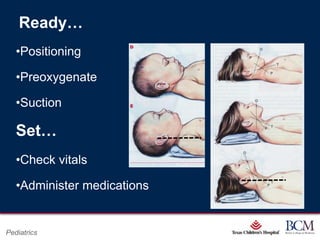
Ready…
   •Positioning

   •Preoxygenate

   •Suction

   Set…
   •Check vitals

   •Administer medications


                                  Page 52
Pediatrics            xxx00.#####.ppt 7/10/2012 8:23:12 AM
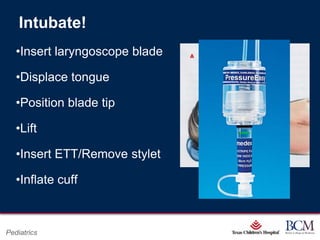
Intubate!
   •Insert laryngoscope blade

   •Displace tongue

   •Position blade tip

   •Lift

   •Insert ETT/Remove stylet

   •Inflate cuff


                                     Page 53
Pediatrics               xxx00.#####.ppt 7/10/2012 8:23:12 AM
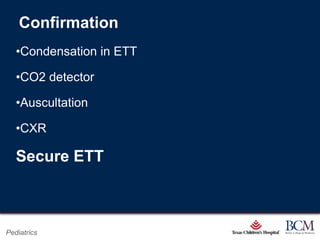
Confirmation
   •Condensation in ETT

   •CO2 detector

   •Auscultation

   •CXR

   Secure ETT


                                 Page 54
Pediatrics           xxx00.#####.ppt 7/10/2012 8:23:12 AM
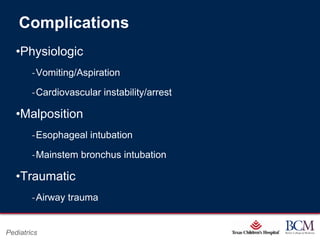
Complications
   •Physiologic
        ‐Vomiting/Aspiration

        ‐Cardiovascular instability/arrest

   •Malposition
        ‐Esophageal intubation

        ‐Mainstem bronchus intubation

   •Traumatic
        ‐Airway trauma

                                           Page 55
Pediatrics                     xxx00.#####.ppt 7/10/2012 8:23:12 AM
Page 56
Pediatrics   xxx00.#####.ppt 7/10/2012 8:23:12 AM
Rapid Sequence
Intubation
Slides courtesy of Dr. Fong Lam


                           Pediatrics
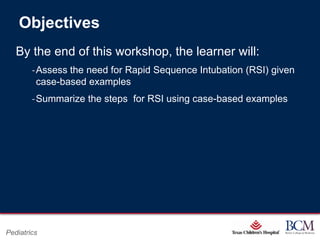
Objectives
   By the end of this workshop, the learner will:
        ‐Assess the need for Rapid Sequence Intubation (RSI) given
         case-based examples
        ‐Summarize the steps for RSI using case-based examples


                                         Page 64
Pediatrics                   xxx00.#####.ppt 7/10/2012 8:23:12 AM
What is Rapid Sequence Intubation
    (RSI)?
   •Intubating quickly

   •Intubating efficiently

   •Intubating without bag-mask ventilation
        ‐ AVOID bag-mask ventilation
        ‐ AVOID bag-mask ventilation
        ‐ AVOID bag-mask ventilation


   •BUT… do what you have to do. If you can‟t intubate,
    then bag-mask ventilate

                                           Page 65
Pediatrics                     xxx00.#####.ppt 7/10/2012 8:23:12 AM
When Should I Use RSI?
   •Any acute/sudden respiratory decompensation
        ‐Acute traumas
        ‐Code Reds


   •When risk of aspiration of gastric contents is high


                                     Page 66
Pediatrics               xxx00.#####.ppt 7/10/2012 8:23:12 AM
How Do I Perform RSI?
   •Prepare

   •Preoxygenate

   •Premedicate

   •Paralyze

   •Place ETT

                               Page 67
Pediatrics         xxx00.#####.ppt 7/10/2012 8:23:12 AM
Prepare
   •Let the RN and RT know that RSI will be done
        ‐ That way, they are also ready
        ‐ Minimize bag-mask ventilation
        ‐ Cricoid pressure AFTER sedation, although care should be taken to
          avoid deforming/moving the airway from view
        ‐ Once medications are given, give in succession as quickly as possible


   •Talk to the patient, if possible
        ‐ Spontaneously ventilating, even minimally will help prior to induction


   •Get in the best position possible
        ‐ Stand at head of bed & position the patient
        ‐ Get all equipment ready

                                                Page 68
Pediatrics                          xxx00.#####.ppt 7/10/2012 8:23:12 AM
Preoxygenate
   •Supply 100% oxygen at the highest flow rate
        ‐Goal is to fill FRC
        ‐~3-5 minutes, if possible
        ‐Avoid BMV, if possible
        ‐This allows for longer apnea time prior to desaturation
        ‐Patient will still become hypercarbic


                                           Page 69
Pediatrics                     xxx00.#####.ppt 7/10/2012 8:23:12 AM
Premedicate
   •Atropine (0.02 mg/kg IV)
        ‐Blunt vagal effects of laryngoscopy (especially in infants)
        ‐Dries secretions


   •Lidocaine (1mg/kg IV)
        ‐Blunts ICP spike from laryngoscopy


                                         Page 70
Pediatrics                   xxx00.#####.ppt 7/10/2012 8:23:12 AM
Premedication
   •Midazolam (0.1-0.2 mg/kg IV/IM/IN)
        ‐Hemodynamically neutral

   •Fentanyl (2-4 mcg/kg IV)
        ‐Beware of rigid chest when infused quickly
        ‐Hemodynamically neutral

   •Ketamine (1-3 mg/kg IV)
        ‐Raises BP and HR
        ‐Useful if hypotensive or with asthma
        ‐Avoid in head trauma/increased ICP/IOP

                                          Page 71
Pediatrics                    xxx00.#####.ppt 7/10/2012 8:23:12 AM
Premedicate
   •Thiopental (3-5 mg/kg IV)
        ‐Negative inotrope
        ‐Decreases CMR & CBF  ICP


   •Etomidate (0.25 mg/kg IV)
        ‐Causes adrenal suppression
        ‐Avoid in septic shock, if possible


                                           Page 72
Pediatrics                     xxx00.#####.ppt 7/10/2012 8:23:12 AM
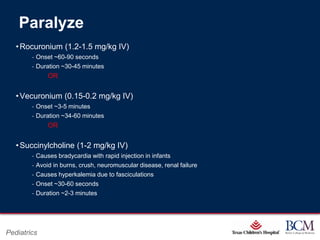
Paralyze
   • Rocuronium (1.2-1.5 mg/kg IV)
        ‐ Onset ~60-90 seconds
        ‐ Duration ~30-45 minutes
                OR


   • Vecuronium (0.15-0.2 mg/kg IV)
        ‐ Onset ~3-5 minutes
        ‐ Duration ~34-60 minutes
                OR


   • Succinylcholine (1-2 mg/kg IV)
        ‐   Causes bradycardia with rapid injection in infants
        ‐   Avoid in burns, crush, neuromuscular disease, renal failure
        ‐   Causes hyperkalemia due to fasciculations
        ‐   Onset ~30-60 seconds
        ‐   Duration ~2-3 minutes


                                                          Page 73
Pediatrics                                    xxx00.#####.ppt 7/10/2012 8:23:12 AM
Place ETT
   •Use cricoid pressure, if possible
        ‐Some helpers get overanxious and give too much pressure
        ‐It may be useful for you to find the best location and then
         have someone hold the position


   •Place the tube

   •Be prepared for difficult airways!!!


                                           Page 74
Pediatrics                     xxx00.#####.ppt 7/10/2012 8:23:12 AM
REMEMBER:
   •Prepare
        ‐ Good communication


   •Preoxygenate
        ‐ Avoid bag-mask ventilation


   •Premedicate
        ‐ Based on the disease


   •Paralyze
        ‐ Safer to use non-depolarizing if history unknown


   •Place ETT
        ‐ Be prepared for difficult airways

                                                   Page 75
Pediatrics                             xxx00.#####.ppt 7/10/2012 8:23:12 AM
Vignette 1
   3 mos. old previously healthy infant presents with
   bronchiolitis and requires intubation for impending
   respiratory failure. Last fed breast milk 5 hrs ago.


        ‐What medications are you going to administer?
        ‐Why?
        ‐Requires RSI??


                                      Page 76
Pediatrics                xxx00.#####.ppt 7/10/2012 8:23:12 AM
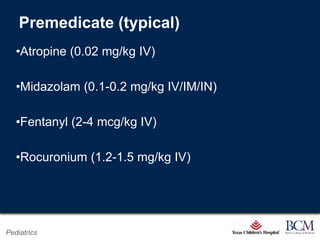
Premedicate (typical)
   •Atropine (0.02 mg/kg IV)

   •Midazolam (0.1-0.2 mg/kg IV/IM/IN)

   •Fentanyl (2-4 mcg/kg IV)

   •Rocuronium (1.2-1.5 mg/kg IV)


                                   Page 77
Pediatrics             xxx00.#####.ppt 7/10/2012 8:23:12 AM
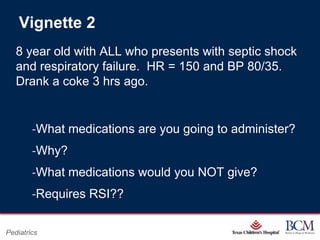
Vignette 2
   8 year old with ALL who presents with septic shock
   and respiratory failure. HR = 150 and BP 80/35.
   Drank a coke 3 hrs ago.


        ‐What medications are you going to administer?
        ‐Why?
        ‐What medications would you NOT give?
        ‐Requires RSI??

                                      Page 78
Pediatrics                xxx00.#####.ppt 7/10/2012 8:23:12 AM
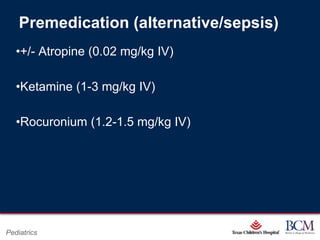
Premedication (alternative/sepsis)
   •+/- Atropine (0.02 mg/kg IV)

   •Ketamine (1-3 mg/kg IV)

   •Rocuronium (1.2-1.5 mg/kg IV)


                                    Page 79
Pediatrics              xxx00.#####.ppt 7/10/2012 8:23:12 AM
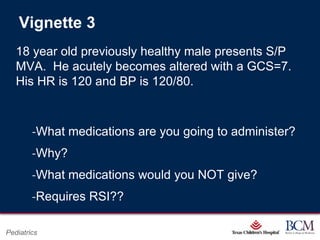
Vignette 3
   18 year old previously healthy male presents S/P
   MVA. He acutely becomes altered with a GCS=7.
   His HR is 120 and BP is 120/80.


        ‐What medications are you going to administer?
        ‐Why?
        ‐What medications would you NOT give?
        ‐Requires RSI??

                                      Page 80
Pediatrics                xxx00.#####.ppt 7/10/2012 8:23:12 AM
Premedicate (risk of increased ICP)
   •+/-Atropine (0.02 mg/kg IV)

   •Lidocaine (1mg/kg IV)

   •Thiopental (3-5 mg/kg IV) – if hemodynamically
    intact

              OR

   •Etomidate (0.25 mg/kg IV) – if hypotensive

                                   Page 81
Pediatrics             xxx00.#####.ppt 7/10/2012 8:23:12 AM
The
Difficult Airway


             Pediatrics
Objectives
   By the end of this workshop, the learner will:
        ‐Be aware of the institutional protocol for a “Known/Suspected
         Critical Airway”
        ‐List at least 3 complications associated with LMA insertion
        ‐Choose the appropriate sized LMA according to the patient‟s
         weight
        ‐Practice the placement of LMA „s using an airway task trainer


                                           Page 83
Pediatrics                     xxx00.#####.ppt 7/10/2012 8:23:12 AM
1st Commandment


                           Page 84
Pediatrics     xxx00.#####.ppt 7/10/2012 8:23:12 AM
2nd Commandment


The intubator should always have a
second strategy to provide
oxygenation and ventilation if the
initial airway approach fails.


                           Page 86
Pediatrics     xxx00.#####.ppt 7/10/2012 8:23:12 AM
Remember…


             Anticipate
                 &
               Plan

                            Page 87
Pediatrics      xxx00.#####.ppt 7/10/2012 8:23:12 AM
Laryngeal Mask Airway
   •Supraglottic device                           •Indications:
                                                           ‐ Failed BVM or endotracheal
   •Easy to insert                                           intubation


   •Low complication rate                         •Contraindications:
                                                           ‐ Awake patients or patients
        ‐Malpositioning
                                                             with a gag reflex
        ‐Increased insertion difficulty                    ‐ Those requiring high
        ‐Laryngosapsm                                        pressures to ventilate

        ‐Bronchospasm


                                            Page 88
Pediatrics                      xxx00.#####.ppt 7/10/2012 8:23:12 AM
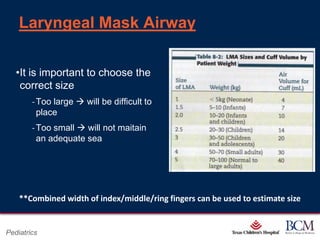
Laryngeal Mask Airway


   •It is important to choose the
    correct size
        ‐ Too large  will be difficult to
          place
        ‐ Too small  will not maitain
          an adequate sea


    **Combined width of index/middle/ring fingers can be used to estimate size


                                               Page 90
Pediatrics                         xxx00.#####.ppt 7/10/2012 8:23:12 AM

2012 airway management

  • 1.
  • 2.
    Overview •REFLECTION •Advanced airway management •Pediatric airway anatomy & physiology •PRACTICE •O2 delivery devices •Rapid sequence intubation (RSI) •Basic airway management •The Difficult Airway •PRACTICE •PRACTICE Page 1 Pediatrics xxx00.#####.ppt 7/10/2012 8:23:12 AM
  • 3.
  • 4.
    Objectives By the end of this workshop, the learner will: ‐List 5 anatomical differences between a pediatric and adult airway ‐Describe in your own words at least 3 physiologic factors that make pediatric patients more susceptible to hypoxemia Page 3 Pediatrics xxx00.#####.ppt 7/10/2012 8:23:12 AM
  • 5.
    Children are NOTsmall adults!!! •Major differences between pediatric and adult airway are: ‐Size ‐Shape ‐Position •Pediatric airway similar to adult at approx. 8-14 years of age Page 4 Pediatrics xxx00.#####.ppt 7/10/2012 8:23:12 AM
  • 6.
    Pediatric vs. AdultAirway Page 5 Pediatrics xxx00.#####.ppt 7/10/2012 8:23:12 AM
  • 7.
    Pediatric vs. AdultAirway •Conical larynx •Narrowest point @ cricoid ring •Larger occiput •Compliant and distensible large airways Page 6 Pediatrics xxx00.#####.ppt 7/10/2012 8:23:12 AM
  • 8.
    Pediatric vs. AdultAirway •Larger adenoidal tissues •Narrower tracheal diameter and shorter tracheal length •Narrower larger airways Page 7 Pediatrics xxx00.#####.ppt 7/10/2012 8:23:12 AM
  • 9.
    So what isthe relevance? Larynx more superior and anterior •Shortens thyromental distance •“Bunching” of the tongue in the oropharynx •More acute angle between tracheal opening & epiglottis Relatively large tongue •Difficult to move out of the way Large, floppy epiglottis •Can cause obstruction •Influences choice of laryngoscope blade Conical larynx •Narrowest point is cricoid •Influences ETT size Page 8 Pediatrics xxx00.#####.ppt 7/10/2012 8:23:12 AM
  • 10.
    So what isthe relevance? Large occiput •Obstructs airway •Influences patient positioning Compliant & distensible large •Susceptible to collapse & airways obstruction Narrower tracheal diameter, •Alters airway resistance large airways & shorter tracheal •Can influence WOB length Larger adenoidal/tonsillar •Can cause obstruction tissue •Susceptible to bleeding Page 9 Pediatrics xxx00.#####.ppt 7/10/2012 8:23:12 AM
  • 11.
    Physiologic Differences •Lower %age of slow twitch muscle fibers •Preferentially nose-breathers •Compliant chest wall •Ribs in a horizontal position •Flatter diaphragm •Higher oxygen consumption •Higher MV:FRC Page 11 Pediatrics xxx00.#####.ppt 7/10/2012 8:23:12 AM
  • 12.
    Physiologic Differences •Lower %age of slow twitch muscle fibers •Preferentially nose-breathers •Compliant chest wall •Ribs in a horizontal position •Flatter diaphragm •Higher oxygen consumption •Higher MV:FRC Page 12 Pediatrics xxx00.#####.ppt 7/10/2012 8:23:12 AM
  • 13.
    Oxygen Delivery Devices & BasicAirway Management Pediatrics
  • 14.
    Objectives By the end of this workshop, the learner will: ‐Decide which O2 delivery device would be most appropriate given a case-based example ‐Recall at least: •5 complications associated with the use of airway adjuncts •3 complications associated with BVM ‐Practice the placement of airway adjuncts using an airway task trainer ‐Perform proper bag-valve mask ventilation using an airway task trainer Page 14 Pediatrics xxx00.#####.ppt 7/10/2012 8:23:12 AM
  • 15.
    Oxygen delivery devices •Nasal Cannula •Non rebreather mask •Heated high flow Nasal •Cpap/Bipap Cannula •Tent/hoods •Simple Face mask •Bag mask •Venturi mask Page 15 Pediatrics xxx00.#####.ppt 7/10/2012 8:23:12 AM
  • 16.
    •Nasal Cannula ‐ up to 4 lpm (adults 6 lpm) ‐Approximately 24-45% Fio2 Page 16 Pediatrics xxx00.#####.ppt 7/10/2012 8:23:12 AM
  • 17.
    Heated High FlowNasal Cannula •Uses Optimal heated humidified O2 •Higher flow which causes a “splinting” effect to the airways •Reduces WOB •Flow rates exceed patients inspiratory flow rate Page 17 Pediatrics xxx00.#####.ppt 7/10/2012 8:23:12 AM
  • 18.
    Heated High FlowNasal Cannula •Infant/ Pediatric cannula ‐up to 8 lpm •Adult Cannula ‐ 10 to 60 lpm Page 18 Pediatrics xxx00.#####.ppt 7/10/2012 8:23:12 AM
  • 19.
    Simple Face Mask •Flow Rates 6-10 lpm •Approximately 35%-55% Page 19 Pediatrics xxx00.#####.ppt 7/10/2012 8:23:12 AM
  • 20.
    Venturi Masks •Allow for a set O2 concentration •Entrain Room Air •Liter flow depends on Set Fio2 •Can deliver up to 100% Page 20 Pediatrics xxx00.#####.ppt 7/10/2012 8:23:12 AM
  • 21.
    Non rebreather mask •Has a one way valve •Can deliver close to 100% Fio2 •Liter flow enough to keep the bag inflated Page 21 Pediatrics xxx00.#####.ppt 7/10/2012 8:23:12 AM
  • 22.
    Bipap/Cpap •BiPAP- delivers a higher pressure on inspiration, helping the patient obtain a full breath, and a low pressure on expiration, allowing the patient to exhale easily. •CPAP-delivers a steady pressure of air, which assists the patient's inspiration (breathing in) and resists expiration (breathing out). Page 22 Pediatrics xxx00.#####.ppt 7/10/2012 8:23:12 AM
  • 23.
    Page 23 Pediatrics xxx00.#####.ppt 7/10/2012 8:23:12 AM
  • 24.
    Bag/Mask •Used to ventilate •Delivers 100% Fio2 •Describe technique for bagging Page 24 Pediatrics xxx00.#####.ppt 7/10/2012 8:23:12 AM
  • 25.
    Page 25 Pediatrics xxx00.#####.ppt 7/10/2012 8:23:12 AM
  • 26.
    Intro to AmbuBag Page 26 Pediatrics xxx00.#####.ppt 7/10/2012 8:23:12 AM
  • 27.
    Page 27 Pediatrics xxx00.#####.ppt 7/10/2012 8:23:12 AM
  • 28.
    Positioning and openingthe airway Page 28 Pediatrics xxx00.#####.ppt 7/10/2012 8:23:12 AM
  • 29.
    Oropharyngeal Airway •Prevents upper airway obstruction •May be used as a bite block •May make Bag-valve-mask ventilation more effective •Should not be used in semi comatose of alert patients Page 29 Pediatrics xxx00.#####.ppt 7/10/2012 8:23:12 AM
  • 30.
    Complications of OropharyngealAirways •Vomiting and aspiration •Obstruction can occur if the tube is to Large or to small •Dental damage •Oral damage •Laryngospasm Page 30 Pediatrics xxx00.#####.ppt 7/10/2012 8:23:12 AM
  • 31.
    Oropharyngeal Airway Page 31 Pediatrics xxx00.#####.ppt 7/10/2012 8:23:12 AM
  • 32.
    Nasopharyngeal Airway •May be used to bypass an upper airway obstruction •Reduce trauma caused by nasotracheal suctioning •To determine proper size measure from the tip of the nose to the tragus of the ear plus 2 cm. Page 32 Pediatrics xxx00.#####.ppt 7/10/2012 8:23:12 AM
  • 33.
    Complications of Nasopharyngeal Airways •Laryngospasm and coughing (too long) •Nosebleeds •Do not use of patients undergoing anticoagulation therapy. •Sinus infection Page 33 Pediatrics xxx00.#####.ppt 7/10/2012 8:23:12 AM
  • 34.
    Nasopharyngeal Airway Page 34 Pediatrics xxx00.#####.ppt 7/10/2012 8:23:12 AM
  • 35.
    What would youdo??? •Intervention •Why •Liter flow Page 36 Pediatrics xxx00.#####.ppt 7/10/2012 8:23:12 AM
  • 36.
    •14 y/o malewith end-stage CF and recent sinus surgery is admitted to your service. His blood gas is as followed pH 7.35 Pco2 60 Pao2 85, HCO3 26 Vital signs O2 sat 88%, RR 30 HR 95 BP 130/90 What would you do? Page 37 Pediatrics xxx00.#####.ppt 7/10/2012 8:23:12 AM
  • 37.
    •16 year oldsoccer player is admitted to the ICU, following an acute onset of SOB after a coughing spell. His recent chest x-ray shows a moderate right sided pneumothorax. Pt is hemodynamically stable. •What would you recommend? Page 38 Pediatrics xxx00.#####.ppt 7/10/2012 8:23:12 AM
  • 38.
    •A 6 monthold RSV+ is admitted to the ICU with increase WOB. His vital signs are as followed HR 180 RR 80 Sat 90 What would you recommend? Page 39 Pediatrics xxx00.#####.ppt 7/10/2012 8:23:12 AM
  • 39.
  • 40.
    Objectives By the end of this workshop, the learner will: ‐Identify 5 laryngeal anatomic landmarks seen during laryngoscopy ‐Recall at least 3 indications and 5 complications associated with orotracheal intubation ‐Choose the appropriate sized ETT and laryngoscopy blade according to the patient‟s age/weight ‐Decide on an appropriate combination and dosage of medications required for intubation ‐Carry out the proper sequence of events involved in tracheal intubation Page 41 Pediatrics xxx00.#####.ppt 7/10/2012 8:23:12 AM
  • 41.
    General Anatomic Overview Anatomical Pop Quiz EPIGLOTTIS ARYEPIGLOTTIC FOLD CUNEIFORM TUBERCLE INTERARYTENOID ARCH CORNICULATE TUBERCLE Page 42 Pediatrics xxx00.#####.ppt 7/10/2012 8:23:12 AM
  • 42.
    Anatomical Pop Quiz INNERVATION •Sensation ‐Supraglottic ‐Infraglottic •Motor ‐Exception Page 43 Pediatrics xxx00.#####.ppt 7/10/2012 8:23:12 AM
  • 43.
    1st Commandment Page 44 Pediatrics xxx00.#####.ppt 7/10/2012 8:23:12 AM
  • 44.
    3 Basic Components •Most difficult airways can be recognized by 3 maneuvers: ‐Examination of the oropharynx ‐Evaluation of the range of motion at the atlanto-occipital joint ‐Measurement of the mandibular displacement area Page 45 Pediatrics xxx00.#####.ppt 7/10/2012 8:23:12 AM
  • 45.
    Examination of theoropharynx •With mouth open to the fullest extent and tongue maximally protruding you can assess: ‐ROM at TMJ ‐Size of tongue ‐Palate (highly arch palate increases difficulty) Page 46 Pediatrics xxx00.#####.ppt 7/10/2012 8:23:12 AM
  • 46.
    Examination of theoropharynx •Mallampati Classification: degree of airway difficulty based on ability to visualize ‐Soft palate ‐Faucial pillars ‐Uvula. Page 47 Pediatrics xxx00.#####.ppt 7/10/2012 8:23:12 AM
  • 47.
    Range of motionat the AO joint •Reduced ROM does not allow alignment of airway axes Page 48 Pediatrics xxx00.#####.ppt 7/10/2012 8:23:12 AM
  • 48.
    Mandibular Displacement Area •Tongue & soft tissues must be displaced and compressed into this space •Adequate when distance between the anterior ramus of the mandible and the hyoid bone is: ‐3 cm (2 finger breadths) in a child ‐1.5 cm in an infant Page 49 Pediatrics xxx00.#####.ppt 7/10/2012 8:23:12 AM
  • 49.
    Indications •Actual or anticipated compromise in airway patency, ventilation and/or oxygenation •Altered mentation/Compromised airway reflexes •Airway or parenchymal lung disease •Hemodynamic compromise •Cardiopulmonary arrest •Neuromuscular weakness Page 50 Pediatrics xxx00.#####.ppt 7/10/2012 8:23:12 AM
  • 50.
    Equipment/Preparation •Monitors •ETT, stylet and syringe •Gloves •Laryngoscope and blade •Suctioning equipment •Tape/tube holder ‐Test suction •Obtain/verify IV access ‐Ensure within reach •Medications •CO2 detector Page 51 Pediatrics xxx00.#####.ppt 7/10/2012 8:23:12 AM
  • 51.
    Ready… •Positioning •Preoxygenate •Suction Set… •Check vitals •Administer medications Page 52 Pediatrics xxx00.#####.ppt 7/10/2012 8:23:12 AM
  • 52.
    Intubate! •Insert laryngoscope blade •Displace tongue •Position blade tip •Lift •Insert ETT/Remove stylet •Inflate cuff Page 53 Pediatrics xxx00.#####.ppt 7/10/2012 8:23:12 AM
  • 53.
    Confirmation •Condensation in ETT •CO2 detector •Auscultation •CXR Secure ETT Page 54 Pediatrics xxx00.#####.ppt 7/10/2012 8:23:12 AM
  • 54.
    Complications •Physiologic ‐Vomiting/Aspiration ‐Cardiovascular instability/arrest •Malposition ‐Esophageal intubation ‐Mainstem bronchus intubation •Traumatic ‐Airway trauma Page 55 Pediatrics xxx00.#####.ppt 7/10/2012 8:23:12 AM
  • 55.
    Page 56 Pediatrics xxx00.#####.ppt 7/10/2012 8:23:12 AM
  • 56.
  • 57.
    Objectives By the end of this workshop, the learner will: ‐Assess the need for Rapid Sequence Intubation (RSI) given case-based examples ‐Summarize the steps for RSI using case-based examples Page 64 Pediatrics xxx00.#####.ppt 7/10/2012 8:23:12 AM
  • 58.
    What is RapidSequence Intubation (RSI)? •Intubating quickly •Intubating efficiently •Intubating without bag-mask ventilation ‐ AVOID bag-mask ventilation ‐ AVOID bag-mask ventilation ‐ AVOID bag-mask ventilation •BUT… do what you have to do. If you can‟t intubate, then bag-mask ventilate Page 65 Pediatrics xxx00.#####.ppt 7/10/2012 8:23:12 AM
  • 59.
    When Should IUse RSI? •Any acute/sudden respiratory decompensation ‐Acute traumas ‐Code Reds •When risk of aspiration of gastric contents is high Page 66 Pediatrics xxx00.#####.ppt 7/10/2012 8:23:12 AM
  • 60.
    How Do IPerform RSI? •Prepare •Preoxygenate •Premedicate •Paralyze •Place ETT Page 67 Pediatrics xxx00.#####.ppt 7/10/2012 8:23:12 AM
  • 61.
    Prepare •Let the RN and RT know that RSI will be done ‐ That way, they are also ready ‐ Minimize bag-mask ventilation ‐ Cricoid pressure AFTER sedation, although care should be taken to avoid deforming/moving the airway from view ‐ Once medications are given, give in succession as quickly as possible •Talk to the patient, if possible ‐ Spontaneously ventilating, even minimally will help prior to induction •Get in the best position possible ‐ Stand at head of bed & position the patient ‐ Get all equipment ready Page 68 Pediatrics xxx00.#####.ppt 7/10/2012 8:23:12 AM
  • 62.
    Preoxygenate •Supply 100% oxygen at the highest flow rate ‐Goal is to fill FRC ‐~3-5 minutes, if possible ‐Avoid BMV, if possible ‐This allows for longer apnea time prior to desaturation ‐Patient will still become hypercarbic Page 69 Pediatrics xxx00.#####.ppt 7/10/2012 8:23:12 AM
  • 63.
    Premedicate •Atropine (0.02 mg/kg IV) ‐Blunt vagal effects of laryngoscopy (especially in infants) ‐Dries secretions •Lidocaine (1mg/kg IV) ‐Blunts ICP spike from laryngoscopy Page 70 Pediatrics xxx00.#####.ppt 7/10/2012 8:23:12 AM
  • 64.
    Premedication •Midazolam (0.1-0.2 mg/kg IV/IM/IN) ‐Hemodynamically neutral •Fentanyl (2-4 mcg/kg IV) ‐Beware of rigid chest when infused quickly ‐Hemodynamically neutral •Ketamine (1-3 mg/kg IV) ‐Raises BP and HR ‐Useful if hypotensive or with asthma ‐Avoid in head trauma/increased ICP/IOP Page 71 Pediatrics xxx00.#####.ppt 7/10/2012 8:23:12 AM
  • 65.
    Premedicate •Thiopental (3-5 mg/kg IV) ‐Negative inotrope ‐Decreases CMR & CBF  ICP •Etomidate (0.25 mg/kg IV) ‐Causes adrenal suppression ‐Avoid in septic shock, if possible Page 72 Pediatrics xxx00.#####.ppt 7/10/2012 8:23:12 AM
  • 66.
    Paralyze • Rocuronium (1.2-1.5 mg/kg IV) ‐ Onset ~60-90 seconds ‐ Duration ~30-45 minutes OR • Vecuronium (0.15-0.2 mg/kg IV) ‐ Onset ~3-5 minutes ‐ Duration ~34-60 minutes OR • Succinylcholine (1-2 mg/kg IV) ‐ Causes bradycardia with rapid injection in infants ‐ Avoid in burns, crush, neuromuscular disease, renal failure ‐ Causes hyperkalemia due to fasciculations ‐ Onset ~30-60 seconds ‐ Duration ~2-3 minutes Page 73 Pediatrics xxx00.#####.ppt 7/10/2012 8:23:12 AM
  • 67.
    Place ETT •Use cricoid pressure, if possible ‐Some helpers get overanxious and give too much pressure ‐It may be useful for you to find the best location and then have someone hold the position •Place the tube •Be prepared for difficult airways!!! Page 74 Pediatrics xxx00.#####.ppt 7/10/2012 8:23:12 AM
  • 68.
    REMEMBER: •Prepare ‐ Good communication •Preoxygenate ‐ Avoid bag-mask ventilation •Premedicate ‐ Based on the disease •Paralyze ‐ Safer to use non-depolarizing if history unknown •Place ETT ‐ Be prepared for difficult airways Page 75 Pediatrics xxx00.#####.ppt 7/10/2012 8:23:12 AM
  • 69.
    Vignette 1 3 mos. old previously healthy infant presents with bronchiolitis and requires intubation for impending respiratory failure. Last fed breast milk 5 hrs ago. ‐What medications are you going to administer? ‐Why? ‐Requires RSI?? Page 76 Pediatrics xxx00.#####.ppt 7/10/2012 8:23:12 AM
  • 70.
    Premedicate (typical) •Atropine (0.02 mg/kg IV) •Midazolam (0.1-0.2 mg/kg IV/IM/IN) •Fentanyl (2-4 mcg/kg IV) •Rocuronium (1.2-1.5 mg/kg IV) Page 77 Pediatrics xxx00.#####.ppt 7/10/2012 8:23:12 AM
  • 71.
    Vignette 2 8 year old with ALL who presents with septic shock and respiratory failure. HR = 150 and BP 80/35. Drank a coke 3 hrs ago. ‐What medications are you going to administer? ‐Why? ‐What medications would you NOT give? ‐Requires RSI?? Page 78 Pediatrics xxx00.#####.ppt 7/10/2012 8:23:12 AM
  • 72.
    Premedication (alternative/sepsis) •+/- Atropine (0.02 mg/kg IV) •Ketamine (1-3 mg/kg IV) •Rocuronium (1.2-1.5 mg/kg IV) Page 79 Pediatrics xxx00.#####.ppt 7/10/2012 8:23:12 AM
  • 73.
    Vignette 3 18 year old previously healthy male presents S/P MVA. He acutely becomes altered with a GCS=7. His HR is 120 and BP is 120/80. ‐What medications are you going to administer? ‐Why? ‐What medications would you NOT give? ‐Requires RSI?? Page 80 Pediatrics xxx00.#####.ppt 7/10/2012 8:23:12 AM
  • 74.
    Premedicate (risk ofincreased ICP) •+/-Atropine (0.02 mg/kg IV) •Lidocaine (1mg/kg IV) •Thiopental (3-5 mg/kg IV) – if hemodynamically intact OR •Etomidate (0.25 mg/kg IV) – if hypotensive Page 81 Pediatrics xxx00.#####.ppt 7/10/2012 8:23:12 AM
  • 75.
  • 76.
    Objectives By the end of this workshop, the learner will: ‐Be aware of the institutional protocol for a “Known/Suspected Critical Airway” ‐List at least 3 complications associated with LMA insertion ‐Choose the appropriate sized LMA according to the patient‟s weight ‐Practice the placement of LMA „s using an airway task trainer Page 83 Pediatrics xxx00.#####.ppt 7/10/2012 8:23:12 AM
  • 77.
    1st Commandment Page 84 Pediatrics xxx00.#####.ppt 7/10/2012 8:23:12 AM
  • 78.
    2nd Commandment The intubatorshould always have a second strategy to provide oxygenation and ventilation if the initial airway approach fails. Page 86 Pediatrics xxx00.#####.ppt 7/10/2012 8:23:12 AM
  • 79.
    Remember… Anticipate & Plan Page 87 Pediatrics xxx00.#####.ppt 7/10/2012 8:23:12 AM
  • 80.
    Laryngeal Mask Airway •Supraglottic device •Indications: ‐ Failed BVM or endotracheal •Easy to insert intubation •Low complication rate •Contraindications: ‐ Awake patients or patients ‐Malpositioning with a gag reflex ‐Increased insertion difficulty ‐ Those requiring high ‐Laryngosapsm pressures to ventilate ‐Bronchospasm Page 88 Pediatrics xxx00.#####.ppt 7/10/2012 8:23:12 AM
  • 81.
    Laryngeal Mask Airway •It is important to choose the correct size ‐ Too large  will be difficult to place ‐ Too small  will not maitain an adequate sea **Combined width of index/middle/ring fingers can be used to estimate size Page 90 Pediatrics xxx00.#####.ppt 7/10/2012 8:23:12 AM

Editor's Notes

  • #4 The major differences btwn a ped and adult airway are size, shape and position IN THE NECK The differences in adult anatomy are particularly marked when compared to infantsThe form and position of the pediatric airway is more like an adults as early as 8yrs of ageSo now well talk about the differences and their clinical implications
  • #5 Larynx is generally higher (cephalad) and more forward (anterior) in the neck than adults. This is more evident as you appreciate its position in relation to the C spine (GLOTTIS at C3-C4 in newborns, C4-C5 by 2 years of age, C5-C6 in adults) Epiglottis is:longer, floppier and more U-shapedbecomes more adult-like after 3 yoTongue:Relatively large tongue
  • #7 Larger adenoidal tissues: can contribute to airway obstruction and bleed if traumatized complicating airway managementGreater Raw bc R is inversely proportional to the fourth power of the radius (Poiseuille’s law). Thus even the slightest compromise in radius can cause significant Raw and increased WOB (when flow is laminar, ie at rest, fifth power when turbulent, ie agitation)
  • #8 Larynx higher and anterior:Shortens thyromental distance  “Bunching” of the tongue in the oropharynxGlottis opening at base of the tongue therefore more acute angle btwn tracheal opening and epiglottisEpiglottisDifficult to move out of the way during ETIInfluences laryngoscope blade type TongueCan cause obstruction due to close proximity to soft palateOcciput protuberant thus making the head flex on the C spine and thereby obstructing the airway
  • #9 Compliant & distensible large airways:Can be susceptible to collapse/obstruction esp with cricoid pressureAdd. sublglottic airway is smaller and more compliant, and supporting cartilage is not well developed compared to adultsUpper airway obstruction can cause tracheal collapse and stridorNarrow/shorter trachea:Greater Raw bc R is inversely proportional to the fourth power of the radius (Poiseuille’s law). Thus even the slightest compromise in radius can cause significant Raw and increased WOB (when flow is laminar, ie at rest, fifth power when turbulent, ie agitation)Larger adenoidal tissues: can contribute to airway obstruction and bleed if traumatized complicating airway managementIMPLICATION: All these things together make the pediatric patient very susceptible to airway obstruction esp when loss of muscle tone/supine position. Additionally, can make visualization of airway difficult and thus ETI is challengingJaw thrust opens both the pharynx and oropharynx. The jaw-thrust maneuver can be a potent arousal stimulus, also improvingrespiratory effort
  • #10 Lower percentage of type 1 or slow-twitch skeletal muscle fibers in their intercostal muscles and diaphragm. Type 1 muscle fibers are less prone to fatigue. Infants also have lower stores of glycogen and fat in their respiratory muscles. These differences predispose infants to respiratory muscle fatigue.During oral breathing, must use soft palate muscles to maintain an open oral airway.Reduced FRC (40% that of adults in AWAKE infants)Bullets 4 & 5: they hold their respiratory muscles in a slightly inspiratory position.infants have less reserve and are more susceptible to respiratory failure.Additionally, infants have less and immature alveoli
  • #11 Faster falls in PaO2 during periods of apnea, i.e. for ETI, and/or resp compromise
  • #14 Before performing any invasive airway procedure, the provider MUST assess for a potentially difficult airwayFIRST THINGS FIRST:2 extremes in time:Elective (i.e. MAC) you have time to do full BAAEmergent you don’t have the time, therefore, If emergent quickly perform a basic airway assessment (BAA) BEFORE intubation
  • #15 Combination predicts adult difficult airway but no ped data
  • #16 Class 1laryngoscopy yields adequate laryngeal exposure in >99% of adultsClass 3 is 7% adultsNot validated in children and has a high-false positive rate (50%) in identifying difficult pediatric airways
  • #18 Mandibular space is of importance because the tongue and soft tissues must be displaced and compressed into this spacePotential displacement area is adequate when the distance between the anterior ramus of the mandible and the hyoid bone is…If this space is small it will make laryngoscopy more difficult bc cannot align axes (laryngeal and pharyngeal axes make a more acute angle
  • #19 i.e. Respiratory failure (or impending)/arrestHead traumaPneumonia, bronchiolitis, etcShock
  • #20 DEPENDING UPON EMERGENCY of the procedure; consider informing parents/guardians of risks/benefits/alternative. May even delegate someone to do so on your behalf.GET YOUR TEAM READY!Prepare your:TeamYourselfPatientequipmentAnatomy INFLUENCES your choice of equipment
  • #21 PositioningAdjust the bed, if possible, so pt’s head is level with lower sternumSniffing positionShoulder/head rollAirway patencyAligns all 3 axes to gain a line of vision from the mouth to the glottisIN ALL AGES, axes are correctly aligned for ETI if external auditory canal is anterior to the front edge of the patients shouldersPreoxygenate for at least 3 minSuction: for less than 10 sec and if use soft catheter, suction on the way out
  • #22 Insert laryngoscope: Hold laryngoscope with left hand, insert blade into right side of pts mouthDisplace tongue to left Position blade tip: Mac vs. MillerLift: Cricoid vs. BURP, 2nd person hold right side of mouth openInsert ETT/Remove stylet: using right hand, insert to predetermined depth, ensure cuff passes through VC/lines on tube at VC, (CAREFUL NOT TO OVER DO IT AS CHILDREN SUSCEPTIBLE TO RIGHT MAINSTEM INTUBATION BC OF SHORTER TRACHEAL LENGTHInflate cuff: A pressure of 20cm H2O is sufficient to provide a seal, but does not compromise mucosal blood flow. Tracheal mucosal blood flow is compromised at 30 cm water pressure, and mucosal blood flow is completely obstructed at pressures of 45 cm water
  • #23 CO2 detector: color change from purple to yellow. Bag for 6 breathsAuscultation: listen over stomach first then B/L mid axillary lung fields. Esophageal intubation if gurgling sounds heard, BS can be transmitted. Give time for oxygenation to improveConfirm ETT depth and secure with tape/holder, sedation/analgesia, hook up to ventilator
  • #24 Immediate complications of ETI
  • #26 Suction should beWorking ANDable to generate at least -80 to -120 but wall-suction able to generate -300mm Hg is preferableIf using flexible suction catheter for nasopharynx. If so, DON’T place it further than approximated
  • #27 NOT SENSITIVE WITH NON PERFUSING RHYTHM!!!If ped used in adults take out after 6 breaths due to RawIf adults used in peds take out after 6 breaths bc of dead space
  • #29 Check functionality of laryngoscope/blade apparatus including light bulbChoice of bladeMacIntosh: curved blade is placed in the vallecula, at the base of the tongue, and used to indirectly lift the epiglottis from above.Miller:Infant/child epiglottis is floppy and elusive so straight blade may be safer for child <5yo but curve may also be used if > 2yoblade to be positioned below the epiglottis, which is lifted directly. ****Although this provides an improved view of the larynx, it may stimulate the vagus nerve, which innervates the underside of the epiglottis, resulting in bradycardia.
  • #31 Full or presumed full stomachRisk of regurgitation and aspiration is high
  • #32 Bradycardia from airway manipulation and meds can reduce DO2PALS and ACEP recommend atropine for RSI in children <1 yr, 1-5y receiving succinylcholine and for adolescents receiving a second dose of succinylcholineAtropine causes pupillary dilation, Glycopyrrolate an alternative Lido-Suppress autonomic and airway responses to laryngoscopy esp with elevated ICP. However, proof of efficacy in ped. Lit. limited
  • #33 Benzos blunt endogenous catecholamines therefore can have negative hemodynamic effectsRigid chest with fentanyl >5mcg/kg and high doses can effect hemodynamicsKetamine with increased secretions
  • #36 Volume load also!!!
  • #39 Before performing any invasive airway procedure, the provider MUST assess for a potentially difficult airwayFIRST THINGS FIRST:2 extremes in time:Elective (i.e. MAC) you have time to do full BAAEmergent you don’t have the time, therefore, If emergent quickly perform a basic airway assessment (BAA) BEFORE intubation
  • #40 Easy to insert but dependent on operator experience Malpoitioning/insertion difficulty more common in younger children
  • #41 Combined width of index/middle/ring fingers can be used to estimate size