Headline Text
Airway management in ER settings 

“Basic & Advanced”
Updated with recent advances
Dr.Venugopalan. P.P DA,DNB,MNAMS,MEM-GWU
Director , Emergency Medicine
Aster DM Healthcare
PG teacher NBE
Lecture ; NBE E learning program , July 2017
Why airway management in Emergency Room ?
• Airway management is the cornerstone of resuscitation
• A defining skill for the specialty of emergency medicine
• The emergency physician has primary responsibility for
management of the airway
• All airway management techniques lie within the domain of
emergency medicine
When to intubate ?
• 1.Failure to maintain
or protect the airway
• 2.Failure of ventilation
or oxygenation
• 3.Anticipated clinical
course and likelihood
of deterioration.
Clinical Decision
How do you know airway is patent?
• Level of consciousness
• Ability to phonate in response to voice command
or query (Integrity of the upper airway and the
level of consciousness)
• Ability to manage his or her own secretions
( pooling of secretions in the oropharynx, absence
of swallowing spontaneously or on command)
Intubation?
A patient who requires a manoeuver to establish a
patent airway or who easily tolerates an oral
airway probably requires intubation for protection
of that airway, unless temporary or readily
reversible condition, such as opioid overdose, is
present.
Ventilatory failure or Oxygenation failure?
• Clinical assessment
• Pulse oximetry with or without
capnography
• Observation of improvement or
deterioration in the patient’s clinical
condition
The decision to intubate
Intubate early especially in dynamic airways
Bullets - neck trauma
Bites- anaphylaxis / angioedema
Burns -caustic airway injuries,Thermal injuries
Three B ’s
Airway - mouth and neck infections, tumors, foreign bodies, bleeds
stridor, phonation, swallowing, secretions, dyspnea
Breathing- failure of oxygenation or ventilation
often amenable to medical and non-invasive therapies – think NIV
Circulation supporting tissue oxygen delivery by unloading the muscles of respiration
sepsis
A-B-C-D-E-F
A-B-C-D-E-F
Disability : CNS catastrophes and CNS depression, ongoing seizures, weakness
Avoid gag – assess ability to swallow and handle secretions (pooling, drooling, gurgling) for neuromuscular weakness: FVC < 12 ml/kg and NIF
< 20 cm H20
vomiting in the obtunded patient is a particular concern
Expected course:anticipated decline, transfer to radiology or another institution
Feral -need for prompt, aggressive sedation to protect patient/others
especially with potential or undiagnosed medical instability
Arterial blood gases (ABGs) generally are not required to determine the
patient’s need for intubation
Anticipated clinical deterioration
• Certain overdoses
• Significant multiple trauma, with or without head injury
• Multiple trauma with hypotension, an open femur fracture, and
diffuse abdominal tenderness
• Aggressive resuscitation, pain control, invasive procedures and
imaging outside of the emergency department ,inevitable operative
management
• Evidence of vascular or direct airway injury in the neck
Obstructed airway ?
Tongue and Epiglottis
Any Foreign materials ?
Clear it
Noisy breathing ?
Tongue obstructing
Airway
Head tilt &Chin lift
Jaw thrust
Trauma ?
Airway
Not – Maintainable ?
Adjuncts
Choice –OPA !
• Airway Reflexes ? …..No !
O P A
Sizing - oropharyngeal airway
Oropharyngeal airway Insertion
Best method
OPA Insertion
N P A
• OPA is not tolerating ?
• Airway reflexes retained ?
• Inability to open mouth ?
N
P
A
Airway
Still not – Maintainable ?
Advanced Airway
No Breathing ?
E – C Clamp
Place and hold mask
properly
Two hand technique
Non-maintainable Airway
R
S
I
Conscious patient?
Semiconscious with retained reflexes?
RSI Defined
“Virtually simultaneous administration
of a potent sedative agent and a
neuromuscular blocking agent to
induce unconsciousness and motor
paralysis for tracheal intubation”
What are The Problems Inherent to Intubation?
• Laryngoscopy and Intubation
– Increased bronchospasm
– Increased ICP
– Increased catecholamine release
Beneficial Effects of RSI
• “Tight Heads”
– Intracranial pathology
• “Tight Hearts” or “Tight Vessels”
– Cardiovascular disease
• “Tight Lungs”
– Reactive airway disease
Conventional
With LMA
Pre Oxygenation…
RSI: Timeline
T – 10 minutes Prepare
T – 5 minutes Preoxygenate
T – 3 minutes Pretreat
T = 0 Paralysis with
induction
T + 30 seconds Protection
T + 45 seconds Placement
T + 90 seconds Post-Intubation
management
Problem Airway
epiglottis Vocal cords
Airway Evaluation
Double set up
• Neuromuscular paralysis generally
should be avoided in patients for
whom a high degree of intubation
difficulty is predicted, unless the
administration of the
neuromuscular blocking agent
(NMBA) is part of a planned
approach to the difficult airway
Look Externally
• Severely bruised
• Bloodied face of a combative trauma patient
• Immobilised in a cervical collar on a spine board
• Anatomical deformities
• Subjective clinical judgment can be highly specific (90%) but
insensitive and so should be augmented by other evaluations.
Obstruction or obesity
• Visualization of the glottis, or intubation
itself, mechanically impossible
• Epiglottis, head and neck cancer, Ludwig’s
angina, neck hematoma, or glottic polyps
• Examine the patient for airway obstruction
and assess the patient’s voice to satisfy this
evaluation step
Neck mobility
• Neck mobility is desirable for any
intubation technique and is essential for
positioning the patient for optimal direct
laryngoscopy. Neck mobility is assessed
with the patient’s flexion and extension of
the head and neck through a full range of
motion
Lemon in ER setting
• Unresponsive patient - Mallampatti is not
practical - LEON
• Unresponsive plus Trauma - Mallampatti
and Neck mobility are not practical - LEO
Cormack and Lehane[CL]
• The most widely used system for grading
laryngoscopic view of the glottis is that of
Cormack and Lehane (CL)
• Grades laryngoscopy according to the
extent to which laryngeal and glottic
structures can be seen.
CL grading
• Grade 1 laryngoscopy, all or nearly all of the glottic aperture is seen.
• Grade 2 laryngoscopy visualizes only a portion of the glottis
(arytenoid cartilages alone or arytenoid cartilages plus part of the
vocal cords).
• Grade 3 laryngoscopy visualizes only the epiglottis.
• Grade 4 laryngoscopy, not even the epiglottis is visible.
Percentage
Of Glottic Opening (POGO) score
Confirmation of Endotracheal Tube Placement
• Direct visualisation
• Chest auscultation
• Gastric auscultation
• Bag resistance
• Exhaled volume
• Visualization of condensation within the ETT
• Chest radiography
• All are prone to failure as means of confirming tracheal intubation.
ETCO2
• End-tidal carbon dioxide (ETCO2) detection
device to the ETT and assess it through six
manual ventilations
• Disposable, colorimetric ETCO2 detectors
are highly reliable, convenient, and easy to
interpret, indicating adequate CO2
detection by color change
End tidal CO2 detection
USG- EDD
• When ETCO2 detection
is not possible,
tracheal tube position
can be confirmed with
other techniques.
• One novel approach
Bedside ultrasound.
USG guided Intubation
and placement
confirmation
Esophageal Detector Devices 

(EDD)
EDD - how to work ?
Recognize Adequacy of Ventilations
Pulse oximeter
Approximate Blood oxygen level !
➢SpO2 100% = PaO2 100mm of Hg
➢SpO2 90%= PaO2 60mm of Hg
➢SpO2 60%= PaO2 30mm of Hg
➢SpO2 50%= PaO2 27mm of Hg
Chest X ray
• Although chest
radiography is universally
recommended after ETT
placement, its primary
purpose is to ensure that
the tube is well
positioned below the
cords and above the
carina.
Other methods 

Gold standard
• Fiberoptic confirmation
Difficult Airway Assessment
• 4 D’s
– Distortion, Disproportion, Dysmobility, Dentition
• BONES
– Beard, Obese, No teeth, Elderly, Snores (sleep apnea)
• SHORT
– Surgery (head/neck/jaw), Hematoma, Obese, Radiation, Tumor
• LEMON
• MALLAMPATI
• Always have a “Rescue Airway” technique ready
McIntyre;Thedifficulttrachealintubation
Rescue Airways
• Gum Elastic Bougie (GEB)
• Laryngeal Mask Airway (LMA/ILMA)
• Combitube
• Surgical Cricothyrotomy
Gum elastic bougie
Gum elastic bouge
• Useful only when
larynges is visualise at
least partially
• Difficulty intubation
• Tube changing
• Provision to
supplement oxygen
Advanced airway –Best choice
Intubation
Equipments Needed
❑ Laryngoscope with different types of
blade.
❑ ET tube with proper size and type.
Average adult male: 8.5 mm
Average adult female: 7.5 mm
Low pressure cuff tubes above 5 years
Uncuffed tubes below 5 years
< 4 Age + 3.5
3
> 4 Age + 4.5
4
Laryngoscope
Macoy Laryngoscope
Align the airway axis by
proper positions
Intubation Axis
ET Tube insertion
Reverse
Ramp
Position
Cricoid pressure
Pressure on Cricoid cartilage
Compress oesophagus between
Cricoid ring and Vertebral column
Prevent Regurgitation and Aspiration
Make cord visualisation difficult
Not recommended in Crash airway
External Laryngeal
manipulation
BURP - Backward -
Upward - Right-
Posterior Pressure
over thyroid cartilage
Better vocal cord
visualisation
A grade 3 larynx
become grade 2 with
ELM
It is not Cricoid
pressure
Blind insertion devices
LMA, Combitube ,King’s airway
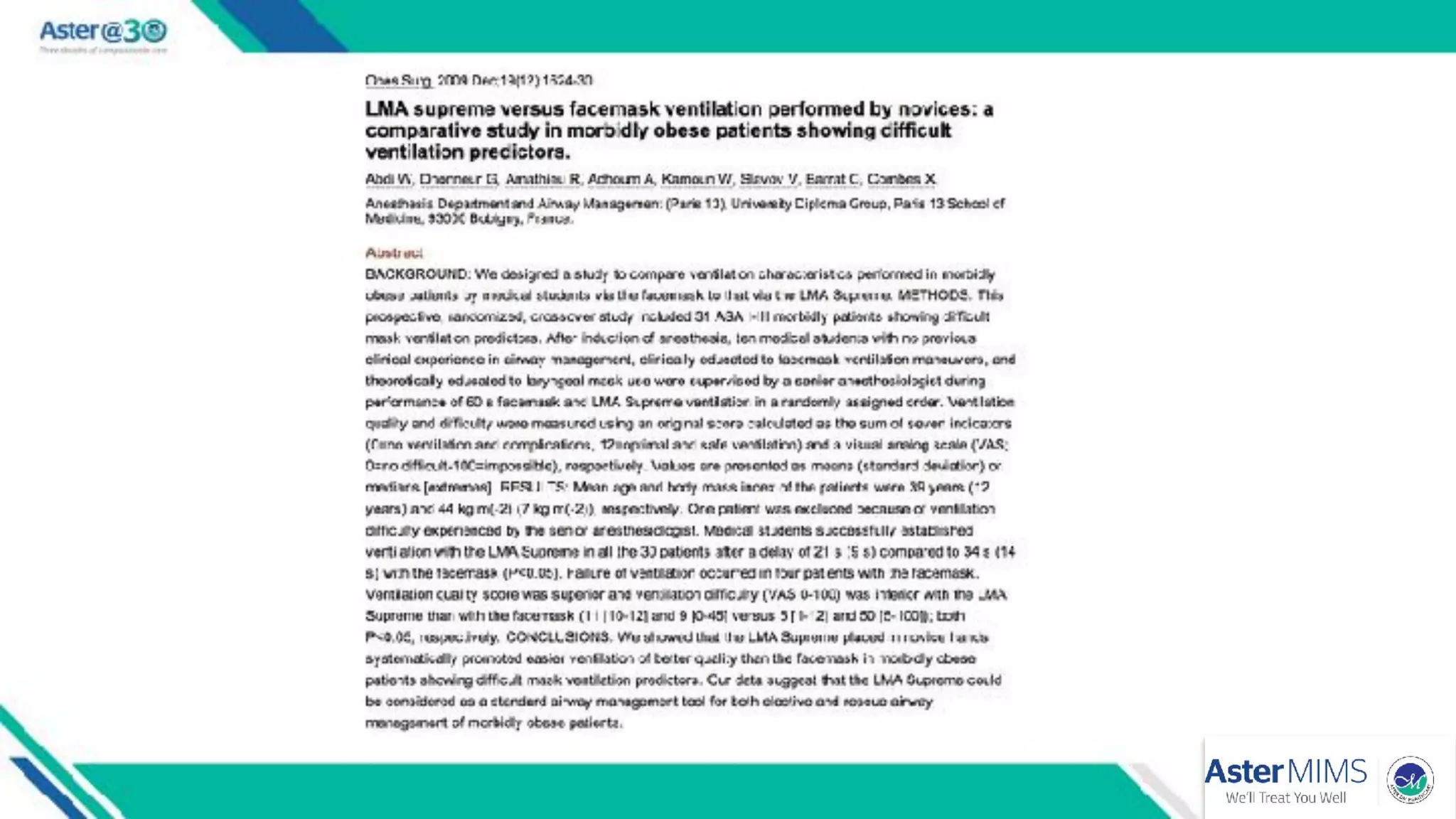
Laryngeal Mask Airway
❑A silicone rubber device that combines.
Tracheal intubation and the use of a face
mask.
❑Used for situations when intubation
attempts have failed, bag-valve mask
ventilation is unsuccessful, and the patient
needs immediate airway management.
LMA
Venugopalan.P.P; EMCME 2009;MIMS.CALICUT.15.03.09
LMA- Sizes
Size Description Weight
1 Neonates Upto 5 Kg
1 ½ Pediatric 5 - 10 Kg
2 Infant 10 – 20 Kg
2 ½ Child 20-30 Kg
3 Large child/ Small Adult 30 – 50 Kg
4 Adult 50 – 70 Kg
5 Adult > 70 Kg
Combitube
Combitube Insertion
Surgical Airway
Needle Cric and Surgical Cric
Needle cric
• Buying time in
Emergency airway
• Picture cricothyroid
membrane
• Provide some
oxygenation
• Proceed to surgical cric
Blind Nasotracheal Intubation
• BNTI remains a valid method of intubation in
the out-of-hospital setting, where it
occasionally is used. In the ED, BNTI rarely, if
ever, should be used and is reserved for
patients in whom the presence of a narrowly
defined type of difficult airway makes RSI
undesirable or contraindicated and alternatives
Awake Oral Intubation
• Awake oral intubation is a technique in which sedative and topical
anesthetic agents are administered to permit management of a difficult
airway without neuromuscular blockade.
• Topical anesthesia may be achieved by spray, nebulization, or local
anesthetic nerve block. After the patient is sedated and topical anesthesia
has been achieved, gentle direct, video, or flexible endoscopic laryngoscopy
is performed to determine whether the glottis is visible and intubation
possible
Awake intubation
Laryngeal Nerve Block
What is the Disaster in Airway management?
Can’t
Intubate !
Can’t
Ventilate !!
LMA ,Combitube , Bougie assisted intubation
Surgical Airway
• Rescue Airway
New Airway Devices
Video Assisted Laryngoscope

Airway management made easy
Algorithms
THANK YOU

Airway management in ER @ nbe presentation 2017

  • 1.
  • 2.
    Airway management inER settings 
 “Basic & Advanced” Updated with recent advances Dr.Venugopalan. P.P DA,DNB,MNAMS,MEM-GWU Director , Emergency Medicine Aster DM Healthcare PG teacher NBE Lecture ; NBE E learning program , July 2017
  • 3.
    Why airway managementin Emergency Room ? • Airway management is the cornerstone of resuscitation • A defining skill for the specialty of emergency medicine • The emergency physician has primary responsibility for management of the airway • All airway management techniques lie within the domain of emergency medicine
  • 4.
    When to intubate? • 1.Failure to maintain or protect the airway • 2.Failure of ventilation or oxygenation • 3.Anticipated clinical course and likelihood of deterioration. Clinical Decision
  • 5.
    How do youknow airway is patent? • Level of consciousness • Ability to phonate in response to voice command or query (Integrity of the upper airway and the level of consciousness) • Ability to manage his or her own secretions ( pooling of secretions in the oropharynx, absence of swallowing spontaneously or on command)
  • 6.
    Intubation? A patient whorequires a manoeuver to establish a patent airway or who easily tolerates an oral airway probably requires intubation for protection of that airway, unless temporary or readily reversible condition, such as opioid overdose, is present.
  • 7.
    Ventilatory failure orOxygenation failure? • Clinical assessment • Pulse oximetry with or without capnography • Observation of improvement or deterioration in the patient’s clinical condition
  • 8.
    The decision tointubate Intubate early especially in dynamic airways Bullets - neck trauma Bites- anaphylaxis / angioedema Burns -caustic airway injuries,Thermal injuries Three B ’s
  • 9.
    Airway - mouthand neck infections, tumors, foreign bodies, bleeds stridor, phonation, swallowing, secretions, dyspnea Breathing- failure of oxygenation or ventilation often amenable to medical and non-invasive therapies – think NIV Circulation supporting tissue oxygen delivery by unloading the muscles of respiration sepsis A-B-C-D-E-F
  • 10.
    A-B-C-D-E-F Disability : CNScatastrophes and CNS depression, ongoing seizures, weakness Avoid gag – assess ability to swallow and handle secretions (pooling, drooling, gurgling) for neuromuscular weakness: FVC < 12 ml/kg and NIF < 20 cm H20 vomiting in the obtunded patient is a particular concern Expected course:anticipated decline, transfer to radiology or another institution Feral -need for prompt, aggressive sedation to protect patient/others especially with potential or undiagnosed medical instability
  • 11.
    Arterial blood gases(ABGs) generally are not required to determine the patient’s need for intubation
  • 12.
    Anticipated clinical deterioration •Certain overdoses • Significant multiple trauma, with or without head injury • Multiple trauma with hypotension, an open femur fracture, and diffuse abdominal tenderness • Aggressive resuscitation, pain control, invasive procedures and imaging outside of the emergency department ,inevitable operative management • Evidence of vascular or direct airway injury in the neck
  • 13.
    Obstructed airway ? Tongueand Epiglottis Any Foreign materials ? Clear it Noisy breathing ?
  • 14.
  • 15.
  • 16.
  • 18.
  • 19.
  • 20.
    Choice –OPA ! •Airway Reflexes ? …..No !
  • 21.
  • 22.
  • 25.
  • 26.
  • 27.
    N P A •OPA is not tolerating ? • Airway reflexes retained ? • Inability to open mouth ?
  • 28.
  • 30.
    Airway Still not –Maintainable ? Advanced Airway
  • 31.
    No Breathing ? E– C Clamp Place and hold mask properly
  • 33.
  • 35.
  • 36.
    RSI Defined “Virtually simultaneousadministration of a potent sedative agent and a neuromuscular blocking agent to induce unconsciousness and motor paralysis for tracheal intubation”
  • 37.
    What are TheProblems Inherent to Intubation? • Laryngoscopy and Intubation – Increased bronchospasm – Increased ICP – Increased catecholamine release
  • 38.
    Beneficial Effects ofRSI • “Tight Heads” – Intracranial pathology • “Tight Hearts” or “Tight Vessels” – Cardiovascular disease • “Tight Lungs” – Reactive airway disease
  • 42.
  • 45.
    RSI: Timeline T –10 minutes Prepare T – 5 minutes Preoxygenate T – 3 minutes Pretreat T = 0 Paralysis with induction T + 30 seconds Protection T + 45 seconds Placement T + 90 seconds Post-Intubation management
  • 47.
    Problem Airway epiglottis Vocalcords Airway Evaluation
  • 49.
    Double set up •Neuromuscular paralysis generally should be avoided in patients for whom a high degree of intubation difficulty is predicted, unless the administration of the neuromuscular blocking agent (NMBA) is part of a planned approach to the difficult airway
  • 51.
    Look Externally • Severelybruised • Bloodied face of a combative trauma patient • Immobilised in a cervical collar on a spine board • Anatomical deformities • Subjective clinical judgment can be highly specific (90%) but insensitive and so should be augmented by other evaluations.
  • 54.
    Obstruction or obesity •Visualization of the glottis, or intubation itself, mechanically impossible • Epiglottis, head and neck cancer, Ludwig’s angina, neck hematoma, or glottic polyps • Examine the patient for airway obstruction and assess the patient’s voice to satisfy this evaluation step
  • 55.
    Neck mobility • Neckmobility is desirable for any intubation technique and is essential for positioning the patient for optimal direct laryngoscopy. Neck mobility is assessed with the patient’s flexion and extension of the head and neck through a full range of motion
  • 56.
    Lemon in ERsetting • Unresponsive patient - Mallampatti is not practical - LEON • Unresponsive plus Trauma - Mallampatti and Neck mobility are not practical - LEO
  • 60.
    Cormack and Lehane[CL] •The most widely used system for grading laryngoscopic view of the glottis is that of Cormack and Lehane (CL) • Grades laryngoscopy according to the extent to which laryngeal and glottic structures can be seen.
  • 61.
    CL grading • Grade1 laryngoscopy, all or nearly all of the glottic aperture is seen. • Grade 2 laryngoscopy visualizes only a portion of the glottis (arytenoid cartilages alone or arytenoid cartilages plus part of the vocal cords). • Grade 3 laryngoscopy visualizes only the epiglottis. • Grade 4 laryngoscopy, not even the epiglottis is visible.
  • 63.
  • 66.
    Confirmation of EndotrachealTube Placement • Direct visualisation • Chest auscultation • Gastric auscultation • Bag resistance • Exhaled volume • Visualization of condensation within the ETT • Chest radiography • All are prone to failure as means of confirming tracheal intubation.
  • 67.
    ETCO2 • End-tidal carbondioxide (ETCO2) detection device to the ETT and assess it through six manual ventilations • Disposable, colorimetric ETCO2 detectors are highly reliable, convenient, and easy to interpret, indicating adequate CO2 detection by color change
  • 68.
    End tidal CO2detection
  • 70.
    USG- EDD • WhenETCO2 detection is not possible, tracheal tube position can be confirmed with other techniques. • One novel approach Bedside ultrasound.
  • 71.
    USG guided Intubation andplacement confirmation
  • 72.
  • 73.
    EDD - howto work ?
  • 74.
    Recognize Adequacy ofVentilations Pulse oximeter
  • 75.
    Approximate Blood oxygenlevel ! ➢SpO2 100% = PaO2 100mm of Hg ➢SpO2 90%= PaO2 60mm of Hg ➢SpO2 60%= PaO2 30mm of Hg ➢SpO2 50%= PaO2 27mm of Hg
  • 76.
    Chest X ray •Although chest radiography is universally recommended after ETT placement, its primary purpose is to ensure that the tube is well positioned below the cords and above the carina.
  • 77.
    Other methods 
 Goldstandard • Fiberoptic confirmation
  • 78.
    Difficult Airway Assessment •4 D’s – Distortion, Disproportion, Dysmobility, Dentition • BONES – Beard, Obese, No teeth, Elderly, Snores (sleep apnea) • SHORT – Surgery (head/neck/jaw), Hematoma, Obese, Radiation, Tumor • LEMON • MALLAMPATI • Always have a “Rescue Airway” technique ready
  • 79.
  • 80.
    Rescue Airways • GumElastic Bougie (GEB) • Laryngeal Mask Airway (LMA/ILMA) • Combitube • Surgical Cricothyrotomy
  • 81.
  • 82.
    Gum elastic bouge •Useful only when larynges is visualise at least partially • Difficulty intubation • Tube changing • Provision to supplement oxygen
  • 83.
    Advanced airway –Bestchoice Intubation
  • 85.
    Equipments Needed ❑ Laryngoscopewith different types of blade. ❑ ET tube with proper size and type. Average adult male: 8.5 mm Average adult female: 7.5 mm Low pressure cuff tubes above 5 years Uncuffed tubes below 5 years < 4 Age + 3.5 3 > 4 Age + 4.5 4
  • 86.
  • 87.
  • 88.
    Align the airwayaxis by proper positions
  • 89.
  • 91.
  • 94.
  • 95.
    Cricoid pressure Pressure onCricoid cartilage Compress oesophagus between Cricoid ring and Vertebral column Prevent Regurgitation and Aspiration Make cord visualisation difficult Not recommended in Crash airway
  • 96.
    External Laryngeal manipulation BURP -Backward - Upward - Right- Posterior Pressure over thyroid cartilage Better vocal cord visualisation A grade 3 larynx become grade 2 with ELM It is not Cricoid pressure
  • 97.
    Blind insertion devices LMA,Combitube ,King’s airway
  • 98.
    Laryngeal Mask Airway ❑Asilicone rubber device that combines. Tracheal intubation and the use of a face mask. ❑Used for situations when intubation attempts have failed, bag-valve mask ventilation is unsuccessful, and the patient needs immediate airway management.
  • 99.
  • 102.
    Venugopalan.P.P; EMCME 2009;MIMS.CALICUT.15.03.09 LMA-Sizes Size Description Weight 1 Neonates Upto 5 Kg 1 ½ Pediatric 5 - 10 Kg 2 Infant 10 – 20 Kg 2 ½ Child 20-30 Kg 3 Large child/ Small Adult 30 – 50 Kg 4 Adult 50 – 70 Kg 5 Adult > 70 Kg
  • 104.
  • 105.
  • 106.
    Surgical Airway Needle Cricand Surgical Cric
  • 107.
    Needle cric • Buyingtime in Emergency airway • Picture cricothyroid membrane • Provide some oxygenation • Proceed to surgical cric
  • 111.
    Blind Nasotracheal Intubation •BNTI remains a valid method of intubation in the out-of-hospital setting, where it occasionally is used. In the ED, BNTI rarely, if ever, should be used and is reserved for patients in whom the presence of a narrowly defined type of difficult airway makes RSI undesirable or contraindicated and alternatives
  • 113.
    Awake Oral Intubation •Awake oral intubation is a technique in which sedative and topical anesthetic agents are administered to permit management of a difficult airway without neuromuscular blockade. • Topical anesthesia may be achieved by spray, nebulization, or local anesthetic nerve block. After the patient is sedated and topical anesthesia has been achieved, gentle direct, video, or flexible endoscopic laryngoscopy is performed to determine whether the glottis is visible and intubation possible
  • 114.
  • 115.
  • 116.
    What is theDisaster in Airway management? Can’t Intubate ! Can’t Ventilate !!
  • 117.
    LMA ,Combitube ,Bougie assisted intubation Surgical Airway • Rescue Airway
  • 118.
  • 122.
  • 125.
    Airway management madeeasy Algorithms
  • 132.