
INTUBATION IN CRITICAL
CARE SETTING
DR.MALAKA MUNASINGHE
2018.11.29
 6% of ICU patients- predicted difficult airways
 Severe hypoxaemia( SPO2< 80%)- 25% during ICU intubations
 NAP 4 STUDY - 60% of air way incidents in ICU
DEATH OR PERMANENT NEUROLOGICAL INJURY
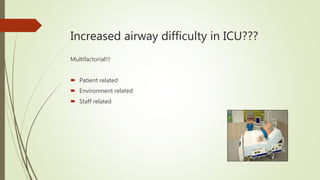
Increased airway difficulty in ICU???
Multifactorial!!!
 Patient related
 Environment related
 Staff related
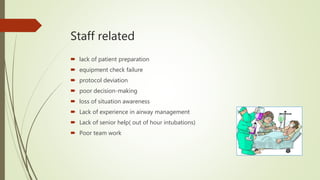
Staff related
 lack of patient preparation
 equipment check failure
 protocol deviation
 poor decision-making
 loss of situation awareness
 Lack of experience in airway management
 Lack of senior help( out of hour intubations)
 Poor team work
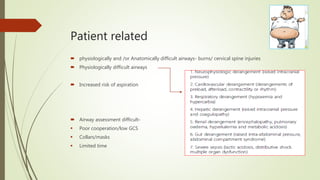
Patient related
 physiologically and /or Anatomically difficult airways- burns/ cervical spine injuries
 Physiologically difficult airways
 Increased risk of aspiration
 Airway assessment difficult-
 Poor cooperation/low GCS
 Collars/masks
 Limited time
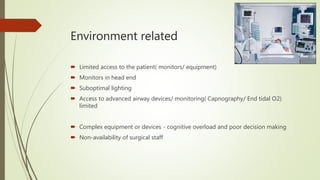
Environment related
 Limited access to the patient( monitors/ equipment)
 Monitors in head end
 Suboptimal lighting
 Access to advanced airway devices/ monitoring( Capnography/ End tidal O2)
limited
 Complex equipment or devices - cognitive overload and poor decision making
 Non-availability of surgical staff
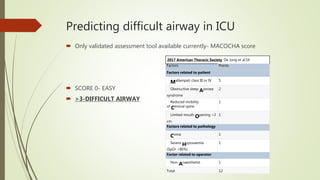
Predicting difficult airway in ICU
 Only validated assessment tool available currently- MACOCHA score
 SCORE 0- EASY
 >3-DIFFICULT AIRWAY
2017 American Thoracic Society. De Jong et al.54
Factors Points
Factors related to patient
Mallampati class III or IV 5
Obstructive sleep
Apnoea
syndrome
2
Reduced mobility
of
Cervical spine
1
Limited mouth
Opening <3
cm
1
Factors related to pathology
Coma 1
Severe
Hypoxaemia
(SpO2 <80%)
1
Factor related to operator
Non-
Anaesthetist 1
Total 12
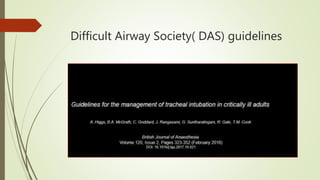
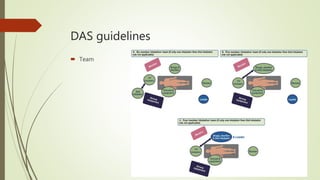
Difficult Airway Society( DAS) guidelines
DAS guidelines
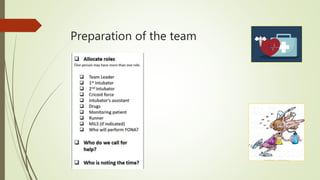
 Team
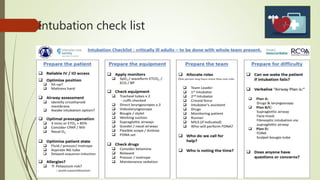
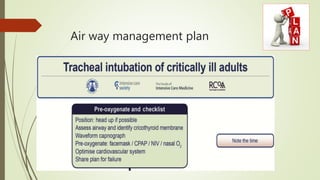
Intubation check list
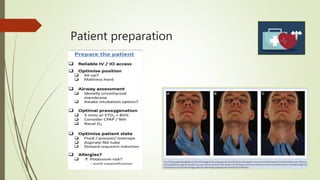
Patient preparation
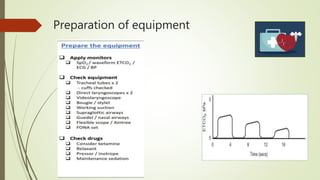
Preparation of equipment
Preparation of the team
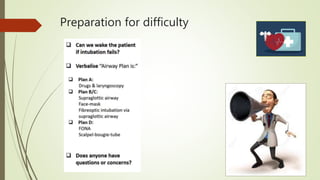
Preparation for difficulty
Air way management plan
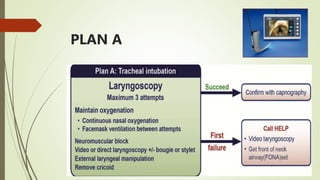
PLAN A
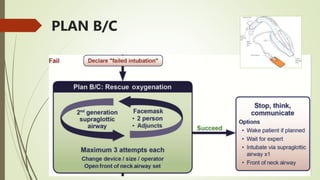
PLAN B/C
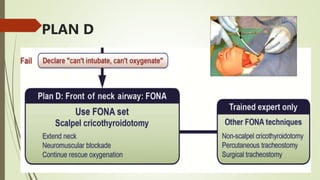
PLAN D
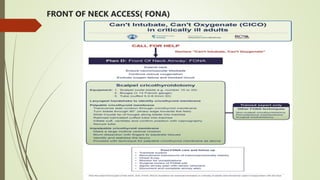
FRONT OF NECK ACCESS( FONA)
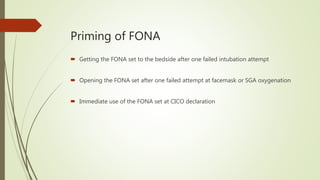
Priming of FONA
 Getting the FONA set to the bedside after one failed intubation attempt
 Opening the FONA set after one failed attempt at facemask or SGA oxygenation
 Immediate use of the FONA set at CICO declaration
ISSUES
 AWAKE INTUBATION in ICU?
 WHAT TO USE DURING INDUCTION?
 WHAT IS DELAYED SEQUENCE INDUCTION?
 Can you wake up the patient if intubation fails?
Post intubation
 Complications are common- 80% of airway problems occur after intubation
 Continuous monitoring continued
 Care of the tube/ adequate sedation/ physiotherapy
 CXR- to exclude endobronchial intubation/aspiration
 If patient haemodynamically stable but hypoxaemic- recruitment maneuvers
performed
SUMMARY
 Morbidity and mortality during ICU intubations are significantly high compared to
elective surgical intubations
 Patient related, staff and environment related factors are contributory factors
 Simplified, protocolized approach would reduce detrimental outcomes during
these airway interventions
Intubation in critical care setting

Intubation in critical care setting

  • 1.
    INTUBATION IN CRITICAL CARESETTING DR.MALAKA MUNASINGHE 2018.11.29
  • 2.
     6% ofICU patients- predicted difficult airways  Severe hypoxaemia( SPO2< 80%)- 25% during ICU intubations  NAP 4 STUDY - 60% of air way incidents in ICU DEATH OR PERMANENT NEUROLOGICAL INJURY
  • 3.
    Increased airway difficultyin ICU??? Multifactorial!!!  Patient related  Environment related  Staff related
  • 4.
    Staff related  lackof patient preparation  equipment check failure  protocol deviation  poor decision-making  loss of situation awareness  Lack of experience in airway management  Lack of senior help( out of hour intubations)  Poor team work
  • 5.
    Patient related  physiologicallyand /or Anatomically difficult airways- burns/ cervical spine injuries  Physiologically difficult airways  Increased risk of aspiration  Airway assessment difficult-  Poor cooperation/low GCS  Collars/masks  Limited time
  • 6.
    Environment related  Limitedaccess to the patient( monitors/ equipment)  Monitors in head end  Suboptimal lighting  Access to advanced airway devices/ monitoring( Capnography/ End tidal O2) limited  Complex equipment or devices - cognitive overload and poor decision making  Non-availability of surgical staff
  • 7.
    Predicting difficult airwayin ICU  Only validated assessment tool available currently- MACOCHA score  SCORE 0- EASY  >3-DIFFICULT AIRWAY 2017 American Thoracic Society. De Jong et al.54 Factors Points Factors related to patient Mallampati class III or IV 5 Obstructive sleep Apnoea syndrome 2 Reduced mobility of Cervical spine 1 Limited mouth Opening <3 cm 1 Factors related to pathology Coma 1 Severe Hypoxaemia (SpO2 <80%) 1 Factor related to operator Non- Anaesthetist 1 Total 12
  • 8.
  • 9.
  • 10.
  • 11.
  • 12.
  • 13.
  • 14.
  • 15.
  • 16.
  • 17.
  • 18.
  • 19.
    FRONT OF NECKACCESS( FONA)
  • 20.
    Priming of FONA Getting the FONA set to the bedside after one failed intubation attempt  Opening the FONA set after one failed attempt at facemask or SGA oxygenation  Immediate use of the FONA set at CICO declaration
  • 21.
    ISSUES  AWAKE INTUBATIONin ICU?  WHAT TO USE DURING INDUCTION?  WHAT IS DELAYED SEQUENCE INDUCTION?  Can you wake up the patient if intubation fails?
  • 22.
    Post intubation  Complicationsare common- 80% of airway problems occur after intubation  Continuous monitoring continued  Care of the tube/ adequate sedation/ physiotherapy  CXR- to exclude endobronchial intubation/aspiration  If patient haemodynamically stable but hypoxaemic- recruitment maneuvers performed
  • 23.
    SUMMARY  Morbidity andmortality during ICU intubations are significantly high compared to elective surgical intubations  Patient related, staff and environment related factors are contributory factors  Simplified, protocolized approach would reduce detrimental outcomes during these airway interventions