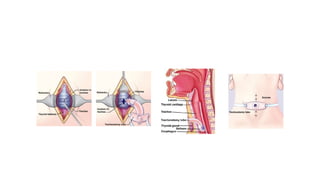
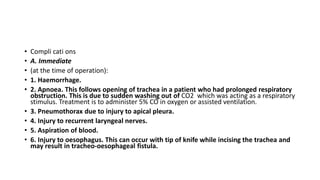
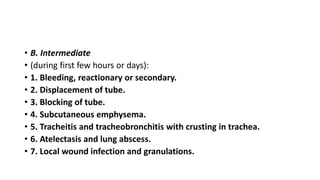
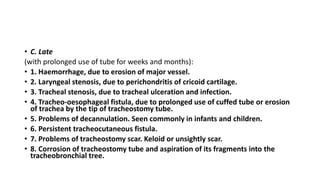
TRACHEOSTOMY
TRACHEOSTOMY 
• MAKING AN OPENING IN THE ANTERIOR WALL OF TRACHEA & 
CONVERTING IT IN TO A STOMA ON THE SKIN THE SURFACE
Functions of Tracheostomy 
• 1. Alternative pathway for breathing 
• 2. Improves alveolar ventilation In cases of respiratory insufficiency : 
(a) Decreasing the dead space by 30-50% (normal dead space is 150 ml). 
(b) Reducing the resistance to airflow. 
• 3. Protects the airways By using cuffed tube, tracheobronchial tree is protected against aspiration of: 
(a) Pharyngeal secretions, as in case of bulbar paralysis or coma. 
(b) Blood, as in haemorrhage from pharynx, larynx or maxillofacial injuries. With tracheostomy, pharynx and larynx can also be 
packed to control bleeding. 
• 4. Permits removal of tracheobronchial secretions 
When patient is unable to cough as in coma, head injuries, respiratory paralysis; or 
when cough is painful, as in chest injuries or upper abdominal operations, the tracheobronchial airway can be kept clean of secretions by 
repeated suction through the tracheostomy, thus avoiding need for repeated bronchoscopy or intubation which is not only traumatic but 
requires expertise. 
• 5. Intermittent positive pressure respiration (IPPR) If IPPR is required beyond 72 hours, tracheostomy is superior to intubation. 
• 6. To administer anaesthesia } laryngopharyngeal growths or trismus.
Indications of Tracheostomy 
• There are three main indications 
• A. Respiratory obstruction. 
• B. Retained secretions. 
• C. Respiratory insufficiency.
A. Respiratory obstruction 
• 1. Infections 
Acute laryngo-tracheo-bronchitis, acute epiglottitis, diphtheria Ludwig's angina, peritonsillar, 
retropharyngeal or parapharyngeal abscess, tongue abscess 
• 2. Trauma 
External injury of larynx and trachea ,Trauma due to endoscopies, especially in infants and 
children,Fractures of mandible or maxillofacial injuries 
• 3. Neoplasms 
Benign and malignant neoplasms of larynx, pharynx, upper trachea, tongue and thyroid 
• 4. Foreign body larynx 
• 5. Oedema larynx 
due to steam, irritant fumes or gases, allergy (angioneurotic or drug sensitivity), radiation 
• 6. Bilateral abductor paralysis 
• 7. Congenital anomalies 
• Laryngeal web, cysts, tracheo-oesophageal fistula Bilateral choanal atresia
B. Retained secretions 
• 1. Inability to cough 
• Coma of any cause, e.g. head injuries, cerebrovascular accidents, narcotic 
overdose 
• Paralysis of respiratory muscles, e.g. spinal injuries, polio, Guillain-Barre 
syndrome, myasthenia gravis 
• Spasm of respiratory muscles, tetanus, eclampsia, strychnine poisoning 
• 2. Painful cough 
• Chest injuries, multiple rib fractures, pneumonia 
• 3. Aspiration of pharyngeal secretions 
• Bulbar polio, polyneuritis, bilateral laryngeal paralysis
C. Respiratory insufficiency 
• Chronic lung conditions, viz. emphysema, chronic bronchitis, 
bronchiectasis, atelectasis
Types of Tracheostomy 
• Emergency tracheostomy 
• Elective or tranquil tracheostomy 
• Permanent tracheostomy 
• Percutaneous dilatational tracheostomy 
• Mini tracheostomy (cricothyroidotomy)
1. Emergency tracheostomy 
• It is employed when airway obstruction is complete or almost 
complete and 
• there is an urgent need to establish the airway. 
• Intubation or laryngotomy are either not possible or feasible in such 
cases.
2. Elective tracheostomy 
(syn. tranquil, orderly or routine tracheostomy) 
• This is a planned, unhurried procedure. Almost all operative surgical 
facilities are available, endotracheal tube can be put and local or 
general anaesthesia can be given. 
• It is of two types: 
• (a) Therapeutic, to relieve respiratory obstruction, remove 
tracheobronchial secretions or give assisted ventilation. 
• (b) Prophylactic, to guard against anticipated respiratory obstruction 
or aspiration of blood or pharyngeal secretions such as in extensive 
surgery of tongue, floor of mouth, mandibular resection or 
laryngofissure.
3. Permanent tracheostomy 
• bilateral abductor paralysis & laryngeal stenosis.
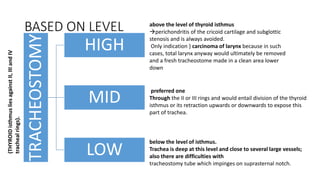
BASED ON LEVEL 
TRACHEOSTOMY 
HIGH 
MID 
LOW 
above the level of thyroid isthmus 
perichondritis of the cricoid cartilage and subglottic 
stenosis and is always avoided. 
Only indication } carcinoma of larynx because in such 
cases, total larynx anyway would ultimately be removed 
and a fresh tracheostome made in a clean area lower 
down 
(THYROID isthmus lies against II, III and IV 
tracheal rings). 
preferred one 
Through the II or III rings and would entail division of the thyroid 
isthmus or its retraction upwards or downwards to expose this 
part of trachea. 
below the level of isthmus. 
Trachea is deep at this level and close to several large vessels; 
also there are difficulties with 
tracheostomy tube which impinges on suprasternal notch.
Technique 
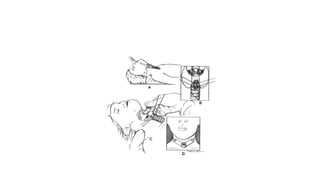
• Whenever possible, endotracheal intubation should be done before 
tracheostomy. This is specially important in infants and children. 
• Position 
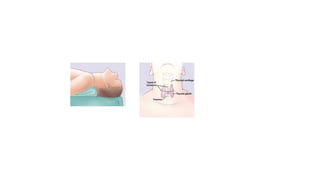
• supine with a pillow under the shoulders so that neck is extended. 
• Anaesthesia 
• No anaesthesia }unconscious patients/ emergency procedure. 
• conscious patients, 1-2% lignocaine with epinephrine 
• GA with intubation+/-
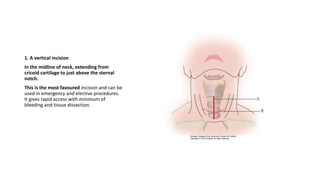
1. A vertical incision 
in the midline of neck, extending from 
cricoid cartilage to just above the sternal 
notch. 
This is the most favoured incision and can be 
used in emergency and elective procedures. 
It gives rapid access with minimum of 
bleeding and tissue dissection.
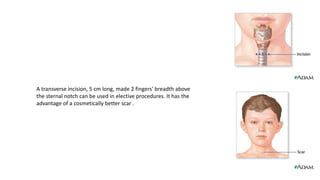
A transverse incision, 5 cm long, made 2 fingers' breadth above 
the sternal notch can be used in elective procedures. It has the 
advantage of a cosmetically better scar .
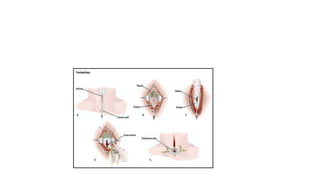
• 2. After incision, tissues are dissected in the midline. Dilated veins 
are either displaced or ligated. 
• 3. Strap muscles are separated in the midline and retracted laterally. 
• 4. Thyroid isthmus is displaced upwards or divided between the 
clamps, and suture-ligated.
• 6. Trachea is fixed with a hook and opened with a vertical incision in the 
region of 3rd and 4th or 3rd and 2nd rings. This is then converted 
• into a circular opening. The first tracheal ring is never divided as 
perichondritis of cricoid cartilage with stenosis can result (Fig. 63.2). 
• 7. Tracheostomy tube of appropriate size is inserted and secured by tapes 
• 8. Skin incision should not be sutured or packed tightly as it may lead to 
development of subcutaneous emphysema. 
• 9. Gauze dressing is placed between the skin and flange of the tube 
around the stoma.
• Compli cati ons 
• A. Immediate 
• (at the time of operation): 
• 1. Haemorrhage. 
• 2. Apnoea. This follows opening of trachea in a patient who had prolonged respiratory 
obstruction. This is due to sudden washing out of CO2 which was acting as a respiratory 
stimulus. Treatment is to administer 5% CO in oxygen or assisted ventilation. 
• 3. Pneumothorax due to injury to apical pleura. 
• 4. Injury to recurrent laryngeal nerves. 
• 5. Aspiration of blood. 
• 6. Injury to oesophagus. This can occur with tip of knife while incising the trachea and 
may result in tracheo-oesophageal fistula.
• B. Intermediate 
• (during first few hours or days): 
• 1. Bleeding, reactionary or secondary. 
• 2. Displacement of tube. 
• 3. Blocking of tube. 
• 4. Subcutaneous emphysema. 
• 5. Tracheitis and tracheobronchitis with crusting in trachea. 
• 6. Atelectasis and lung abscess. 
• 7. Local wound infection and granulations.
• C. Late 
(with prolonged use of tube for weeks and months): 
• 1. Haemorrhage, due to erosion of major vessel. 
• 2. Laryngeal stenosis, due to perichondritis of cricoid cartilage. 
• 3. Tracheal stenosis, due to tracheal ulceration and infection. 
• 4. Tracheo-oesophageal fistula, due to prolonged use of cuffed tube or erosion 
of trachea by the tip of tracheostomy tube. 
• 5. Problems of decannulation. Seen commonly in infants and children. 
• 6. Persistent tracheocutaneous fistula. 
• 7. Problems of tracheostomy scar. Keloid or unsightly scar. 
• 8. Corrosion of tracheostomy tube and aspiration of its fragments into the 
tracheobronchial tree.
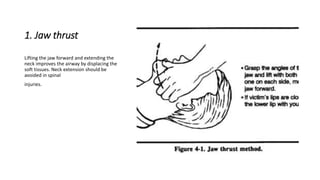
1. Jaw thrust 
Lifting the jaw forward and extending the 
neck improves the airway by displacing the 
soft tissues. Neck extension should be 
avoided in spinal 
injuries.
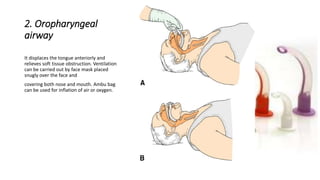
2. Oropharyngeal 
airway 
It displaces the tongue anteriorly and 
relieves soft tissue obstruction. Ventilation 
can be carried out by face mask placed 
snugly over the face and 
covering both nose and mouth. Ambu bag 
can be used for inflation of air or oxygen.
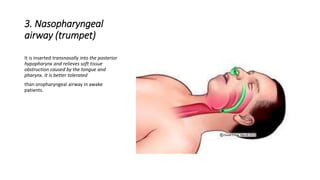
3. Nasopharyngeal 
airway (trumpet) 
It is inserted transnasally into the posterior 
hypopharynx and relieves soft tissue 
obstruction caused by the tongue and 
pharynx. It is better tolerated 
than oropharyngeal airway in awake 
patients.
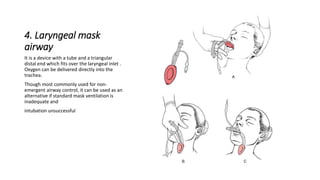
4. Laryngeal mask 
airway 
It is a device with a tube and a triangular 
distal end which fits over the laryngeal inlet . 
Oxygen can be delivered directly into the 
trachea. 
Though most commonly used for non-emergent 
airway control, it can be used as an 
alternative if standard mask ventilation is 
inadequate and 
intubation unsuccessful
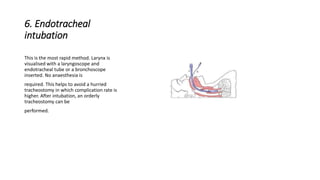
6. Endotracheal 
intubation 
This is the most rapid method. Larynx is 
visualised with a laryngoscope and 
endotracheal tube or a bronchoscope 
inserted. No anaesthesia is 
required. This helps to avoid a hurried 
tracheostomy in which complication rate is 
higher. After intubation, an orderly 
tracheostomy can be 
performed.
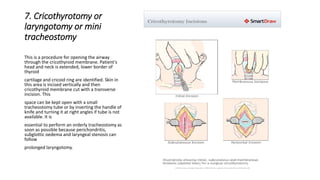
7. Cricothyrotomy or 
laryngotomy or mini 
tracheostomy 
This is a procedure for opening the airway 
through the cricothyroid membrane. Patient's 
head and neck is extended, lower border of 
thyroid 
cartilage and cricoid ring are identified. Skin in 
this area is incised vertically and then 
cricothyroid membrane cut with a transverse 
incision. This 
space can be kept open with a small 
tracheostomy tube or by inserting the handle of 
knife and turning it at right angles if tube is not 
available. It is 
essential to perform an orderly tracheostomy as 
soon as possible because perichondritis, 
subglottic oedema and laryngeal stenosis can 
follow 
prolonged laryngotomy.
8. Emergency 
tracheostomy 
Technique of emergency tracheostomy is as follows: 
Patient's neck is extended, trachea identified and fixed 
between surgeon's left thumb and 
index finger. A vertical incision is made from lower border of 
thyroid to suprasternal notch cutting through skin and 
subcutaneous tissues. Lower 
border of cricoid cartilage is identified and a transverse 
incision made in pretracheal fascia. The thyroid isthmus 
dissected down to expose upper 
three tracheal rings. Vertical tracheal incision is made in 2nd 
and 3rd rings, opened with a haemostat and the tube 
inserted. Bleeding can be 
controlled by packing with gauze. 
Emergency tracheostomy on a struggling patient with 
inadequate lighting, suction and instruments is fraught with 
many complications. If possible, 
an endotracheal tube should be put for a more orderly 
procedure to be carried out. 
page 340 
page 341

Tracheostomy ent indications procedure complications ppt

  • 1.
  • 2.
    TRACHEOSTOMY • MAKINGAN OPENING IN THE ANTERIOR WALL OF TRACHEA & CONVERTING IT IN TO A STOMA ON THE SKIN THE SURFACE
  • 3.
    Functions of Tracheostomy • 1. Alternative pathway for breathing • 2. Improves alveolar ventilation In cases of respiratory insufficiency : (a) Decreasing the dead space by 30-50% (normal dead space is 150 ml). (b) Reducing the resistance to airflow. • 3. Protects the airways By using cuffed tube, tracheobronchial tree is protected against aspiration of: (a) Pharyngeal secretions, as in case of bulbar paralysis or coma. (b) Blood, as in haemorrhage from pharynx, larynx or maxillofacial injuries. With tracheostomy, pharynx and larynx can also be packed to control bleeding. • 4. Permits removal of tracheobronchial secretions When patient is unable to cough as in coma, head injuries, respiratory paralysis; or when cough is painful, as in chest injuries or upper abdominal operations, the tracheobronchial airway can be kept clean of secretions by repeated suction through the tracheostomy, thus avoiding need for repeated bronchoscopy or intubation which is not only traumatic but requires expertise. • 5. Intermittent positive pressure respiration (IPPR) If IPPR is required beyond 72 hours, tracheostomy is superior to intubation. • 6. To administer anaesthesia } laryngopharyngeal growths or trismus.
  • 4.
    Indications of Tracheostomy • There are three main indications • A. Respiratory obstruction. • B. Retained secretions. • C. Respiratory insufficiency.
  • 5.
    A. Respiratory obstruction • 1. Infections Acute laryngo-tracheo-bronchitis, acute epiglottitis, diphtheria Ludwig's angina, peritonsillar, retropharyngeal or parapharyngeal abscess, tongue abscess • 2. Trauma External injury of larynx and trachea ,Trauma due to endoscopies, especially in infants and children,Fractures of mandible or maxillofacial injuries • 3. Neoplasms Benign and malignant neoplasms of larynx, pharynx, upper trachea, tongue and thyroid • 4. Foreign body larynx • 5. Oedema larynx due to steam, irritant fumes or gases, allergy (angioneurotic or drug sensitivity), radiation • 6. Bilateral abductor paralysis • 7. Congenital anomalies • Laryngeal web, cysts, tracheo-oesophageal fistula Bilateral choanal atresia
  • 6.
    B. Retained secretions • 1. Inability to cough • Coma of any cause, e.g. head injuries, cerebrovascular accidents, narcotic overdose • Paralysis of respiratory muscles, e.g. spinal injuries, polio, Guillain-Barre syndrome, myasthenia gravis • Spasm of respiratory muscles, tetanus, eclampsia, strychnine poisoning • 2. Painful cough • Chest injuries, multiple rib fractures, pneumonia • 3. Aspiration of pharyngeal secretions • Bulbar polio, polyneuritis, bilateral laryngeal paralysis
  • 7.
    C. Respiratory insufficiency • Chronic lung conditions, viz. emphysema, chronic bronchitis, bronchiectasis, atelectasis
  • 8.
    Types of Tracheostomy • Emergency tracheostomy • Elective or tranquil tracheostomy • Permanent tracheostomy • Percutaneous dilatational tracheostomy • Mini tracheostomy (cricothyroidotomy)
  • 9.
    1. Emergency tracheostomy • It is employed when airway obstruction is complete or almost complete and • there is an urgent need to establish the airway. • Intubation or laryngotomy are either not possible or feasible in such cases.
  • 10.
    2. Elective tracheostomy (syn. tranquil, orderly or routine tracheostomy) • This is a planned, unhurried procedure. Almost all operative surgical facilities are available, endotracheal tube can be put and local or general anaesthesia can be given. • It is of two types: • (a) Therapeutic, to relieve respiratory obstruction, remove tracheobronchial secretions or give assisted ventilation. • (b) Prophylactic, to guard against anticipated respiratory obstruction or aspiration of blood or pharyngeal secretions such as in extensive surgery of tongue, floor of mouth, mandibular resection or laryngofissure.
  • 11.
    3. Permanent tracheostomy • bilateral abductor paralysis & laryngeal stenosis.
  • 12.
    BASED ON LEVEL TRACHEOSTOMY HIGH MID LOW above the level of thyroid isthmus perichondritis of the cricoid cartilage and subglottic stenosis and is always avoided. Only indication } carcinoma of larynx because in such cases, total larynx anyway would ultimately be removed and a fresh tracheostome made in a clean area lower down (THYROID isthmus lies against II, III and IV tracheal rings). preferred one Through the II or III rings and would entail division of the thyroid isthmus or its retraction upwards or downwards to expose this part of trachea. below the level of isthmus. Trachea is deep at this level and close to several large vessels; also there are difficulties with tracheostomy tube which impinges on suprasternal notch.
  • 13.
    Technique • Wheneverpossible, endotracheal intubation should be done before tracheostomy. This is specially important in infants and children. • Position • supine with a pillow under the shoulders so that neck is extended. • Anaesthesia • No anaesthesia }unconscious patients/ emergency procedure. • conscious patients, 1-2% lignocaine with epinephrine • GA with intubation+/-
  • 16.
    1. A verticalincision in the midline of neck, extending from cricoid cartilage to just above the sternal notch. This is the most favoured incision and can be used in emergency and elective procedures. It gives rapid access with minimum of bleeding and tissue dissection.
  • 17.
    A transverse incision,5 cm long, made 2 fingers' breadth above the sternal notch can be used in elective procedures. It has the advantage of a cosmetically better scar .
  • 18.
    • 2. Afterincision, tissues are dissected in the midline. Dilated veins are either displaced or ligated. • 3. Strap muscles are separated in the midline and retracted laterally. • 4. Thyroid isthmus is displaced upwards or divided between the clamps, and suture-ligated.
  • 19.
    • 6. Tracheais fixed with a hook and opened with a vertical incision in the region of 3rd and 4th or 3rd and 2nd rings. This is then converted • into a circular opening. The first tracheal ring is never divided as perichondritis of cricoid cartilage with stenosis can result (Fig. 63.2). • 7. Tracheostomy tube of appropriate size is inserted and secured by tapes • 8. Skin incision should not be sutured or packed tightly as it may lead to development of subcutaneous emphysema. • 9. Gauze dressing is placed between the skin and flange of the tube around the stoma.
  • 22.
    • Compli cations • A. Immediate • (at the time of operation): • 1. Haemorrhage. • 2. Apnoea. This follows opening of trachea in a patient who had prolonged respiratory obstruction. This is due to sudden washing out of CO2 which was acting as a respiratory stimulus. Treatment is to administer 5% CO in oxygen or assisted ventilation. • 3. Pneumothorax due to injury to apical pleura. • 4. Injury to recurrent laryngeal nerves. • 5. Aspiration of blood. • 6. Injury to oesophagus. This can occur with tip of knife while incising the trachea and may result in tracheo-oesophageal fistula.
  • 23.
    • B. Intermediate • (during first few hours or days): • 1. Bleeding, reactionary or secondary. • 2. Displacement of tube. • 3. Blocking of tube. • 4. Subcutaneous emphysema. • 5. Tracheitis and tracheobronchitis with crusting in trachea. • 6. Atelectasis and lung abscess. • 7. Local wound infection and granulations.
  • 24.
    • C. Late (with prolonged use of tube for weeks and months): • 1. Haemorrhage, due to erosion of major vessel. • 2. Laryngeal stenosis, due to perichondritis of cricoid cartilage. • 3. Tracheal stenosis, due to tracheal ulceration and infection. • 4. Tracheo-oesophageal fistula, due to prolonged use of cuffed tube or erosion of trachea by the tip of tracheostomy tube. • 5. Problems of decannulation. Seen commonly in infants and children. • 6. Persistent tracheocutaneous fistula. • 7. Problems of tracheostomy scar. Keloid or unsightly scar. • 8. Corrosion of tracheostomy tube and aspiration of its fragments into the tracheobronchial tree.
  • 25.
    1. Jaw thrust Lifting the jaw forward and extending the neck improves the airway by displacing the soft tissues. Neck extension should be avoided in spinal injuries.
  • 26.
    2. Oropharyngeal airway It displaces the tongue anteriorly and relieves soft tissue obstruction. Ventilation can be carried out by face mask placed snugly over the face and covering both nose and mouth. Ambu bag can be used for inflation of air or oxygen.
  • 27.
    3. Nasopharyngeal airway(trumpet) It is inserted transnasally into the posterior hypopharynx and relieves soft tissue obstruction caused by the tongue and pharynx. It is better tolerated than oropharyngeal airway in awake patients.
  • 28.
    4. Laryngeal mask airway It is a device with a tube and a triangular distal end which fits over the laryngeal inlet . Oxygen can be delivered directly into the trachea. Though most commonly used for non-emergent airway control, it can be used as an alternative if standard mask ventilation is inadequate and intubation unsuccessful
  • 29.
    6. Endotracheal intubation This is the most rapid method. Larynx is visualised with a laryngoscope and endotracheal tube or a bronchoscope inserted. No anaesthesia is required. This helps to avoid a hurried tracheostomy in which complication rate is higher. After intubation, an orderly tracheostomy can be performed.
  • 30.
    7. Cricothyrotomy or laryngotomy or mini tracheostomy This is a procedure for opening the airway through the cricothyroid membrane. Patient's head and neck is extended, lower border of thyroid cartilage and cricoid ring are identified. Skin in this area is incised vertically and then cricothyroid membrane cut with a transverse incision. This space can be kept open with a small tracheostomy tube or by inserting the handle of knife and turning it at right angles if tube is not available. It is essential to perform an orderly tracheostomy as soon as possible because perichondritis, subglottic oedema and laryngeal stenosis can follow prolonged laryngotomy.
  • 31.
    8. Emergency tracheostomy Technique of emergency tracheostomy is as follows: Patient's neck is extended, trachea identified and fixed between surgeon's left thumb and index finger. A vertical incision is made from lower border of thyroid to suprasternal notch cutting through skin and subcutaneous tissues. Lower border of cricoid cartilage is identified and a transverse incision made in pretracheal fascia. The thyroid isthmus dissected down to expose upper three tracheal rings. Vertical tracheal incision is made in 2nd and 3rd rings, opened with a haemostat and the tube inserted. Bleeding can be controlled by packing with gauze. Emergency tracheostomy on a struggling patient with inadequate lighting, suction and instruments is fraught with many complications. If possible, an endotracheal tube should be put for a more orderly procedure to be carried out. page 340 page 341