Airway Management
Tracheal Intubation is useful to  deliver anaesthetic gases  directly to trachea and allow  control of ventilation  and oxygenation and  no aspiration . The airway device is maintained in situ from the start to the end of anaesthesia.
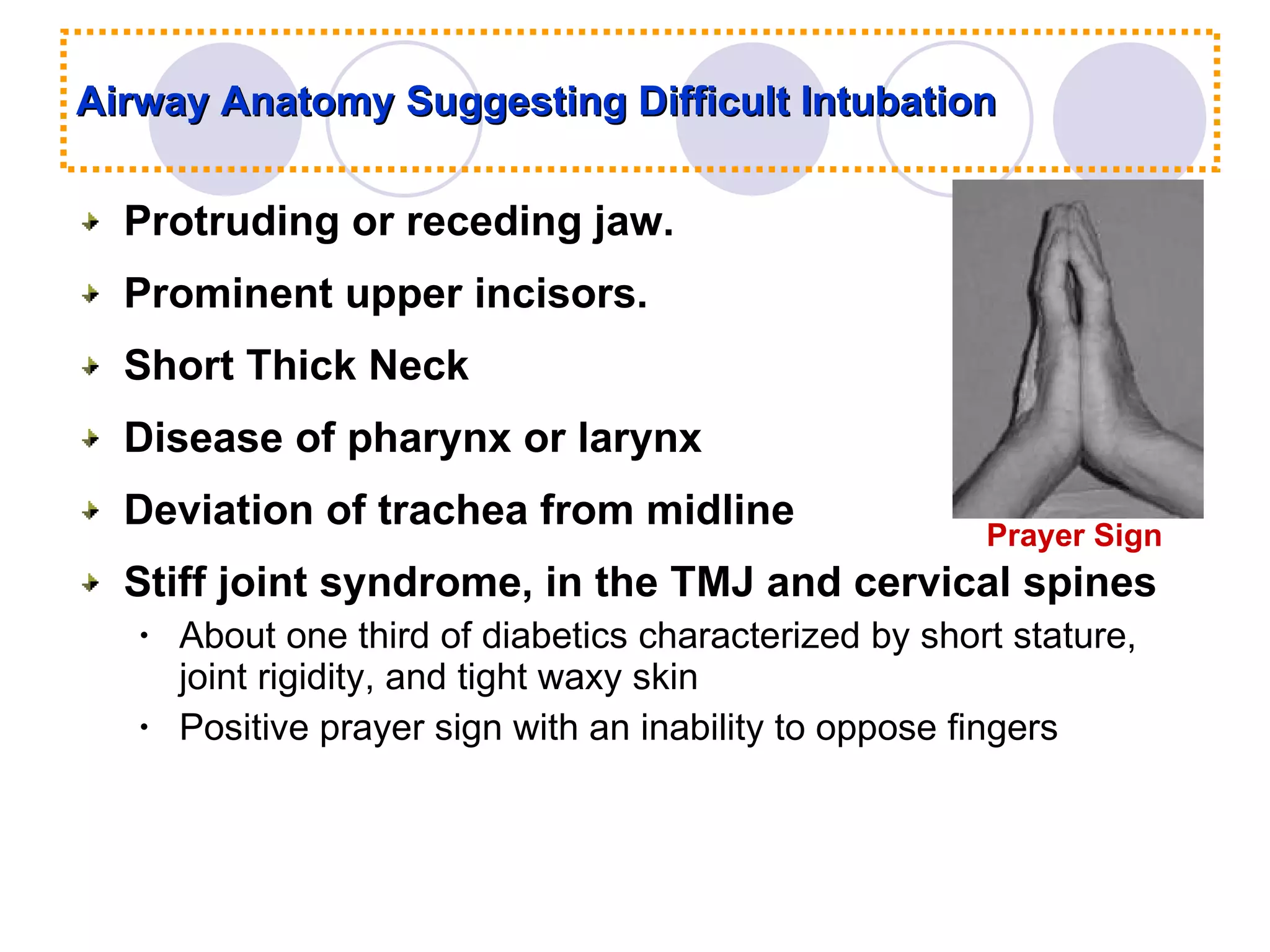
Airway Anatomy Suggesting Difficult Intubation Protruding or receding jaw. Prominent upper incisors.  Short Thick Neck Disease of pharynx or larynx Deviation of trachea from midline Stiff joint syndrome, in the TMJ and cervical spines About one third of diabetics characterized by short stature, joint rigidity, and tight waxy skin Positive prayer sign with an inability to oppose fingers Prayer Sign
Indications of Tracheal Intubation In the operating room Maintenance of patent airway Abnormal intraoperative positions Airway inaccessible (eg. Head & Neck surgery) Expected difficulty in use of face mask Airway Protection - From contamination by blood, pus, debris, etc. Use of controlled ventilation  -  During anaesthesia
Indications of Tracheal Intubation In the operating room Unconscious patient Pulmonary toilet Mechanical ventilation During CPR
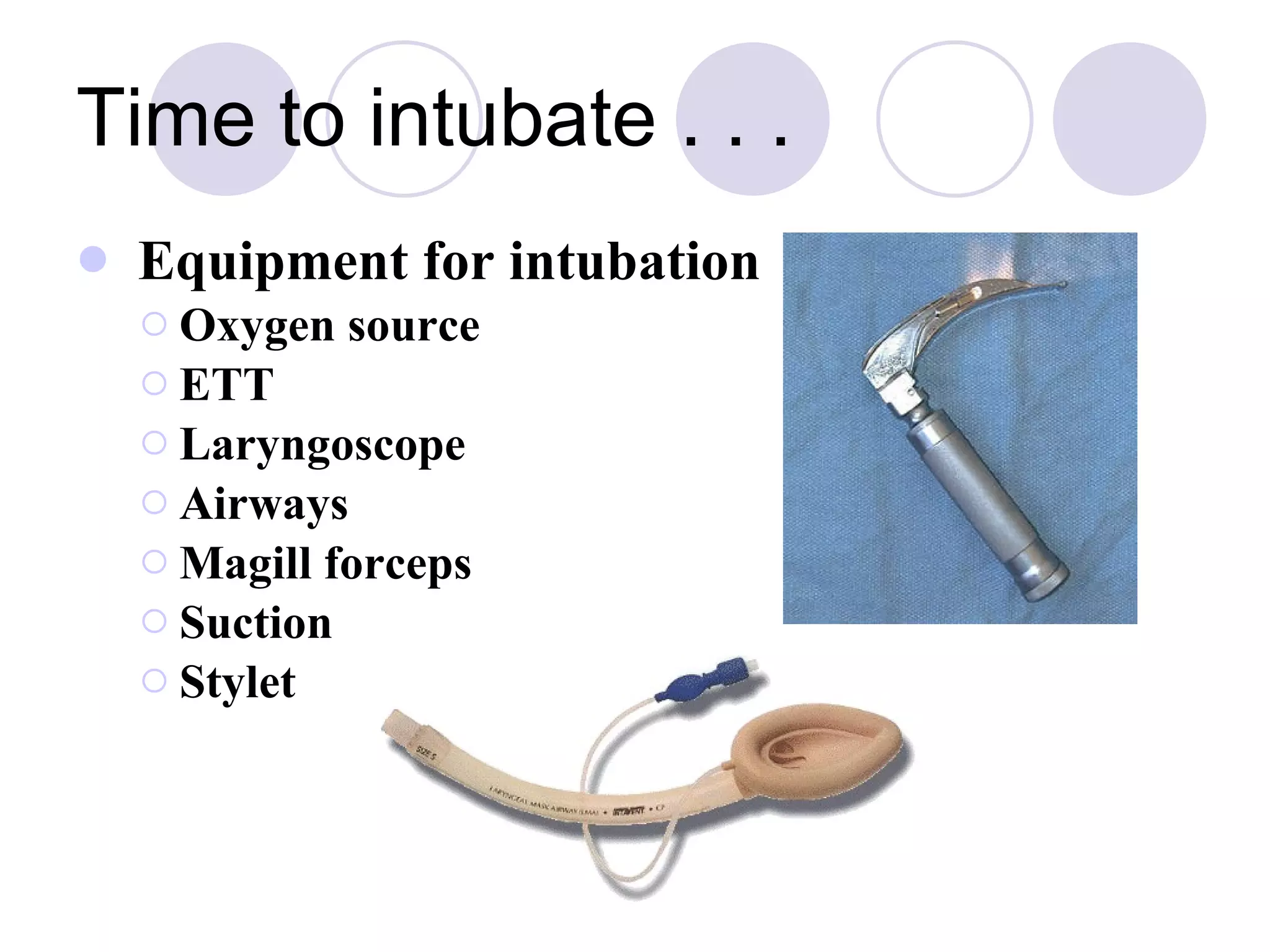
Time to intubate . . . Equipment for intubation Oxygen source ETT Laryngoscope Airways Magill forceps Suction Stylet
Oral/Nasal Airways Moulded tubes in different sizes and shaped to  curve behind the tongue  lifting it away from posterior pharynx. Oral airways are made of hard plastic Nasal airways are made of very soft latex and better tolerated in lightly anaesthesised patient. Uses: Keep airway patent Prevent falling back of tongue in unconsious patients Prevents semiconsoius patient from biting and occluding ETT Prevent biting of tongue in patient with status epilepticus
Oral/Nasal Airways
OPA Oropharyngeal Airway
NPA Nasopharyngeal airway
Laryngoscopes
Laryngoscope Used for  direct inspection  of larynx Has 2 separate parts;  handle  and interchangeable  blades
Laryngoscope There are 2 types of laryngoscopes: Macintosh : for adults, with curved blade Miller or Magill : for children, with straight blade
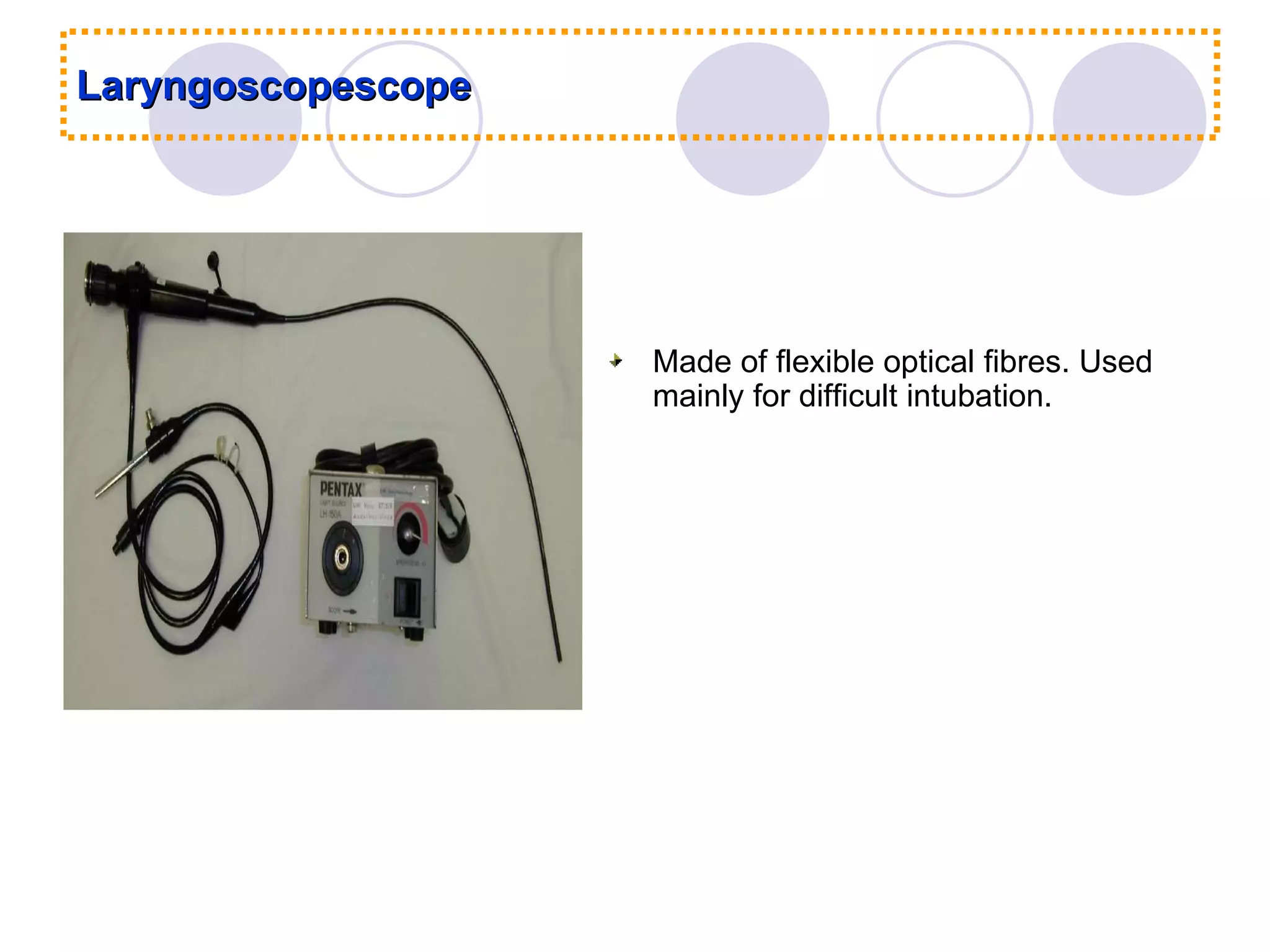
Laryngoscopescope Made of flexible optical fibres. Used mainly for difficult intubation.
Endotracheal Tubes ETT for Fastrach LMA Pediatric uncuffed ETT ETT for blind nasal Standard ETT General features: Made of PVC with low-pressure high-volume cuffs Sizes from 2.5 to 9.0 mm (internal diameter) Radio-opaque incorporated to aid placement Distal end is beveled
What Size Endotracheal Tube ? Adult male 7.5-8 mm Adult female 7-7.5 mm Pediatric (16 + AGE)/4 Nasal intubation Size reduced 1-2 mm
Types of ETTs The Robertshaw double-lumen tracheal tube attached to a single-use pediatric pulse oximeter.   1.  Portex tubes: -  Semirigid, with little tendency to kink. Most commonly used. 2.  Rubber tubes: - Soft, easily kinked. 3.  Reinforced tubes: - Cuffed or non cuffed. Reinforced with wire to prevent kinking. 4.  Special tubes: - Double lumen (Robertshaw). Used for thoracic surgery to isolate the 2 lungs completely.
TT cuff Most TTs have cuff inflating system consisting of valve, balloon, inflating tube and cuff. Uncuffed tubes used in children to minimise pressure injury Purpose of cuff is: Airtight seal between tube and trachea Protect from aspiration of blood, mucus or vomitus.
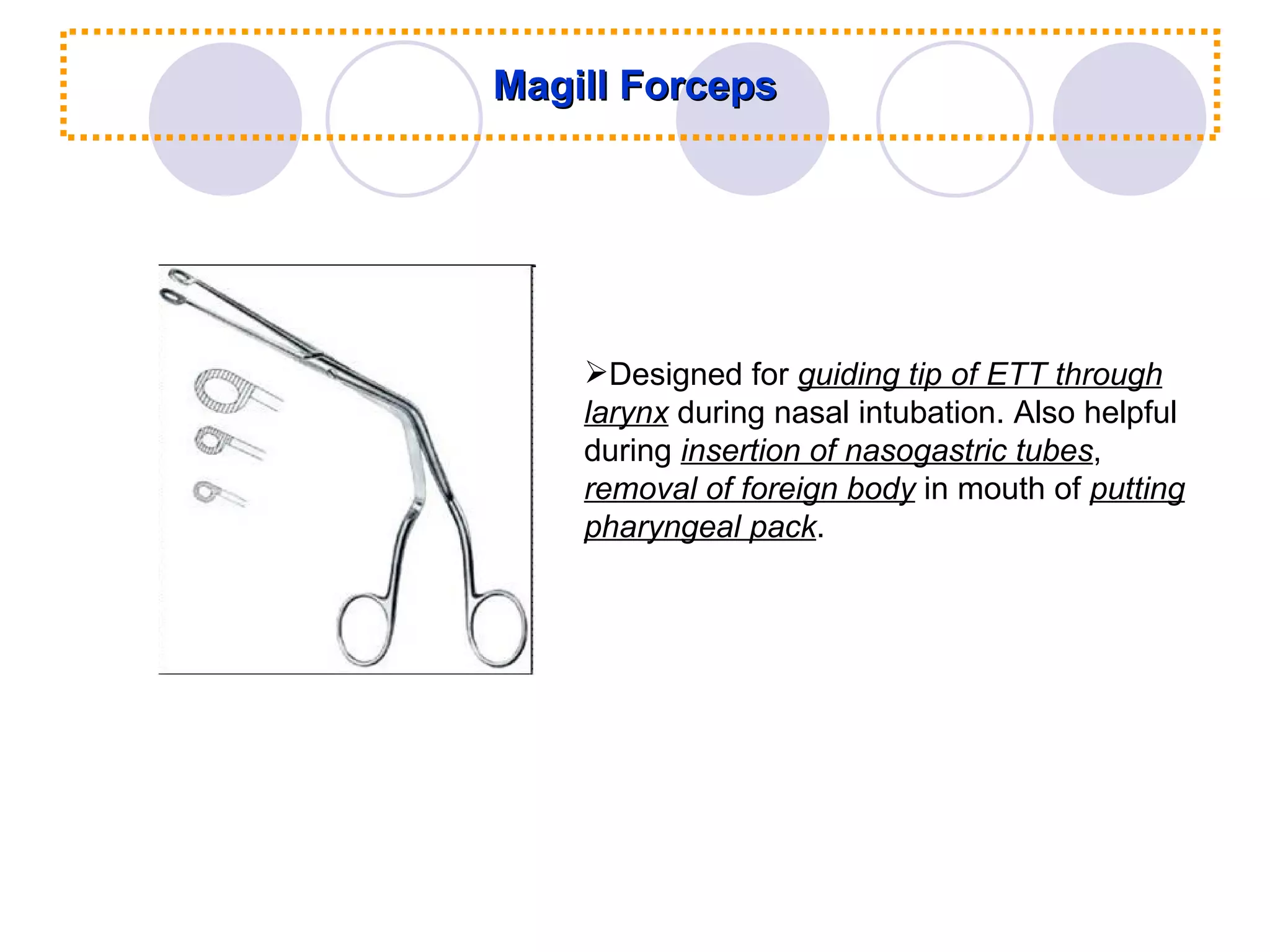
Magill Forceps Designed for  guiding tip of ETT through larynx  during nasal intubation. Also helpful during  insertion of nasogastric tubes ,  removal of foreign body  in mouth of  putting pharyngeal pack .
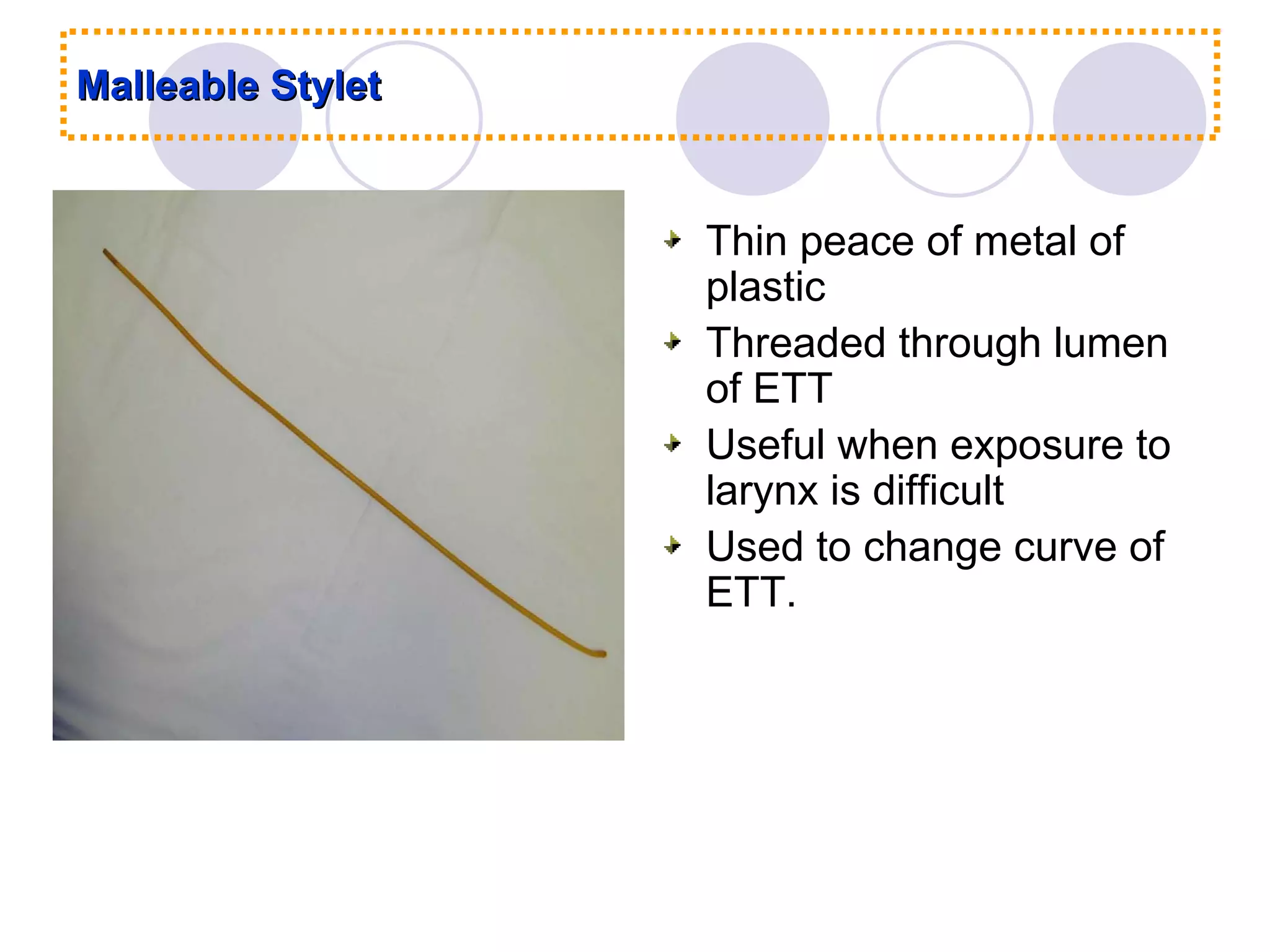
Malleable Stylet Thin peace of metal of plastic Threaded through lumen of ETT Useful when exposure to larynx is difficult Used to change curve of ETT.
Local Anaesthesia Spray Attenuates haemodynamic response to ETT and reduce intensity of cough reflex at light anaesthesia.
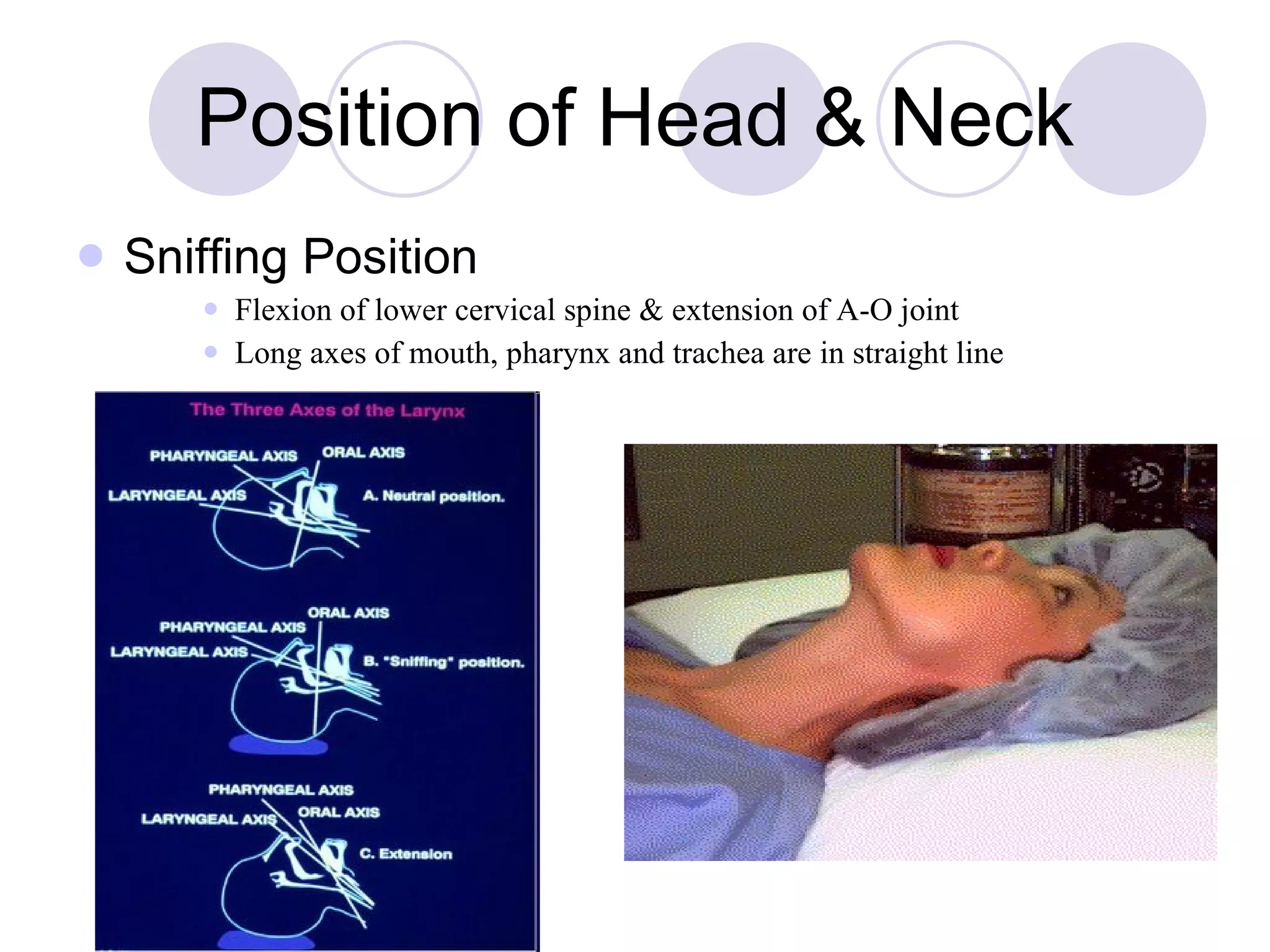
Position of Head & Neck Sniffing Position Flexion of lower cervical spine & extension of A-O joint Long axes of mouth, pharynx and trachea are in straight line
Orotracheal Intubation Place the patient in the correct position.  Grasp the laryngoscope in the left hand.  Spread the patient's lips, and insert the blade between the teeth, being careful not to break a tooth.  Pass the blade to the right of the tongue, and advance the blade into the hypopharynx, pushing the tongue to the left.  Lift the laryngoscope upward and forward, without changing the angle of the blade, to expose the vocal cords.
Orotracheal Intubation Gently pass the tube next the laryngoscope blade through the vocal cords into trachea, far enough so that the balloon is just beyond the cords.  Pressing downward on the thyroid cartilage. This helps bring an anteriorly placed larynx into view and facilitate intubation.  Once in place, inflate the cuff till airtight seal is obtained. Confirm that the tube is properly positioned. First, listen over the stomach with a stethoscope while ventilating the patient. If sounds of airflow are heard or if distension of the stomach occurs, the tube is in the esophagus. If the esophagus has been intubated instead of the trachea, remove the tube and try again.
Orotracheal Intubation Listen to each side of the chest, be sure that  breath sounds are equal in both sides  of the thorax. If not, reposition the tube. When breath sounds are equal on both sides and the thorax rises equally on both sides with each inspiration, note the position of the tube (mark the tube at patient's mouth). Wrap adhesive tape around the tube where it comes out of the mouth. Then carry the tape over the cheek and around the back of the head onto the other cheek. Fasten the end of the tape around the tube.  Obtain a  chest x-ray film immediately to check tube placement , and also obtain arterial blood gas measurements to assess the adequacy of ventilation.
Orotracheal Intubation Gently pass the tube next the laryngoscope blade through the vocal cords into trachea, far enough so that the balloon is just beyond the cords.  Pressing downward on the thyroid cartilage. This helps bring an anteriorly placed larynx into view and facilitate intubation.  Once in place, inflate the cuff till airtight seal is obtained. Confirm that the tube is properly positioned. First, listen over the stomach with a stethoscope while ventilating the patient. If sounds of airflow are heard or if distension of the stomach occurs, the tube is in the esophagus. If the esophagus has been intubated instead of the trachea, remove the tube and try again.
 Animation of  Intubation Actual  Intubation
Nasotracheal Intubation Indications Oral Surgery Faciomaxillary surgery If mouth need to be closed after surgery Closed mouth Difficult oral intubation Prolonged mechanical ventilation in ICU
Nasotracheal Intubation Contraindications Coagulopathy Severe intranasal pathology Fracture of skull base CSF leak
Nasotracheal Intubation Technique  Apply vasoconstrictor nasal drops Lubricate tube wall. Length should be 2 cm longer and 1-2 mm smaller diameter Guide the tube slowly but firmly into the nasal passage, going up from the nostril (to avoid the large inferior turbinate) and then backward and down into the nasopharynx Proceed with the procedure as an orotracheal intubation, guiding the tube through the vocal cords with a Magill’s forceps
Nasotracheal Intubation Technique (blind intubation) Blind nasal intubation is tried if laryngoscopy isn’t feasible The patient is allowed to breathe during induction of anaesthesia to facilitate intubation Tube is inserted till maximun breath sounds are heard Tube is then blindly inserted into glottis during inspiration
Methods of Anaesthesia for TI General Anaesthesia  (GA) by rapid IV agent In children, induction is done by  inhalational agent ETI can be done  without muscle relaxant  under deep anaesthesia Intubation through  tracheal stoma  can be done without GA, muscle relaxant or laryngoscope Awake intubation  using only topical anaesthesia. Indicated in patients whom induction is unsafe unless airway is secured first ETI can be done  without anaesthesia  in comatose patients or during CPR
Extubation Muscle relaxant fully reversed Patient awake & responsive, sable vital signs 100% oxygen at high flow 2-3 min Remove secretion in trachea or pharynx Turn patient to lateral position Defkate cuff and remove ETT during inspiration Continue 100% oxygen by facemask Extubation in semiconscious patient can provoke laryngospasm
Complications of Laryngoscopy & ETI A) During Intubation Prologned attempt :  hypoxia – hypercapnia – risk of aspiration  With inadequate anesthesia :  Coughing – Laryngospasm - Bronchospasm Trauma Bruising lips,tongue,pharynx Fracture,chipping,dislogement of teeth Perforation trachea,esophagus Fracture or dislocation cervical spine Dislocation arytenoid cartilages or mandible Endobronchial intubation Oesophageal intubation Nasal Intubation Epistaxis Mucosal damage Displaced polyp or adenoid Bacteraemia from nasal obstruction Haemodynamic response to laryngoscopy  * Hypertension, tachycardia, arrhythmia (bradycardia in children)  * Common at light anesthesia, dangerous to cardiacs * Minimized by deep anesthsia, propofol induction
Complications of Laryngoscopy & ETI B) With tube in situ -Accidental extubation -Endobronchial intubation -Tube malfunction Obstruction / kinking Ignition of tube by laser device  Cuff perforation -Bronchospasm -Aspiration -Sinusitis -Excoriation of nose or mouth
Complications of Laryngoscopy & ETI C) After extubation Haemodynamic response Hypoxia Laryngospasm Common in semiconscious Better extubate in deep anesthesia or awake patient Treated with giving oxygen via facemask Pulmonary Oedema :  dt. Prolonged powerful inspiratory effort against closed epiglottis – require re-intubation Stridor or croup  due to oedema in subglottic region in children. Hoarsness and sore throat VC paralysis – Granuloma of cords – Laryngeal or tracheal Stenosis Watch demo
The Laryngeal Mask Airway (LMA)
The Laryngeal Mask Airway (LMA) New device to maintain airway during anesthesia when TI is not desired. It’s easier in insertion and has high rate of success It’s made in 8 sizes to suite neonates, children and adults. Better inserted with propofol (that depresses laryngeal reflex) or deep inhalation anesthesia. After adequate anesthesia, LMA is inserted to mouth blindly without laryngoscope and pushed downward till resistance is felt. The cough is then inflated.
The Laryngeal Mask Airway (LMA) Video of insertion of an LMA
Laryngeal Mask Airway  Uses In short procedures  Life-saving difficult intubation Conduit for smooth emergence Way of intubation in difficult cases Contraindications  Increased risk of aspiration Full stomach
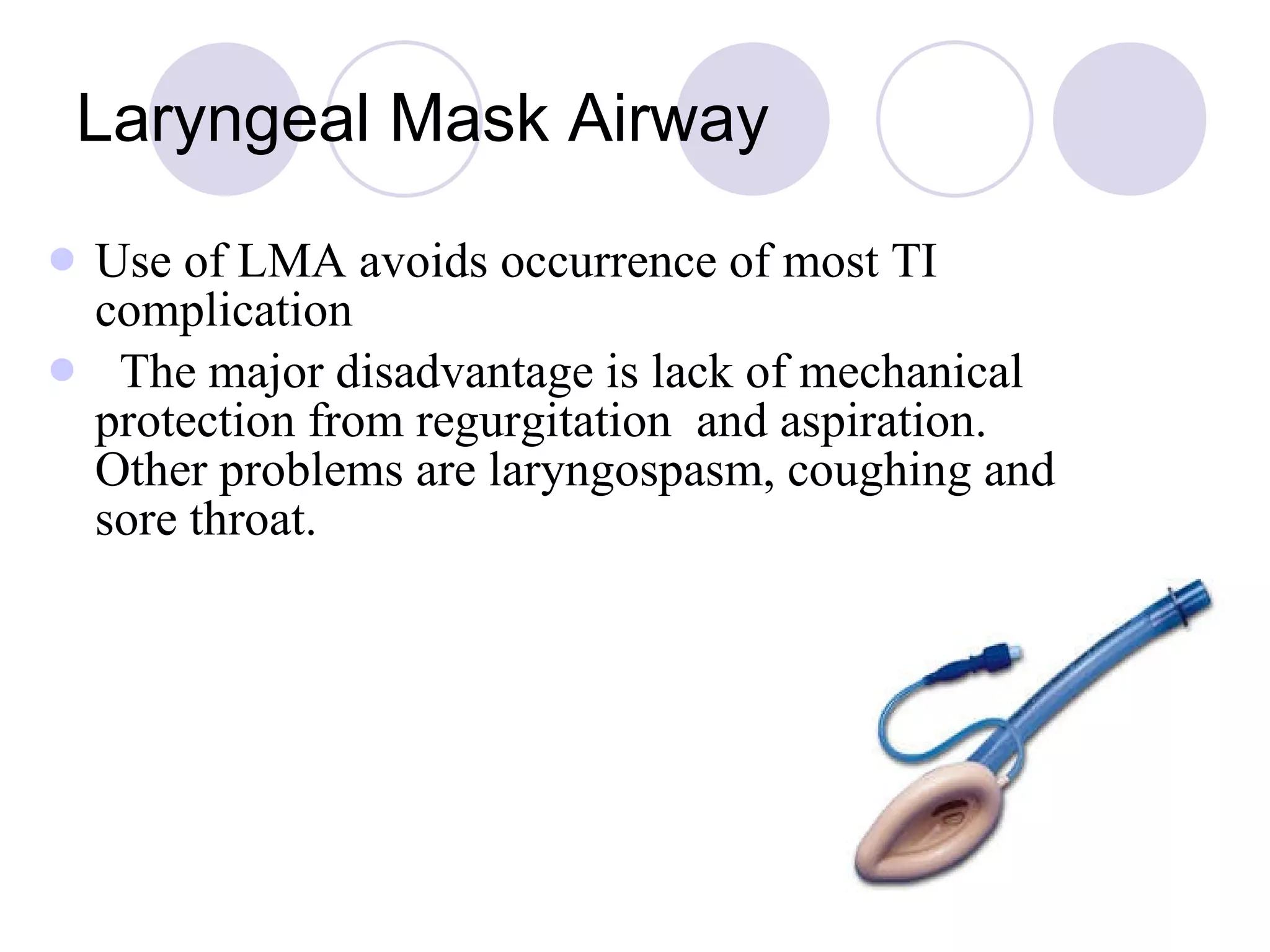
Laryngeal Mask Airway  Use of LMA avoids occurrence of most TI complication The major disadvantage is lack of mechanical protection from regurgitation  and aspiration. Other problems are laryngospasm, coughing and sore throat.

Airway Management

  • 1.
  • 2.
    Tracheal Intubation isuseful to deliver anaesthetic gases directly to trachea and allow control of ventilation and oxygenation and no aspiration . The airway device is maintained in situ from the start to the end of anaesthesia.
  • 3.
    Airway Anatomy SuggestingDifficult Intubation Protruding or receding jaw. Prominent upper incisors. Short Thick Neck Disease of pharynx or larynx Deviation of trachea from midline Stiff joint syndrome, in the TMJ and cervical spines About one third of diabetics characterized by short stature, joint rigidity, and tight waxy skin Positive prayer sign with an inability to oppose fingers Prayer Sign
  • 4.
    Indications of TrachealIntubation In the operating room Maintenance of patent airway Abnormal intraoperative positions Airway inaccessible (eg. Head & Neck surgery) Expected difficulty in use of face mask Airway Protection - From contamination by blood, pus, debris, etc. Use of controlled ventilation - During anaesthesia
  • 5.
    Indications of TrachealIntubation In the operating room Unconscious patient Pulmonary toilet Mechanical ventilation During CPR
  • 6.
    Time to intubate. . . Equipment for intubation Oxygen source ETT Laryngoscope Airways Magill forceps Suction Stylet
  • 7.
    Oral/Nasal Airways Mouldedtubes in different sizes and shaped to curve behind the tongue lifting it away from posterior pharynx. Oral airways are made of hard plastic Nasal airways are made of very soft latex and better tolerated in lightly anaesthesised patient. Uses: Keep airway patent Prevent falling back of tongue in unconsious patients Prevents semiconsoius patient from biting and occluding ETT Prevent biting of tongue in patient with status epilepticus
  • 8.
  • 9.
  • 10.
  • 11.
  • 12.
    Laryngoscope Used for direct inspection of larynx Has 2 separate parts; handle and interchangeable blades
  • 13.
    Laryngoscope There are2 types of laryngoscopes: Macintosh : for adults, with curved blade Miller or Magill : for children, with straight blade
  • 14.
    Laryngoscopescope Made offlexible optical fibres. Used mainly for difficult intubation.
  • 15.
    Endotracheal Tubes ETTfor Fastrach LMA Pediatric uncuffed ETT ETT for blind nasal Standard ETT General features: Made of PVC with low-pressure high-volume cuffs Sizes from 2.5 to 9.0 mm (internal diameter) Radio-opaque incorporated to aid placement Distal end is beveled
  • 16.
    What Size EndotrachealTube ? Adult male 7.5-8 mm Adult female 7-7.5 mm Pediatric (16 + AGE)/4 Nasal intubation Size reduced 1-2 mm
  • 17.
    Types of ETTsThe Robertshaw double-lumen tracheal tube attached to a single-use pediatric pulse oximeter. 1. Portex tubes: - Semirigid, with little tendency to kink. Most commonly used. 2. Rubber tubes: - Soft, easily kinked. 3. Reinforced tubes: - Cuffed or non cuffed. Reinforced with wire to prevent kinking. 4. Special tubes: - Double lumen (Robertshaw). Used for thoracic surgery to isolate the 2 lungs completely.
  • 18.
    TT cuff MostTTs have cuff inflating system consisting of valve, balloon, inflating tube and cuff. Uncuffed tubes used in children to minimise pressure injury Purpose of cuff is: Airtight seal between tube and trachea Protect from aspiration of blood, mucus or vomitus.
  • 19.
    Magill Forceps Designedfor guiding tip of ETT through larynx during nasal intubation. Also helpful during insertion of nasogastric tubes , removal of foreign body in mouth of putting pharyngeal pack .
  • 20.
    Malleable Stylet Thinpeace of metal of plastic Threaded through lumen of ETT Useful when exposure to larynx is difficult Used to change curve of ETT.
  • 21.
    Local Anaesthesia SprayAttenuates haemodynamic response to ETT and reduce intensity of cough reflex at light anaesthesia.
  • 22.
    Position of Head& Neck Sniffing Position Flexion of lower cervical spine & extension of A-O joint Long axes of mouth, pharynx and trachea are in straight line
  • 23.
    Orotracheal Intubation Placethe patient in the correct position. Grasp the laryngoscope in the left hand. Spread the patient's lips, and insert the blade between the teeth, being careful not to break a tooth. Pass the blade to the right of the tongue, and advance the blade into the hypopharynx, pushing the tongue to the left. Lift the laryngoscope upward and forward, without changing the angle of the blade, to expose the vocal cords.
  • 24.
    Orotracheal Intubation Gentlypass the tube next the laryngoscope blade through the vocal cords into trachea, far enough so that the balloon is just beyond the cords. Pressing downward on the thyroid cartilage. This helps bring an anteriorly placed larynx into view and facilitate intubation. Once in place, inflate the cuff till airtight seal is obtained. Confirm that the tube is properly positioned. First, listen over the stomach with a stethoscope while ventilating the patient. If sounds of airflow are heard or if distension of the stomach occurs, the tube is in the esophagus. If the esophagus has been intubated instead of the trachea, remove the tube and try again.
  • 25.
    Orotracheal Intubation Listento each side of the chest, be sure that breath sounds are equal in both sides of the thorax. If not, reposition the tube. When breath sounds are equal on both sides and the thorax rises equally on both sides with each inspiration, note the position of the tube (mark the tube at patient's mouth). Wrap adhesive tape around the tube where it comes out of the mouth. Then carry the tape over the cheek and around the back of the head onto the other cheek. Fasten the end of the tape around the tube. Obtain a chest x-ray film immediately to check tube placement , and also obtain arterial blood gas measurements to assess the adequacy of ventilation.
  • 26.
    Orotracheal Intubation Gentlypass the tube next the laryngoscope blade through the vocal cords into trachea, far enough so that the balloon is just beyond the cords. Pressing downward on the thyroid cartilage. This helps bring an anteriorly placed larynx into view and facilitate intubation. Once in place, inflate the cuff till airtight seal is obtained. Confirm that the tube is properly positioned. First, listen over the stomach with a stethoscope while ventilating the patient. If sounds of airflow are heard or if distension of the stomach occurs, the tube is in the esophagus. If the esophagus has been intubated instead of the trachea, remove the tube and try again.
  • 27.
    Animation of Intubation Actual Intubation
  • 28.
    Nasotracheal Intubation IndicationsOral Surgery Faciomaxillary surgery If mouth need to be closed after surgery Closed mouth Difficult oral intubation Prolonged mechanical ventilation in ICU
  • 29.
    Nasotracheal Intubation ContraindicationsCoagulopathy Severe intranasal pathology Fracture of skull base CSF leak
  • 30.
    Nasotracheal Intubation Technique Apply vasoconstrictor nasal drops Lubricate tube wall. Length should be 2 cm longer and 1-2 mm smaller diameter Guide the tube slowly but firmly into the nasal passage, going up from the nostril (to avoid the large inferior turbinate) and then backward and down into the nasopharynx Proceed with the procedure as an orotracheal intubation, guiding the tube through the vocal cords with a Magill’s forceps
  • 31.
    Nasotracheal Intubation Technique(blind intubation) Blind nasal intubation is tried if laryngoscopy isn’t feasible The patient is allowed to breathe during induction of anaesthesia to facilitate intubation Tube is inserted till maximun breath sounds are heard Tube is then blindly inserted into glottis during inspiration
  • 32.
    Methods of Anaesthesiafor TI General Anaesthesia (GA) by rapid IV agent In children, induction is done by inhalational agent ETI can be done without muscle relaxant under deep anaesthesia Intubation through tracheal stoma can be done without GA, muscle relaxant or laryngoscope Awake intubation using only topical anaesthesia. Indicated in patients whom induction is unsafe unless airway is secured first ETI can be done without anaesthesia in comatose patients or during CPR
  • 33.
    Extubation Muscle relaxantfully reversed Patient awake & responsive, sable vital signs 100% oxygen at high flow 2-3 min Remove secretion in trachea or pharynx Turn patient to lateral position Defkate cuff and remove ETT during inspiration Continue 100% oxygen by facemask Extubation in semiconscious patient can provoke laryngospasm
  • 34.
    Complications of Laryngoscopy& ETI A) During Intubation Prologned attempt : hypoxia – hypercapnia – risk of aspiration With inadequate anesthesia : Coughing – Laryngospasm - Bronchospasm Trauma Bruising lips,tongue,pharynx Fracture,chipping,dislogement of teeth Perforation trachea,esophagus Fracture or dislocation cervical spine Dislocation arytenoid cartilages or mandible Endobronchial intubation Oesophageal intubation Nasal Intubation Epistaxis Mucosal damage Displaced polyp or adenoid Bacteraemia from nasal obstruction Haemodynamic response to laryngoscopy * Hypertension, tachycardia, arrhythmia (bradycardia in children) * Common at light anesthesia, dangerous to cardiacs * Minimized by deep anesthsia, propofol induction
  • 35.
    Complications of Laryngoscopy& ETI B) With tube in situ -Accidental extubation -Endobronchial intubation -Tube malfunction Obstruction / kinking Ignition of tube by laser device Cuff perforation -Bronchospasm -Aspiration -Sinusitis -Excoriation of nose or mouth
  • 36.
    Complications of Laryngoscopy& ETI C) After extubation Haemodynamic response Hypoxia Laryngospasm Common in semiconscious Better extubate in deep anesthesia or awake patient Treated with giving oxygen via facemask Pulmonary Oedema : dt. Prolonged powerful inspiratory effort against closed epiglottis – require re-intubation Stridor or croup due to oedema in subglottic region in children. Hoarsness and sore throat VC paralysis – Granuloma of cords – Laryngeal or tracheal Stenosis Watch demo
  • 37.
    The Laryngeal MaskAirway (LMA)
  • 38.
    The Laryngeal MaskAirway (LMA) New device to maintain airway during anesthesia when TI is not desired. It’s easier in insertion and has high rate of success It’s made in 8 sizes to suite neonates, children and adults. Better inserted with propofol (that depresses laryngeal reflex) or deep inhalation anesthesia. After adequate anesthesia, LMA is inserted to mouth blindly without laryngoscope and pushed downward till resistance is felt. The cough is then inflated.
  • 39.
    The Laryngeal MaskAirway (LMA) Video of insertion of an LMA
  • 40.
    Laryngeal Mask Airway Uses In short procedures Life-saving difficult intubation Conduit for smooth emergence Way of intubation in difficult cases Contraindications Increased risk of aspiration Full stomach
  • 41.
    Laryngeal Mask Airway Use of LMA avoids occurrence of most TI complication The major disadvantage is lack of mechanical protection from regurgitation and aspiration. Other problems are laryngospasm, coughing and sore throat.