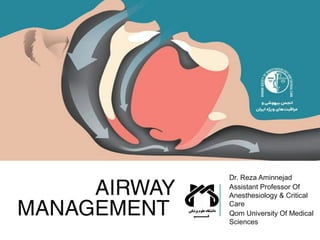
AIRWAY
MANAGEMENT
Dr. Reza Aminnejad
Assistant Professor Of
Anesthesiology & Critical
Care
Qom University Of Medical
Sciences
OBJECTIVES
Review aims of airway management
Review airway anatomy
Review airway examination
Review basic airway maneuvers
Review blind insertion airways
Review advanced airway techniques
AIMS OF AIRWAY
MANAGEMENT
Airway management in critical situations (life support)
Airway management in elective cases (surgical purposes)
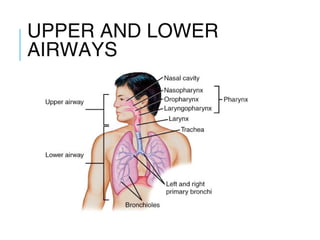
UPPER AND LOWER
AIRWAYS
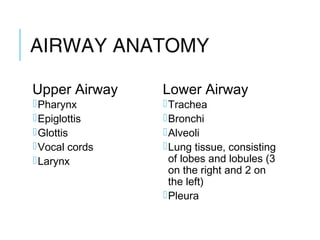
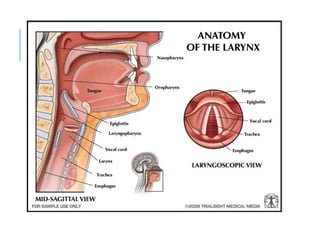
AIRWAY ANATOMY
Upper Airway
Pharynx
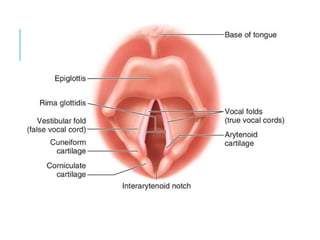
Epiglottis
Glottis
Vocal cords
Larynx
Lower Airway
Trachea
Bronchi
Alveoli
Lung tissue, consisting
of lobes and lobules (3
on the right and 2 on
the left)
Pleura
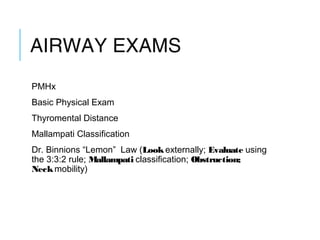
AIRWAY EXAMS
PMHx
Basic Physical Exam
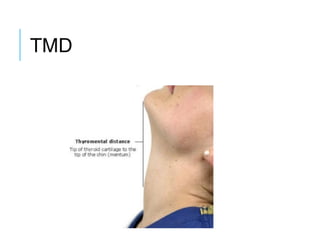
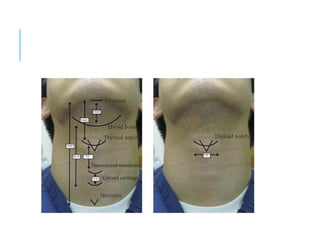
Thyromental Distance
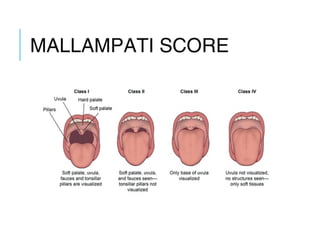
Mallampati Classification
Dr. Binnions “Lemon” Law (Look externally; Evaluate using
the 3:3:2 rule; Mallampati classification; Obstruction;
Neck mobility)
TMD
MALLAMPATI SCORE
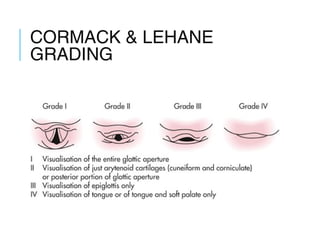
CORMACK & LEHANE
GRADING
BASIC AIRWAY
MANEUVERS
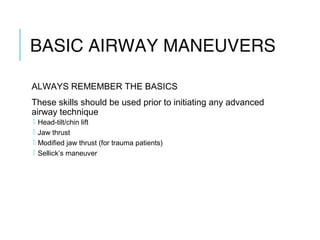
ALWAYS REMEMBER THE BASICS
These skills should be used prior to initiating any advanced
airway technique
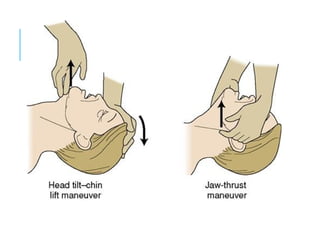
 Head-tilt/chin lift
 Jaw thrust
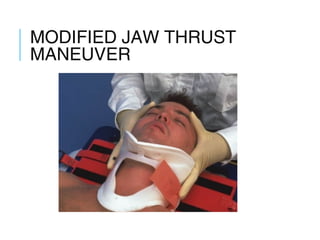
 Modified jaw thrust (for trauma patients)
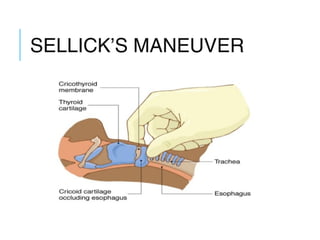
 Sellick’s maneuver
MODIFIED JAW THRUST
MANEUVER
SELLICK’S MANEUVER
OROPHARYNGEAL
AIRWAY
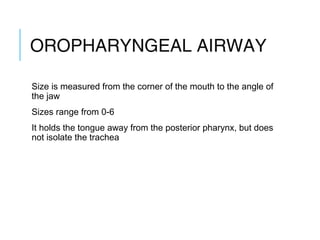
Size is measured from the corner of the mouth to the angle of
the jaw
Sizes range from 0-6
It holds the tongue away from the posterior pharynx, but does
not isolate the trachea
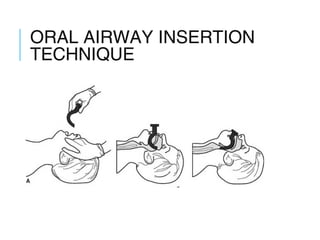
ORAL AIRWAY INSERTION
TECHNIQUE
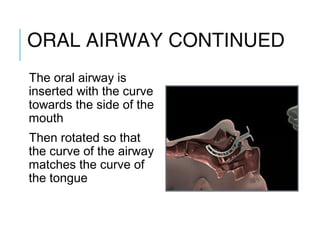
ORAL AIRWAY CONTINUED
The oral airway is
inserted with the curve
towards the side of the
mouth
Then rotated so that
the curve of the airway
matches the curve of
the tongue
NASOPHARYNGEAL
AIRWAY
Soft plastic or rubber tube that is designed to
pass just inferior to the base of the tongue
Passed through one of the nares and can be
used in patients with an intact gag reflex
CONTRAINDICATED in cases of suspected or
possible basilar skull fracture
Sizes range from 17-26 cm in length and 6-9
mm internal diameter
Measured from tip of the nose to the corner of
the patients ear
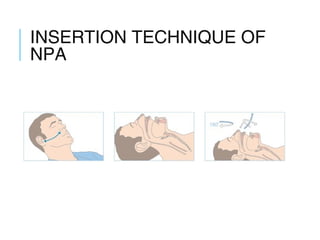
INSERTION TECHNIQUE
OF NPA
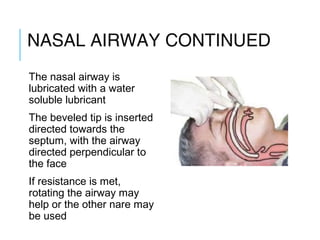
NASAL AIRWAY
CONTINUED
The nasal airway is
lubricated with a water
soluble lubricant
The beveled tip is inserted
directed towards the
septum, with the airway
directed perpendicular to
the face
If resistance is met,
rotating the airway may
help or the other nare may
be used
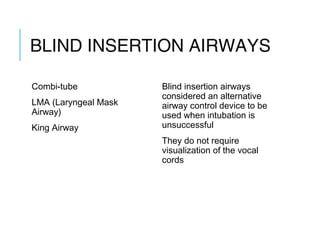
BLIND INSERTION
AIRWAYS
Combi-tube
LMA (Laryngeal Mask
Airway)
King Airway
Blind insertion airways
considered an alternative
airway control device to be
used when intubation is
unsuccessful
They do not require
visualization of the vocal
cords
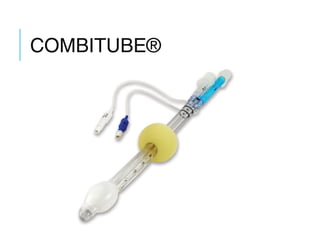
COMBITUBE®
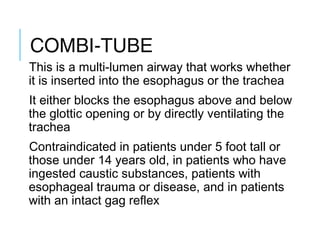
COMBI-TUBE
This is a multi-lumen airway that works whether
it is inserted into the esophagus or the trachea
It either blocks the esophagus above and below
the glottic opening or by directly ventilating the
trachea
Contraindicated in patients under 5 foot tall or
those under 14 years old, in patients who have
ingested caustic substances, patients with
esophageal trauma or disease, and in patients
with an intact gag reflex
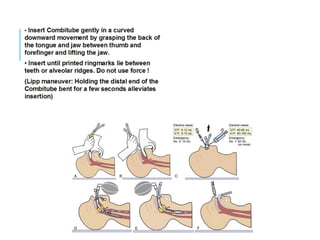
COMBITUBE INSERTION
TECHNIQUE
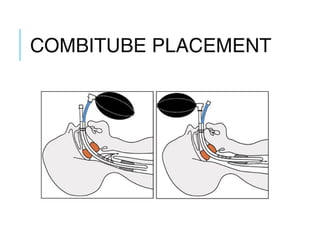
COMBITUBE PLACEMENT
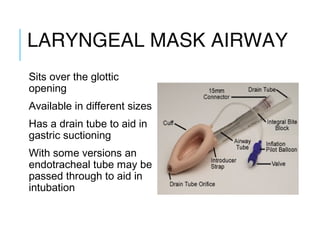
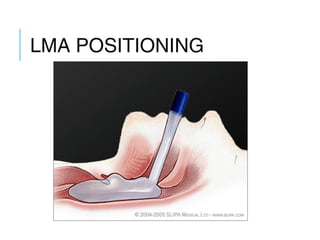
LARYNGEAL MASK AIRWAY
Sits over the glottic
opening
Available in different sizes
Has a drain tube to aid in
gastric suctioning
With some versions an
endotracheal tube may be
passed through to aid in
intubation
LMA POSITIONING
LMA CLASSIC
Designed in 1981 by Dr Archie Brain
Specified in difficult airway management
Can not protect aspiration
Can not be used for pulmonary toilet
On insertion the Backward folding of the cuff (tip roll) causes
resistance
LMA is Less Stimulating than ETT
Remove it awake in adults and deep in children
LMA ADVANTAGE
Rapidity and ease of placement
Improved hemodynamic stability
Minimal rise in intraocular pressure
Reduced anesthesia requirements
Reduced cough on emergence
Lower incidence of sore throat in adults
Its utility in difficult intubation
LMA DISADVANTAGES
No protection against aspiration
Gastric insufflations
Air leak with positive pressure ventilation
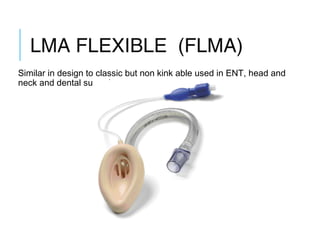
LMA FLEXIBLE (FLMA)
Similar in design to classic but non kink able used in ENT, head and
neck and dental surgeries.
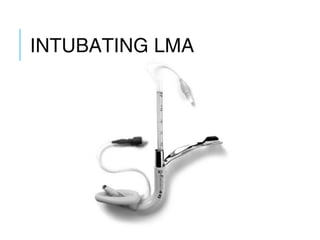
INTUBATING LMA
LMA FASTRACK (ILMA)
Designed by Dr Brain
Reusable, easy to use, and high success
rate
Intubation may be difficult if mouth opens
less than 20 mm
Its better to withdraw the device after
intubation
ILMA
Ventilation and intubation can be successfully
achieved in obese patients (BMI >30)
Accepted in guideline of unanticipated difficult
airway in non obstetrical patents
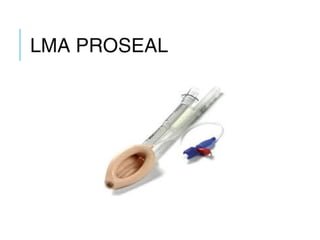
LMA PROSEAL
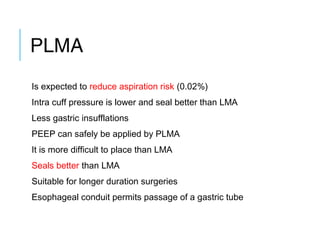
PLMA
Is expected to reduce aspiration risk (0.02%)
Intra cuff pressure is lower and seal better than LMA
Less gastric insufflations
PEEP can safely be applied by PLMA
It is more difficult to place than LMA
Seals better than LMA
Suitable for longer duration surgeries
Esophageal conduit permits passage of a gastric tube
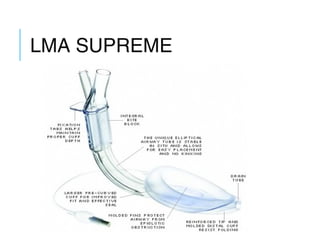
LMA SUPREME
LMA SUPREME
Sealling pressure is like PLMA
Ease of intubation is like CLASSIC
Single use as unique
Has drainage tube as PLMA
Latex free
Candidate for CPR
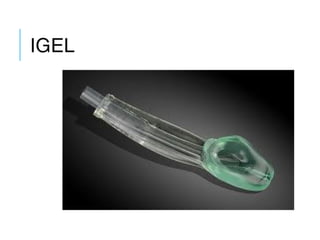
IGEL
IGEL
Single use thermoplastic device in size 3-5
There is no cuff
Has a gastric drainage
Seals better than Proseal and LMA (but if there is a leak you
must change the iGEL)
Drainage tube of iGEL is smaller than Proseal
iGEL is the easiest EGD to insert (98%)
COMBITUBE (CBT)
Easily inserted highly efficacious device
Primary rescue device in CVCI
Successfully used in CPR
Has 2 rings on proximal end that upper teeth are situated
between them
Size 37F for adults with height of 120-180cm and 41F for
tallers
Distal balloon needs 10 cc & proximal one needs 80-100 cc air
for insuflation
It enters to the esophagus in 95% of cases
CBT
May be kept in place for 8 hours and allows high pressure
ventilation (50 cmH20)
Can be used in bleeding and aspiration situations
Does not need neck extension for insertion (it only requires
modest mouth opening)
Doesn't need any cervical manipulation
DISADVANTAGES OF CBT
Suction of trachea is impossible with CBT
Complications such as subcutaneous emphysema,
pneumomediastinum and pneumoperitoneum should be
considered.
Esophageal rupture and tongue engorgement are rare
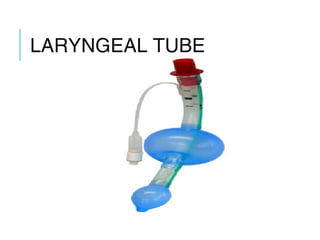
LARYNGEAL TUBE
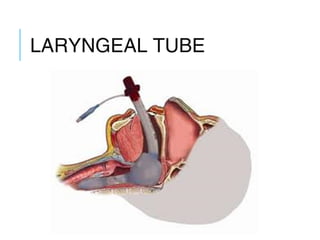
LARYNGEAL TUBE IN
PLACE
LARYNGEAL TUBE (LT)
Silicon airway tube
Requires 23mm mouth opening
Has single inflation pilot balloon apparatus
Amount of air needed depends on size and is indicated on a
syringe that is included
Cuff pressure should be limited to 60cm H20
Its is very easy to insert, black line on proximal part shall align
upper teeth
LARYNGEAL TUBE
ADVANTEGES
Easy to insert
Non traumatic
Good seal
Adequacy of ventilation
Efficient use in children
>2y
Protection of GE-Reflux
DISADVANTEGES
Aspiration protection
is less than offered
Cuff pressure may
increase in
concomitant N2O
usage
LMA is better in
children under 10
years
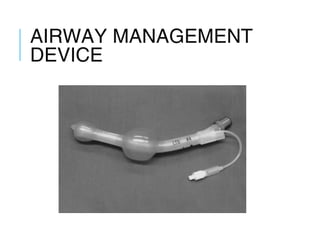
AIRWAY MANAGEMENT
DEVICE
AIRWAY MANAGEMENT
DEVICE
(AMD)
Is a clear silicon dual lumen tube
Proximal port is y shaped )one a channel to esophagus and
second for delivering anesthetic gases)
Esophageal cuff should filled with 5-9 cc air
Pharyngeal cuff needs 50-80 cc air for full filling
It is available in 3-3.5 size for a 30-60 kg patient
Size 4-5 for patients weighing >60 kg
It is hard to insert successfully in 66% cases at the first time
Loss of airway during anesthesia has been reported
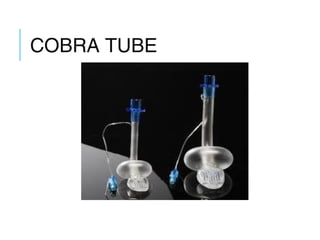
COBRA TUBE
COBRA PLA
Cobra shaped EGDs are available in eight sizes (3 for females
& 4 for males)
Cobra PLUS has a temperature probe and a gas sampling line
for pediatric patients
It Should be removed awake (while reflexes are intact)
COBRA PLA
Advantages
larger lumen
can be used as ETT
conduit
seals better than
LMA
is better in limited
mouth opening
Disadvantages
takes longer to insert
no reflux protection
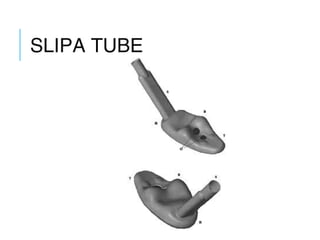
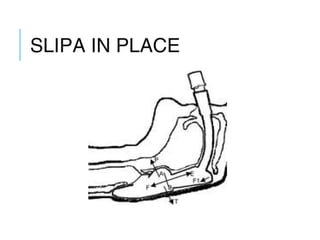
SLIPA TUBE
SLIPA IN PLACE
SLIPA
Designed by Dr. Miller (South Africa)
Soft plastic hallow boot shaped with heel
Has higher rate of gastric insufflations (19%) compared to LMA (3%)
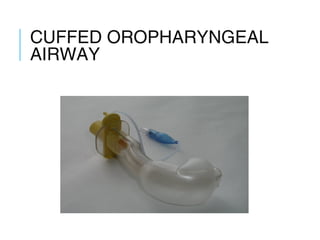
CUFFED
OROPHARYNGEAL
AIRWAY
CUFFED
OROPHARYNGEAL
AIRWAY
COPA
Is modified GUDEL airway with a distal cuff and a 15mm connector
Described in 1992 for spontaneously breathing patients (no longer
manufactured)
LMA TAKE-HOME POINTS
Test cuff before use
Don’t lubricate anterior mask
Insert only in comatose patient
Keep cuff inflated until patient awake
ADVANCED AIRWAYS
Orotracheal Intubation
Nasotracheal Intubation
Digital Intubation
Surgical Airways
INDICATIONS OF
INTUBATION
Airway protection
Maintaining oxygenation
Continuing ventilation
Delivering some drugs
Anticipating upcoming needs
DIFFICULT INTUBATION
Definition
If proper tube insertion needs
more than 3 consecutive
attempts
or
If proper tube insertion
prolongs more than 10
minutes.
What should be
considered?
Need for help
Awake intubation
Appropriate equipments
Plan B
OROTRACHEAL
INTUBATION
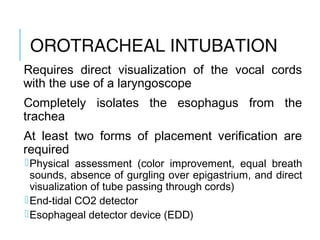
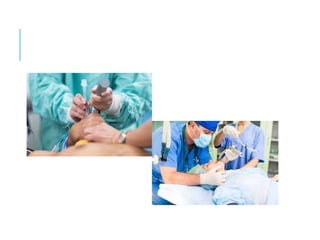
Requires direct visualization of the vocal cords
with the use of a laryngoscope
Completely isolates the esophagus from the
trachea
At least two forms of placement verification are
required
Physical assessment (color improvement, equal breath
sounds, absence of gurgling over epigastrium, and direct
visualization of tube passing through cords)
End-tidal CO2 detector
Esophageal detector device (EDD)
PATIENT PREPARATION
Patient should be informed of the risk & the planning of
intubation (awake)
Premedication (atropine/sedatives)
An assistant should be available
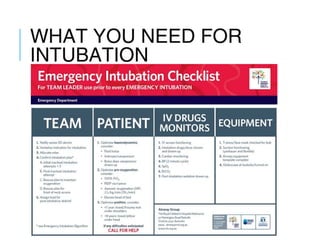
WHAT YOU NEED FOR
INTUBATION
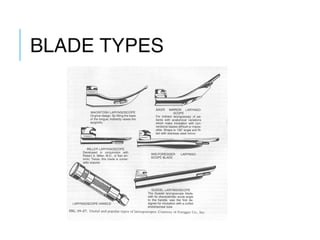
BLADE TYPES
OROTRACHEAL
INTUBATION
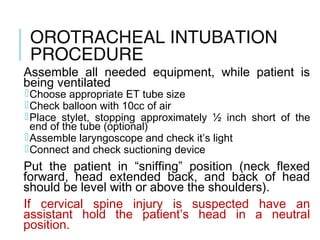
PROCEDUREAssemble all needed equipment, while patient is
being ventilated
Choose appropriate ET tube size
Check balloon with 10cc of air
Place stylet, stopping approximately ½ inch short of the
end of the tube (optional)
Assemble laryngoscope and check it’s light
Connect and check suctioning device
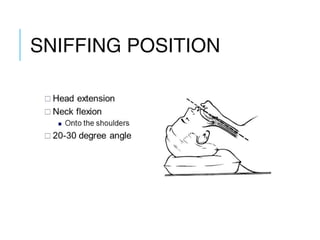
Put the patient in “sniffing” position (neck flexed
forward, head extended back, and back of head
should be level with or above the shoulders).
If cervical spine injury is suspected have an
assistant hold the patient’s head in a neutral
position.
SNIFFING POSITION
INTUBATION
(CONTINUED)
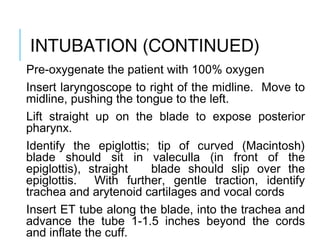
Pre-oxygenate the patient with 100% oxygen
Insert laryngoscope to right of the midline. Move to
midline, pushing the tongue to the left.
Lift straight up on the blade to expose posterior
pharynx.
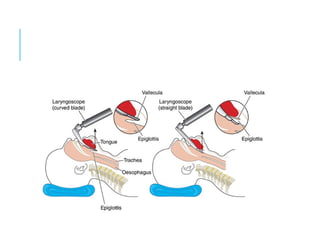
Identify the epiglottis; tip of curved (Macintosh)
blade should sit in valeculla (in front of the
epiglottis), straight blade should slip over the
epiglottis. With further, gentle traction, identify
trachea and arytenoid cartilages and vocal cords
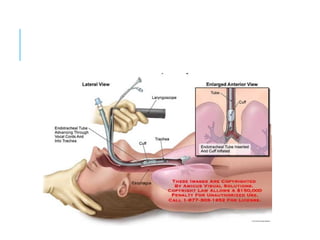
Insert ET tube along the blade, into the trachea and
advance the tube 1-1.5 inches beyond the cords
and inflate the cuff.
INTUBATION
(CONTINUED)
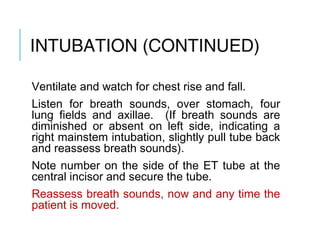
Ventilate and watch for chest rise and fall.
Listen for breath sounds, over stomach, four
lung fields and axillae. (If breath sounds are
diminished or absent on left side, indicating a
right mainstem intubation, slightly pull tube back
and reassess breath sounds).
Note number on the side of the ET tube at the
central incisor and secure the tube.
Reassess breath sounds, now and any time the
patient is moved.
NASOTRACH
EAL
INTUBATION
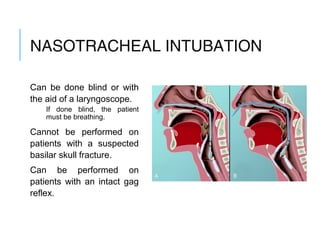
Can be done blind or with
the aid of a laryngoscope.
If done blind, the patient
must be breathing.
Cannot be performed on
patients with a suspected
basilar skull fracture.
Can be performed on
patients with an intact gag
reflex.
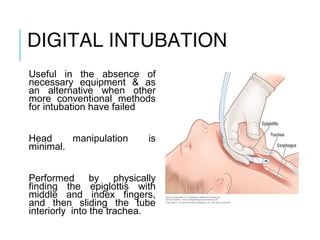
DIGITAL INTUBATION
Useful in the absence of
necessary equipment & as
an alternative when other
more conventional methods
for intubation have failed
Head manipulation is
minimal.
Performed by physically
finding the epiglottis with
middle and index fingers,
and then sliding the tube
interiorly into the trachea.
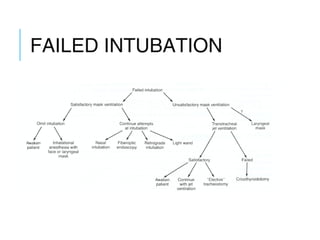
FAILED INTUBATION
A. FLEXIBLE FIBEROPTIC
SCOPE
FIBEROPTIC
LARYNGOSCOPY
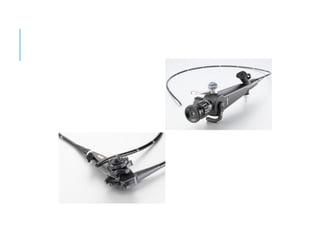
FLEXIBLE FIBEROPTIC
SCOPE
Advantages
Allows direct airway visualization
Causes little hemodynamic stress
Nasotracheal or orotracheal route can be used
Can be done in all age groups
Requires minimal neck movements
FLEXIBLE FIBEROPTIC
SCOPE
Disadvantages
Expensive
Expertise requires practice
Delicate equipment needs careful maintenance
Visual field easily impaired by blood and secretions
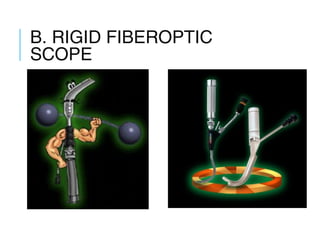
B. RIGID FIBEROPTIC
SCOPE
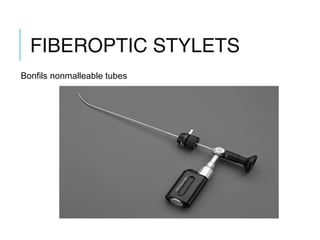
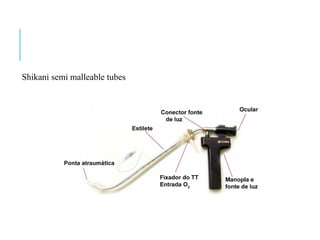
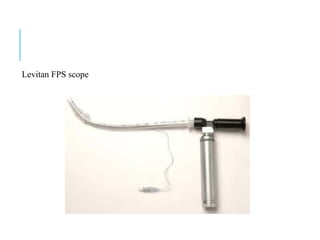
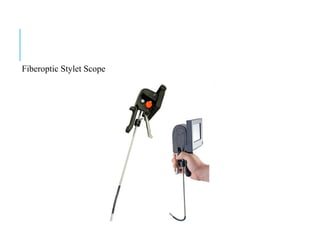
FIBEROPTIC STYLETS
Bonfils nonmalleable tubes
Shikani semi malleable tubes
Levitan FPS scope
Fiberoptic Stylet Scope
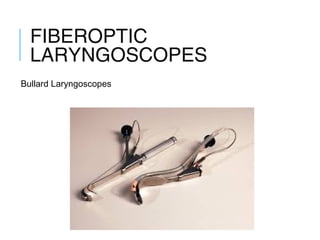
FIBEROPTIC
LARYNGOSCOPES
Bullard Laryngoscopes
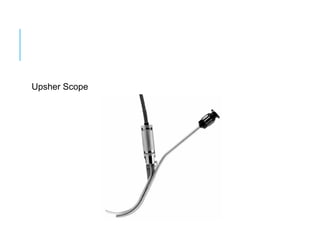
Upsher Scope
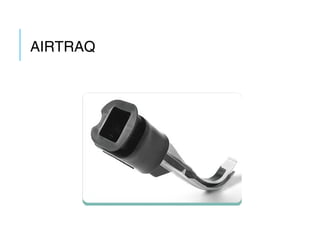
AIRTRAQ
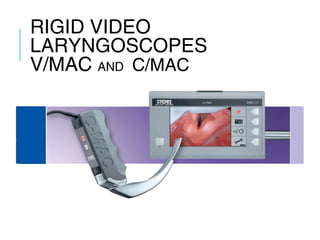
RIGID VIDEO
LARYNGOSCOPES
V/MAC AND C/MAC
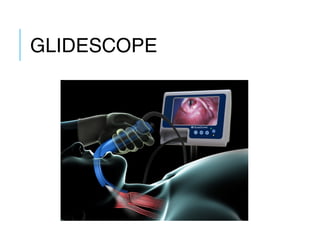
GLIDESCOPE
RIGID VIDEO
LARYNGOSCOPES
are simple to use/ no wires/ portable
low cost/ compact and light weight
easy insertion/ no damage
good exposure/ high success rate
non problematic tube passage
works well with restricted neck movement
fogging is not a limitation
are very useful in morbid obese patients and low grade
Cormack score
RIGID FIBEROPTIC
LARYNGOSCOPES
they have working channel
allow visual controlled ETT insertion
give wider visual field
anatomical field more identifiable
fogging and secretions are still problematic
does not need extended cervical extension
they give superior glottic view but directing ETT is an
obstacle to success
RIGID FIBEROPTIC
SCOPE
Advantages
Direct airway visualization
Minimal neck movement
May overcome difficult view
Useful in disrupted airway
Durable, sturdy instruments
RIGID FIBEROPTIC
SCOPE
Disadvantages
Expensive
Expertise requires practice
Visual field easily impaired by blood and secretions
Not readily available
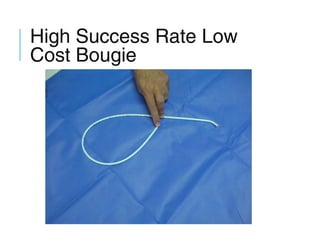
High Success Rate Low
Cost Bougie
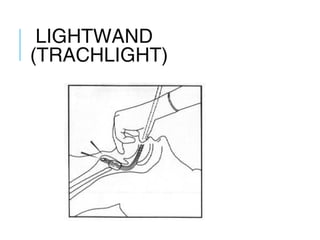
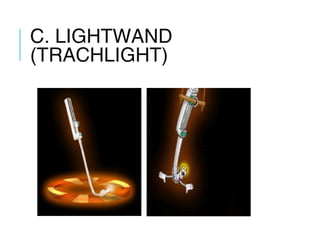
C. LIGHTWAND
(TRACHLIGHT)
LIGHTWAND
(TRACHLIGHT)
LIGHTWAND
(TRACHLIGHT)
Disadvantages
Blind technique
May damage airway
Usually requires darkened room
Expertise requires practice
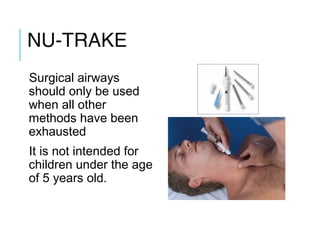
NU-TRAKE
Surgical airways
should only be used
when all other
methods have been
exhausted
It is not intended for
children under the age
of 5 years old.
SUMMARY
Always remember the ABCs, without an airway your patient will
not survive.
There are several ways to manage a patient’s airway.
Don’t forget the basics, all your patient may need is for
someone to open their airway, to start improving.
IT’S NOT OVER …
Any question?
MANY THANKS FOR
YOUR KIND
ATTENTION
Many thanks to Dr. S.
Malek for sharing his
valuable slides on this
topic.

Airway Management

  • 1.
    AIRWAY MANAGEMENT Dr. Reza Aminnejad AssistantProfessor Of Anesthesiology & Critical Care Qom University Of Medical Sciences
  • 2.
    OBJECTIVES Review aims ofairway management Review airway anatomy Review airway examination Review basic airway maneuvers Review blind insertion airways Review advanced airway techniques
  • 3.
    AIMS OF AIRWAY MANAGEMENT Airwaymanagement in critical situations (life support) Airway management in elective cases (surgical purposes)
  • 4.
  • 5.
    AIRWAY ANATOMY Upper Airway Pharynx Epiglottis Glottis Vocalcords Larynx Lower Airway Trachea Bronchi Alveoli Lung tissue, consisting of lobes and lobules (3 on the right and 2 on the left) Pleura
  • 8.
    AIRWAY EXAMS PMHx Basic PhysicalExam Thyromental Distance Mallampati Classification Dr. Binnions “Lemon” Law (Look externally; Evaluate using the 3:3:2 rule; Mallampati classification; Obstruction; Neck mobility)
  • 9.
  • 11.
  • 12.
  • 13.
    BASIC AIRWAY MANEUVERS ALWAYS REMEMBERTHE BASICS These skills should be used prior to initiating any advanced airway technique  Head-tilt/chin lift  Jaw thrust  Modified jaw thrust (for trauma patients)  Sellick’s maneuver
  • 15.
  • 16.
  • 17.
    OROPHARYNGEAL AIRWAY Size is measuredfrom the corner of the mouth to the angle of the jaw Sizes range from 0-6 It holds the tongue away from the posterior pharynx, but does not isolate the trachea
  • 18.
  • 19.
    ORAL AIRWAY CONTINUED Theoral airway is inserted with the curve towards the side of the mouth Then rotated so that the curve of the airway matches the curve of the tongue
  • 20.
    NASOPHARYNGEAL AIRWAY Soft plastic orrubber tube that is designed to pass just inferior to the base of the tongue Passed through one of the nares and can be used in patients with an intact gag reflex CONTRAINDICATED in cases of suspected or possible basilar skull fracture Sizes range from 17-26 cm in length and 6-9 mm internal diameter Measured from tip of the nose to the corner of the patients ear
  • 21.
  • 22.
    NASAL AIRWAY CONTINUED The nasalairway is lubricated with a water soluble lubricant The beveled tip is inserted directed towards the septum, with the airway directed perpendicular to the face If resistance is met, rotating the airway may help or the other nare may be used
  • 23.
    BLIND INSERTION AIRWAYS Combi-tube LMA (LaryngealMask Airway) King Airway Blind insertion airways considered an alternative airway control device to be used when intubation is unsuccessful They do not require visualization of the vocal cords
  • 24.
  • 25.
    COMBI-TUBE This is amulti-lumen airway that works whether it is inserted into the esophagus or the trachea It either blocks the esophagus above and below the glottic opening or by directly ventilating the trachea Contraindicated in patients under 5 foot tall or those under 14 years old, in patients who have ingested caustic substances, patients with esophageal trauma or disease, and in patients with an intact gag reflex
  • 26.
  • 27.
  • 28.
    LARYNGEAL MASK AIRWAY Sitsover the glottic opening Available in different sizes Has a drain tube to aid in gastric suctioning With some versions an endotracheal tube may be passed through to aid in intubation
  • 29.
  • 30.
    LMA CLASSIC Designed in1981 by Dr Archie Brain Specified in difficult airway management Can not protect aspiration Can not be used for pulmonary toilet On insertion the Backward folding of the cuff (tip roll) causes resistance LMA is Less Stimulating than ETT Remove it awake in adults and deep in children
  • 31.
    LMA ADVANTAGE Rapidity andease of placement Improved hemodynamic stability Minimal rise in intraocular pressure Reduced anesthesia requirements Reduced cough on emergence Lower incidence of sore throat in adults Its utility in difficult intubation
  • 32.
    LMA DISADVANTAGES No protectionagainst aspiration Gastric insufflations Air leak with positive pressure ventilation
  • 33.
    LMA FLEXIBLE (FLMA) Similarin design to classic but non kink able used in ENT, head and neck and dental surgeries.
  • 34.
  • 35.
    LMA FASTRACK (ILMA) Designedby Dr Brain Reusable, easy to use, and high success rate Intubation may be difficult if mouth opens less than 20 mm Its better to withdraw the device after intubation
  • 36.
    ILMA Ventilation and intubationcan be successfully achieved in obese patients (BMI >30) Accepted in guideline of unanticipated difficult airway in non obstetrical patents
  • 37.
  • 38.
    PLMA Is expected toreduce aspiration risk (0.02%) Intra cuff pressure is lower and seal better than LMA Less gastric insufflations PEEP can safely be applied by PLMA It is more difficult to place than LMA Seals better than LMA Suitable for longer duration surgeries Esophageal conduit permits passage of a gastric tube
  • 39.
  • 40.
    LMA SUPREME Sealling pressureis like PLMA Ease of intubation is like CLASSIC Single use as unique Has drainage tube as PLMA Latex free Candidate for CPR
  • 41.
  • 42.
    IGEL Single use thermoplasticdevice in size 3-5 There is no cuff Has a gastric drainage Seals better than Proseal and LMA (but if there is a leak you must change the iGEL) Drainage tube of iGEL is smaller than Proseal iGEL is the easiest EGD to insert (98%)
  • 43.
    COMBITUBE (CBT) Easily insertedhighly efficacious device Primary rescue device in CVCI Successfully used in CPR Has 2 rings on proximal end that upper teeth are situated between them Size 37F for adults with height of 120-180cm and 41F for tallers Distal balloon needs 10 cc & proximal one needs 80-100 cc air for insuflation It enters to the esophagus in 95% of cases
  • 44.
    CBT May be keptin place for 8 hours and allows high pressure ventilation (50 cmH20) Can be used in bleeding and aspiration situations Does not need neck extension for insertion (it only requires modest mouth opening) Doesn't need any cervical manipulation
  • 45.
    DISADVANTAGES OF CBT Suctionof trachea is impossible with CBT Complications such as subcutaneous emphysema, pneumomediastinum and pneumoperitoneum should be considered. Esophageal rupture and tongue engorgement are rare
  • 46.
  • 47.
  • 48.
    LARYNGEAL TUBE (LT) Siliconairway tube Requires 23mm mouth opening Has single inflation pilot balloon apparatus Amount of air needed depends on size and is indicated on a syringe that is included Cuff pressure should be limited to 60cm H20 Its is very easy to insert, black line on proximal part shall align upper teeth
  • 49.
    LARYNGEAL TUBE ADVANTEGES Easy toinsert Non traumatic Good seal Adequacy of ventilation Efficient use in children >2y Protection of GE-Reflux DISADVANTEGES Aspiration protection is less than offered Cuff pressure may increase in concomitant N2O usage LMA is better in children under 10 years
  • 50.
  • 51.
    AIRWAY MANAGEMENT DEVICE (AMD) Is aclear silicon dual lumen tube Proximal port is y shaped )one a channel to esophagus and second for delivering anesthetic gases) Esophageal cuff should filled with 5-9 cc air Pharyngeal cuff needs 50-80 cc air for full filling It is available in 3-3.5 size for a 30-60 kg patient Size 4-5 for patients weighing >60 kg It is hard to insert successfully in 66% cases at the first time Loss of airway during anesthesia has been reported
  • 52.
  • 53.
    COBRA PLA Cobra shapedEGDs are available in eight sizes (3 for females & 4 for males) Cobra PLUS has a temperature probe and a gas sampling line for pediatric patients It Should be removed awake (while reflexes are intact)
  • 54.
    COBRA PLA Advantages larger lumen canbe used as ETT conduit seals better than LMA is better in limited mouth opening Disadvantages takes longer to insert no reflux protection
  • 55.
  • 56.
  • 57.
    SLIPA Designed by Dr.Miller (South Africa) Soft plastic hallow boot shaped with heel Has higher rate of gastric insufflations (19%) compared to LMA (3%)
  • 58.
  • 59.
    CUFFED OROPHARYNGEAL AIRWAY COPA Is modified GUDELairway with a distal cuff and a 15mm connector Described in 1992 for spontaneously breathing patients (no longer manufactured)
  • 60.
    LMA TAKE-HOME POINTS Testcuff before use Don’t lubricate anterior mask Insert only in comatose patient Keep cuff inflated until patient awake
  • 62.
    ADVANCED AIRWAYS Orotracheal Intubation NasotrachealIntubation Digital Intubation Surgical Airways
  • 63.
    INDICATIONS OF INTUBATION Airway protection Maintainingoxygenation Continuing ventilation Delivering some drugs Anticipating upcoming needs
  • 64.
    DIFFICULT INTUBATION Definition If propertube insertion needs more than 3 consecutive attempts or If proper tube insertion prolongs more than 10 minutes. What should be considered? Need for help Awake intubation Appropriate equipments Plan B
  • 65.
    OROTRACHEAL INTUBATION Requires direct visualizationof the vocal cords with the use of a laryngoscope Completely isolates the esophagus from the trachea At least two forms of placement verification are required Physical assessment (color improvement, equal breath sounds, absence of gurgling over epigastrium, and direct visualization of tube passing through cords) End-tidal CO2 detector Esophageal detector device (EDD)
  • 66.
    PATIENT PREPARATION Patient shouldbe informed of the risk & the planning of intubation (awake) Premedication (atropine/sedatives) An assistant should be available
  • 67.
    WHAT YOU NEEDFOR INTUBATION
  • 68.
  • 69.
    OROTRACHEAL INTUBATION PROCEDUREAssemble all neededequipment, while patient is being ventilated Choose appropriate ET tube size Check balloon with 10cc of air Place stylet, stopping approximately ½ inch short of the end of the tube (optional) Assemble laryngoscope and check it’s light Connect and check suctioning device Put the patient in “sniffing” position (neck flexed forward, head extended back, and back of head should be level with or above the shoulders). If cervical spine injury is suspected have an assistant hold the patient’s head in a neutral position.
  • 70.
  • 71.
    INTUBATION (CONTINUED) Pre-oxygenate the patientwith 100% oxygen Insert laryngoscope to right of the midline. Move to midline, pushing the tongue to the left. Lift straight up on the blade to expose posterior pharynx. Identify the epiglottis; tip of curved (Macintosh) blade should sit in valeculla (in front of the epiglottis), straight blade should slip over the epiglottis. With further, gentle traction, identify trachea and arytenoid cartilages and vocal cords Insert ET tube along the blade, into the trachea and advance the tube 1-1.5 inches beyond the cords and inflate the cuff.
  • 72.
    INTUBATION (CONTINUED) Ventilate and watchfor chest rise and fall. Listen for breath sounds, over stomach, four lung fields and axillae. (If breath sounds are diminished or absent on left side, indicating a right mainstem intubation, slightly pull tube back and reassess breath sounds). Note number on the side of the ET tube at the central incisor and secure the tube. Reassess breath sounds, now and any time the patient is moved.
  • 76.
    NASOTRACH EAL INTUBATION Can be doneblind or with the aid of a laryngoscope. If done blind, the patient must be breathing. Cannot be performed on patients with a suspected basilar skull fracture. Can be performed on patients with an intact gag reflex.
  • 77.
    DIGITAL INTUBATION Useful inthe absence of necessary equipment & as an alternative when other more conventional methods for intubation have failed Head manipulation is minimal. Performed by physically finding the epiglottis with middle and index fingers, and then sliding the tube interiorly into the trachea.
  • 78.
  • 79.
  • 81.
  • 82.
    FLEXIBLE FIBEROPTIC SCOPE Advantages Allows directairway visualization Causes little hemodynamic stress Nasotracheal or orotracheal route can be used Can be done in all age groups Requires minimal neck movements
  • 83.
    FLEXIBLE FIBEROPTIC SCOPE Disadvantages Expensive Expertise requirespractice Delicate equipment needs careful maintenance Visual field easily impaired by blood and secretions
  • 84.
  • 85.
  • 86.
  • 87.
  • 88.
  • 89.
  • 90.
  • 91.
  • 92.
  • 93.
  • 94.
    RIGID VIDEO LARYNGOSCOPES are simpleto use/ no wires/ portable low cost/ compact and light weight easy insertion/ no damage good exposure/ high success rate non problematic tube passage works well with restricted neck movement fogging is not a limitation are very useful in morbid obese patients and low grade Cormack score
  • 95.
    RIGID FIBEROPTIC LARYNGOSCOPES they haveworking channel allow visual controlled ETT insertion give wider visual field anatomical field more identifiable fogging and secretions are still problematic does not need extended cervical extension they give superior glottic view but directing ETT is an obstacle to success
  • 96.
    RIGID FIBEROPTIC SCOPE Advantages Direct airwayvisualization Minimal neck movement May overcome difficult view Useful in disrupted airway Durable, sturdy instruments
  • 97.
    RIGID FIBEROPTIC SCOPE Disadvantages Expensive Expertise requirespractice Visual field easily impaired by blood and secretions Not readily available
  • 98.
    High Success RateLow Cost Bougie
  • 99.
  • 100.
  • 101.
    LIGHTWAND (TRACHLIGHT) Disadvantages Blind technique May damageairway Usually requires darkened room Expertise requires practice
  • 102.
    NU-TRAKE Surgical airways should onlybe used when all other methods have been exhausted It is not intended for children under the age of 5 years old.
  • 103.
    SUMMARY Always remember theABCs, without an airway your patient will not survive. There are several ways to manage a patient’s airway. Don’t forget the basics, all your patient may need is for someone to open their airway, to start improving.
  • 104.
    IT’S NOT OVER… Any question?
  • 105.
    MANY THANKS FOR YOURKIND ATTENTION
  • 106.
    Many thanks toDr. S. Malek for sharing his valuable slides on this topic.