Airway Management
Techniques
Dr. THAN VUTHA
CAMETTE HOSPITAL, Phnom Penh
thanvutha07@gmail.com
Introduction
• Key management of BLS and ACLS
• Cornerstone of resuscitation
• Brain tissue begin to die after 4-6 min without O2
• When to intubate?
• Airways devices
• Intubation Method
• Difficult airway evaluation
• Airway management algorithm
• Approaches to the difficult airway
• Rescue techniques when intubation fails
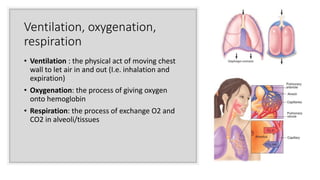
Ventilation, oxygenation,
respiration
• Ventilation : the physical act of moving chest
wall to let air in and out (I.e. inhalation and
expiration)
• Oxygenation: the process of giving oxygen
onto hemoglobin
• Respiration: the process of exchange O2 and
CO2 in alveoli/tissues
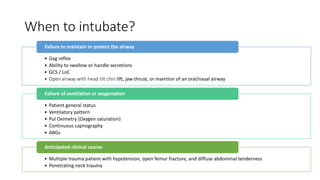
When to intubate?
• Gag reflex
• Ability to swallow or handle secretions
• GCS / LoC
• Open airway with head tilt chin lift, jaw thrust, or insertion of an oral/nasal airway
Failure to maintain or protect the airway
• Patient general status
• Ventilatory pattern
• Pul Oximetry (Oxygen saturation)
• Continuous capnography
• ABGs
Failure of ventilation or oxygenation
• Multiple trauma patient with hypotension, open femur fracture, and diffuse abdominal tenderness
• Penetrating neck trauma
Anticipated clinical course
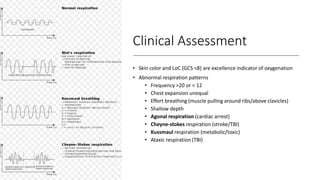
Clinical Assessment
• Skin color and LoC (GCS <8) are excellence indicator of oxygenation
• Abnormal respiration patterns
• Frequency >20 or < 12
• Chest expansion unequal
• Effort breathing (muscle pulling around ribs/above clavicles)
• Shallow depth
• Agonal respiration (cardiac arrest)
• Cheyne-stokes respiration (stroke/TBI)
• Kussmaul respiration (metabolic/toxic)
• Ataxic respiration (TBI)
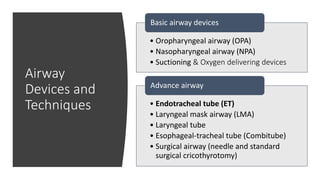
Airway
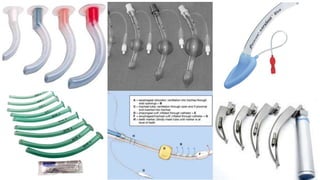
Devices and
Techniques
• Oropharyngeal airway (OPA)
• Nasopharyngeal airway (NPA)
• Suctioning & Oxygen delivering devices
Basic airway devices
• Endotracheal tube (ET)
• Laryngeal mask airway (LMA)
• Laryngeal tube
• Esophageal-tracheal tube (Combitube)
• Surgical airway (needle and standard
surgical cricothyrotomy)
Advance airway
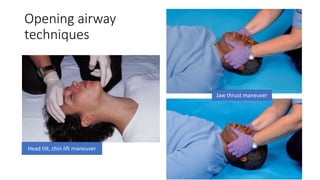
Opening airway
techniques
Head tilt, chin lift maneuver
Jaw thrust maneuver
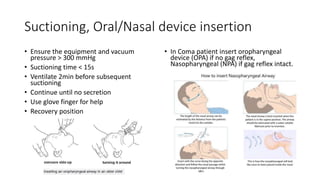
Suctioning, Oral/Nasal device insertion
• Ensure the equipment and vacuum
pressure > 300 mmHg
• Suctioning time < 15s
• Ventilate 2min before subsequent
suctioning
• Continue until no secretion
• Use glove finger for help
• Recovery position
• In Coma patient insert oropharyngeal
device (OPA) if no gag reflex,
Nasopharyngeal (NPA) if gag reflex intact.
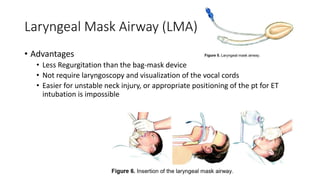
Laryngeal Mask Airway (LMA)
• Advantages
• Less Regurgitation than the bag-mask device
• Not require laryngoscopy and visualization of the vocal cords
• Easier for unstable neck injury, or appropriate positioning of the pt for ET
intubation is impossible
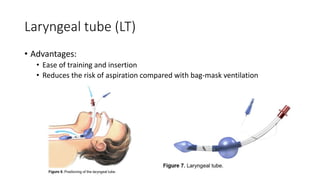
Laryngeal tube (LT)
• Advantages:
• Ease of training and insertion
• Reduces the risk of aspiration compared with bag-mask ventilation
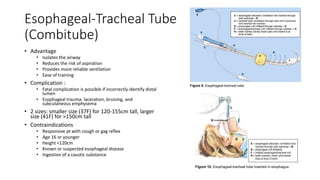
Esophageal-Tracheal Tube
(Combitube)
• Advantage
• Isolates the airway
• Reduces the risk of aspiration
• Provides more reliable ventilation
• Ease of training
• Complication :
• Fatal complication is possible if incorrectly identify distal
lumen
• Esophageal trauma: laceration, bruising, and
subcutaneous emphysema
• 2 sizes: smaller size (37F) for 120-155cm tall, larger
size (41F) for >150cm tall
• Contraindications
• Responsive pt with cough or gag reflex
• Age 16 or younger
• Height <120cm
• Known or suspected esophageal disease
• Ingestion of a caustic substance
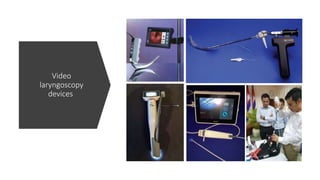
Video
laryngoscopy
devices
ET intubation
Advantages of ET tube insertion
Maintains patent airway
Protect from aspiration
Effective suctioning of trachea
Facilitates delivery of positive end-expiratory
pressure
Foute for resuscitation medications (naloxone,
atropine, epinephrine, and lidocaine)
Longer-term ventilation
Provides the greatest compliance in the
situations that require higher airway pressure
Indication :
Cardiac arrest when bag-mask ventilation is not
possible/ ineffective/ protected airway is needed
Responsive pt in respiratory distress or
compromise
Pt unable to protect airway (eg, coma, areflexia,
or cardiac arrest)
Method of ET intubation
Rapid Sequence Intubation (RSI)
Delayed Sequence Intubation (DSI)
Blind Nasotracheal Intubation
Awake Oral Intubation
Oral Intubation Without Pharmacologic Agents
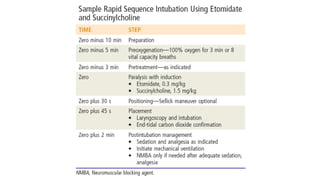
Rapid Sequence Intubation (RSI)
The nearly simultaneous administration of a potent sedative (induction)
agent and NMBA, usually succinylcholine or rocuronium, for the purpose
of tracheal intubation
Whether it reduce the risk of gastric aspiration is unclear
Used in 85% of all emergency department
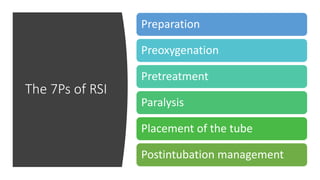
The 7Ps of RSI
Preparation
Preoxygenation
Pretreatment
Paralysis
Placement of the tube
Postintubation management
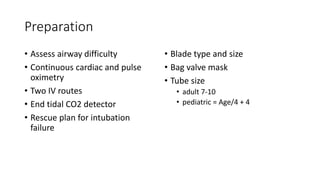
Preparation
• Assess airway difficulty
• Continuous cardiac and pulse
oximetry
• Two IV routes
• End tidal CO2 detector
• Rescue plan for intubation
failure
• Blade type and size
• Bag valve mask
• Tube size
• adult 7-10
• pediatric = Age/4 + 4
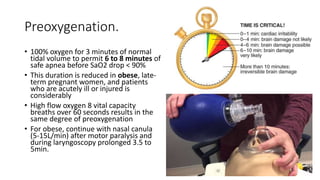
Preoxygenation.
• 100% oxygen for 3 minutes of normal
tidal volume to permit 6 to 8 minutes of
safe apnea before SaO2 drop < 90%
• This duration is reduced in obese, late-
term pregnant women, and patients
who are acutely ill or injured is
considerably
• High flow oxygen 8 vital capacity
breaths over 60 seconds results in the
same degree of preoxygenation
• For obese, continue with nasal canula
(5-15L/min) after motor paralysis and
during laryngoscopy prolonged 3.5 to
5min.
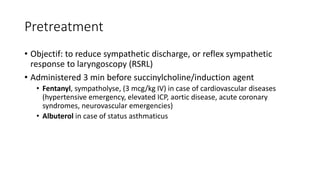
Pretreatment
• Objectif: to reduce sympathetic discharge, or reflex sympathetic
response to laryngoscopy (RSRL)
• Administered 3 min before succinylcholine/induction agent
• Fentanyl, sympatholyse, (3 mcg/kg IV) in case of cardiovascular diseases
(hypertensive emergency, elevated ICP, aortic disease, acute coronary
syndromes, neurovascular emergencies)
• Albuterol in case of status asthmaticus
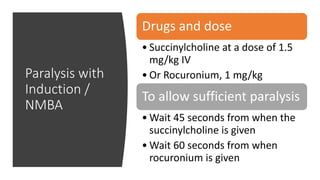
Paralysis with
Induction /
NMBA
Drugs and dose
• Succinylcholine at a dose of 1.5
mg/kg IV
• Or Rocuronium, 1 mg/kg
To allow sufficient paralysis
• Wait 45 seconds from when the
succinylcholine is given
• Wait 60 seconds from when
rocuronium is given
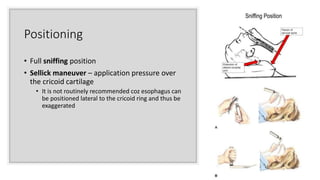
Positioning
• Full sniffing position
• Sellick maneuver – application pressure over
the cricoid cartilage
• It is not routinely recommended coz esophagus can
be positioned lateral to the cricoid ring and thus be
exaggerated
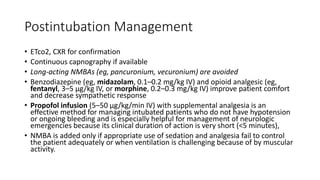
Postintubation Management
• ETco2, CXR for confirmation
• Continuous capnography if available
• Long-acting NMBAs (eg, pancuronium, vecuronium) are avoided
• Benzodiazepine (eg, midazolam, 0.1–0.2 mg/kg IV) and opioid analgesic (eg,
fentanyl, 3–5 μg/kg IV, or morphine, 0.2–0.3 mg/kg IV) improve patient comfort
and decrease sympathetic response
• Propofol infusion (5–50 μg/kg/min IV) with supplemental analgesia is an
effective method for managing intubated patients who do not have hypotension
or ongoing bleeding and is especially helpful for management of neurologic
emergencies because its clinical duration of action is very short (<5 minutes),
• NMBA is added only if appropriate use of sedation and analgesia fail to control
the patient adequately or when ventilation is challenging because of by muscular
activity.
Delayed Sequence Intubation (DSI)
• Indicated in case of agitation, delirium, and confusion which
preoxygenation is challenging
• ketamine (1.0 mg/kg IV) as procedural sedation to accomplish this
• More investigation is required to determine the possible indications
for and safety of DSI
Awake oral intubation
• Intubation with sedation alone or non-paralytic RSI
• Aliquots of ketamine at a dose of 0.5 mg/kg IV, titrated to the desired
level of sedation
• Dexmedetomidine (alpha blocker) 1.0 mg/kg IV infused over 5 to 10
minutes +/- benzodiazepines
• Gentle direct video-laryngoscopy or flexible endoscopic laryngoscopy
to determine whether the glottis is visible and intubation possible, if
not turn to RSI
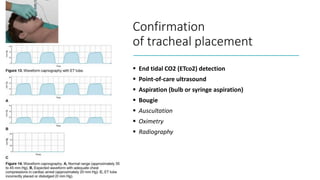
Confirmation
of tracheal placement
 End tidal CO2 (ETco2) detection
 Point-of-care ultrasound
 Aspiration (bulb or syringe aspiration)
 Bougie
 Auscultation
 Oximetry
 Radiography
Difficult Airway
• Difficult Direct Laryngoscopy
• Difficult Bag-Mask Ventilation
• Difficult Extra-glottic devices (EGD)
• Difficult Cricothyrotomy
Difficult Direct Laryngoscopy
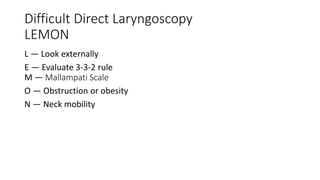
LEMON
L — Look externally
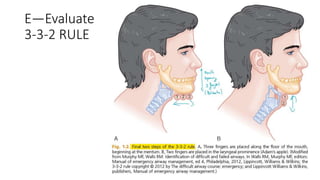
E — Evaluate 3-3-2 rule
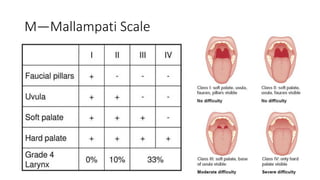
M — Mallampati Scale
O — Obstruction or obesity
N — Neck mobility
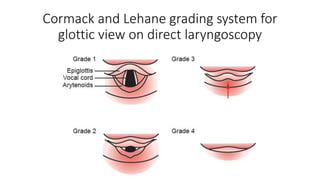
Cormack and Lehane grading system for
glottic view on direct laryngoscopy
E—Evaluate
3-3-2 RULE
M—Mallampati Scale
• O—Obstruction or Obesity.
• Conditions such as epiglottitis, head and neck cancer, Ludwig’s angina, neck
hematoma, glottis swelling, or glottic polyps
• N—Neck Mobility
• Flexion and extension of the neck
• Sniffing position
• severe loss of motion
• ankylosing spondylitis
• rheumatoid arthritis,
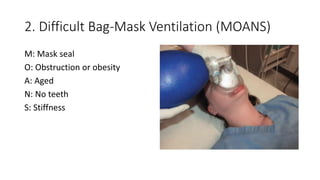
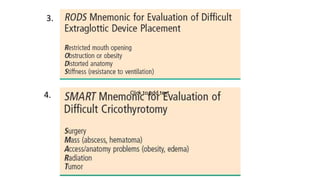
2. Difficult Bag-Mask Ventilation (MOANS)
M: Mask seal
O: Obstruction or obesity
A: Aged
N: No teeth
S: Stiffness
3.
Click to add text
4.
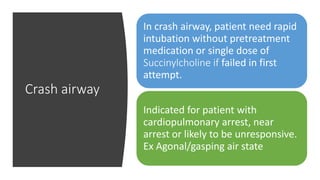
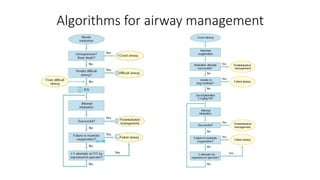
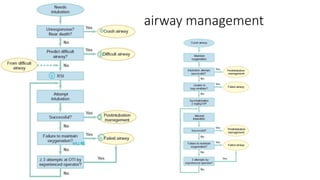
Crash airway
In crash airway, patient need rapid
intubation without pretreatment
medication or single dose of
Succinylcholine if failed in first
attempt.
Indicated for patient with
cardiopulmonary arrest, near
arrest or likely to be unresponsive.
Ex Agonal/gasping air state
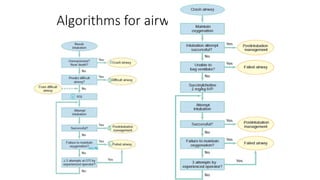
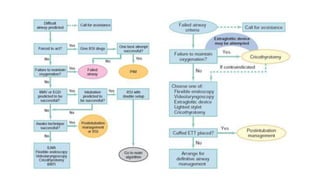
Algorithms for airway management
References
Ron M. Walls, Rosen's Emergency Medicine: Concepts and
Practice. 9th Edition, Elsevier 2018.
Karl Disque, Advanced Cardiac Life Support Provider
Handbook 2015-2020. Save a Live Initiative and Disque
Foundation
American Heart Association, ACLS Provider Manual
Supplementary Materials. 2016
American Heart Association, Airway Management
Video, ACLS student Website 2019.
2011 Jone & Battlet Learning, LLC
Thank You!
Questions and Discussion

Airway management techniques by Dr Than Vutha

  • 1.
    Airway Management Techniques Dr. THANVUTHA CAMETTE HOSPITAL, Phnom Penh thanvutha07@gmail.com
  • 2.
    Introduction • Key managementof BLS and ACLS • Cornerstone of resuscitation • Brain tissue begin to die after 4-6 min without O2 • When to intubate? • Airways devices • Intubation Method • Difficult airway evaluation • Airway management algorithm • Approaches to the difficult airway • Rescue techniques when intubation fails
  • 3.
    Ventilation, oxygenation, respiration • Ventilation: the physical act of moving chest wall to let air in and out (I.e. inhalation and expiration) • Oxygenation: the process of giving oxygen onto hemoglobin • Respiration: the process of exchange O2 and CO2 in alveoli/tissues
  • 4.
    When to intubate? •Gag reflex • Ability to swallow or handle secretions • GCS / LoC • Open airway with head tilt chin lift, jaw thrust, or insertion of an oral/nasal airway Failure to maintain or protect the airway • Patient general status • Ventilatory pattern • Pul Oximetry (Oxygen saturation) • Continuous capnography • ABGs Failure of ventilation or oxygenation • Multiple trauma patient with hypotension, open femur fracture, and diffuse abdominal tenderness • Penetrating neck trauma Anticipated clinical course
  • 5.
    Clinical Assessment • Skincolor and LoC (GCS <8) are excellence indicator of oxygenation • Abnormal respiration patterns • Frequency >20 or < 12 • Chest expansion unequal • Effort breathing (muscle pulling around ribs/above clavicles) • Shallow depth • Agonal respiration (cardiac arrest) • Cheyne-stokes respiration (stroke/TBI) • Kussmaul respiration (metabolic/toxic) • Ataxic respiration (TBI)
  • 6.
    Airway Devices and Techniques • Oropharyngealairway (OPA) • Nasopharyngeal airway (NPA) • Suctioning & Oxygen delivering devices Basic airway devices • Endotracheal tube (ET) • Laryngeal mask airway (LMA) • Laryngeal tube • Esophageal-tracheal tube (Combitube) • Surgical airway (needle and standard surgical cricothyrotomy) Advance airway
  • 7.
    Opening airway techniques Head tilt,chin lift maneuver Jaw thrust maneuver
  • 8.
    Suctioning, Oral/Nasal deviceinsertion • Ensure the equipment and vacuum pressure > 300 mmHg • Suctioning time < 15s • Ventilate 2min before subsequent suctioning • Continue until no secretion • Use glove finger for help • Recovery position • In Coma patient insert oropharyngeal device (OPA) if no gag reflex, Nasopharyngeal (NPA) if gag reflex intact.
  • 10.
    Laryngeal Mask Airway(LMA) • Advantages • Less Regurgitation than the bag-mask device • Not require laryngoscopy and visualization of the vocal cords • Easier for unstable neck injury, or appropriate positioning of the pt for ET intubation is impossible
  • 11.
    Laryngeal tube (LT) •Advantages: • Ease of training and insertion • Reduces the risk of aspiration compared with bag-mask ventilation
  • 12.
    Esophageal-Tracheal Tube (Combitube) • Advantage •Isolates the airway • Reduces the risk of aspiration • Provides more reliable ventilation • Ease of training • Complication : • Fatal complication is possible if incorrectly identify distal lumen • Esophageal trauma: laceration, bruising, and subcutaneous emphysema • 2 sizes: smaller size (37F) for 120-155cm tall, larger size (41F) for >150cm tall • Contraindications • Responsive pt with cough or gag reflex • Age 16 or younger • Height <120cm • Known or suspected esophageal disease • Ingestion of a caustic substance
  • 13.
  • 14.
    ET intubation Advantages ofET tube insertion Maintains patent airway Protect from aspiration Effective suctioning of trachea Facilitates delivery of positive end-expiratory pressure Foute for resuscitation medications (naloxone, atropine, epinephrine, and lidocaine) Longer-term ventilation Provides the greatest compliance in the situations that require higher airway pressure Indication : Cardiac arrest when bag-mask ventilation is not possible/ ineffective/ protected airway is needed Responsive pt in respiratory distress or compromise Pt unable to protect airway (eg, coma, areflexia, or cardiac arrest)
  • 15.
    Method of ETintubation Rapid Sequence Intubation (RSI) Delayed Sequence Intubation (DSI) Blind Nasotracheal Intubation Awake Oral Intubation Oral Intubation Without Pharmacologic Agents
  • 16.
    Rapid Sequence Intubation(RSI) The nearly simultaneous administration of a potent sedative (induction) agent and NMBA, usually succinylcholine or rocuronium, for the purpose of tracheal intubation Whether it reduce the risk of gastric aspiration is unclear Used in 85% of all emergency department
  • 17.
    The 7Ps ofRSI Preparation Preoxygenation Pretreatment Paralysis Placement of the tube Postintubation management
  • 18.
    Preparation • Assess airwaydifficulty • Continuous cardiac and pulse oximetry • Two IV routes • End tidal CO2 detector • Rescue plan for intubation failure • Blade type and size • Bag valve mask • Tube size • adult 7-10 • pediatric = Age/4 + 4
  • 19.
    Preoxygenation. • 100% oxygenfor 3 minutes of normal tidal volume to permit 6 to 8 minutes of safe apnea before SaO2 drop < 90% • This duration is reduced in obese, late- term pregnant women, and patients who are acutely ill or injured is considerably • High flow oxygen 8 vital capacity breaths over 60 seconds results in the same degree of preoxygenation • For obese, continue with nasal canula (5-15L/min) after motor paralysis and during laryngoscopy prolonged 3.5 to 5min.
  • 20.
    Pretreatment • Objectif: toreduce sympathetic discharge, or reflex sympathetic response to laryngoscopy (RSRL) • Administered 3 min before succinylcholine/induction agent • Fentanyl, sympatholyse, (3 mcg/kg IV) in case of cardiovascular diseases (hypertensive emergency, elevated ICP, aortic disease, acute coronary syndromes, neurovascular emergencies) • Albuterol in case of status asthmaticus
  • 21.
    Paralysis with Induction / NMBA Drugsand dose • Succinylcholine at a dose of 1.5 mg/kg IV • Or Rocuronium, 1 mg/kg To allow sufficient paralysis • Wait 45 seconds from when the succinylcholine is given • Wait 60 seconds from when rocuronium is given
  • 22.
    Positioning • Full sniffingposition • Sellick maneuver – application pressure over the cricoid cartilage • It is not routinely recommended coz esophagus can be positioned lateral to the cricoid ring and thus be exaggerated
  • 23.
    Postintubation Management • ETco2,CXR for confirmation • Continuous capnography if available • Long-acting NMBAs (eg, pancuronium, vecuronium) are avoided • Benzodiazepine (eg, midazolam, 0.1–0.2 mg/kg IV) and opioid analgesic (eg, fentanyl, 3–5 μg/kg IV, or morphine, 0.2–0.3 mg/kg IV) improve patient comfort and decrease sympathetic response • Propofol infusion (5–50 μg/kg/min IV) with supplemental analgesia is an effective method for managing intubated patients who do not have hypotension or ongoing bleeding and is especially helpful for management of neurologic emergencies because its clinical duration of action is very short (<5 minutes), • NMBA is added only if appropriate use of sedation and analgesia fail to control the patient adequately or when ventilation is challenging because of by muscular activity.
  • 25.
    Delayed Sequence Intubation(DSI) • Indicated in case of agitation, delirium, and confusion which preoxygenation is challenging • ketamine (1.0 mg/kg IV) as procedural sedation to accomplish this • More investigation is required to determine the possible indications for and safety of DSI
  • 26.
    Awake oral intubation •Intubation with sedation alone or non-paralytic RSI • Aliquots of ketamine at a dose of 0.5 mg/kg IV, titrated to the desired level of sedation • Dexmedetomidine (alpha blocker) 1.0 mg/kg IV infused over 5 to 10 minutes +/- benzodiazepines • Gentle direct video-laryngoscopy or flexible endoscopic laryngoscopy to determine whether the glottis is visible and intubation possible, if not turn to RSI
  • 27.
    Confirmation of tracheal placement End tidal CO2 (ETco2) detection  Point-of-care ultrasound  Aspiration (bulb or syringe aspiration)  Bougie  Auscultation  Oximetry  Radiography
  • 28.
    Difficult Airway • DifficultDirect Laryngoscopy • Difficult Bag-Mask Ventilation • Difficult Extra-glottic devices (EGD) • Difficult Cricothyrotomy
  • 29.
    Difficult Direct Laryngoscopy LEMON L— Look externally E — Evaluate 3-3-2 rule M — Mallampati Scale O — Obstruction or obesity N — Neck mobility
  • 30.
    Cormack and Lehanegrading system for glottic view on direct laryngoscopy
  • 31.
  • 32.
  • 33.
    • O—Obstruction orObesity. • Conditions such as epiglottitis, head and neck cancer, Ludwig’s angina, neck hematoma, glottis swelling, or glottic polyps • N—Neck Mobility • Flexion and extension of the neck • Sniffing position • severe loss of motion • ankylosing spondylitis • rheumatoid arthritis,
  • 34.
    2. Difficult Bag-MaskVentilation (MOANS) M: Mask seal O: Obstruction or obesity A: Aged N: No teeth S: Stiffness
  • 35.
  • 36.
    Crash airway In crashairway, patient need rapid intubation without pretreatment medication or single dose of Succinylcholine if failed in first attempt. Indicated for patient with cardiopulmonary arrest, near arrest or likely to be unresponsive. Ex Agonal/gasping air state
  • 37.
  • 38.
  • 39.
  • 41.
    References Ron M. Walls,Rosen's Emergency Medicine: Concepts and Practice. 9th Edition, Elsevier 2018. Karl Disque, Advanced Cardiac Life Support Provider Handbook 2015-2020. Save a Live Initiative and Disque Foundation American Heart Association, ACLS Provider Manual Supplementary Materials. 2016 American Heart Association, Airway Management Video, ACLS student Website 2019. 2011 Jone & Battlet Learning, LLC
  • 42.

Editor's Notes

  • #17 A systematic review of the literature in 2007 failed to prove that RSI results in a lower incidence of aspiration than other techniques
  • #22 Ectomidate, fentatnyl, ketamine, propofol
  • #27 ketamine, which provides dissociative anesthesia, analgesia, maintenance of protective airway reflexes, and minimal respiratory depression, is often the best choice
  • #28 Ultrasound place over  the cricothyroid membrane or upper trachea  Aspiration device Bulb or syringe aspiration devices may be used in patients in cardiac arrest who have no detectable CO2. 
  • #34 A Mallampati score necessitates an awake compliant patient to perform the assessment in the way in which it was originally described
  • #36 Asthma, COPD, pulmonary edema, restrictive lung disease, term pregnancy
  • #37 Prior surgery, hematoma, tumor, abscess, scarring (as from radiation therapy or prior injury), local trauma, obesity, edema, or subcutaneous air each has the potential to make cricothyrotomy more difficult
  • #42 Awake means that the patient continues to breathe and, intravenous sedation and analgesia may be administered, can cooperate with caregivers. The patient is prepared by applying topical anesthesia with atomized or nebulized lidocaine, ideally preceded by a drying agent such as glycopyrrolate. Titrated doses of a sedative and analgesic agents (or ketamine, which provides both actions) may be required for the patient to tolerate the procedure. Then attempt for glottic visualization, flexible bronchoscopes and videolaryngoscopes are preferable.