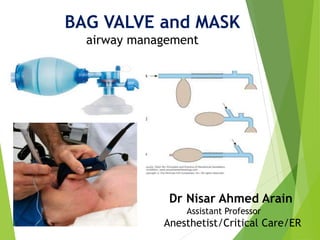
BAG VALVE and MASK
airway management
Dr Nisar Ahmed Arain
Assistant Professor
Anesthetist/Critical Care/ER
Safe airway
management
-airway evaluation
-identification of the difficult
airway
-assessment of other clinical
factors
-selection of the likely most
successful plan of action
-reasonable alternative plan
Algorithmic Approach to Airway
Management
-Have a precompiled plan of airway
management ready for
implementation as clinical airway
difficulties are encountered
-develop a plan and a back-up plan
-Practice guidelines for management
of the difficult airway
a-ASA taskforce
b-ASA Anesthesia Guidelines
Emergency Airway Guidelines
-Full stomach
-Altered level of consciousness
-Deteriorating cardiorespiratory
physiology
-Abnormal or distorted upper
airway anatomy
-No time for pre-assessment or
plan
-Airway Assessment
-compromise or threats
-potentially difficult airway
The Three Pillars of Airway
Management
-Patency ( airflow integrity )
-Protection against aspiration
-Assurance of oxygenation
and ventilation
Indications for Active Airway
Intervention
-Patency - relief of obstruction
-Protection from aspiration
-Hypoxic/Hypercapnic respiratory
failure
-Airway access for pulmonary
toilet drug delivery per
therapeutic hyperventilation
-Shock
Clinical Signs of Airway
Compromise : Patency
-Inspiratory stridor
-Snoring ( pharyngeal obstruction )
-Gurgling ( foreign matter/ secretions )
-Drooling ( epiglottitis )
-Hoarseness ( laryngeal edema/ vc
paralysis)
-Paradoxical chest wall movement
-Tracheal tug
Clinical Signs of Airway
Compromise Protection
-Blood in upper airway
-Pus in upper airway
-persistant vomiting
-Loss of protective
airway reflexes
Clinical Signs of Airway
Compromise
Oxygenation and Ventilation
-Central cyanosis
-Obtundation and diaphoresis
-rapid shallow respirations
-Accessory muscle use
-Retractions
-Abdominal paradox
The Difficult Airway
-Difficult laryngoscopy
-Difficult bag-mask ventilation
-Lower airway difficulty
-Techniques for the
Compromised Airway
-Bag-Valve-Mask Ventilation
-Endotracheal Intubation
-Rapid Sequence Intubation
-Alternate techniques for
the difficult airway
Golden Rules of Bagging
-Anybody ( almost ) can be oxygenated
and ventilated with a bag and a mask
-The art of bagging should be mastered
before the art of intubation
-Manual ventilation skill with proper
equipment is a fundamental premise
of advanced airway management
Frequent Errors with BVM
-failure to recognize its importance
-forget to bag ( focused on ETT )
-give up on bagging too early
-bag but don’t assess efficacy
-failure to assign one person to
airway management only
Difficult Airway : BVM
-Upper airway obstruction
-Lack of dentures
-Beard
-Mid facial smash
-facial burns, dressings
scarring
-poor lung mechanics
Difficult Airway : BVM
-Degree of difficulty from zero to infinite
-zero = no external effort/internal device
-one person jaw thrust/ face seal
-oropharyngeal or nasopharyngeal Airway
- two person jaw thrust / face seal
both internal airway devices
-infinite -no patency despite maximal
external effort and full use of OP/NP
Difficult Airway : BVM
-Remove FB - Magill forceps
-Triple maneuver if c-spine clear
Head tilt, jaw lift, mouth opening
-Nasopharyngeal or oropharyngeal
airway
-two-person, four-hand technique
- Prediction of the difficult
airway (Intubation)
-1200 prospectively studied
patients
-of 84 patients predicted to
have problem, only 22
(25%) actually had a
problem
-of 43 actual difficult
intubations incurred, only
22 (51%) were predicted
Prediction of the difficult airway
-History of past airway problems
-Careful physical assessment
-knowledge and experience to
overcome the "unpredicted
difficult airway".
-learning practical airway
management skills in an
environment that is not urgent
stressful or life threatening
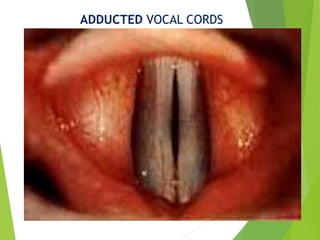
ADDUCTED VOCAL CORDS
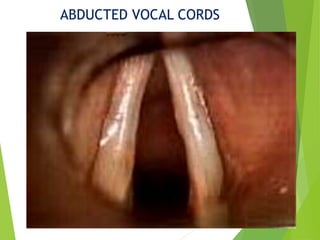
ABDUCTED VOCAL CORDS
Difficult Airway Laryngoscopy
-Short thick neck
-Receding mandible
-Buck teeth
-Poor mandibular mobility
-Limited jaw opening
-Limited head and neck
movement
(including trauma)
Difficult Airway Laryngoscopy
-Tumor, abscess or hematoma
-Burns
-Angioneurotic edema
-Blunt or penetrating trauma
-Rheumatoid arthritis
ankylosing spondylitis
-Congenital syndromes
-Neck surgery or radiation
Difficult Airway Laryngoscopy
-3 fingerbreadths mentum to hyoid
-3 finger breadths chin to thyroid
notch
-3 finger breadths upper to lower
incisors
-Head extension and neck flexion
-Mallampati classification
-Previous history of difficult
intubation
Mallampati Classification
(Tongue to Pharyngeal Size )
-I - soft palate, uvula, tonsillar
pillars
99 % have grade I laryngoscopic
view
-II - soft palate, uvula (partly)
-III - soft palate, base of uvula
-IV - soft palate not visible
100% grade III or grade IV
views
REMEDY FOR
Unsuccessful Intubation
-Bag the patient
-Maximize neck flexion/ head
extension
-Move tongue out of line of site
-Maximize mouth opening
-Look for landmarks and adjust blade
-BURP maneuver(Backward, Upward
Rightward, Pressure)
-increasing lifting force
-consider Miller blade
-Bag the patient
-Awake or Asleep
-Oral or Nasal
-Laryngoscopy or Blind
Intubation
-To Paralyze or Not
DILEMMAS
Case report no-1
-43 year old female, day 12 post SAH
-5 unclipped cerebral aneurysms
-vasospasm with left hemiparesis
-hydrocephalus with clotted IV drain
-rising ICP and BP
-decreasing LOC
-ate breakfast
Techniques
-DL without pharmacologic aids
-Awake Direct Laryngoscopy
-Awake Blind Nasal intubation
-Rapid Sequence Intubation (RSI)
-Fiberoptic Laryngoscopy
-Surgical Crico-thyroid-otomy
Anesthesia Airway Maxims
-the awake airway is the safest to
manage
-spontaneous breathing is
generally safer than paralysis
with PPV by mask
-have a low threshold to wake the
patient up and cancel the
case
-call for help early
The “Intubation Reflex”
-Catecholamine release in response to
laryngeal manipulation
-Tachycardia, hypertension, raised ICP
-ICP rise possibly attenuated by
lidocaine
-Midazolam and thiopental have no
effect
Rapid Sequence Intubation
Definition
-The near simultaneous administration
of a sedative-hypnotic agent and a
neuromuscular blocker in the
presence of continuous cricoid
pressure to facilitate endotracheal
intubation and minimize risk of
aspiration
-modifications are made depending
upon the clinical scenario
*Rapid Sequence Intubation
Advantages
-Optimizes intubating conditions and
facilitates visualization
-Increased rate of successful
intubation
-Decreased time to intubation
-Decreased risk of aspiration
-Attenuation of hemodynamic and
ICP changes
Rapid Sequence Intubation
Contraindications
-Anticipated difficulty with
endotracheal intubation
anatomic distortion
-Lack of operator skill or
familiarity
-inability to preoxygenate
Rapid Sequence Intubation
Procedure
-Pre-intubation assessment
-Pre-oxygenation
-Prepare ( for the worst )
-Paralyze
-Premedicate
-Pressure on cricoid
-Place the tube
-Post intubation assessment
Pre-oxygenate Time
5 Minutes
-100 % oxygen for 5 minutes
-4 conscious deep breaths of 100 % O2
-Fill FRC with reservoir of 100 % O2
-Allows 3 to 5 minutes of apnea
-Essential to allow avoidance of
bagging
-If necessary bag with cricoid pressure
Preparation Time 5 Minutes
-ETT, stylet, blades, suction, BVM
All should be ready
-Cardiac monitor, pulse oximeter,
ETCO2, should be ready
-One ( preferably two ) iv lines should
be placed
-All required drugs should be ready
-Difficult airway kit including cric kit
(This is kit which carries all the items to
deal with the emergency situation)
-Patient positioning is important
Pre-treatment
Prime Time 2 Minutes
-Lidocaine 1.5 mg/kg iv
-De-fasciculating dose of
non-depolarizing NMB drugs
-Beta-blocker or fentanyl
-Induction agent
-Thiopental 3 - 5 mg/kg
-Midazolam 0.1 - 0.4mg/kg
-Ketamine 1.5 - 2.0 mg/kg
-Fentanyl 2 - 30 mcg/kg
Paralyze (Time Zero)
-Succinylcholine 1.5 mg/kg iv
-Allow 45 - 60 seconds for complete
muscle relaxation
-Alternatives
Vecuromium 0.1 - 0.2 mg/kg
Rocuronium o.6 - 1.2 mg/kg
-Pressure
-Sellick maneuver
-initiate upon loss of
consciousness
-continue until ETT balloon
inflation
-release if active vomiting
Place the Tube (Time
Zero + 45 Secs)
-Wait for optimal paralysis
-Confirm tube placement
with ETCO2
-Post-intubation Hypotension
-Loss of sympathetic drive
-Myocardial infarction
-Tension pneumothorax
-Auto-peep
-Succinylcholine
Contraindications
-Hyperkalemia - renal failure
-Active neuromuscular disease
with functional denervation
( 6 days to 6 months)
-Extensive burns or crush injuries
-Malignant hyperthermia
-Pseudo cholinesterase deficiency
-Organophosphate poisoning
Succinylcholine
Complications
-Inability to secure airway
-Increased vagal tone
( after second dose )
-Histamine release ( rare )
-Increased ICP/ IOP/ intragastric
pressure
-Myalgia’s
-Hyperkalemia with burns, NM
disease
-Malignant hyperthermia
-Difficult Airway Kit
-Multiple blades and ETTs
-C(LMA, Combitube, TTJV(Trans
Tracheal-Jet-Ventillation)
-Emergency surgical airway
access(Cricothyrodotomy
kit-Cricitomes
-ETT placement verification
-Fiberoptic and retrograde intubation
Emergency Surgical
Airway Maxims
they are usually a bloody mess, but….
(a bloody surgical airway is better
than an arrested patient with a nice
looking neck)
Second Case Report
-42 year old female
-right Pancoast tumor
-RUL, RML, RLL collapse
-ARDS on left
-hypoxemic respiratory
failure
FOR HOME WORK
THANK YOU

#Bag valve mask

  • 1.
    BAG VALVE andMASK airway management Dr Nisar Ahmed Arain Assistant Professor Anesthetist/Critical Care/ER
  • 2.
    Safe airway management -airway evaluation -identificationof the difficult airway -assessment of other clinical factors -selection of the likely most successful plan of action -reasonable alternative plan
  • 3.
    Algorithmic Approach toAirway Management -Have a precompiled plan of airway management ready for implementation as clinical airway difficulties are encountered -develop a plan and a back-up plan -Practice guidelines for management of the difficult airway a-ASA taskforce b-ASA Anesthesia Guidelines
  • 4.
    Emergency Airway Guidelines -Fullstomach -Altered level of consciousness -Deteriorating cardiorespiratory physiology -Abnormal or distorted upper airway anatomy -No time for pre-assessment or plan
  • 5.
    -Airway Assessment -compromise orthreats -potentially difficult airway
  • 6.
    The Three Pillarsof Airway Management -Patency ( airflow integrity ) -Protection against aspiration -Assurance of oxygenation and ventilation
  • 7.
    Indications for ActiveAirway Intervention -Patency - relief of obstruction -Protection from aspiration -Hypoxic/Hypercapnic respiratory failure -Airway access for pulmonary toilet drug delivery per therapeutic hyperventilation -Shock
  • 8.
    Clinical Signs ofAirway Compromise : Patency -Inspiratory stridor -Snoring ( pharyngeal obstruction ) -Gurgling ( foreign matter/ secretions ) -Drooling ( epiglottitis ) -Hoarseness ( laryngeal edema/ vc paralysis) -Paradoxical chest wall movement -Tracheal tug
  • 9.
    Clinical Signs ofAirway Compromise Protection -Blood in upper airway -Pus in upper airway -persistant vomiting -Loss of protective airway reflexes
  • 10.
    Clinical Signs ofAirway Compromise Oxygenation and Ventilation -Central cyanosis -Obtundation and diaphoresis -rapid shallow respirations -Accessory muscle use -Retractions -Abdominal paradox
  • 11.
    The Difficult Airway -Difficultlaryngoscopy -Difficult bag-mask ventilation -Lower airway difficulty
  • 12.
    -Techniques for the CompromisedAirway -Bag-Valve-Mask Ventilation -Endotracheal Intubation -Rapid Sequence Intubation -Alternate techniques for the difficult airway
  • 13.
    Golden Rules ofBagging -Anybody ( almost ) can be oxygenated and ventilated with a bag and a mask -The art of bagging should be mastered before the art of intubation -Manual ventilation skill with proper equipment is a fundamental premise of advanced airway management
  • 14.
    Frequent Errors withBVM -failure to recognize its importance -forget to bag ( focused on ETT ) -give up on bagging too early -bag but don’t assess efficacy -failure to assign one person to airway management only
  • 15.
    Difficult Airway :BVM -Upper airway obstruction -Lack of dentures -Beard -Mid facial smash -facial burns, dressings scarring -poor lung mechanics
  • 16.
    Difficult Airway :BVM -Degree of difficulty from zero to infinite -zero = no external effort/internal device -one person jaw thrust/ face seal -oropharyngeal or nasopharyngeal Airway - two person jaw thrust / face seal both internal airway devices -infinite -no patency despite maximal external effort and full use of OP/NP
  • 17.
    Difficult Airway :BVM -Remove FB - Magill forceps -Triple maneuver if c-spine clear Head tilt, jaw lift, mouth opening -Nasopharyngeal or oropharyngeal airway -two-person, four-hand technique
  • 18.
    - Prediction ofthe difficult airway (Intubation) -1200 prospectively studied patients -of 84 patients predicted to have problem, only 22 (25%) actually had a problem -of 43 actual difficult intubations incurred, only 22 (51%) were predicted
  • 19.
    Prediction of thedifficult airway -History of past airway problems -Careful physical assessment -knowledge and experience to overcome the "unpredicted difficult airway". -learning practical airway management skills in an environment that is not urgent stressful or life threatening
  • 20.
  • 21.
  • 22.
    Difficult Airway Laryngoscopy -Shortthick neck -Receding mandible -Buck teeth -Poor mandibular mobility -Limited jaw opening -Limited head and neck movement (including trauma)
  • 23.
    Difficult Airway Laryngoscopy -Tumor,abscess or hematoma -Burns -Angioneurotic edema -Blunt or penetrating trauma -Rheumatoid arthritis ankylosing spondylitis -Congenital syndromes -Neck surgery or radiation
  • 24.
    Difficult Airway Laryngoscopy -3fingerbreadths mentum to hyoid -3 finger breadths chin to thyroid notch -3 finger breadths upper to lower incisors -Head extension and neck flexion -Mallampati classification -Previous history of difficult intubation
  • 25.
    Mallampati Classification (Tongue toPharyngeal Size ) -I - soft palate, uvula, tonsillar pillars 99 % have grade I laryngoscopic view -II - soft palate, uvula (partly) -III - soft palate, base of uvula -IV - soft palate not visible 100% grade III or grade IV views
  • 26.
    REMEDY FOR Unsuccessful Intubation -Bagthe patient -Maximize neck flexion/ head extension -Move tongue out of line of site -Maximize mouth opening -Look for landmarks and adjust blade -BURP maneuver(Backward, Upward Rightward, Pressure) -increasing lifting force -consider Miller blade -Bag the patient
  • 27.
    -Awake or Asleep -Oralor Nasal -Laryngoscopy or Blind Intubation -To Paralyze or Not DILEMMAS
  • 28.
    Case report no-1 -43year old female, day 12 post SAH -5 unclipped cerebral aneurysms -vasospasm with left hemiparesis -hydrocephalus with clotted IV drain -rising ICP and BP -decreasing LOC -ate breakfast
  • 29.
    Techniques -DL without pharmacologicaids -Awake Direct Laryngoscopy -Awake Blind Nasal intubation -Rapid Sequence Intubation (RSI) -Fiberoptic Laryngoscopy -Surgical Crico-thyroid-otomy
  • 30.
    Anesthesia Airway Maxims -theawake airway is the safest to manage -spontaneous breathing is generally safer than paralysis with PPV by mask -have a low threshold to wake the patient up and cancel the case -call for help early
  • 31.
    The “Intubation Reflex” -Catecholaminerelease in response to laryngeal manipulation -Tachycardia, hypertension, raised ICP -Tachycardia, hypertension, raised ICP -ICP rise possibly attenuated by lidocaine -Midazolam and thiopental have no effect
  • 32.
    Rapid Sequence Intubation Definition -Thenear simultaneous administration of a sedative-hypnotic agent and a neuromuscular blocker in the presence of continuous cricoid pressure to facilitate endotracheal intubation and minimize risk of aspiration -modifications are made depending upon the clinical scenario
  • 33.
    *Rapid Sequence Intubation Advantages -Optimizesintubating conditions and facilitates visualization -Increased rate of successful intubation -Decreased time to intubation -Decreased risk of aspiration -Attenuation of hemodynamic and ICP changes
  • 34.
    Rapid Sequence Intubation Contraindications -Anticipateddifficulty with endotracheal intubation anatomic distortion -Lack of operator skill or familiarity -inability to preoxygenate
  • 35.
    Rapid Sequence Intubation Procedure -Pre-intubationassessment -Pre-oxygenation -Prepare ( for the worst ) -Paralyze -Premedicate -Pressure on cricoid -Place the tube -Post intubation assessment
  • 36.
    Pre-oxygenate Time 5 Minutes -100% oxygen for 5 minutes -4 conscious deep breaths of 100 % O2 -Fill FRC with reservoir of 100 % O2 -Allows 3 to 5 minutes of apnea -Essential to allow avoidance of bagging -If necessary bag with cricoid pressure
  • 37.
    Preparation Time 5Minutes -ETT, stylet, blades, suction, BVM All should be ready -Cardiac monitor, pulse oximeter, ETCO2, should be ready -One ( preferably two ) iv lines should be placed -All required drugs should be ready -Difficult airway kit including cric kit (This is kit which carries all the items to deal with the emergency situation) -Patient positioning is important
  • 38.
    Pre-treatment Prime Time 2Minutes -Lidocaine 1.5 mg/kg iv -De-fasciculating dose of non-depolarizing NMB drugs -Beta-blocker or fentanyl -Induction agent -Thiopental 3 - 5 mg/kg -Midazolam 0.1 - 0.4mg/kg -Ketamine 1.5 - 2.0 mg/kg -Fentanyl 2 - 30 mcg/kg
  • 39.
    Paralyze (Time Zero) -Succinylcholine1.5 mg/kg iv -Allow 45 - 60 seconds for complete muscle relaxation -Alternatives Vecuromium 0.1 - 0.2 mg/kg Rocuronium o.6 - 1.2 mg/kg
  • 40.
    -Pressure -Sellick maneuver -initiate uponloss of consciousness -continue until ETT balloon inflation -release if active vomiting
  • 41.
    Place the Tube(Time Zero + 45 Secs) -Wait for optimal paralysis -Confirm tube placement with ETCO2
  • 42.
    -Post-intubation Hypotension -Loss ofsympathetic drive -Myocardial infarction -Tension pneumothorax -Auto-peep
  • 43.
    -Succinylcholine Contraindications -Hyperkalemia - renalfailure -Active neuromuscular disease with functional denervation ( 6 days to 6 months) -Extensive burns or crush injuries -Malignant hyperthermia -Pseudo cholinesterase deficiency -Organophosphate poisoning
  • 44.
    Succinylcholine Complications -Inability to secureairway -Increased vagal tone ( after second dose ) -Histamine release ( rare ) -Increased ICP/ IOP/ intragastric pressure -Myalgia’s -Hyperkalemia with burns, NM disease -Malignant hyperthermia
  • 45.
    -Difficult Airway Kit -Multipleblades and ETTs -C(LMA, Combitube, TTJV(Trans Tracheal-Jet-Ventillation) -Emergency surgical airway access(Cricothyrodotomy kit-Cricitomes -ETT placement verification -Fiberoptic and retrograde intubation
  • 46.
    Emergency Surgical Airway Maxims theyare usually a bloody mess, but…. (a bloody surgical airway is better than an arrested patient with a nice looking neck)
  • 47.
    Second Case Report -42year old female -right Pancoast tumor -RUL, RML, RLL collapse -ARDS on left -hypoxemic respiratory failure FOR HOME WORK
  • 48.