The Critical Airway: RSI & Failed Intubation
Andrew J. Bowman Acute Care Nurse Practitioner Trauma Nurse Specialist Registered Nurse Paramedic Emergency Department Emergency Department Witham Health Services Clarian Arnett Hospital KATS Transport Ambulance
Disclaimer I have no financial disclosures and I have no affiliation with any company to promote use of any drug or device described in this presentation.
Every Single Training Program
AIRWAY COMES FIRST!!!!! But….. Not always as easy as it sounds!
Attempts to Intubate <= 2 Attempts > 2 Attempts
Overview What is RSI? RSI: The 10 “P’s” Failed Intubation Alternative airways and devices
What is RSI? Rapid Sequence Intubation =  RSI Cornerstone of emergency department (ED) airway management Timed delivery of medications to sedate and paralyze a patient to facilitate rapid placement of an endotracheal tube (ETT) Copyright  © 2007 ENA
Who Needs RSI? One or more of the following: Inability to maintain a patent airway Inability to protect against aspiration Compromised or impaired ventilation Failure to adequately oxygenate blood Anticipation of patient deterioration that will lead to any/all of the above Copyright  © 2007 ENA
Why RSI? Results in rapid unconsciousness and chemical paralysis Most ED patients are not fasting Ideally, intubation without bag/mask ventilation Copyright  © 2007 ENA
When  NOT  to RSI Unconscious Apneic Need “ Crash ” airway Immediate BVM and ETT without pre-treatment Copyright  © 2007 ENA
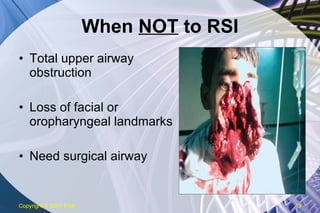
When  NOT  to RSI Total upper airway obstruction Loss of facial or oropharyngeal landmarks Need surgical airway Copyright  © 2007 ENA
Cautious Use of RSI Suspected difficult airway or BVM “ LEMON”, “BONES”, “SHORT” Mallampati Classification 3-3-2 Rule Copyright  © 2007 ENA
The 10 “P’s” of RSI Copyright  © 2007 ENA
The 10 “P’s” of RSI Preparation Pre-oxygenation Pre-treatment Put to sleep Paralyze Protect Position Placement Proof Post-Intubation management Copyright  © 2007 ENA
Preparation Best defense against the chaos of achieving an emergent airway Why is it a dying patient only vomits when the suction has not been checked????? Copyright  © 2007 ENA
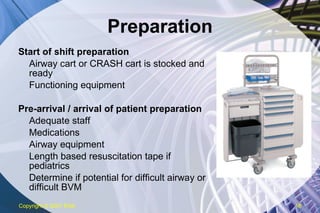
Preparation Start of shift preparation Airway cart or CRASH cart is stocked and ready Functioning equipment Pre-arrival / arrival of patient preparation Adequate staff Medications Airway equipment Length based resuscitation tape if pediatrics Determine if potential for difficult airway or difficult BVM Copyright  © 2007 ENA
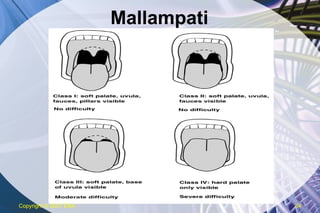
Difficult ETT Prediction LEMON Mallampati Classification 3-3-2 Copyright  © 2007 ENA
LEMON L ook externally E valuate internally M allampati O bstruction N eck mobility Copyright  © 2007 ENA
Look Externally Beard Small jaw, receding chin “Buck” teeth Craniofacial deformity or trauma Copyright  © 2007 ENA
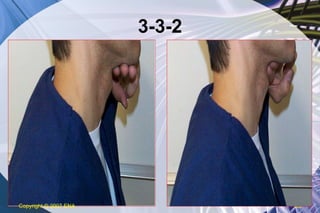
Evaluate Internally 3-3-2 3 fingers of mouth opening 3 fingers mentum to hyoid 2 fingers hyoid to thyroid Copyright  © 2007 ENA
3-3-2 Copyright  © 2007 ENA
Mallampati Copyright  © 2007 ENA
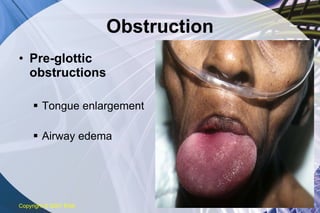
Obstruction Pre-glottic obstructions Tongue enlargement Airway edema Copyright  © 2007 ENA
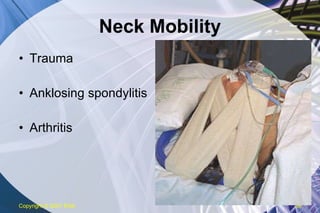
Neck Mobility Trauma Anklosing spondylitis Arthritis Copyright  © 2007 ENA
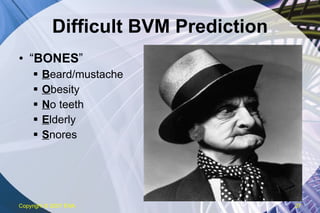
Difficult BVM Prediction “ BONES ” B eard/mustache O besity N o teeth E lderly S nores Copyright  © 2007 ENA
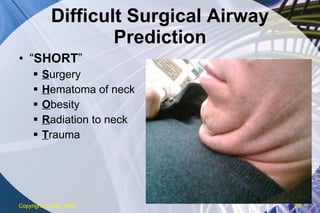
Difficult Surgical Airway Prediction “ SHORT ” S urgery H ematoma of neck O besity R adiation to neck T rauma Copyright  © 2007 ENA
Pre-Oxygenation AKA: Nitrogen Washout Copyright  © 2007 ENA
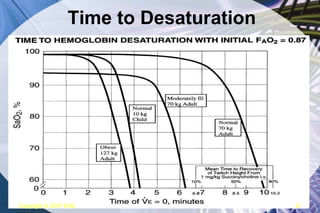
Pre-Oxygenation Best supplied by high flow non-rebreather mask for at least  5 minutes   prior to RSI Creates a reservoir of oxygen in lungs, alveoli, blood and tissue Use positive pressure ventilation with BVM  only  when necessary (8 vital capacity breaths) Copyright  © 2007 ENA
Time to Desaturation Copyright  © 2007 ENA
Pre-Treatment Use of medications to blunt or decrease adverse physiologic responses to laryngoscopy and intubation “ LOAD ” Copyright  © 2007 ENA
“ LOAD” L idocaine O piates A tropine D efasciculating agents Copyright  © 2007 ENA
Lidocaine 1.5mg/kg IV  - Given  3 minutes prior  to ETT Suppresses cough and gag reflex MAY  decrease rises in ICP No good studies that prove benefit Copyright  © 2007 ENA
Lidocaine May decrease or diminish reflex bronchospasm in patients with reactive airway disease  Asthma COPD Copyright  © 2007 ENA
Lidocaine Topical lidocaine may deliver a more consistent blunting of responses to intubation Copyright  © 2007 ENA
Opiates Fentanyl  1-3mcg/kg IVP  – Given 2 - 3 minutes prior to ETT Decreases sympathetic response to intubation Possible benefit with increased ICP, aortic dissection, ICH, ischemic heart disease  Copyright  © 2007 ENA
Atropine 0.02 mg/kg  IV to maximum 1mg (minimum 0.1mg) Historically used in pediatrics being treated with succinylcholine to prevent reflexive bradycardia Copyright  © 2007 ENA
Atropine No longer recommended Eliminates a step that has no clear benefit Bradycardia, especially in pediatrics, is a hallmark of hypoxemia and should not be masked by medications Copyright  © 2007 ENA
Defasciculating Agents Use of a competitive neuromuscular blocker (NMB) 3 minutes before succinylcholine to decrease fasciculations Decrease increases in ICP Shown to have little, if any benefit and again eliminates a step Copyright  © 2007 ENA
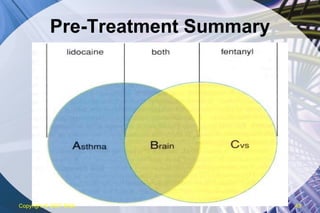
Pre-Treatment Summary Lidocaine Reactive airway disease (good evidence) Increased ICP (conflicting evidence) Opiates Increased ICP Cardiovascular disease Copyright  © 2007 ENA
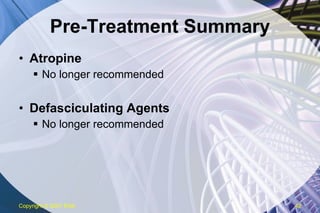
Pre-Treatment Summary Atropine No longer recommended Defasciculating Agents No longer recommended Copyright  © 2007 ENA
Pre-Treatment Summary Copyright  © 2007 ENA
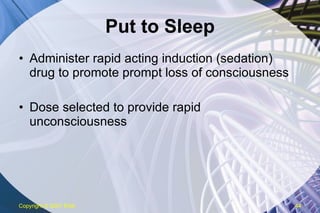
Put to Sleep Administer rapid acting induction (sedation) drug to promote prompt loss of consciousness Dose selected to provide rapid unconsciousness Copyright  © 2007 ENA
Induction Agents Etomidate Ketamine Propofol Midazolam Copyright  © 2007 ENA
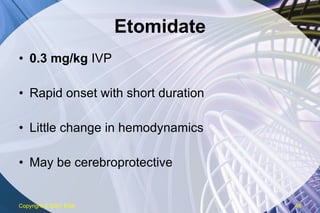
Etomidate 0.3 mg/kg  IVP Rapid onset with short duration Little change in hemodynamics May be cerebroprotective Copyright  © 2007 ENA
Etomidate Concern for adrenal suppression in patients with prior known adrenal dysfunction or in patients with sepsis May prefer alternative agent in these scenarios Copyright  © 2007 ENA
Ketamine 1-2 mg/kg  IVP Dissociative state with some analgesic properties Bronchodilation May increase ICP (Recent conflicting data) Copyright  © 2007 ENA
Ketamine Consider for use in asthmatics or in anaphylaxis ???Avoid use with increased ICP??? Copyright  © 2007 ENA
Propofol 2 mg/kg  IVP Rapid onset and short duration Cerebral protection Myocardial depressant and decreases systemic vascular resistance Copyright  © 2007 ENA
Midazolam 0.3 mg/kg  IVP Slow onset (minutes) and long duration (hours) Hypotension common Rarely recommended Copyright  © 2007 ENA
Paralyze Provides neuromuscular blockade and is given immediately after induction agent Does not provide sedation, analgesia or amnesia Copyright  © 2007 ENA
Paralyze Depolarizing Agent Succinylcholine Non-Depolarizing Agents Rocuronium Vecuronium Copyright  © 2007 ENA
Succinylcholine 1.5 – 2 mg/kg  IVP Rapid onset (45 – 60 seconds) Shortest duration (8 -10 minutes) Cautious use in hyperkalemia, muscular disorders, open globe injuries Copyright  © 2007 ENA
Rocuronium Good 2 nd  line agent after succinylcholine Does not worsen hyperkalemia 1 mg/kg  IVP At this dose has rapid onset similar to succinylcholine but  MUCH  longer duration of action (30 – 60 minutes) Copyright  © 2007 ENA
Vecuronium Good 3 rd  line agent 0.15 mg/kg  IVP Onset 75 -90 seconds, duration 60 -75 minutes Copyright  © 2007 ENA
Drug & Weight Considerations Dose based on  TRUE  body weight Succinylcholine Etomidate Midazolam Dose based on  IDEAL  body weight Propofol Rocuronium Copyright  © 2007 ENA
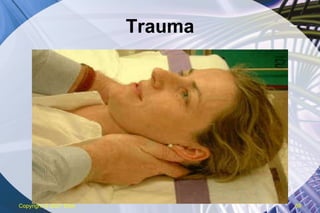
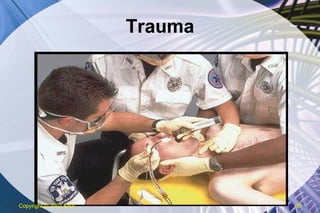
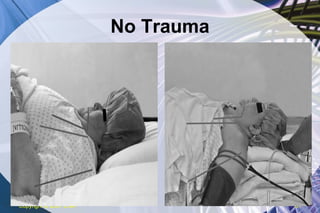
Positioning If concern for trauma Manual immobilization of head/neck by experienced assistant C-collar is  NOT  adequate!!!! If NO concern for trauma Intubator positions head and airway to facilitate visualization for intubation Copyright  © 2007 ENA
Trauma Copyright  © 2007 ENA
No Trauma Copyright  © 2007 ENA
Protection Application of Sellick maneuver (cricoid pressure) to prevent aspiration Applied with delivery of induction/paralytic medications “ BURP” Copyright  © 2007 ENA
Protection Recent studies show little evidence that aspiration is effectively reduced Copyright  © 2007 ENA
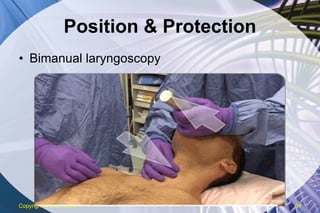
Position & Protection Bimanual laryngoscopy Copyright  © 2007 ENA
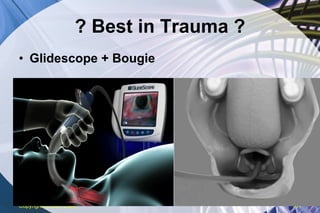
Placement The intubator places the ETT into the trachea Direct laryngoscopy with conventional laryngoscope Direct laryngoscopy with video laryngoscope Laryngoscopy with bougie device Combination of above Copyright  © 2007 ENA
Proof Primary Methods Secondary Methods NO SINGLE METHOD PROVIDES 100% RELIABILITY THAT ETT IS IN THE TRACHEA! Copyright  © 2007 ENA
Primary Methods Intubator sees tube go through cords Symmetrical rise and fall of chest Absence of air sounds over epigastrium Presence of bilateral breath sounds Copyright  © 2007 ENA
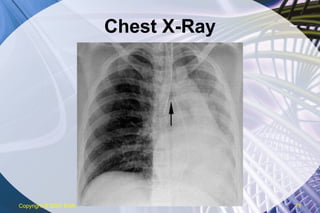
Secondary Methods Presence of exhaled CO2 Colorimetric Capnography Aspiration of air from ETT EDD Chest X-Ray Assures proper height above carina Copyright  © 2007 ENA
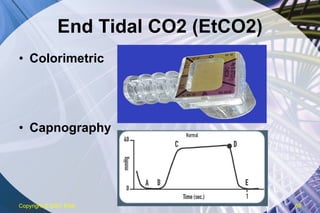
End Tidal CO2 (EtCO2) Colorimetric Capnography Copyright  © 2007 ENA
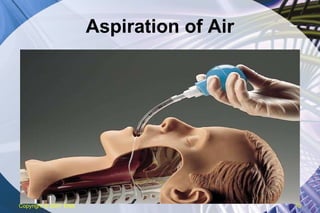
Aspiration of Air Copyright  © 2007 ENA
Chest X-Ray Copyright  © 2007 ENA
Post-Intubation Management Secure ETT and record depth of insertion Initiate mechanical ventilation Administer ordered analgesics, sedation agents and possibly prolonged paralysis as required by clinical situation Copyright  © 2007 ENA
Post-Intubation Management Hypotension is  COMMON! Often related to: Decreased venous return with positive pressure ventilation Induction agent side effect Cardiogenic Pneumothorax Auto-PEEP Copyright  © 2007 ENA
Failed Intubation Copyright  © 2007 ENA
Failed Intubation Cannot Intubate –   Can   Ventilate Cannot Intubate –   Cannot   Ventilate Copyright  © 2007 ENA
Can Ventilate Call for assistance Oxygenation and Ventilation is being maintained with BVM Alternative Airway Copyright  © 2007 ENA
Alternative Airway Fiberoptic Method Video Laryngoscopy Extra-Glottic Device Bougie Surgical (Cricothyrotomy) Copyright  © 2007 ENA
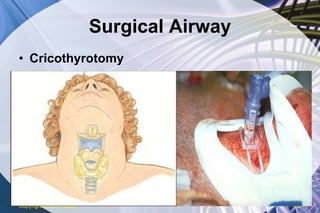
Cannot Ventilate Call for assistance Simultaneous preparation for cricothyrotomy while  MAYBE, BRIEFLY  attempting alternative airway Cricothyrotomy will usually be   THE   method of  CHOICE  in cannot intubate, cannot ventilate scenario!!! Copyright  © 2007 ENA
Rescue Airway Devices and Alternative Methods for Intubation or Airway Acquisition Copyright  © 2007 ENA
Alternative Airways Fiberoptic Video Laryngoscopy Extra-Glottic Device Bougie Surgical Copyright  © 2007 ENA
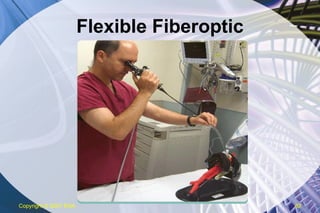
Fiberoptic Flexible fiberoptic Fiberoptic stylets and guides Copyright  © 2007 ENA
Flexible Fiberoptic Copyright  © 2007 ENA
Fiberoptic Stylets & Guides Shikani Optical Stylet Levitan/FPS Scope Airway RIFL Copyright  © 2007 ENA
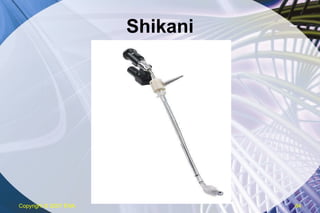
Shikani Copyright  © 2007 ENA
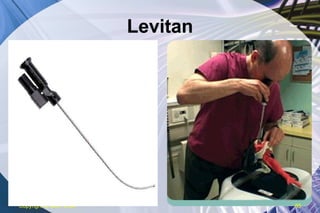
Levitan Copyright  © 2007 ENA
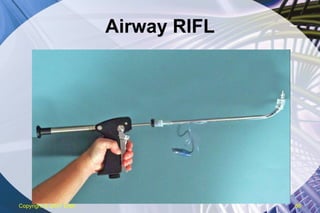
Airway RIFL Copyright  © 2007 ENA
Video Laryngoscopy Glidescope C-MAC Video Laryngoscope McGrath Video Laryngoscope Pentax Airway Scope Res-Q-Scope II Copyright  © 2007 ENA
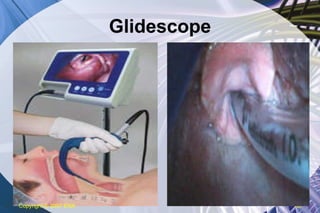
Glidescope Copyright  © 2007 ENA
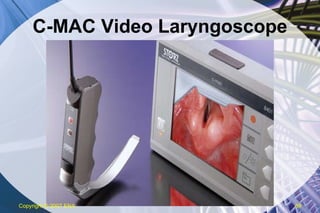
C-MAC Video Laryngoscope Copyright  © 2007 ENA
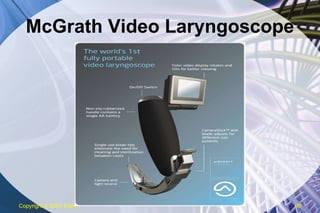
McGrath Video Laryngoscope Copyright  © 2007 ENA
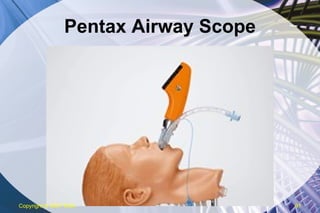
Pentax Airway Scope Copyright  © 2007 ENA
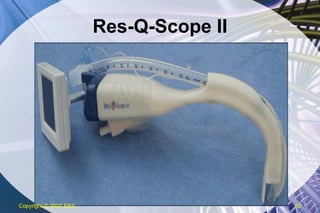
Res-Q-Scope II Copyright  © 2007 ENA
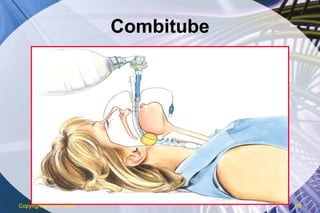
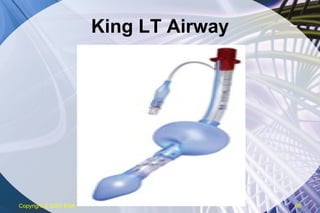
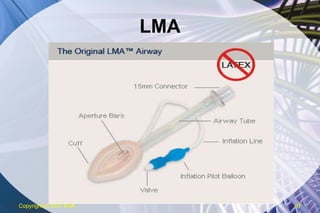
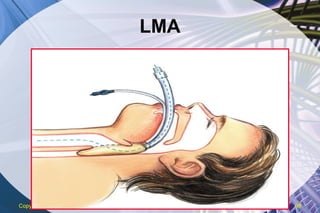
Extra-Glottic Devices Combitube King LT Airway Laryngeal Mask Airway (LMA) Copyright  © 2007 ENA
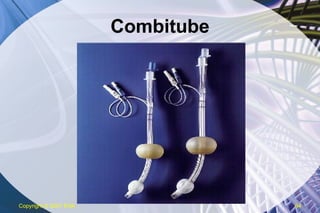
Combitube Copyright  © 2007 ENA
King LT Airway Copyright  © 2007 ENA
LMA Copyright  © 2007 ENA
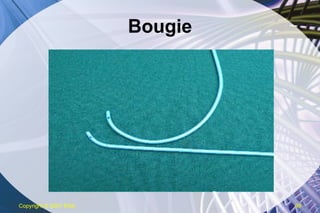
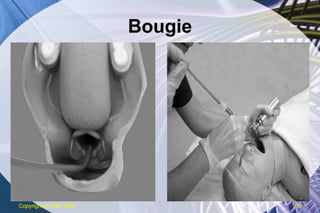
Bougie Copyright  © 2007 ENA
? Best in Trauma ? Glidescope + Bougie Copyright  © 2007 ENA
Surgical Airway Cricothyrotomy Copyright  © 2007 ENA
Summary Copyright  © 2007 ENA
To simplify RSI, think  INDUCTION  (etomidate) and  PARALYSIS  (succinylcholine) In trauma, maintain  MANUAL  c-spine immobilization during intubation Adequate pre-oxygenation is paramount to success, best delivered by high flow mask Copyright  © 2007 ENA
Anticipate post-intubation hypotension as it is  COMMON Anticipate difficult intubation, BVM, surgical airway by “ LEMON ”, “ BONES”  & “ SHORT ” Copyright  © 2007 ENA
Know what methods/devices you have available in case of failed intubation ( AND   where they are!!!!!) Copyright  © 2007 ENA
QUESTIONS? Copyright  © 2007 ENA
Thank You! Copyright  © 2007 ENA

Indiana ENA 2010 RSI And Difficult Intubation

  • 2.
    The Critical Airway:RSI & Failed Intubation
  • 3.
    Andrew J. BowmanAcute Care Nurse Practitioner Trauma Nurse Specialist Registered Nurse Paramedic Emergency Department Emergency Department Witham Health Services Clarian Arnett Hospital KATS Transport Ambulance
  • 4.
    Disclaimer I haveno financial disclosures and I have no affiliation with any company to promote use of any drug or device described in this presentation.
  • 5.
  • 6.
    AIRWAY COMES FIRST!!!!!But….. Not always as easy as it sounds!
  • 7.
    Attempts to Intubate<= 2 Attempts > 2 Attempts
  • 8.
    Overview What isRSI? RSI: The 10 “P’s” Failed Intubation Alternative airways and devices
  • 9.
    What is RSI?Rapid Sequence Intubation = RSI Cornerstone of emergency department (ED) airway management Timed delivery of medications to sedate and paralyze a patient to facilitate rapid placement of an endotracheal tube (ETT) Copyright © 2007 ENA
  • 10.
    Who Needs RSI?One or more of the following: Inability to maintain a patent airway Inability to protect against aspiration Compromised or impaired ventilation Failure to adequately oxygenate blood Anticipation of patient deterioration that will lead to any/all of the above Copyright © 2007 ENA
  • 11.
    Why RSI? Resultsin rapid unconsciousness and chemical paralysis Most ED patients are not fasting Ideally, intubation without bag/mask ventilation Copyright © 2007 ENA
  • 12.
    When NOT to RSI Unconscious Apneic Need “ Crash ” airway Immediate BVM and ETT without pre-treatment Copyright © 2007 ENA
  • 13.
    When NOT to RSI Total upper airway obstruction Loss of facial or oropharyngeal landmarks Need surgical airway Copyright © 2007 ENA
  • 14.
    Cautious Use ofRSI Suspected difficult airway or BVM “ LEMON”, “BONES”, “SHORT” Mallampati Classification 3-3-2 Rule Copyright © 2007 ENA
  • 15.
    The 10 “P’s”of RSI Copyright © 2007 ENA
  • 16.
    The 10 “P’s”of RSI Preparation Pre-oxygenation Pre-treatment Put to sleep Paralyze Protect Position Placement Proof Post-Intubation management Copyright © 2007 ENA
  • 17.
    Preparation Best defenseagainst the chaos of achieving an emergent airway Why is it a dying patient only vomits when the suction has not been checked????? Copyright © 2007 ENA
  • 18.
    Preparation Start ofshift preparation Airway cart or CRASH cart is stocked and ready Functioning equipment Pre-arrival / arrival of patient preparation Adequate staff Medications Airway equipment Length based resuscitation tape if pediatrics Determine if potential for difficult airway or difficult BVM Copyright © 2007 ENA
  • 19.
    Difficult ETT PredictionLEMON Mallampati Classification 3-3-2 Copyright © 2007 ENA
  • 20.
    LEMON L ookexternally E valuate internally M allampati O bstruction N eck mobility Copyright © 2007 ENA
  • 21.
    Look Externally BeardSmall jaw, receding chin “Buck” teeth Craniofacial deformity or trauma Copyright © 2007 ENA
  • 22.
    Evaluate Internally 3-3-23 fingers of mouth opening 3 fingers mentum to hyoid 2 fingers hyoid to thyroid Copyright © 2007 ENA
  • 23.
    3-3-2 Copyright © 2007 ENA
  • 24.
  • 25.
    Obstruction Pre-glottic obstructionsTongue enlargement Airway edema Copyright © 2007 ENA
  • 26.
    Neck Mobility TraumaAnklosing spondylitis Arthritis Copyright © 2007 ENA
  • 27.
    Difficult BVM Prediction“ BONES ” B eard/mustache O besity N o teeth E lderly S nores Copyright © 2007 ENA
  • 28.
    Difficult Surgical AirwayPrediction “ SHORT ” S urgery H ematoma of neck O besity R adiation to neck T rauma Copyright © 2007 ENA
  • 29.
    Pre-Oxygenation AKA: NitrogenWashout Copyright © 2007 ENA
  • 30.
    Pre-Oxygenation Best suppliedby high flow non-rebreather mask for at least 5 minutes prior to RSI Creates a reservoir of oxygen in lungs, alveoli, blood and tissue Use positive pressure ventilation with BVM only when necessary (8 vital capacity breaths) Copyright © 2007 ENA
  • 31.
    Time to DesaturationCopyright © 2007 ENA
  • 32.
    Pre-Treatment Use ofmedications to blunt or decrease adverse physiologic responses to laryngoscopy and intubation “ LOAD ” Copyright © 2007 ENA
  • 33.
    “ LOAD” Lidocaine O piates A tropine D efasciculating agents Copyright © 2007 ENA
  • 34.
    Lidocaine 1.5mg/kg IV - Given 3 minutes prior to ETT Suppresses cough and gag reflex MAY decrease rises in ICP No good studies that prove benefit Copyright © 2007 ENA
  • 35.
    Lidocaine May decreaseor diminish reflex bronchospasm in patients with reactive airway disease Asthma COPD Copyright © 2007 ENA
  • 36.
    Lidocaine Topical lidocainemay deliver a more consistent blunting of responses to intubation Copyright © 2007 ENA
  • 37.
    Opiates Fentanyl 1-3mcg/kg IVP – Given 2 - 3 minutes prior to ETT Decreases sympathetic response to intubation Possible benefit with increased ICP, aortic dissection, ICH, ischemic heart disease Copyright © 2007 ENA
  • 38.
    Atropine 0.02 mg/kg IV to maximum 1mg (minimum 0.1mg) Historically used in pediatrics being treated with succinylcholine to prevent reflexive bradycardia Copyright © 2007 ENA
  • 39.
    Atropine No longerrecommended Eliminates a step that has no clear benefit Bradycardia, especially in pediatrics, is a hallmark of hypoxemia and should not be masked by medications Copyright © 2007 ENA
  • 40.
    Defasciculating Agents Useof a competitive neuromuscular blocker (NMB) 3 minutes before succinylcholine to decrease fasciculations Decrease increases in ICP Shown to have little, if any benefit and again eliminates a step Copyright © 2007 ENA
  • 41.
    Pre-Treatment Summary LidocaineReactive airway disease (good evidence) Increased ICP (conflicting evidence) Opiates Increased ICP Cardiovascular disease Copyright © 2007 ENA
  • 42.
    Pre-Treatment Summary AtropineNo longer recommended Defasciculating Agents No longer recommended Copyright © 2007 ENA
  • 43.
  • 44.
    Put to SleepAdminister rapid acting induction (sedation) drug to promote prompt loss of consciousness Dose selected to provide rapid unconsciousness Copyright © 2007 ENA
  • 45.
    Induction Agents EtomidateKetamine Propofol Midazolam Copyright © 2007 ENA
  • 46.
    Etomidate 0.3 mg/kg IVP Rapid onset with short duration Little change in hemodynamics May be cerebroprotective Copyright © 2007 ENA
  • 47.
    Etomidate Concern foradrenal suppression in patients with prior known adrenal dysfunction or in patients with sepsis May prefer alternative agent in these scenarios Copyright © 2007 ENA
  • 48.
    Ketamine 1-2 mg/kg IVP Dissociative state with some analgesic properties Bronchodilation May increase ICP (Recent conflicting data) Copyright © 2007 ENA
  • 49.
    Ketamine Consider foruse in asthmatics or in anaphylaxis ???Avoid use with increased ICP??? Copyright © 2007 ENA
  • 50.
    Propofol 2 mg/kg IVP Rapid onset and short duration Cerebral protection Myocardial depressant and decreases systemic vascular resistance Copyright © 2007 ENA
  • 51.
    Midazolam 0.3 mg/kg IVP Slow onset (minutes) and long duration (hours) Hypotension common Rarely recommended Copyright © 2007 ENA
  • 52.
    Paralyze Provides neuromuscularblockade and is given immediately after induction agent Does not provide sedation, analgesia or amnesia Copyright © 2007 ENA
  • 53.
    Paralyze Depolarizing AgentSuccinylcholine Non-Depolarizing Agents Rocuronium Vecuronium Copyright © 2007 ENA
  • 54.
    Succinylcholine 1.5 –2 mg/kg IVP Rapid onset (45 – 60 seconds) Shortest duration (8 -10 minutes) Cautious use in hyperkalemia, muscular disorders, open globe injuries Copyright © 2007 ENA
  • 55.
    Rocuronium Good 2nd line agent after succinylcholine Does not worsen hyperkalemia 1 mg/kg IVP At this dose has rapid onset similar to succinylcholine but MUCH longer duration of action (30 – 60 minutes) Copyright © 2007 ENA
  • 56.
    Vecuronium Good 3rd line agent 0.15 mg/kg IVP Onset 75 -90 seconds, duration 60 -75 minutes Copyright © 2007 ENA
  • 57.
    Drug & WeightConsiderations Dose based on TRUE body weight Succinylcholine Etomidate Midazolam Dose based on IDEAL body weight Propofol Rocuronium Copyright © 2007 ENA
  • 58.
    Positioning If concernfor trauma Manual immobilization of head/neck by experienced assistant C-collar is NOT adequate!!!! If NO concern for trauma Intubator positions head and airway to facilitate visualization for intubation Copyright © 2007 ENA
  • 59.
    Trauma Copyright © 2007 ENA
  • 60.
    Trauma Copyright © 2007 ENA
  • 61.
    No Trauma Copyright © 2007 ENA
  • 62.
    Protection Application ofSellick maneuver (cricoid pressure) to prevent aspiration Applied with delivery of induction/paralytic medications “ BURP” Copyright © 2007 ENA
  • 63.
    Protection Recent studiesshow little evidence that aspiration is effectively reduced Copyright © 2007 ENA
  • 64.
    Position & ProtectionBimanual laryngoscopy Copyright © 2007 ENA
  • 65.
    Placement The intubatorplaces the ETT into the trachea Direct laryngoscopy with conventional laryngoscope Direct laryngoscopy with video laryngoscope Laryngoscopy with bougie device Combination of above Copyright © 2007 ENA
  • 66.
    Proof Primary MethodsSecondary Methods NO SINGLE METHOD PROVIDES 100% RELIABILITY THAT ETT IS IN THE TRACHEA! Copyright © 2007 ENA
  • 67.
    Primary Methods Intubatorsees tube go through cords Symmetrical rise and fall of chest Absence of air sounds over epigastrium Presence of bilateral breath sounds Copyright © 2007 ENA
  • 68.
    Secondary Methods Presenceof exhaled CO2 Colorimetric Capnography Aspiration of air from ETT EDD Chest X-Ray Assures proper height above carina Copyright © 2007 ENA
  • 69.
    End Tidal CO2(EtCO2) Colorimetric Capnography Copyright © 2007 ENA
  • 70.
    Aspiration of AirCopyright © 2007 ENA
  • 71.
  • 72.
    Post-Intubation Management SecureETT and record depth of insertion Initiate mechanical ventilation Administer ordered analgesics, sedation agents and possibly prolonged paralysis as required by clinical situation Copyright © 2007 ENA
  • 73.
    Post-Intubation Management Hypotensionis COMMON! Often related to: Decreased venous return with positive pressure ventilation Induction agent side effect Cardiogenic Pneumothorax Auto-PEEP Copyright © 2007 ENA
  • 74.
  • 75.
    Failed Intubation CannotIntubate – Can Ventilate Cannot Intubate – Cannot Ventilate Copyright © 2007 ENA
  • 76.
    Can Ventilate Callfor assistance Oxygenation and Ventilation is being maintained with BVM Alternative Airway Copyright © 2007 ENA
  • 77.
    Alternative Airway FiberopticMethod Video Laryngoscopy Extra-Glottic Device Bougie Surgical (Cricothyrotomy) Copyright © 2007 ENA
  • 78.
    Cannot Ventilate Callfor assistance Simultaneous preparation for cricothyrotomy while MAYBE, BRIEFLY attempting alternative airway Cricothyrotomy will usually be THE method of CHOICE in cannot intubate, cannot ventilate scenario!!! Copyright © 2007 ENA
  • 79.
    Rescue Airway Devicesand Alternative Methods for Intubation or Airway Acquisition Copyright © 2007 ENA
  • 80.
    Alternative Airways FiberopticVideo Laryngoscopy Extra-Glottic Device Bougie Surgical Copyright © 2007 ENA
  • 81.
    Fiberoptic Flexible fiberopticFiberoptic stylets and guides Copyright © 2007 ENA
  • 82.
  • 83.
    Fiberoptic Stylets &Guides Shikani Optical Stylet Levitan/FPS Scope Airway RIFL Copyright © 2007 ENA
  • 84.
    Shikani Copyright © 2007 ENA
  • 85.
    Levitan Copyright © 2007 ENA
  • 86.
  • 87.
    Video Laryngoscopy GlidescopeC-MAC Video Laryngoscope McGrath Video Laryngoscope Pentax Airway Scope Res-Q-Scope II Copyright © 2007 ENA
  • 88.
  • 89.
    C-MAC Video LaryngoscopeCopyright © 2007 ENA
  • 90.
    McGrath Video LaryngoscopeCopyright © 2007 ENA
  • 91.
    Pentax Airway ScopeCopyright © 2007 ENA
  • 92.
  • 93.
    Extra-Glottic Devices CombitubeKing LT Airway Laryngeal Mask Airway (LMA) Copyright © 2007 ENA
  • 94.
  • 95.
  • 96.
    King LT AirwayCopyright © 2007 ENA
  • 97.
    LMA Copyright © 2007 ENA
  • 98.
    LMA Copyright © 2007 ENA
  • 99.
    Bougie Copyright © 2007 ENA
  • 100.
    Bougie Copyright © 2007 ENA
  • 101.
    ? Best inTrauma ? Glidescope + Bougie Copyright © 2007 ENA
  • 102.
    Surgical Airway CricothyrotomyCopyright © 2007 ENA
  • 103.
    Summary Copyright © 2007 ENA
  • 104.
    To simplify RSI,think INDUCTION (etomidate) and PARALYSIS (succinylcholine) In trauma, maintain MANUAL c-spine immobilization during intubation Adequate pre-oxygenation is paramount to success, best delivered by high flow mask Copyright © 2007 ENA
  • 105.
    Anticipate post-intubation hypotensionas it is COMMON Anticipate difficult intubation, BVM, surgical airway by “ LEMON ”, “ BONES” & “ SHORT ” Copyright © 2007 ENA
  • 106.
    Know what methods/devicesyou have available in case of failed intubation ( AND where they are!!!!!) Copyright © 2007 ENA
  • 107.
  • 108.

Editor's Notes

  • #3 Slide 1 Note to Faculty : Information that is italicized in this outline indicates points that should be discussed with the Instructor Candidates. This lecture will be most effective if experiences with teaching are shared.
  • #4 Slide 2 Discuss the principles of adult learning. Discuss methods of teaching TNCC Provider course chapters to include: Preparing and presenting the chapters. Individualizing the content. Controlling difficult situations. Discuss methods for teaching TNCC Provider course psychomotor skill stations to include: Preparing and conducting the situations. Controlling difficult situations.
  • #5 Slide 2 Discuss the principles of adult learning. Discuss methods of teaching TNCC Provider course chapters to include: Preparing and presenting the chapters. Individualizing the content. Controlling difficult situations. Discuss methods for teaching TNCC Provider course psychomotor skill stations to include: Preparing and conducting the situations. Controlling difficult situations.
  • #16 Slide 1 Note to Faculty : Information that is italicized in this outline indicates points that should be discussed with the Instructor Candidates. This lecture will be most effective if experiences with teaching are shared.
  • #17 Slide 2 Discuss the principles of adult learning. Discuss methods of teaching TNCC Provider course chapters to include: Preparing and presenting the chapters. Individualizing the content. Controlling difficult situations. Discuss methods for teaching TNCC Provider course psychomotor skill stations to include: Preparing and conducting the situations. Controlling difficult situations.
  • #19 Slide 2 Discuss the principles of adult learning. Discuss methods of teaching TNCC Provider course chapters to include: Preparing and presenting the chapters. Individualizing the content. Controlling difficult situations. Discuss methods for teaching TNCC Provider course psychomotor skill stations to include: Preparing and conducting the situations. Controlling difficult situations.
  • #75 Slide 1 Note to Faculty : Information that is italicized in this outline indicates points that should be discussed with the Instructor Candidates. This lecture will be most effective if experiences with teaching are shared.
  • #76 Slide 2 Discuss the principles of adult learning. Discuss methods of teaching TNCC Provider course chapters to include: Preparing and presenting the chapters. Individualizing the content. Controlling difficult situations. Discuss methods for teaching TNCC Provider course psychomotor skill stations to include: Preparing and conducting the situations. Controlling difficult situations.
  • #80 Slide 1 Note to Faculty : Information that is italicized in this outline indicates points that should be discussed with the Instructor Candidates. This lecture will be most effective if experiences with teaching are shared.
  • #81 Slide 2 Discuss the principles of adult learning. Discuss methods of teaching TNCC Provider course chapters to include: Preparing and presenting the chapters. Individualizing the content. Controlling difficult situations. Discuss methods for teaching TNCC Provider course psychomotor skill stations to include: Preparing and conducting the situations. Controlling difficult situations.
  • #104 Slide 1 Note to Faculty : Information that is italicized in this outline indicates points that should be discussed with the Instructor Candidates. This lecture will be most effective if experiences with teaching are shared.
  • #109 Slide 1 Note to Faculty : Information that is italicized in this outline indicates points that should be discussed with the Instructor Candidates. This lecture will be most effective if experiences with teaching are shared.