PRONE POSITION
RESCUE THEAPY FOR SEVERE ARDS
PRONE POSITION
Acute Respiratory Distress Syndrome (ARDS) is
defined as a:
“syndrome of acute and persistent lung
inflammation with increased vascular
permeability” (Hansen-Fletcher et al)
PRONE POSITION
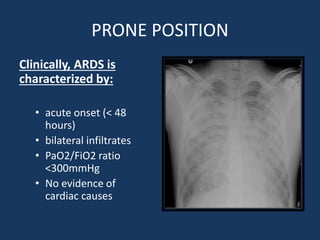
Clinically, ARDS is
characterized by:
• acute onset (< 48
hours)
• bilateral infiltrates
• PaO2/FiO2 ratio
<300mmHg
• No evidence of
cardiac causes
PRONE POSITION
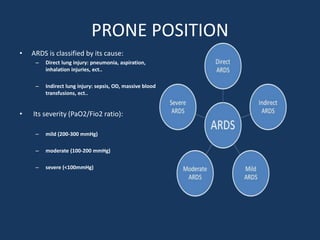
• ARDS is classified by its cause:
– Direct lung injury: pneumonia, aspiration,
inhalation injuries, ect..
– Indirect lung injury: sepsis, OD, massive blood
transfusions, ect..
• Its severity (PaO2/Fio2 ratio):
– mild (200-300 mmHg)
– moderate (100-200 mmHg)
– severe (<100mmHg)
PRONE POSITION
Recovery
Stage
•Slow restoration of lung
function
Proliferative
Stage
•7—21 days
•Alteration of lung tissue
•Poor Compliance
•Decreased Edema
Exudative
Stage
•0-7 days
•Edema (peaks 048hrs)
•Inflammation
Typically, lung dysfunction is the worst during the first 0-48hours and
may last for up to a week.
PRONE POSITION
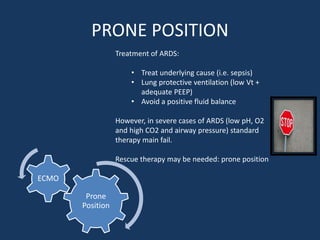
Treatment of ARDS:
• Treat underlying cause (i.e. sepsis)
• Lung protective ventilation (low Vt +
adequate PEEP)
• Avoid a positive fluid balance
However, in severe cases of ARDS (low pH, O2
and high CO2 and airway pressure) standard
therapy main fail.
Rescue therapy may be needed: prone position
Prone
Position
ECMO
PRONE POSITION
Indications for the prone position:
Capital Health Prone Criteria:
• ARDS
• < 48 hours
• Pa02/FiO2 <200mmHg
PRONE POSITION
Relative contraindications for the prone position:
• Elevated ICP
• Intestinal ischemia
• Obesity
• Recent Abdominal Surgery
Absolute contraindications for the prone position:
• spinal cord instability,
• unstable facial fractures
• anterior burns, open abdomen
• increased abdominal pressures
• unstable pelvic fractures.
PRONE POSITION
The Prone Position:
• Improves perfusion to the lungs → Better V:Q matching
• The diaphragm drops and the heart shift forward → Improved compliance
• Improved lung recruitment
• Lung Protective
• Indicated:
• Moderate to Severe ARDS
• Early (<48hours)
• Duration: 12 – 16 hours
PRONE POSITION
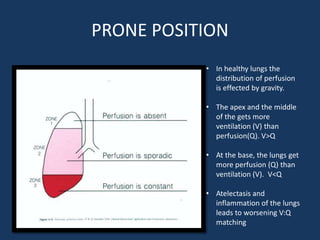
• In healthy lungs the
distribution of perfusion
is effected by gravity.
• The apex and the middle
of the gets more
ventilation (V) than
perfusion(Q). V>Q
• At the base, the lungs get
more perfusion (Q) than
ventilation (V). V<Q
• Atelectasis and
inflammation of the lungs
leads to worsening V:Q
matching
PRONE POSITION
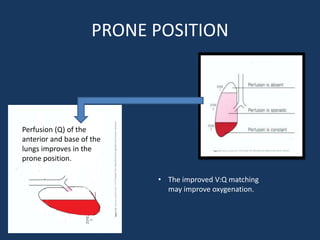
Perfusion (Q) of the
anterior and base of the
lungs improves in the
prone position.
• The improved V:Q matching
may improve oxygenation.
PRONE POSITION
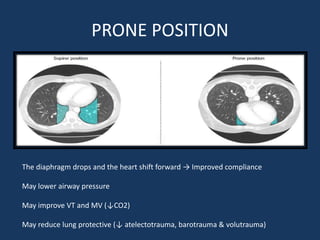
The diaphragm drops and the heart shift forward → Improved compliance
May lower airway pressure
May improve VT and MV (↓CO2)
May reduce lung protective (↓ atelectotrauma, barotrauma & volutrauma)
PRONE POSITION
NURSING CARE:
• Ensure adequate sedation and analgesia (meet
goal RASS)
• Ensure adequate paralysis (meet TOF goal)
• ABG PRN to assess oxygenation (PaO2) &
ventilation (PaCo2)
• Reposition arms Q2H (see prone policy)
• Check Q2H for pressure areas
• Family education
PRONE POSITION
IN CONCLUSION:
• Current research (PROSEVA) demonstrates
that the prone position is may be beneficial
in severe ARDS (<48 hours).
• Duration 16-24 hours
• Inexpensive compared and easy to perform
• May be lung protective (improve
compliance)
• May improve oxygen and ventilation (better
V:Q matching)
PRONE POSITION
THANK YOU!

Prone Position

  • 1.
  • 2.
    PRONE POSITION Acute RespiratoryDistress Syndrome (ARDS) is defined as a: “syndrome of acute and persistent lung inflammation with increased vascular permeability” (Hansen-Fletcher et al)
  • 3.
    PRONE POSITION Clinically, ARDSis characterized by: • acute onset (< 48 hours) • bilateral infiltrates • PaO2/FiO2 ratio <300mmHg • No evidence of cardiac causes
  • 4.
    PRONE POSITION • ARDSis classified by its cause: – Direct lung injury: pneumonia, aspiration, inhalation injuries, ect.. – Indirect lung injury: sepsis, OD, massive blood transfusions, ect.. • Its severity (PaO2/Fio2 ratio): – mild (200-300 mmHg) – moderate (100-200 mmHg) – severe (<100mmHg)
  • 5.
    PRONE POSITION Recovery Stage •Slow restorationof lung function Proliferative Stage •7—21 days •Alteration of lung tissue •Poor Compliance •Decreased Edema Exudative Stage •0-7 days •Edema (peaks 048hrs) •Inflammation Typically, lung dysfunction is the worst during the first 0-48hours and may last for up to a week.
  • 6.
    PRONE POSITION Treatment ofARDS: • Treat underlying cause (i.e. sepsis) • Lung protective ventilation (low Vt + adequate PEEP) • Avoid a positive fluid balance However, in severe cases of ARDS (low pH, O2 and high CO2 and airway pressure) standard therapy main fail. Rescue therapy may be needed: prone position Prone Position ECMO
  • 7.
    PRONE POSITION Indications forthe prone position: Capital Health Prone Criteria: • ARDS • < 48 hours • Pa02/FiO2 <200mmHg
  • 8.
    PRONE POSITION Relative contraindicationsfor the prone position: • Elevated ICP • Intestinal ischemia • Obesity • Recent Abdominal Surgery Absolute contraindications for the prone position: • spinal cord instability, • unstable facial fractures • anterior burns, open abdomen • increased abdominal pressures • unstable pelvic fractures.
  • 9.
    PRONE POSITION The PronePosition: • Improves perfusion to the lungs → Better V:Q matching • The diaphragm drops and the heart shift forward → Improved compliance • Improved lung recruitment • Lung Protective • Indicated: • Moderate to Severe ARDS • Early (<48hours) • Duration: 12 – 16 hours
  • 10.
    PRONE POSITION • Inhealthy lungs the distribution of perfusion is effected by gravity. • The apex and the middle of the gets more ventilation (V) than perfusion(Q). V>Q • At the base, the lungs get more perfusion (Q) than ventilation (V). V<Q • Atelectasis and inflammation of the lungs leads to worsening V:Q matching
  • 11.
    PRONE POSITION Perfusion (Q)of the anterior and base of the lungs improves in the prone position. • The improved V:Q matching may improve oxygenation.
  • 12.
    PRONE POSITION The diaphragmdrops and the heart shift forward → Improved compliance May lower airway pressure May improve VT and MV (↓CO2) May reduce lung protective (↓ atelectotrauma, barotrauma & volutrauma)
  • 13.
    PRONE POSITION NURSING CARE: •Ensure adequate sedation and analgesia (meet goal RASS) • Ensure adequate paralysis (meet TOF goal) • ABG PRN to assess oxygenation (PaO2) & ventilation (PaCo2) • Reposition arms Q2H (see prone policy) • Check Q2H for pressure areas • Family education
  • 14.
    PRONE POSITION IN CONCLUSION: •Current research (PROSEVA) demonstrates that the prone position is may be beneficial in severe ARDS (<48 hours). • Duration 16-24 hours • Inexpensive compared and easy to perform • May be lung protective (improve compliance) • May improve oxygen and ventilation (better V:Q matching)
  • 15.