Tutorial on Histogram Processing for Contrast Enhancement of Digital Images Brightness Preserving Contrast Enhancement Hrushikesh Garud Senior Software Engineer Texas Instruments (India), Bangalore and School of Medical Science and Technology, Indian Institute of Technology, Kharagpur  International Conference on Data Engineering and Communication Systems (ICDECS-2011)  30-31 December 2011  Bangalore, India Thanks: Mr. Debdoot Sheet School of Medical Science and Technology, Indian Institute of Technology, Kharagpur
Outline How do we distinguish objects from surroundings? What is contrast? What is Subjective Contrast Enhancement? Why it is necessary? Histogram Processing for Contrast Enhancement Histogram equalization - procedure, results and limitations Bi-histogram equalization - procedure and results Multi-histogram equalization Brightness preserving dynamic fuzzy histogram equalization - procedure and results Brightness Preserving Contrast Enhancement in Color Images Application: Brightness Preserving Contrast Enhancement in Digital Pathology Conclusion
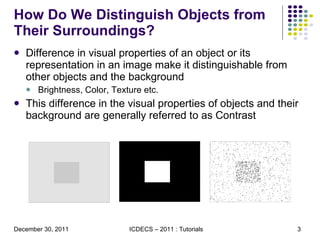
How Do We Distinguish Objects from Their Surroundings? Difference in visual properties of an object or its representation in an image make it distinguishable from other objects and the background Brightness, Color, Texture etc. This difference in the visual properties of objects and their background are generally referred to as Contrast
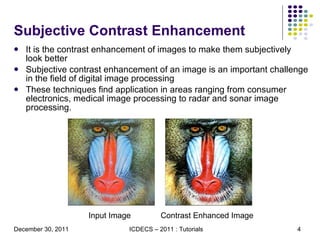
Subjective Contrast Enhancement It is the contrast enhancement of images to make them subjectively look better Subjective contrast enhancement of an image is an important challenge in the field of digital image processing These techniques find application in areas ranging from consumer electronics, medical image processing to radar and sonar image processing. Input Image Contrast Enhanced Image
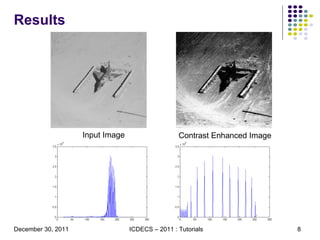
Histogram Processing for Contrast Enhancement In a poorly contrasted image a large number of pixels occupy only a small portion of the available range of intensities.  Through histogram modification we reassign each pixel with a new intensity value so that the dynamic range of gray levels is increased. Common histogram modification techniques [1] Histogram Equalization (HE) Modifications: Locally Adaptive Histogram Equalization, Bi-histogram Equalization and Multi-histogram Equalization  Histogram Specification  Histogram Hyperbolization
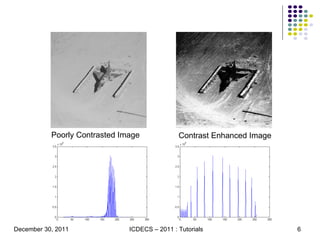
Poorly Contrasted Image Contrast Enhanced Image
Histogram Equalization [1] Histogram equalization (HE) is a technique of adjusting the gray scale of the image such that the gray level histogram of the input image is mapped into a uniform histogram.  The assumption here is that the information conveyed by an image is related to the probability of occurrence of gray levels in the image.  Procedure: Consider a  grayscale image with dimensions  MxN Compute histogram  H   for the gray scales. Where value  H(i)  represents the frequency of occurrence of the  i th  gray level in the image. Compute cumulative frequency  H cf (i)   of the histogram.  Then the  equalized histogram   EqH  is obtained as  Here the  EqH  contains the new mapping of gray values .  In the input image  replace the each gray value  i,  by  EqH(i)  to obtain the equalized image.
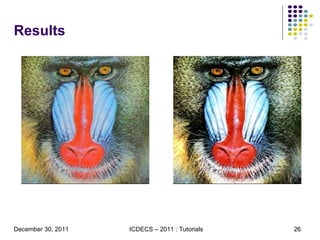
Results Input Image Contrast Enhanced Image
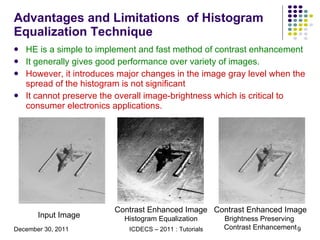
Advantages and Limitations  of Histogram Equalization Technique HE is a simple to implement and fast method of contrast enhancement It generally gives good performance over variety of images. However, it introduces major changes in the image gray level when the spread of the histogram is not significant  It cannot preserve the overall image-brightness which is critical to consumer electronics applications. Input Image Contrast Enhanced Image Histogram Equalization Contrast Enhanced Image Brightness Preserving  Contrast Enhancement
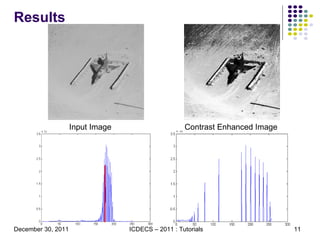
Bi-histogram Equalization[2] Bi-histogram equalization techniques partition histograms in two sub-histograms and equalize them independently. These techniques have been proposed to minimize the change in mean image brightness aftre histogram equalization Several image parameters such as  median, mean gray  level or some sort of automatically selected  grayscale threshold  are used to partitioning of the histogram.  Procedure: Compute histogram  H   for the gray scales. Where value  H(i)  represents the frequency of occurrence of the  i th  gray level in the image. Split the histogram in to two sub-histograms Equalize the two sub-histograms independently .  Let  EqH contain the new mapping of gray values  obtained after equalization. In the input image  replace the each gray value  i,  by  EqH(i)  to obtain the equalized image.
Results Input Image Contrast Enhanced Image
Multi-histogram Equalization [7] Multi-histogram equalization techniques partition histograms in multiple sub-histograms and equalize them independently. These techniques have been proposed to further improve the mean image brightness preserving capabilities of the aftre histogram equalization Several histogram features as  local peak or valley points act as markers for partitioning  of the histogram.  Thus  valley portions  between two consecutive peaks or  peaks  between two consecutive valley point  form the sub-histograms for equalization Procedure: Compute histogram  H   for the gray scales. Where value  H(i)  represents the frequency of occurrence of the  i th  gray level in the image. Split the histogram  in to multiple sub-histograms Equalize the each sub-histogram independently .  Let  EqH contain the new mapping of gray values  obtained after equalization. In the input image  replace the each gray value  i,  by  EqH(i)  to obtain the equalized image.
Brightness Preserving Dynamic Fuzzy Histogram Equalization[10] The BPDFHE technique as shown in Fig 2 comprises of four functional steps Fuzzy histogram computation  with a suitable membership function Partitioning of the histogram  to create sub-histograms, each comprising of a valley portion between two consecutive histogram peaks Dynamic equalization of the histogram partitions Normalization of image brightness  to match mean image brightness of input and output images The detailed description of each of the functional steps is given further in the presentation. Fuzzy Histogram Computation Partitioning of the Histogram Dynamic Equalization of the Histogram Partitions Normalization of Image Brightness Low Contrast Image Contrast Enhanced Image BPDFHE Stages
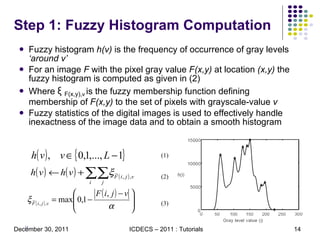
Step 1: Fuzzy Histogram Computation Fuzzy histogram  h(v)  is the frequency of occurrence of gray levels  ‘around v’ For an image  F  with the pixel gray value  F(x,y)  at location  (x,y)  the fuzzy histogram is computed as given in (2) Where  ξ   F(x,y), ν   is the fuzzy membership function defining membership of  F(x,y)  to the set of pixels with grayscale-value  v Fuzzy statistics of the digital images is used to effectively handle inexactness of the image data and to obtain a smooth histogram (1) (2) (3)
Step 2:  Histogram Partitioning The fuzzy histogram now obtained is partitioned to obtain sub histograms which are to be dynamically equalized The histogram partitioning involves two steps Local maxima detection:  located using the first and second order derivatives of the histogram Creating partitions:  Each valley portion between two consecutive local maxima is considered as a partition.  Let  {m 1 , m 2 , ···  m n }   be the  n   local maxima points detected. Then for a histogram with spread  [F min , F max ]   the  n+1 sub-histograms obtained after partitioning are { [F min ,, m 1 ],  [m 1 ,  m 2 ],  ··· [m n ,F max ]  }
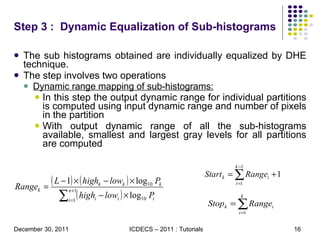
Step 3 :  Dynamic Equalization of Sub-histograms   The sub histograms obtained are individually equalized by DHE technique.  The step involves two operations Dynamic range mapping of sub-histograms: In this step the output dynamic range for individual partitions is computed using input dynamic range and number of pixels in the partition  With output dynamic range of all the sub-histograms available, smallest and largest gray levels for all partitions are computed
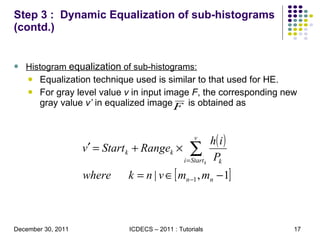
Step 3 :  Dynamic Equalization of sub-histograms (contd.) Histogram  equalization  of sub-histograms: Equalization technique used is similar to that used for HE. For gray level value  v  in input image  F , the corresponding new gray value  v’  in equalized image  is obtained as
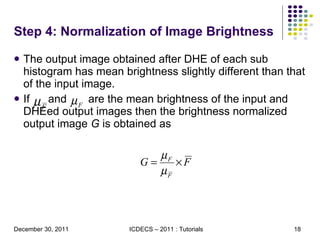
Step 4: Normalization of Image Brightness The output image obtained after DHE of each sub histogram has mean brightness slightly different than that of the input image. If  and  are the mean brightness of the input and DHEed output images then the brightness normalized output image  G  is obtained as
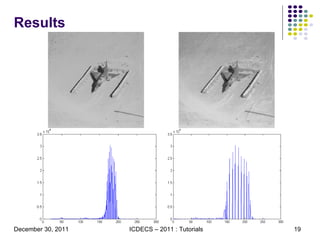
Results
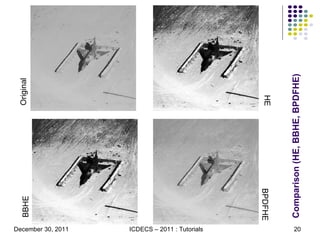
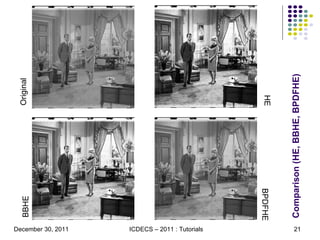
Comparison (HE, BBHE, BPDFHE) Original BBHE HE BPDFHE
Objective Evaluation of Contrast Enhancement and Brightness Preservation Capabilities Image contrast enhancement  without altering its brightness is a restrained goal of this technique. Thus the performance of the algorithms needs to be evaluated objectively  Thus two parameters that can be used are  Brightness preserving capability Luminance distortion (LD) measure is used to evaluate an algorithm’s brightness preserving capability measure. Contrast enhancement capability Contrast from Fuzzy Gray Level Co-occurrence Matrix (FGLCM) is used as contrast enhancement evaluation metric
This is the measure of closeness of mean luminance of two images being compared. For the pair of reference image  F  and enhanced image  G,  having the mean brightness  μ F  and  μ G  respectively, the LD measure  Q  is given below.  Here LD measure  Q image  is computed as a mean of local LD values  Q(x,y)  computed at every pixel  7x7  location considering the neighborhood surrounding it . Luminance Distortion[11] (9) (10) TABLE I: LUMINANCE DISTORTION *   More results available in [10] and [13] 0.9950 --- 0.9199  5.2.08 BPDFHE BBHE HE Image ID
Contrast from Fuzzy- GLCM [12] This measure evaluates the local contrast in image. Fuzzy co-occurrence matrix on image is determined with pyramidal membership function By averaging four symmetrical co-occurrence matrices computed with different values of  θ , we compute rotational invariant FGLCM ( M’ ) The rotational invariant FGLCM ( M’ )  is normalized ( M’ norm ) and contrast is determined . TABLE II: CONTRAST FROM FUZZY  CO -OCCURRENCE MATRIX *   * More results available in [10] and [13] 301.0 Original 348.9 --- 888.6 5.2.08 BPDFHE BBHE HE Image ID
Brightness Preserving Contrast Enhancement in Color Images [13] The brightness preserving contrast enhancement process uses Brightness Preserving Dynamic Fuzzy Histogram Equalization for contrast enhancement  Images are processed in CIE L*a*b* color space where contrast enhancement is performed on the L* channel while keeping chroma information unaltered  The BPDFHE technique manipulates image histogram to redistribute gray-level values in the valley portions between two consecutive histogram peaks and keep histogram peaks unaffected Color Space Conversion (RGB to CIEL*a*b*) Contrast Enhancement in L* Channel  Color Space Conversion (CIEL*a*b* to RGB) Contrast Enhanced Color Image Low Contrast Color Image
Results
Some State of the Art Bi-histogram Equalization Techniques: Contrast Enhancement Using Brightness Preserving Bi-Histogram Equalization[2] Minimum Mean Brightness Error Bi-Histogram Equalization in Contrast Enhancement[3] Image Enhancement Based On Equal Area Dualistic Sub-Image Histogram Equalization Method[4] Contrast enhancement using recursive MeanSeparate histogram equalization for scalable brightness preservation[5] Multi-histogram Equalization Techniques Multi-Histogram Equalization Methods  for Contrast Enhancement and Brightness Preserving[6] A Dynamic Histogram Equalization for Image Contrast Enhancement[7] Brightness Preserving Dynamic Histogram Equalization for Image Contrast Enhancement[8] Brightness Preserving Histogram Equalization with Maximum Entropy: A Variational Perspective[9] Brightness Preserving Dynamic Fuzzy Histogram Equalization[10]
Application of Brightness Preserving Contrast Enhancement Techniques Digital Pathology[12] Digital pathology  is an image-based environment that enables acquisition, management and interpretation of the information generated from a digitized glass slide.  Brightfield microscopy , commonly used in pathological investigations produces low contrast images for most biological samples as few absorb light to a large extent. Thus, tissue staining is used for introduction of contrast.  Nevertheless a majority of the images in digital pathology require adjustments to optimize brightness, contrast, and image visibility. Here we present study on application of  Brightness Preserving Dynamic Fuzzy Histogram Equalization  (BPDFHE) technique in digital pathology to achieve balance between two important attributes of the image quality contrast and image brightness.
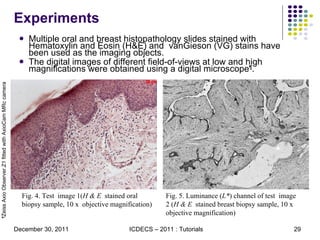
Experiments Multiple oral and breast histopathology slides stained with Hematoxylin and Eosin (H&E) and  vanGieson (VG) stains have been used as the imaging objects. The digital images of different field-of-views at low and high magnifications were obtained using a digital microscope ¶ . Fig. 4. Test  image 1( H & E  stained oral biopsy sample, 10 x  objective magnification)  Fig. 5. Luminance ( L* ) channel of test  image 2 ( H & E  stained breast biopsy sample, 10 x  objective magnification)  ¶ Zeiss Axio Observer.Z1 fitted with AxioCam MRc camera
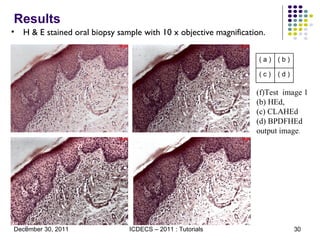
Results H & E stained oral biopsy sample with 10 x objective magnification. Test  image 1 (b) HEd,  (c) CLAHEd  (d) BPDFHEd output image .  ( a ) ( b ) ( c ) ( d )
Results H & E stained breast biopsy sample with 10 x objective magnification. Fig. 7.  Test image 2 (b) HEd,  (c) CLAHEd []  (d) BPDFHEd output image .  ( a ) ( b ) ( c ) ( d )
Observations for Brightness preserving Contrast Enhancement in Digital Pathology Even though the contrast enhancement capability of BPDFHE limits when trying to preserve brightness, performance is still comparable and often better than that of the HE technique. By virtue of operating on the global statistics of images BPDFHE is computationally more efficient than CLAHE. CLAHE, though able to increase the contrast more than other techniques compared, it introduces large changes in the pixel gray levels. This may lead to introduction of the processing artifacts and affect the decision making process. The study of the effects of image contrast enhancement on diagnostic value of pathological images by organ, diseases and feature specific categories through involvement of domain experts will be an important aspect for future development.
Conclusions Histogram equalization (HE) has been a simple yet effective image enhancement technique. However, it tends to change the brightness of an image significantly, causing annoying artifacts andunnatural contrast enhancement.  Brightness preserving contrast enhancement by use of bi-histogram equalization and multi-histogram equalization techniques can overcome this limitation very effectively.  Multi-histogram techniques are generally better than bi-histogram equalization techniques in brightness preservation over wide variety of images.
Image Sources USC SIPI Image Database- Miscellaneous  http://sipi.usc.edu/database/database.php?volume=misc 4.2.03 Mandrill (a.k.a. Baboon)  7.1.02 Airplane School of Medical Science and Technology IIT Kharagpur Private Image Archieves Oral Histopathology Image Breast Histopathology Image
References T. Acharya and A. K. Ray Image Processing Principles and Applicatins, John Wiley & Sons, Inc., Hoboken, New Jersey, 2005 Y. T. Kim, “Contrast Enhancement Using Brightness Preserving Bi-Histogram Equalization”,  IEEE Trans., Consumer Electronics , vol. 43, no. 1, pp. 1-8, 1997. S. D. Chen and A. R. Ramli, “Minimum Mean Brightness Error Bi-Histogram Equalization in Contrast Enhancement”,  IEEE Trans.,Consumer Electronics , vol. 49, no. 4, pp. 1310-1319, Nov. 2003. Yu Wan, Qian Chen and Bao-Min Zhang., “Image Enhancement Based On Equal Area Dualistic Sub-Image Histogram Equalization Method,”  IEEE Trans Consumer Electronics, vol. 45, no. 1, pp. 68-75, Feb. 1999. S.-D. Chen and A. Ramli, “Contrast enhancement using recursive MeanSeparate histogram equalization for scalable brightness preservation,”  IEEE Trans. on Consumer Electronics, vol. 49, no. 4, pp. 1301-1309,  Nov. 2003. D. Menotti, L. Najman, J. Facon, and A.A. Araújo, “Multi-Histogram Equalization Methods for Contrast Enhancement and Brightness Preserving”, IEEE Transactions on Consumer Electronics, Vol. 53, No. 3, AUGUST 2007.  M. Abdullah-Al-Wadud, et al, “A Dynamic Histogram Equalization for Image Contrast Enhancement”, IEEE Trans., Consumer Electronics, vol.53, no. 2, pp. 593–600, May 2007.
References (Continued) H. Ibrahim, and N. S. P. Kong, “Brightness Preserving Dynamic Histogram Equalization for Image Contrast Enhancement”,  IEEE Trans.,Consumer Electronics , vol. 53, no. 4, pp. 1752–1758, Nov. 2007. C. Wang and Z. Ye, “Brightness Preserving Histogram Equalization with Maximum Entropy: A Variational Perspective”,  IEEE Trans., Consumer Electronics , vol. 51, no. 4, pp. 1326-1334, Nov. 2005. D. Sheet, H. Garud, A. Suveer, M. Mahadevappa, and J. Chatterjee, “Brightness preserving dynamic fuzzy histogram equalization,” Cons. Elect. IEEE Trans. on, vol. 56, no. 4, pp. 2475 –2480, Nov. 2010. Z. Wang and A. C. Bovik, “A universal image quality index,” IEEE Signal Processing Letters, vol. 9, no. 3, pp. 81–84, Mar 2002. C. V. Jawahar and A. K. Ray, “Incorporation of gray-level imprecision in representation and processing of digital images,” Pattern Recognition Letters, vol. 17, no. 5, pp. 541–546, 1996. H. Garud et. al. “Brightness Preserving Contrast Enhancement in Digital Pathology” Proceedings of the ICIIP -2011, Shimla, India. (To be indexed on IEEExplore Digital Library)
Thank You! [email_address] Hrushikesh Garud

Icdecs 2011

  • 1.
    Tutorial on HistogramProcessing for Contrast Enhancement of Digital Images Brightness Preserving Contrast Enhancement Hrushikesh Garud Senior Software Engineer Texas Instruments (India), Bangalore and School of Medical Science and Technology, Indian Institute of Technology, Kharagpur International Conference on Data Engineering and Communication Systems (ICDECS-2011) 30-31 December 2011 Bangalore, India Thanks: Mr. Debdoot Sheet School of Medical Science and Technology, Indian Institute of Technology, Kharagpur
  • 2.
    Outline How dowe distinguish objects from surroundings? What is contrast? What is Subjective Contrast Enhancement? Why it is necessary? Histogram Processing for Contrast Enhancement Histogram equalization - procedure, results and limitations Bi-histogram equalization - procedure and results Multi-histogram equalization Brightness preserving dynamic fuzzy histogram equalization - procedure and results Brightness Preserving Contrast Enhancement in Color Images Application: Brightness Preserving Contrast Enhancement in Digital Pathology Conclusion
  • 3.
    How Do WeDistinguish Objects from Their Surroundings? Difference in visual properties of an object or its representation in an image make it distinguishable from other objects and the background Brightness, Color, Texture etc. This difference in the visual properties of objects and their background are generally referred to as Contrast
  • 4.
    Subjective Contrast EnhancementIt is the contrast enhancement of images to make them subjectively look better Subjective contrast enhancement of an image is an important challenge in the field of digital image processing These techniques find application in areas ranging from consumer electronics, medical image processing to radar and sonar image processing. Input Image Contrast Enhanced Image
  • 5.
    Histogram Processing forContrast Enhancement In a poorly contrasted image a large number of pixels occupy only a small portion of the available range of intensities. Through histogram modification we reassign each pixel with a new intensity value so that the dynamic range of gray levels is increased. Common histogram modification techniques [1] Histogram Equalization (HE) Modifications: Locally Adaptive Histogram Equalization, Bi-histogram Equalization and Multi-histogram Equalization Histogram Specification Histogram Hyperbolization
  • 6.
    Poorly Contrasted ImageContrast Enhanced Image
  • 7.
    Histogram Equalization [1]Histogram equalization (HE) is a technique of adjusting the gray scale of the image such that the gray level histogram of the input image is mapped into a uniform histogram. The assumption here is that the information conveyed by an image is related to the probability of occurrence of gray levels in the image. Procedure: Consider a grayscale image with dimensions MxN Compute histogram H for the gray scales. Where value H(i) represents the frequency of occurrence of the i th gray level in the image. Compute cumulative frequency H cf (i) of the histogram. Then the equalized histogram EqH is obtained as Here the EqH contains the new mapping of gray values . In the input image replace the each gray value i, by EqH(i) to obtain the equalized image.
  • 8.
    Results Input ImageContrast Enhanced Image
  • 9.
    Advantages and Limitations of Histogram Equalization Technique HE is a simple to implement and fast method of contrast enhancement It generally gives good performance over variety of images. However, it introduces major changes in the image gray level when the spread of the histogram is not significant It cannot preserve the overall image-brightness which is critical to consumer electronics applications. Input Image Contrast Enhanced Image Histogram Equalization Contrast Enhanced Image Brightness Preserving Contrast Enhancement
  • 10.
    Bi-histogram Equalization[2] Bi-histogramequalization techniques partition histograms in two sub-histograms and equalize them independently. These techniques have been proposed to minimize the change in mean image brightness aftre histogram equalization Several image parameters such as median, mean gray level or some sort of automatically selected grayscale threshold are used to partitioning of the histogram. Procedure: Compute histogram H for the gray scales. Where value H(i) represents the frequency of occurrence of the i th gray level in the image. Split the histogram in to two sub-histograms Equalize the two sub-histograms independently . Let EqH contain the new mapping of gray values obtained after equalization. In the input image replace the each gray value i, by EqH(i) to obtain the equalized image.
  • 11.
    Results Input ImageContrast Enhanced Image
  • 12.
    Multi-histogram Equalization [7]Multi-histogram equalization techniques partition histograms in multiple sub-histograms and equalize them independently. These techniques have been proposed to further improve the mean image brightness preserving capabilities of the aftre histogram equalization Several histogram features as local peak or valley points act as markers for partitioning of the histogram. Thus valley portions between two consecutive peaks or peaks between two consecutive valley point form the sub-histograms for equalization Procedure: Compute histogram H for the gray scales. Where value H(i) represents the frequency of occurrence of the i th gray level in the image. Split the histogram in to multiple sub-histograms Equalize the each sub-histogram independently . Let EqH contain the new mapping of gray values obtained after equalization. In the input image replace the each gray value i, by EqH(i) to obtain the equalized image.
  • 13.
    Brightness Preserving DynamicFuzzy Histogram Equalization[10] The BPDFHE technique as shown in Fig 2 comprises of four functional steps Fuzzy histogram computation with a suitable membership function Partitioning of the histogram to create sub-histograms, each comprising of a valley portion between two consecutive histogram peaks Dynamic equalization of the histogram partitions Normalization of image brightness to match mean image brightness of input and output images The detailed description of each of the functional steps is given further in the presentation. Fuzzy Histogram Computation Partitioning of the Histogram Dynamic Equalization of the Histogram Partitions Normalization of Image Brightness Low Contrast Image Contrast Enhanced Image BPDFHE Stages
  • 14.
    Step 1: FuzzyHistogram Computation Fuzzy histogram h(v) is the frequency of occurrence of gray levels ‘around v’ For an image F with the pixel gray value F(x,y) at location (x,y) the fuzzy histogram is computed as given in (2) Where ξ F(x,y), ν is the fuzzy membership function defining membership of F(x,y) to the set of pixels with grayscale-value v Fuzzy statistics of the digital images is used to effectively handle inexactness of the image data and to obtain a smooth histogram (1) (2) (3)
  • 15.
    Step 2: Histogram Partitioning The fuzzy histogram now obtained is partitioned to obtain sub histograms which are to be dynamically equalized The histogram partitioning involves two steps Local maxima detection: located using the first and second order derivatives of the histogram Creating partitions: Each valley portion between two consecutive local maxima is considered as a partition. Let {m 1 , m 2 , ··· m n } be the n local maxima points detected. Then for a histogram with spread [F min , F max ] the n+1 sub-histograms obtained after partitioning are { [F min ,, m 1 ], [m 1 , m 2 ], ··· [m n ,F max ] }
  • 16.
    Step 3 : Dynamic Equalization of Sub-histograms The sub histograms obtained are individually equalized by DHE technique. The step involves two operations Dynamic range mapping of sub-histograms: In this step the output dynamic range for individual partitions is computed using input dynamic range and number of pixels in the partition With output dynamic range of all the sub-histograms available, smallest and largest gray levels for all partitions are computed
  • 17.
    Step 3 : Dynamic Equalization of sub-histograms (contd.) Histogram equalization of sub-histograms: Equalization technique used is similar to that used for HE. For gray level value v in input image F , the corresponding new gray value v’ in equalized image is obtained as
  • 18.
    Step 4: Normalizationof Image Brightness The output image obtained after DHE of each sub histogram has mean brightness slightly different than that of the input image. If and are the mean brightness of the input and DHEed output images then the brightness normalized output image G is obtained as
  • 19.
  • 20.
    Comparison (HE, BBHE,BPDFHE) Original BBHE HE BPDFHE
  • 21.
    Comparison (HE, BBHE,BPDFHE) Original BBHE HE BPDFHE
  • 22.
    Objective Evaluation ofContrast Enhancement and Brightness Preservation Capabilities Image contrast enhancement without altering its brightness is a restrained goal of this technique. Thus the performance of the algorithms needs to be evaluated objectively Thus two parameters that can be used are Brightness preserving capability Luminance distortion (LD) measure is used to evaluate an algorithm’s brightness preserving capability measure. Contrast enhancement capability Contrast from Fuzzy Gray Level Co-occurrence Matrix (FGLCM) is used as contrast enhancement evaluation metric
  • 23.
    This is themeasure of closeness of mean luminance of two images being compared. For the pair of reference image F and enhanced image G, having the mean brightness μ F and μ G respectively, the LD measure Q is given below. Here LD measure Q image is computed as a mean of local LD values Q(x,y) computed at every pixel 7x7 location considering the neighborhood surrounding it . Luminance Distortion[11] (9) (10) TABLE I: LUMINANCE DISTORTION * More results available in [10] and [13] 0.9950 --- 0.9199 5.2.08 BPDFHE BBHE HE Image ID
  • 24.
    Contrast from Fuzzy-GLCM [12] This measure evaluates the local contrast in image. Fuzzy co-occurrence matrix on image is determined with pyramidal membership function By averaging four symmetrical co-occurrence matrices computed with different values of θ , we compute rotational invariant FGLCM ( M’ ) The rotational invariant FGLCM ( M’ ) is normalized ( M’ norm ) and contrast is determined . TABLE II: CONTRAST FROM FUZZY CO -OCCURRENCE MATRIX * * More results available in [10] and [13] 301.0 Original 348.9 --- 888.6 5.2.08 BPDFHE BBHE HE Image ID
  • 25.
    Brightness Preserving ContrastEnhancement in Color Images [13] The brightness preserving contrast enhancement process uses Brightness Preserving Dynamic Fuzzy Histogram Equalization for contrast enhancement Images are processed in CIE L*a*b* color space where contrast enhancement is performed on the L* channel while keeping chroma information unaltered The BPDFHE technique manipulates image histogram to redistribute gray-level values in the valley portions between two consecutive histogram peaks and keep histogram peaks unaffected Color Space Conversion (RGB to CIEL*a*b*) Contrast Enhancement in L* Channel Color Space Conversion (CIEL*a*b* to RGB) Contrast Enhanced Color Image Low Contrast Color Image
  • 26.
  • 27.
    Some State ofthe Art Bi-histogram Equalization Techniques: Contrast Enhancement Using Brightness Preserving Bi-Histogram Equalization[2] Minimum Mean Brightness Error Bi-Histogram Equalization in Contrast Enhancement[3] Image Enhancement Based On Equal Area Dualistic Sub-Image Histogram Equalization Method[4] Contrast enhancement using recursive MeanSeparate histogram equalization for scalable brightness preservation[5] Multi-histogram Equalization Techniques Multi-Histogram Equalization Methods for Contrast Enhancement and Brightness Preserving[6] A Dynamic Histogram Equalization for Image Contrast Enhancement[7] Brightness Preserving Dynamic Histogram Equalization for Image Contrast Enhancement[8] Brightness Preserving Histogram Equalization with Maximum Entropy: A Variational Perspective[9] Brightness Preserving Dynamic Fuzzy Histogram Equalization[10]
  • 28.
    Application of BrightnessPreserving Contrast Enhancement Techniques Digital Pathology[12] Digital pathology is an image-based environment that enables acquisition, management and interpretation of the information generated from a digitized glass slide. Brightfield microscopy , commonly used in pathological investigations produces low contrast images for most biological samples as few absorb light to a large extent. Thus, tissue staining is used for introduction of contrast. Nevertheless a majority of the images in digital pathology require adjustments to optimize brightness, contrast, and image visibility. Here we present study on application of Brightness Preserving Dynamic Fuzzy Histogram Equalization (BPDFHE) technique in digital pathology to achieve balance between two important attributes of the image quality contrast and image brightness.
  • 29.
    Experiments Multiple oraland breast histopathology slides stained with Hematoxylin and Eosin (H&E) and vanGieson (VG) stains have been used as the imaging objects. The digital images of different field-of-views at low and high magnifications were obtained using a digital microscope ¶ . Fig. 4. Test image 1( H & E stained oral biopsy sample, 10 x objective magnification) Fig. 5. Luminance ( L* ) channel of test image 2 ( H & E stained breast biopsy sample, 10 x objective magnification) ¶ Zeiss Axio Observer.Z1 fitted with AxioCam MRc camera
  • 30.
    Results H &E stained oral biopsy sample with 10 x objective magnification. Test image 1 (b) HEd, (c) CLAHEd (d) BPDFHEd output image . ( a ) ( b ) ( c ) ( d )
  • 31.
    Results H &E stained breast biopsy sample with 10 x objective magnification. Fig. 7. Test image 2 (b) HEd, (c) CLAHEd [] (d) BPDFHEd output image . ( a ) ( b ) ( c ) ( d )
  • 32.
    Observations for Brightnesspreserving Contrast Enhancement in Digital Pathology Even though the contrast enhancement capability of BPDFHE limits when trying to preserve brightness, performance is still comparable and often better than that of the HE technique. By virtue of operating on the global statistics of images BPDFHE is computationally more efficient than CLAHE. CLAHE, though able to increase the contrast more than other techniques compared, it introduces large changes in the pixel gray levels. This may lead to introduction of the processing artifacts and affect the decision making process. The study of the effects of image contrast enhancement on diagnostic value of pathological images by organ, diseases and feature specific categories through involvement of domain experts will be an important aspect for future development.
  • 33.
    Conclusions Histogram equalization(HE) has been a simple yet effective image enhancement technique. However, it tends to change the brightness of an image significantly, causing annoying artifacts andunnatural contrast enhancement. Brightness preserving contrast enhancement by use of bi-histogram equalization and multi-histogram equalization techniques can overcome this limitation very effectively. Multi-histogram techniques are generally better than bi-histogram equalization techniques in brightness preservation over wide variety of images.
  • 34.
    Image Sources USCSIPI Image Database- Miscellaneous http://sipi.usc.edu/database/database.php?volume=misc 4.2.03 Mandrill (a.k.a. Baboon) 7.1.02 Airplane School of Medical Science and Technology IIT Kharagpur Private Image Archieves Oral Histopathology Image Breast Histopathology Image
  • 35.
    References T. Acharyaand A. K. Ray Image Processing Principles and Applicatins, John Wiley & Sons, Inc., Hoboken, New Jersey, 2005 Y. T. Kim, “Contrast Enhancement Using Brightness Preserving Bi-Histogram Equalization”, IEEE Trans., Consumer Electronics , vol. 43, no. 1, pp. 1-8, 1997. S. D. Chen and A. R. Ramli, “Minimum Mean Brightness Error Bi-Histogram Equalization in Contrast Enhancement”, IEEE Trans.,Consumer Electronics , vol. 49, no. 4, pp. 1310-1319, Nov. 2003. Yu Wan, Qian Chen and Bao-Min Zhang., “Image Enhancement Based On Equal Area Dualistic Sub-Image Histogram Equalization Method,” IEEE Trans Consumer Electronics, vol. 45, no. 1, pp. 68-75, Feb. 1999. S.-D. Chen and A. Ramli, “Contrast enhancement using recursive MeanSeparate histogram equalization for scalable brightness preservation,” IEEE Trans. on Consumer Electronics, vol. 49, no. 4, pp. 1301-1309, Nov. 2003. D. Menotti, L. Najman, J. Facon, and A.A. Araújo, “Multi-Histogram Equalization Methods for Contrast Enhancement and Brightness Preserving”, IEEE Transactions on Consumer Electronics, Vol. 53, No. 3, AUGUST 2007. M. Abdullah-Al-Wadud, et al, “A Dynamic Histogram Equalization for Image Contrast Enhancement”, IEEE Trans., Consumer Electronics, vol.53, no. 2, pp. 593–600, May 2007.
  • 36.
    References (Continued) H.Ibrahim, and N. S. P. Kong, “Brightness Preserving Dynamic Histogram Equalization for Image Contrast Enhancement”, IEEE Trans.,Consumer Electronics , vol. 53, no. 4, pp. 1752–1758, Nov. 2007. C. Wang and Z. Ye, “Brightness Preserving Histogram Equalization with Maximum Entropy: A Variational Perspective”, IEEE Trans., Consumer Electronics , vol. 51, no. 4, pp. 1326-1334, Nov. 2005. D. Sheet, H. Garud, A. Suveer, M. Mahadevappa, and J. Chatterjee, “Brightness preserving dynamic fuzzy histogram equalization,” Cons. Elect. IEEE Trans. on, vol. 56, no. 4, pp. 2475 –2480, Nov. 2010. Z. Wang and A. C. Bovik, “A universal image quality index,” IEEE Signal Processing Letters, vol. 9, no. 3, pp. 81–84, Mar 2002. C. V. Jawahar and A. K. Ray, “Incorporation of gray-level imprecision in representation and processing of digital images,” Pattern Recognition Letters, vol. 17, no. 5, pp. 541–546, 1996. H. Garud et. al. “Brightness Preserving Contrast Enhancement in Digital Pathology” Proceedings of the ICIIP -2011, Shimla, India. (To be indexed on IEEExplore Digital Library)
  • 37.

Editor's Notes

  • #15 Fuzzy statistics of the digital images is in general used to effectively handle inexactness of the image data and to obtain a smooth histogram Smooth histogram helps perform its meaningful partitioning for brightness preserving equalization
  • #17 where, high and low are the highest and lowest intensity value of the kth input sub-histogram and P_k is the total number of pixel in that partition
  • #18 In eq.12: V’ is new gray value Start_k is starting intensity value for kth partition Range_k is range of kth partition as computed in previous sub-step h(i)/P_k is the probability of ith intensity value starting from start intensity value of that partition to intensity value v.
  • #24 In the TABLE I: it can be seen that our technique (BPDFHE) Out-performs both HE and CLAHE and preserves the image brightness to the maximum extent
  • #25 Here we compute the contrast of an image from rotational invariant Fuzzy-GLCM, obtained by averaging four symmetrical co-occurrence matrices obtained with different values of theta. In TABLE 2: it can be observed that BPDFHE provides contrast enhancement equivalent to HE and CLAHE, but it should be remembered that BPDFHE preserves the Manifestation of clinical feature and image brightness better than HE and CLAHE It has been observed that the BPDFHE provides contrast enhancement comparable to that provided by HE and CLAHE techniq ues. Whereas, it outperforms both He and CLAHE in image brightness preservation.
  • #26 The non-shifting of the peaks in histogram helps to preserve the mean image-brightness while increasing contrast
  • #31 HE though able to enhance the contrast but it leads to saturation of pixels to two extremities, even though overall contrast improves, the visibility of some of the details is lost CLAHE is able to enhance local contrast to large extent but it completely alters appearance of the different tissue regions in image, which may lead severe degradation in diagnostic value of the image. (such as regions of epithelial region) Where as BPDFHE enhances image contrast while preserving image brightness. It has been observed that while providing good contrast enhancement BPDFHE retains Manifestation of clinical feature (Texture of epithelial region /chromaticity (not to be confused with chroma inforation) of the nuclear regions.)
  • #32 Another sample image, only lightness channel is considered Clearly notice the saturation effect in HE image. Whereas ClAHE and BPDFHE have comparable contrast enhancement