Data Compression
Lossy and Lossless Data Compression Methods
Made by:
Humaid Mustajab
General Overview
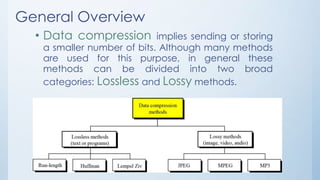
• Data compression implies sending or storing
a smaller number of bits. Although many methods
are used for this purpose, in general these
methods can be divided into two broad
categories: Lossless and Lossy methods.
Lossless Data
Compression
Lossless data compression is a class of data
compression algorithms that allows the
original data to be perfectly reconstructed
from the compressed data.
What is Lossless Compression?
In Lossless data compression, the integrity of the data is
preserved. The original data and the data after compression
and decompression are exactly the same because, in these
methods, the compression and decompression algorithms are
exact inverses of each other: no part of the data is lost in the
process. Redundant data is removed in compression and
added during decompression. Lossless compression methods
are normally used when we cannot afford to lose any data.
 Data redundancy is a condition created within a database or data storage
technology in which the same piece of data is held in two separate places.
Method of Lossless Encoding
Run-length Encoding
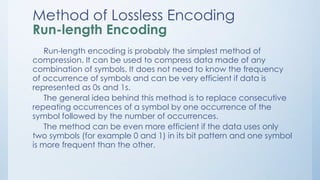
Run-length encoding is probably the simplest method of
compression. It can be used to compress data made of any
combination of symbols. It does not need to know the frequency
of occurrence of symbols and can be very efficient if data is
represented as 0s and 1s.
The general idea behind this method is to replace consecutive
repeating occurrences of a symbol by one occurrence of the
symbol followed by the number of occurrences.
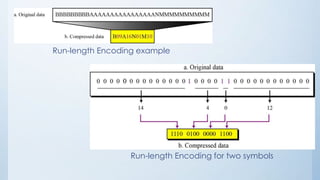
The method can be even more efficient if the data uses only
two symbols (for example 0 and 1) in its bit pattern and one symbol
is more frequent than the other.
Run-length Encoding example
Run-length Encoding for two symbols
Method of Lossless Encoding
Huffman Coding
Huffman coding assigns shorter codes to symbols that occur more
frequently and longer codes to those that occur less frequently. For
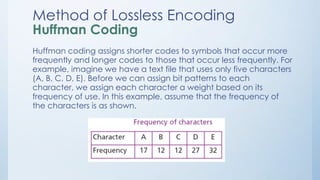
example, imagine we have a text file that uses only five characters
(A, B, C, D, E). Before we can assign bit patterns to each
character, we assign each character a weight based on its
frequency of use. In this example, assume that the frequency of
the characters is as shown.
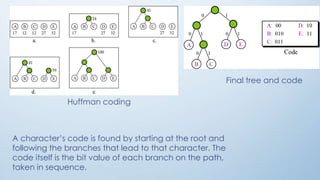
Huffman coding
A character’s code is found by starting at the root and
following the branches that lead to that character. The
code itself is the bit value of each branch on the path,
taken in sequence.
Final tree and code
Lempel Ziv (LZ) encoding is an example of a category of
algorithms called dictionary-based encoding. The idea is
to create a dictionary (a table) of strings used during the
communication session. If both the sender and the
receiver have a copy of the dictionary, then previously-
encountered strings can be substituted by their index in
the dictionary to reduce the amount of information
transmitted.
Method of Lossless Encoding
Lempel Ziv Coding
Compression
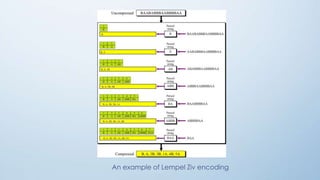
In this phase there are two concurrent events: building an
indexed dictionary and compressing a string of symbols. The
algorithm extracts the smallest substring that cannot be found in
the dictionary from the remaining uncompressed string. It then
stores a copy of this substring in the dictionary as a new entry and
assigns it an index value. Compression occurs when the substring,
except for the last character, is replaced with the index found in
the dictionary. The process then inserts the index and the last
character of the substring into the compressed string.
An example of Lempel Ziv encoding
Decompression
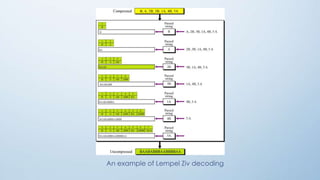
Decompression is the inverse of the compression process. The
process extracts the substrings from the compressed string and tries
to replace the indexes with the corresponding entry in the
dictionary, which is empty at first and built up gradually. The idea is
that when an index is received, there is already an entry in the
dictionary corresponding to that index.
An example of Lempel Ziv decoding
Lossy Data
Compression
In information technology, Lossy compression
is the class of data encoding methods that
uses inexact approximations (or partial data
discarding) for representing the content that
has been encoded.
What is Lossy Data Compression?
Our eyes and ears cannot distinguish subtle changes. In such
cases, we can use a Lossy data compression method. These
methods are cheaper—they take less time and space when it
comes to sending millions of bits per second for images and video.
Several methods have been developed using Lossy compression
techniques:
JPEG (Joint Photographic Experts Group) encoding is used to
compress pictures and graphics,
MPEG (Moving Picture Experts Group) encoding is used to
compress video
MP3 (MPEG audio layer 3) for audio compression
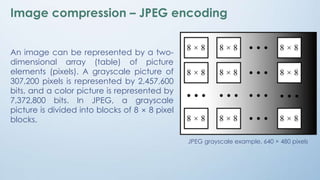
Image compression – JPEG encoding
An image can be represented by a two-
dimensional array (table) of picture
elements (pixels). A grayscale picture of
307,200 pixels is represented by 2,457,600
bits, and a color picture is represented by
7,372,800 bits. In JPEG, a grayscale
picture is divided into blocks of 8 × 8 pixel
blocks.
JPEG grayscale example, 640 × 480 pixels
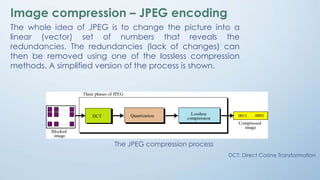
The whole idea of JPEG is to change the picture into a
linear (vector) set of numbers that reveals the
redundancies. The redundancies (lack of changes) can
then be removed using one of the lossless compression
methods. A simplified version of the process is shown.
The JPEG compression process
Image compression – JPEG encoding
DCT: Direct Cosine Transformation
Video compression – MPEG encoding
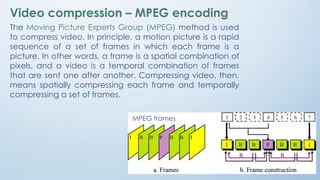
The Moving Picture Experts Group (MPEG) method is used
to compress video. In principle, a motion picture is a rapid
sequence of a set of frames in which each frame is a
picture. In other words, a frame is a spatial combination of
pixels, and a video is a temporal combination of frames
that are sent one after another. Compressing video, then,
means spatially compressing each frame and temporally
compressing a set of frames.
MPEG frames
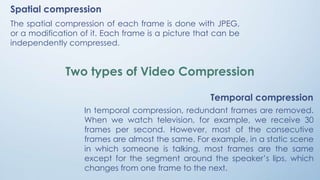
Spatial compression
The spatial compression of each frame is done with JPEG,
or a modification of it. Each frame is a picture that can be
independently compressed.
Temporal compression
In temporal compression, redundant frames are removed.
When we watch television, for example, we receive 30
frames per second. However, most of the consecutive
frames are almost the same. For example, in a static scene
in which someone is talking, most frames are the same
except for the segment around the speaker’s lips, which
changes from one frame to the next.
Two types of Video Compression
Audio compression-MP3
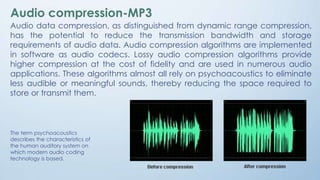
Audio data compression, as distinguished from dynamic range compression,
has the potential to reduce the transmission bandwidth and storage
requirements of audio data. Audio compression algorithms are implemented
in software as audio codecs. Lossy audio compression algorithms provide
higher compression at the cost of fidelity and are used in numerous audio
applications. These algorithms almost all rely on psychoacoustics to eliminate
less audible or meaningful sounds, thereby reducing the space required to
store or transmit them.
The term psychoacoustics
describes the characteristics of
the human auditory system on
which modern audio coding
technology is based.
Perceptual encoding
In digital audio perceptual coding is a coding
method used to reduce the amount of data
needed to produce high-quality sound. Perceptual
coding takes advantage of the human ear,
screening out a certain amount of sound that is
perceived as noise. In perceptual coding you
reduce or eliminate the sounds that the ear would
perceive as noise.
The most common compression technique used
to create CD-quality audio is based on the
perceptual encoding technique. This type of audio
needs at least 1.411 Mbps, which cannot be sent
over the Internet without compression. MP3 (MPEG
audio layer 3) uses this technique.
Types of Audio
Compression

Data compression

  • 1.
    Data Compression Lossy andLossless Data Compression Methods Made by: Humaid Mustajab
  • 2.
    General Overview • Datacompression implies sending or storing a smaller number of bits. Although many methods are used for this purpose, in general these methods can be divided into two broad categories: Lossless and Lossy methods.
  • 3.
    Lossless Data Compression Lossless datacompression is a class of data compression algorithms that allows the original data to be perfectly reconstructed from the compressed data.
  • 4.
    What is LosslessCompression? In Lossless data compression, the integrity of the data is preserved. The original data and the data after compression and decompression are exactly the same because, in these methods, the compression and decompression algorithms are exact inverses of each other: no part of the data is lost in the process. Redundant data is removed in compression and added during decompression. Lossless compression methods are normally used when we cannot afford to lose any data.  Data redundancy is a condition created within a database or data storage technology in which the same piece of data is held in two separate places.
  • 5.
    Method of LosslessEncoding Run-length Encoding Run-length encoding is probably the simplest method of compression. It can be used to compress data made of any combination of symbols. It does not need to know the frequency of occurrence of symbols and can be very efficient if data is represented as 0s and 1s. The general idea behind this method is to replace consecutive repeating occurrences of a symbol by one occurrence of the symbol followed by the number of occurrences. The method can be even more efficient if the data uses only two symbols (for example 0 and 1) in its bit pattern and one symbol is more frequent than the other.
  • 6.
  • 7.
    Method of LosslessEncoding Huffman Coding Huffman coding assigns shorter codes to symbols that occur more frequently and longer codes to those that occur less frequently. For example, imagine we have a text file that uses only five characters (A, B, C, D, E). Before we can assign bit patterns to each character, we assign each character a weight based on its frequency of use. In this example, assume that the frequency of the characters is as shown.
  • 8.
    Huffman coding A character’scode is found by starting at the root and following the branches that lead to that character. The code itself is the bit value of each branch on the path, taken in sequence. Final tree and code
  • 9.
    Lempel Ziv (LZ)encoding is an example of a category of algorithms called dictionary-based encoding. The idea is to create a dictionary (a table) of strings used during the communication session. If both the sender and the receiver have a copy of the dictionary, then previously- encountered strings can be substituted by their index in the dictionary to reduce the amount of information transmitted. Method of Lossless Encoding Lempel Ziv Coding
  • 10.
    Compression In this phasethere are two concurrent events: building an indexed dictionary and compressing a string of symbols. The algorithm extracts the smallest substring that cannot be found in the dictionary from the remaining uncompressed string. It then stores a copy of this substring in the dictionary as a new entry and assigns it an index value. Compression occurs when the substring, except for the last character, is replaced with the index found in the dictionary. The process then inserts the index and the last character of the substring into the compressed string.
  • 11.
    An example ofLempel Ziv encoding
  • 12.
    Decompression Decompression is theinverse of the compression process. The process extracts the substrings from the compressed string and tries to replace the indexes with the corresponding entry in the dictionary, which is empty at first and built up gradually. The idea is that when an index is received, there is already an entry in the dictionary corresponding to that index.
  • 13.
    An example ofLempel Ziv decoding
  • 14.
    Lossy Data Compression In informationtechnology, Lossy compression is the class of data encoding methods that uses inexact approximations (or partial data discarding) for representing the content that has been encoded.
  • 15.
    What is LossyData Compression? Our eyes and ears cannot distinguish subtle changes. In such cases, we can use a Lossy data compression method. These methods are cheaper—they take less time and space when it comes to sending millions of bits per second for images and video. Several methods have been developed using Lossy compression techniques: JPEG (Joint Photographic Experts Group) encoding is used to compress pictures and graphics, MPEG (Moving Picture Experts Group) encoding is used to compress video MP3 (MPEG audio layer 3) for audio compression
  • 16.
    Image compression –JPEG encoding An image can be represented by a two- dimensional array (table) of picture elements (pixels). A grayscale picture of 307,200 pixels is represented by 2,457,600 bits, and a color picture is represented by 7,372,800 bits. In JPEG, a grayscale picture is divided into blocks of 8 × 8 pixel blocks. JPEG grayscale example, 640 × 480 pixels
  • 17.
    The whole ideaof JPEG is to change the picture into a linear (vector) set of numbers that reveals the redundancies. The redundancies (lack of changes) can then be removed using one of the lossless compression methods. A simplified version of the process is shown. The JPEG compression process Image compression – JPEG encoding DCT: Direct Cosine Transformation
  • 18.
    Video compression –MPEG encoding The Moving Picture Experts Group (MPEG) method is used to compress video. In principle, a motion picture is a rapid sequence of a set of frames in which each frame is a picture. In other words, a frame is a spatial combination of pixels, and a video is a temporal combination of frames that are sent one after another. Compressing video, then, means spatially compressing each frame and temporally compressing a set of frames. MPEG frames
  • 19.
    Spatial compression The spatialcompression of each frame is done with JPEG, or a modification of it. Each frame is a picture that can be independently compressed. Temporal compression In temporal compression, redundant frames are removed. When we watch television, for example, we receive 30 frames per second. However, most of the consecutive frames are almost the same. For example, in a static scene in which someone is talking, most frames are the same except for the segment around the speaker’s lips, which changes from one frame to the next. Two types of Video Compression
  • 20.
    Audio compression-MP3 Audio datacompression, as distinguished from dynamic range compression, has the potential to reduce the transmission bandwidth and storage requirements of audio data. Audio compression algorithms are implemented in software as audio codecs. Lossy audio compression algorithms provide higher compression at the cost of fidelity and are used in numerous audio applications. These algorithms almost all rely on psychoacoustics to eliminate less audible or meaningful sounds, thereby reducing the space required to store or transmit them. The term psychoacoustics describes the characteristics of the human auditory system on which modern audio coding technology is based.
  • 21.
    Perceptual encoding In digitalaudio perceptual coding is a coding method used to reduce the amount of data needed to produce high-quality sound. Perceptual coding takes advantage of the human ear, screening out a certain amount of sound that is perceived as noise. In perceptual coding you reduce or eliminate the sounds that the ear would perceive as noise. The most common compression technique used to create CD-quality audio is based on the perceptual encoding technique. This type of audio needs at least 1.411 Mbps, which cannot be sent over the Internet without compression. MP3 (MPEG audio layer 3) uses this technique. Types of Audio Compression