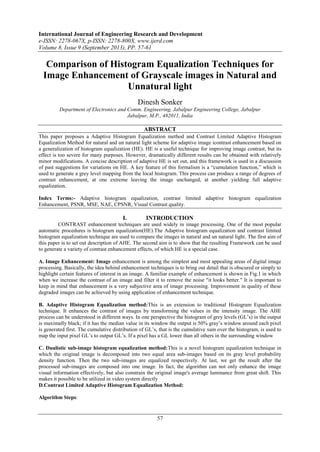
International Journal of Engineering Research and Development
e-ISSN: 2278-067X, p-ISSN: 2278-800X, www.ijerd.com
Volume 8, Issue 9 (September 2013), PP. 57-61
57
Comparison of Histogram Equalization Techniques for
Image Enhancement of Grayscale images in Natural and
Unnatural light
Dinesh Sonker
Department of Electronics and Comm. Engineering, Jabalpur Engineering College, Jabalpur
Jabalpur, M.P., 482011, India
ABSTRACT
This paper proposes a Adaptive Histogram Equalization method and Contrast Limited Adaptive Histogram
Equalization Method for natural and un natural light scheme for adaptive image icontrast enhancement based on
a generalization of histogram equalization (HE). HE is a useful technique for improving image contrast, but its
effect is too severe for many purposes. However, dramatically different results can be obtained with relatively
minor modifications. A concise description of adaptive HE is set out, and this framework is used in a discussion
of past suggestions for variations on HE. A key feature of this formalism is a “cumulation function,” which is
used to generate a grey level mapping from the local histogram. This process can produce a range of degrees of
contrast enhancement, at one extreme leaving the image unchanged, at another yielding full adaptive
equalization.
Index Terms:- Adaptive histogram equalization, contrast limited adaptive histogram equalization
Enhancement, PSNR, MSE, NAE, CPSNR, Visual Contrast quality.
I. INTRODUCTION
CONTRAST enhancement techniques are used widely in image processing. One of the most popular
automatic procedures is histogram equalization(HE).The Adaptive histogram equalization and contrast limited
histogram equalization technique are used to compare the images in natural and un natural light. The first aim of
this paper is to set out description of AHE. The second aim is to show that the resulting Framework can be used
to generate a variety of contrast enhancement effects, of which HE is a special case.
A. Image Enhancement: Image enhancement is among the simplest and most appealing areas of digital image
processing. Basically, the idea behind enhancement techniques is to bring out detail that is obscured or simply to
highlight certain features of interest in an image. A familiar example of enhancement is shown in Fig.1 in which
when we increase the contrast of an image and filter it to remove the noise "it looks better." It is important to
keep in mind that enhancement is a very subjective area of image processing. Improvement in quality of these
degraded images can be achieved by using application of enhancement technique.
B. Adaptive Histogram Equalization method:This is an extension to traditional Histogram Equalization
technique. It enhances the contrast of images by transforming the values in the intensity image. The AHE
process can be understood in different ways. In one perspective the histogram of grey levels (GL’s) in the output
is maximally black; if it has the median value in its window the output is 50% gray’s window around each pixel
is generated first. The cumulative distribution of GL’s, that is the cumulative sum over the histogram, is used to
map the input pixel GL’s to output GL’s. If a pixel has a GL lower than all others in the surrounding window
C. Dualistic sub-image histogram equalization method:This is a novel histogram equalization technique in
which the original image is decomposed into two equal area sub-images based on its gray level probability
density function. Then the two sub-images are equalized respectively. At last, we get the result after the
processed sub-images are composed into one image. In fact, the algorithm can not only enhance the image
visual information effectively, but also constrain the original image's average luminance from great shift. This
makes it possible to be utilized in video system directly
D.Contrast Limited Adaptive Histogram Equalization Method:
Algorithm Steps:
Comparison of Histogram Equalization Techniques for Image Enhancement…
58
1. Obtain all the inputs: Image, Number of regions in row and column directions, Number of bins for the
histograms used in building image transform function (dynamic range), Clip limit for contrast limiting
(normalized from 0 to 1).
2. Pre-process the inputs: Determine real clip limit from the normalized value if necessary, pad the image
before splitting it into regions.
3. Process each contextual region (tile) thus producing gray level mappings: Extract a single image region,
make a histogram for this region using the specified number of bins, clip the histogram using clip limit, and
create a mapping (transformation function) for this region
4. Interpolate gray level mappings in order to assemble final CLAHE image: Extract cluster of four neighboring
mapping functions, process image region partly overlapping each of the mapping tiles, extract a single pixel,
apply four mappings to that pixel, and interpolate between the results to obtain the output pixel; repeat over the
entire image.
1. Peak-signal-to-noise-ratio (PSNR):PSNR is the evaluation standard of the reconstructed image quality, and
is important measurement feature. PSNR is measured in decibels (dB) and is given by:
PSNR= 10log ( 2552
/MSE)
Where the value 255 is maximum possible value that can be attained by the image signal. Mean square
error (MSE) is defined as Where M*N is the size of the original image. Higher the PSNR value is, better the
reconstructed image.
2. Contrast:Contrast defines the difference between lowest and highest intensity level. Higher the value of
contrast means more difference between lowest and highest intensity level.
Histogram Technique For Equalization:
Enhance contrast using histogram equalization
Syntax:
J=histeq(I,hgram)
J=histeq(I,n)
[J,T]=histeq(I,...)
newmap=histeq(X,map,hgram)
newmap=histeq(X,map)
[newmap, T] = histeq(X,...)
Class Support
For syntax that includes an intensity image I as input, I can be of class uint8, uint16, int16, single, or
double. The output image J has the same class as I.
For syntax that includes an indexed image X as input, X can be of class uint8, single, or double; the output color
map is always of class double. The optional output T (the gray-level transform) is always of class double.
Examples
Enhance the contrast of an intensity image using histogram equalization.
I = imread('tire.tif');
J = histeq(I);
imshow(I)
figure,imshow(J)
Comparison of Histogram Equalization Techniques for Image Enhancement…
59
Results of test image “Rice”
(a) Original image (a) Histogram of Image
(d) CLAHE Image
(d) CLAHE Histogram
Comparison of Histogram Equalization Techniques for Image Enhancement…
60
(c)DSIHE Image (c) DSIHE Histogram
Table 1: Comparison of Various Parameters for “Rice” Image:
Parameter
Technique
AMBE Contrast PSNR
CLAHE 12.230 22.481 0.0278
DSIHE 4.402 32.876 0.0257
Comparison of Histogram Equalization Techniques for Image Enhancement…
61
IN NATURAL LIGHT IN UN NATURAL LIGHT
II. CONCLUSION AND FUTURE ASPECT
We will be compared images by Histogram Equalization. In this Paper; a frame work for image
enhancement based on prior knowledge on the Histogram Equalization has been presented. Many image
enhancement schemes like Contrast limited Adaptive Histogram Equalization (CLAHE),Dualastic sub
Histogram equalization (DSIHE) Algorithm has been implemented and compared. The Performance of all these
Methods has been analyzed and a number of Practical experiments of real time images have been presented.
From the experimental results, it is found that all the three techniques yields Different aspects for different
parameters. In future, for the enhancement purpose more images can be taken from the different application
fields so that it becomes clearer that for which application which part Color technique is better both for Gray
Scale Images and color Images
REFERENCE
[1]. M. Abdullah-Al-Wadud, Md. Hasanul Kabir, M. Ali Akber Dewan, Oksam Chae, “A dynamic
histogram equalization for image contrast enhancement”, IEEE Transactions. Consumer Electron. vol.
53, no. 2, pp. 593- 600, May2007.
[2]. “ Histogram Equalization Techniques For Image Enhancement”Rajesh Garg, Bhawna Mittal, Sheetal
Garg,H.I.T., Sonepat, Haryana, India3S.M.Hindu Sr.Sec.School, Sonepat, Haryana, India IJECT Vol.
2, Issue 1, March 2011.
[3]. V. T. Tom and G. J. Wolfe, “Adaptive histogram equalization and its applications,” SPIE Applicat.
Dig. Image Process. IV, vol. 359, pp.
[4]. Rafael C. Gonzalez, Richard E. Woods, “Digital Image Processing”, 2nd edition, Prentice Hall, 2002.
[5]. A. K. Jain, “Fundamentals of Digital Image Processing”.Englewood Cliffs, NJ: Prentice-Hall, 1991.
[6]. J. M. Gauch, “Investigations of image contrast space defined by variations on histogram equalization,”
CVGIP: Graph. Models Image Process., vol. 54, pp. 269–280, July 1992.
[7]. Stephen M. Pizer, R. Eugene Johnston, James P. Ericksen, Bonnie C. Yankaskas, Keith E. Muller,
“Contrast-Limited Adaptive Histogram Equalization Speed and Effectiveness, IEEE Int. Conf. Neural
Networks & Signal Processing,Nanjing, China, December 14-17, 2003.

International Journal of Engineering Research and Development (IJERD)

  • 1.
    International Journal ofEngineering Research and Development e-ISSN: 2278-067X, p-ISSN: 2278-800X, www.ijerd.com Volume 8, Issue 9 (September 2013), PP. 57-61 57 Comparison of Histogram Equalization Techniques for Image Enhancement of Grayscale images in Natural and Unnatural light Dinesh Sonker Department of Electronics and Comm. Engineering, Jabalpur Engineering College, Jabalpur Jabalpur, M.P., 482011, India ABSTRACT This paper proposes a Adaptive Histogram Equalization method and Contrast Limited Adaptive Histogram Equalization Method for natural and un natural light scheme for adaptive image icontrast enhancement based on a generalization of histogram equalization (HE). HE is a useful technique for improving image contrast, but its effect is too severe for many purposes. However, dramatically different results can be obtained with relatively minor modifications. A concise description of adaptive HE is set out, and this framework is used in a discussion of past suggestions for variations on HE. A key feature of this formalism is a “cumulation function,” which is used to generate a grey level mapping from the local histogram. This process can produce a range of degrees of contrast enhancement, at one extreme leaving the image unchanged, at another yielding full adaptive equalization. Index Terms:- Adaptive histogram equalization, contrast limited adaptive histogram equalization Enhancement, PSNR, MSE, NAE, CPSNR, Visual Contrast quality. I. INTRODUCTION CONTRAST enhancement techniques are used widely in image processing. One of the most popular automatic procedures is histogram equalization(HE).The Adaptive histogram equalization and contrast limited histogram equalization technique are used to compare the images in natural and un natural light. The first aim of this paper is to set out description of AHE. The second aim is to show that the resulting Framework can be used to generate a variety of contrast enhancement effects, of which HE is a special case. A. Image Enhancement: Image enhancement is among the simplest and most appealing areas of digital image processing. Basically, the idea behind enhancement techniques is to bring out detail that is obscured or simply to highlight certain features of interest in an image. A familiar example of enhancement is shown in Fig.1 in which when we increase the contrast of an image and filter it to remove the noise "it looks better." It is important to keep in mind that enhancement is a very subjective area of image processing. Improvement in quality of these degraded images can be achieved by using application of enhancement technique. B. Adaptive Histogram Equalization method:This is an extension to traditional Histogram Equalization technique. It enhances the contrast of images by transforming the values in the intensity image. The AHE process can be understood in different ways. In one perspective the histogram of grey levels (GL’s) in the output is maximally black; if it has the median value in its window the output is 50% gray’s window around each pixel is generated first. The cumulative distribution of GL’s, that is the cumulative sum over the histogram, is used to map the input pixel GL’s to output GL’s. If a pixel has a GL lower than all others in the surrounding window C. Dualistic sub-image histogram equalization method:This is a novel histogram equalization technique in which the original image is decomposed into two equal area sub-images based on its gray level probability density function. Then the two sub-images are equalized respectively. At last, we get the result after the processed sub-images are composed into one image. In fact, the algorithm can not only enhance the image visual information effectively, but also constrain the original image's average luminance from great shift. This makes it possible to be utilized in video system directly D.Contrast Limited Adaptive Histogram Equalization Method: Algorithm Steps:
  • 2.
    Comparison of HistogramEqualization Techniques for Image Enhancement… 58 1. Obtain all the inputs: Image, Number of regions in row and column directions, Number of bins for the histograms used in building image transform function (dynamic range), Clip limit for contrast limiting (normalized from 0 to 1). 2. Pre-process the inputs: Determine real clip limit from the normalized value if necessary, pad the image before splitting it into regions. 3. Process each contextual region (tile) thus producing gray level mappings: Extract a single image region, make a histogram for this region using the specified number of bins, clip the histogram using clip limit, and create a mapping (transformation function) for this region 4. Interpolate gray level mappings in order to assemble final CLAHE image: Extract cluster of four neighboring mapping functions, process image region partly overlapping each of the mapping tiles, extract a single pixel, apply four mappings to that pixel, and interpolate between the results to obtain the output pixel; repeat over the entire image. 1. Peak-signal-to-noise-ratio (PSNR):PSNR is the evaluation standard of the reconstructed image quality, and is important measurement feature. PSNR is measured in decibels (dB) and is given by: PSNR= 10log ( 2552 /MSE) Where the value 255 is maximum possible value that can be attained by the image signal. Mean square error (MSE) is defined as Where M*N is the size of the original image. Higher the PSNR value is, better the reconstructed image. 2. Contrast:Contrast defines the difference between lowest and highest intensity level. Higher the value of contrast means more difference between lowest and highest intensity level. Histogram Technique For Equalization: Enhance contrast using histogram equalization Syntax: J=histeq(I,hgram) J=histeq(I,n) [J,T]=histeq(I,...) newmap=histeq(X,map,hgram) newmap=histeq(X,map) [newmap, T] = histeq(X,...) Class Support For syntax that includes an intensity image I as input, I can be of class uint8, uint16, int16, single, or double. The output image J has the same class as I. For syntax that includes an indexed image X as input, X can be of class uint8, single, or double; the output color map is always of class double. The optional output T (the gray-level transform) is always of class double. Examples Enhance the contrast of an intensity image using histogram equalization. I = imread('tire.tif'); J = histeq(I); imshow(I) figure,imshow(J)
  • 3.
    Comparison of HistogramEqualization Techniques for Image Enhancement… 59 Results of test image “Rice” (a) Original image (a) Histogram of Image (d) CLAHE Image (d) CLAHE Histogram
  • 4.
    Comparison of HistogramEqualization Techniques for Image Enhancement… 60 (c)DSIHE Image (c) DSIHE Histogram Table 1: Comparison of Various Parameters for “Rice” Image: Parameter Technique AMBE Contrast PSNR CLAHE 12.230 22.481 0.0278 DSIHE 4.402 32.876 0.0257
  • 5.
    Comparison of HistogramEqualization Techniques for Image Enhancement… 61 IN NATURAL LIGHT IN UN NATURAL LIGHT II. CONCLUSION AND FUTURE ASPECT We will be compared images by Histogram Equalization. In this Paper; a frame work for image enhancement based on prior knowledge on the Histogram Equalization has been presented. Many image enhancement schemes like Contrast limited Adaptive Histogram Equalization (CLAHE),Dualastic sub Histogram equalization (DSIHE) Algorithm has been implemented and compared. The Performance of all these Methods has been analyzed and a number of Practical experiments of real time images have been presented. From the experimental results, it is found that all the three techniques yields Different aspects for different parameters. In future, for the enhancement purpose more images can be taken from the different application fields so that it becomes clearer that for which application which part Color technique is better both for Gray Scale Images and color Images REFERENCE [1]. M. Abdullah-Al-Wadud, Md. Hasanul Kabir, M. Ali Akber Dewan, Oksam Chae, “A dynamic histogram equalization for image contrast enhancement”, IEEE Transactions. Consumer Electron. vol. 53, no. 2, pp. 593- 600, May2007. [2]. “ Histogram Equalization Techniques For Image Enhancement”Rajesh Garg, Bhawna Mittal, Sheetal Garg,H.I.T., Sonepat, Haryana, India3S.M.Hindu Sr.Sec.School, Sonepat, Haryana, India IJECT Vol. 2, Issue 1, March 2011. [3]. V. T. Tom and G. J. Wolfe, “Adaptive histogram equalization and its applications,” SPIE Applicat. Dig. Image Process. IV, vol. 359, pp. [4]. Rafael C. Gonzalez, Richard E. Woods, “Digital Image Processing”, 2nd edition, Prentice Hall, 2002. [5]. A. K. Jain, “Fundamentals of Digital Image Processing”.Englewood Cliffs, NJ: Prentice-Hall, 1991. [6]. J. M. Gauch, “Investigations of image contrast space defined by variations on histogram equalization,” CVGIP: Graph. Models Image Process., vol. 54, pp. 269–280, July 1992. [7]. Stephen M. Pizer, R. Eugene Johnston, James P. Ericksen, Bonnie C. Yankaskas, Keith E. Muller, “Contrast-Limited Adaptive Histogram Equalization Speed and Effectiveness, IEEE Int. Conf. Neural Networks & Signal Processing,Nanjing, China, December 14-17, 2003.