The Low Vision Examination
The Initial Assessment •  The aims and results of a low vision examination are different to those of a ‘normal’ sight test. •  It is important to have access to all the spectacles and Low  Vision Aids (LVAs) the patient has. •  Time must be allowed to obtain a more detailed case history. •  The use of high illumination techniques such as slit-lamp  and ophthalmoscopy should not be used until after visual  assessment has taken place.
General Observation of the Patient •  Does the patient appear to be bothered by bright lights? •  Can the patient navigate themselves to your consulting room? General mobility?  Guidance •  Physical infirmities – e.g. hand tremor •  Eccentric viewing
Case History •  Most important part of the low vision examination  •  Establishes what each patient needs and wants •  Probably going to take a little more time than a conventional  History & Symptoms and the Px should not feel rushed. •  Start with the easy stuff:  name, DOB, Address etc.
1. Duration/Onset of condition. 2. Stability of the the condition ‘ When did you start having difficulties managing with your  current spectacles’ Is the condition constantly changing? - frequently change LVAs - variable magnification
3. Patient’s knowledge of the condition and prognosis 4. Ongoing hospital treatment/monitoring Any Px that has not had an ophthalmological assessment should  be referred. Medical/Surgical intervention can often be a treatment option Nature of visual loss?  Congenital/acquired ? Preferred eye ?
5. Current Visual Status What spectacles and/or LVAs the Px is currently using. Are they useful Determine current Rx and magnification of any LVAs used What is the smallest print the Px can read? Are they able to watch TV? Can they recognise faces at a distance? Can they see well enough to get around unassisted?
6. Registration Status 7. Education/employment Registration should be encouraged whenever possible Major factor in defining the Px’s requirements 8. General Health & Medication May affect the Px’s ability to perform everyday tasks or  use the LVA properly
9. Social Assessment Does the Px live alone or with spouse or family? How is daily life affected by the vision problem? Does the Px have a support network?  (family, friends, agency)  Is the Px’s independence threatened?
10. Reason for consultation What would the Px like to get out of the consultation? Personal reading 75.17% Daily living activities 14.45% Other 7.32% Watching TV 3.06%
Loss Model of Adjustment to Visual Impairment Shock Depression Anger Anxiety Denial Disbelief Realistic Acceptance
Giving Information & Advice Optometrist’s Aim  -  what practical help the Px might might    require in the form of LVAs and training. Px’s Requirements ‘ What did it all mean? I wanted someone to explain what  was happening.’ Psychological support The low vision examination is an opportunity to provide the Px  with further information about the eye condition and advice on how to cope with it.
Determining Refractive Correction The subjective routine should begin with an approximately correct Rx in place -  Retinoscopy -  Radical Retinoscopy - Keratometry for high cyls -  Current Rx
Subjective Testing Use steps of +/- 2.00DS in order to produce a response (bracketing procedure) Remember to compensate for reduced testing distance +/- 1.00DC x cyl may be used to optimise clarity of a  circular letter Stenopaeic slit may also be used to optimise axis.  Is the Px binocular?  Cover test/ocular motility
Assessment of Visual Acuity Snellen charts are the most commonly used. There are certain disadvantages associated with them: non-uniform increase in size of letters 6/5     6/6  x1.2  increase 6/36     6/60  x1.67 increase  variation in the number of letters per line (contour interaction effect)
Bailey-Lovie chart Uniform increase in size of  Letters for each line (1.25 x) Same number of letters on each line. Facilitates specification of VA in terms of logMAR (Log 10  of minimum angle of  resolution.)
6/600 6/300 6/240 6/120 6/60 6/48 6/30 6/24 6/12 6/6 6/4.8 6/3 2.0 1.7 1.6 1.3 1.0 0.9 0.7 0.6 0.3 0.0 -0.1 -0.3 100 50 40 20 10 8 5 4 2 1 0.8 0.5 Snellen logMAR MAR(min arc)
Measuring Visual Acuity In low vision work the chart is presented at different distances: 3 60 viewing distance distance from which ‘normal’ subject can recognise  the letter. 3m    2m    1m    0.5m Count fingers Hand movements Light projection Light perception No light perception
Predicting the magnification required  Magnification required =  required VA   present VA In Snellen notation to improve from 6/60 to 6/6 Magnification required =  6 x 60   6 x 6  = 10 x
If VA is measured in a LogMAR notation: Magnification = (1.25) n Where n = number of steps If the present acuity = 0.5 and the required acuity = 0.1 Then  Magnification  = (1.25) 4   =  2.44x
Near Visual Acuity Testing Near charts typically use sentences or paragraphs rather than  isolated letters.  They should perhaps be referred to a reading tests. Reading acuity does not correlate well with distance VA Reading tests measure a more complex function than VA and some low vision Pxs have a reading acuity the is significantly  worse than isolated near VA Assess at the Px’s preferred working distance with the  appropriate near addition in place (+4.00DS in max. normal) Encourage the Px to hold the print as close as possible.
N - notation N print uses New Times Roman font and is the standard UK test. It has a linear scale:   N10  is 2x the size of N5 Magnification required =  present VA   required VA N48 N6 M = 8x A measurement of near VA should always be accompanied by the working distance at which it is taken.  Illumination
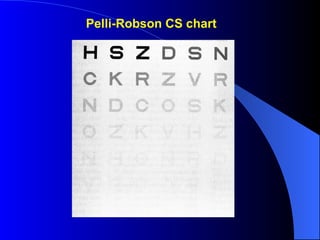
Contrast Sensitivity  Constitutes a more complete description of visual performance than acuity. Measurement in a clinical setting is fraught with problems Contrast sensitivity may help to explain a Px’s functional  difficulties.
Human Contrast Sensitivity Function (CSF) f x max  =  spatial resolution S max  = maximum sensitivity Log Spatial frequency 100 10 1 Sensitivity (log scale) (S = 1 /C) 1  10  100  c/deg
Pelli-Robson CS chart
Effect of a Glare Source Loss of sensitivity for low  contrast targets may occur  in the presence of high  ambient illumination.  This is due to    light scatter  producing  -  disability glare Brightness  Acuity Tester
Other Tests of Visual Function Visual Field Assessment Determination of the dimensions of the peripheral visual field Determination of the distorted regions in the central field  using the Amsler chart.
Outcomes of Low Vision Examination 1.  No LVA is suitable for task The task may be tackled most effectively by sensory  substitution. 3.  The task can be approach by using and LVA to overcome  the visual impairment
Determine whether binocular or monocular correction is preferable. Identify the specific task to be performed and predict the  magnification required. 3.  Select the appropriate LVA. 4. Trial of predicted magnification and LVA, modify if necessary. 5.  Determine the required spectacle correction to be used in  conjunction with the LVA 6.  Loan aid for trial and instruction in its use. 7.  Plan follow up visits.

The Low Vision Examination

  • 1.
    The Low VisionExamination
  • 2.
    The Initial Assessment• The aims and results of a low vision examination are different to those of a ‘normal’ sight test. • It is important to have access to all the spectacles and Low Vision Aids (LVAs) the patient has. • Time must be allowed to obtain a more detailed case history. • The use of high illumination techniques such as slit-lamp and ophthalmoscopy should not be used until after visual assessment has taken place.
  • 3.
    General Observation ofthe Patient • Does the patient appear to be bothered by bright lights? • Can the patient navigate themselves to your consulting room? General mobility? Guidance • Physical infirmities – e.g. hand tremor • Eccentric viewing
  • 4.
    Case History • Most important part of the low vision examination • Establishes what each patient needs and wants • Probably going to take a little more time than a conventional History & Symptoms and the Px should not feel rushed. • Start with the easy stuff: name, DOB, Address etc.
  • 5.
    1. Duration/Onset ofcondition. 2. Stability of the the condition ‘ When did you start having difficulties managing with your current spectacles’ Is the condition constantly changing? - frequently change LVAs - variable magnification
  • 6.
    3. Patient’s knowledgeof the condition and prognosis 4. Ongoing hospital treatment/monitoring Any Px that has not had an ophthalmological assessment should be referred. Medical/Surgical intervention can often be a treatment option Nature of visual loss? Congenital/acquired ? Preferred eye ?
  • 7.
    5. Current VisualStatus What spectacles and/or LVAs the Px is currently using. Are they useful Determine current Rx and magnification of any LVAs used What is the smallest print the Px can read? Are they able to watch TV? Can they recognise faces at a distance? Can they see well enough to get around unassisted?
  • 8.
    6. Registration Status7. Education/employment Registration should be encouraged whenever possible Major factor in defining the Px’s requirements 8. General Health & Medication May affect the Px’s ability to perform everyday tasks or use the LVA properly
  • 9.
    9. Social AssessmentDoes the Px live alone or with spouse or family? How is daily life affected by the vision problem? Does the Px have a support network? (family, friends, agency) Is the Px’s independence threatened?
  • 10.
    10. Reason forconsultation What would the Px like to get out of the consultation? Personal reading 75.17% Daily living activities 14.45% Other 7.32% Watching TV 3.06%
  • 11.
    Loss Model ofAdjustment to Visual Impairment Shock Depression Anger Anxiety Denial Disbelief Realistic Acceptance
  • 12.
    Giving Information &Advice Optometrist’s Aim - what practical help the Px might might require in the form of LVAs and training. Px’s Requirements ‘ What did it all mean? I wanted someone to explain what was happening.’ Psychological support The low vision examination is an opportunity to provide the Px with further information about the eye condition and advice on how to cope with it.
  • 13.
    Determining Refractive CorrectionThe subjective routine should begin with an approximately correct Rx in place - Retinoscopy - Radical Retinoscopy - Keratometry for high cyls - Current Rx
  • 14.
    Subjective Testing Usesteps of +/- 2.00DS in order to produce a response (bracketing procedure) Remember to compensate for reduced testing distance +/- 1.00DC x cyl may be used to optimise clarity of a circular letter Stenopaeic slit may also be used to optimise axis. Is the Px binocular? Cover test/ocular motility
  • 15.
    Assessment of VisualAcuity Snellen charts are the most commonly used. There are certain disadvantages associated with them: non-uniform increase in size of letters 6/5  6/6 x1.2 increase 6/36  6/60 x1.67 increase variation in the number of letters per line (contour interaction effect)
  • 16.
    Bailey-Lovie chart Uniformincrease in size of Letters for each line (1.25 x) Same number of letters on each line. Facilitates specification of VA in terms of logMAR (Log 10 of minimum angle of resolution.)
  • 17.
    6/600 6/300 6/2406/120 6/60 6/48 6/30 6/24 6/12 6/6 6/4.8 6/3 2.0 1.7 1.6 1.3 1.0 0.9 0.7 0.6 0.3 0.0 -0.1 -0.3 100 50 40 20 10 8 5 4 2 1 0.8 0.5 Snellen logMAR MAR(min arc)
  • 18.
    Measuring Visual AcuityIn low vision work the chart is presented at different distances: 3 60 viewing distance distance from which ‘normal’ subject can recognise the letter. 3m  2m  1m  0.5m Count fingers Hand movements Light projection Light perception No light perception
  • 19.
    Predicting the magnificationrequired Magnification required = required VA present VA In Snellen notation to improve from 6/60 to 6/6 Magnification required = 6 x 60 6 x 6 = 10 x
  • 20.
    If VA ismeasured in a LogMAR notation: Magnification = (1.25) n Where n = number of steps If the present acuity = 0.5 and the required acuity = 0.1 Then Magnification = (1.25) 4 = 2.44x
  • 21.
    Near Visual AcuityTesting Near charts typically use sentences or paragraphs rather than isolated letters. They should perhaps be referred to a reading tests. Reading acuity does not correlate well with distance VA Reading tests measure a more complex function than VA and some low vision Pxs have a reading acuity the is significantly worse than isolated near VA Assess at the Px’s preferred working distance with the appropriate near addition in place (+4.00DS in max. normal) Encourage the Px to hold the print as close as possible.
  • 22.
    N - notationN print uses New Times Roman font and is the standard UK test. It has a linear scale: N10 is 2x the size of N5 Magnification required = present VA required VA N48 N6 M = 8x A measurement of near VA should always be accompanied by the working distance at which it is taken. Illumination
  • 23.
    Contrast Sensitivity Constitutes a more complete description of visual performance than acuity. Measurement in a clinical setting is fraught with problems Contrast sensitivity may help to explain a Px’s functional difficulties.
  • 24.
    Human Contrast SensitivityFunction (CSF) f x max = spatial resolution S max = maximum sensitivity Log Spatial frequency 100 10 1 Sensitivity (log scale) (S = 1 /C) 1 10 100 c/deg
  • 25.
  • 26.
    Effect of aGlare Source Loss of sensitivity for low contrast targets may occur in the presence of high ambient illumination. This is due to  light scatter producing - disability glare Brightness Acuity Tester
  • 27.
    Other Tests ofVisual Function Visual Field Assessment Determination of the dimensions of the peripheral visual field Determination of the distorted regions in the central field using the Amsler chart.
  • 28.
    Outcomes of LowVision Examination 1. No LVA is suitable for task The task may be tackled most effectively by sensory substitution. 3. The task can be approach by using and LVA to overcome the visual impairment
  • 29.
    Determine whether binocularor monocular correction is preferable. Identify the specific task to be performed and predict the magnification required. 3. Select the appropriate LVA. 4. Trial of predicted magnification and LVA, modify if necessary. 5. Determine the required spectacle correction to be used in conjunction with the LVA 6. Loan aid for trial and instruction in its use. 7. Plan follow up visits.