IMAGE ENHANCEMENT
Image Enhancement - Objectives
 To process an image so that the result is more suitable than the
original image for a specific application.
 Accentuation or sharpening of image features such as edges,
boundaries, or contrast to make an image more useful for
display and analysis.
 When images are processed to improve their appearance to
human viewers, the objective may be to improve perceptual
aspects, such as image quality, intelligibility, or visual
appearance. In other applications, such as object identification
by a machine, an image may be preprocessed to aid machine
performance.
Types Of Processing
 The processing techniques are very much problem
oriented. Means an image enhancement algorithm
that performs well for one class of images may not
perform well for other classes.
 There are several enhancement techniques available,
and we can classify them into two broad categories.
 Spatial domain methods – Direct manipulations of pixels
in an image.
 Frequency domain methods – Modifying the fourier
transform of an image.
Spatial domain Methods
 The spatial domain refers to the image plane itself, that is
the collection of pixels constituting an image.
 The spatial domain process can be denoted as
 f(x,y) - input image; g(x,y) - processed image;
T – operator on f, defined over some neighbourhood of
f(x,y)
 The neighbourhood about point (x,y) is a square or
rectangular sub image area centered at (x,y).
[ ]),(),( yxfTyxg =
Spatial domain Methods
 The simplest form of T is when the neighbourhood is of size
1x1, that is a single pixel.
 Then g depends only on the value of f, at (x,y) or the gray
level f(x,y), and T becomes a gray level transformation
function of the form
 s = T(r). s – gray level of g(x,y)
 r – gray level of f(x,y) at any point (x,y)
 This type of processing is known as point processing,
because the processing depends only on the gray level at that
point.
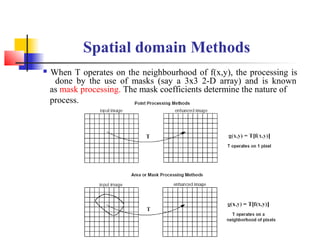
 When T operates on the neighbourhood of f(x,y), the processing is
done by the use of masks (say a 3x3 2-D array) and is known
as mask processing. The mask coefficients determine the nature of
process.
Spatial domain Methods
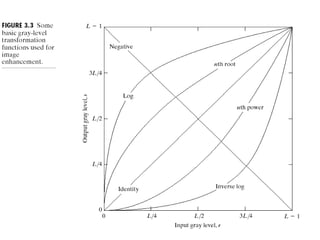
Basic Gray level Transformations
 Three basic types of functions used for gray
level transformations in image enhancement
are
 Linear.
 Logarithmic.
 Power low.
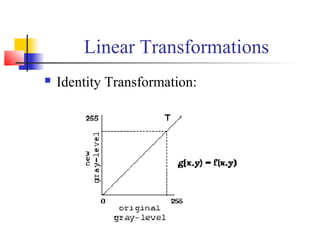
Linear Transformations
 Identity Transformation:
Linear Transformations Cont..
 Negative Transformation:
The negative of a digital image with gray levels in the range
[0,L-1] is obtained by the transformation function
 s = T(r) = L-1-r = 255-r, for an 8-bit image
r
s
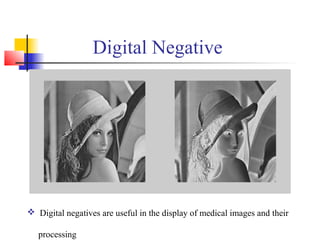
Digital Negative
 Digital negatives are useful in the display of medical images and their
processing
Logarithmic Transformations
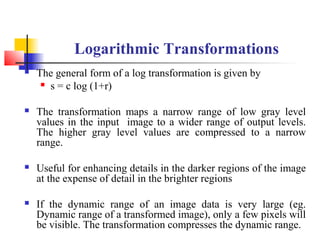
 The general form of a log transformation is given by
 s = c log (1+r)
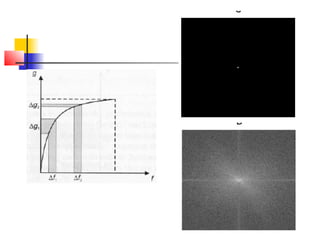
 The transformation maps a narrow range of low gray level
values in the input image to a wider range of output levels.
The higher gray level values are compressed to a narrow
range.
 Useful for enhancing details in the darker regions of the image
at the expense of detail in the brighter regions
 If the dynamic range of an image data is very large (eg.
Dynamic range of a transformed image), only a few pixels will
be visible. The transformation compresses the dynamic range.
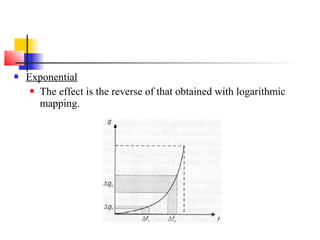
 Exponential
 The effect is the reverse of that obtained with logarithmic
mapping.
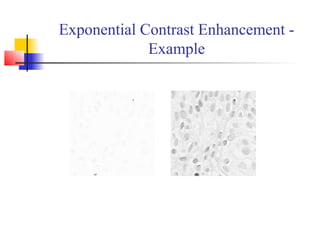
Exponential Contrast Enhancement -
Example
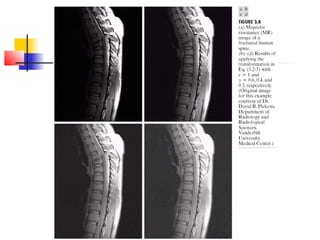
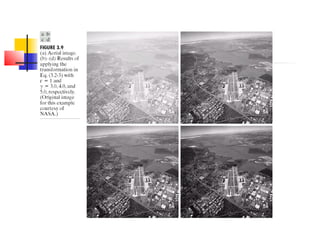
Power Law Transformations
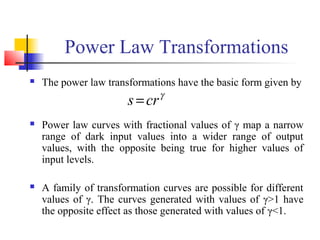
 The power law transformations have the basic form given by
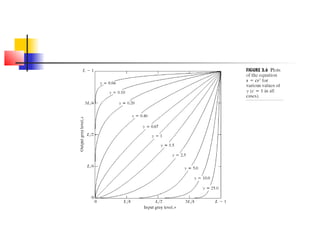
 Power law curves with fractional values of γ map a narrow
range of dark input values into a wider range of output
values, with the opposite being true for higher values of
input levels.
 A family of transformation curves are possible for different
values of γ. The curves generated with values of γ>1 have
the opposite effect as those generated with values of γ<1.
γ
crs =
Power Law Transformation - Application
 A variety of devices used for image capture, printing
and display respond according to power law.
 The exponent in the power law equation is referred
to as gamma and the process used to correct this
power law response phenomenon is gamma
correction.
 CRT devices have a intensity to voltage response
that is a power function with gamma varying from
1.8 to 2.5.
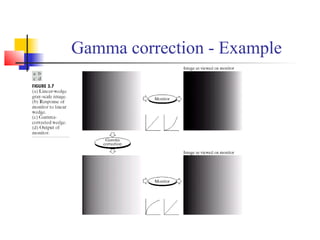
Gamma correction - Example
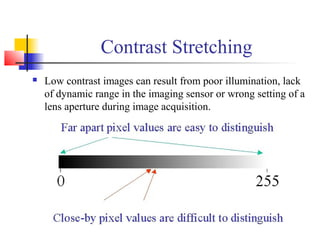
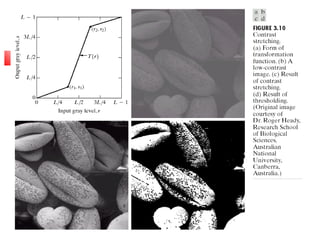
Contrast Stretching
 Low contrast images can result from poor illumination, lack
of dynamic range in the imaging sensor or wrong setting of a
lens aperture during image acquisition.
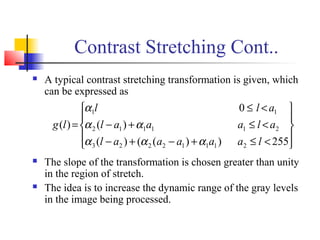
Contrast Stretching Cont..
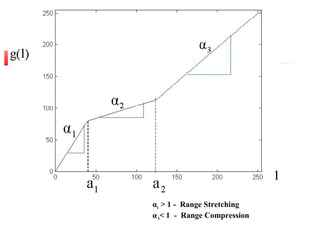
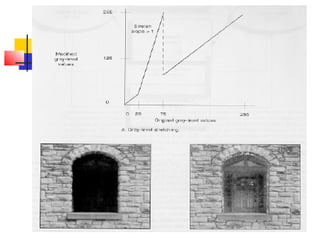
 A typical contrast stretching transformation is given, which
can be expressed as
 The slope of the transformation is chosen greater than unity
in the region of stretch.
 The idea is to increase the dynamic range of the gray levels
in the image being processed.










<≤+−+−
<≤+−
<≤
=
255))(()(
)(
0
)(
21112223
211112
11
laaaaal
alaaal
all
lg
ααα
αα
α
αi > 1 - Range Stretching
αi< 1 - Range Compression
Contrast Stretching Cont..
 Let T(a1) = s1 and T(a2) = s2
 If a1 = s1 and a2 = s2 – linear transformation with no
changes in the gray levels.
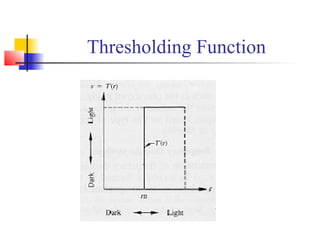
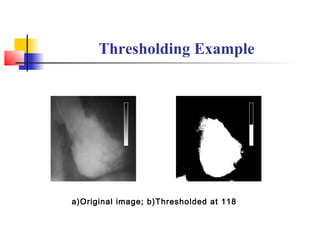
 If a1=a2 and s1 = 0; s2 = L-1 – thresholding function
which creates a binary image.
 Any intermediate values of (a1,s1) and (a2,s2)
produce various degrees of spreads in the gray
levels of the output image, which affects its
contrast.
Thresholding Function
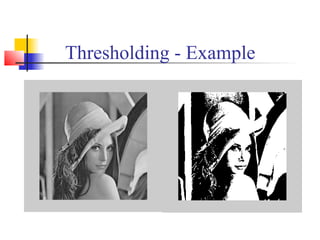
Thresholding - Example
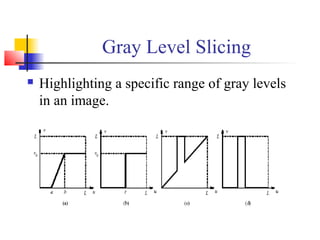
Gray Level Slicing
 Highlighting a specific range of gray levels
in an image.
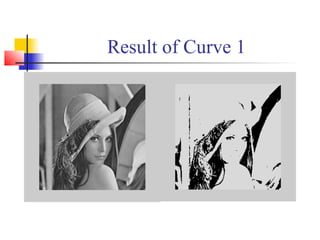
Result of Curve 1
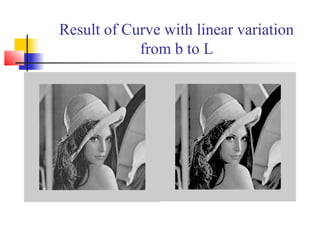
Result of Curve with linear variation
from b to L
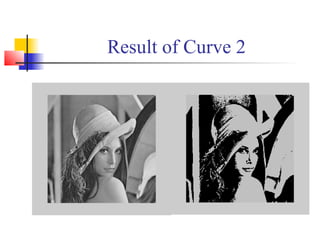
Result of Curve 2
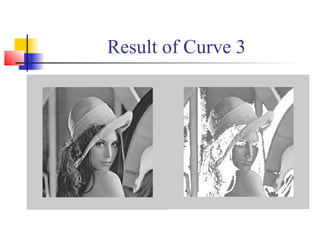
Result of Curve 3
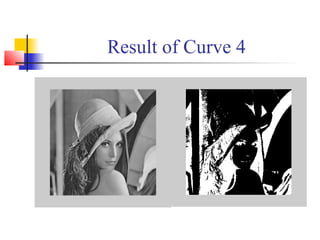
Result of Curve 4
Thresholding Example
a)Original image; b)Thresholded at 118
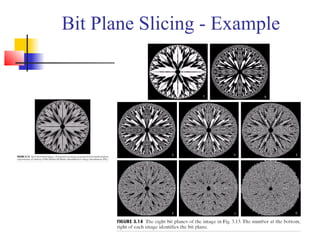
Bit Plane Slicing
 Highlighting the contributions made to total
image appearance by specific bits.
 An 8-bit image contains 8 bit planes.
 We can analyze the relative importance of
each bit plane an image.
Bit Plane Slicing - Example

image enhancement

  • 1.
  • 2.
    Image Enhancement -Objectives  To process an image so that the result is more suitable than the original image for a specific application.  Accentuation or sharpening of image features such as edges, boundaries, or contrast to make an image more useful for display and analysis.  When images are processed to improve their appearance to human viewers, the objective may be to improve perceptual aspects, such as image quality, intelligibility, or visual appearance. In other applications, such as object identification by a machine, an image may be preprocessed to aid machine performance.
  • 3.
    Types Of Processing The processing techniques are very much problem oriented. Means an image enhancement algorithm that performs well for one class of images may not perform well for other classes.  There are several enhancement techniques available, and we can classify them into two broad categories.  Spatial domain methods – Direct manipulations of pixels in an image.  Frequency domain methods – Modifying the fourier transform of an image.
  • 4.
    Spatial domain Methods The spatial domain refers to the image plane itself, that is the collection of pixels constituting an image.  The spatial domain process can be denoted as  f(x,y) - input image; g(x,y) - processed image; T – operator on f, defined over some neighbourhood of f(x,y)  The neighbourhood about point (x,y) is a square or rectangular sub image area centered at (x,y). [ ]),(),( yxfTyxg =
  • 5.
    Spatial domain Methods The simplest form of T is when the neighbourhood is of size 1x1, that is a single pixel.  Then g depends only on the value of f, at (x,y) or the gray level f(x,y), and T becomes a gray level transformation function of the form  s = T(r). s – gray level of g(x,y)  r – gray level of f(x,y) at any point (x,y)  This type of processing is known as point processing, because the processing depends only on the gray level at that point.
  • 6.
     When Toperates on the neighbourhood of f(x,y), the processing is done by the use of masks (say a 3x3 2-D array) and is known as mask processing. The mask coefficients determine the nature of process. Spatial domain Methods
  • 7.
    Basic Gray levelTransformations  Three basic types of functions used for gray level transformations in image enhancement are  Linear.  Logarithmic.  Power low.
  • 9.
  • 10.
    Linear Transformations Cont.. Negative Transformation: The negative of a digital image with gray levels in the range [0,L-1] is obtained by the transformation function  s = T(r) = L-1-r = 255-r, for an 8-bit image r s
  • 11.
    Digital Negative  Digitalnegatives are useful in the display of medical images and their processing
  • 12.
    Logarithmic Transformations  Thegeneral form of a log transformation is given by  s = c log (1+r)  The transformation maps a narrow range of low gray level values in the input image to a wider range of output levels. The higher gray level values are compressed to a narrow range.  Useful for enhancing details in the darker regions of the image at the expense of detail in the brighter regions  If the dynamic range of an image data is very large (eg. Dynamic range of a transformed image), only a few pixels will be visible. The transformation compresses the dynamic range.
  • 14.
     Exponential  Theeffect is the reverse of that obtained with logarithmic mapping.
  • 15.
  • 16.
    Power Law Transformations The power law transformations have the basic form given by  Power law curves with fractional values of γ map a narrow range of dark input values into a wider range of output values, with the opposite being true for higher values of input levels.  A family of transformation curves are possible for different values of γ. The curves generated with values of γ>1 have the opposite effect as those generated with values of γ<1. γ crs =
  • 18.
    Power Law Transformation- Application  A variety of devices used for image capture, printing and display respond according to power law.  The exponent in the power law equation is referred to as gamma and the process used to correct this power law response phenomenon is gamma correction.  CRT devices have a intensity to voltage response that is a power function with gamma varying from 1.8 to 2.5.
  • 19.
  • 22.
    Contrast Stretching  Lowcontrast images can result from poor illumination, lack of dynamic range in the imaging sensor or wrong setting of a lens aperture during image acquisition.
  • 23.
    Contrast Stretching Cont.. A typical contrast stretching transformation is given, which can be expressed as  The slope of the transformation is chosen greater than unity in the region of stretch.  The idea is to increase the dynamic range of the gray levels in the image being processed.           <≤+−+− <≤+− <≤ = 255))(()( )( 0 )( 21112223 211112 11 laaaaal alaaal all lg ααα αα α
  • 24.
    αi > 1- Range Stretching αi< 1 - Range Compression
  • 25.
    Contrast Stretching Cont.. Let T(a1) = s1 and T(a2) = s2  If a1 = s1 and a2 = s2 – linear transformation with no changes in the gray levels.  If a1=a2 and s1 = 0; s2 = L-1 – thresholding function which creates a binary image.  Any intermediate values of (a1,s1) and (a2,s2) produce various degrees of spreads in the gray levels of the output image, which affects its contrast.
  • 26.
  • 27.
  • 30.
    Gray Level Slicing Highlighting a specific range of gray levels in an image.
  • 31.
  • 32.
    Result of Curvewith linear variation from b to L
  • 33.
  • 34.
  • 35.
  • 36.
  • 37.
    Bit Plane Slicing Highlighting the contributions made to total image appearance by specific bits.  An 8-bit image contains 8 bit planes.  We can analyze the relative importance of each bit plane an image.
  • 38.