Image Enhancement
Prepared by
Aya Elshiwi
Supervisor
Dr.Osama Ouda
outline
• Introduction
• Image enhancement methods:
Spatial-Frequency domain enhancement methods
Point operations
Histogram operations
Spatial operations
Transform operations
• Multi-spectral image enhancement
• False color and pseudocoloring
• Color image enhancement
Introduction
• The principal objective of image enhancement is to process a given
image so that the result is more suitable than the original image
for a specific application.
• It accentuates or sharpens image features such as edges,
boundaries, or contrast to make a graphic display more helpful for
display and analysis.
• The enhancement doesn't increase the inherent information
content of the data, but it increases the dynamic range of the
chosen features so that they can be detected easily.
Cont.

• The greatest difficulty in image enhancement is quantifying the
criterion for enhancement and, therefore, a large number of
image enhancement techniques are empirical and require
interactive procedures to obtain satisfactory results.
• Image enhancement methods can be based on either spatial or
frequency domain techniques.
Spatial-Frequency domain enhancement methods
Spatial domain enhancement methods:
• Spatial domain techniques are performed to the image plane itself and
they are based on direct manipulation of pixels in an image.
• The operation can be formulated as g(x,y) = T[f(x,y)],
where g is the output, f is the input image and T is an operation on f
defined over some neighborhood of (x,y).
• According to the operations on the image pixels, it can be further
divided into 2 categories: Point operations and spatial operations.

Frequency domain enhancement methods:
• These methods enhance an image f(x,y) by convoluting the image with a
linear, position invariant operator.
• The 2D convolution is performed in frequency domain with DFT.
Spatial domain: g(x,y)=f(x,y)*h(x,y)
Frequency domain: G(w1,w2)=F(w1,w2)H(w1,w2)
Point operations
-Zero-memory operations where a given gray level u∈[0,L] is mapped
into a gray level v∈[0,L] according to a transformation.
v(m,n)=f(u(m,n))
1-contrast stretching
• The idea behind contrast stretching is to increase the dynamic
range of the gray levels in the image being processed.
• Low contrast images occur often due to :
-poor or nonuniform lightning conditions
-small dynamic range of imaging sensors
• Expressed as :

-For dark region stretch α>1 ,a=L/3

-For mid region stretch β>1 ,b=2/3L
-For bright region stretch γ>1
Example 1
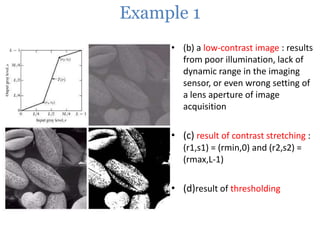
• (b) a low-contrast image : results
from poor illumination, lack of
dynamic range in the imaging
sensor, or even wrong setting of
a lens aperture of image
acquisition

• (c) result of contrast stretching :
(r1,s1) = (rmin,0) and (r2,s2) =
(rmax,L-1)

• (d)result of thresholding
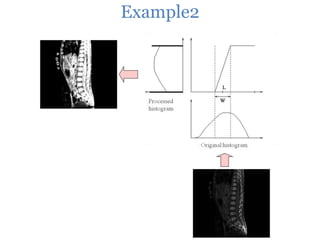
Example2
2-Clipping and Thresholding
• Expressed as :

• Clipping:

-Special case of contrast stretching ,where α= γ=0
-Useful for noise reduction when the input signal is known to lie in the
range [a,b].
Cont.

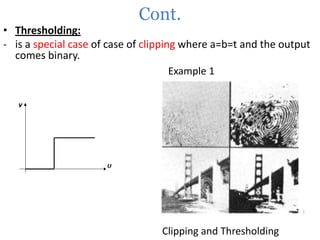
• Thresholding:
- is a special case of case of clipping where a=b=t and the output
comes binary.
Example 1

Clipping and Thresholding
Example2
3-Digital negative
• Negative image can be obtained by reverse scaling of the gray levels
according to the transformation,

v=L-u
• Useful in the display of medical images.
• Example:
4-intensity level slicing
• Permit segmentation of certain gray level regions from the rest of the
image.
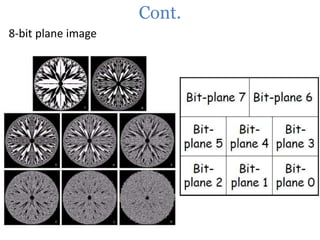
5-Bit extraction
• This transformation is useful
In determining the number of
Visually significant bits in an
Image.
• Suppose each pixel is
represented by 8 bits it is desired
To extract the nth most significant bit
And display it .

• Higher-order bits contain the
majority of the visually significant data
Example

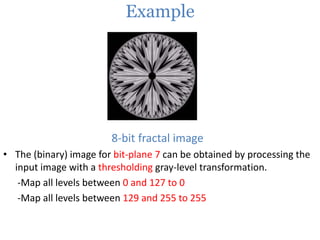
8-bit fractal image
• The (binary) image for bit-plane 7 can be obtained by processing the
input image with a thresholding gray-level transformation.
-Map all levels between 0 and 127 to 0
-Map all levels between 129 and 255 to 255
Cont.
8-bit plane image
6-Range compression
• Sometimes the dynamic range of a processed image far exceeds the
capability of the display device, in which case only the brightest parts
of the images are visible on the display screen.

• An effective way to compress the dynamic range of pixel values is to
perform the following intensity transformation function:
s = c log(1+|u|)
where c is a scaling constant, and the logarithm function performs the
desired compression.
7-Image subtraction and change detection
• In many imaging applications it is desired to compare two
complicated or busy images .
• A simple ,but powerful method is to align the two images and
subtract them .The difference image is then enhanced .
• Applications such as imaging of the blood vessils and arteries in a
body , security monitoring systems .
• Example:

_
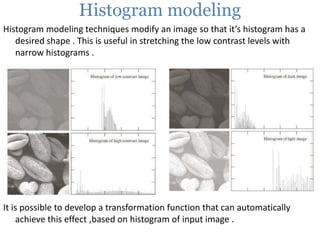
Histogram modeling
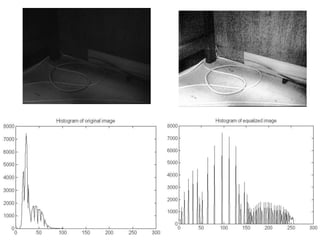
Histogram modeling techniques modify an image so that it’s histogram has a
desired shape . This is useful in stretching the low contrast levels with
narrow histograms .

It is possible to develop a transformation function that can automatically
achieve this effect ,based on histogram of input image .
Histogram modeling Cont.
Image Histogram
1-Histogram equalization
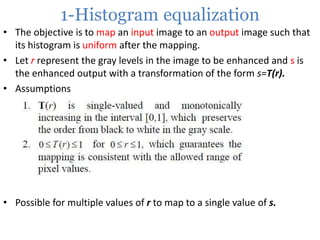
• The objective is to map an input image to an output image such that
its histogram is uniform after the mapping.
• Let r represent the gray levels in the image to be enhanced and s is
the enhanced output with a transformation of the form s=T(r).
• Assumptions

• Possible for multiple values of r to map to a single value of s.
Histogram Equalization cont.
Example 1:
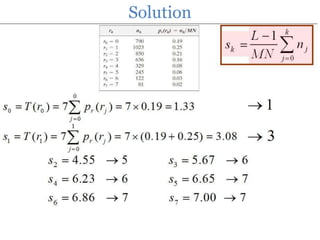
Solution
Solution cont.
Solution cont.
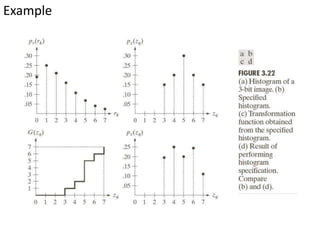
Example 2: Equalizing an image of 6 gray levels
Histogram specification
• Histogram equalization only generates an approximation to a uniform
histogram.

• With Histogram Specification, we can specify the shape of the
histogram that we wish the output image to have.
• It doesn’t have to be a uniform histogram.
• The principal difficulty in applying the histogram specification
method to image enhancement lies in being able to construct a
meaningful histogram.
Histogram specification cont.
Procedure :
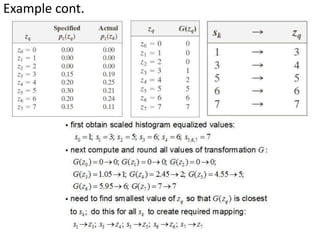
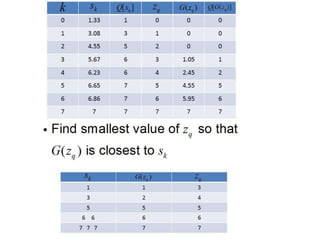
Example
Example cont.
Spatial operations
• Operations performed on local neighborhoods of input pixels

• Image is convolved with [FIR] finite impulse response filter called
spatial mask .
• Techniques such as :

- Noise smoothing
- Median filtering
- LP,HP &PB filtering
- Zooming
Spatial averaging and spatial low-pass filtering
•

Each pixel is replaced by a weighted average of it’s neighborhood pixels
that is,

-y(m,n) and v(m,n) are the input and output images ,respectively.
-W is suitably chosen window .
-a(k,l) are the filter weights .
• A common class of spatial averaging filters has all equal weights,

• Used for Noise smoothing , low-pass filtering and subsampling of images.
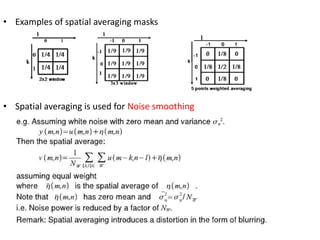
• Examples of spatial averaging masks

• Spatial averaging is used for Noise smoothing
Example
directional smoothing
• To protect edges from blurring while smoothing.
•

spatial averages are calculated in several directions , and the direction
giving the smallest changes before and after filtering is selected.

• The direction (θ) is found such that
• Then

gives the desired result.

is minimum
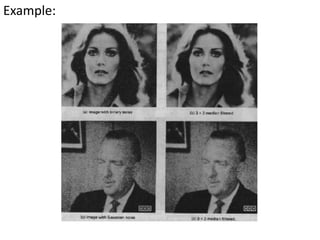
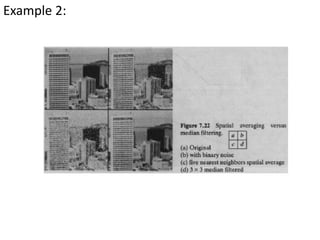
Median filtering
• Input pixel is replaced by the median of the pixels contained in a window
around a pixel

• The algorithm requires arranging the pixels in an increasing or decreasing
order and picking the middle value.
• For Odd window size is commonly used [3*3-5*5-7*7]
• For even window size the average of two middle values is taken.
• Median filter properties:
1- Non-linear filter

2-Performes very well on images containing binary noise , poorly when the
noise is gaussian.
3-performance is poor in case that the number of noise pixels in the window is
greater than or half the number of pixels in the window.
Example:
Example 2:
Unsharp masking and crispening
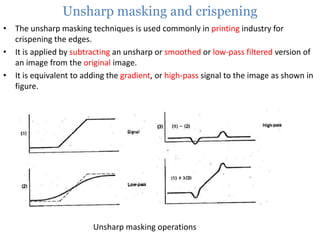
• The unsharp masking techniques is used commonly in printing industry for
crispening the edges.
• It is applied by subtracting an unsharp or smoothed or low-pass filtered version of
an image from the original image.
• It is equivalent to adding the gradient, or high-pass signal to the image as shown in
figure.

Unsharp masking operations
Unsharp masking and crispening cont.

• Unsharp masking operation can be represented by :
v(m,n) = u(m,n) + λg(m,n)
Where λ > 0 and g(m,n) is a suitably defined gradient at (m,n).

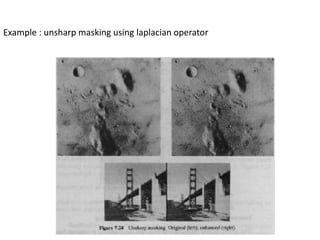
• A commonly used gradient function is the discrete laplacian.
Example : unsharp masking using laplacian operator
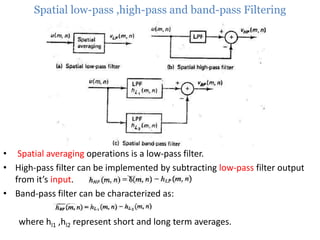
Spatial low-pass ,high-pass and band-pass Filtering

• Spatial averaging operations is a low-pass filter.
• High-pass filter can be implemented by subtracting low-pass filter output
from it’s input.
• Band-pass filter can be characterized as:
where hl1 ,hl2 represent short and long term averages.
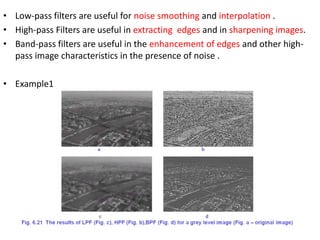
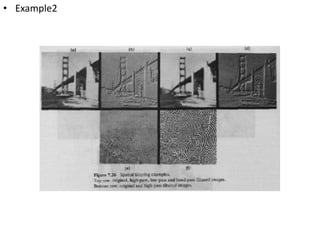
• Low-pass filters are useful for noise smoothing and interpolation .
• High-pass Filters are useful in extracting edges and in sharpening images.
• Band-pass filters are useful in the enhancement of edges and other highpass image characteristics in the presence of noise .

• Example1
• Example2
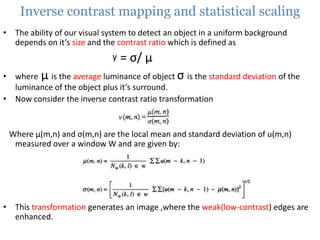
Inverse contrast mapping and statistical scaling
• The ability of our visual system to detect an object in a uniform background
depends on it’s size and the contrast ratio which is defined as

γ

= σ/ μ

• where μ is the average luminance of object σ is the standard deviation of the
luminance of the object plus it’s surround.
• Now consider the inverse contrast ratio transformation

Where μ(m,n) and σ(m,n) are the local mean and standard deviation of u(m,n)
measured over a window W and are given by:

• This transformation generates an image ,where the weak(low-contrast) edges are
enhanced.
• A special case of this transformation

•

which scales each pixel by it’s standard deviation to generate an image
whose pixels have unity variance .

• This mapping is also called statistical scaling.
• Example:
Magnification and interpolation (zooming)
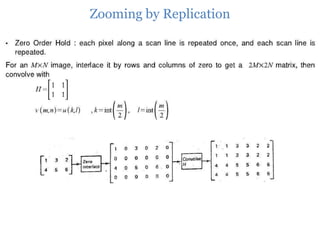
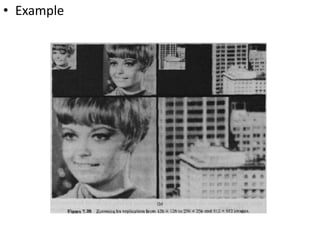
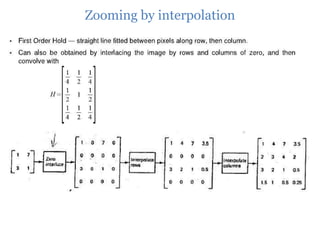
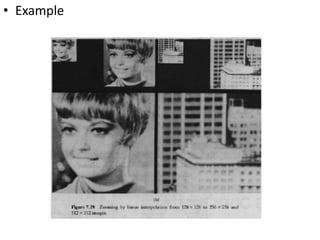
• Often it is desired to zoom on a given region of an image .This requires
taking an image and displaying it as a larger image .

• Techniques : -Replication
-linear interpolation
Zooming by Replication
• Example
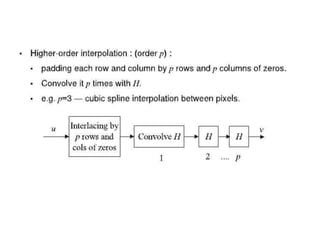
Zooming by interpolation
• Example
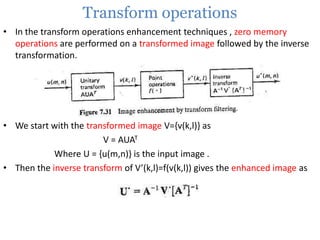
Transform operations
• In the transform operations enhancement techniques , zero memory
operations are performed on a transformed image followed by the inverse
transformation.

• We start with the transformed image V={v(k,l)} as
V = AUAT
Where U = {u(m,n)} is the input image .
• Then the inverse transform of V’(k,l)=f(v(k,l)) gives the enhanced image as
Generalized linear Filtering
• The zero memory transform domain operation is a pixel by pixel
multiplication .

Where g(k,l) is called a zonal mask.
• A filter of special interest is the inverse gaussian filter ,whose zonal mask for
N.N images is defined as:

When A is a DFT.
• For other orthogonal transforms the gaussian zonal mask is used as :

• Usually, the inverse Gaussian filter is used as high-frequency filter that
restore the blurred images.
Example:

Inverse gaussian Filtering
Root Filtering
• The transform coefficients v(k,l) can be written as:

• In root filtering, the α-root of the magnitude component of v(k,l) is taken,
while retaining the phase component, to yield

• For common images, since the magnitude of v(k,l) is relatively smaller at
higher frequencies, the effect of α -rooting is to enhance higher frequencies
(low amplitudes) relative to lower frequencies (high amplitudes).
• The following figure shows the effect of these filters
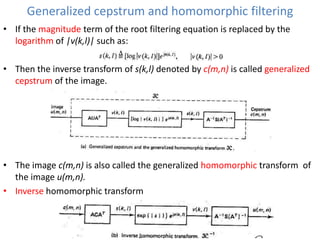
Generalized cepstrum and homomorphic filtering
• If the magnitude term of the root filtering equation is replaced by the
logarithm of |v(k,l)| such as:
• Then the inverse transform of s(k,l) denoted by c(m,n) is called generalized
cepstrum of the image.

• The image c(m,n) is also called the generalized homomorphic transform of
the image u(m,n).
• Inverse homomorphic transform
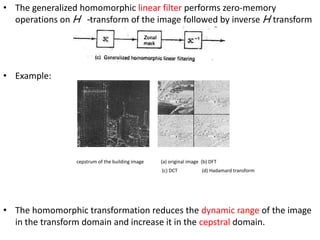
• The generalized homomorphic linear filter performs zero-memory
operations on H -transform of the image followed by inverse H transform

• Example:

cepstrum of the building image

(a) original image (b) DFT
(c) DCT

(d) Hadamard transform

• The homomorphic transformation reduces the dynamic range of the image
in the transform domain and increase it in the cepstral domain.
Multispectral image enhancement
• In multispectral imaging there is a sequence of I images Ui(m,n) ,i=0,1,2….L
where L is typically between 2 and 12.
• It is desired to combine these images to generate a single or a few display
images that are representative of their features.
• Three methods to enhance such images:
-Intensity ratios
-Log ratios
-Principal components
Intensity ratios
•

Define the ratios:

• Where ui(m,n) represents the intensity and is assumed to be positive.
• This methods gives I2-I combinations for the ratios the most suitable of
which are chosen by visual inspection.
• Sometimes the ratios are defined with respect to the average image
to reduce the number of combinations.
Log ratios
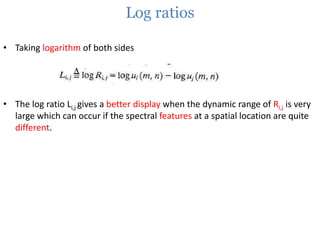
• Taking logarithm of both sides

• The log ratio Li,j gives a better display when the dynamic range of Ri,j is very
large which can occur if the spectral features at a spatial location are quite
different.
Principal components
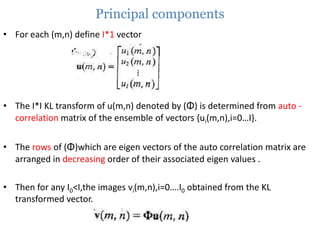
• For each (m,n) define I*1 vector

• The I*I KL transform of u(m,n) denoted by (Φ) is determined from auto correlation matrix of the ensemble of vectors {ui(m,n),i=0…I}.
• The rows of (Φ)which are eigen vectors of the auto correlation matrix are
arranged in decreasing order of their associated eigen values .
• Then for any I0<I,the images vi(m,n),i=0….I0 obtained from the KL
transformed vector.
False color and pseudocolor
-Human can distinguish more colors than gray levels.
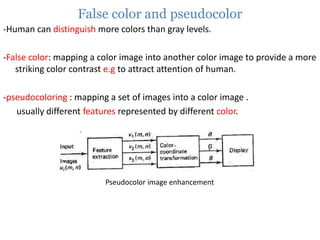
-False color: mapping a color image into another color image to provide a more
striking color contrast e.g to attract attention of human.
-pseudocoloring : mapping a set of images into a color image .
usually different features represented by different color.

Pseudocolor image enhancement
• Other methods are possible ,including a pseudorandom mapping of gray
levels into R,G,B coordinates , as is done in some image display systems.
• For image data set where the number of images is greater than or equal to
three , the data set can be reduced to three ratios, three log-ratios or three
principle components , which are then mapped into suitable colors.
•

In general, the pseudocolor mappings are nonunique , and extensive
interactive trials may be required to determine an acceptable mapping for
displaying a given set of data.
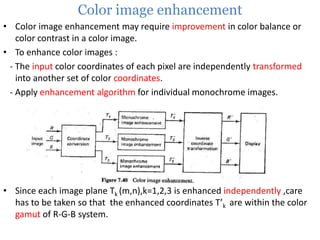
Color image enhancement
• Color image enhancement may require improvement in color balance or
color contrast in a color image.
• To enhance color images :
- The input color coordinates of each pixel are independently transformed
into another set of color coordinates.
- Apply enhancement algorithm for individual monochrome images.

• Since each image plane Tk (m,n),k=1,2,3 is enhanced independently ,care
has to be taken so that the enhanced coordinates T’k are within the color
gamut of R-G-B system.
Questions ?

Image enhancement

  • 1.
    Image Enhancement Prepared by AyaElshiwi Supervisor Dr.Osama Ouda
  • 2.
    outline • Introduction • Imageenhancement methods: Spatial-Frequency domain enhancement methods Point operations Histogram operations Spatial operations Transform operations • Multi-spectral image enhancement • False color and pseudocoloring • Color image enhancement
  • 3.
    Introduction • The principalobjective of image enhancement is to process a given image so that the result is more suitable than the original image for a specific application. • It accentuates or sharpens image features such as edges, boundaries, or contrast to make a graphic display more helpful for display and analysis. • The enhancement doesn't increase the inherent information content of the data, but it increases the dynamic range of the chosen features so that they can be detected easily.
  • 4.
    Cont. • The greatestdifficulty in image enhancement is quantifying the criterion for enhancement and, therefore, a large number of image enhancement techniques are empirical and require interactive procedures to obtain satisfactory results. • Image enhancement methods can be based on either spatial or frequency domain techniques.
  • 5.
    Spatial-Frequency domain enhancementmethods Spatial domain enhancement methods: • Spatial domain techniques are performed to the image plane itself and they are based on direct manipulation of pixels in an image. • The operation can be formulated as g(x,y) = T[f(x,y)], where g is the output, f is the input image and T is an operation on f defined over some neighborhood of (x,y). • According to the operations on the image pixels, it can be further divided into 2 categories: Point operations and spatial operations. Frequency domain enhancement methods: • These methods enhance an image f(x,y) by convoluting the image with a linear, position invariant operator. • The 2D convolution is performed in frequency domain with DFT. Spatial domain: g(x,y)=f(x,y)*h(x,y) Frequency domain: G(w1,w2)=F(w1,w2)H(w1,w2)
  • 6.
    Point operations -Zero-memory operationswhere a given gray level u∈[0,L] is mapped into a gray level v∈[0,L] according to a transformation. v(m,n)=f(u(m,n))
  • 7.
    1-contrast stretching • Theidea behind contrast stretching is to increase the dynamic range of the gray levels in the image being processed. • Low contrast images occur often due to : -poor or nonuniform lightning conditions -small dynamic range of imaging sensors • Expressed as : -For dark region stretch α>1 ,a=L/3 -For mid region stretch β>1 ,b=2/3L -For bright region stretch γ>1
  • 8.
    Example 1 • (b)a low-contrast image : results from poor illumination, lack of dynamic range in the imaging sensor, or even wrong setting of a lens aperture of image acquisition • (c) result of contrast stretching : (r1,s1) = (rmin,0) and (r2,s2) = (rmax,L-1) • (d)result of thresholding
  • 9.
  • 10.
    2-Clipping and Thresholding •Expressed as : • Clipping: -Special case of contrast stretching ,where α= γ=0 -Useful for noise reduction when the input signal is known to lie in the range [a,b].
  • 11.
    Cont. • Thresholding: - isa special case of case of clipping where a=b=t and the output comes binary. Example 1 Clipping and Thresholding
  • 12.
  • 13.
    3-Digital negative • Negativeimage can be obtained by reverse scaling of the gray levels according to the transformation, v=L-u • Useful in the display of medical images. • Example:
  • 14.
    4-intensity level slicing •Permit segmentation of certain gray level regions from the rest of the image.
  • 15.
    5-Bit extraction • Thistransformation is useful In determining the number of Visually significant bits in an Image. • Suppose each pixel is represented by 8 bits it is desired To extract the nth most significant bit And display it . • Higher-order bits contain the majority of the visually significant data
  • 16.
    Example 8-bit fractal image •The (binary) image for bit-plane 7 can be obtained by processing the input image with a thresholding gray-level transformation. -Map all levels between 0 and 127 to 0 -Map all levels between 129 and 255 to 255
  • 17.
  • 18.
    6-Range compression • Sometimesthe dynamic range of a processed image far exceeds the capability of the display device, in which case only the brightest parts of the images are visible on the display screen. • An effective way to compress the dynamic range of pixel values is to perform the following intensity transformation function: s = c log(1+|u|) where c is a scaling constant, and the logarithm function performs the desired compression.
  • 19.
    7-Image subtraction andchange detection • In many imaging applications it is desired to compare two complicated or busy images . • A simple ,but powerful method is to align the two images and subtract them .The difference image is then enhanced . • Applications such as imaging of the blood vessils and arteries in a body , security monitoring systems . • Example: _
  • 20.
    Histogram modeling Histogram modelingtechniques modify an image so that it’s histogram has a desired shape . This is useful in stretching the low contrast levels with narrow histograms . It is possible to develop a transformation function that can automatically achieve this effect ,based on histogram of input image .
  • 21.
  • 22.
    1-Histogram equalization • Theobjective is to map an input image to an output image such that its histogram is uniform after the mapping. • Let r represent the gray levels in the image to be enhanced and s is the enhanced output with a transformation of the form s=T(r). • Assumptions • Possible for multiple values of r to map to a single value of s.
  • 23.
  • 24.
  • 25.
  • 26.
  • 27.
    Example 2: Equalizingan image of 6 gray levels
  • 29.
    Histogram specification • Histogramequalization only generates an approximation to a uniform histogram. • With Histogram Specification, we can specify the shape of the histogram that we wish the output image to have. • It doesn’t have to be a uniform histogram. • The principal difficulty in applying the histogram specification method to image enhancement lies in being able to construct a meaningful histogram.
  • 30.
  • 31.
  • 32.
  • 33.
  • 35.
    Spatial operations • Operationsperformed on local neighborhoods of input pixels • Image is convolved with [FIR] finite impulse response filter called spatial mask . • Techniques such as : - Noise smoothing - Median filtering - LP,HP &PB filtering - Zooming
  • 36.
    Spatial averaging andspatial low-pass filtering • Each pixel is replaced by a weighted average of it’s neighborhood pixels that is, -y(m,n) and v(m,n) are the input and output images ,respectively. -W is suitably chosen window . -a(k,l) are the filter weights . • A common class of spatial averaging filters has all equal weights, • Used for Noise smoothing , low-pass filtering and subsampling of images.
  • 37.
    • Examples ofspatial averaging masks • Spatial averaging is used for Noise smoothing
  • 38.
  • 39.
    directional smoothing • Toprotect edges from blurring while smoothing. • spatial averages are calculated in several directions , and the direction giving the smallest changes before and after filtering is selected. • The direction (θ) is found such that • Then gives the desired result. is minimum
  • 40.
    Median filtering • Inputpixel is replaced by the median of the pixels contained in a window around a pixel • The algorithm requires arranging the pixels in an increasing or decreasing order and picking the middle value. • For Odd window size is commonly used [3*3-5*5-7*7] • For even window size the average of two middle values is taken. • Median filter properties: 1- Non-linear filter 2-Performes very well on images containing binary noise , poorly when the noise is gaussian. 3-performance is poor in case that the number of noise pixels in the window is greater than or half the number of pixels in the window.
  • 41.
  • 42.
  • 43.
    Unsharp masking andcrispening • The unsharp masking techniques is used commonly in printing industry for crispening the edges. • It is applied by subtracting an unsharp or smoothed or low-pass filtered version of an image from the original image. • It is equivalent to adding the gradient, or high-pass signal to the image as shown in figure. Unsharp masking operations
  • 44.
    Unsharp masking andcrispening cont. • Unsharp masking operation can be represented by : v(m,n) = u(m,n) + λg(m,n) Where λ > 0 and g(m,n) is a suitably defined gradient at (m,n). • A commonly used gradient function is the discrete laplacian.
  • 45.
    Example : unsharpmasking using laplacian operator
  • 46.
    Spatial low-pass ,high-passand band-pass Filtering • Spatial averaging operations is a low-pass filter. • High-pass filter can be implemented by subtracting low-pass filter output from it’s input. • Band-pass filter can be characterized as: where hl1 ,hl2 represent short and long term averages.
  • 47.
    • Low-pass filtersare useful for noise smoothing and interpolation . • High-pass Filters are useful in extracting edges and in sharpening images. • Band-pass filters are useful in the enhancement of edges and other highpass image characteristics in the presence of noise . • Example1
  • 48.
  • 49.
    Inverse contrast mappingand statistical scaling • The ability of our visual system to detect an object in a uniform background depends on it’s size and the contrast ratio which is defined as γ = σ/ μ • where μ is the average luminance of object σ is the standard deviation of the luminance of the object plus it’s surround. • Now consider the inverse contrast ratio transformation Where μ(m,n) and σ(m,n) are the local mean and standard deviation of u(m,n) measured over a window W and are given by: • This transformation generates an image ,where the weak(low-contrast) edges are enhanced.
  • 50.
    • A specialcase of this transformation • which scales each pixel by it’s standard deviation to generate an image whose pixels have unity variance . • This mapping is also called statistical scaling. • Example:
  • 51.
    Magnification and interpolation(zooming) • Often it is desired to zoom on a given region of an image .This requires taking an image and displaying it as a larger image . • Techniques : -Replication -linear interpolation
  • 52.
  • 53.
  • 54.
  • 55.
  • 57.
    Transform operations • Inthe transform operations enhancement techniques , zero memory operations are performed on a transformed image followed by the inverse transformation. • We start with the transformed image V={v(k,l)} as V = AUAT Where U = {u(m,n)} is the input image . • Then the inverse transform of V’(k,l)=f(v(k,l)) gives the enhanced image as
  • 58.
    Generalized linear Filtering •The zero memory transform domain operation is a pixel by pixel multiplication . Where g(k,l) is called a zonal mask.
  • 60.
    • A filterof special interest is the inverse gaussian filter ,whose zonal mask for N.N images is defined as: When A is a DFT. • For other orthogonal transforms the gaussian zonal mask is used as : • Usually, the inverse Gaussian filter is used as high-frequency filter that restore the blurred images. Example: Inverse gaussian Filtering
  • 61.
    Root Filtering • Thetransform coefficients v(k,l) can be written as: • In root filtering, the α-root of the magnitude component of v(k,l) is taken, while retaining the phase component, to yield • For common images, since the magnitude of v(k,l) is relatively smaller at higher frequencies, the effect of α -rooting is to enhance higher frequencies (low amplitudes) relative to lower frequencies (high amplitudes). • The following figure shows the effect of these filters
  • 62.
    Generalized cepstrum andhomomorphic filtering • If the magnitude term of the root filtering equation is replaced by the logarithm of |v(k,l)| such as: • Then the inverse transform of s(k,l) denoted by c(m,n) is called generalized cepstrum of the image. • The image c(m,n) is also called the generalized homomorphic transform of the image u(m,n). • Inverse homomorphic transform
  • 63.
    • The generalizedhomomorphic linear filter performs zero-memory operations on H -transform of the image followed by inverse H transform • Example: cepstrum of the building image (a) original image (b) DFT (c) DCT (d) Hadamard transform • The homomorphic transformation reduces the dynamic range of the image in the transform domain and increase it in the cepstral domain.
  • 64.
    Multispectral image enhancement •In multispectral imaging there is a sequence of I images Ui(m,n) ,i=0,1,2….L where L is typically between 2 and 12. • It is desired to combine these images to generate a single or a few display images that are representative of their features. • Three methods to enhance such images: -Intensity ratios -Log ratios -Principal components
  • 65.
    Intensity ratios • Define theratios: • Where ui(m,n) represents the intensity and is assumed to be positive. • This methods gives I2-I combinations for the ratios the most suitable of which are chosen by visual inspection. • Sometimes the ratios are defined with respect to the average image to reduce the number of combinations.
  • 66.
    Log ratios • Takinglogarithm of both sides • The log ratio Li,j gives a better display when the dynamic range of Ri,j is very large which can occur if the spectral features at a spatial location are quite different.
  • 67.
    Principal components • Foreach (m,n) define I*1 vector • The I*I KL transform of u(m,n) denoted by (Φ) is determined from auto correlation matrix of the ensemble of vectors {ui(m,n),i=0…I}. • The rows of (Φ)which are eigen vectors of the auto correlation matrix are arranged in decreasing order of their associated eigen values . • Then for any I0<I,the images vi(m,n),i=0….I0 obtained from the KL transformed vector.
  • 68.
    False color andpseudocolor -Human can distinguish more colors than gray levels. -False color: mapping a color image into another color image to provide a more striking color contrast e.g to attract attention of human. -pseudocoloring : mapping a set of images into a color image . usually different features represented by different color. Pseudocolor image enhancement
  • 69.
    • Other methodsare possible ,including a pseudorandom mapping of gray levels into R,G,B coordinates , as is done in some image display systems. • For image data set where the number of images is greater than or equal to three , the data set can be reduced to three ratios, three log-ratios or three principle components , which are then mapped into suitable colors. • In general, the pseudocolor mappings are nonunique , and extensive interactive trials may be required to determine an acceptable mapping for displaying a given set of data.
  • 70.
    Color image enhancement •Color image enhancement may require improvement in color balance or color contrast in a color image. • To enhance color images : - The input color coordinates of each pixel are independently transformed into another set of color coordinates. - Apply enhancement algorithm for individual monochrome images. • Since each image plane Tk (m,n),k=1,2,3 is enhanced independently ,care has to be taken so that the enhanced coordinates T’k are within the color gamut of R-G-B system.
  • 71.