KALMAN FILTER
  Applications in Image processing
Introduction
• The kalman filter is a recursive state space model based
  estimation algorithm.

• This filter is named after Rudolph E. Kalman, who in
  1960 published his famous paper describing a recursive
  solution to the discrete data linear filtering problem
  (Kalman 1960).

• This algorithm was basically developed for single
  dimensional and real valued signals which are
  associated with the linear systems assuming the system
  is corrupted with linear additive white Gaussian noise.
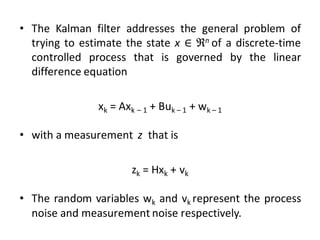
• The Kalman filter addresses the general problem of
  trying to estimate the state x ∈ ℜn of a discrete-time
  controlled process that is governed by the linear
  difference equation

               xk = Axk – 1 + Buk – 1 + wk – 1

• with a measurement z that is

                       zk = Hxk + vk

• The random variables wk and vk represent the process
  noise and measurement noise respectively.
• The nxn matrix A in the previous difference
  equation relates the state at the previous time
  step k-1 to the state at the current step k , in the
  absence of either a driving function or process
  noise.

• The nxl matrix B relates the optional control input
  u to the state x.

• The mxn matrix H in the measurement equation
  relates the state to the measurement zk.
The Computational Origins of the Filter :

• We define𝑥 − ∈ℜn to be our a priori state
               𝑘
  estimate at step k given knowledge of the
  process prior to step k , and 𝑥 𝑘 ∈ℜn to be our a
  posteriori state estimate at step k given
  measurement zk.
• We can then define a priori and a posteriori
  estimate errors as
                   −           −
                  𝑒𝑘 ≡ 𝑥𝑘 − 𝑥𝑘 &
                  𝑒𝑘 ≡ 𝑥𝑘 − 𝑥𝑘
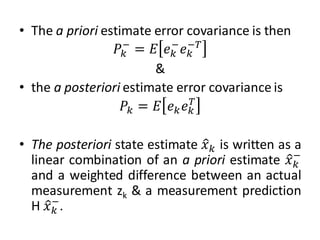
• The a priori estimate error covariance is then
                   −       − −𝑇
                  𝑃𝑘 = 𝐸 𝑒 𝑘 𝑒 𝑘
                        &
• the a posteriori estimate error covariance is
                                𝑇
                   𝑃𝑘 = 𝐸 𝑒 𝑘 𝑒 𝑘

• The posteriori state estimate 𝑥 𝑘 is written as a
  linear combination of an a priori estimate 𝑥 −  𝑘
  and a weighted difference between an actual
  measurement zk & a measurement prediction
  H 𝑥 −.
      𝑘
.
            𝑥 𝑘 = 𝑥 − + 𝐾 𝑧 𝑘 − 𝐻𝑥 −
                    𝑘              𝑘

• The difference   𝑧 𝑘 − 𝐻𝑥 −
                            𝑘     is called the
  measurement innovation, or the residual.

• The nxm matrix K is chosen to be the gain or
  blending factor that minimizes the a posteriori
  error covariance.

• Substituting 𝑥 𝑘 in 𝑒 𝑘 and 𝑒 𝑘 in Pk , and
  performing minimization, we get
                𝑃− 𝐻 𝑇
                 𝑘
     𝐾𝑘 =                = 𝑃− 𝐻 𝑇 𝐻𝑃− 𝐻 𝑇 + 𝑅 −1
                            𝑘       𝑘
             𝐻𝑃− 𝐻 𝑇 + 𝑅
               𝑘
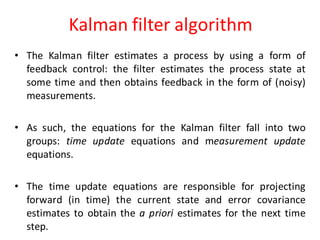
Kalman filter algorithm
• The Kalman filter estimates a process by using a form of
  feedback control: the filter estimates the process state at
  some time and then obtains feedback in the form of (noisy)
  measurements.

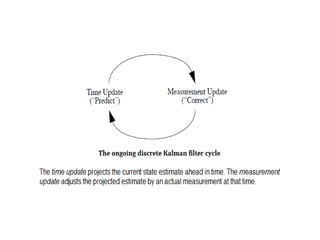
• As such, the equations for the Kalman filter fall into two
  groups: time update equations and measurement update
  equations.

• The time update equations are responsible for projecting
  forward (in time) the current state and error covariance
  estimates to obtain the a priori estimates for the next time
  step.
• The measurement update equations are responsible
  for the feedback—i.e. for incorporating a new
  measurement into the a priori estimate to obtain an
  improved a posteriori estimate.

• The time update equations can also be thought of as
  predictor equations, while the measurement update
  equations can be thought of as corrector equations.

• The final estimation algorithm resembles that of a
  predictor-corrector algorithm.
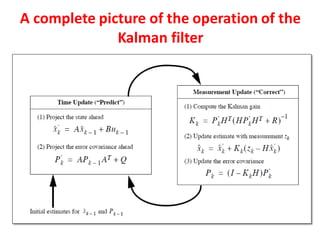
Discrete Kalman filter time update equations:

              𝑥 − = 𝐴𝑥 𝑘−1 + 𝐵𝑢 𝑘−1
                𝑘
                                              Prediction
               𝑃 − = 𝐴𝑃 𝑘−1 𝐴 𝑇 + 𝑄
                 𝑘

Discrete Kalman filter measurement update
equations:
           𝐾 𝑘 = 𝑃 − 𝐻 𝑇 𝐻𝑃− 𝐻 𝑇 + 𝑅
                   𝑘       𝑘
                                         −1


            𝑥 𝑘 = 𝑥 − + 𝐾 𝑘 𝑧 𝑘 − 𝐻𝑥 −
                    𝑘                𝑘           Correction

               𝑃 𝑘 = 𝐼 − 𝐾 𝑘 𝐻 𝑃−
                                𝑘
A complete picture of the operation of the
              Kalman filter
Implementation
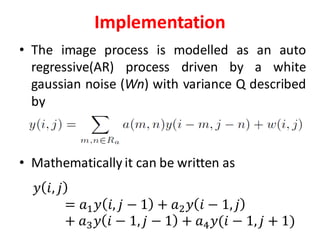
• The image process is modelled as an auto
  regressive(AR) process driven by a white
  gaussian noise (Wn) with variance Q described
  by


• Mathematically it can be written as
   𝑦 𝑖, 𝑗
            = 𝑎1 𝑦 𝑖, 𝑗 − 1 + 𝑎2 𝑦 𝑖 − 1, 𝑗
            + 𝑎3 𝑦 𝑖 − 1, 𝑗 − 1 + 𝑎4 𝑦(𝑖 − 1, 𝑗 + 1)
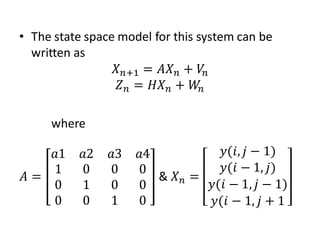
• The state space model for this system can be
  written as
                 𝑋 𝑛+1 = 𝐴𝑋 𝑛 + 𝑉𝑛
                  𝑍 𝑛 = 𝐻𝑋 𝑛 + 𝑊𝑛

     where

   𝑎1      𝑎2   𝑎3   𝑎4           𝑦(𝑖, 𝑗 − 1)
   1       0    0    0            𝑦(𝑖 − 1, 𝑗)
𝐴=                      & 𝑋𝑛 =
   0       1    0    0         𝑦(𝑖 − 1, 𝑗 − 1)
   0       0    1    0          𝑦(𝑖 − 1, 𝑗 + 1
Results
Original Images   Measured Images   Corrected Images
Extended Kalman Filter
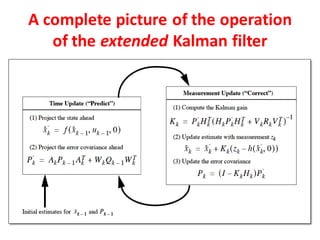
• An extended Kalman filter is used if the
  process to be estimated and (or) the
  measurement relationship to the process is
  non-linear.
• Here
           𝑥 𝑘 = 𝑓 𝑥 𝑘−1 , 𝑢 𝑘−1 , 𝑤 𝑘−1

• with measurement z that is

                𝑧 𝑘 = ℎ 𝑥 𝑘, 𝑣 𝑘
• Similar to the Kalman filter, the time and
  measurement equations for EKF can be
  written as below:
• EKF time update equations:


• EKF measurement update eqns:
A complete picture of the operation
   of the extended Kalman filter
Results

Original Image   Measured Image   Corrected Image
COMPLEX KALMAN FILTERING
• In complex Kalman filtering, image model is
  represented in complex form as real and imaginary
  values represented as real and imaginary part of the
  complex number.
                   Y= Real+(imag)i

• where, Y is complex image model.

• Complex valued Kalman filters have been used
  extensively in a variety of applications, including
  frequency estimation of time-varying signals, training
  of neural networks etc.
Properties of Kalman filter
• Kalman filter is a time-varying filter as Kalman gain
  changes with n.

• The filter is very powerful in several aspects: it
  supports estimations of past, present, and even
  future states, and it can do so even when the precise
  nature of the modeled system is unknown.

• In the Kalman filter, prediction acts like the prior
  information about the state at time n before we
  observe the data at time n.
Refernces
• Natasha Devroye. Estimation: parts of Chapters 12-13,
  Wiener and Kalman Filtering.

• Greg Welch and Gary Bishop. An Introduction to the
  Kalman Filter, Monday, July 24, 2006.

• R. E. KALMAN. A New Approach to Linear Filtering and
  Prediction Problems.

• http://www.cs.unc.edu/~welch/kalman/
Kalman filter - Applications in Image processing

Kalman filter - Applications in Image processing

  • 1.
    KALMAN FILTER Applications in Image processing
  • 2.
    Introduction • The kalmanfilter is a recursive state space model based estimation algorithm. • This filter is named after Rudolph E. Kalman, who in 1960 published his famous paper describing a recursive solution to the discrete data linear filtering problem (Kalman 1960). • This algorithm was basically developed for single dimensional and real valued signals which are associated with the linear systems assuming the system is corrupted with linear additive white Gaussian noise.
  • 3.
    • The Kalmanfilter addresses the general problem of trying to estimate the state x ∈ ℜn of a discrete-time controlled process that is governed by the linear difference equation xk = Axk – 1 + Buk – 1 + wk – 1 • with a measurement z that is zk = Hxk + vk • The random variables wk and vk represent the process noise and measurement noise respectively.
  • 4.
    • The nxnmatrix A in the previous difference equation relates the state at the previous time step k-1 to the state at the current step k , in the absence of either a driving function or process noise. • The nxl matrix B relates the optional control input u to the state x. • The mxn matrix H in the measurement equation relates the state to the measurement zk.
  • 5.
    The Computational Originsof the Filter : • We define𝑥 − ∈ℜn to be our a priori state 𝑘 estimate at step k given knowledge of the process prior to step k , and 𝑥 𝑘 ∈ℜn to be our a posteriori state estimate at step k given measurement zk. • We can then define a priori and a posteriori estimate errors as − − 𝑒𝑘 ≡ 𝑥𝑘 − 𝑥𝑘 & 𝑒𝑘 ≡ 𝑥𝑘 − 𝑥𝑘
  • 6.
    • The apriori estimate error covariance is then − − −𝑇 𝑃𝑘 = 𝐸 𝑒 𝑘 𝑒 𝑘 & • the a posteriori estimate error covariance is 𝑇 𝑃𝑘 = 𝐸 𝑒 𝑘 𝑒 𝑘 • The posteriori state estimate 𝑥 𝑘 is written as a linear combination of an a priori estimate 𝑥 − 𝑘 and a weighted difference between an actual measurement zk & a measurement prediction H 𝑥 −. 𝑘
  • 7.
    . 𝑥 𝑘 = 𝑥 − + 𝐾 𝑧 𝑘 − 𝐻𝑥 − 𝑘 𝑘 • The difference 𝑧 𝑘 − 𝐻𝑥 − 𝑘 is called the measurement innovation, or the residual. • The nxm matrix K is chosen to be the gain or blending factor that minimizes the a posteriori error covariance. • Substituting 𝑥 𝑘 in 𝑒 𝑘 and 𝑒 𝑘 in Pk , and performing minimization, we get 𝑃− 𝐻 𝑇 𝑘 𝐾𝑘 = = 𝑃− 𝐻 𝑇 𝐻𝑃− 𝐻 𝑇 + 𝑅 −1 𝑘 𝑘 𝐻𝑃− 𝐻 𝑇 + 𝑅 𝑘
  • 8.
    Kalman filter algorithm •The Kalman filter estimates a process by using a form of feedback control: the filter estimates the process state at some time and then obtains feedback in the form of (noisy) measurements. • As such, the equations for the Kalman filter fall into two groups: time update equations and measurement update equations. • The time update equations are responsible for projecting forward (in time) the current state and error covariance estimates to obtain the a priori estimates for the next time step.
  • 9.
    • The measurementupdate equations are responsible for the feedback—i.e. for incorporating a new measurement into the a priori estimate to obtain an improved a posteriori estimate. • The time update equations can also be thought of as predictor equations, while the measurement update equations can be thought of as corrector equations. • The final estimation algorithm resembles that of a predictor-corrector algorithm.
  • 11.
    Discrete Kalman filtertime update equations: 𝑥 − = 𝐴𝑥 𝑘−1 + 𝐵𝑢 𝑘−1 𝑘 Prediction 𝑃 − = 𝐴𝑃 𝑘−1 𝐴 𝑇 + 𝑄 𝑘 Discrete Kalman filter measurement update equations: 𝐾 𝑘 = 𝑃 − 𝐻 𝑇 𝐻𝑃− 𝐻 𝑇 + 𝑅 𝑘 𝑘 −1 𝑥 𝑘 = 𝑥 − + 𝐾 𝑘 𝑧 𝑘 − 𝐻𝑥 − 𝑘 𝑘 Correction 𝑃 𝑘 = 𝐼 − 𝐾 𝑘 𝐻 𝑃− 𝑘
  • 12.
    A complete pictureof the operation of the Kalman filter
  • 13.
    Implementation • The imageprocess is modelled as an auto regressive(AR) process driven by a white gaussian noise (Wn) with variance Q described by • Mathematically it can be written as 𝑦 𝑖, 𝑗 = 𝑎1 𝑦 𝑖, 𝑗 − 1 + 𝑎2 𝑦 𝑖 − 1, 𝑗 + 𝑎3 𝑦 𝑖 − 1, 𝑗 − 1 + 𝑎4 𝑦(𝑖 − 1, 𝑗 + 1)
  • 14.
    • The statespace model for this system can be written as 𝑋 𝑛+1 = 𝐴𝑋 𝑛 + 𝑉𝑛 𝑍 𝑛 = 𝐻𝑋 𝑛 + 𝑊𝑛 where 𝑎1 𝑎2 𝑎3 𝑎4 𝑦(𝑖, 𝑗 − 1) 1 0 0 0 𝑦(𝑖 − 1, 𝑗) 𝐴= & 𝑋𝑛 = 0 1 0 0 𝑦(𝑖 − 1, 𝑗 − 1) 0 0 1 0 𝑦(𝑖 − 1, 𝑗 + 1
  • 15.
    Results Original Images Measured Images Corrected Images
  • 16.
    Extended Kalman Filter •An extended Kalman filter is used if the process to be estimated and (or) the measurement relationship to the process is non-linear. • Here 𝑥 𝑘 = 𝑓 𝑥 𝑘−1 , 𝑢 𝑘−1 , 𝑤 𝑘−1 • with measurement z that is 𝑧 𝑘 = ℎ 𝑥 𝑘, 𝑣 𝑘
  • 17.
    • Similar tothe Kalman filter, the time and measurement equations for EKF can be written as below: • EKF time update equations: • EKF measurement update eqns:
  • 19.
    A complete pictureof the operation of the extended Kalman filter
  • 20.
    Results Original Image Measured Image Corrected Image
  • 21.
    COMPLEX KALMAN FILTERING •In complex Kalman filtering, image model is represented in complex form as real and imaginary values represented as real and imaginary part of the complex number. Y= Real+(imag)i • where, Y is complex image model. • Complex valued Kalman filters have been used extensively in a variety of applications, including frequency estimation of time-varying signals, training of neural networks etc.
  • 22.
    Properties of Kalmanfilter • Kalman filter is a time-varying filter as Kalman gain changes with n. • The filter is very powerful in several aspects: it supports estimations of past, present, and even future states, and it can do so even when the precise nature of the modeled system is unknown. • In the Kalman filter, prediction acts like the prior information about the state at time n before we observe the data at time n.
  • 23.
    Refernces • Natasha Devroye.Estimation: parts of Chapters 12-13, Wiener and Kalman Filtering. • Greg Welch and Gary Bishop. An Introduction to the Kalman Filter, Monday, July 24, 2006. • R. E. KALMAN. A New Approach to Linear Filtering and Prediction Problems. • http://www.cs.unc.edu/~welch/kalman/