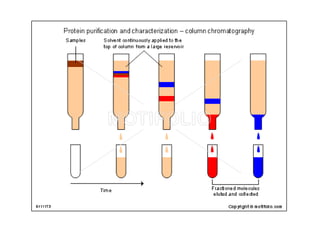
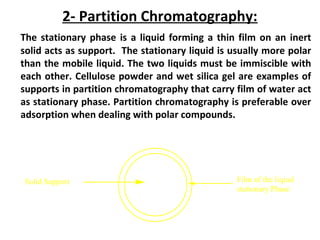
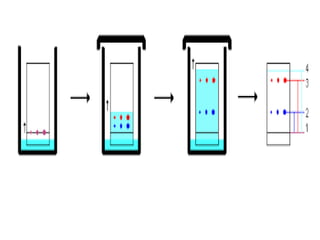
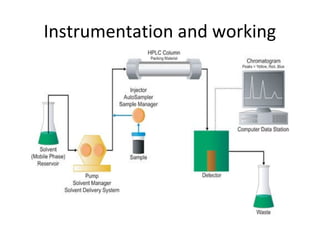
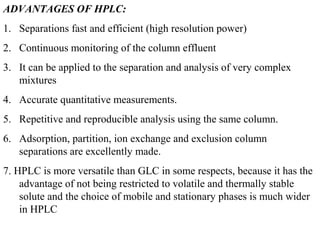
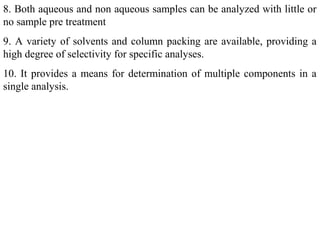
Chromatography was first developed in 1906 by Russian scientist Tswett who separated plant pigments using calcium carbonate columns. The term "chromatography" comes from the Greek words for "color" and "to write". Chromatography separates mixtures based on how their components interact and distribute between a stationary and mobile phase. High performance liquid chromatography (HPLC) uses high pressure to force a mobile phase through a column packed with tiny particles. HPLC provides efficient separation of mixtures and is commonly used in analytical and preparative applications.