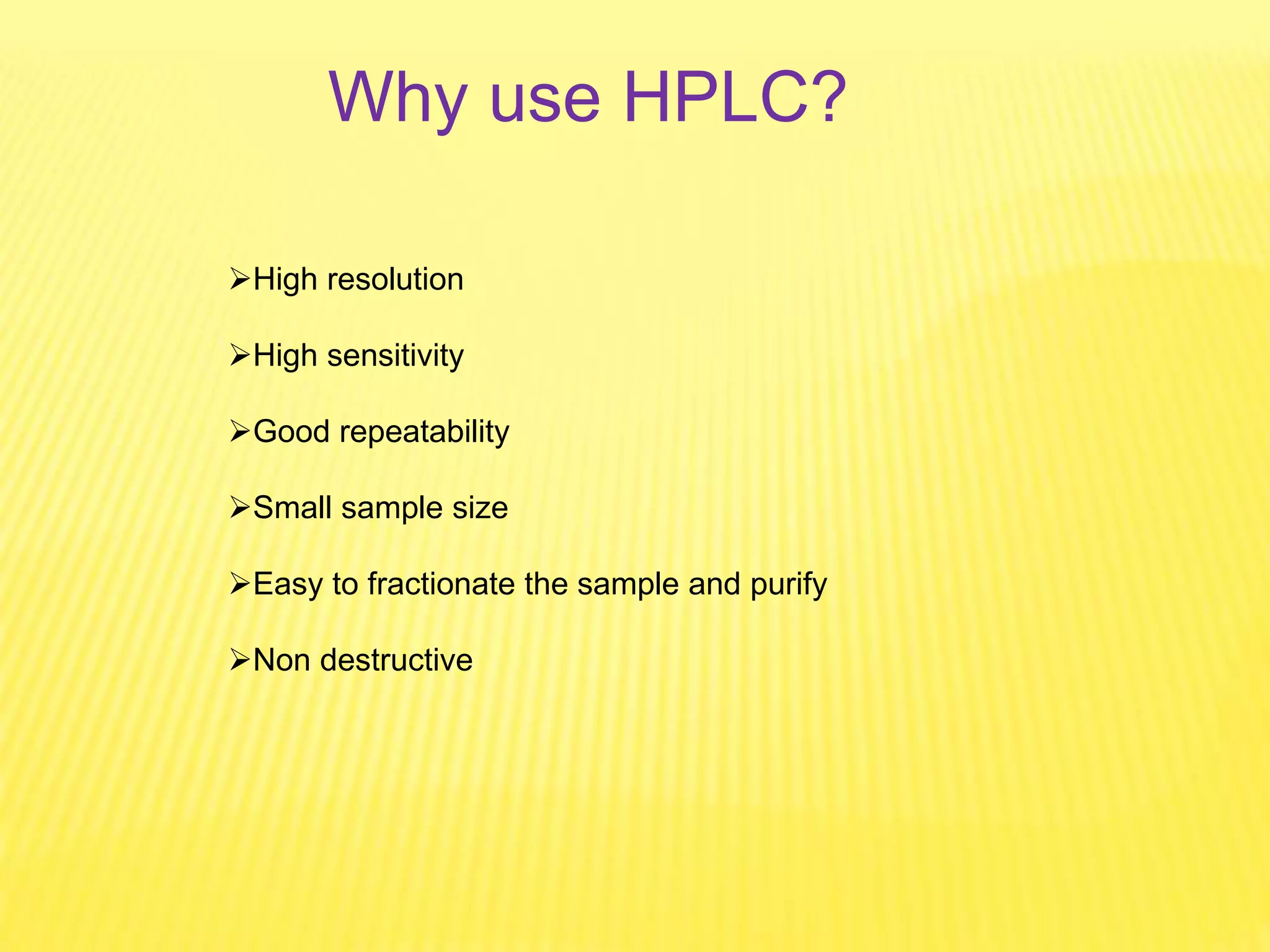
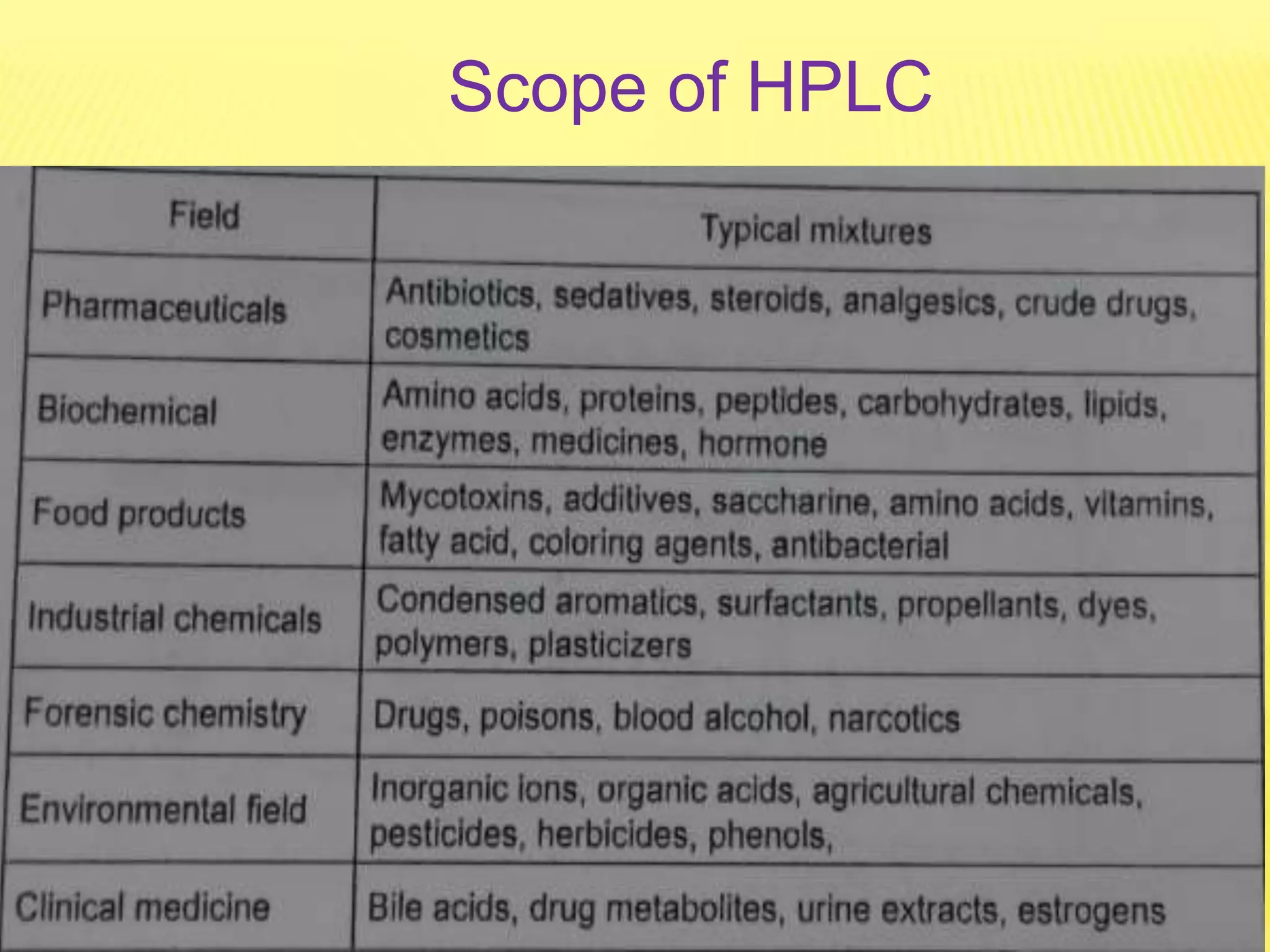
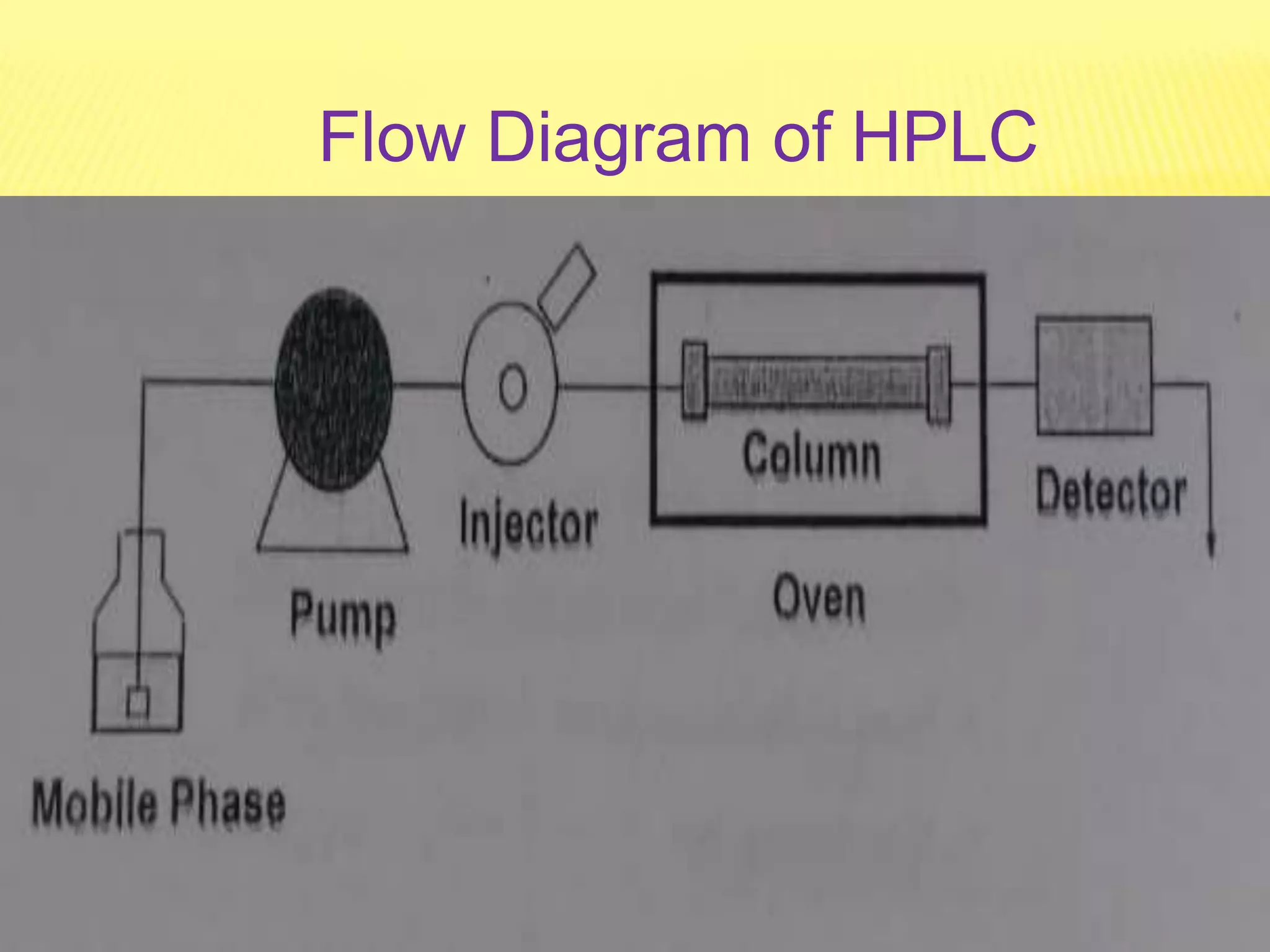
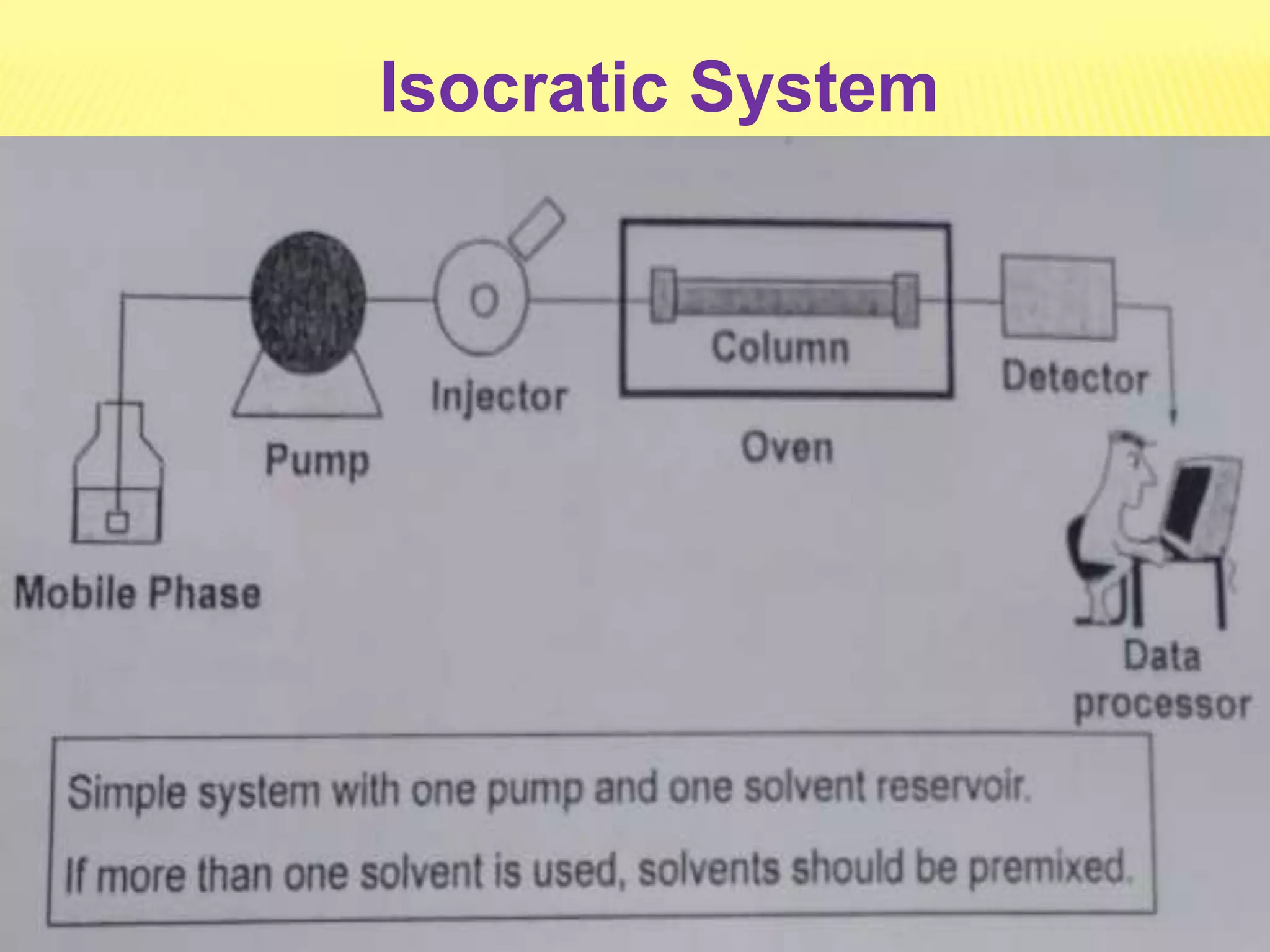
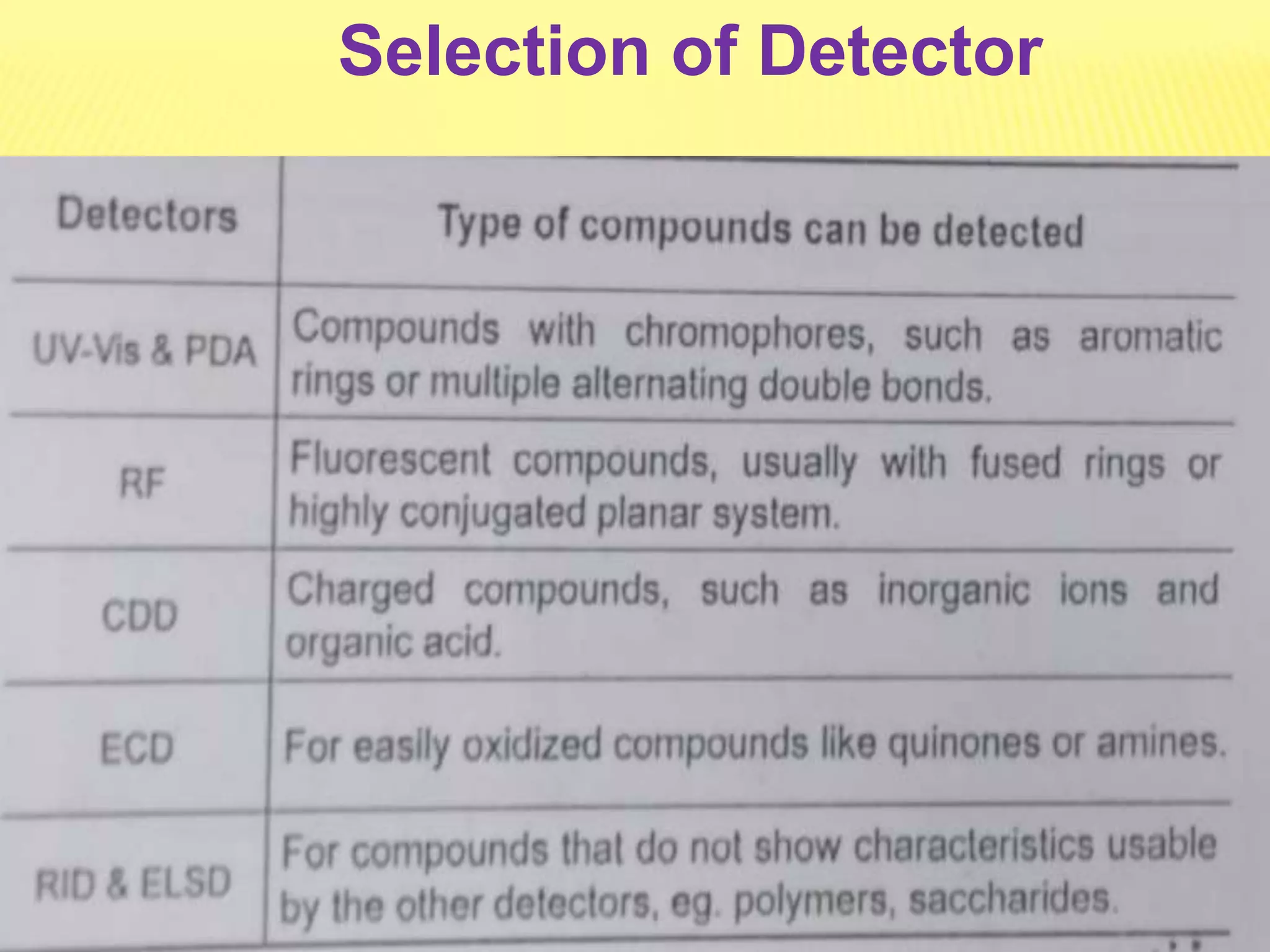
This document provides an overview of high performance liquid chromatography (HPLC). It discusses the basic principles of chromatography and how HPLC works to separate compounds. HPLC uses a stationary phase and mobile phase to separate samples based on properties like polarity. Different separation modes are used like normal phase, reversed phase, ion exchange, size exclusion, and affinity chromatography. Instrumentation includes the column, detector, pump, injection port, and auto-injector. Various detectors can be used like UV/Vis detectors and photo diode array detectors. HPLC provides high resolution, sensitivity, repeatability and is useful for analyzing small samples and purifying compounds.
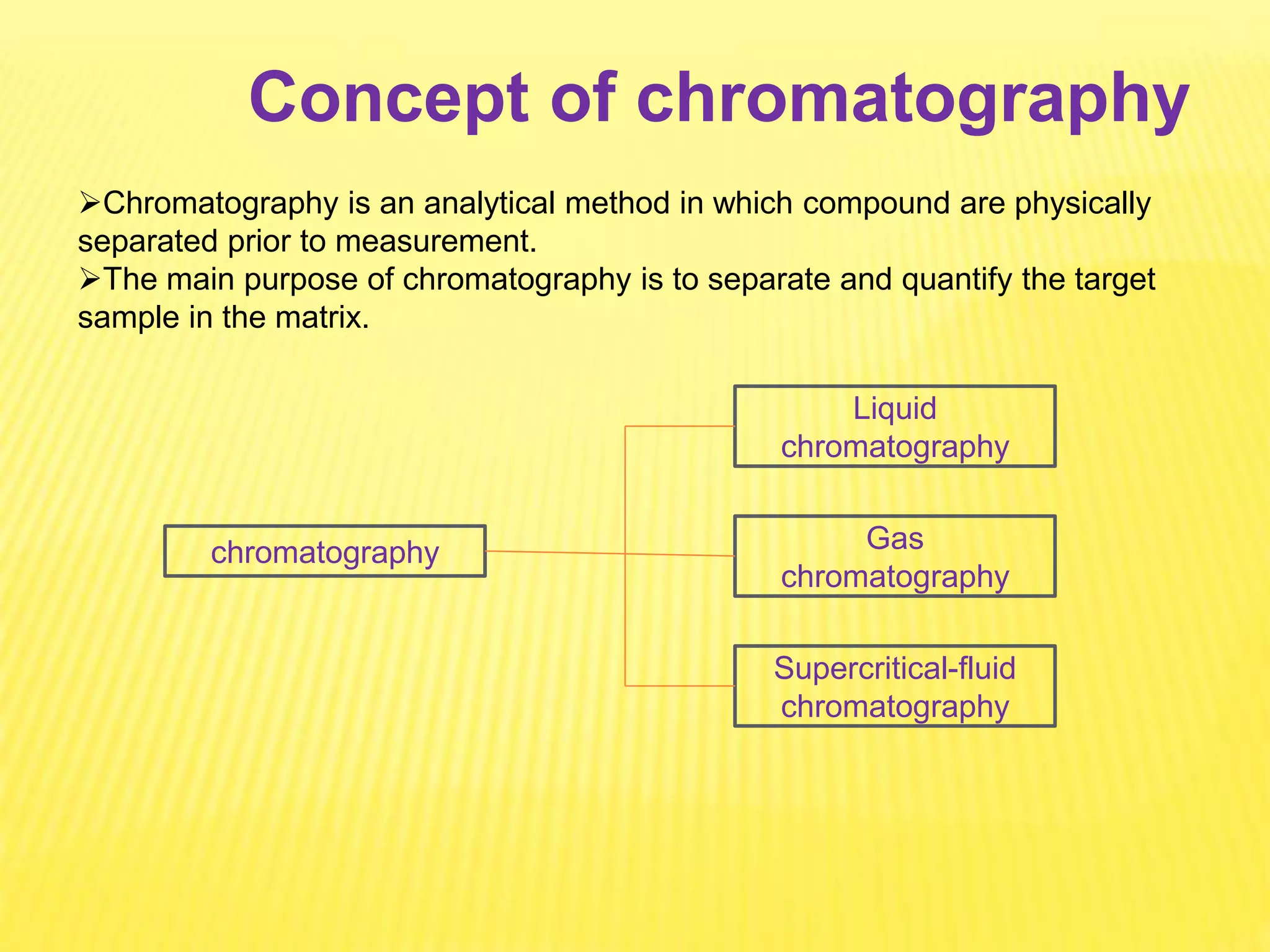
Concept of chromatography
Chromatographyis an analytical method in which compound are physically
separated prior to measurement.
The main purpose of chromatography is to separate and quantify the target
sample in the matrix.
chromatography
Liquid
chromatography
Gas
chromatography
Supercritical-fluid
chromatography
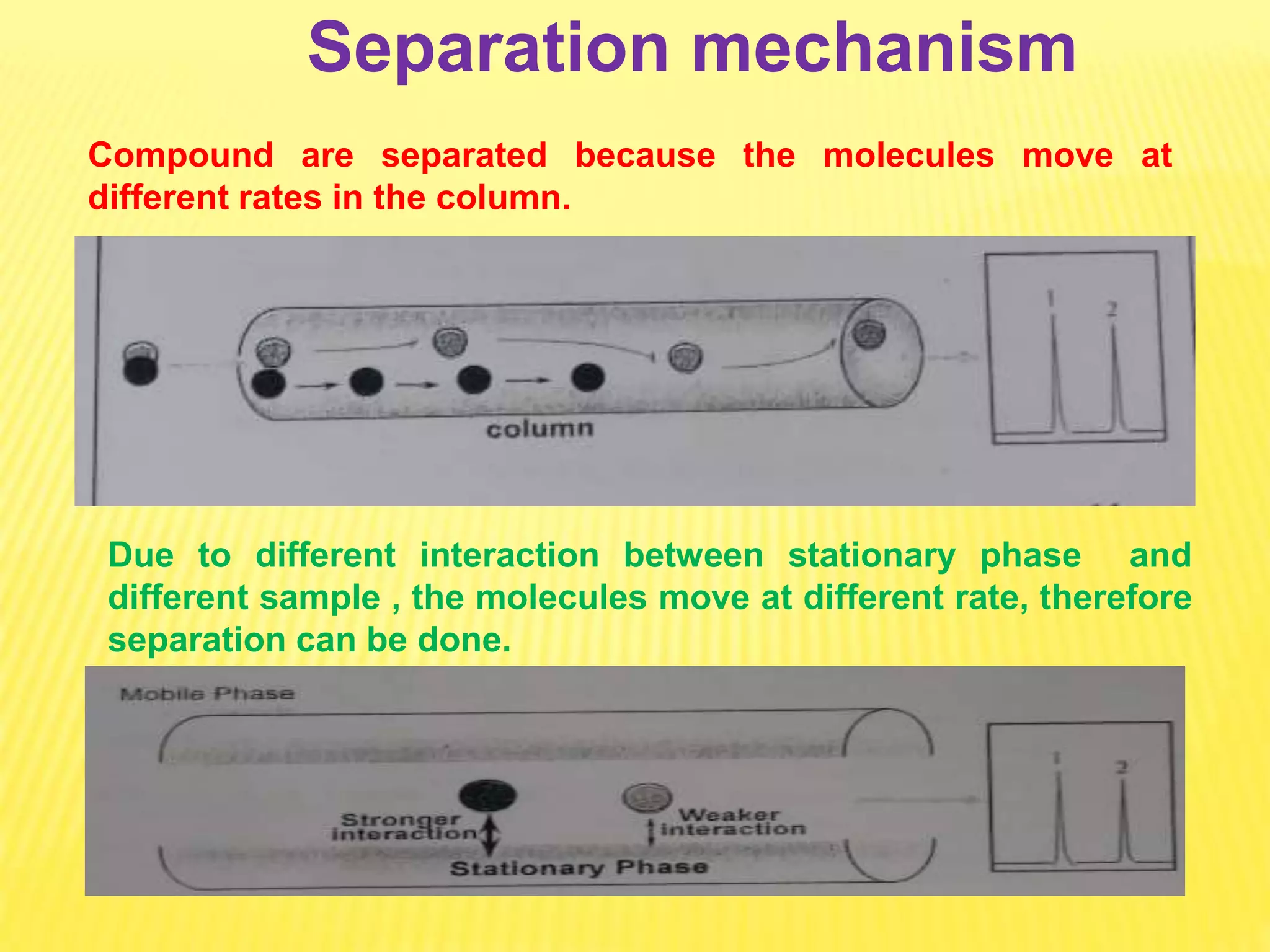
Separation mechanism
Compound areseparated because the molecules move at
different rates in the column.
Due to different interaction between stationary phase and
different sample , the molecules move at different rate, therefore
separation can be done.
Normal Phase chromatography
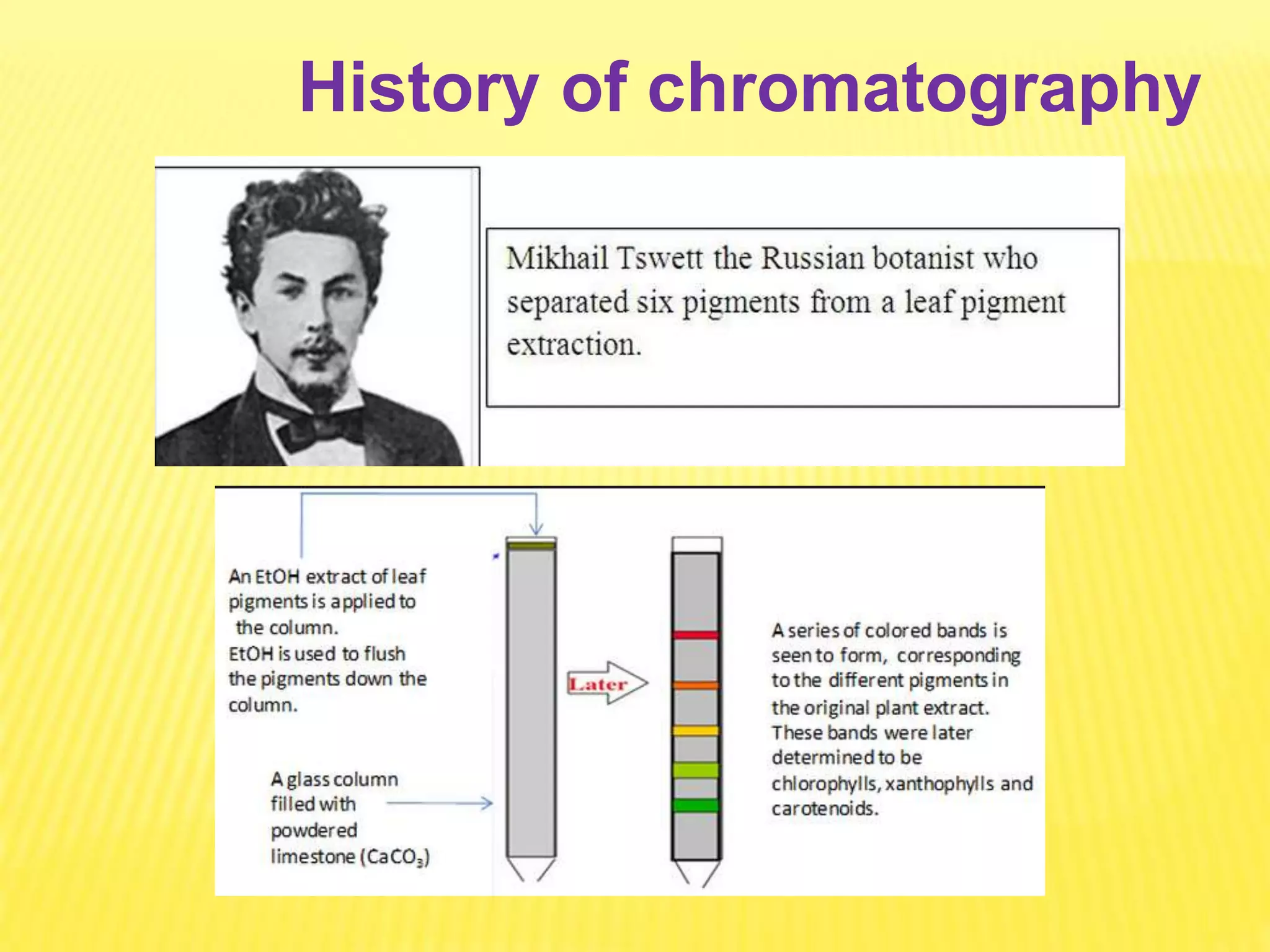
Firstdeveloper used
- CaCO3 as separation column
- Petroleum ether as solvent
Stationary phase: Polar property
Mobil phase: Non-polar property
This combination is defined as Normal phase
chromatography
12.
Normal Phase chromatography
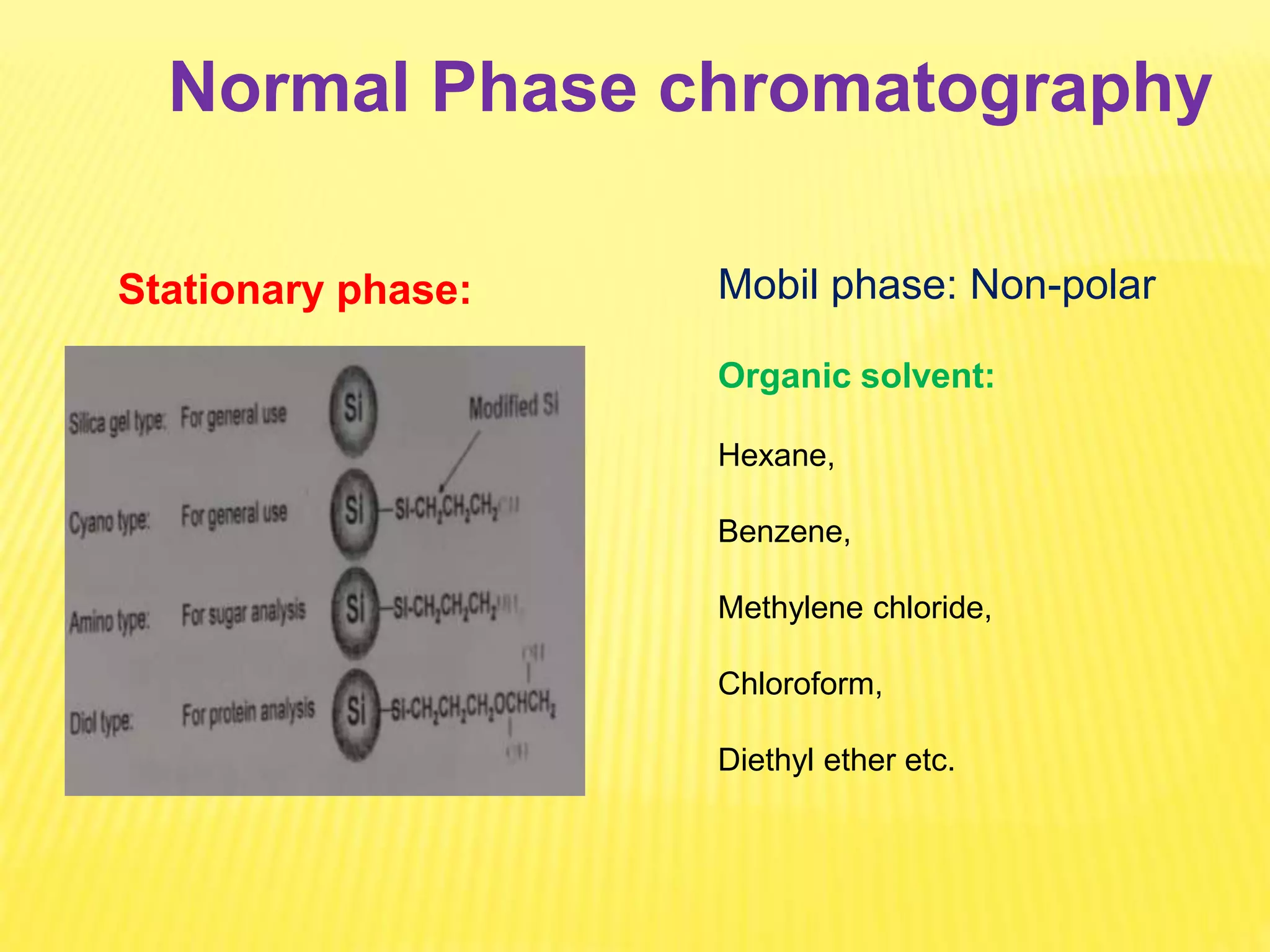
Mobilphase: Non-polar
Organic solvent:
Hexane,
Benzene,
Methylene chloride,
Chloroform,
Diethyl ether etc.
Stationary phase:
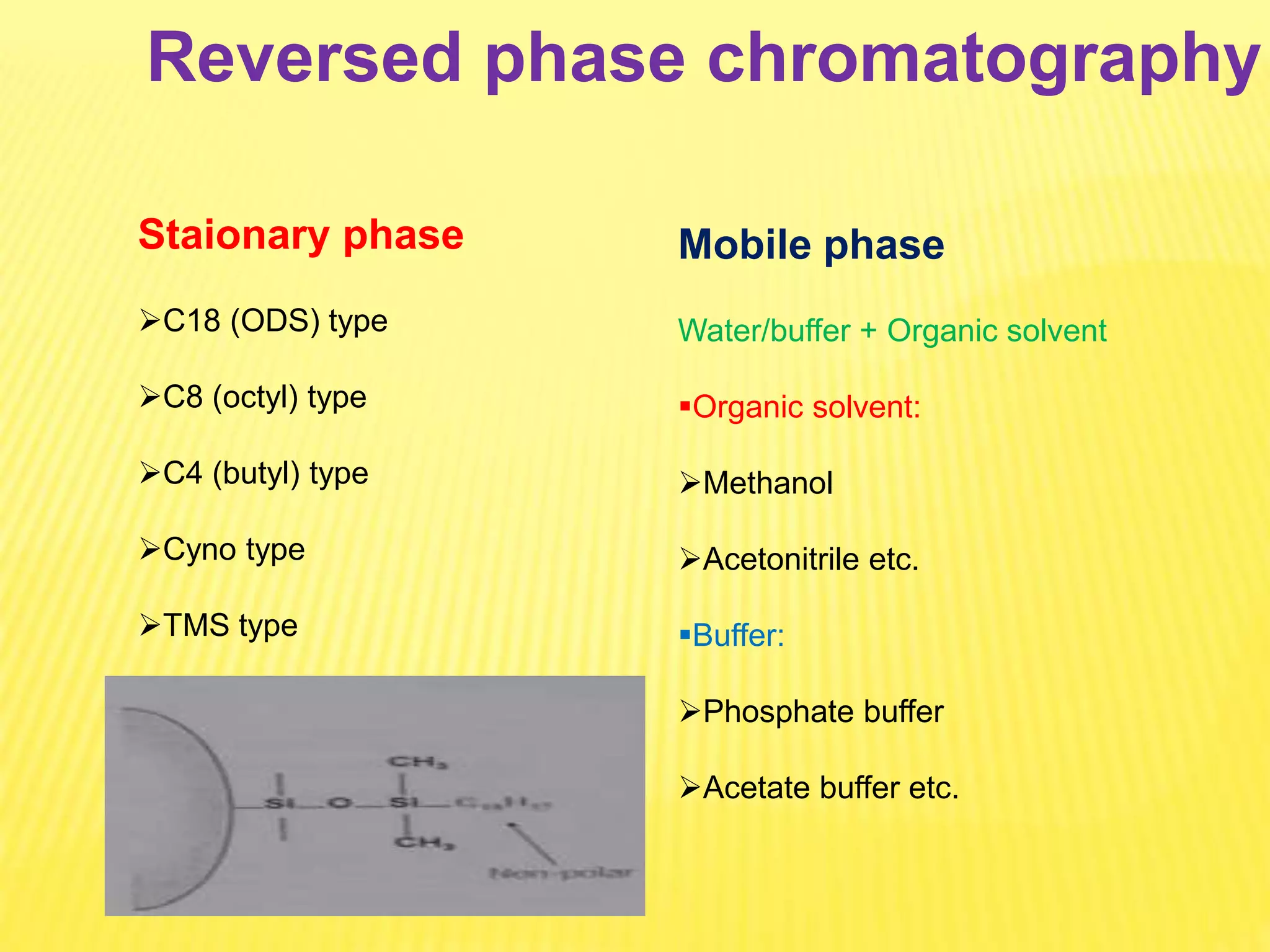
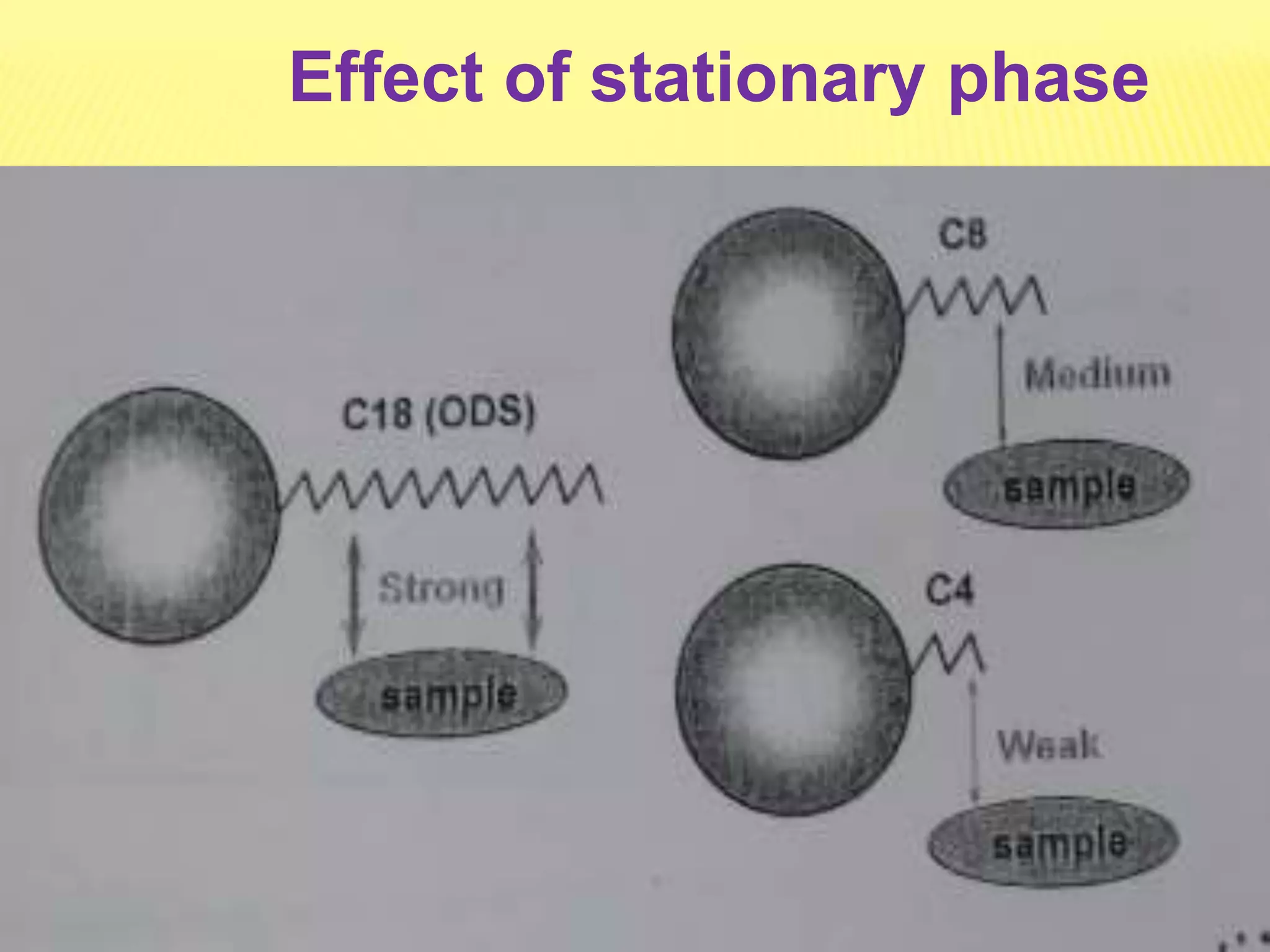
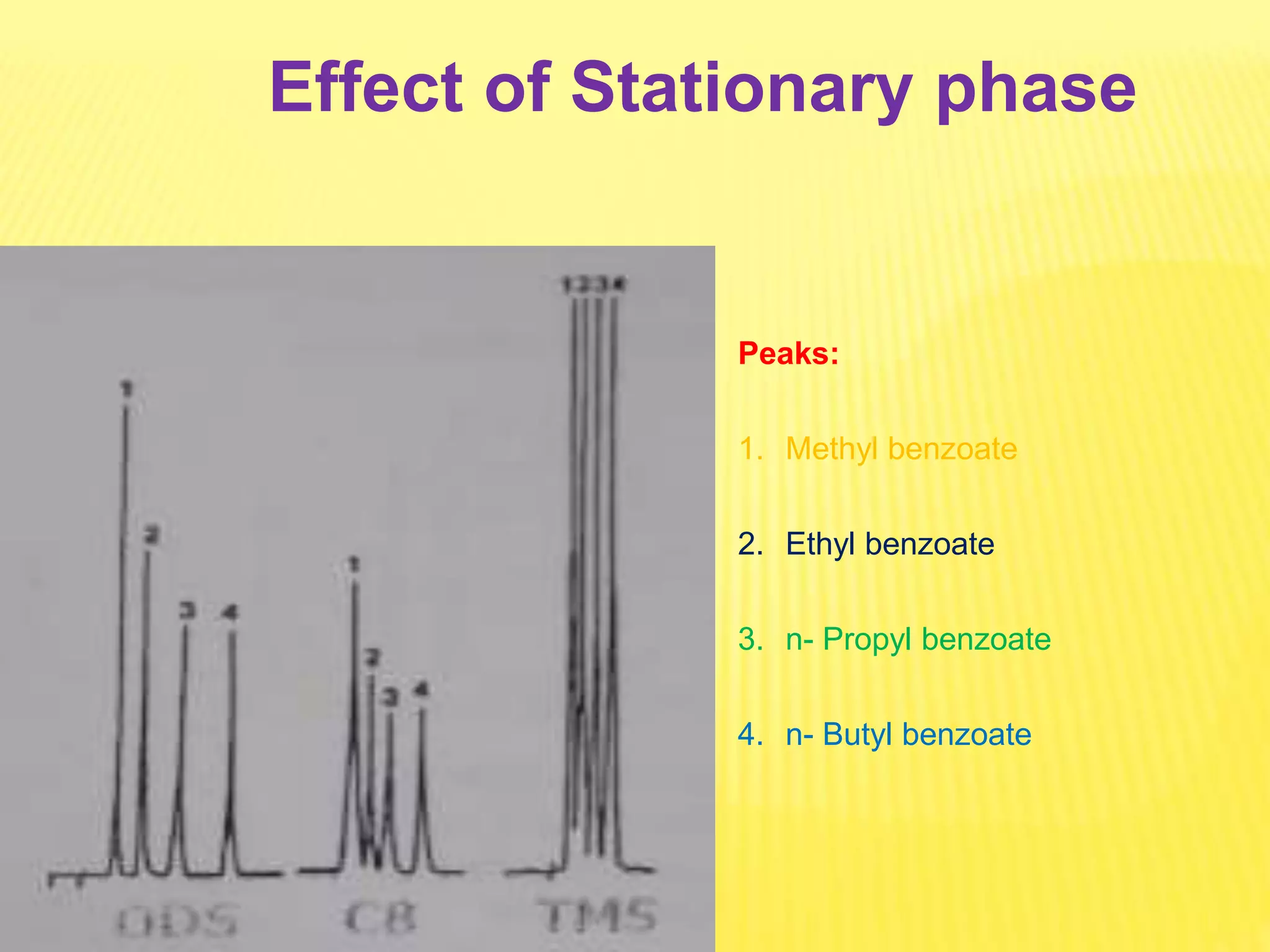
Staionary phase
C18 (ODS)type
C8 (octyl) type
C4 (butyl) type
Cyno type
TMS type
Mobile phase
Water/buffer + Organic solvent
Organic solvent:
Methanol
Acetonitrile etc.
Buffer:
Phosphate buffer
Acetate buffer etc.
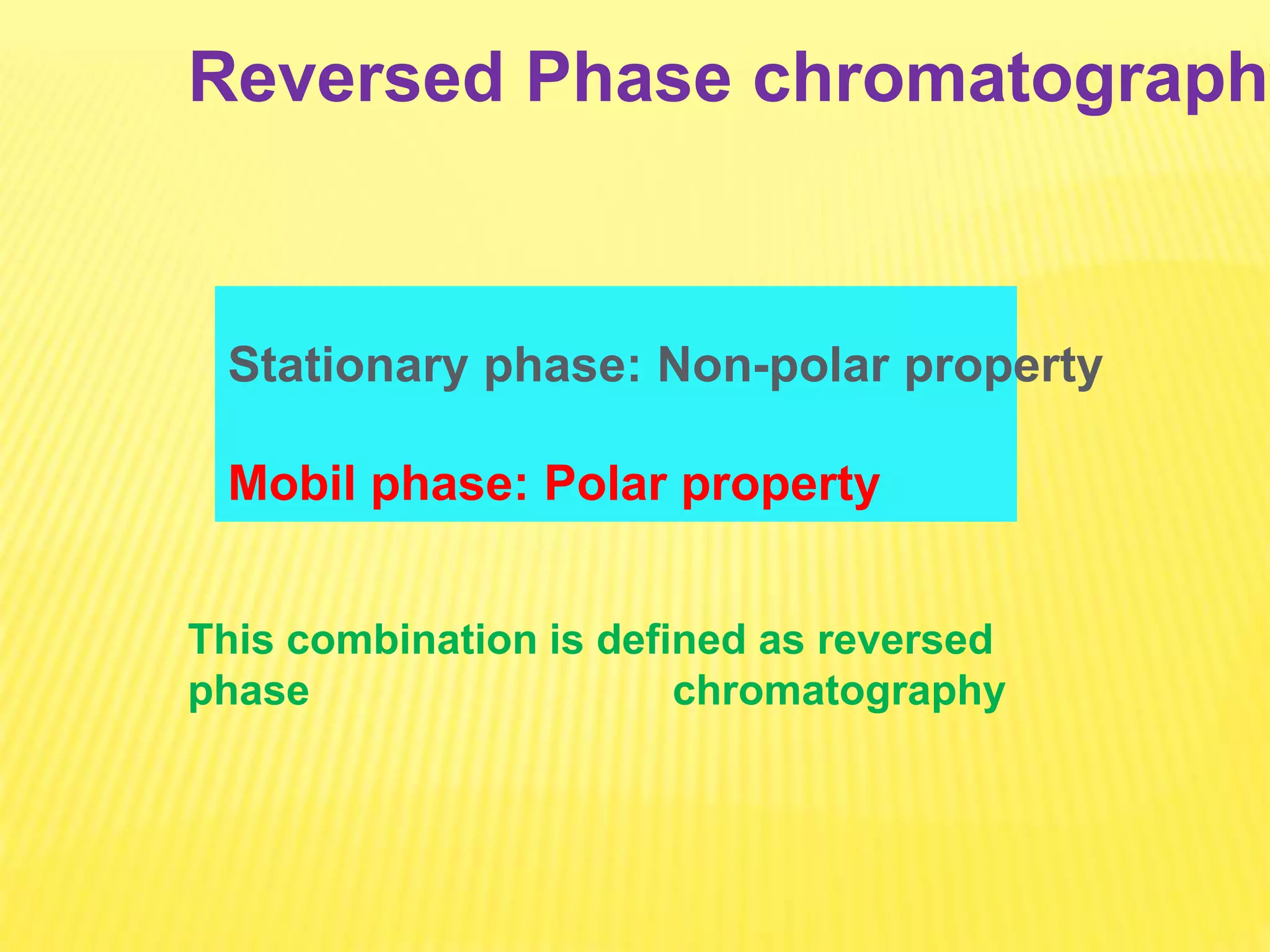
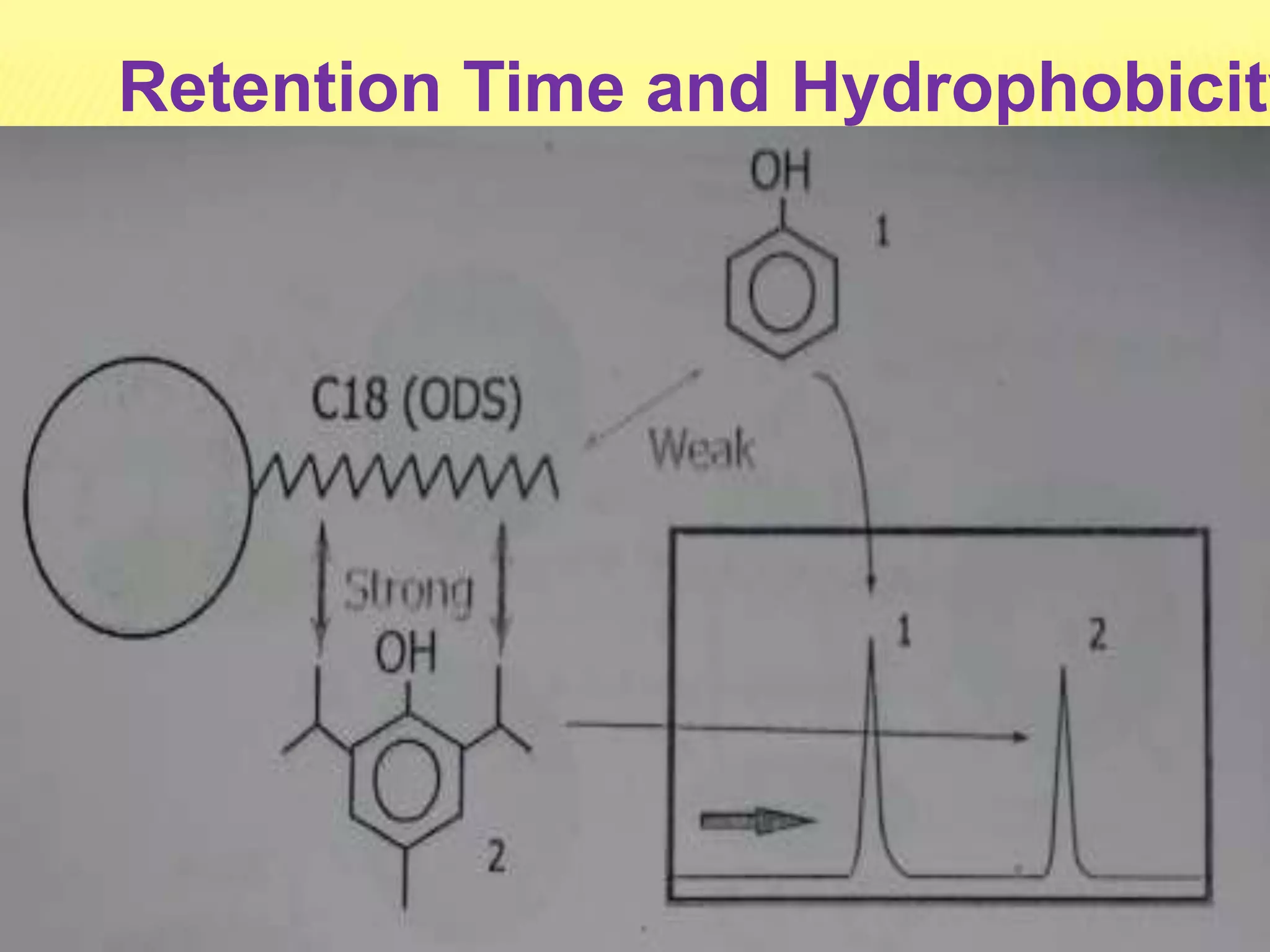
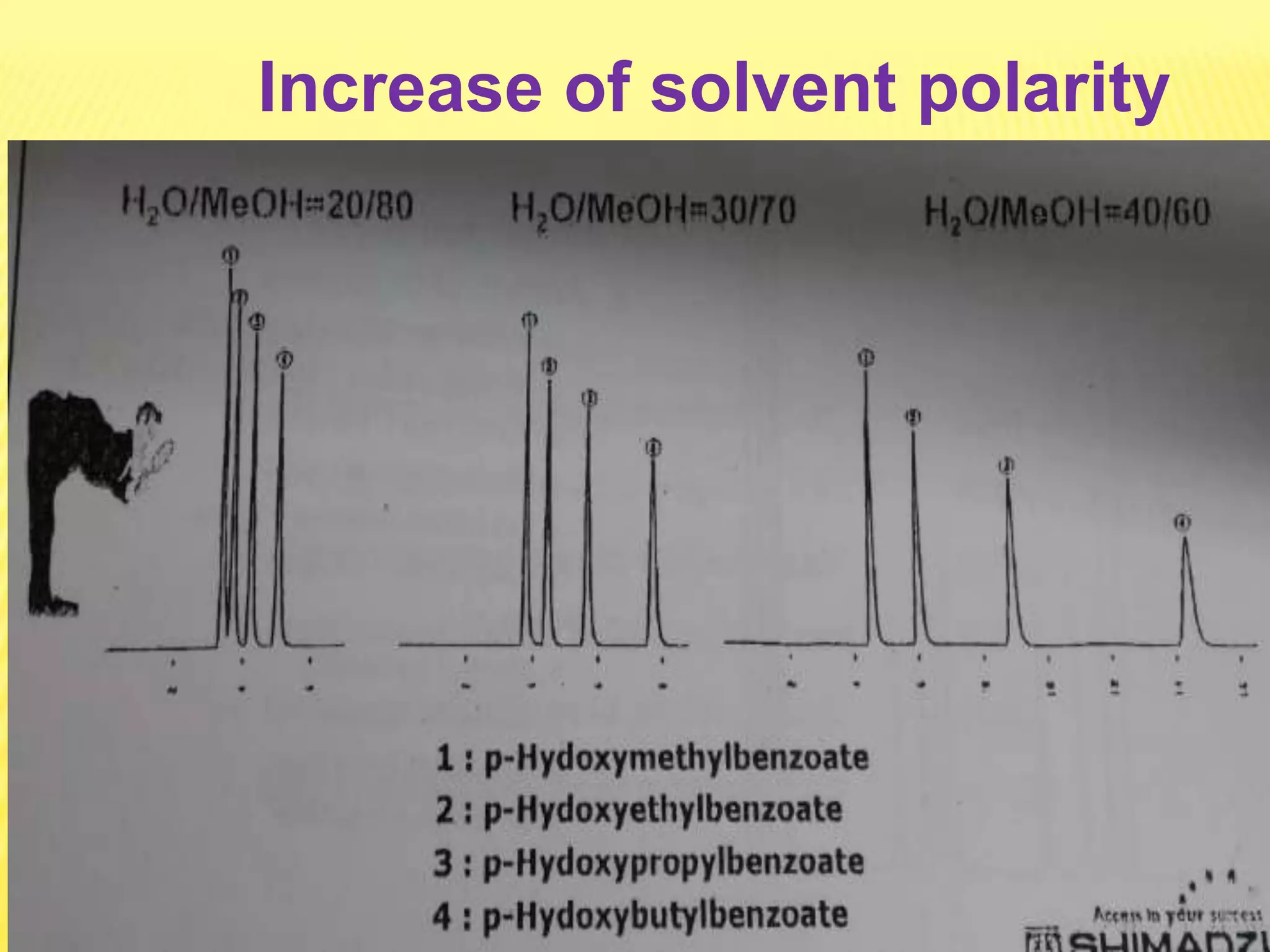
Reversed phase chromatography
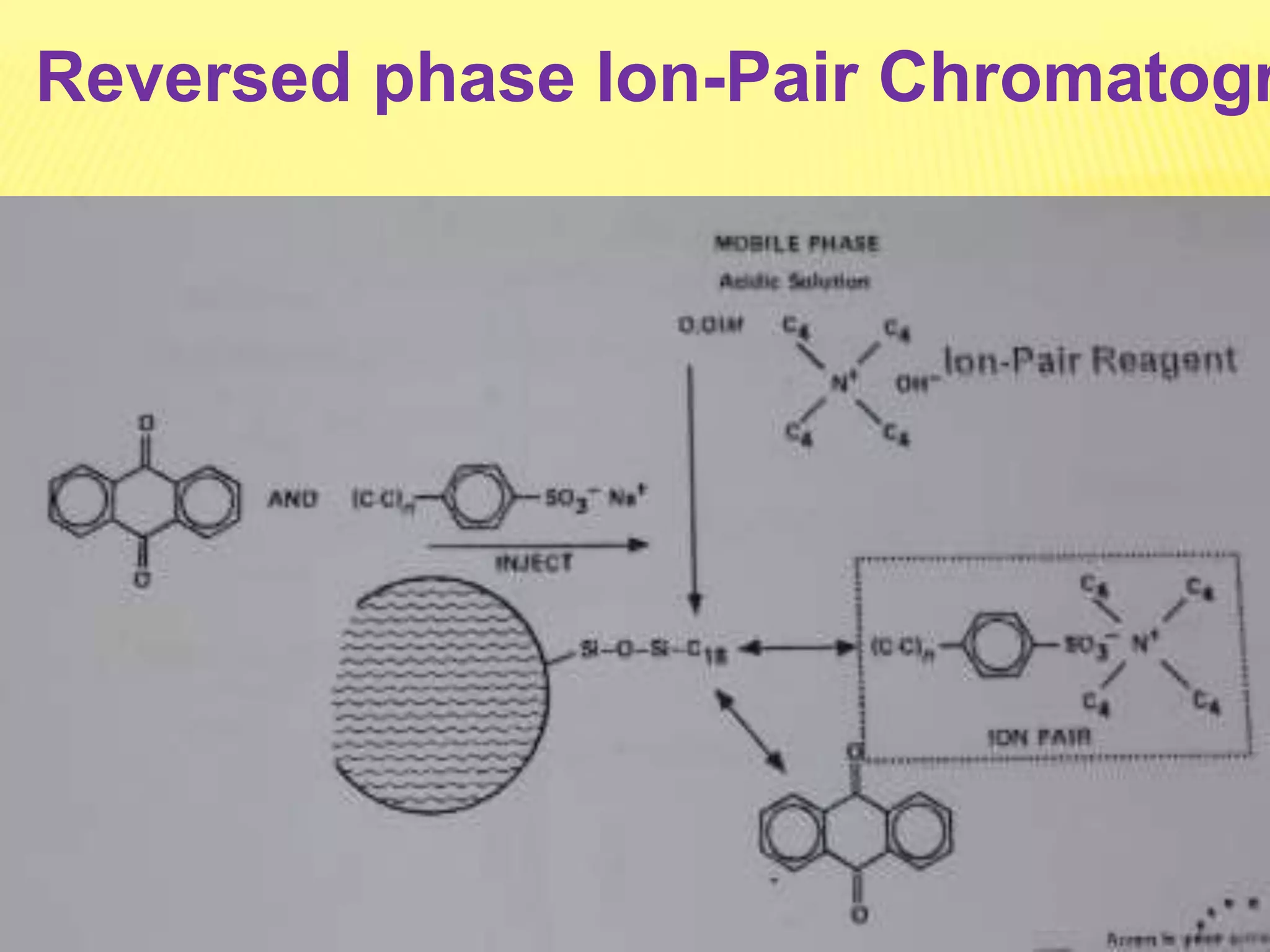
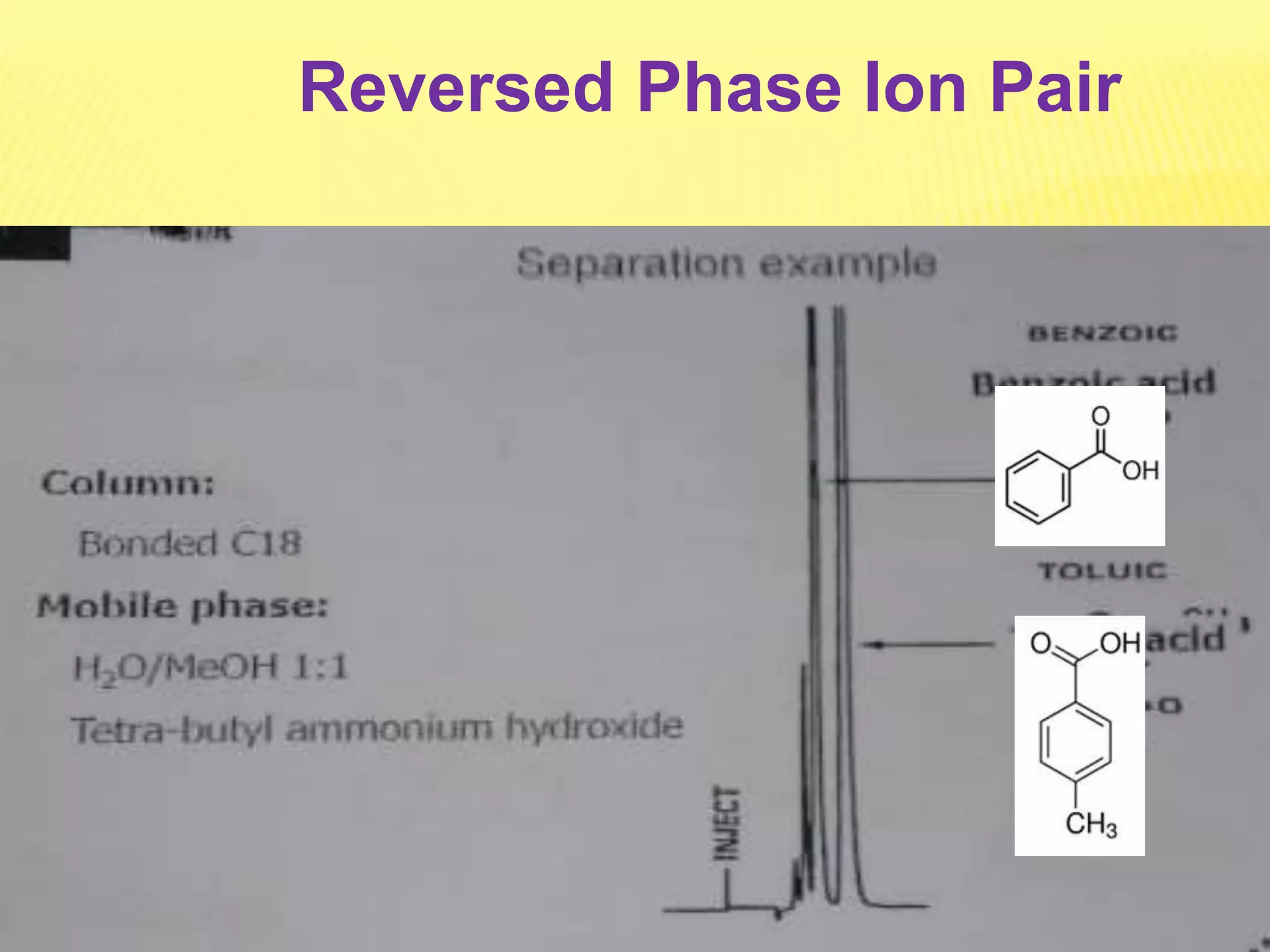
Reversed Phase IonPair
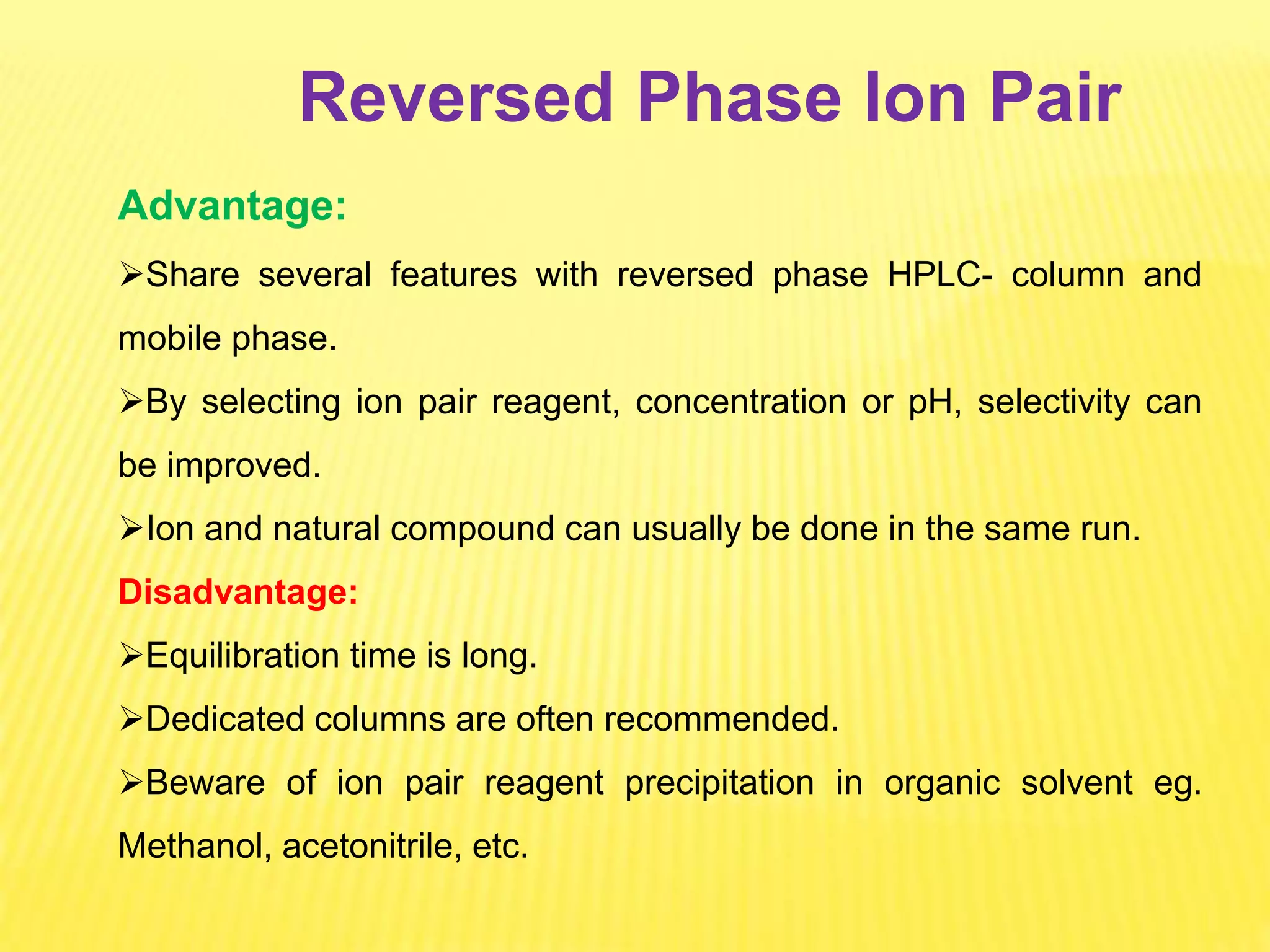
Advantage:
Share several features with reversed phase HPLC- column and
mobile phase.
By selecting ion pair reagent, concentration or pH, selectivity can
be improved.
Ion and natural compound can usually be done in the same run.
Disadvantage:
Equilibration time is long.
Dedicated columns are often recommended.
Beware of ion pair reagent precipitation in organic solvent eg.
Methanol, acetonitrile, etc.










![Understanding Parkinson’s Disease: Causes, Symptoms, and Treatment [2025]](https://cdn.slidesharecdn.com/ss_thumbnails/understandingparkinson-251208102525-80ba3223-thumbnail.jpg?width=640&height=640&fit=bounds)


