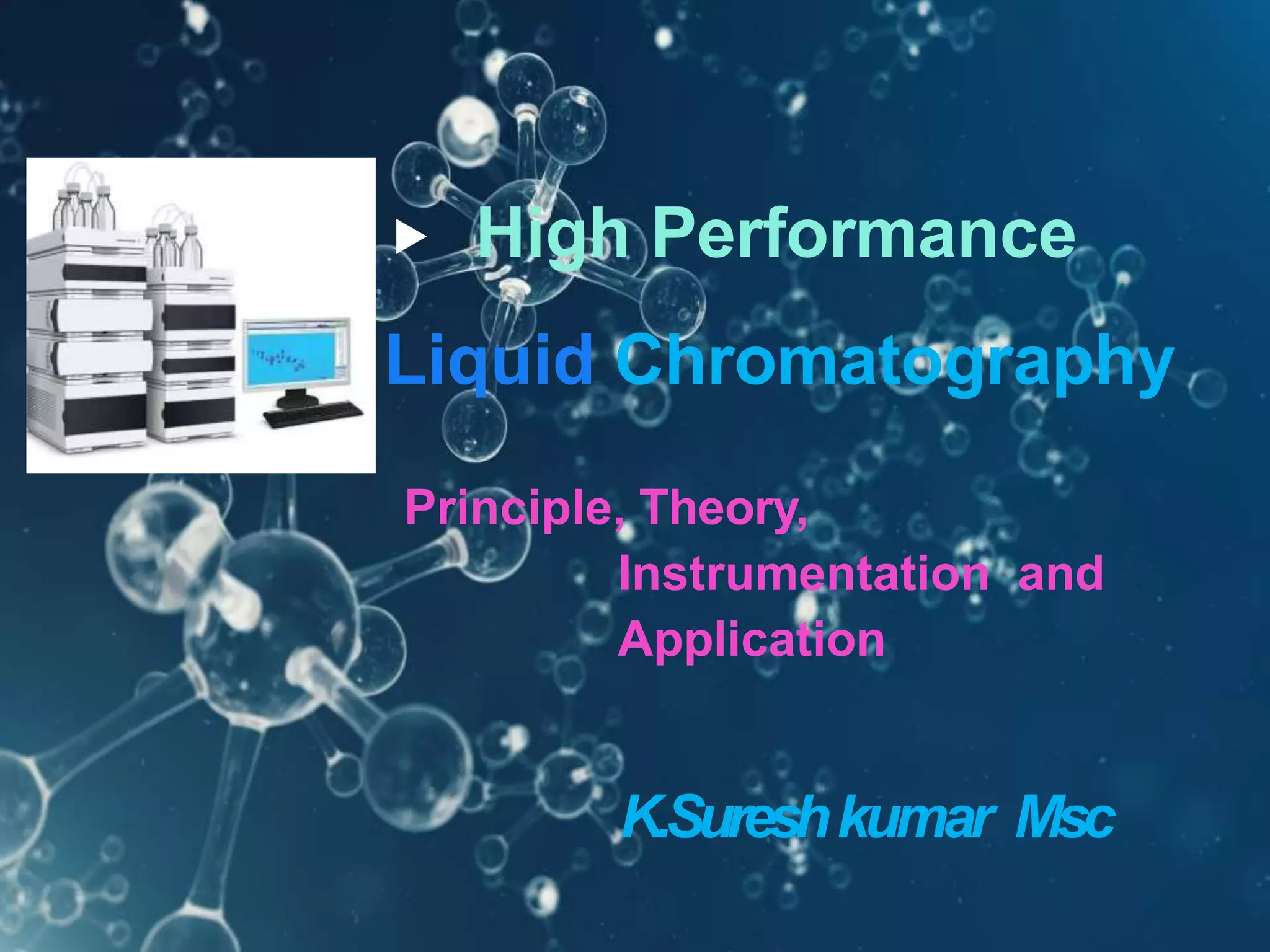
 High Performance
Liquid Chromatography
Principle, Theory,
Instrumentation and
Application
K.Sureshkumar Msc
AN OVERVIEW
• Introduction
• Chromatographic Separation
• Definitions
• HPLC Techniques
• Instrumentation & Types of detectors
• Qualification & Calibration
• Method Development – Basics
• Column Chemistry
• Applications, Specifically Pharmaceutical QC
WHAT IS CHROMATOGRAPHY?
• Chromatography is a separation technique used for Qualitative
and
Quantitative Analysis.
• Essential for testing of chemicals in an Industries & academics
• Technique developed in 1941 by Martin & Synge and were
awarded Nobel Prize in 1952 (partition chromatography)
• In 1951 first GC experiment was performed by Martin & James
• Horvath & Lipsky built the first high-pressure liquid
chromatograph. End of the 70’s improvised – High Performance
Liquid Chromatograph instruments become familiar.
• Pharmaceutical industry made HPLC the workhorse beginning
in the 1970s and become boom in 1980s
• Since 2006 advance models like UPLC, RRLC,UFLC, RSLC..
are available
CHROMATOGRAPHICSEPARATION
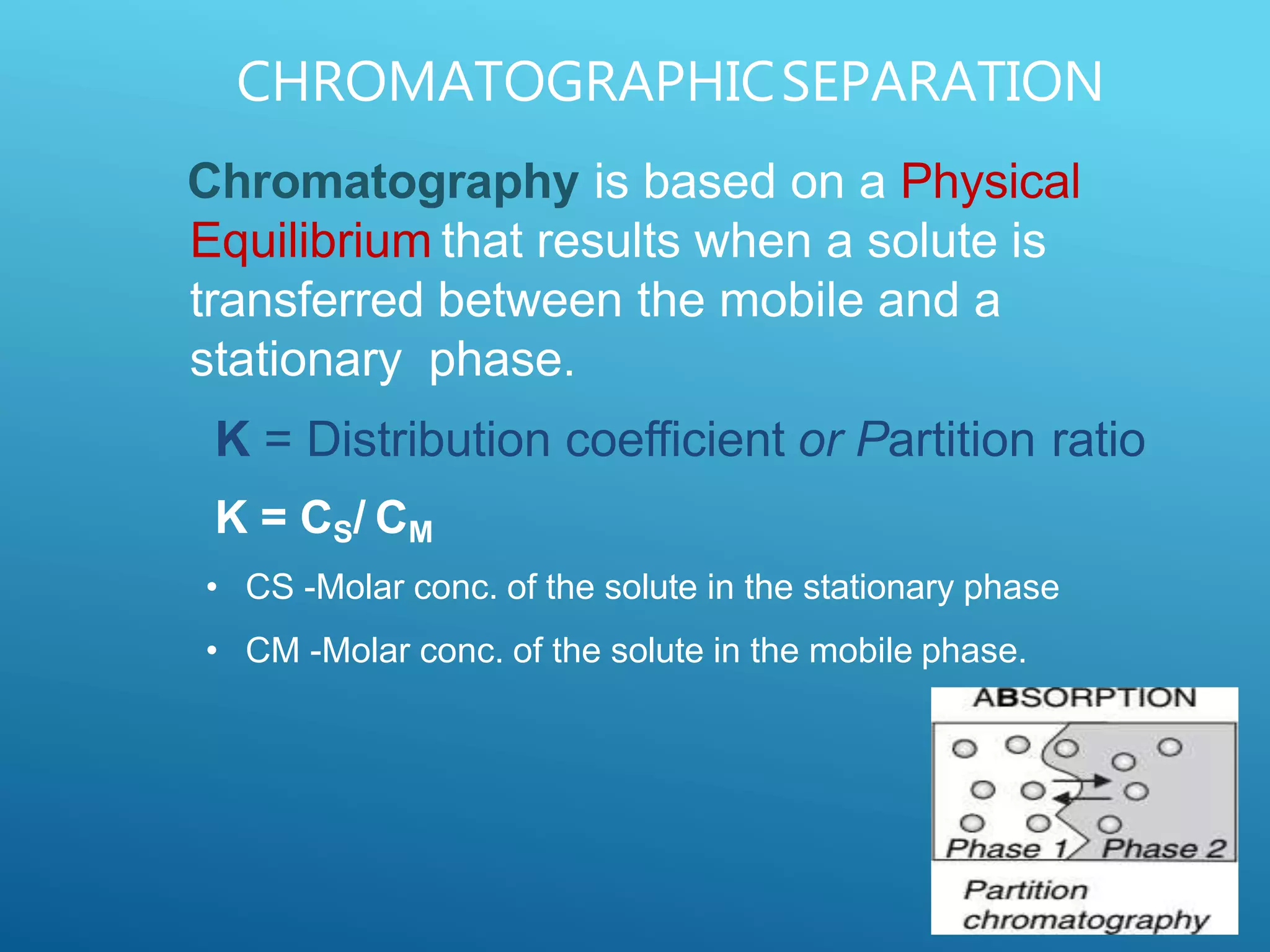
Chromatography is based on a Physical
Equilibrium that results when a solute is
transferred between the mobile and a
stationary phase.
K = Distribution coefficient or Partition ratio
K = CS/ CM
• CS -Molar conc. of the solute in the stationary phase
• CM -Molar conc. of the solute in the mobile phase.
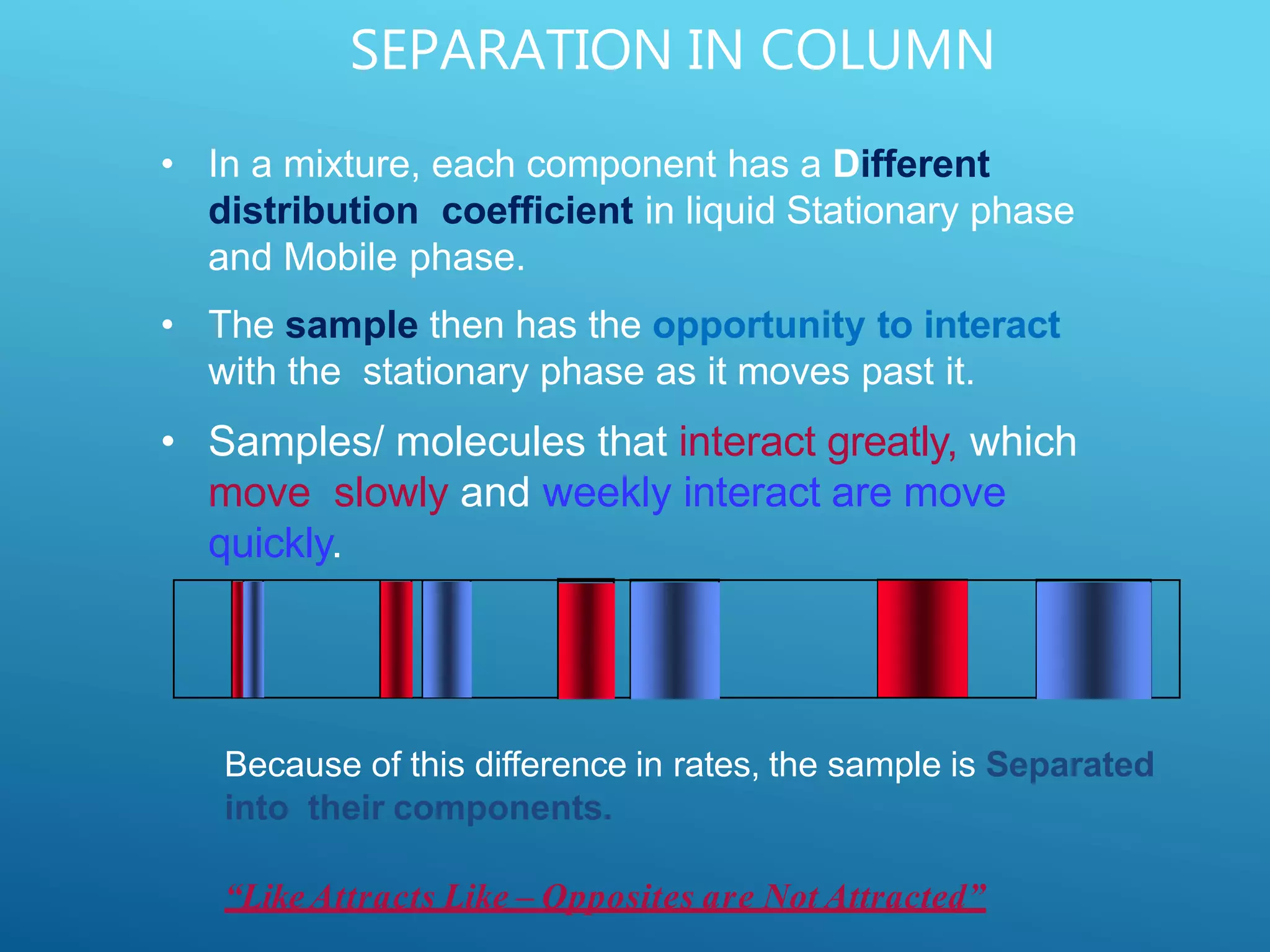
SEPARATION IN COLUMN
• In a mixture, each component has a Different
distribution coefficient in liquid Stationary phase
and Mobile phase.
• The sample then has the opportunity to interact
with the stationary phase as it moves past it.
• Samples/ molecules that interact greatly, which
move slowly and weekly interact are move
quickly.
Because of this difference in rates, the sample is Separated
into their components.
“Like Attracts Like – Opposites are Not Attracted”
DEFINITIONS
Gradient elution:
Continuously changing the solvent composition during the
chromatographic run is called gradient elution or solvent
programming.
Retention factor (k):1 Also known asthe “capacity factor
(k)”
k = time spent by substance in Stationary
phase time spent by substance in
mobile phase
k = (tR - tM) /tM
Hold-up time (tM): The time required for elution of an unretained
component Retention time (tR) ,
DEFINITIONS
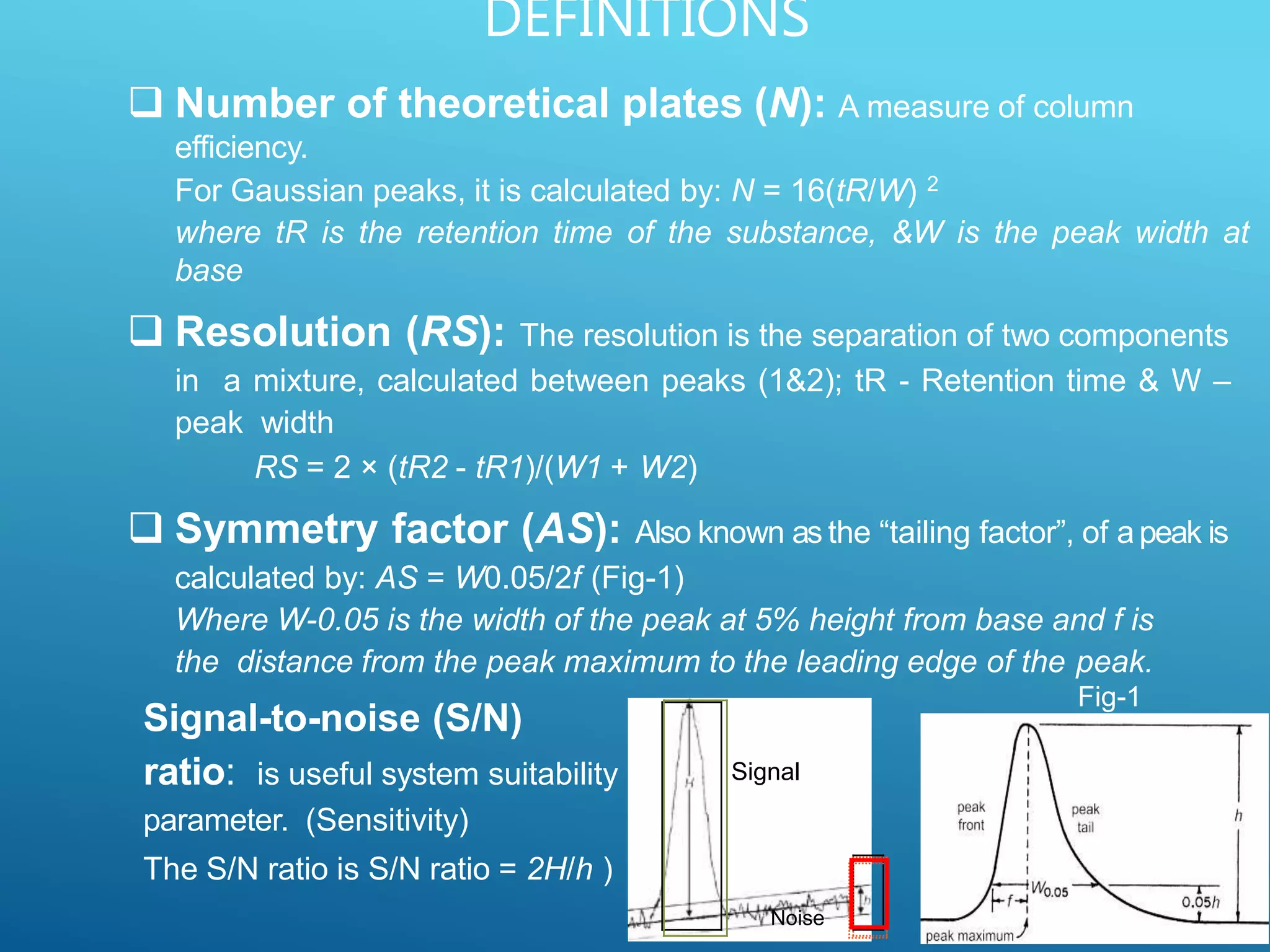
 Number of theoretical plates (N): A measure of column
efficiency.
For Gaussian peaks, it is calculated by: N = 16(tR/W) 2
where tR is the retention time of the substance, &W is the peak width at
base
 Resolution (RS): The resolution is the separation of two components
in a mixture, calculated between peaks (1&2); tR - Retention time & W –
peak width
RS = 2 × (tR2 - tR1)/(W1 + W2)
 Symmetry factor (AS): Also known as the “tailing factor”, of a peak is
calculated by: AS = W0.05/2f (Fig-1)
Where W-0.05 is the width of the peak at 5% height from base and f is
the distance from the peak maximum to the leading edge of the peak.
Fig-1
Signal-to-noise (S/N)
ratio: is useful system suitability
parameter. (Sensitivity)
The S/N ratio is S/N ratio = 2H/h )
Signal
Noise
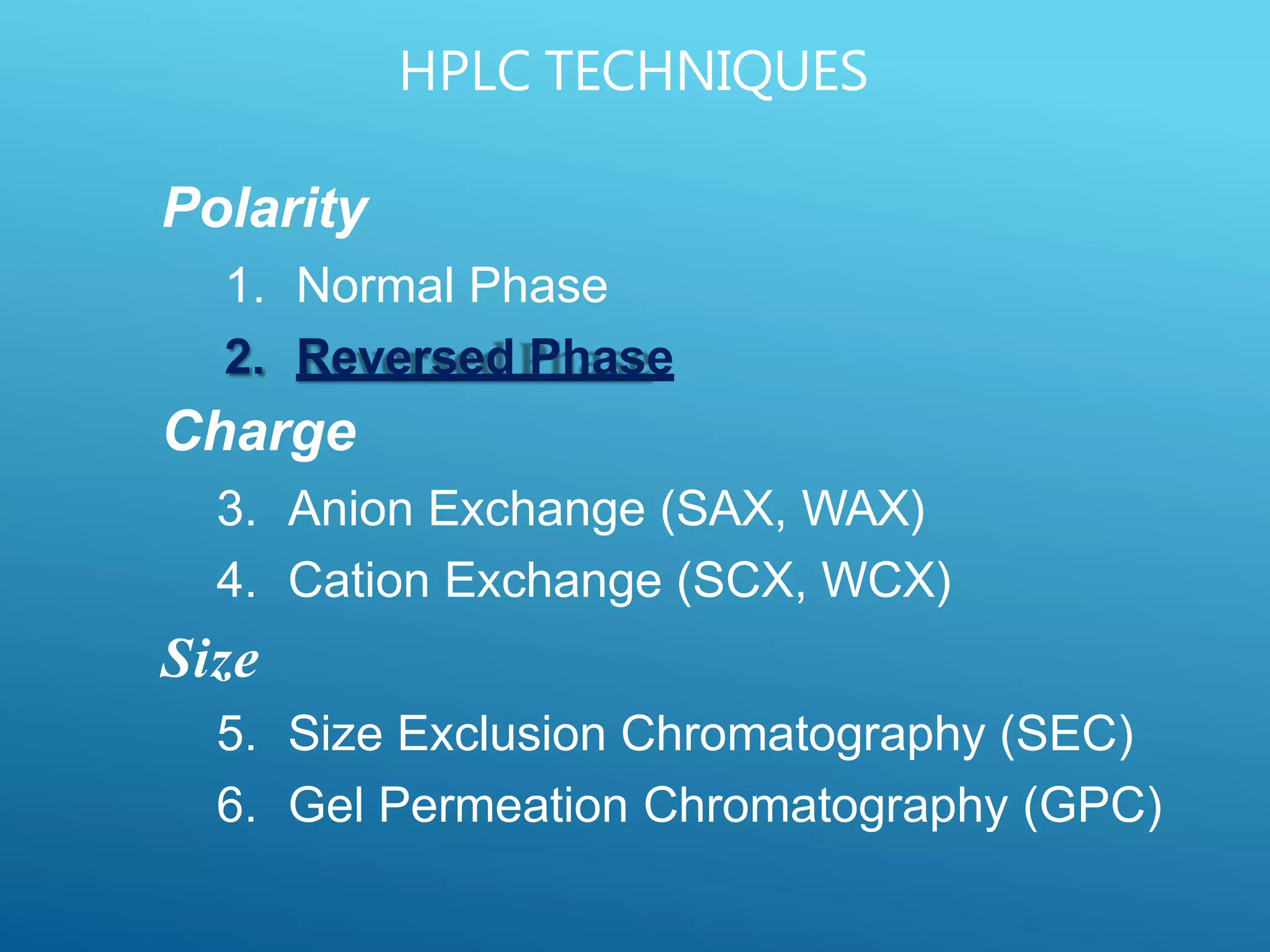
HPLC TECHNIQUES
Polarity
1. Normal Phase
2. Reversed Phase
Charge
3. Anion Exchange (SAX, WAX)
4. Cation Exchange (SCX, WCX)
Size
5. Size Exclusion Chromatography (SEC)
6. Gel Permeation Chromatography (GPC)
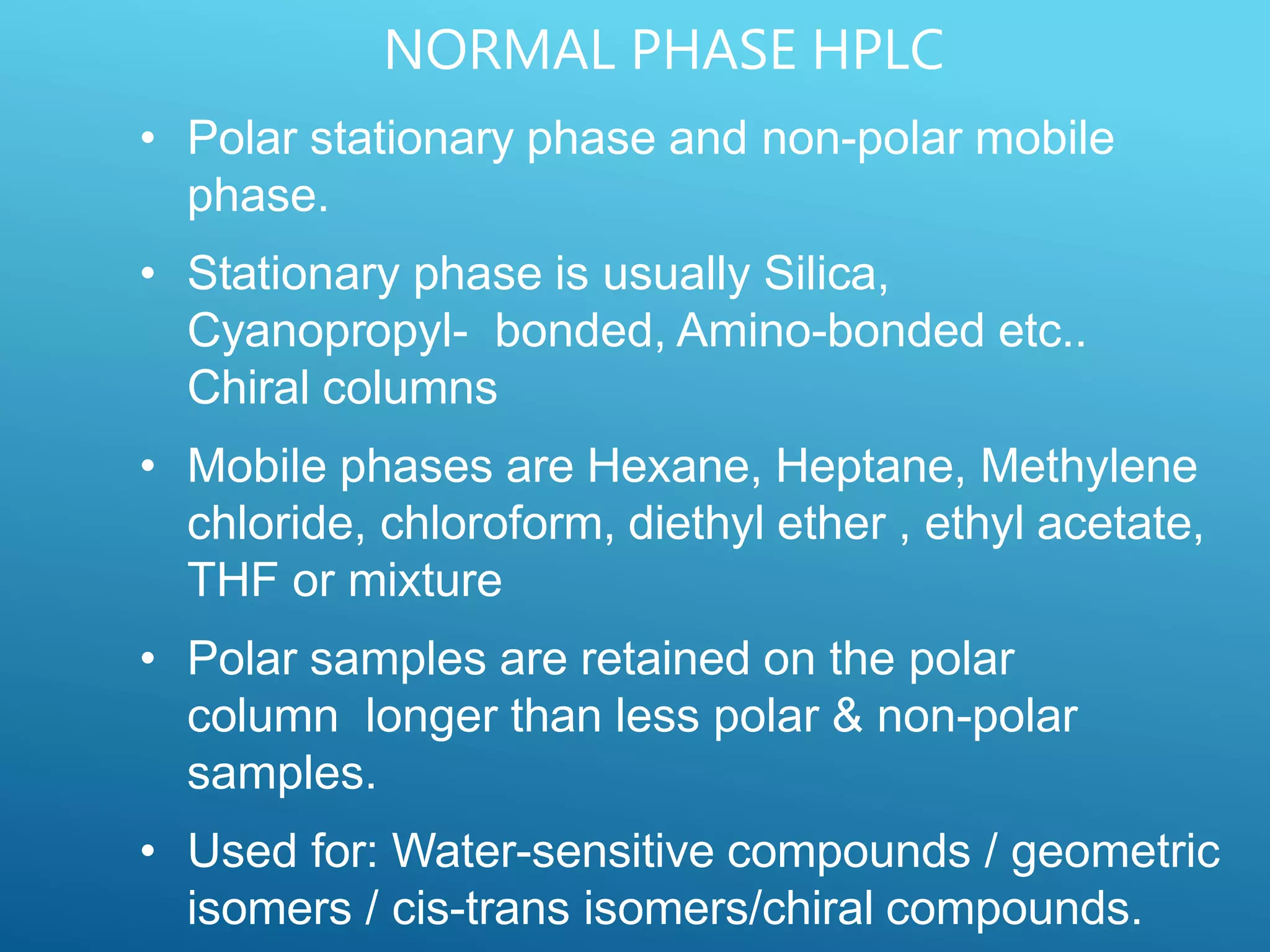
NORMAL PHASE HPLC
• Polar stationary phase and non-polar mobile
phase.
• Stationary phase is usually Silica,
Cyanopropyl- bonded, Amino-bonded etc..
Chiral columns
• Mobile phases are Hexane, Heptane, Methylene
chloride, chloroform, diethyl ether , ethyl acetate,
THF or mixture
• Polar samples are retained on the polar
column longer than less polar & non-polar
samples.
• Used for: Water-sensitive compounds / geometric
isomers / cis-trans isomers/chiral compounds.
REVERSE PHASE HPLC
• Reverse Phase is opposite to normal phase: Stationary phase
is nonpolar ( C-18 Hydrophobic) and Mobile phase is a polar
liquid; eg. mixtures of water and methanol or acetonitrile.
• Lowering the amount of organic solvent in the mobile phase
increases the retention time.
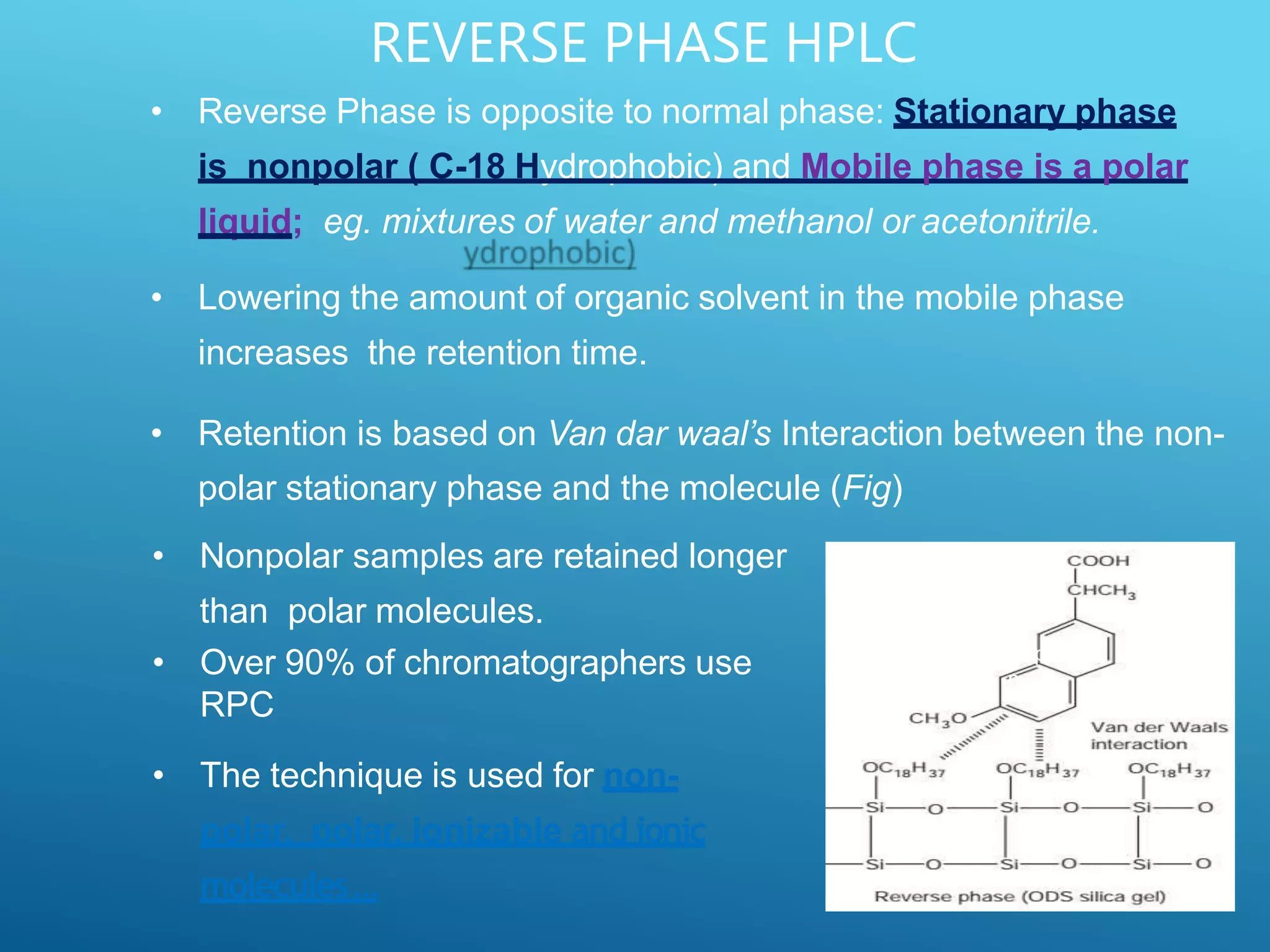
• Retention is based on Van dar waal’s Interaction between the non-
polar stationary phase and the molecule (Fig)
• Nonpolar samples are retained longer
than polar molecules.
• Over 90% of chromatographers use
RPC
• The technique is used for non-
polar, polar, ionizable and ionic
molecules…
Neproxe
n
SEPARATION AND POLARITY
• Chromatographic Retention Behavior
“Like Attracts Like – Opposites are Not Attracted”
• Polars attracted to other Polars
• Non-polars attracted to other non-polars
Polarity Compound Mobile
Phase-
Solvent
Coulmn
Polar Salts
Acids
Alcohol
s
Ketone
s
Ethers
Halogenated
compounds
Aliphatic
hydrocabons
Water Diol
Alcohols Amine
Acetonitrile Silica
Ethylacetate Cyano
THF Phenyl
Dichloromethane C8 (Octyl)
Non-
Polar
Toluene
Hexane
C18
(Octadecyl)
ION-PAIR CHROMATOGRAPHY
• Ion-pair chromatography is a subset of reversed-phase
chromatography. Used for separation of complex mixtures of
very polar and ionic molecules.
• Organic salt containing a large organic counter-ion, such as a
quaternary ammonium ion or alkyl sulfonate is added to the
mobile phase as an ion-pairing reagent. Eg. Heptane or Octyl
sulfonic acid (for base) Tetrabutyl ammonium Hydroxide,
certrimide (for acid)
• Ion-pairing reagents having a charge opposite to the analyte of
interest as well as a substantial hydrophobic region that allows
interaction with the stationary phase, plus associated counter-
ions.
• This counter ion forms an uncharged ion pair with a solute ion of
opposite charge in the mobile phase. This ion pair then partitions
into the nonpolar stationary phase giving differential retention of
solutes based on the affinity of the ion pair for the two phases.
ION-PAIR CHROMATOGRAPHY
Advantage of Ion-pair chromatography : Reduced separation
times; Highly reproducible results; Sharper peak shapes;
Simultaneous separation of ionized and non-ionized analytes;
and Wide choice of additives to improve separation
Example for Ion-pairing reagent (IPR) and interaction with molecule
Anionic ion-pairing agent:
Adrenaline with an ion-pairing agent
in ODS column.
0.1 M sodium phosphate
buffer/methanol 9:1 containing 0.02 %
sodium octanesulphonic acid (IPR)
Cationic ion-pairing agent :
Ascorbic acid
with anion-pairing agent in ODS
column.
0.1 M sodium acetate buffer pH
4.2, Acetonitrile 95:5 containing
0.03 M cetrimide (IPR)
ION-EXCHANGE HPLC
• The stationary phase is Ionically charged
functional groups on polymer
• The mobile phase is an aqueous buffer, where
both pH and ionic strength are used to control
elution time.
• The mobile phase is an aqueous buffer (e.g.
phosphate, formate, etc.).
• Opposite charge of the sample ions are attracted
and elutes later.
• This technique is used almost exclusively with
ionic or ionizable samples.
ION-EXCHANGE MECHANISM
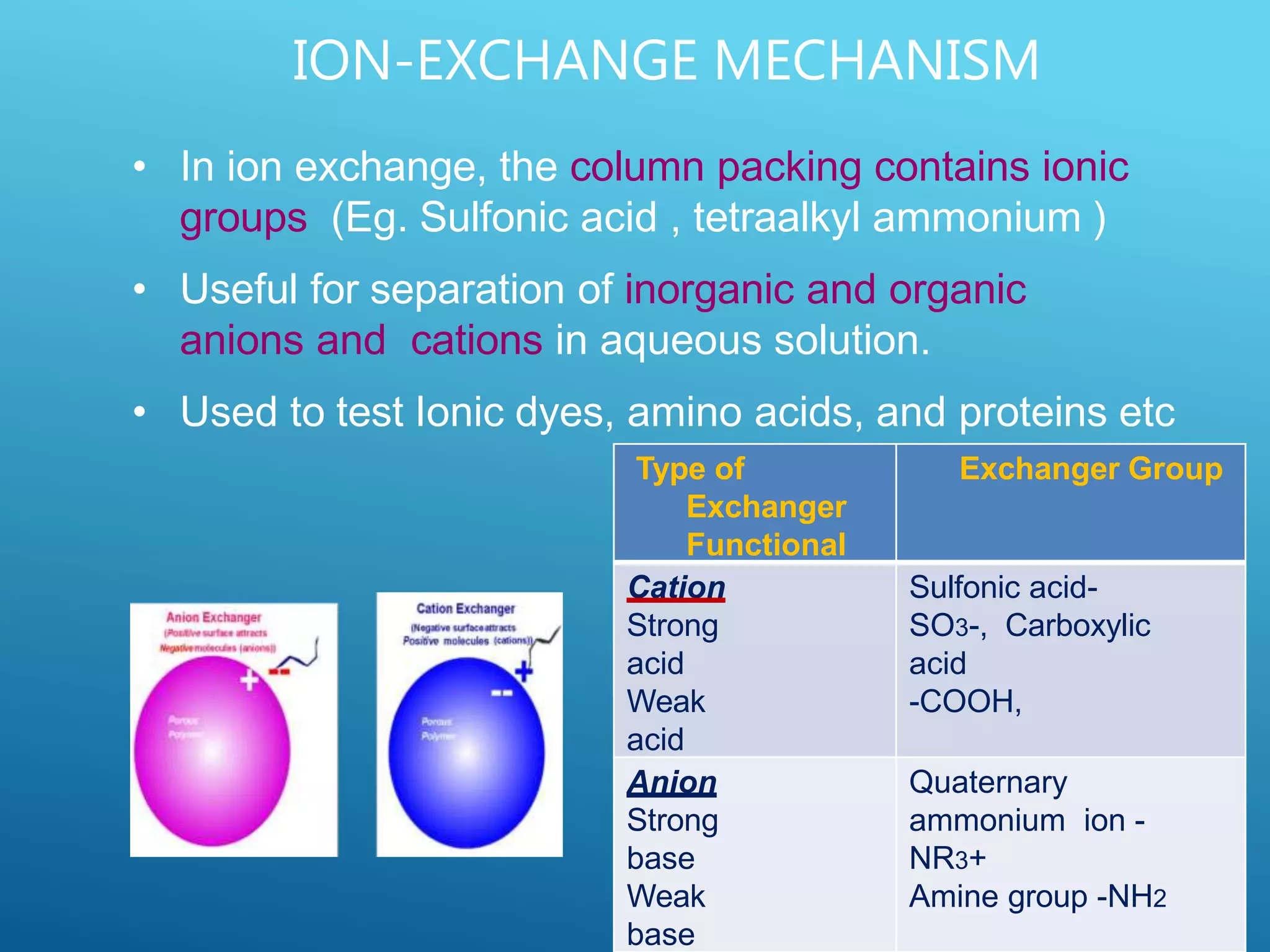
• In ion exchange, the column packing contains ionic
groups (Eg. Sulfonic acid , tetraalkyl ammonium )
• Useful for separation of inorganic and organic
anions and cations in aqueous solution.
• Used to test Ionic dyes, amino acids, and proteins etc
Type of
Exchanger
Functional
Exchanger Group
Cation
Strong
acid
Weak
acid
Sulfonic acid-
SO3-, Carboxylic
acid
-COOH,
Anion
Strong
base
Weak
base
Quaternary
ammonium ion -
NR3+
Amine group -NH2
SIZE EXCLUSION HPLC
• No interaction between the sample compounds and
the column.
• The column is filled with material having
precisely controlled pore sizes.
• Molecule /particles are separated according to its
their molecular size.
• Molecules larger than the pore opening do not
diffuse into the particles, while molecules smaller
than the pore opening enter the particle and are
separated.
• Large molecules elute first. Smaller molecules elute
later.
• Mainly for polymer characterization and for proteins.
SEC RETENTION MECHANISM
Molecular Size in solution
• Analytes are dissolved in solution, injected into mobile
phase
•Analytes are separated by their size once they are in
solution There are two modes:
• Non-aqueous SEC [Gel Permeation Chromatography
(GPC)]
– Used in polymer separations
• Aqueous SEC [Gel Filtration Chromatography (GFC)].
– Used in biomolecule separations.
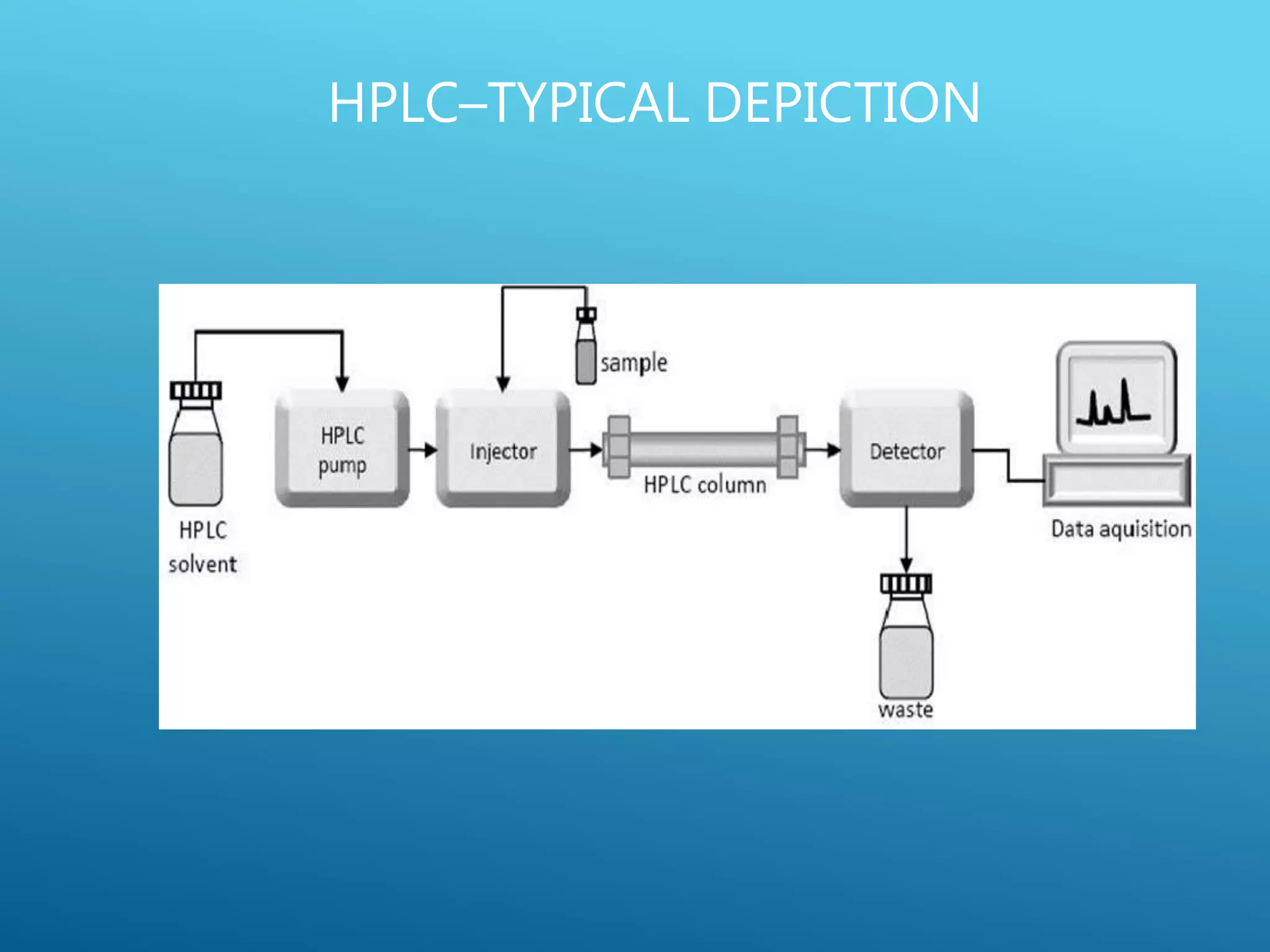
HPLC INSTRUMENTATION
HPLC consists:
1. Reservoir containing the mobile phase,
2. Pump to force the mobile phase through
the system at high pressure,
3. Injector to introduce the sample into the
mobile phase
4. Chromatographic column,
5. Detector
6. Data collection device.
HPLC–TYPICAL DEPICTION
HPLC : PUMP
• The role of the pump is to force the mobile phase at a specific
flow rate, (mL/min).
• Normal flow rates in HPLC are in the 1- to 2-mL/min range.
• Typical pumps can reach pressures in the range of 400 to 600
bar.
• During the chromatographic experiment, a pump can deliver a
constant mobile phase composition (isocratic) or an increasing
mobile phase composition (gradient).
• Quaternary pump (low pressure) and binary pump (high
pressure) are available.
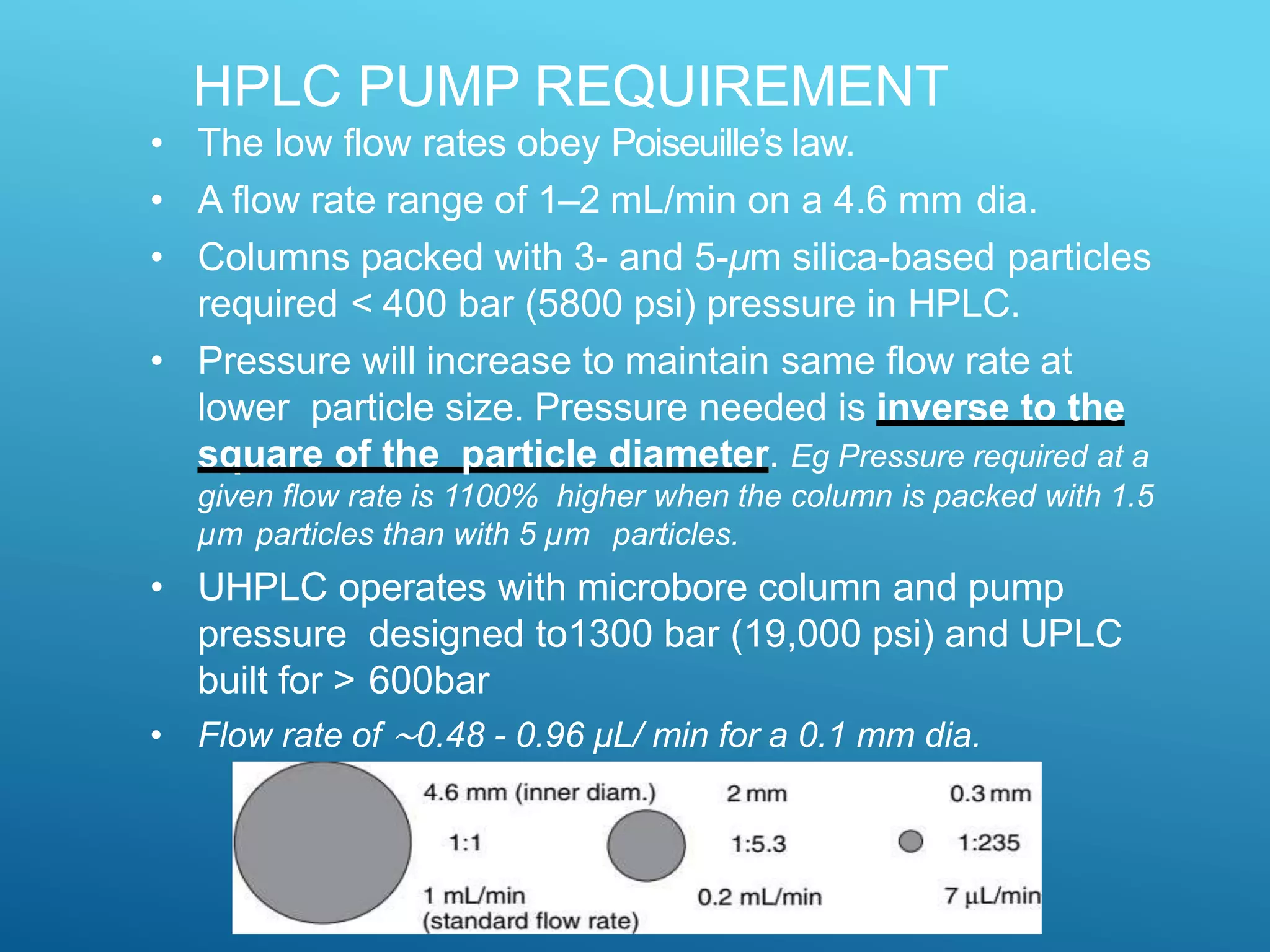
• A flow rate range of 1–2 mL/min on a 4.6 mm dia. column
will translate to a flow rate of ∼0.48 - 0.96 μL/ min for a 0.1 mm
dia.
HPLC PUMP REQUIREMENT
• The low flow rates obey Poiseuille’s law.
• A flow rate range of 1–2 mL/min on a 4.6 mm dia.
• Columns packed with 3- and 5-μm silica-based particles
required < 400 bar (5800 psi) pressure in HPLC.
• Pressure will increase to maintain same flow rate at
lower particle size. Pressure needed is inverse to the
square of the particle diameter. Eg Pressure required at a
given flow rate is 1100% higher when the column is packed with 1.5
μm particles than with 5 μm particles.
• UHPLC operates with microbore column and pump
pressure designed to1300 bar (19,000 psi) and UPLC
built for > 600bar
• Flow rate of ∼0.48 - 0.96 μL/ min for a 0.1 mm dia.
MOBILE PHASE ELUTION
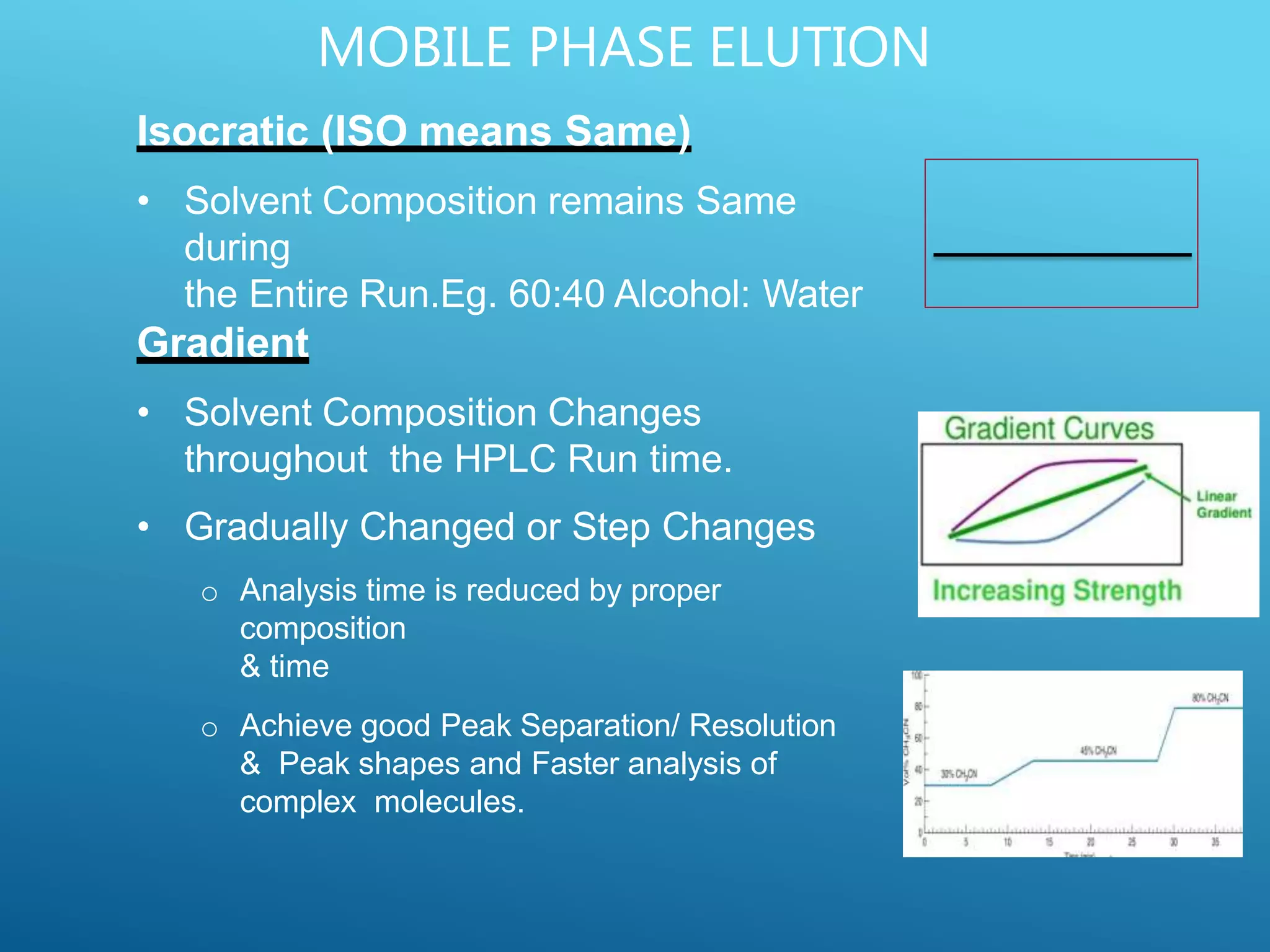
Isocratic (ISO means Same)
• Solvent Composition remains Same
during
the Entire Run.Eg. 60:40 Alcohol: Water
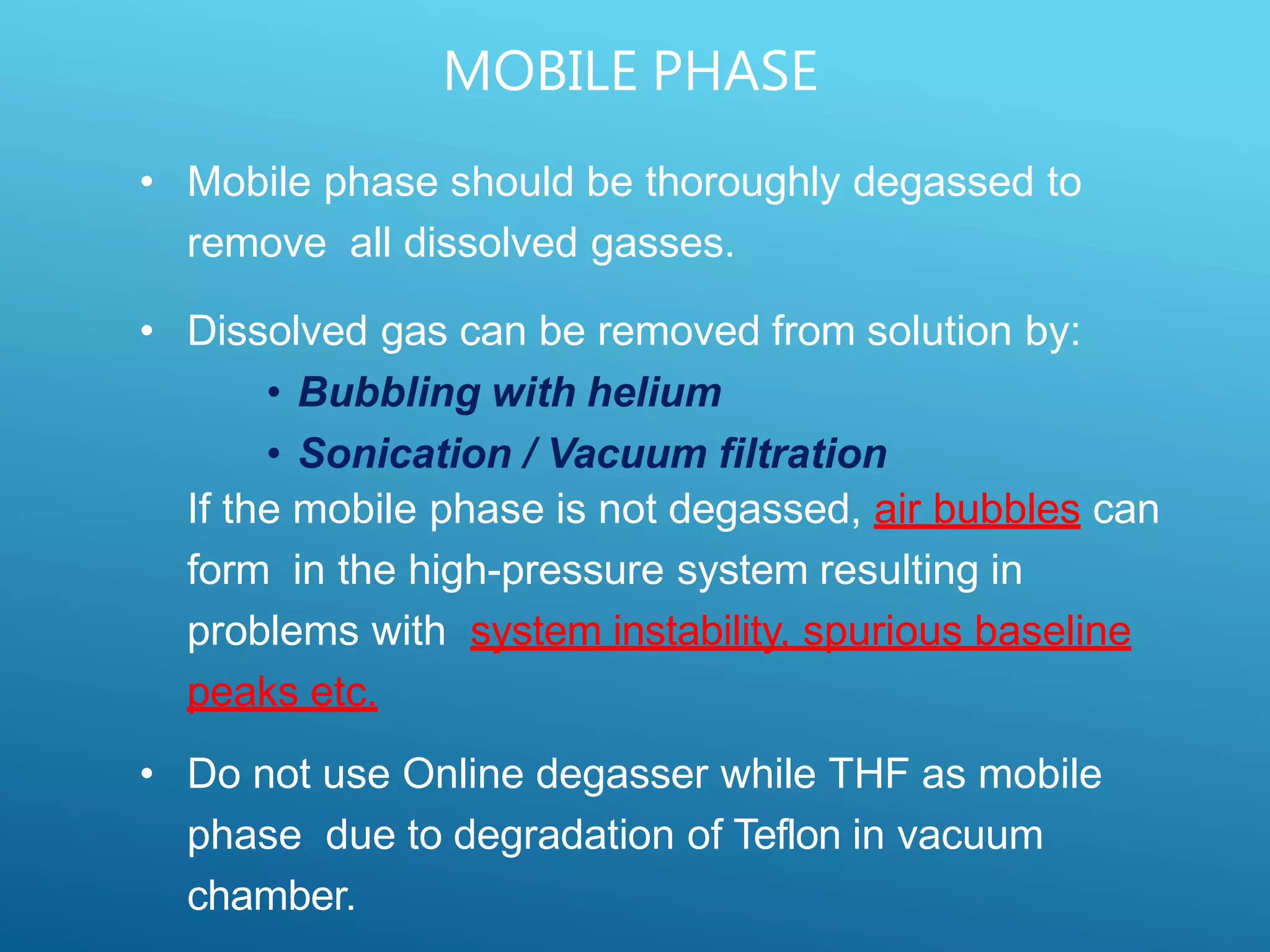
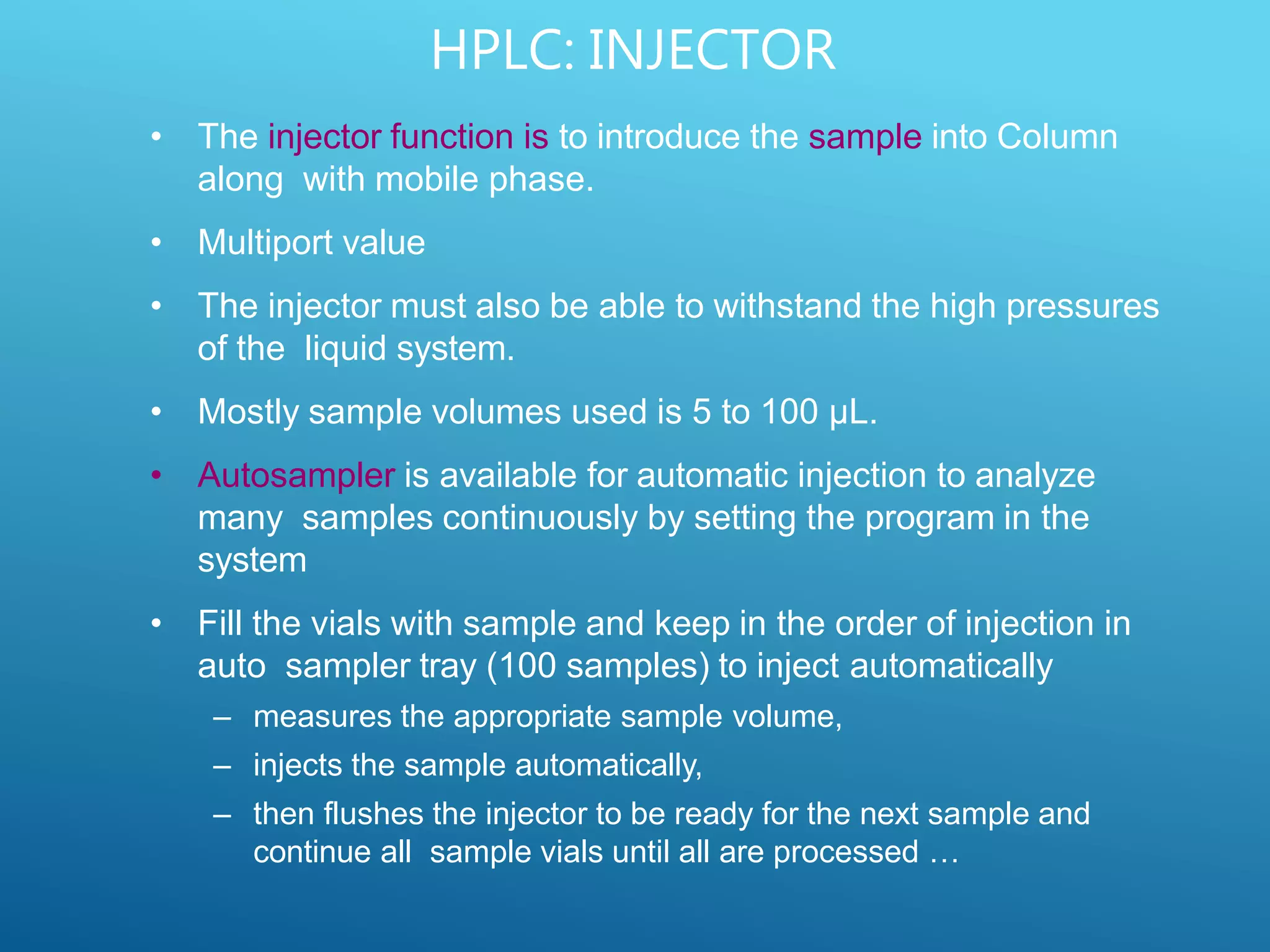
Gradient
• Solvent Composition Changes
throughout the HPLC Run time.
• Gradually Changed or Step Changes
o Analysis time is reduced by proper
composition
& time
o Achieve good Peak Separation/ Resolution
& Peak shapes and Faster analysis of
complex molecules.
MOBILE PHASE
• Mobile phase should be thoroughly degassed to
remove all dissolved gasses.
• Dissolved gas can be removed from solution by:
• Bubbling with helium
• Sonication / Vacuum filtration
If the mobile phase is not degassed, air bubbles can
form in the high-pressure system resulting in
problems with system instability, spurious baseline
peaks etc.
• Do not use Online degasser while THF as mobile
phase due to degradation of Teflon in vacuum
chamber.
HPLC: INJECTOR
• The injector function is to introduce the sample into Column
along with mobile phase.
• Multiport value
• The injector must also be able to withstand the high pressures
of the liquid system.
• Mostly sample volumes used is 5 to 100 µL.
• Autosampler is available for automatic injection to analyze
many samples continuously by setting the program in the
system
• Fill the vials with sample and keep in the order of injection in
auto sampler tray (100 samples) to inject automatically
– measures the appropriate sample volume,
– injects the sample automatically,
– then flushes the injector to be ready for the next sample and
continue all sample vials until all are processed …
HPLC COLUMNS
• Consideredthe “heart of thechromatograph”
• High-purity spherical silica particles with low in trace metal content, of
2-10
μm diameter particles are coated with chemical stationary phase.
• Pore sizes of the particles are 60–150, 200–300, and 1,000–
4,000°A, used for separation of small molecules,
polypeptides/proteins, and very high molecular weight proteins
respectively to allow the analyte to penetrate the pores.
• Nonporous packings- of very small silica particle <1.5 μm
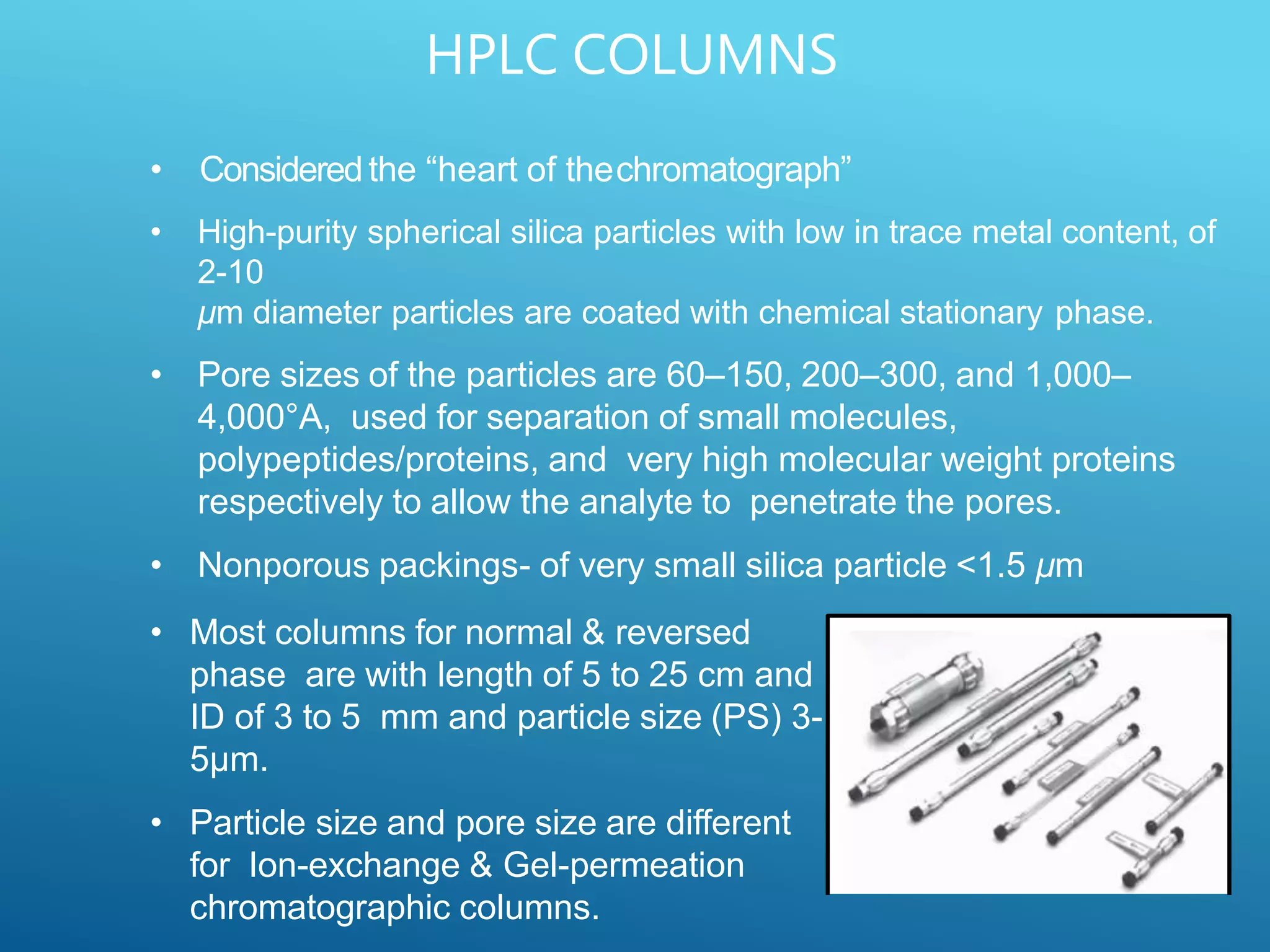
• Most columns for normal & reversed
phase are with length of 5 to 25 cm and
ID of 3 to 5 mm and particle size (PS) 3-
5µm.
• Particle size and pore size are different
for Ion-exchange & Gel-permeation
chromatographic columns.
HPLC COLUMNS
• Materials of construction for the Column tubings;
– Stainless steel (gives high pressure capabilities and commonly
used)
– Glass (mostly for biomolecules)
– PEEK polymer (biocompatible and chemically inert to most
solvents)
• Analytical column : Length of 150 – 250 mm & ID 1.0 - 4.6-mm, PS.3
to 5µm (40,000 to 70,000 plates/m)
• Preparative column: Lengths 50 – 250 mm & ID > 4.6 mm
• The below types of columns are advantage of speed and
minimal solvent consumption and high plates > 100,000
plates/m
– Microcolumn: Length 100 – 150 mm & ID 1.0 - 4.6-mm, PS.3 to 5µm
– Capillary: various lengths, ID 0.1 - 1.0 mm;
– Nano (i.d. < 0.1 mm, or sometimes stated as < 100 µm)
GUARD COLUMN & GHOST-BUSTER
COLUMN
• Guard column, is a short column packed with a
similar stationary phase as the analytical column.
• The purpose of the guard column is to prevent impurities,
such as highly retained compounds and particulate
matter, system debris from reaching and contaminating
the analytical column.
• In gradient elution unexpected peaks ie Ghost
Peaks may appear.
• Ghost-Buster Column absorb the week polar and non-
polar impurities in the mobile phase and eliminate ghost.
Also baseline drift /fluctuation caused in the gradient is
eliminated and gives stable baseline. It is connected
between mixture and sample injection.
COLUMN OVEN
 Temperature Control in HPLC: Uniform temperature throughout the run
give reproducible result. Column oven available with 5°C to 85°C.
Reproducibility:
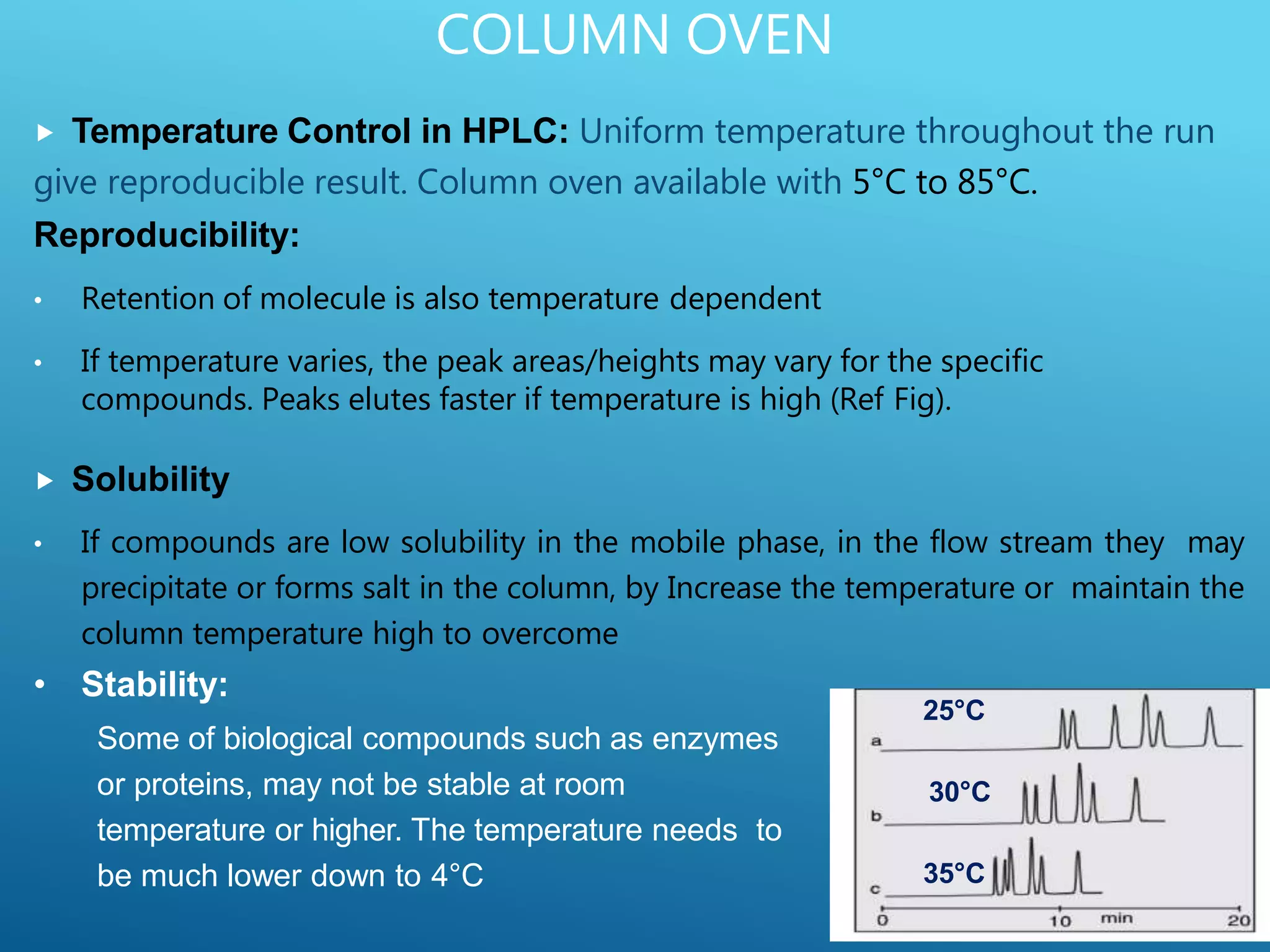
• Retention of molecule is also temperature dependent
• If temperature varies, the peak areas/heights may vary for the specific
compounds. Peaks elutes faster if temperature is high (Ref Fig).
 Solubility
• If compounds are low solubility in the mobile phase, in the flow stream they may
precipitate or forms salt in the column, by Increase the temperature or maintain the
column temperature high to overcome
• Stability:
Some of biological compounds such as enzymes
or proteins, may not be stable at room
temperature or higher. The temperature needs to
be much lower down to 4°C
25°C
30°C
35°C
DETECTORS
• Detectors sense the separated components and
provide a signal. Selection of detectors based on the
compounds
• All the detectors are either concentration-dependent or
mass
dependant. Can connect multiple detectors for good
response
Commonly used detectors are;
 UV-spectroscopy: Dual wavelength & PDA
 Refractive Index
 Fluorescence,
 Mass Spectrometric
 Electrochemical detectors
 ELSD and etc
UV DETECTOR
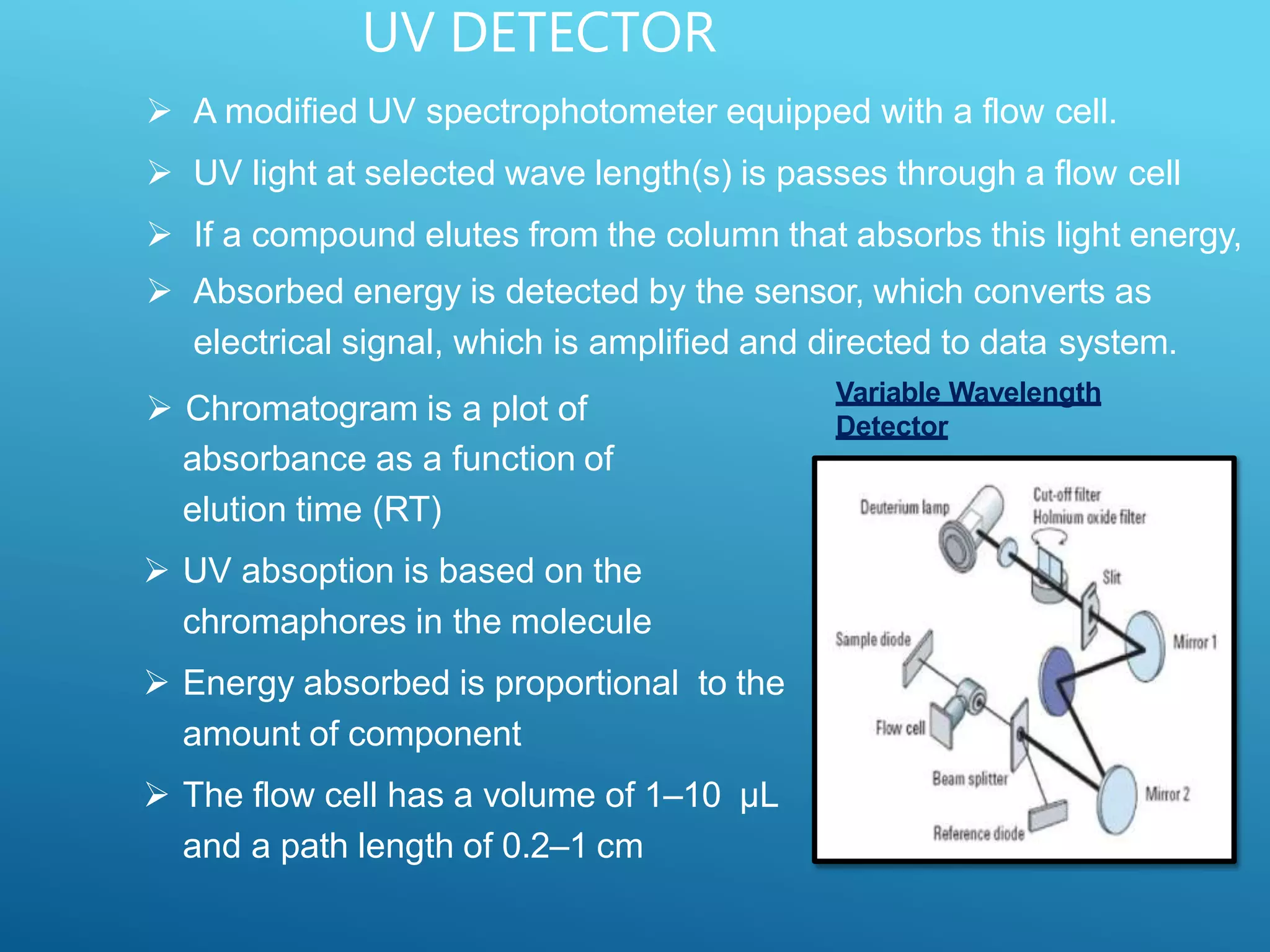
 A modified UV spectrophotometer equipped with a flow cell.
 UV light at selected wave length(s) is passes through a flow cell
 If a compound elutes from the column that absorbs this light energy,
 Absorbed energy is detected by the sensor, which converts as
electrical signal, which is amplified and directed to data system.
 Chromatogram is a plot of
absorbance as a function of
elution time (RT)
 UV absoption is based on the
chromaphores in the molecule
 Energy absorbed is proportional to the
amount of component
 The flow cell has a volume of 1–10 µL
and a path length of 0.2–1 cm
Variable Wavelength
Detector
DIODE ARRAY DETECTOR
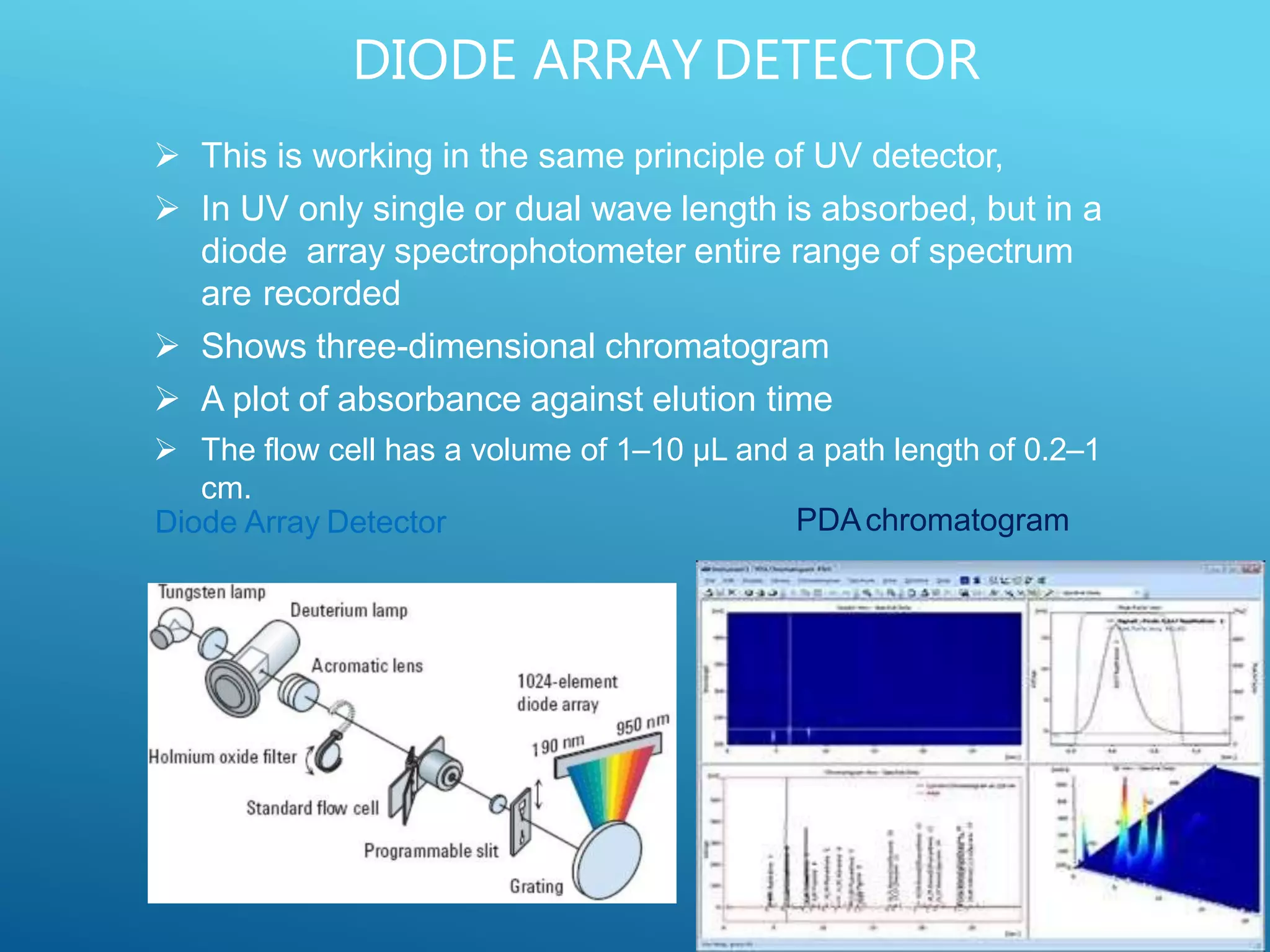
 This is working in the same principle of UV detector,
 In UV only single or dual wave length is absorbed, but in a
diode array spectrophotometer entire range of spectrum
are recorded
 Shows three-dimensional chromatogram
 A plot of absorbance against elution time
 The flow cell has a volume of 1–10 µL and a path length of 0.2–1
cm.
Diode Array Detector PDAchromatogram
REFRACTIVE INDEX (RI) DETECTION
• Snell’slaw of refraction – Sin i/Sin r
• It is a bulk property detector; Any change in its composition is reflected
in the RI.
• The ability of a compound or solvent to deflect light provides a way
to detect.
• The RI is ameasure of molecule’s ability to deflect light in aflowing mobile
phase in a flow cell relative to a static mobile phase contained in a
reference flow cell.
• The amount of deflection is proportional to concentration.
• The RI detector is considered to be a universal detector but it is
not very sensitive.
Limitations:
• Commonly used water methanol
solvent system
• RI changes considerably with temperature
• RI detection is generally incompatible
with gradient elution.
• Not suitable for trace analysis
FLUORESCENCE DETECTION
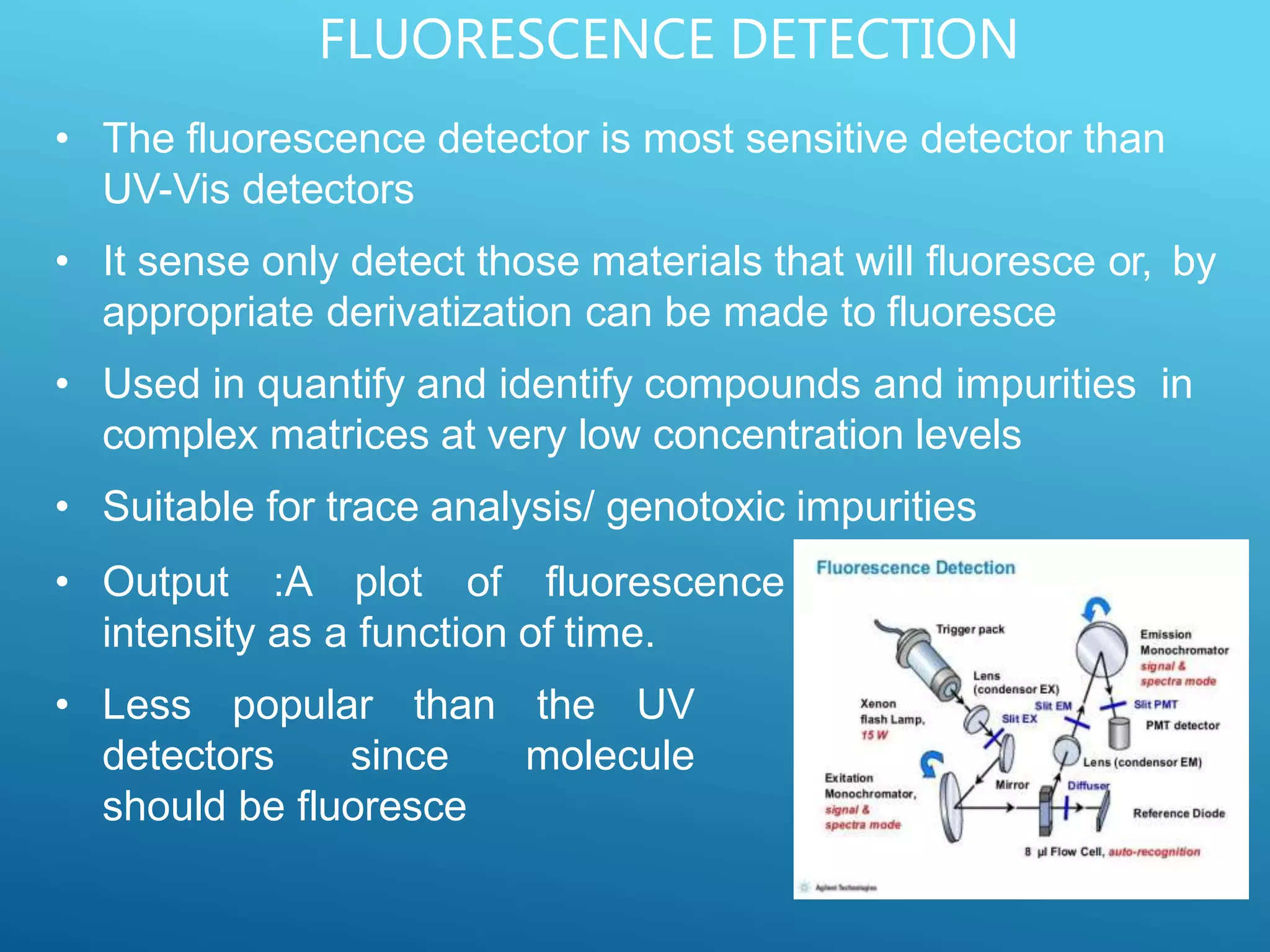
• The fluorescence detector is most sensitive detector than
UV-Vis detectors
• It sense only detect those materials that will fluoresce or, by
appropriate derivatization can be made to fluoresce
• Used in quantify and identify compounds and impurities in
complex matrices at very low concentration levels
• Suitable for trace analysis/ genotoxic impurities
• Output :A plot of fluorescence
intensity as a function of time.
• Less popular than the UV
detectors since molecule
should be fluoresce
MASS SPECTROSCOPY (MS)
• An MS detector senses a compound eluting from the HPLC
column first by ionizing it then by measuring it’s mass
and/or fragmenting the molecule into smaller pieces that
are unique to the compound.
• Mass spectrum is like a fingerprint and is quite unique to
that compound.
• The MS detector used to identify the compound with
library in application and also determine the quantity of
molecule.
• MS detector is sensitive and used for trace analysis
DATA PROCESSER
• Data system/ processing : The computer controls all the modules of
the HPLC instrument and converts the signal from the detector.
• Algorithms establish the time of elution (retention time) of the
sample components (qualitative analysis) and the peak area ie
amount of sample (quantitative analysis).
• Signals from the detector are processed based on the set of
integration
events and displays the chromatograms for easy to read and interpret.
• Availability of Function for process chromatographic data based on
the application
• Computer with application available with many options like method
development, determine system suitability, calibration, auto
calculation etc. Also used to store, archive & back up of the data
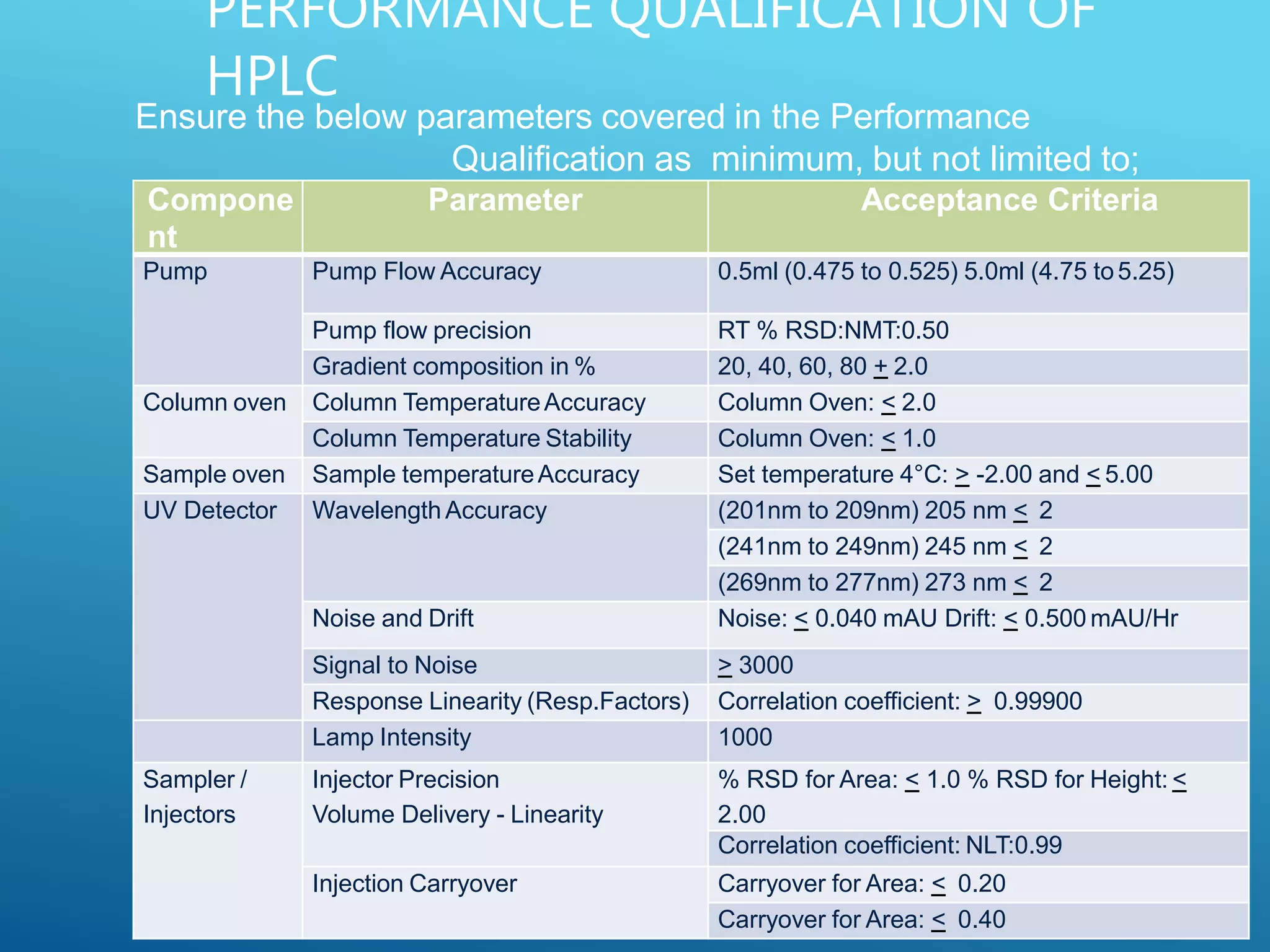
PERFORMANCE QUALIFICATION OF
HPLC
Compone
nt
Parameter Acceptance Criteria
Pump Pump Flow Accuracy 0.5ml (0.475 to 0.525) 5.0ml (4.75 to5.25)
Pump flow precision RT % RSD:NMT:0.50
Gradient composition in % 20, 40, 60, 80 + 2.0
Column oven Column TemperatureAccuracy Column Oven: < 2.0
Column Temperature Stability Column Oven: < 1.0
Sample oven Sample temperatureAccuracy Set temperature 4°C: > -2.00 and < 5.00
UV Detector Wavelength Accuracy (201nm to 209nm) 205 nm < 2
(241nm to 249nm) 245 nm < 2
(269nm to 277nm) 273 nm < 2
Noise and Drift Noise: < 0.040 mAU Drift: < 0.500 mAU/Hr
Signal to Noise > 3000
Response Linearity (Resp.Factors) Correlation coefficient: > 0.99900
Lamp Intensity 1000
Sampler /
Injectors
Injector Precision
Volume Delivery - Linearity
% RSD for Area: < 1.0 % RSD for Height: <
2.00
Correlation coefficient: NLT:0.99
Injection Carryover Carryover for Area: < 0.20
Carryover for Area: < 0.40
Ensure the below parameters covered in the Performance
Qualification as minimum, but not limited to;
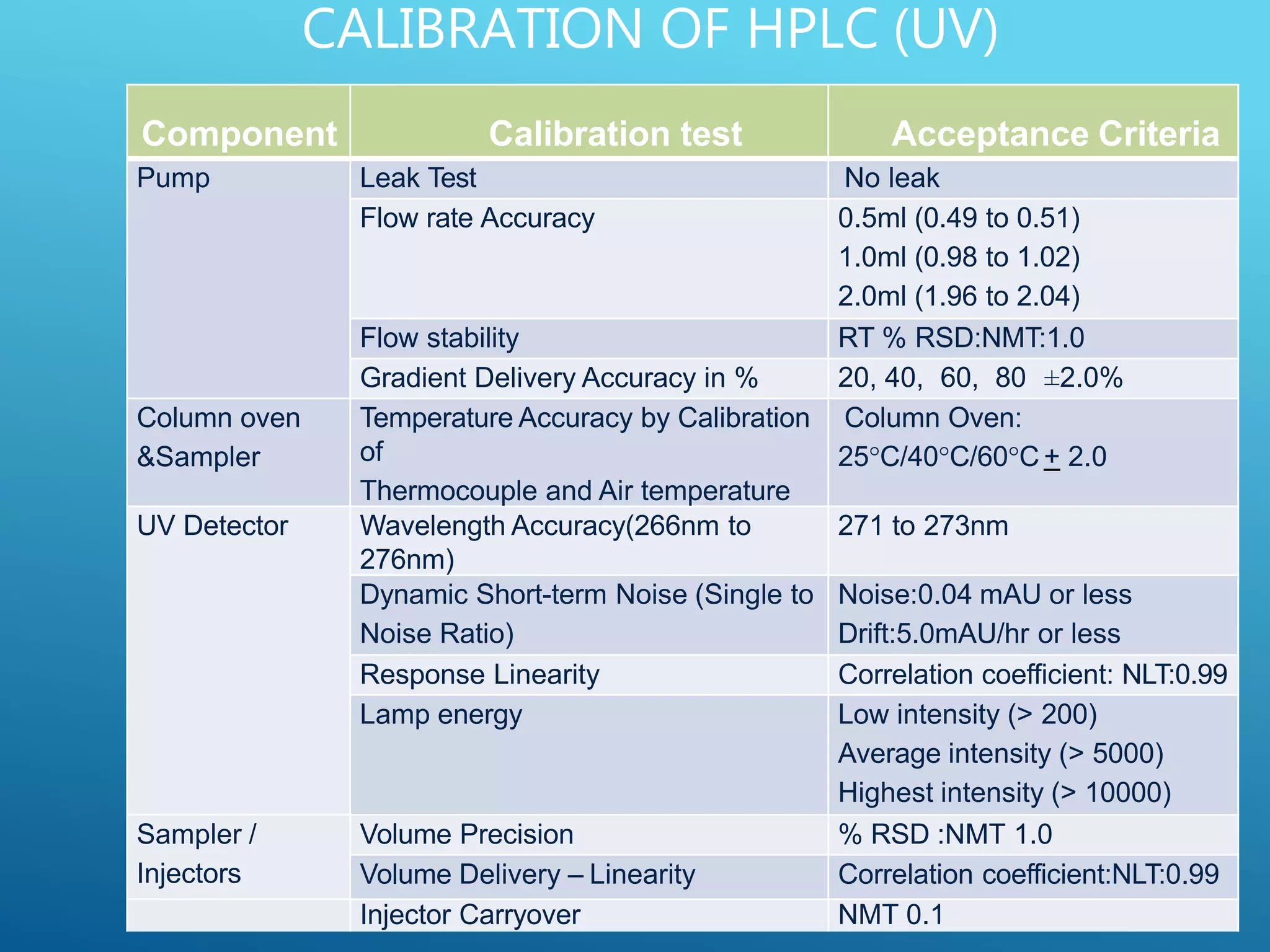
CALIBRATION OF HPLC (UV)
Component Calibration test Acceptance Criteria
Pump Leak Test No leak
Flow rate Accuracy 0.5ml (0.49 to 0.51)
1.0ml (0.98 to 1.02)
2.0ml (1.96 to 2.04)
Flow stability RT % RSD:NMT:1.0
Gradient Delivery Accuracy in % 20, 40, 60, 80 ±2.0%
Column oven
&Sampler
Temperature Accuracy by Calibration
of
Thermocouple and Air temperature
Column Oven:
25°C/40°C/60°C + 2.0
UV Detector Wavelength Accuracy(266nm to
276nm)
271 to 273nm
Dynamic Short-term Noise (Single to
Noise Ratio)
Noise:0.04 mAU or less
Drift:5.0mAU/hr or less
Response Linearity Correlation coefficient: NLT:0.99
Lamp energy Low intensity (> 200)
Average intensity (> 5000)
Highest intensity (> 10000)
Sampler /
Injectors
Volume Precision % RSD :NMT 1.0
Volume Delivery – Linearity Correlation coefficient:NLT:0.99
Injector Carryover NMT 0.1
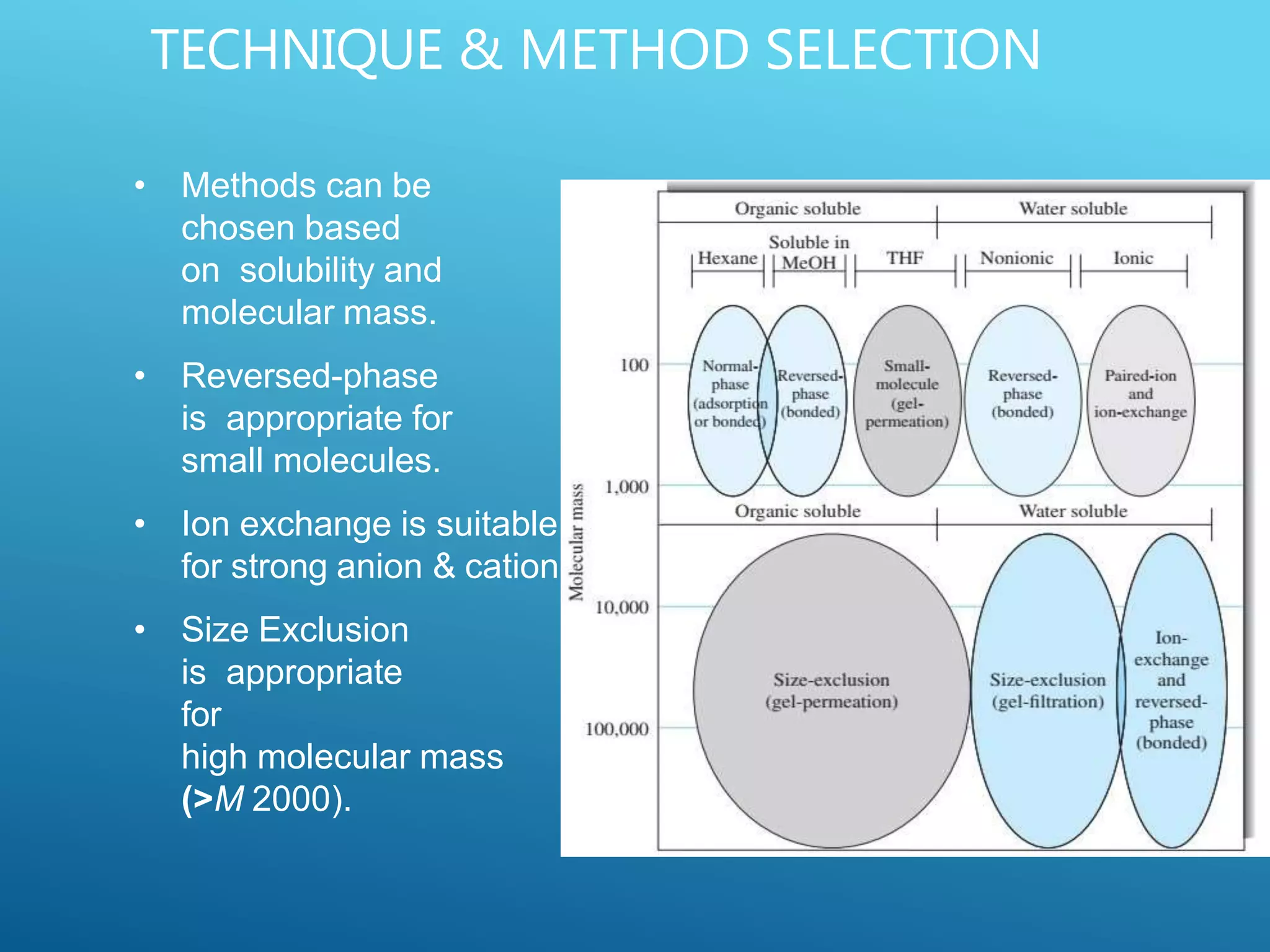
TECHNIQUE & METHOD SELECTION
• Methods can be
chosen based
on solubility and
molecular mass.
• Reversed-phase
is appropriate for
small molecules.
• Ion exchange is suitable
for strong anion & cation
• Size Exclusion
is appropriate
for
high molecular mass
(>M 2000).
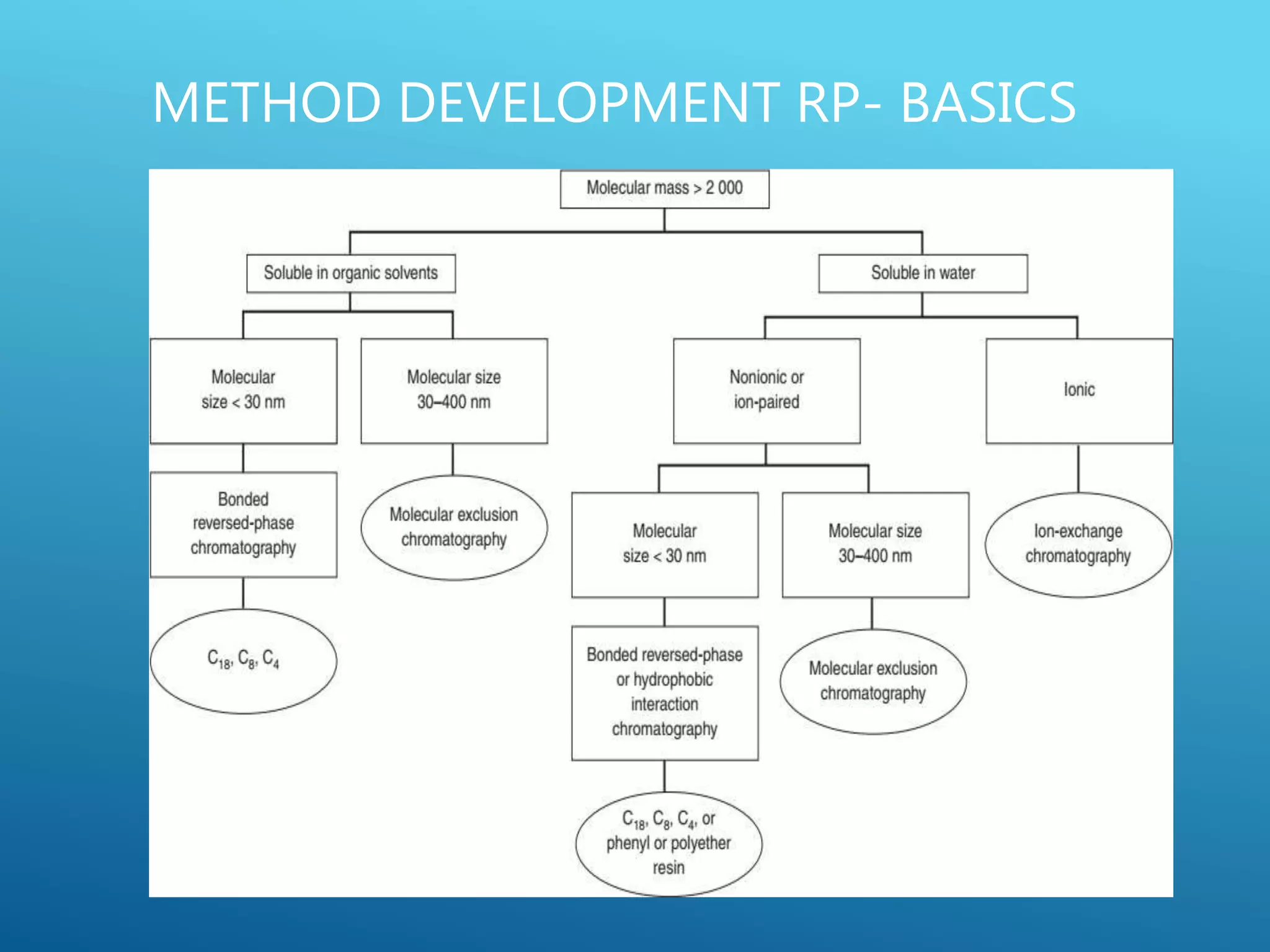
METHOD DEVELOPMENT
RP- BASICS
Chemical nature and functional
groups:
METHOD DEVELOPMENT RP- BASICS
COLUMN CHEMISTRY
Reverse
phases:
Phenyl : R = -C6H5,
C8 (octyl silane):R = -(CH2)7CH3,
moderate
less hydrophobic
C18/ODS: R = -(CH2)17CH3, hydrophobic
Normal phases :
Cyanopropyl
Diol:
Amino :
Dimethylamino,
[R = (CH2)3CN], less polar
[R = -(CH2)2OCH2CH(OH)CH2OH],
[R = -(CH2)3NH2],
[R = -(CH2)3N(CH3)2] more polar
Silica based columns have limited lifetime at pH levels below 2 or above 8.
COLUMN CHEMISTRY
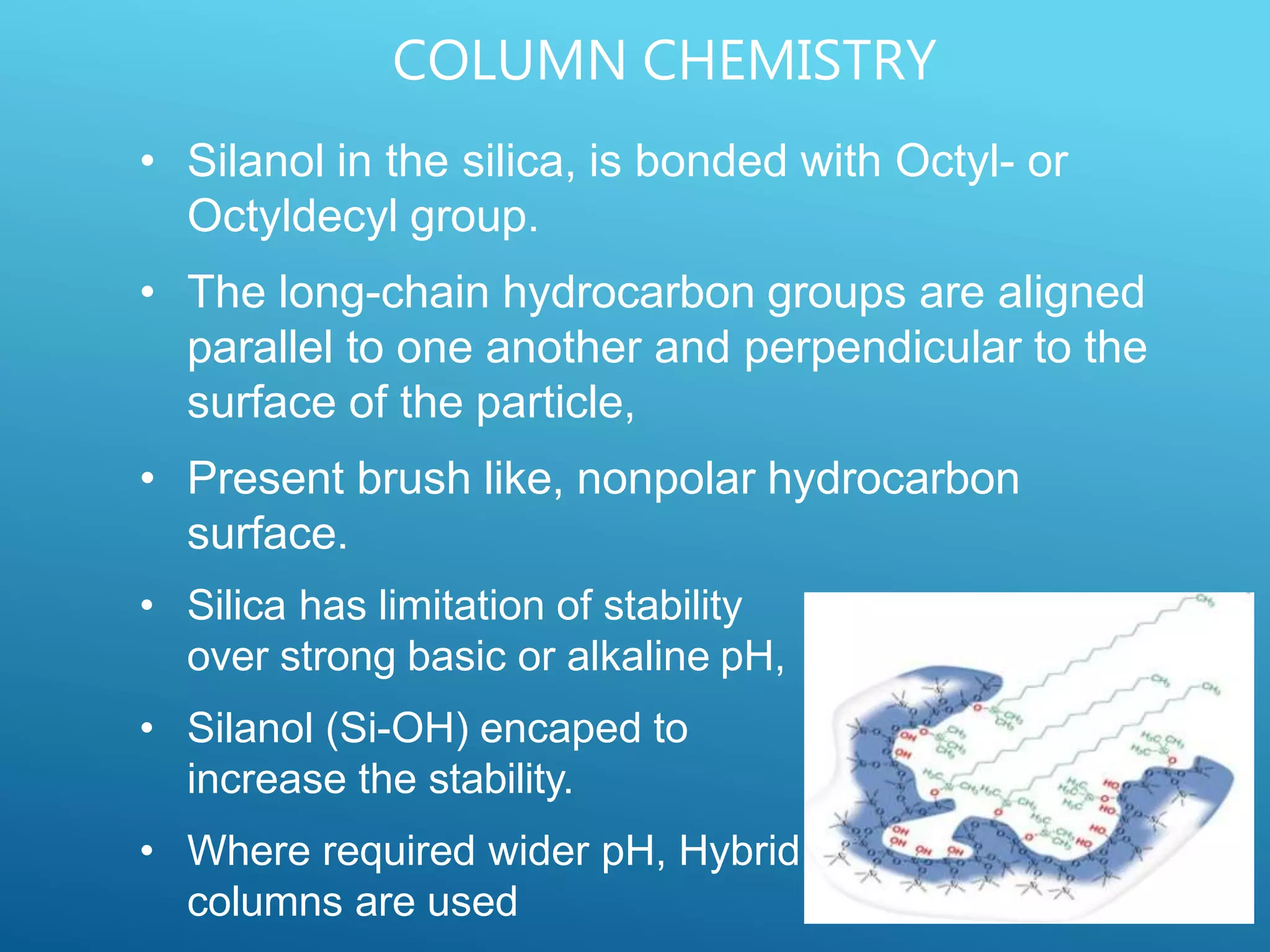
• Silanol in the silica, is bonded with Octyl- or
Octyldecyl group.
• The long-chain hydrocarbon groups are aligned
parallel to one another and perpendicular to the
surface of the particle,
• Present brush like, nonpolar hydrocarbon
surface.
• Silica has limitation of stability
over strong basic or alkaline pH,
• Silanol (Si-OH) encaped to
increase the stability.
• Where required wider pH, Hybrid
columns are used
COLUMN AND PH
• Organic–inorganic hybrid silica particle with ethylene
bridge improves the stability to use wider pH range. Eg
Propylene bridged bidentate C18 silane (Fig).
• Chromatographic columns with Graphitic carbon,
alumina, titania, and zirconia are also available for
wider pH
tolerance.
• pH Cross-linked polymeric particles. for
example, poly(methacrylate)s, and
especially cross-linked poly(styrene), can
withstand the full range of pH.
CHIRAL COLUMNS
• Silicamatrix bonded to β- and γ - cyclodextrins via a small
hydrocarbon chain /ether linkage.
• These cylindrically shaped ligands, which are oligosaccharides
made of five to seven molecules of glucose, possess a
hydrophobic internal cavity while the external part is hydrophilic.
• Central cavity is somewhat hydrophobic and the outer
surface is hydrophilic.
• This gives them a selective permeability and it forms
reversible diastereoisomer complexes at the surface and
separates.
– Eg.Cyclofructans (CFs) based stationary phases are commonly used in
the normal separation mode of HPLC - to separate chiral primary amine
enantiomers.
SELECTION OF HPLC COLUMNS
Bonded
Group
Polarity Retention
mechanisms
Comments
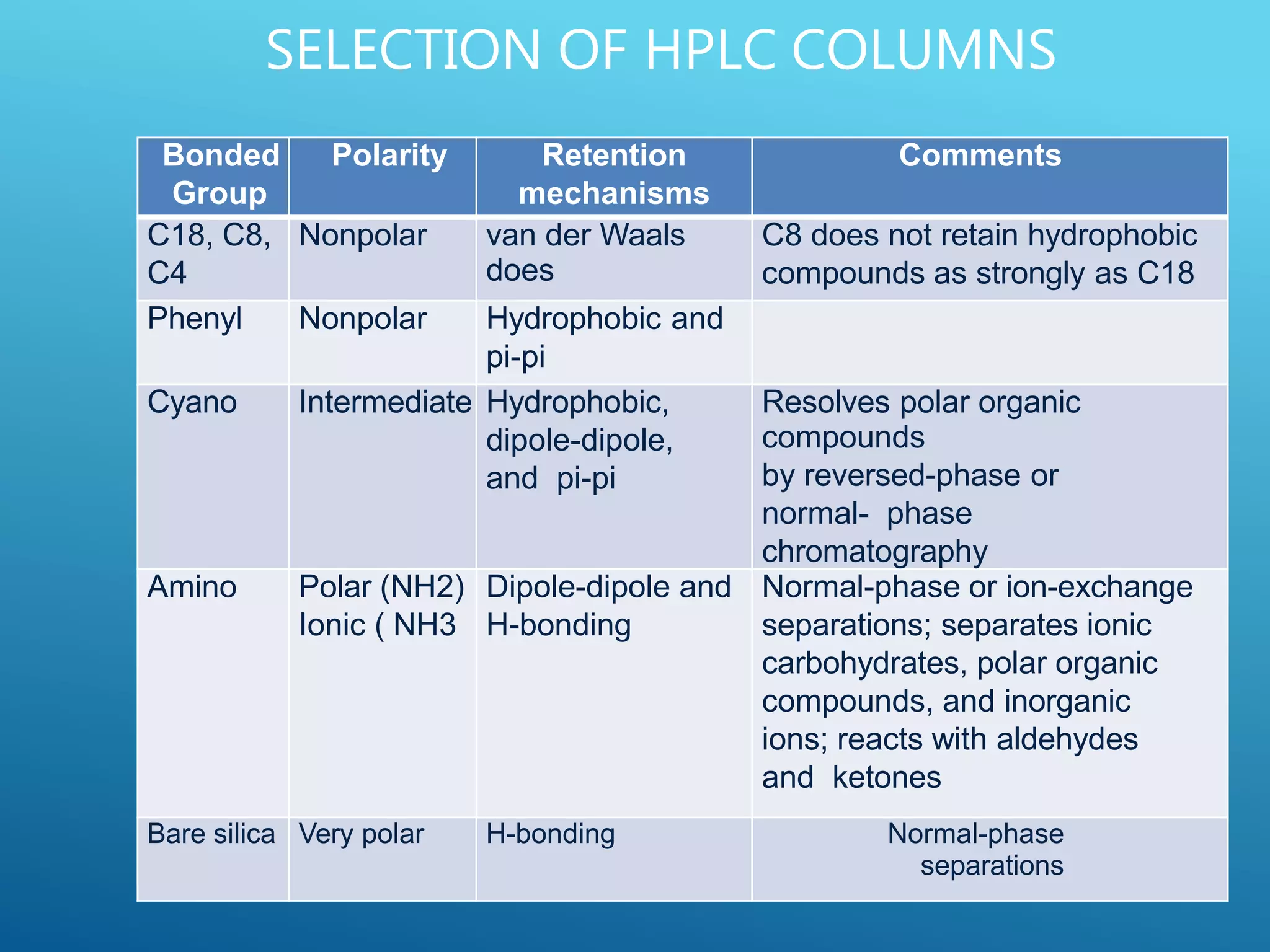
C18, C8,
C4
Nonpolar van der Waals
does
C8 does not retain hydrophobic
compounds as strongly as C18
Phenyl Nonpolar Hydrophobic and
pi-pi
Cyano Intermediate Hydrophobic,
dipole-dipole,
and pi-pi
Resolves polar organic
compounds
by reversed-phase or
normal- phase
chromatography
Amino Polar (NH2)
Ionic ( NH3
Dipole-dipole and
H-bonding
Normal-phase or ion-exchange
separations; separates ionic
carbohydrates, polar organic
compounds, and inorganic
ions; reacts with aldehydes
and ketones
Bare silica Very polar H-bonding Normal-phase
separations
FACTORS AFFECTS THE PERFORMANCE
• pH of the mobile phase shuold be close to the pKa value
of compound for better separation.
• Resolution is dependant on three variables, the column
efficiency
(N), capacity factor (k’) & selectivity(α).
• Selectivity is a measure of the relative retention of two adjacent
peaks in a chromatogram
• Capacity factor is affected by changes in mobile phase,
operating temperature, analyte retention characteristics and
changes to the surface chemistry of the column.
• Increasing N increases resolution because peak width decreases.
• Decreasing k’ sharpensthe peaksbut decreasesresolution.
Increasing α increasesresolution.
• capacity factor decreases with an increase in temperature
according to the van’t Hoff equation
ADJUSTMENT ALLOWED FOR HPLC
CONDITION
Property USP General Chapter 621 Ph.Eur. Gen.
Chapter 2.2.46
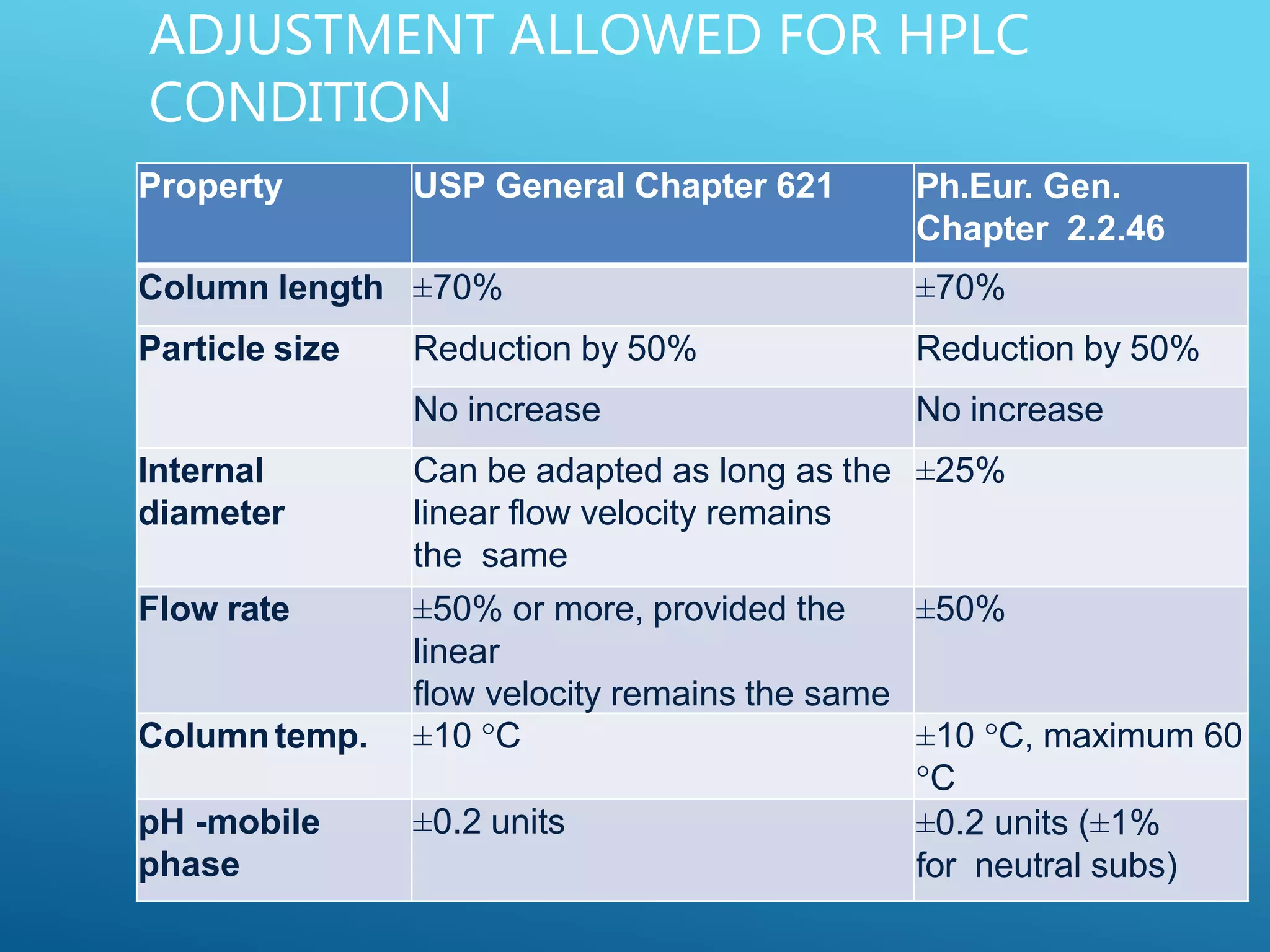
Column length ±70% ±70%
Particle size Reduction by 50% Reduction by 50%
No increase No increase
Internal
diameter
Can be adapted as long as the
linear flow velocity remains
the same
±25%
Flow rate ±50% or more, provided the
linear
flow velocity remains the same
±50%
Columntemp. ±10 °C ±10 °C, maximum 60
°C
pH -mobile
phase
±0.2 units ±0.2 units (±1%
for neutral subs)
ADJUSTMENT ALLOWED FOR HPLC
CONDITION
Property USP General Chapter 621 Ph.Eur. Gen. Chapter
2.2.46
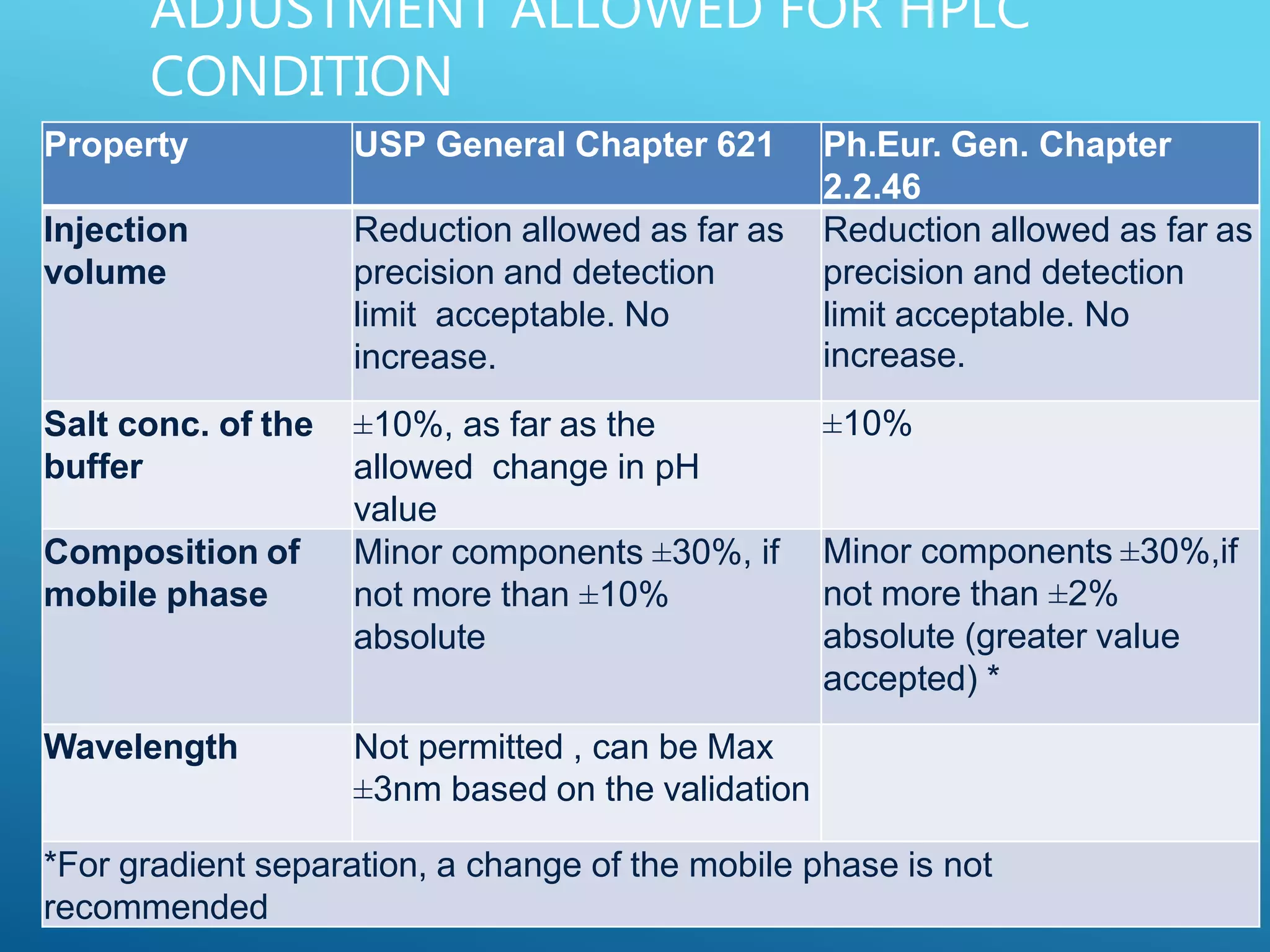
Injection
volume
Reduction allowed as far as
precision and detection
limit acceptable. No
increase.
Reduction allowed as far as
precision and detection
limit acceptable. No
increase.
Salt conc. of the
buffer
±10%, as far as the
allowed change in pH
value
±10%
Composition of
mobile phase
Minor components ±30%, if
not more than ±10%
absolute
Minor components ±30%,if
not more than ±2%
absolute (greater value
accepted) *
Wavelength Not permitted , can be Max
±3nm based on the validation
*For gradient separation, a change of the mobile phase is not
recommended
ANALYTICAL METHOD VALIDATION
• Ensure that Analytical method used is validated to the
above characteristics and suitable for its intended
purpose (ICH Q2).
• Method should demonstrate Specificity, Precision
(Repeatability Intermediate Precision, Reproducibility ),
Linearity, Range, Accuracy, Robustness, Limit of
Detection & Limit of Quantification as appropriate.
• If test method is as per monograph, ensure that
Analytical method is verified for its suitability Eg USP
General Chapter
<1226>
• Any change in the test method /condition shall be within
the allowable limit of Pharmacopeia methods (next
page)
HPLC APPLICATION
• Qualitative Analysis – by comparing the retention time or
volume of the sample to the standard against the
sample.
• Retention time or relative retention time can be used for
identification of eluted compound. Retention times are
characteristic of the compounds they represent (but are
not unique). Mass Detector gives the mass value to
identify precisely.
• Quantitative Analysis- Peak area / Peak height of elution
peak is proportional to the quantity / concentration. Peak
response is based of the detector used.
• Method used for Quantitative Analysis shall be validated
• Type of estimation- Area normalization, Internal
standard, Calibration and standard, Standard addition
and etc
HPLC APPLICATION
Pharmaceutical Applications
• Testing of Quality of raw material, in-process , intermediates, APIs and
drug
products
• Pharmaceutical quality control: Assay, related substances, content
and, trace analysis like genotoxic, nitrosamine impurities at ppm
level.
• To perform drug stability.
• Testing the content of pharmaceutical dosages form, content uniformity
• Phytochemical & nutraceuticals- plant extracts, Ginseng, herbal
medicines
Applications in Clinical Tests
• Bio-availability and bio-equivalency
• Toxicology, pharmacology, phatmacokinetics
• Urine analysis, analysis of blood, Bile acids, drug metabolites, urine
extracts, estrogens etc
• Detection of endogenous Neuropeptides in extracellular fluid of brain etc.
HPLC APPLICATION
Environmental Applications
• Detection of chemical compounds / contaminant in water and air quality
• Chemical Exposure in the workplace / environment
• Pesticides, herbicides, phenols, polychlorinated biphenyls (PCBs
Applications in Forensics
• Identification & determination of abuse drugs in blood, urine etc. Eg.
Cocaine, steroid, ketamine, amphetamine etc
• Quantification of Drugs, poisons, blood alcohol, narcotics.
• Forensic analysis like textile dyes, chemicals, etc
Industrial Application:
• Identification & determination of cosmetics- Active ingredient content,
purity, impurities and stability study.
• Analysis of Preservative, surfactants, propellants, dyes etc
• Organic chemicals like polymers (e.g. polystyrene, polyethylene)
• Artifcial sweeteners, antioxidants, aflatoxins, additives
• Thermally unstable compounds such as trinitrotoluene (TNT), enzymes
TIPS FOR GOOD HPLC PRACTICE
Always use only Ultra pure / Milli-Q water for
HPLC analysis
Ultra pure HPLCwater of 18MΩresistivity
Do not use RO water/de-ionised water for HPLC analysis.
It will have organic and in-organics impurities
If water contains impurities, it will have higher absorption
and lead to poor baseline , drift , ghost peak and less
accurate
• All reagents and solvents should be highest quality.
• HPLC grade reagents & solvents are high purity
will have low UV absorbance
• Low grade solvent contain impurities to produce spurious
peaks, poor peak , high baseline etc
TIPS FOR GOOD HPLC PRACTICE
Do not store HPLC columns in buffers. A buffer may precipitate inside
the column, it will clog and affects the packing material.
Mobile phases with 100% or close to 100% buffer may lead to
bacterial growth, which can block the column & frit and packing
material.
Bacteria may also affect the analyte, and organic products from the
dead bacteria may cause "ghost peaks" in chromatograms.
Do not store HPLC columns in solvents that degrade easily tetrahydrofuran
(THF), triethylamine (TEA), trifluoroacetic acid (TFA).
Unstabilized THF can form peroxides which may degrade the column
All buffers should be washed out of the column before flushing
with Acetonitrile.
Gradually start the column washing : Eg Starts the flow with 0.2 ml/min and
increases gradually to 2.0 ml/min and continues for 20min to 30 min or as
per procedure
Have Dedicated Columns for each Method / each product
INTEGRATION OF PEAKS
• Do not integrate any peak by manually.
• Integrate all the peaks or else as per procedure
• Always use same processing method for processing of blank,
standard & sample chromatograms in case of Assay & related
substances, etc.
• Verify the processing parameters like
– Threshold,
– Width,
– System suitability,
– Peak names etc.
• Save the processing method
• Re-integration:
– Do not re-integrate the chromatograms without documenting.
– Document the reason for reintegration.
COMMON PROBLEMS IN HPLC
ANALYSIS
• System failures may occur during analysis due
to
– System over pressure
– Leakage
– Poor mobile phase
• dissolved gas, pH, solvent purity or composition,
filtration,
– Communication error
– Failure of system suitability
– Peak splitting/ negative peak
– Spurious peak
– Bracketing standard failure
HANDLING OF DEVIATION/FAILURE
 SOP shall be available and shall address the handling of Lab
deviation/ incidents.
 SOP shall define clearly the deviation/ incident , reporting
investigation, CAPA and documentation
 Record all the deviation/ incident happened in
chromatographic analysis
 Process all the injections including the invalid injection and report
and store the data along with Raw data.
 Do not omit any injection
 Investigate the deviation/ incident and find the root cause for the
failure.
 Rectify the problem, take appropriate CAPA and document
 Repeat complete sample set of injections in case of sample
injection failure
REFERENCES
1. Chemical Analysis: Modern Instrumentation Methods and
Techniques- Francis and Annick Rouessac and Steve Brooks
- John Wiley & Sons Ltd,.
2. Pharmaceutical Analysis David G. Watson
3. Analytical Chemistry for Technicians -John Kenkel
4. Analytical Chemistry - Gary D. Christian , Purnendu K.
(Sandy) Dasgupta & Kevin A. Schug
5. Quantitative Chemical Analysis- Daniel C. Harris
6. Vogel’s – Quantitative Chemical Analysis- 6th edition
7. Principles of Instrumental Analysis- 6th Edition- D.A. Skoog et
al
8. United States Pharmacopeia
9. European Pharmacopeia
59
ABOUT ME:
I am Suresh kumar kandode, born at Tatipally, Medak-Dist, Telangana,
India.
Completed my M.Sc.in Analytical Chemistry, NagarjunaUniversity.
Worked asLecturer and also worked in various Chemical & Pharmaceutical
Industries like Cipla, Piramal, Hetero and Bio-Synth for the past 20 years.
Presently working asSr.Manager−Quality at Adeptpharma.Hyderabad.

HPLC Principle,Instrumentation and Application

  • 1.
     High Performance LiquidChromatography Principle, Theory, Instrumentation and Application K.Sureshkumar Msc
  • 2.
    AN OVERVIEW • Introduction •Chromatographic Separation • Definitions • HPLC Techniques • Instrumentation & Types of detectors • Qualification & Calibration • Method Development – Basics • Column Chemistry • Applications, Specifically Pharmaceutical QC
  • 3.
    WHAT IS CHROMATOGRAPHY? •Chromatography is a separation technique used for Qualitative and Quantitative Analysis. • Essential for testing of chemicals in an Industries & academics • Technique developed in 1941 by Martin & Synge and were awarded Nobel Prize in 1952 (partition chromatography) • In 1951 first GC experiment was performed by Martin & James • Horvath & Lipsky built the first high-pressure liquid chromatograph. End of the 70’s improvised – High Performance Liquid Chromatograph instruments become familiar. • Pharmaceutical industry made HPLC the workhorse beginning in the 1970s and become boom in 1980s • Since 2006 advance models like UPLC, RRLC,UFLC, RSLC.. are available
  • 4.
    CHROMATOGRAPHICSEPARATION Chromatography is basedon a Physical Equilibrium that results when a solute is transferred between the mobile and a stationary phase. K = Distribution coefficient or Partition ratio K = CS/ CM • CS -Molar conc. of the solute in the stationary phase • CM -Molar conc. of the solute in the mobile phase.
  • 5.
    SEPARATION IN COLUMN •In a mixture, each component has a Different distribution coefficient in liquid Stationary phase and Mobile phase. • The sample then has the opportunity to interact with the stationary phase as it moves past it. • Samples/ molecules that interact greatly, which move slowly and weekly interact are move quickly. Because of this difference in rates, the sample is Separated into their components. “Like Attracts Like – Opposites are Not Attracted”
  • 6.
    DEFINITIONS Gradient elution: Continuously changingthe solvent composition during the chromatographic run is called gradient elution or solvent programming. Retention factor (k):1 Also known asthe “capacity factor (k)” k = time spent by substance in Stationary phase time spent by substance in mobile phase k = (tR - tM) /tM Hold-up time (tM): The time required for elution of an unretained component Retention time (tR) ,
  • 7.
    DEFINITIONS  Number oftheoretical plates (N): A measure of column efficiency. For Gaussian peaks, it is calculated by: N = 16(tR/W) 2 where tR is the retention time of the substance, &W is the peak width at base  Resolution (RS): The resolution is the separation of two components in a mixture, calculated between peaks (1&2); tR - Retention time & W – peak width RS = 2 × (tR2 - tR1)/(W1 + W2)  Symmetry factor (AS): Also known as the “tailing factor”, of a peak is calculated by: AS = W0.05/2f (Fig-1) Where W-0.05 is the width of the peak at 5% height from base and f is the distance from the peak maximum to the leading edge of the peak. Fig-1 Signal-to-noise (S/N) ratio: is useful system suitability parameter. (Sensitivity) The S/N ratio is S/N ratio = 2H/h ) Signal Noise
  • 8.
    HPLC TECHNIQUES Polarity 1. NormalPhase 2. Reversed Phase Charge 3. Anion Exchange (SAX, WAX) 4. Cation Exchange (SCX, WCX) Size 5. Size Exclusion Chromatography (SEC) 6. Gel Permeation Chromatography (GPC)
  • 9.
    NORMAL PHASE HPLC •Polar stationary phase and non-polar mobile phase. • Stationary phase is usually Silica, Cyanopropyl- bonded, Amino-bonded etc.. Chiral columns • Mobile phases are Hexane, Heptane, Methylene chloride, chloroform, diethyl ether , ethyl acetate, THF or mixture • Polar samples are retained on the polar column longer than less polar & non-polar samples. • Used for: Water-sensitive compounds / geometric isomers / cis-trans isomers/chiral compounds.
  • 10.
    REVERSE PHASE HPLC •Reverse Phase is opposite to normal phase: Stationary phase is nonpolar ( C-18 Hydrophobic) and Mobile phase is a polar liquid; eg. mixtures of water and methanol or acetonitrile. • Lowering the amount of organic solvent in the mobile phase increases the retention time. • Retention is based on Van dar waal’s Interaction between the non- polar stationary phase and the molecule (Fig) • Nonpolar samples are retained longer than polar molecules. • Over 90% of chromatographers use RPC • The technique is used for non- polar, polar, ionizable and ionic molecules… Neproxe n
  • 11.
    SEPARATION AND POLARITY •Chromatographic Retention Behavior “Like Attracts Like – Opposites are Not Attracted” • Polars attracted to other Polars • Non-polars attracted to other non-polars Polarity Compound Mobile Phase- Solvent Coulmn Polar Salts Acids Alcohol s Ketone s Ethers Halogenated compounds Aliphatic hydrocabons Water Diol Alcohols Amine Acetonitrile Silica Ethylacetate Cyano THF Phenyl Dichloromethane C8 (Octyl) Non- Polar Toluene Hexane C18 (Octadecyl)
  • 12.
    ION-PAIR CHROMATOGRAPHY • Ion-pairchromatography is a subset of reversed-phase chromatography. Used for separation of complex mixtures of very polar and ionic molecules. • Organic salt containing a large organic counter-ion, such as a quaternary ammonium ion or alkyl sulfonate is added to the mobile phase as an ion-pairing reagent. Eg. Heptane or Octyl sulfonic acid (for base) Tetrabutyl ammonium Hydroxide, certrimide (for acid) • Ion-pairing reagents having a charge opposite to the analyte of interest as well as a substantial hydrophobic region that allows interaction with the stationary phase, plus associated counter- ions. • This counter ion forms an uncharged ion pair with a solute ion of opposite charge in the mobile phase. This ion pair then partitions into the nonpolar stationary phase giving differential retention of solutes based on the affinity of the ion pair for the two phases.
  • 13.
    ION-PAIR CHROMATOGRAPHY Advantage ofIon-pair chromatography : Reduced separation times; Highly reproducible results; Sharper peak shapes; Simultaneous separation of ionized and non-ionized analytes; and Wide choice of additives to improve separation Example for Ion-pairing reagent (IPR) and interaction with molecule Anionic ion-pairing agent: Adrenaline with an ion-pairing agent in ODS column. 0.1 M sodium phosphate buffer/methanol 9:1 containing 0.02 % sodium octanesulphonic acid (IPR) Cationic ion-pairing agent : Ascorbic acid with anion-pairing agent in ODS column. 0.1 M sodium acetate buffer pH 4.2, Acetonitrile 95:5 containing 0.03 M cetrimide (IPR)
  • 14.
    ION-EXCHANGE HPLC • Thestationary phase is Ionically charged functional groups on polymer • The mobile phase is an aqueous buffer, where both pH and ionic strength are used to control elution time. • The mobile phase is an aqueous buffer (e.g. phosphate, formate, etc.). • Opposite charge of the sample ions are attracted and elutes later. • This technique is used almost exclusively with ionic or ionizable samples.
  • 15.
    ION-EXCHANGE MECHANISM • Inion exchange, the column packing contains ionic groups (Eg. Sulfonic acid , tetraalkyl ammonium ) • Useful for separation of inorganic and organic anions and cations in aqueous solution. • Used to test Ionic dyes, amino acids, and proteins etc Type of Exchanger Functional Exchanger Group Cation Strong acid Weak acid Sulfonic acid- SO3-, Carboxylic acid -COOH, Anion Strong base Weak base Quaternary ammonium ion - NR3+ Amine group -NH2
  • 16.
    SIZE EXCLUSION HPLC •No interaction between the sample compounds and the column. • The column is filled with material having precisely controlled pore sizes. • Molecule /particles are separated according to its their molecular size. • Molecules larger than the pore opening do not diffuse into the particles, while molecules smaller than the pore opening enter the particle and are separated. • Large molecules elute first. Smaller molecules elute later. • Mainly for polymer characterization and for proteins.
  • 17.
    SEC RETENTION MECHANISM MolecularSize in solution • Analytes are dissolved in solution, injected into mobile phase •Analytes are separated by their size once they are in solution There are two modes: • Non-aqueous SEC [Gel Permeation Chromatography (GPC)] – Used in polymer separations • Aqueous SEC [Gel Filtration Chromatography (GFC)]. – Used in biomolecule separations.
  • 18.
    HPLC INSTRUMENTATION HPLC consists: 1.Reservoir containing the mobile phase, 2. Pump to force the mobile phase through the system at high pressure, 3. Injector to introduce the sample into the mobile phase 4. Chromatographic column, 5. Detector 6. Data collection device.
  • 19.
  • 20.
    HPLC : PUMP •The role of the pump is to force the mobile phase at a specific flow rate, (mL/min). • Normal flow rates in HPLC are in the 1- to 2-mL/min range. • Typical pumps can reach pressures in the range of 400 to 600 bar. • During the chromatographic experiment, a pump can deliver a constant mobile phase composition (isocratic) or an increasing mobile phase composition (gradient). • Quaternary pump (low pressure) and binary pump (high pressure) are available. • A flow rate range of 1–2 mL/min on a 4.6 mm dia. column will translate to a flow rate of ∼0.48 - 0.96 μL/ min for a 0.1 mm dia.
  • 21.
    HPLC PUMP REQUIREMENT •The low flow rates obey Poiseuille’s law. • A flow rate range of 1–2 mL/min on a 4.6 mm dia. • Columns packed with 3- and 5-μm silica-based particles required < 400 bar (5800 psi) pressure in HPLC. • Pressure will increase to maintain same flow rate at lower particle size. Pressure needed is inverse to the square of the particle diameter. Eg Pressure required at a given flow rate is 1100% higher when the column is packed with 1.5 μm particles than with 5 μm particles. • UHPLC operates with microbore column and pump pressure designed to1300 bar (19,000 psi) and UPLC built for > 600bar • Flow rate of ∼0.48 - 0.96 μL/ min for a 0.1 mm dia.
  • 22.
    MOBILE PHASE ELUTION Isocratic(ISO means Same) • Solvent Composition remains Same during the Entire Run.Eg. 60:40 Alcohol: Water Gradient • Solvent Composition Changes throughout the HPLC Run time. • Gradually Changed or Step Changes o Analysis time is reduced by proper composition & time o Achieve good Peak Separation/ Resolution & Peak shapes and Faster analysis of complex molecules.
  • 23.
    MOBILE PHASE • Mobilephase should be thoroughly degassed to remove all dissolved gasses. • Dissolved gas can be removed from solution by: • Bubbling with helium • Sonication / Vacuum filtration If the mobile phase is not degassed, air bubbles can form in the high-pressure system resulting in problems with system instability, spurious baseline peaks etc. • Do not use Online degasser while THF as mobile phase due to degradation of Teflon in vacuum chamber.
  • 24.
    HPLC: INJECTOR • Theinjector function is to introduce the sample into Column along with mobile phase. • Multiport value • The injector must also be able to withstand the high pressures of the liquid system. • Mostly sample volumes used is 5 to 100 µL. • Autosampler is available for automatic injection to analyze many samples continuously by setting the program in the system • Fill the vials with sample and keep in the order of injection in auto sampler tray (100 samples) to inject automatically – measures the appropriate sample volume, – injects the sample automatically, – then flushes the injector to be ready for the next sample and continue all sample vials until all are processed …
  • 25.
    HPLC COLUMNS • Consideredthe“heart of thechromatograph” • High-purity spherical silica particles with low in trace metal content, of 2-10 μm diameter particles are coated with chemical stationary phase. • Pore sizes of the particles are 60–150, 200–300, and 1,000– 4,000°A, used for separation of small molecules, polypeptides/proteins, and very high molecular weight proteins respectively to allow the analyte to penetrate the pores. • Nonporous packings- of very small silica particle <1.5 μm • Most columns for normal & reversed phase are with length of 5 to 25 cm and ID of 3 to 5 mm and particle size (PS) 3- 5µm. • Particle size and pore size are different for Ion-exchange & Gel-permeation chromatographic columns.
  • 26.
    HPLC COLUMNS • Materialsof construction for the Column tubings; – Stainless steel (gives high pressure capabilities and commonly used) – Glass (mostly for biomolecules) – PEEK polymer (biocompatible and chemically inert to most solvents) • Analytical column : Length of 150 – 250 mm & ID 1.0 - 4.6-mm, PS.3 to 5µm (40,000 to 70,000 plates/m) • Preparative column: Lengths 50 – 250 mm & ID > 4.6 mm • The below types of columns are advantage of speed and minimal solvent consumption and high plates > 100,000 plates/m – Microcolumn: Length 100 – 150 mm & ID 1.0 - 4.6-mm, PS.3 to 5µm – Capillary: various lengths, ID 0.1 - 1.0 mm; – Nano (i.d. < 0.1 mm, or sometimes stated as < 100 µm)
  • 27.
    GUARD COLUMN &GHOST-BUSTER COLUMN • Guard column, is a short column packed with a similar stationary phase as the analytical column. • The purpose of the guard column is to prevent impurities, such as highly retained compounds and particulate matter, system debris from reaching and contaminating the analytical column. • In gradient elution unexpected peaks ie Ghost Peaks may appear. • Ghost-Buster Column absorb the week polar and non- polar impurities in the mobile phase and eliminate ghost. Also baseline drift /fluctuation caused in the gradient is eliminated and gives stable baseline. It is connected between mixture and sample injection.
  • 28.
    COLUMN OVEN  TemperatureControl in HPLC: Uniform temperature throughout the run give reproducible result. Column oven available with 5°C to 85°C. Reproducibility: • Retention of molecule is also temperature dependent • If temperature varies, the peak areas/heights may vary for the specific compounds. Peaks elutes faster if temperature is high (Ref Fig).  Solubility • If compounds are low solubility in the mobile phase, in the flow stream they may precipitate or forms salt in the column, by Increase the temperature or maintain the column temperature high to overcome • Stability: Some of biological compounds such as enzymes or proteins, may not be stable at room temperature or higher. The temperature needs to be much lower down to 4°C 25°C 30°C 35°C
  • 29.
    DETECTORS • Detectors sensethe separated components and provide a signal. Selection of detectors based on the compounds • All the detectors are either concentration-dependent or mass dependant. Can connect multiple detectors for good response Commonly used detectors are;  UV-spectroscopy: Dual wavelength & PDA  Refractive Index  Fluorescence,  Mass Spectrometric  Electrochemical detectors  ELSD and etc
  • 30.
    UV DETECTOR  Amodified UV spectrophotometer equipped with a flow cell.  UV light at selected wave length(s) is passes through a flow cell  If a compound elutes from the column that absorbs this light energy,  Absorbed energy is detected by the sensor, which converts as electrical signal, which is amplified and directed to data system.  Chromatogram is a plot of absorbance as a function of elution time (RT)  UV absoption is based on the chromaphores in the molecule  Energy absorbed is proportional to the amount of component  The flow cell has a volume of 1–10 µL and a path length of 0.2–1 cm Variable Wavelength Detector
  • 31.
    DIODE ARRAY DETECTOR This is working in the same principle of UV detector,  In UV only single or dual wave length is absorbed, but in a diode array spectrophotometer entire range of spectrum are recorded  Shows three-dimensional chromatogram  A plot of absorbance against elution time  The flow cell has a volume of 1–10 µL and a path length of 0.2–1 cm. Diode Array Detector PDAchromatogram
  • 32.
    REFRACTIVE INDEX (RI)DETECTION • Snell’slaw of refraction – Sin i/Sin r • It is a bulk property detector; Any change in its composition is reflected in the RI. • The ability of a compound or solvent to deflect light provides a way to detect. • The RI is ameasure of molecule’s ability to deflect light in aflowing mobile phase in a flow cell relative to a static mobile phase contained in a reference flow cell. • The amount of deflection is proportional to concentration. • The RI detector is considered to be a universal detector but it is not very sensitive. Limitations: • Commonly used water methanol solvent system • RI changes considerably with temperature • RI detection is generally incompatible with gradient elution. • Not suitable for trace analysis
  • 33.
    FLUORESCENCE DETECTION • Thefluorescence detector is most sensitive detector than UV-Vis detectors • It sense only detect those materials that will fluoresce or, by appropriate derivatization can be made to fluoresce • Used in quantify and identify compounds and impurities in complex matrices at very low concentration levels • Suitable for trace analysis/ genotoxic impurities • Output :A plot of fluorescence intensity as a function of time. • Less popular than the UV detectors since molecule should be fluoresce
  • 34.
    MASS SPECTROSCOPY (MS) •An MS detector senses a compound eluting from the HPLC column first by ionizing it then by measuring it’s mass and/or fragmenting the molecule into smaller pieces that are unique to the compound. • Mass spectrum is like a fingerprint and is quite unique to that compound. • The MS detector used to identify the compound with library in application and also determine the quantity of molecule. • MS detector is sensitive and used for trace analysis
  • 35.
    DATA PROCESSER • Datasystem/ processing : The computer controls all the modules of the HPLC instrument and converts the signal from the detector. • Algorithms establish the time of elution (retention time) of the sample components (qualitative analysis) and the peak area ie amount of sample (quantitative analysis). • Signals from the detector are processed based on the set of integration events and displays the chromatograms for easy to read and interpret. • Availability of Function for process chromatographic data based on the application • Computer with application available with many options like method development, determine system suitability, calibration, auto calculation etc. Also used to store, archive & back up of the data
  • 36.
    PERFORMANCE QUALIFICATION OF HPLC Compone nt ParameterAcceptance Criteria Pump Pump Flow Accuracy 0.5ml (0.475 to 0.525) 5.0ml (4.75 to5.25) Pump flow precision RT % RSD:NMT:0.50 Gradient composition in % 20, 40, 60, 80 + 2.0 Column oven Column TemperatureAccuracy Column Oven: < 2.0 Column Temperature Stability Column Oven: < 1.0 Sample oven Sample temperatureAccuracy Set temperature 4°C: > -2.00 and < 5.00 UV Detector Wavelength Accuracy (201nm to 209nm) 205 nm < 2 (241nm to 249nm) 245 nm < 2 (269nm to 277nm) 273 nm < 2 Noise and Drift Noise: < 0.040 mAU Drift: < 0.500 mAU/Hr Signal to Noise > 3000 Response Linearity (Resp.Factors) Correlation coefficient: > 0.99900 Lamp Intensity 1000 Sampler / Injectors Injector Precision Volume Delivery - Linearity % RSD for Area: < 1.0 % RSD for Height: < 2.00 Correlation coefficient: NLT:0.99 Injection Carryover Carryover for Area: < 0.20 Carryover for Area: < 0.40 Ensure the below parameters covered in the Performance Qualification as minimum, but not limited to;
  • 37.
    CALIBRATION OF HPLC(UV) Component Calibration test Acceptance Criteria Pump Leak Test No leak Flow rate Accuracy 0.5ml (0.49 to 0.51) 1.0ml (0.98 to 1.02) 2.0ml (1.96 to 2.04) Flow stability RT % RSD:NMT:1.0 Gradient Delivery Accuracy in % 20, 40, 60, 80 ±2.0% Column oven &Sampler Temperature Accuracy by Calibration of Thermocouple and Air temperature Column Oven: 25°C/40°C/60°C + 2.0 UV Detector Wavelength Accuracy(266nm to 276nm) 271 to 273nm Dynamic Short-term Noise (Single to Noise Ratio) Noise:0.04 mAU or less Drift:5.0mAU/hr or less Response Linearity Correlation coefficient: NLT:0.99 Lamp energy Low intensity (> 200) Average intensity (> 5000) Highest intensity (> 10000) Sampler / Injectors Volume Precision % RSD :NMT 1.0 Volume Delivery – Linearity Correlation coefficient:NLT:0.99 Injector Carryover NMT 0.1
  • 38.
    TECHNIQUE & METHODSELECTION • Methods can be chosen based on solubility and molecular mass. • Reversed-phase is appropriate for small molecules. • Ion exchange is suitable for strong anion & cation • Size Exclusion is appropriate for high molecular mass (>M 2000).
  • 39.
    METHOD DEVELOPMENT RP- BASICS Chemicalnature and functional groups:
  • 40.
  • 41.
    COLUMN CHEMISTRY Reverse phases: Phenyl :R = -C6H5, C8 (octyl silane):R = -(CH2)7CH3, moderate less hydrophobic C18/ODS: R = -(CH2)17CH3, hydrophobic Normal phases : Cyanopropyl Diol: Amino : Dimethylamino, [R = (CH2)3CN], less polar [R = -(CH2)2OCH2CH(OH)CH2OH], [R = -(CH2)3NH2], [R = -(CH2)3N(CH3)2] more polar Silica based columns have limited lifetime at pH levels below 2 or above 8.
  • 42.
    COLUMN CHEMISTRY • Silanolin the silica, is bonded with Octyl- or Octyldecyl group. • The long-chain hydrocarbon groups are aligned parallel to one another and perpendicular to the surface of the particle, • Present brush like, nonpolar hydrocarbon surface. • Silica has limitation of stability over strong basic or alkaline pH, • Silanol (Si-OH) encaped to increase the stability. • Where required wider pH, Hybrid columns are used
  • 43.
    COLUMN AND PH •Organic–inorganic hybrid silica particle with ethylene bridge improves the stability to use wider pH range. Eg Propylene bridged bidentate C18 silane (Fig). • Chromatographic columns with Graphitic carbon, alumina, titania, and zirconia are also available for wider pH tolerance. • pH Cross-linked polymeric particles. for example, poly(methacrylate)s, and especially cross-linked poly(styrene), can withstand the full range of pH.
  • 44.
    CHIRAL COLUMNS • Silicamatrixbonded to β- and γ - cyclodextrins via a small hydrocarbon chain /ether linkage. • These cylindrically shaped ligands, which are oligosaccharides made of five to seven molecules of glucose, possess a hydrophobic internal cavity while the external part is hydrophilic. • Central cavity is somewhat hydrophobic and the outer surface is hydrophilic. • This gives them a selective permeability and it forms reversible diastereoisomer complexes at the surface and separates. – Eg.Cyclofructans (CFs) based stationary phases are commonly used in the normal separation mode of HPLC - to separate chiral primary amine enantiomers.
  • 45.
    SELECTION OF HPLCCOLUMNS Bonded Group Polarity Retention mechanisms Comments C18, C8, C4 Nonpolar van der Waals does C8 does not retain hydrophobic compounds as strongly as C18 Phenyl Nonpolar Hydrophobic and pi-pi Cyano Intermediate Hydrophobic, dipole-dipole, and pi-pi Resolves polar organic compounds by reversed-phase or normal- phase chromatography Amino Polar (NH2) Ionic ( NH3 Dipole-dipole and H-bonding Normal-phase or ion-exchange separations; separates ionic carbohydrates, polar organic compounds, and inorganic ions; reacts with aldehydes and ketones Bare silica Very polar H-bonding Normal-phase separations
  • 46.
    FACTORS AFFECTS THEPERFORMANCE • pH of the mobile phase shuold be close to the pKa value of compound for better separation. • Resolution is dependant on three variables, the column efficiency (N), capacity factor (k’) & selectivity(α). • Selectivity is a measure of the relative retention of two adjacent peaks in a chromatogram • Capacity factor is affected by changes in mobile phase, operating temperature, analyte retention characteristics and changes to the surface chemistry of the column. • Increasing N increases resolution because peak width decreases. • Decreasing k’ sharpensthe peaksbut decreasesresolution. Increasing α increasesresolution. • capacity factor decreases with an increase in temperature according to the van’t Hoff equation
  • 47.
    ADJUSTMENT ALLOWED FORHPLC CONDITION Property USP General Chapter 621 Ph.Eur. Gen. Chapter 2.2.46 Column length ±70% ±70% Particle size Reduction by 50% Reduction by 50% No increase No increase Internal diameter Can be adapted as long as the linear flow velocity remains the same ±25% Flow rate ±50% or more, provided the linear flow velocity remains the same ±50% Columntemp. ±10 °C ±10 °C, maximum 60 °C pH -mobile phase ±0.2 units ±0.2 units (±1% for neutral subs)
  • 48.
    ADJUSTMENT ALLOWED FORHPLC CONDITION Property USP General Chapter 621 Ph.Eur. Gen. Chapter 2.2.46 Injection volume Reduction allowed as far as precision and detection limit acceptable. No increase. Reduction allowed as far as precision and detection limit acceptable. No increase. Salt conc. of the buffer ±10%, as far as the allowed change in pH value ±10% Composition of mobile phase Minor components ±30%, if not more than ±10% absolute Minor components ±30%,if not more than ±2% absolute (greater value accepted) * Wavelength Not permitted , can be Max ±3nm based on the validation *For gradient separation, a change of the mobile phase is not recommended
  • 49.
    ANALYTICAL METHOD VALIDATION •Ensure that Analytical method used is validated to the above characteristics and suitable for its intended purpose (ICH Q2). • Method should demonstrate Specificity, Precision (Repeatability Intermediate Precision, Reproducibility ), Linearity, Range, Accuracy, Robustness, Limit of Detection & Limit of Quantification as appropriate. • If test method is as per monograph, ensure that Analytical method is verified for its suitability Eg USP General Chapter <1226> • Any change in the test method /condition shall be within the allowable limit of Pharmacopeia methods (next page)
  • 50.
    HPLC APPLICATION • QualitativeAnalysis – by comparing the retention time or volume of the sample to the standard against the sample. • Retention time or relative retention time can be used for identification of eluted compound. Retention times are characteristic of the compounds they represent (but are not unique). Mass Detector gives the mass value to identify precisely. • Quantitative Analysis- Peak area / Peak height of elution peak is proportional to the quantity / concentration. Peak response is based of the detector used. • Method used for Quantitative Analysis shall be validated • Type of estimation- Area normalization, Internal standard, Calibration and standard, Standard addition and etc
  • 51.
    HPLC APPLICATION Pharmaceutical Applications •Testing of Quality of raw material, in-process , intermediates, APIs and drug products • Pharmaceutical quality control: Assay, related substances, content and, trace analysis like genotoxic, nitrosamine impurities at ppm level. • To perform drug stability. • Testing the content of pharmaceutical dosages form, content uniformity • Phytochemical & nutraceuticals- plant extracts, Ginseng, herbal medicines Applications in Clinical Tests • Bio-availability and bio-equivalency • Toxicology, pharmacology, phatmacokinetics • Urine analysis, analysis of blood, Bile acids, drug metabolites, urine extracts, estrogens etc • Detection of endogenous Neuropeptides in extracellular fluid of brain etc.
  • 52.
    HPLC APPLICATION Environmental Applications •Detection of chemical compounds / contaminant in water and air quality • Chemical Exposure in the workplace / environment • Pesticides, herbicides, phenols, polychlorinated biphenyls (PCBs Applications in Forensics • Identification & determination of abuse drugs in blood, urine etc. Eg. Cocaine, steroid, ketamine, amphetamine etc • Quantification of Drugs, poisons, blood alcohol, narcotics. • Forensic analysis like textile dyes, chemicals, etc Industrial Application: • Identification & determination of cosmetics- Active ingredient content, purity, impurities and stability study. • Analysis of Preservative, surfactants, propellants, dyes etc • Organic chemicals like polymers (e.g. polystyrene, polyethylene) • Artifcial sweeteners, antioxidants, aflatoxins, additives • Thermally unstable compounds such as trinitrotoluene (TNT), enzymes
  • 53.
    TIPS FOR GOODHPLC PRACTICE Always use only Ultra pure / Milli-Q water for HPLC analysis Ultra pure HPLCwater of 18MΩresistivity Do not use RO water/de-ionised water for HPLC analysis. It will have organic and in-organics impurities If water contains impurities, it will have higher absorption and lead to poor baseline , drift , ghost peak and less accurate • All reagents and solvents should be highest quality. • HPLC grade reagents & solvents are high purity will have low UV absorbance • Low grade solvent contain impurities to produce spurious peaks, poor peak , high baseline etc
  • 54.
    TIPS FOR GOODHPLC PRACTICE Do not store HPLC columns in buffers. A buffer may precipitate inside the column, it will clog and affects the packing material. Mobile phases with 100% or close to 100% buffer may lead to bacterial growth, which can block the column & frit and packing material. Bacteria may also affect the analyte, and organic products from the dead bacteria may cause "ghost peaks" in chromatograms. Do not store HPLC columns in solvents that degrade easily tetrahydrofuran (THF), triethylamine (TEA), trifluoroacetic acid (TFA). Unstabilized THF can form peroxides which may degrade the column All buffers should be washed out of the column before flushing with Acetonitrile. Gradually start the column washing : Eg Starts the flow with 0.2 ml/min and increases gradually to 2.0 ml/min and continues for 20min to 30 min or as per procedure Have Dedicated Columns for each Method / each product
  • 55.
    INTEGRATION OF PEAKS •Do not integrate any peak by manually. • Integrate all the peaks or else as per procedure • Always use same processing method for processing of blank, standard & sample chromatograms in case of Assay & related substances, etc. • Verify the processing parameters like – Threshold, – Width, – System suitability, – Peak names etc. • Save the processing method • Re-integration: – Do not re-integrate the chromatograms without documenting. – Document the reason for reintegration.
  • 56.
    COMMON PROBLEMS INHPLC ANALYSIS • System failures may occur during analysis due to – System over pressure – Leakage – Poor mobile phase • dissolved gas, pH, solvent purity or composition, filtration, – Communication error – Failure of system suitability – Peak splitting/ negative peak – Spurious peak – Bracketing standard failure
  • 57.
    HANDLING OF DEVIATION/FAILURE SOP shall be available and shall address the handling of Lab deviation/ incidents.  SOP shall define clearly the deviation/ incident , reporting investigation, CAPA and documentation  Record all the deviation/ incident happened in chromatographic analysis  Process all the injections including the invalid injection and report and store the data along with Raw data.  Do not omit any injection  Investigate the deviation/ incident and find the root cause for the failure.  Rectify the problem, take appropriate CAPA and document  Repeat complete sample set of injections in case of sample injection failure
  • 58.
    REFERENCES 1. Chemical Analysis:Modern Instrumentation Methods and Techniques- Francis and Annick Rouessac and Steve Brooks - John Wiley & Sons Ltd,. 2. Pharmaceutical Analysis David G. Watson 3. Analytical Chemistry for Technicians -John Kenkel 4. Analytical Chemistry - Gary D. Christian , Purnendu K. (Sandy) Dasgupta & Kevin A. Schug 5. Quantitative Chemical Analysis- Daniel C. Harris 6. Vogel’s – Quantitative Chemical Analysis- 6th edition 7. Principles of Instrumental Analysis- 6th Edition- D.A. Skoog et al 8. United States Pharmacopeia 9. European Pharmacopeia
  • 59.
    59 ABOUT ME: I amSuresh kumar kandode, born at Tatipally, Medak-Dist, Telangana, India. Completed my M.Sc.in Analytical Chemistry, NagarjunaUniversity. Worked asLecturer and also worked in various Chemical & Pharmaceutical Industries like Cipla, Piramal, Hetero and Bio-Synth for the past 20 years. Presently working asSr.Manager−Quality at Adeptpharma.Hyderabad.