ME2402 - CIM


UNIT – II
            COMPONENTS OF
                 CIM
 CIM as concept and technology
 CASA / SME model
 Fundamentals of computer communication
 Types of communication
 Computer networking
 Network topology
 OSI model


                                           2
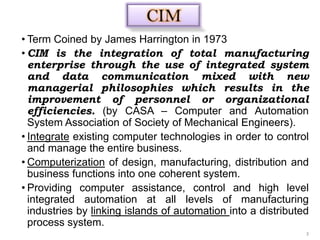
• Term Coined by James Harrington in 1973
• CIM is the integration of total manufacturing
  enterprise through the use of integrated system
  and data communication mixed with new
  managerial philosophies which results in the
  improvement of personnel or organizational
  efficiencies. (by CASA – Computer and Automation
  System Association of Society of Mechanical Engineers).
• Integrate existing computer technologies in order to control
  and manage the entire business.
• Computerization of design, manufacturing, distribution and
  business functions into one coherent system.
• Providing computer assistance, control and high level
  integrated automation at all levels of manufacturing
  industries by linking islands of automation into a distributed
  process system.
                                                               3
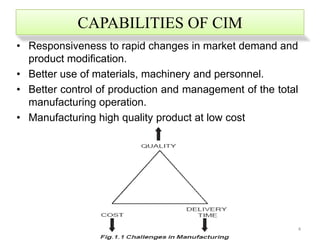
CAPABILITIES OF CIM
• Responsiveness to rapid changes in market demand and
  product modification.
• Better use of materials, machinery and personnel.
• Better control of production and management of the total
  manufacturing operation.
• Manufacturing high quality product at low cost


                                                         4
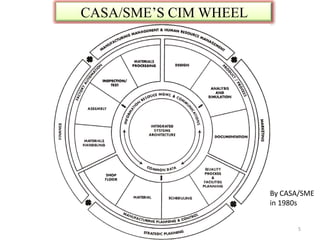
CASA/SME’S CIM WHEEL


                       By CASA/SME
                       in 1980s


                             5
• CIM wheel captures the concept of total
  integration of all industrial functions.
CIM – A concept or Technology
  A concept - For top management, a blue
  print for success.
  A Technology – for middle management
  and line managers, a physical realization
  of resources that are more capable and
  flexible.


                                          6
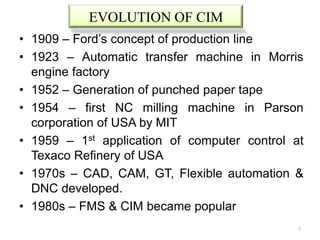
EVOLUTION OF CIM
• 1909 – Ford’s concept of production line
• 1923 – Automatic transfer machine in Morris
  engine factory
• 1952 – Generation of punched paper tape
• 1954 – first NC milling machine in Parson
  corporation of USA by MIT
• 1959 – 1st application of computer control at
  Texaco Refinery of USA
• 1970s – CAD, CAM, GT, Flexible automation &
  DNC developed.
• 1980s – FMS & CIM became popular
                                              7
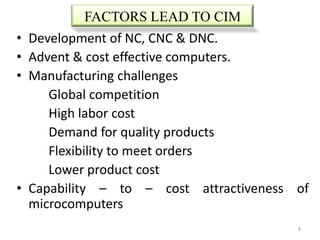
FACTORS LEAD TO CIM
•   Development of NC, CNC & DNC.
•   Advent & cost effective computers.
•   Manufacturing challenges
       Global competition
       High labor cost
       Demand for quality products
       Flexibility to meet orders
       Lower product cost
•   Capability – to – cost attractiveness of
    microcomputers
                                          8
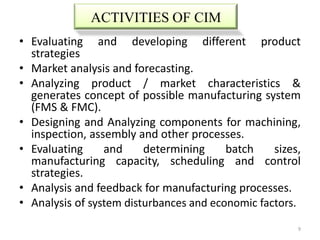
ACTIVITIES OF CIM
• Evaluating and developing different product
  strategies
• Market analysis and forecasting.
• Analyzing product / market characteristics &
  generates concept of possible manufacturing system
  (FMS & FMC).
• Designing and Analyzing components for machining,
  inspection, assembly and other processes.
• Evaluating     and     determining     batch    sizes,
  manufacturing capacity, scheduling and control
  strategies.
• Analysis and feedback for manufacturing processes.
• Analysis of system disturbances and economic factors.
                                                       9
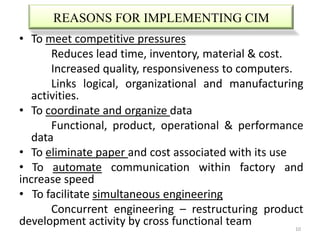
REASONS FOR IMPLEMENTING CIM
• To meet competitive pressures
       Reduces lead time, inventory, material & cost.
       Increased quality, responsiveness to computers.
       Links logical, organizational and manufacturing
   activities.
• To coordinate and organize data
       Functional, product, operational & performance
   data
• To eliminate paper and cost associated with its use
• To automate communication within factory and
increase speed
• To facilitate simultaneous engineering
       Concurrent engineering – restructuring product
development activity by cross functional team          10
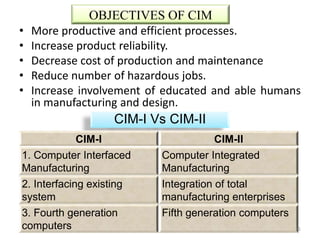
OBJECTIVES OF CIM
•   More productive and efficient processes.
•   Increase product reliability.
•   Decrease cost of production and maintenance
•   Reduce number of hazardous jobs.
•   Increase involvement of educated and able humans
    in manufacturing and design.
                    CIM-I Vs CIM-II
             CIM-I                     CIM-II
1. Computer Interfaced     Computer Integrated
Manufacturing              Manufacturing
2. Interfacing existing    Integration of total
system                     manufacturing enterprises
3. Fourth generation       Fifth generation computers
computers                                               11
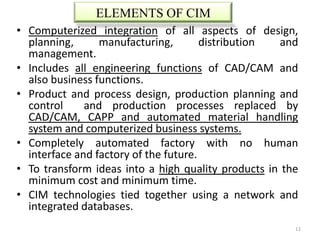
ELEMENTS OF CIM
• Computerized integration of all aspects of design,
  planning,      manufacturing,        distribution and
  management.
• Includes all engineering functions of CAD/CAM and
  also business functions.
• Product and process design, production planning and
  control     and production processes replaced by
  CAD/CAM, CAPP and automated material handling
  system and computerized business systems.
• Completely automated factory with no human
  interface and factory of the future.
• To transform ideas into a high quality products in the
  minimum cost and minimum time.
• CIM technologies tied together using a network and
  integrated databases.
                                                       12
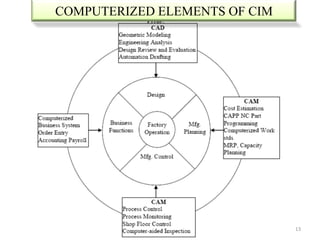
COMPUTERIZED ELEMENTS OF CIM


                               13
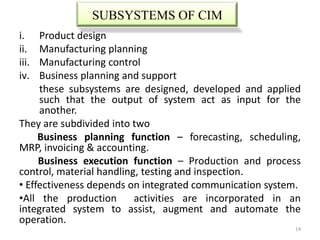
SUBSYSTEMS OF CIM
i.   Product design
ii.  Manufacturing planning
iii. Manufacturing control
iv.  Business planning and support
     these subsystems are designed, developed and applied
     such that the output of system act as input for the
     another.
They are subdivided into two
     Business planning function – forecasting, scheduling,
MRP, invoicing & accounting.
     Business execution function – Production and process
control, material handling, testing and inspection.
• Effectiveness depends on integrated communication system.
•All the production       activities are incorporated in an
integrated system to assist, augment and automate the
operation.
                                                         14
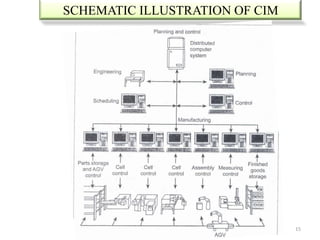
SCHEMATIC ILLUSTRATION OF CIM


                                15
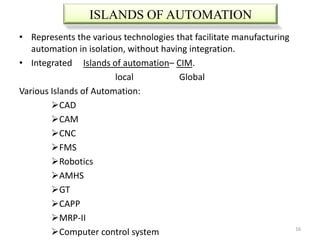
ISLANDS OF AUTOMATION
• Represents the various technologies that facilitate manufacturing
   automation in isolation, without having integration.
• Integrated Islands of automation– CIM.
                        local           Global
Various Islands of Automation:
        CAD
        CAM
        CNC
        FMS
        Robotics
        AMHS
        GT
        CAPP
        MRP-II
        Computer control system                                      16
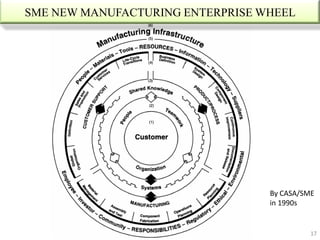
SME NEW MANUFACTURING ENTERPRISE WHEEL


                                  By CASA/SME
                                  in 1990s


                                            17
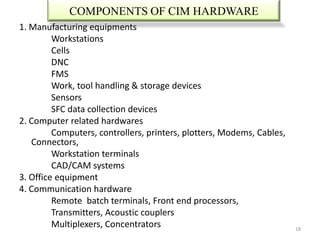
COMPONENTS OF CIM HARDWARE
1. Manufacturing equipments
         Workstations
         Cells
         DNC
         FMS
         Work, tool handling & storage devices
         Sensors
         SFC data collection devices
2. Computer related hardwares
         Computers, controllers, printers, plotters, Modems, Cables,
   Connectors,
         Workstation terminals
         CAD/CAM systems
3. Office equipment
4. Communication hardware
         Remote batch terminals, Front end processors,
         Transmitters, Acoustic couplers
         Multiplexers, Concentrators                                   18
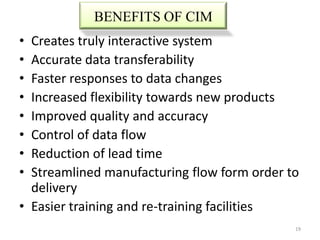
BENEFITS OF CIM
• Creates truly interactive system
• Accurate data transferability
• Faster responses to data changes
• Increased flexibility towards new products
• Improved quality and accuracy
• Control of data flow
• Reduction of lead time
• Streamlined manufacturing flow form order to
  delivery
• Easier training and re-training facilities
                                             19
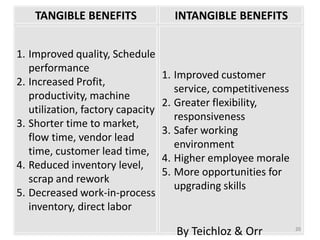
TANGIBLE BENEFITS                INTANGIBLE BENEFITS


1. Improved quality, Schedule
   performance
                                   1. Improved customer
2. Increased Profit,
                                      service, competitiveness
   productivity, machine
                                   2. Greater flexibility,
   utilization, factory capacity
                                      responsiveness
3. Shorter time to market,
                                   3. Safer working
   flow time, vendor lead
                                      environment
   time, customer lead time,
                                   4. Higher employee morale
4. Reduced inventory level,
                                   5. More opportunities for
   scrap and rework
                                      upgrading skills
5. Decreased work-in-process
   inventory, direct labor

                                      By Teichloz & Orr          20

Unit 2.1 cim

  • 1.
    ME2402 - CIM UNIT– II COMPONENTS OF CIM
  • 2.
     CIM asconcept and technology  CASA / SME model  Fundamentals of computer communication  Types of communication  Computer networking  Network topology  OSI model 2
  • 3.
    • Term Coinedby James Harrington in 1973 • CIM is the integration of total manufacturing enterprise through the use of integrated system and data communication mixed with new managerial philosophies which results in the improvement of personnel or organizational efficiencies. (by CASA – Computer and Automation System Association of Society of Mechanical Engineers). • Integrate existing computer technologies in order to control and manage the entire business. • Computerization of design, manufacturing, distribution and business functions into one coherent system. • Providing computer assistance, control and high level integrated automation at all levels of manufacturing industries by linking islands of automation into a distributed process system. 3
  • 4.
    CAPABILITIES OF CIM •Responsiveness to rapid changes in market demand and product modification. • Better use of materials, machinery and personnel. • Better control of production and management of the total manufacturing operation. • Manufacturing high quality product at low cost 4
  • 5.
    CASA/SME’S CIM WHEEL By CASA/SME in 1980s 5
  • 6.
    • CIM wheelcaptures the concept of total integration of all industrial functions. CIM – A concept or Technology A concept - For top management, a blue print for success. A Technology – for middle management and line managers, a physical realization of resources that are more capable and flexible. 6
  • 7.
    EVOLUTION OF CIM •1909 – Ford’s concept of production line • 1923 – Automatic transfer machine in Morris engine factory • 1952 – Generation of punched paper tape • 1954 – first NC milling machine in Parson corporation of USA by MIT • 1959 – 1st application of computer control at Texaco Refinery of USA • 1970s – CAD, CAM, GT, Flexible automation & DNC developed. • 1980s – FMS & CIM became popular 7
  • 8.
    FACTORS LEAD TOCIM • Development of NC, CNC & DNC. • Advent & cost effective computers. • Manufacturing challenges Global competition High labor cost Demand for quality products Flexibility to meet orders Lower product cost • Capability – to – cost attractiveness of microcomputers 8
  • 9.
    ACTIVITIES OF CIM •Evaluating and developing different product strategies • Market analysis and forecasting. • Analyzing product / market characteristics & generates concept of possible manufacturing system (FMS & FMC). • Designing and Analyzing components for machining, inspection, assembly and other processes. • Evaluating and determining batch sizes, manufacturing capacity, scheduling and control strategies. • Analysis and feedback for manufacturing processes. • Analysis of system disturbances and economic factors. 9
  • 10.
    REASONS FOR IMPLEMENTINGCIM • To meet competitive pressures Reduces lead time, inventory, material & cost. Increased quality, responsiveness to computers. Links logical, organizational and manufacturing activities. • To coordinate and organize data Functional, product, operational & performance data • To eliminate paper and cost associated with its use • To automate communication within factory and increase speed • To facilitate simultaneous engineering Concurrent engineering – restructuring product development activity by cross functional team 10
  • 11.
    OBJECTIVES OF CIM • More productive and efficient processes. • Increase product reliability. • Decrease cost of production and maintenance • Reduce number of hazardous jobs. • Increase involvement of educated and able humans in manufacturing and design. CIM-I Vs CIM-II CIM-I CIM-II 1. Computer Interfaced Computer Integrated Manufacturing Manufacturing 2. Interfacing existing Integration of total system manufacturing enterprises 3. Fourth generation Fifth generation computers computers 11
  • 12.
    ELEMENTS OF CIM •Computerized integration of all aspects of design, planning, manufacturing, distribution and management. • Includes all engineering functions of CAD/CAM and also business functions. • Product and process design, production planning and control and production processes replaced by CAD/CAM, CAPP and automated material handling system and computerized business systems. • Completely automated factory with no human interface and factory of the future. • To transform ideas into a high quality products in the minimum cost and minimum time. • CIM technologies tied together using a network and integrated databases. 12
  • 13.
  • 14.
    SUBSYSTEMS OF CIM i. Product design ii. Manufacturing planning iii. Manufacturing control iv. Business planning and support these subsystems are designed, developed and applied such that the output of system act as input for the another. They are subdivided into two Business planning function – forecasting, scheduling, MRP, invoicing & accounting. Business execution function – Production and process control, material handling, testing and inspection. • Effectiveness depends on integrated communication system. •All the production activities are incorporated in an integrated system to assist, augment and automate the operation. 14
  • 15.
  • 16.
    ISLANDS OF AUTOMATION •Represents the various technologies that facilitate manufacturing automation in isolation, without having integration. • Integrated Islands of automation– CIM. local Global Various Islands of Automation: CAD CAM CNC FMS Robotics AMHS GT CAPP MRP-II Computer control system 16
  • 17.
    SME NEW MANUFACTURINGENTERPRISE WHEEL By CASA/SME in 1990s 17
  • 18.
    COMPONENTS OF CIMHARDWARE 1. Manufacturing equipments Workstations Cells DNC FMS Work, tool handling & storage devices Sensors SFC data collection devices 2. Computer related hardwares Computers, controllers, printers, plotters, Modems, Cables, Connectors, Workstation terminals CAD/CAM systems 3. Office equipment 4. Communication hardware Remote batch terminals, Front end processors, Transmitters, Acoustic couplers Multiplexers, Concentrators 18
  • 19.
    BENEFITS OF CIM •Creates truly interactive system • Accurate data transferability • Faster responses to data changes • Increased flexibility towards new products • Improved quality and accuracy • Control of data flow • Reduction of lead time • Streamlined manufacturing flow form order to delivery • Easier training and re-training facilities 19
  • 20.
    TANGIBLE BENEFITS INTANGIBLE BENEFITS 1. Improved quality, Schedule performance 1. Improved customer 2. Increased Profit, service, competitiveness productivity, machine 2. Greater flexibility, utilization, factory capacity responsiveness 3. Shorter time to market, 3. Safer working flow time, vendor lead environment time, customer lead time, 4. Higher employee morale 4. Reduced inventory level, 5. More opportunities for scrap and rework upgrading skills 5. Decreased work-in-process inventory, direct labor By Teichloz & Orr 20