TOPIC :COMPUTER AIDED PROCESS
PLANNING (CAPP)
GOVERNMENT ENGINEERING COLLEGE BHARUCH
SUBJECT: COMPUTER AIDED MANUFACTURING(2171903)
DIVSION : MECHANICAL B (7th SEM)
PREPARED BY :
PATEL RAJ (160140119077)
PRAJAPATI MAYANK (160140119081)
RAVAL KRUNAL (160140119096)
SAKHIWALA MAHIR (160140119098)
SHARDHARA KISHANKUMAR (160140119099)
CONTENT
• INTORDUCTION TO COMPUTER AIDED PROCESS PLANNING
• TYPES OF COMPUTER AIDED PROCESS PLANNING
• VARIANT CAPP SYSTEM
• GENERATIVE CAPP SYSTEM
• HYBRID CAPP SYSTEM
INTRODUCTION TO COMPUTER AIDED PROCESS
PLANNING (CAPP)
 Computer-aided process planning (CAPP) helps determine the processing steps required to make a
part after CAP has been used to define what is to be made. CAPP programs develop a process plan or
route sheet by following either a variant or a generative approach.
 The variant approach uses a file of standard process plans to retrieve the best plan in the file after
reviewing the design. The plan can then be revised manually if it is not totally appropriate.
 The generative approach to CAPP starts with the product design specifications and can generate a
detailed process plan complete with machine settings. CAPP systems use design algorithms, a file of
machine characteristics, and decision logic to build the plans. Expert systems are based on decision
rules and have been used in some generative CAPP systems.
 With the emergence of CIM as predominate thrust area in discrete part industries process planning has
received significant attention, because it is the link between CAD and CAM. Hence, computer aided
process planning (CAPP) has become a necessary and vital objective of CIM system.
Types of computer aided process planning (capp)
The current approaches of computer aided process planning can be
classified into here types :
1. VARIANT (RETRIEVAL) SYSTEM
2. GENERATIVE SYSTEM
3. HYBRID SYSTEM
VARIANT (RETRIEVAL) CAPP SYSTEM :
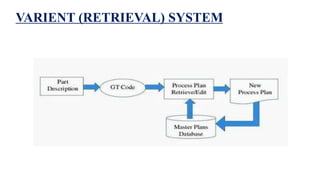
 In variant CAPP system, a process plant for a new part is created by identifying and
retrieving an existing process plan for a part. The existing process plan in examined,
modified to make it compatible to the new part to adopted it to the new part.
 The variant CAPP system is based on group technology (GT) classified and coding
approach.
 The system selects the baseline process plan for the part family, which constitutes
about 90% of the process plan. The process planning engineer adds the remaining
10% of the planning by modifying the baseline process plan.
VARIENT (RETRIEVAL) SYSTEM
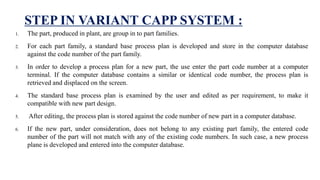
STEP IN VARIANT CAPP SYSTEM :
1. The part, produced in plant, are group in to part families.
2. For each part family, a standard base process plan is developed and store in the computer database
against the code number of the part family.
3. In order to develop a process plan for a new part, the use enter the part code number at a computer
terminal. If the computer database contains a similar or identical code number, the process plan is
retrieved and displaced on the screen.
4. The standard base process plan is examined by the user and edited as per requirement, to make it
compatible with new part design.
5. After editing, the process plan is stored against the code number of new part in a computer database.
6. If the new part, under consideration, does not belong to any existing part family, the entered code
number of the part will not match with any of the existing code numbers. In such case, a new process
plane is developed and entered into the computer database.
ADVANTAGES OF VARIANT CAPP SYSTEM :
 In this system, the process plan are readily available, which can be retrieved and edited in short time.
 As large database is available, the new process plan can be develop in short time duration.
 The system reduces manpower requirement.
 Processing and evaluation of complicated activities and managerial issues are done in an efficient
manner. Hence lead to the reduction of time and labour requirement.
 Structuring manufacturing knowledge of the process plans to company’s needs through standardized
procedures.
 Reduced development and hardware cost and shorter development time. This is an essential issue for
small and medium scale companies, where product variety is not so high and process planner are
interested in establishing their own process planning research activities
Limitation of variant CAPP system :
 The quality of process plan depends upon the knowledge and background of a process
planning engineer.
 High initial investment is required in acquiring hardware and software.
 Trained manpower is required to work on the system.
 It is difficult to maintain consistency during editing.
 Proper accommodation of various combinations of attributes such as material, geometry, size,
precision, quality, alternate processing sequence and machine loading among many other
factors are difficult.
 The quality of the final process plan largely depends on the knowledge and experience of
process planner. The dependency on process planner is one of the major shortcomings of
variant process planning
Some of the most widely used process planning method
developed by various company are mentioned as
follows :
 Mc Donnell-Douglas automation company under the direction and sponsorship of
Computer Aided Manufacturing International (CAM-I) developed a system where
CAPP can be used to generate process plan for rotational, prismatic and sheet metal
part.
 Organization for Industrial Research (OIR) and General Electric Company have
developed and another process plan named as MIPLAN. It accommodates both
rotational and prismatic part, and is based on MICLASS coding.
GENERATIVE CAPP SYSTEM :
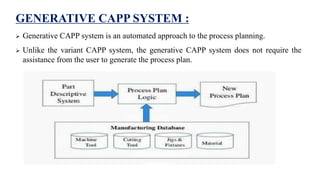
 Generative CAPP system is an automated approach to the process planning.
 Unlike the variant CAPP system, the generative CAPP system does not require the
assistance from the user to generate the process plan.
STEP IN GENERATIVE CAPP SYSTEM :
 In Generative CAPP system, the user input the geometric data ( part drawing) and
manufacturing data to computer.
 The computer, with the help of set of algorithms, automatically generated the process
plan. The format of data input in generative Capp can be divided into two categories :
text input format, graphic input format. In text input format, the user answers
questions in an interactive model. In graphic input format, the data can be directly
obtained from the CAD model. That is, the input can be taken with the help of
computer interface.
 Generative CAPP system does not need standard base process plan. Instead, the
system automatically generate a unique plan for part every time.
ADVANTAGES OF GENERATIVE CAPP SYSTEM :
 It is fully automated system and up-to-dated process plan is generated, each time a part is ordered.
 In graphic input format, even it is not required to input data. The system can be directly interface with
the CAD model.
 For operation, system does not require skilled manpower.
 They rely less on group technology code numbers since the process, usually uses decision tree to
categorize parts into families.
 Maintenance and updating of stored process plans are largely unnecessary. Since, any plan may be
quickly regenerated by processing through the tree. Indeed, many argue that with generable systems,
process plans should not be stored since if the process is changed, and out-of-dated process plan might
find its way back into the system.
 The process logic rules however must be maintained up to dated and ready for use. This provides the
process planner with an assurance that the processes generated will reflect state-of-the-art technology.
LIMITATION OF GENERATIVE CAPP SYSTEM :
 High end hardware and software set-up is required by the generative CAPP system.
 The generative CAPP system requires major revision in design logic, if new
equipment or process capabilities become available.
 In case of generative CAPP, the development of a tailor made system of specific
industry is a formidable task.
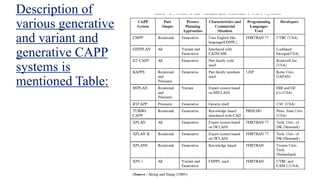
Description of
various generative
and variant and
generative CAPP
systems is
mentioned Table:
Hybrid CAPP system :
The hybrid CAPP system is an advanced application of variant CAPP system with
additional features of generative CAPP system. The hybrid CAPP system can be
Implemented in following three ways :
 The generative CAPP approach is used to create the process plan to possible extent
and then the variant approach is used to fill in the remaining details.
 The variant CAPP approach in used to retrieve the standard base process plan and then
the generative CAPP approach in used to modify it.
 For simple and moderate part feature, the variant CAPP approach in used; while for
complicated part feature, the generative CAPP approach in used.
THANK
YOU
THANK
YOU

COMPUTER AIDED PROCESS PLANNING (CAPP)

  • 1.
    TOPIC :COMPUTER AIDEDPROCESS PLANNING (CAPP) GOVERNMENT ENGINEERING COLLEGE BHARUCH SUBJECT: COMPUTER AIDED MANUFACTURING(2171903) DIVSION : MECHANICAL B (7th SEM) PREPARED BY : PATEL RAJ (160140119077) PRAJAPATI MAYANK (160140119081) RAVAL KRUNAL (160140119096) SAKHIWALA MAHIR (160140119098) SHARDHARA KISHANKUMAR (160140119099)
  • 2.
    CONTENT • INTORDUCTION TOCOMPUTER AIDED PROCESS PLANNING • TYPES OF COMPUTER AIDED PROCESS PLANNING • VARIANT CAPP SYSTEM • GENERATIVE CAPP SYSTEM • HYBRID CAPP SYSTEM
  • 3.
    INTRODUCTION TO COMPUTERAIDED PROCESS PLANNING (CAPP)  Computer-aided process planning (CAPP) helps determine the processing steps required to make a part after CAP has been used to define what is to be made. CAPP programs develop a process plan or route sheet by following either a variant or a generative approach.  The variant approach uses a file of standard process plans to retrieve the best plan in the file after reviewing the design. The plan can then be revised manually if it is not totally appropriate.  The generative approach to CAPP starts with the product design specifications and can generate a detailed process plan complete with machine settings. CAPP systems use design algorithms, a file of machine characteristics, and decision logic to build the plans. Expert systems are based on decision rules and have been used in some generative CAPP systems.  With the emergence of CIM as predominate thrust area in discrete part industries process planning has received significant attention, because it is the link between CAD and CAM. Hence, computer aided process planning (CAPP) has become a necessary and vital objective of CIM system.
  • 4.
    Types of computeraided process planning (capp) The current approaches of computer aided process planning can be classified into here types : 1. VARIANT (RETRIEVAL) SYSTEM 2. GENERATIVE SYSTEM 3. HYBRID SYSTEM
  • 5.
    VARIANT (RETRIEVAL) CAPPSYSTEM :  In variant CAPP system, a process plant for a new part is created by identifying and retrieving an existing process plan for a part. The existing process plan in examined, modified to make it compatible to the new part to adopted it to the new part.  The variant CAPP system is based on group technology (GT) classified and coding approach.  The system selects the baseline process plan for the part family, which constitutes about 90% of the process plan. The process planning engineer adds the remaining 10% of the planning by modifying the baseline process plan.
  • 6.
  • 7.
    STEP IN VARIANTCAPP SYSTEM : 1. The part, produced in plant, are group in to part families. 2. For each part family, a standard base process plan is developed and store in the computer database against the code number of the part family. 3. In order to develop a process plan for a new part, the use enter the part code number at a computer terminal. If the computer database contains a similar or identical code number, the process plan is retrieved and displaced on the screen. 4. The standard base process plan is examined by the user and edited as per requirement, to make it compatible with new part design. 5. After editing, the process plan is stored against the code number of new part in a computer database. 6. If the new part, under consideration, does not belong to any existing part family, the entered code number of the part will not match with any of the existing code numbers. In such case, a new process plane is developed and entered into the computer database.
  • 8.
    ADVANTAGES OF VARIANTCAPP SYSTEM :  In this system, the process plan are readily available, which can be retrieved and edited in short time.  As large database is available, the new process plan can be develop in short time duration.  The system reduces manpower requirement.  Processing and evaluation of complicated activities and managerial issues are done in an efficient manner. Hence lead to the reduction of time and labour requirement.  Structuring manufacturing knowledge of the process plans to company’s needs through standardized procedures.  Reduced development and hardware cost and shorter development time. This is an essential issue for small and medium scale companies, where product variety is not so high and process planner are interested in establishing their own process planning research activities
  • 9.
    Limitation of variantCAPP system :  The quality of process plan depends upon the knowledge and background of a process planning engineer.  High initial investment is required in acquiring hardware and software.  Trained manpower is required to work on the system.  It is difficult to maintain consistency during editing.  Proper accommodation of various combinations of attributes such as material, geometry, size, precision, quality, alternate processing sequence and machine loading among many other factors are difficult.  The quality of the final process plan largely depends on the knowledge and experience of process planner. The dependency on process planner is one of the major shortcomings of variant process planning
  • 10.
    Some of themost widely used process planning method developed by various company are mentioned as follows :  Mc Donnell-Douglas automation company under the direction and sponsorship of Computer Aided Manufacturing International (CAM-I) developed a system where CAPP can be used to generate process plan for rotational, prismatic and sheet metal part.  Organization for Industrial Research (OIR) and General Electric Company have developed and another process plan named as MIPLAN. It accommodates both rotational and prismatic part, and is based on MICLASS coding.
  • 11.
    GENERATIVE CAPP SYSTEM:  Generative CAPP system is an automated approach to the process planning.  Unlike the variant CAPP system, the generative CAPP system does not require the assistance from the user to generate the process plan.
  • 12.
    STEP IN GENERATIVECAPP SYSTEM :  In Generative CAPP system, the user input the geometric data ( part drawing) and manufacturing data to computer.  The computer, with the help of set of algorithms, automatically generated the process plan. The format of data input in generative Capp can be divided into two categories : text input format, graphic input format. In text input format, the user answers questions in an interactive model. In graphic input format, the data can be directly obtained from the CAD model. That is, the input can be taken with the help of computer interface.  Generative CAPP system does not need standard base process plan. Instead, the system automatically generate a unique plan for part every time.
  • 13.
    ADVANTAGES OF GENERATIVECAPP SYSTEM :  It is fully automated system and up-to-dated process plan is generated, each time a part is ordered.  In graphic input format, even it is not required to input data. The system can be directly interface with the CAD model.  For operation, system does not require skilled manpower.  They rely less on group technology code numbers since the process, usually uses decision tree to categorize parts into families.  Maintenance and updating of stored process plans are largely unnecessary. Since, any plan may be quickly regenerated by processing through the tree. Indeed, many argue that with generable systems, process plans should not be stored since if the process is changed, and out-of-dated process plan might find its way back into the system.  The process logic rules however must be maintained up to dated and ready for use. This provides the process planner with an assurance that the processes generated will reflect state-of-the-art technology.
  • 14.
    LIMITATION OF GENERATIVECAPP SYSTEM :  High end hardware and software set-up is required by the generative CAPP system.  The generative CAPP system requires major revision in design logic, if new equipment or process capabilities become available.  In case of generative CAPP, the development of a tailor made system of specific industry is a formidable task.
  • 15.
    Description of various generative andvariant and generative CAPP systems is mentioned Table:
  • 16.
    Hybrid CAPP system: The hybrid CAPP system is an advanced application of variant CAPP system with additional features of generative CAPP system. The hybrid CAPP system can be Implemented in following three ways :  The generative CAPP approach is used to create the process plan to possible extent and then the variant approach is used to fill in the remaining details.  The variant CAPP approach in used to retrieve the standard base process plan and then the generative CAPP approach in used to modify it.  For simple and moderate part feature, the variant CAPP approach in used; while for complicated part feature, the generative CAPP approach in used.
  • 17.