


FLEXIBLE
MANUFACTURING
SYSTEMS
By
Dobariya gautam mansukhbhai
• Introductio
nAs the market became more and
more complex, speed of delivery
became something customer also
needed.
A new strategy was formulated
(Customizability). The companies
have to adapt to the environment in
which they operate, to be more
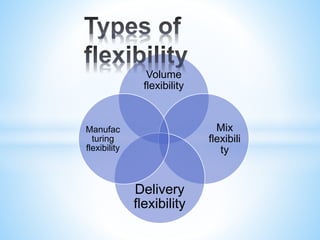
Volume
flexibility
Mix
flexibili
ty
Delivery
flexibility
Manufac
turing
flexibility
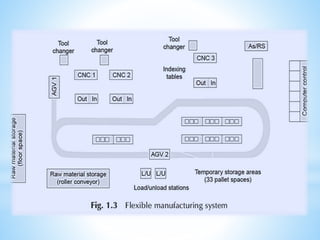
A flexible manufacturing system (FMS)
is an arrangement of machines ...
interconnected by a transport system.
The transporter carries work to the
machines on pallets or other interface
units so that work-machine registration is
accurate, rapid and automatic. A central
computer controls both machines and
transport system.
“FMS consists of a group of processing work
stations interconnected by means of an
The basic components of
FMS are:
1. Workstations
2. Automated Material
Handling and Storage
system.
3. Computer Control System
In present day Flexible manufacturing systems
are being designed with other type of processing
equipments including inspection stations,
assembly works and sheet metal presses. The
various workstations are
(i) Machining centers
(ii) Load and unload stations
(iii) Assembly work stations
(iv) Inspection stations
(v) Forging stations
(vi) Sheet metal processing, etc.
The various automated material handling systems
are used to transport work parts and subassembly
parts between the processing stations, sometimes
incorporating storage into function. The various
functions of automated material handling and storage
system are
(i) Random and independent movement of work
parts between workstations
(ii) Handling of a variety of work part configurations
(iii) Temporary storage
(iv) Convenient access for loading and unloading of
work parts
It is used to coordinate the activities of the
processing stations and the material handling
system in the FMS. The various functions of
computer control system are:
(i) Control of each work station
(ii) Distribution of control instruction to work station
(iii) Production control
(vi) Traffic control
(v) Shuttle control
(vi) Work handling system and monitoring
(vii) System performance monitoring and reporting
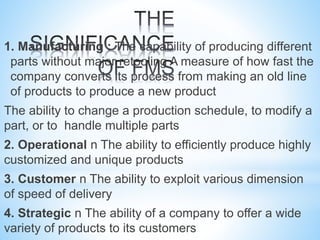
1. Manufacturing : The capability of producing different
parts without major retooling A measure of how fast the
company converts its process from making an old line
of products to produce a new product
The ability to change a production schedule, to modify a
part, or to handle multiple parts
2. Operational n The ability to efficiently produce highly
customized and unique products
3. Customer n The ability to exploit various dimension
of speed of delivery
4. Strategic n The ability of a company to offer a wide
variety of products to its customers
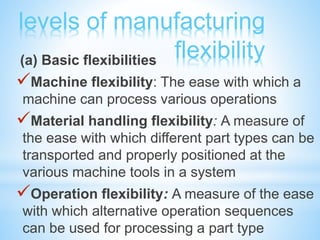
levels of manufacturing
flexibility(a) Basic flexibilities
Machine flexibility: The ease with which a
machine can process various operations
Material handling flexibility: A measure of
the ease with which different part types can be
transported and properly positioned at the
various machine tools in a system
Operation flexibility: A measure of the ease
with which alternative operation sequences
can be used for processing a part type
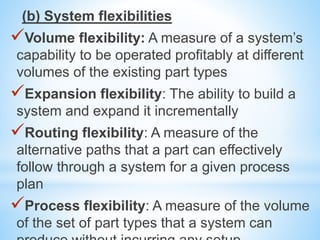
(b) System flexibilities
Volume flexibility: A measure of a system’s
capability to be operated profitably at different
volumes of the existing part types
Expansion flexibility: The ability to build a
system and expand it incrementally
Routing flexibility: A measure of the
alternative paths that a part can effectively
follow through a system for a given process
plan
Process flexibility: A measure of the volume
of the set of part types that a system can
(c) Aggregate flexibilities
Program flexibility: The ability of a
system to run for reasonably long
periods without external intervention
Production flexibility: the volume
of the set of part types that a system
can produce without major
investment in capital equipment
Market flexibility: The ability of a
system to efficiently adapt to
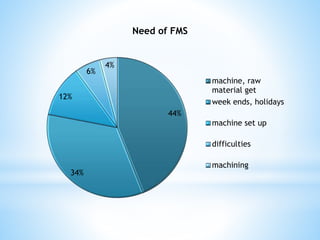
44%
34%
12%
6%
4%
Need of FMS
machine, raw
material get
week ends, holidays
machine set up
difficulties
machining
The different types of FMS are
Sequential FMS
Random FMS
Dedicated FMS
Engineered FMS
Modular FMS
Sequential FMS: It manufactures one-piece
part batch type and then planning and
preparation is carried out for the next piece part
batch type to be manufactured. It operates like a
small batch flexible transfer line.
Random FMS: It manufactures any random mix
of piece part types at any one time.
Dedicated FMS: It continually manufactures, for
extended periods, the same but limited mix of
piece part batch types.
Engineered FMS: It manufactures the same
mix of part types throughout its lifetime.
Modular FMS: A modular FMS, with a
sophisticated FMS host, enables and FMS user
The different types of FMS
layouts are:
1. Progressive or Line Type
2. Loop Type
3. Ladder Type
4. Open field type
5. Robot centered type
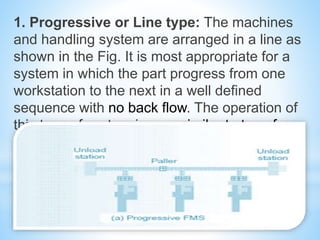
1. Progressive or Line type: The machines
and handling system are arranged in a line as
shown in the Fig. It is most appropriate for a
system in which the part progress from one
workstation to the next in a well defined
sequence with no back flow. The operation of
this type of system is very similar to transfer
type. Work always flows in unidirectional path
as shown in Fig
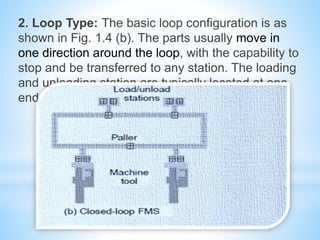
2. Loop Type: The basic loop configuration is as
shown in Fig. 1.4 (b). The parts usually move in
one direction around the loop, with the capability to
stop and be transferred to any station. The loading
and unloading station are typically located at one
end of the loop Fig.1.4 (b)
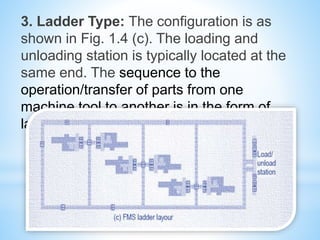
3. Ladder Type: The configuration is as
shown in Fig. 1.4 (c). The loading and
unloading station is typically located at the
same end. The sequence to the
operation/transfer of parts from one
machine tool to another is in the form of
ladder steps as shown in Fig.1.4 (c)
4. Open Field Type: The configuration of
the open field is as shown in Fig.1.4 (d).
The loading and unloading station is
typically located at the same end. The
parts will go through all the substations,
such as CNC machines, coordinate
measuring machines and wash station by
the help of AGV’s from one substation to
another.
5. Robot Centered Type: Robot centered
cell is a relatively new form of flexible
system in which one or more robots are
used as the material handling systems as
The various factors influencing the layouts of
FMS are:
 Availability of raw material
Proximity to market
Transport facilities
Availability of efficient and cheap labor
Availability of power, water and fuel
Atmospheric and climatic condition
Social and recreation facilities
Business and economic conditions
A study, carried out with West Germany
manufacturing has shown the major aims
of installing an FMS to be:
Decreased Lead Times
Increased output(productivity)
Increased machine utilization
Improved Due Date Reliability
Decreased Store Inventors Levels
Decreased Work in Progress
o
To reduce costs
Better utilization of the production
equipment reduction of stocks (ex: Work in
progress capital shorter through put times)
Reduction of piece part unit costs.
To increase Technical Performance:
Increased production levels
Greater product mixture
Shorter or zero change over or reset of
times
To improve Order
Development:
Shorter lead times/delivery
times
Determination of
production capacities
Increased
Competitiveness
Faster, lower-cost changes from one part to
another which will improve capital utilization
Lower direct labor cost, due to the reduction in
number of workers
Reduced inventory, due to the planning and
programming precision
Consistent and better quality, due to the
automated control
Lower cost/unit of output, due to the greater
productivity using the same number of workers
Limited ability to adapt to changes in
product or product mix (ex. machines are of
limited capacity and the tooling necessary for
products, even of the same family, is not
always feasible in a given FMS)
Substantial pre-planning activity
Expensive, costing millions of dollars
Technological problems of exact
component positioning and precise timing
necessary to process a component
Sophisticated manufacturing systems
VARIOUS
EQUIPMENTS AND
THEIR
FUNCTIONS
REQUIRED FOR AN
FMS
1. Primary equipment: It adds value to the piece
parts being manufactured. It consists of work
centers, which physically machine a piece part, and
process centers, which assemble, check or wash,
etc. the piece parts.
2. Secondary equipment: It is used to support
the primary equipment in achieving this goal.
It consists of support stations such as pallet/fixture
load-unload stations and tool
commissioning/setting area, etc. It also consists of
support equipments such as robots,
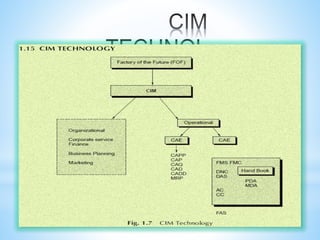
CAPP- Computer Aided Process Planning
CAP -Computer Aided Planning
FMC -Flexible Manufacturing Cell
CAQ -Computer Aided Quality Control
FAS -Flexible Manufacturing Assembly
CAD -Computer Aided Design
DNC -Direct Numerical Control
CADD -Computer Aided Design and Drafting
DAS -Data Acquisition System
MRP -Materials Resource Planning
PDA -Production Data
CIM -Computer Integrated Manufacturing AC Area Control
CC -Cell Control
IT is an arrangement of items (objects,
names, values, categories, etc.) in which
the items are represented as being
"above," "below," or "at the same level as"
one another.
The computer integrated manufacturing
includes all of the engineering functions of
CAD/CAM along with firm’s business
functions that are related to manufacturing.
The activities in factory’s environment
There are 5 levels of control or
organization as shown Fig
Control functions are executed at
Level 0 and 1 of the CIM hierarchy
consisting of CNC, NC, RC and PLC
equipments.
Levels 2, 3 and 4 define the
organizational levels such as FMS
host, area controller, plant control or
MRP computer, etc.
Flexible manufacturing syatem

Flexible manufacturing syatem

  • 1.
  • 2.
    • Introductio nAs themarket became more and more complex, speed of delivery became something customer also needed. A new strategy was formulated (Customizability). The companies have to adapt to the environment in which they operate, to be more
  • 3.
  • 4.
    A flexible manufacturingsystem (FMS) is an arrangement of machines ... interconnected by a transport system. The transporter carries work to the machines on pallets or other interface units so that work-machine registration is accurate, rapid and automatic. A central computer controls both machines and transport system. “FMS consists of a group of processing work stations interconnected by means of an
  • 5.
    The basic componentsof FMS are: 1. Workstations 2. Automated Material Handling and Storage system. 3. Computer Control System
  • 6.
    In present dayFlexible manufacturing systems are being designed with other type of processing equipments including inspection stations, assembly works and sheet metal presses. The various workstations are (i) Machining centers (ii) Load and unload stations (iii) Assembly work stations (iv) Inspection stations (v) Forging stations (vi) Sheet metal processing, etc.
  • 7.
    The various automatedmaterial handling systems are used to transport work parts and subassembly parts between the processing stations, sometimes incorporating storage into function. The various functions of automated material handling and storage system are (i) Random and independent movement of work parts between workstations (ii) Handling of a variety of work part configurations (iii) Temporary storage (iv) Convenient access for loading and unloading of work parts
  • 8.
    It is usedto coordinate the activities of the processing stations and the material handling system in the FMS. The various functions of computer control system are: (i) Control of each work station (ii) Distribution of control instruction to work station (iii) Production control (vi) Traffic control (v) Shuttle control (vi) Work handling system and monitoring (vii) System performance monitoring and reporting
  • 11.
    1. Manufacturing :The capability of producing different parts without major retooling A measure of how fast the company converts its process from making an old line of products to produce a new product The ability to change a production schedule, to modify a part, or to handle multiple parts 2. Operational n The ability to efficiently produce highly customized and unique products 3. Customer n The ability to exploit various dimension of speed of delivery 4. Strategic n The ability of a company to offer a wide variety of products to its customers
  • 12.
    levels of manufacturing flexibility(a)Basic flexibilities Machine flexibility: The ease with which a machine can process various operations Material handling flexibility: A measure of the ease with which different part types can be transported and properly positioned at the various machine tools in a system Operation flexibility: A measure of the ease with which alternative operation sequences can be used for processing a part type
  • 13.
    (b) System flexibilities Volumeflexibility: A measure of a system’s capability to be operated profitably at different volumes of the existing part types Expansion flexibility: The ability to build a system and expand it incrementally Routing flexibility: A measure of the alternative paths that a part can effectively follow through a system for a given process plan Process flexibility: A measure of the volume of the set of part types that a system can
  • 14.
    (c) Aggregate flexibilities Programflexibility: The ability of a system to run for reasonably long periods without external intervention Production flexibility: the volume of the set of part types that a system can produce without major investment in capital equipment Market flexibility: The ability of a system to efficiently adapt to
  • 15.
    44% 34% 12% 6% 4% Need of FMS machine,raw material get week ends, holidays machine set up difficulties machining
  • 16.
    The different typesof FMS are Sequential FMS Random FMS Dedicated FMS Engineered FMS Modular FMS
  • 17.
    Sequential FMS: Itmanufactures one-piece part batch type and then planning and preparation is carried out for the next piece part batch type to be manufactured. It operates like a small batch flexible transfer line. Random FMS: It manufactures any random mix of piece part types at any one time. Dedicated FMS: It continually manufactures, for extended periods, the same but limited mix of piece part batch types. Engineered FMS: It manufactures the same mix of part types throughout its lifetime. Modular FMS: A modular FMS, with a sophisticated FMS host, enables and FMS user
  • 18.
    The different typesof FMS layouts are: 1. Progressive or Line Type 2. Loop Type 3. Ladder Type 4. Open field type 5. Robot centered type
  • 19.
    1. Progressive orLine type: The machines and handling system are arranged in a line as shown in the Fig. It is most appropriate for a system in which the part progress from one workstation to the next in a well defined sequence with no back flow. The operation of this type of system is very similar to transfer type. Work always flows in unidirectional path as shown in Fig
  • 20.
    2. Loop Type:The basic loop configuration is as shown in Fig. 1.4 (b). The parts usually move in one direction around the loop, with the capability to stop and be transferred to any station. The loading and unloading station are typically located at one end of the loop Fig.1.4 (b)
  • 21.
    3. Ladder Type:The configuration is as shown in Fig. 1.4 (c). The loading and unloading station is typically located at the same end. The sequence to the operation/transfer of parts from one machine tool to another is in the form of ladder steps as shown in Fig.1.4 (c)
  • 22.
    4. Open FieldType: The configuration of the open field is as shown in Fig.1.4 (d). The loading and unloading station is typically located at the same end. The parts will go through all the substations, such as CNC machines, coordinate measuring machines and wash station by the help of AGV’s from one substation to another. 5. Robot Centered Type: Robot centered cell is a relatively new form of flexible system in which one or more robots are used as the material handling systems as
  • 23.
    The various factorsinfluencing the layouts of FMS are:  Availability of raw material Proximity to market Transport facilities Availability of efficient and cheap labor Availability of power, water and fuel Atmospheric and climatic condition Social and recreation facilities Business and economic conditions
  • 24.
    A study, carriedout with West Germany manufacturing has shown the major aims of installing an FMS to be: Decreased Lead Times Increased output(productivity) Increased machine utilization Improved Due Date Reliability Decreased Store Inventors Levels Decreased Work in Progress
  • 25.
    o To reduce costs Betterutilization of the production equipment reduction of stocks (ex: Work in progress capital shorter through put times) Reduction of piece part unit costs. To increase Technical Performance: Increased production levels Greater product mixture Shorter or zero change over or reset of times
  • 26.
    To improve Order Development: Shorterlead times/delivery times Determination of production capacities Increased Competitiveness
  • 27.
    Faster, lower-cost changesfrom one part to another which will improve capital utilization Lower direct labor cost, due to the reduction in number of workers Reduced inventory, due to the planning and programming precision Consistent and better quality, due to the automated control Lower cost/unit of output, due to the greater productivity using the same number of workers
  • 28.
    Limited ability toadapt to changes in product or product mix (ex. machines are of limited capacity and the tooling necessary for products, even of the same family, is not always feasible in a given FMS) Substantial pre-planning activity Expensive, costing millions of dollars Technological problems of exact component positioning and precise timing necessary to process a component Sophisticated manufacturing systems
  • 30.
    VARIOUS EQUIPMENTS AND THEIR FUNCTIONS REQUIRED FORAN FMS 1. Primary equipment: It adds value to the piece parts being manufactured. It consists of work centers, which physically machine a piece part, and process centers, which assemble, check or wash, etc. the piece parts. 2. Secondary equipment: It is used to support the primary equipment in achieving this goal. It consists of support stations such as pallet/fixture load-unload stations and tool commissioning/setting area, etc. It also consists of support equipments such as robots,
  • 32.
    CAPP- Computer AidedProcess Planning CAP -Computer Aided Planning FMC -Flexible Manufacturing Cell CAQ -Computer Aided Quality Control FAS -Flexible Manufacturing Assembly CAD -Computer Aided Design DNC -Direct Numerical Control CADD -Computer Aided Design and Drafting DAS -Data Acquisition System MRP -Materials Resource Planning PDA -Production Data CIM -Computer Integrated Manufacturing AC Area Control CC -Cell Control
  • 33.
    IT is anarrangement of items (objects, names, values, categories, etc.) in which the items are represented as being "above," "below," or "at the same level as" one another. The computer integrated manufacturing includes all of the engineering functions of CAD/CAM along with firm’s business functions that are related to manufacturing. The activities in factory’s environment
  • 34.
    There are 5levels of control or organization as shown Fig Control functions are executed at Level 0 and 1 of the CIM hierarchy consisting of CNC, NC, RC and PLC equipments. Levels 2, 3 and 4 define the organizational levels such as FMS host, area controller, plant control or MRP computer, etc.